Capstone Case 1: Eco-Products, Inc.
2008 forecast of $45 million was associated with a decline in economic activity
(recession), increased competition, and a supply chain problem that made it difficult to
first avoid stocking out of inventory and then accumulating excess inventory. By the end
of 2008, inventory had increased to more than $12 million compared to $2.4 million at
the end of 2007.
J. Explain Eco-Products’ supply chain model that existed in early 2008. Describe the
strengths and weaknesses of such a model from an operations viewpoint. What are the
implications of this supply chain model on Eco-Products working capital financing needs
and its cash conversion cycle?
The supply chain model used by Eco-Products resulted in a long inventory cycle (for a
relatively simple production process). Raw materials were often purchased in the U.S. or
from suppliers in other countries, shipped to manufacturers in Asia, with the final
products being shipped back for sale in the U.S. This long inventory cycle tied up cash
and made it difficult to stock adequate inventory in some time periods, or produce excess
inventory at other times. A long supply chain cycle involves larger asset financing
requirements, particularly in the form of inventory.
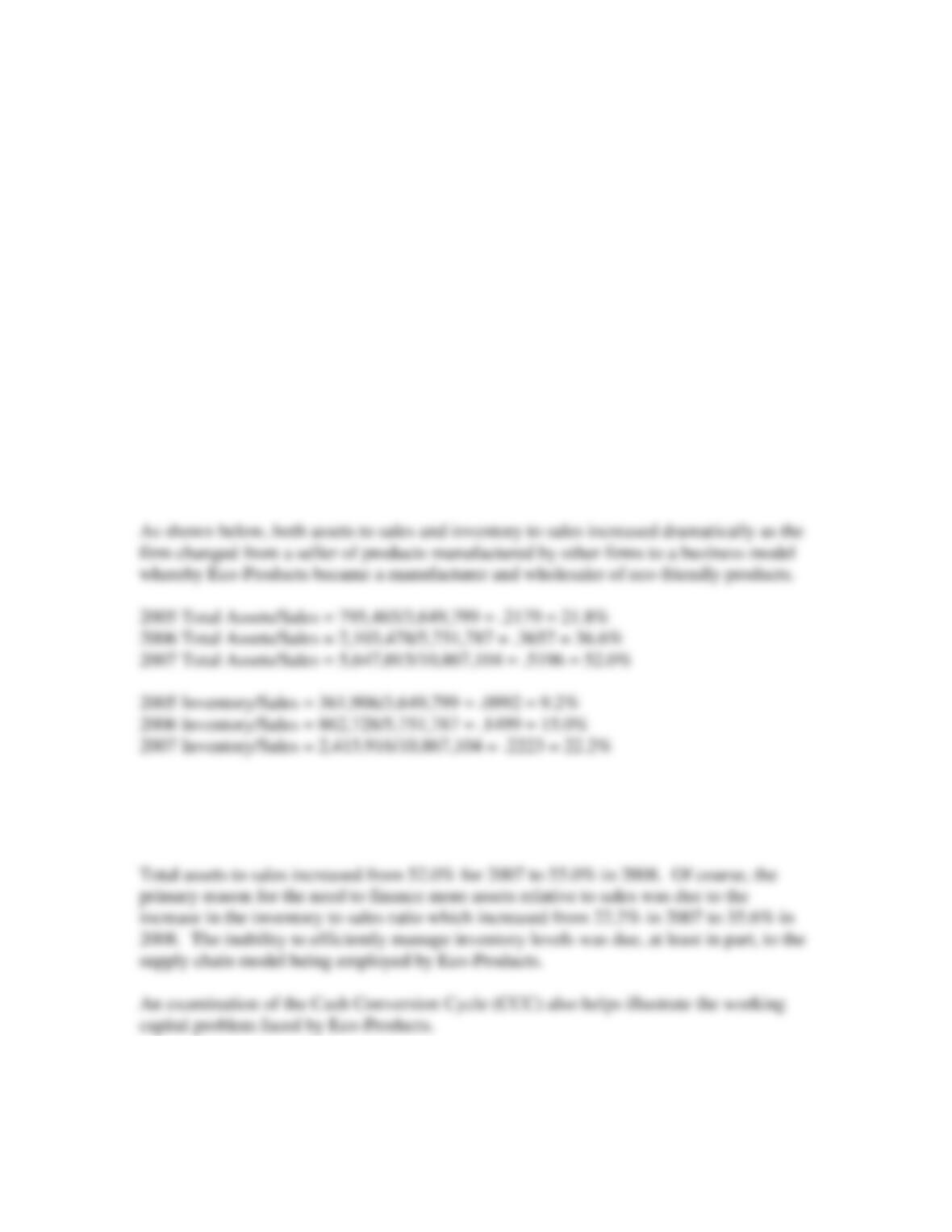
Actual 2008 Results:
2008 Total Assets/Sales = 18,903,838/34,378,138 = .5499 = 55.0%
2008 Inventory/Sales = 12,222,801/34,378,138 = .3555 = 35.6%
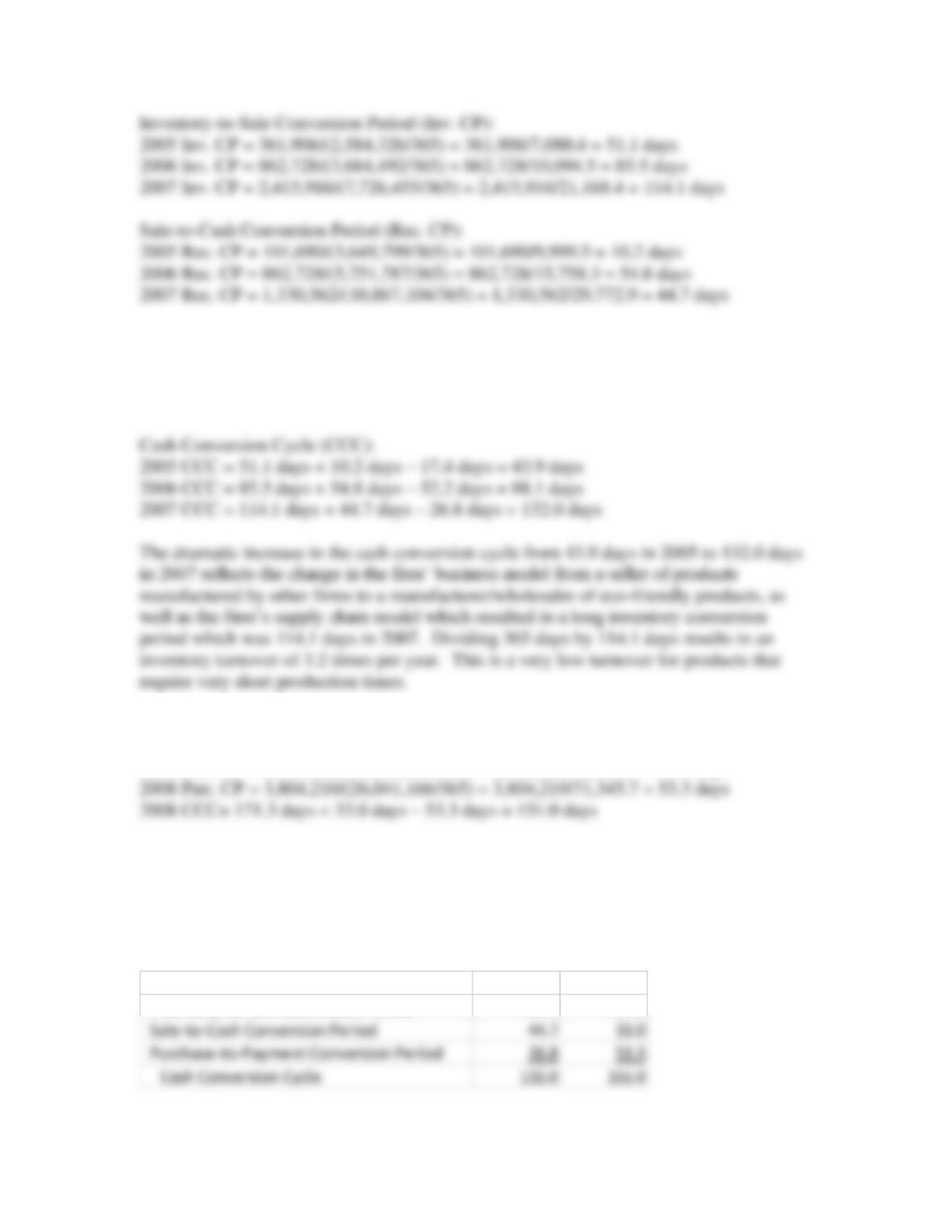
CCC Calculations:
Capstone Case 1: Eco-Products, Inc.
Purchase-to-Payment Conversion Period (Pmt. CP):
2005 Pmt. CP = 123,429/(2,584,326/365) = 123,429/7,080.4 = 17.4 days
2006 Pmt. CP = 526,555/(3,684,492/365) = 526,555/10,094.5 = 52.2 days
2007 Pmt. CP = 568,131/(7,726,455/365) = 568,131/21,168.4 = 26.8 days
For reference, the actual CCC calculations for 2008 were as follows:
2008 Inv. CP = 12,222,801/(26,041,166/365) = 12,222,801/71,345.7 = 171.3 days
2008 Rec. CP = 3,109,920/(34,378,138/365) = 3,109,920/94,186.7 = 33.0 days
This further increase in the CCC meant that even more financing was required to support
the actual 2008 sales.
An accompanying Excel spreadsheet provides the following ratio calculations for
2007 and 2008 (data not available until 2009).
Cash Conversion Cycle (in Days): 2007 2008
Inventory-to-Sale Conversion Period 114.1 171.3
Capstone Case 1: Eco-Products, Inc.
K. In mid-2008, Eco-Products management sought to quickly (hopefully) raise an additional
$2 million in external financing through a single private equity investment. The term
sheet prepared by Greenmont Capital is presented in Appendix B.
1. After considering a number of possible private equity investors, Greenmont Capital
was selected by Eco-Products’ management. Discuss the pros and cons of selecting a
small locally-based private equity firm relative to a larger private equity investor?
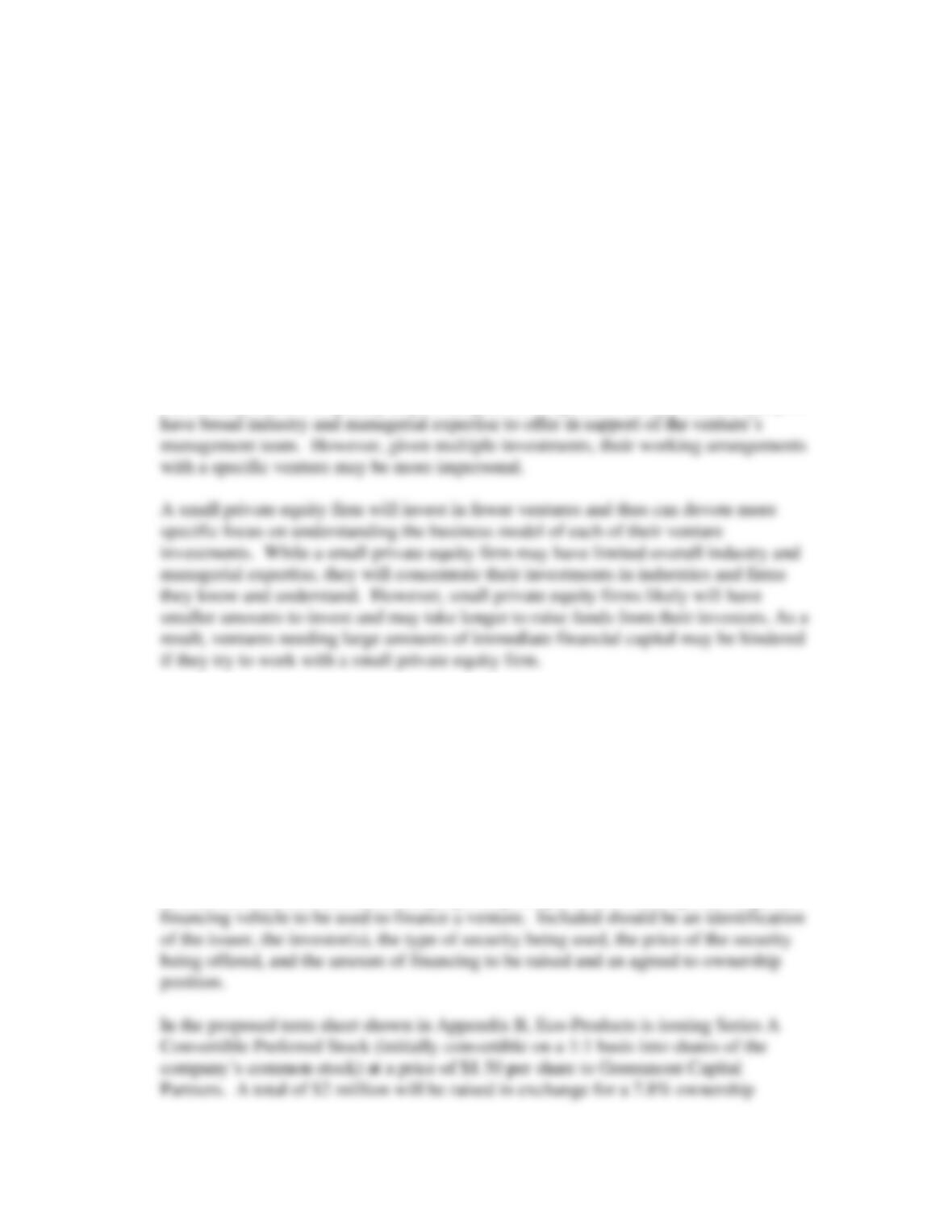
Large private equity firms have large amounts of funds to invest and will have a
portfolio of several projects being simultaneously financed. Large private equity firms
also usually can move quickly in providing funds to specific ventures and are likely to
2. Review the investment terms presented in Appendix B and comment on any factors in
the term sheet that might be “deal breakers.” If you were representing Eco-Products
top management, which terms might you want deleted or modified from the term
sheet? Now, if you were representing Greenmont Capital, which terms would be
important in protecting its investment capital?
It might be helpful to first review Chapter 11, Figure 11.6 which provides a list of
“Typical Issues Addressed in a Term Sheet.’
A term sheet should summarize the proposed principal terms with respect to a specific
Capstone Case 1: Eco-Products, Inc.
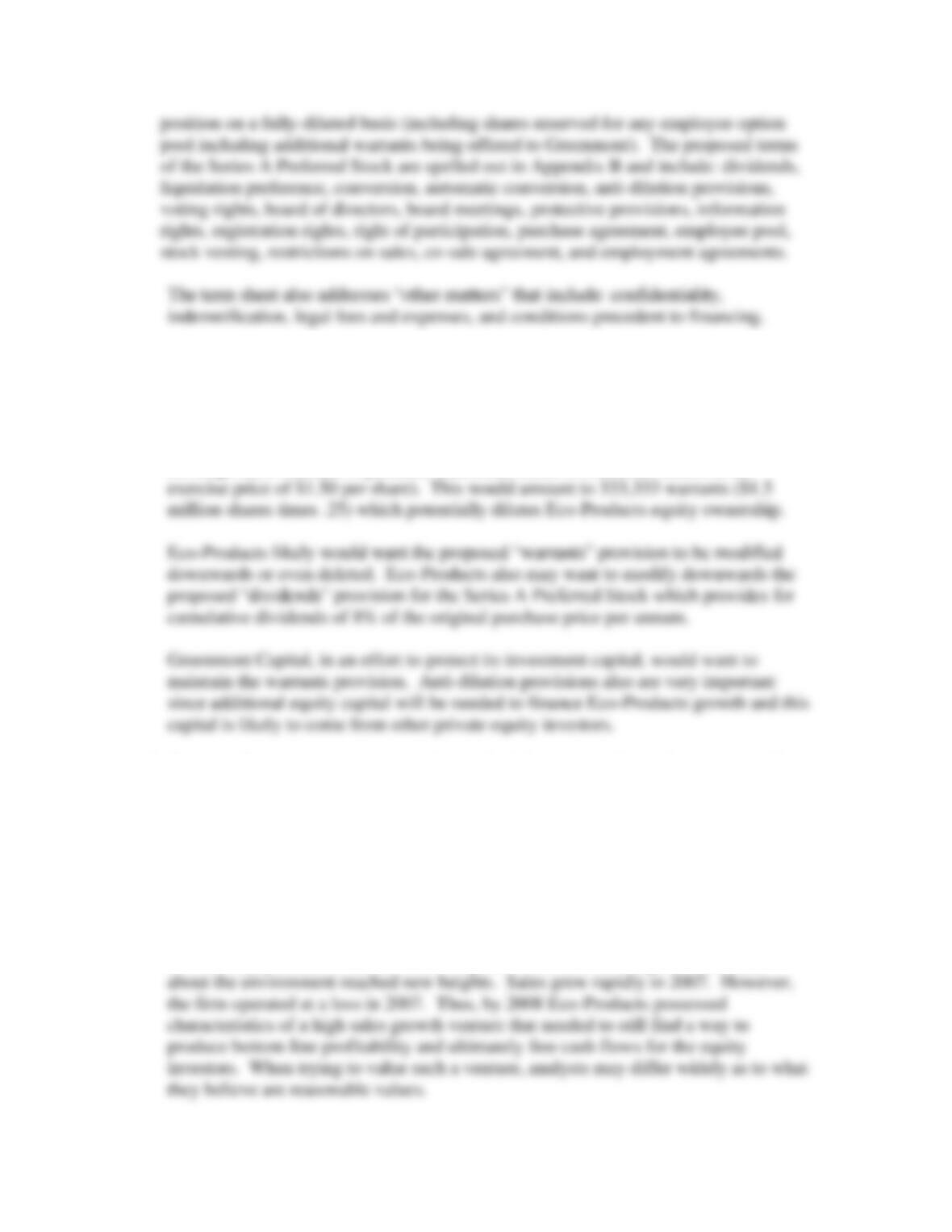
A possible “deal breaker” would be the number of warrants being offered to
Greenmont Partners in the term sheet proposal. The July 18, 2008 term sheet
proposal provides for Greenmont to receive 1.5 million shares of Series A
Convertible Preferred Stock initially convertible on a 1:1 basis into shares of Eco–
Products common stock. The term sheet proposal also provides for a 25% warrant
coverage (i.e., warrants to purchase additional Series A Preferred Shares at an
3. Some analysts employ a relative value method that uses multiples from comparable
firms to estimate the value of a target venture. Exhibit 9 contains enterprise value-to–
sales information for a number of possible comparable firms for the purpose of
valuing Eco-Products. Estimate the enterprise value of Eco-Products. What portion
of equity ownership should Eco- Products be willing to give up for the $2 million
Greenmont Capital investment?
Although Eco-Products had been in business since 1990, its business model changed
between 2005 and 2007. Eco-Products became a manufacturer and wholesaler of
eco-friendly products at a time when oil prices were at record highs and concern
Capstone Case 1: Eco-Products, Inc.
As discussed in the text, ventures may be valued using a discounted cash flow (DCF)
method (see Chapters 9 and 13), a venture capitalist (VC) short-cut method (see
Chapter 10), or a relative valuation method (see Chapter 14). Analysts often attempt
to value a firm on the basis of its top line (sales), its rough cash flow (as reflected in
EBITDA), and/or its bottom line (net income).
Unfortunately, no information was available for EBITDA (except for the dated
Newspring transaction) or net income multiples.
As noted in the case, sales estimates changed rapidly in the case. Eco-Products
management in mid-2007 had forecasted 2008 sales to be $22 million. By early 2008,
A range of possible values for Eco-Products using an enterprise value to sales
multiple of 1.55 might be:
Sales or Rev. x Multiple = Value
12-Month Trailing Sales $19.7 million 1.55 $30.535 million
Management’s Forecast $45.0 million 1.55 $69.750 million
Actual 2008 Results $34.4 million 1.55 $53.320 million
Capstone Case 1: Eco-Products, Inc.
Note: As can be seen from the actual 2008 results, the lines of credit at the end of
2008 amounted to slightly more than $8 million, long-term debt (including the
current portion) was nearly $.5 million, and long-term capital leases (including the
current portion) was nearly $.3 million. Thus, the total interest-bearing debt plus
long-term capital leases amounted to approximately $8.8 million.
Or, using pre-money and post-money shares the calculations would be:
Pre-money shares (fully diluted to account for the employee option pool) =
$29,587,500/$1.50 = 19,725,000 shares
Shares issued to Greenmont = $2,000,000/$1.50 = 1,333,333
Post-money shares = 19,725,000 + 1,333,333 = 21,058,333
As noted in the following epilogue, Greenmont Partners negotiated a larger
percentage ownership as Eco-Products struggled to meet its revenue targets due to
inventory-related problems and the rapidly slowing economy during the last-half of
2008. According to the 2008 balance sheet, 1,366,666 shares of preferred stock were
actually issued to Greenmont, instead of the previously negotiated 1,333,333 shares
Capstone Case 1: Eco-Products, Inc.
EPILOGUE: What Happened
Finance deal. Steve Savage and Greenmont Capital Partners signed a $2 million Series A
investment round on July 1, 2008. Greenmont’s valuation was not the highest of those
Savage received, but it was close. Savage chose Greenmont over others because the
valuation was fair and provided the intangible benefits of a strategic partnership, and the
Greenmont team was beset with industry veterans. Greenmont’s terms sheet contained
Recession. Following the investment, Eco-Products struggled to meet revenue targets.
Prior to the Greenmont deal, Eco-Products had never been accountable to outside
investors for its performance and, at that time, introducing new products impeded
Recovery. Eco-Products overcame the decline in spending that most consumer good
companies and manufacturers experienced beginning in the fall of 2008. The 2008
financial statements are given in Exhibits 1 and 2.One year later Eco-Products’
“GreenStripe” product line was being sold through than 450 distributors and the company
planned to conduct another round of private equity financing, this time for $5 million to
operations. He stated:
This $5 million in financial capital is more than enough unless the core business
really takes off, or the new products lines really take off, or an attractive merger
Capstone Case 1: Eco-Products, Inc.
In August 2009, the company reported revenues had more than doubled over the last
three years and more than 54 new jobs had been created since 2006. As for its founder
and former president, Steve Savage remained interested in leading early stage ventures.
He became the majority owner of Ellie’s Eco Home Store, the former building division of
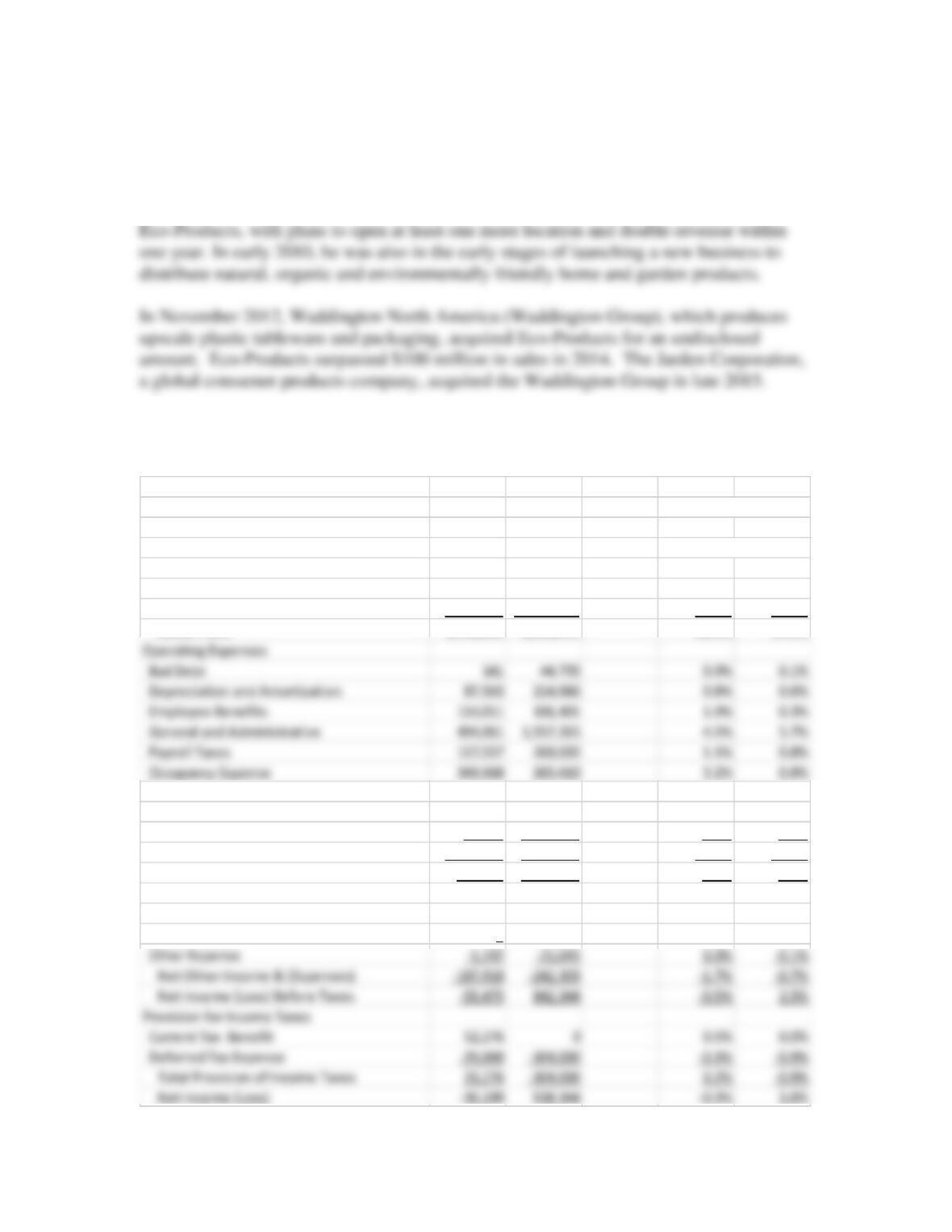
Following are the Eco-Products 2007 and 2008 financial statements that are
available in the accompanying Excel spreadsheet.
Eco-Products, Inc.
Financial Statements and Projections Common–Size
[In Dollars] Actual Actual Financial Statements
Yearend Yearend [Percent of Revenues]
Income Statements 2007 2008 2007 2008
Net Revenues 10,867,104 34,378,138 100.0% 100.0%
Cost of Goods Sold 7,726,455 26,041,166 71.1% 75.7%
Repairs and Maintenance 27,140 45,447 0.2% 0.1%
Salaries and Wages 1,778,282 3,216,385 16.4% 9.4%
Selling and Marketing Expenses 43,783 1,133,334 0.4% 3.3%
Total Operating Expenses 3,012,206 7,252,325 27.7% 21.1%
Operating Profit 128,443 1,084,647 1.2% 3.2%
Other Income and (Expenses)
Interest Expense –186,726 –253,242 –1.7% –0.7%
Other Income 0 35,984 0.0% 0.1%
Capstone Case 1: Eco-Products, Inc.
[Percent of Total Assets]
Balance Sheets 2007 2008 2007 2008
Assets
Current Assets
Cash 51,667 235,618 0.9% 1.2%
Vehicles 228,448 299,178 4.0% 1.6%
Total Property and Equipment 1,349,702 2,443,891 23.9% 12.9%
Less Accumulated Depreciation –360,304 –571,166 -6.4% –3.0%
Net Property and Equipment 989,398 1,872,725 17.5% 9.9%
Intangible Assets
Trademarks 20,800 21,564 0.4% 0.1%
Other Intangible Assets 5,440 84,920 0.1% 0.4%
Capstone Case 1: Eco-Products, Inc.
2007 2008 2007 2008
Liabilities and Equity
Current Liabilities
Accounts Payable & Accrued Expenses 568,131 3,804,210 10.1% 20.1%
Accrued Payroll & Payroll Taxes 6,712 253,094 0.1% 1.3%
Accrued Vacation 39,356 84,755 0.7% 0.4%
Lines of Credit 2,843,242 8,043,568 50.3% 42.5%
Current Portion of Long-Term Debt 39,865 166,310 0.7% 0.9%
Stockholders’ Equity
Common Stock, $.001 Par Value
50,000,000 Shares Authorized
16,935,000 Shares Issued & Outstanding 156,300 169,350 2.8% 0.9%
Preferred Stock, $.001 Par Value
1,750,000 Shares Authorized