Chapter 16
FINANCIALLY TROUBLED VENTURES:
TURNAROUND OPPORTUNITIES?
FOCUS
We direct attention in this chapter toward recognizing and managing financial distress.
An inability to pay creditor obligations as they come due typically poses a major financial
threat and certainly distracts the venture from its primary mission. A successful
entrepreneur copes with such financial distress and finds a way to turn the situation
around. The alternative to a successful turnaround is venture liquidation.
LEARNING OBJECTIVES
LO 16.1: Identify possible options available to struggling or troubled ventures.
LO 16.2: Define financial distress and explain how balance sheet insolvency and cash
flow insolvency differ.
CHAPTER OUTLINE
16.1VENTURE OPERATING AND FINANCING OVERVIEW
16.2 THE TROUBLED VENTURE AND FINANCIAL DISTRESS
16.3 RESOLVING FINANCIAL DISTRESS SITUATIONS
A. Operations Restructuring
16.4 PRIVATE WORKOUTS AND LIQUIDATIONS
A. Private Workouts
16.5 FEDERAL BANKRUPTCY LAW
SUMMARY
DISCUSSION QUESTIONS AND ANSWERS
1. What are the three types or methods of restructuring available when trying to turn
around financially troubled ventures?
The three basic types/methods are: (a) operations restructuring, (b) asset restructuring,
2. Identify major factors that cause ventures to get into financial trouble.
Ventures get into trouble by mishandling strategic issues, failing to unite management
on key initiatives, and having poor finance and accounting practices and controls.
3. What is meant by financial distress?
Financial distress refers to when cash flow is insufficient to meet current debt
obligations.
4. What is meant by loan default? Also, describe (a) an acceleration provision and (b) a
cross-default provision.
A loan default is when there is a failure to meet interest or principal payments when
5. What is foreclosure?
Foreclosure is a legal process used by creditors to try to collect amounts owed on
loans in default.
6. What do we mean when we say a venture is insolvent?
An insolvent venture is one where equity is negative and/or the cash flow of the firm
is unable to meet debt obligations.
7. Compare and contrast (a) balance sheet insolvency and (b) cash flow insolvency.
Balance sheet insolvency is when the firm has negative equity (or the debt is greater
8. Use the concept of cash flow insolvency over time and describe what would happen if
the problem is temporary rather than permanent.
Continued cash flow insolvency over time relates to a sustained inability for cash
9. What are some of the basic requirements of a successful turnaround plan?
A successful turnaround plan should provide immediate remedial actions (once
10. Define operations restructuring and describe how it can be implemented to escape
financial distress.
Operations restructuring is either growing the firm’s revenues relative to cost or
11. Define asset restructuring and describe how it can be implemented to escape from
financial distress.
Asset restructuring involves either selling off assets and/or improving the firm’s
working capital. See Figure 16.2 for this and other ways to address financial distress.
12. Define financial restructuring and describe what is meant by debt payments extension
and debt composition change.
Financial restructuring involves changing the contractual terms or composition of the
13. What is a private workout? Also, describe some of the characteristics of ventures
that are likely to engage in private workouts.
A private workout is a voluntary restructuring of the firm in lieu of declaring
14. What is a private liquidation? What does the process of assignment mean?
A private liquidation is selling the pieces of a venture. The process of assignment is
15. What is Chapter 11 bankruptcy and how is it used by ventures?
Chapter 11 bankruptcy is an attempt by the firm to receive protection from creditors
as it tries to reorganize itself.
16. Describe a venture bankruptcy. Also, indicate the difference between (a) a voluntary
bankruptcy petition and (b) an involuntary bankruptcy petition.
A venture is bankrupt when a petition for bankruptcy is filed with a federal court.
17. Briefly describe the common pool and holdout problems that often make it necessary
for a venture to enter into a court-supervised reorganization.
A common pool problem exists because individual creditors have an incentive to
foreclose on the venture even though it is worth more as a going concern. The
18. Briefly define the following terms: cram down procedure, debtor-in-possession
financing, and prepackaged bankruptcy.
A cram down procedure is when a bankruptcy court accepts a reorganization plan
19. Describe the absolute priority rule.
The absolute priority rule is a hierarchal chain of priority when a firm files for
20. What is the purpose of Chapter 7 of the U.S. Bankruptcy Code? What are some of the
characteristics of ventures that use Chapter 7 instead of private liquidation?
The purpose of Chapter 7 is quickly to shut down the operations of a venture and start
21. From the Headlines – Necton: Describe the business model turnaround Necton
undertook. Comment on what you think would have been the challenges and your
perceptions about the likelihood the new business model will succeed.
Answers will vary: While the market for Necton’s products appears promising, the
INERNET ACTIVITIES
1. Go to the Web site for Wall Street Journal or some other financial publication such
as Inc. magazine and identify a venture that has recently filed for reorganization or
liquidation with the U.S. bankruptcy courts. Then, access the Securities and
EXERCISES/PROBLEMS AND ANSWERS
1. [Balance Sheet Restructuring Concepts] It was shown earlier in the chapter that
Northland Industries was suffering from balance sheet insolvency. Two scenarios are
possible for Northland in year 3. In scenario 1, year 3 for Northland is expected to
result in an additional $150,000 operating loss. On the other hand, scenario 2 is
A. Show Northland’s basic balance sheets under both scenarios.
B. Based on your analysis, will Northland Industries still be balance sheet insolvent
in year 3 under scenario 1? If this trend continues, would you describe
Northland’s financial distress as a temporary or permanent problem?
Northland is balance sheet insolvent in Scenario 1. If this continues, it would be a
C. Based on your analysis, will Northland Industries still be balance sheet insolvent
in year 3 under scenario 2? If this trend continues, would you describe
Northland’s financial distress as a temporary or permanent problem?
Year 0 Year 1 Year 2 Scenario 1 Scenario 2
Current Assets 100,000 100,000 100,000 100,000 100,000
Fixed Assets 100,000 100,000 100,000 100,000 100,000
Total Assets 200,000 200,000 200,000 200,000 200,000
Total Debt $0 $100,000 $250,000 $400,000 $0
YEAR 3
2. [Cash Flow Restructuring Concepts] It was shown earlier in the chapter that
Westland Industries was suffering from cash flow insolvency in terms of its earnings
before interest, taxes, and depreciation (EBITDA). Two scenarios are possible for
If scenario 1 occurs, the cash flow insolvency will continue. Under scenario 2, the
venture moves into substantial cash flow solvency position.
3. [Cash Flow Restructuring Concepts] It was shown earlier in the chapter that
Eastland Industries was suffering from cash flow insolvency. Let’s assume that
scenario 1 projects that year 3 and following years will be like the results incurred
for year 2 where profitability is low and continued large investments in net working
Year 0 Year 1 Year 2 Scenario 1 Scenario 2
YEAR 3
Year 0 Year 1 Year 2 Scenario 1 Scenario 2
Net Income 0 -70,000 20,000 20,000 100,000
+Depreciation 0 20,000 20,000 20,000 20,000
YEAR 3
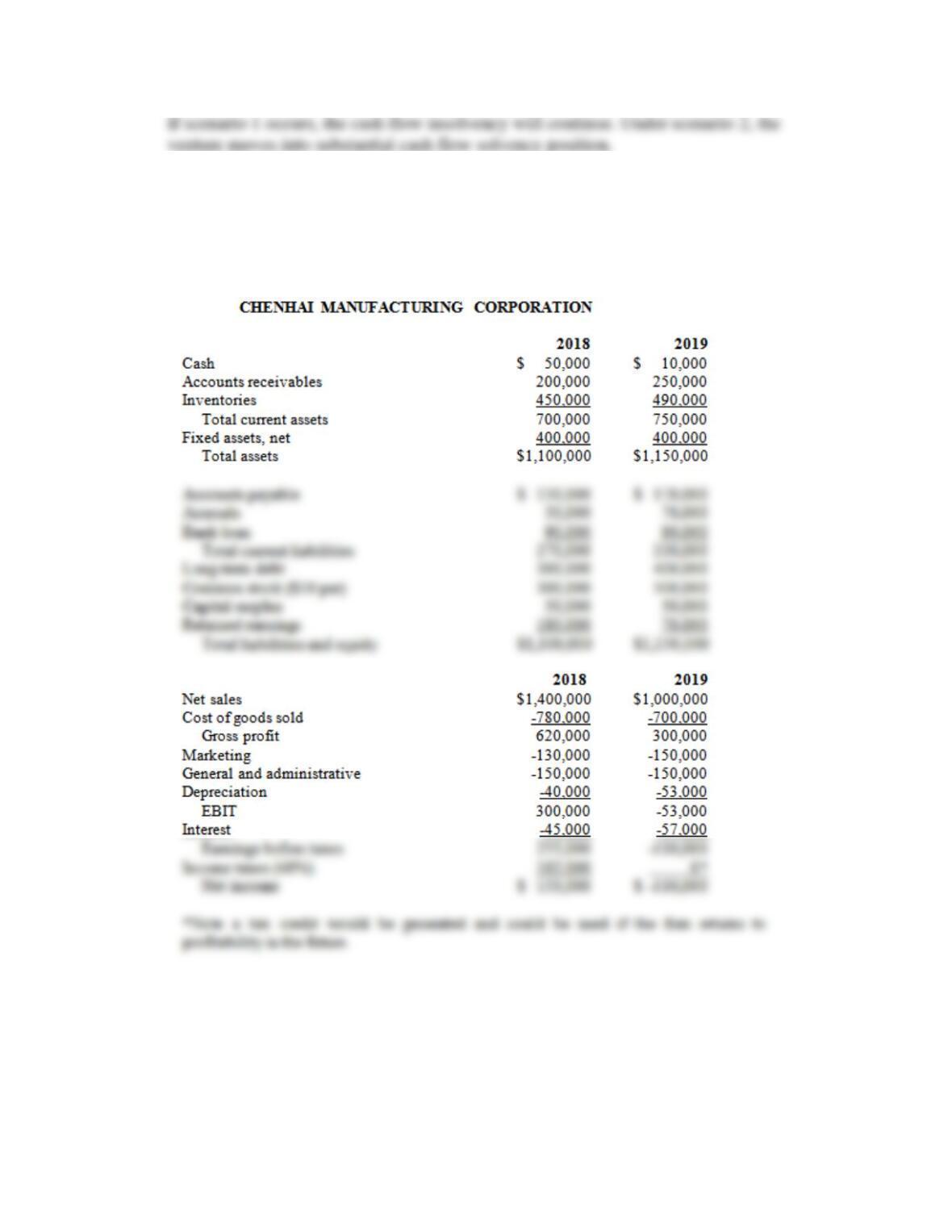
4. [Turnaround Opportunity: Restructuring Issues] Following are the financial
statements for the Chenhai Manufacturing Corporation for 2018 and 2019. The
venture is in financial distress and hopes to turn around its financial performance in
the near future.
A. Calculate the sale-to-cash conversion period for Chenhai in both 2018 and 2019.
Refer to Chapter 6 for calculating the cash conversion cycle and its three
components. Note: use “yearend” balance sheet data instead of averages so that
2018 and 2019 can be compared. Note: the sale-to–cash conversion period also is
2019.
Note: the inventory-to-sale conversion period also is referred to as the inventory
and 2019. Also determine the length of the cash conversion cycle for both 2018
and 2019.
The purchase-to-payment conversion period is the third component in the cash
conversion cycle.
D. What type of working capital restructuring might Chenhai undertake to turn
around its financial performance? What other type of asset restructuring might
Chenhai consider undertaking?
The CCC has increased from 178.49 days to 221.61 days. An effort should be
made to reduce the inventory-to-sale conversion period as well as the sale-to-cash
E. What type(s) of operations restructuring might Chenhai attempt during 2020?
Cost of goods sold increased from 55.7% ($780,000/$1,400,000) in 2018 to
70.0% in 2019 ($700,000/$1,000,000). Better control of the cost of production is
F. What type(s) of financial restructuring might Chenhai attempt during 2020?
Chenhai might attempt to reduce the amount of long-term debt that is outstanding
G. What prevailing conditions (economic, competitive, etc.) might cause you to
believe that Chenhai’s situation may be a turnaround opportunity versus a
permanent problem?
Of major concern is the decline in sales from $1,400,000 to $1,000,000. If the
5. [Financial Restructuring Issues] EnCal is a small West Coast-based power company
specializing in power generation methods that use clean burning fuels and renewable
natural resources. However, due to complex and confusing power pricing structure,
EnCal is reeling from the aftereffects of the state government’s attempt at power
deregulation. EnCal has been unable to pass its operating costs on to its consumers.
to replace all of its subordinated loan balance with a 50% equity stake in the
company.
Income Statement ($ Millions)
2018
2019
2020
Revenue
$240
$360
?
COGS (70% – 2018, 80% – 2019/2020)
–168
–288
?
Gross Profit
72
72
?
SG&A
EBITDA
42
37
?
Depreciation
EBIT
22
?
Interest
?
Earnings Before Taxes
?
Taxes (40%)
?
Net Income
$0
–$85
?
Balance Sheet ($ Millions)
Assets
Cash
$10
$10
Accounts Receivable
20
30
Inventories
10
15
Fixed Assets, Net
510
1,080
Total Assets
$550
$1,135
Liabilities and Equity
Accounts Payable
$14
$24
Notes Payable (8% Bank Loan)
50
140
Accrued Liabilities (Wages & Taxes)
180
460
290
Common Stock
300
300
Retained Earnings
Total Liabilities & Equity
$550
$1,135
A. Assuming a 25% increase in revenue with no additional capital investment, what
will EnCal’s new income statement and balance sheet look like in the business as
usual and financial restructuring scenarios?
EnCal Corporation 2020 2020 Re-
Income Statement ($ Millions) 2018 2019 BAU structure
Revenue $240 $360 $450 $450
COGS (70% – 2015, 80% – 2016 & 2017) –168 –288 –360 –360
Gross Profit 72 72 90 90
SG&A –30 –35 –35 –35
EBITDA 42 37 55 55
Balance Sheet ($ Millions)
Assets
Cash $10 $10 –$32 $17
Accounts Receivable 20 30 38 38
Inventories 10 15 19 19
Fixed Assets, Net 510 1,080 1,040 1,040
Total Assets $550 $1,135 $1,064 $1,113
Liabilities
Accounts Payable $14 $24 $30 $30
Notes Payable (8% to 6% Bank Loan) 50 140 140 100
Note: Interest Calculations
Notes Payable (Bank Loan) 8% to 6% 11 6
Long-Term Mortgage Loans (10% to 8%) 46 37
Long-Term Subordinated Loans (12%) 35 0
Total Interest (subtraction in Inc. Stmt.) 92 43
B. Will EnCal be able to service its debt under either scenario?
Under the restructured 2020 projection they can service the debt. Under the
C. Would EnCal be a likely candidate for Chapter 7 bankruptcy?
EnCal would probably avoid liquidation under Chapter 7 if these projections are
D. Suppose the governor has called an emergency legislative session on the utility’s
behalf to prevent its eventual bankruptcy. If the governor is able to get a bill
($450M)/[(800,000kW)*(50%)*(365days)*(24hrs/day)] = $.128 per kWh
MINI CASE: ENDCO, INC.
Endco is a wireless solutions provider that facilitates wireless Internet access through
small remote devices that connect to portable computers. During the past several years,
Endco was lavished with an abundance of equity financial capital from a variety of
venture investors. Although initial adoption rates for this new service were far below
expectations, most were confident that expanding the service area and thus increasing the
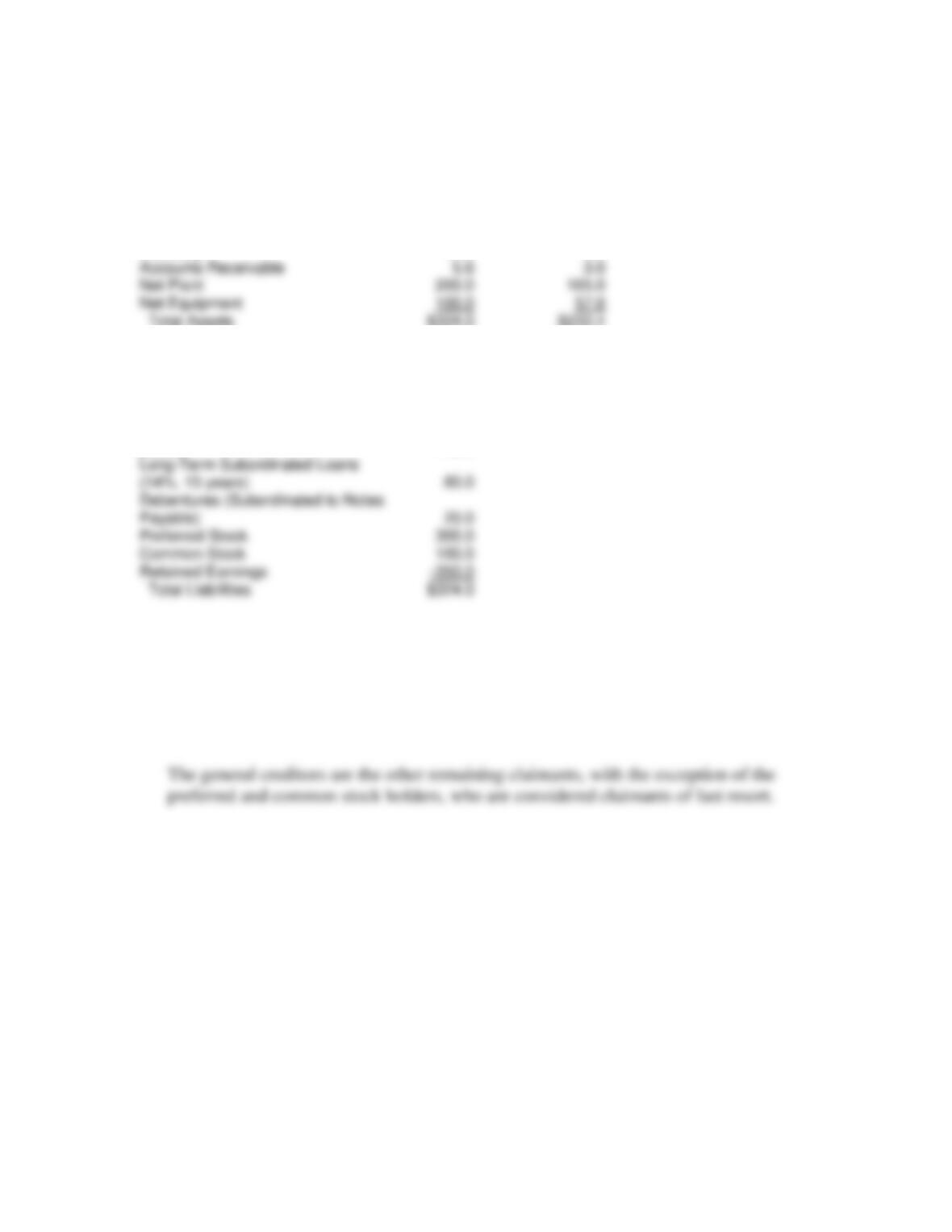
Balance Sheet ($ Millions)
Assets
Liquidation
Receipts
Cash
$2.4
$2.4
Inventory
16.0
5.0
Accounts Receivable
5.6
3.0
Net Plant
200.0
Net Equipment
100.0
57.0
Total Assets
$324.0
$232.4
Liabilities & Equity
Accounts Payable
$3.5
Notes Payable (12% Bank Loan)
29.0
Accrued Liabilities (Wages & Taxes)
1.5
Long-Term Mortgage Loans (12%, 10
years)
140.0
(14%, 15 years)
80.0
Payable)
20.0
Preferred Stock
300.0
Common Stock
100.0
Retained Earnings
Total Liabilities
$324.0
A. Who are considered to be the priority claimants in this liquidation?
The priority claimants are the government, employees and mortgage holders.
B. Who are considered to be general creditors?
C. Create a table indicating the cash distribution to each creditor and the percentage of
the original liability that is satisfied.
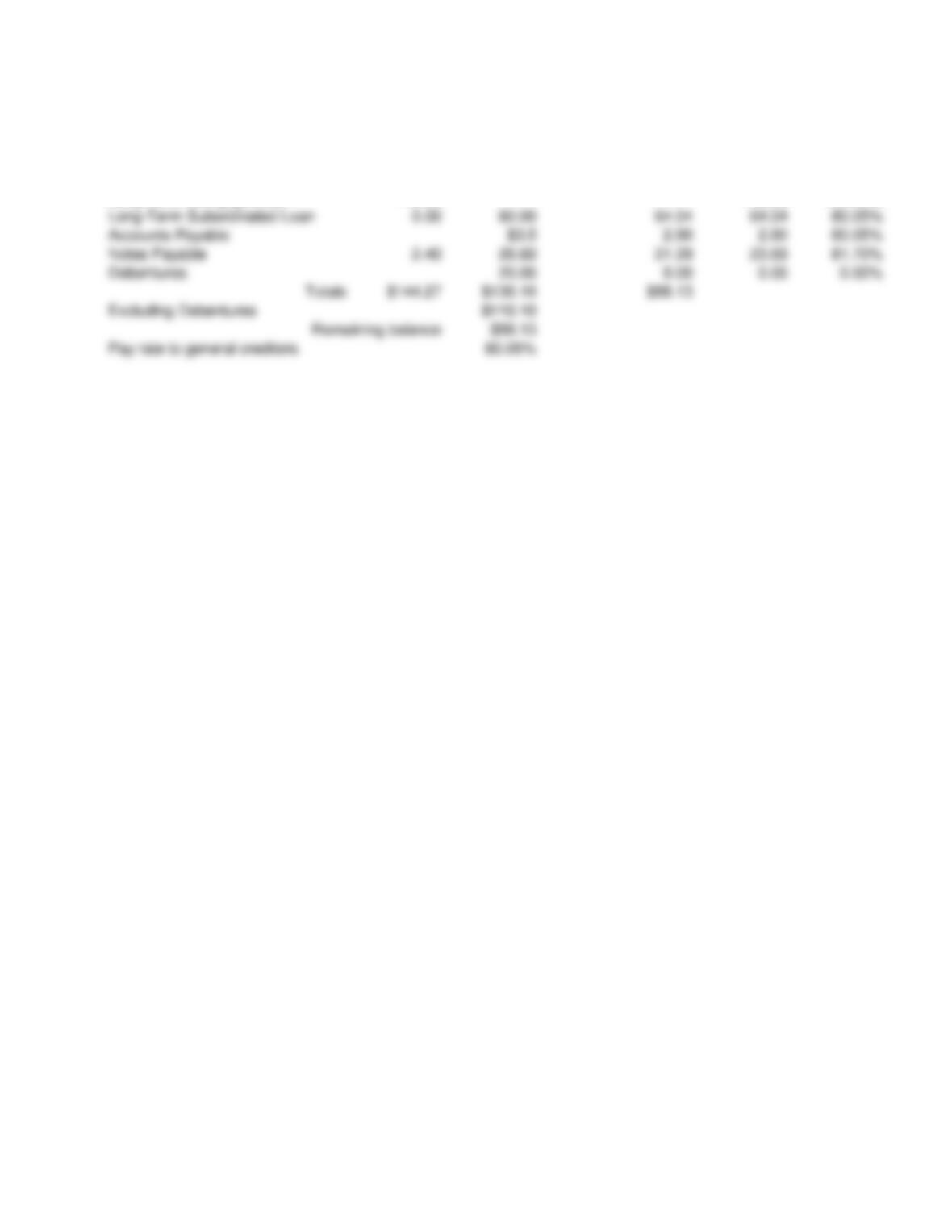
Claimant
Priority
Payments
Remaining
Claims
Payments on
Remaining Claims
Total
% Liability
Satisfied
Administrative and Legal
0.37 0.37
Wages & Taxes 1.50 1.50 100.00%
Long-Term Mortgage Loan 140.00 140.00 100.00%