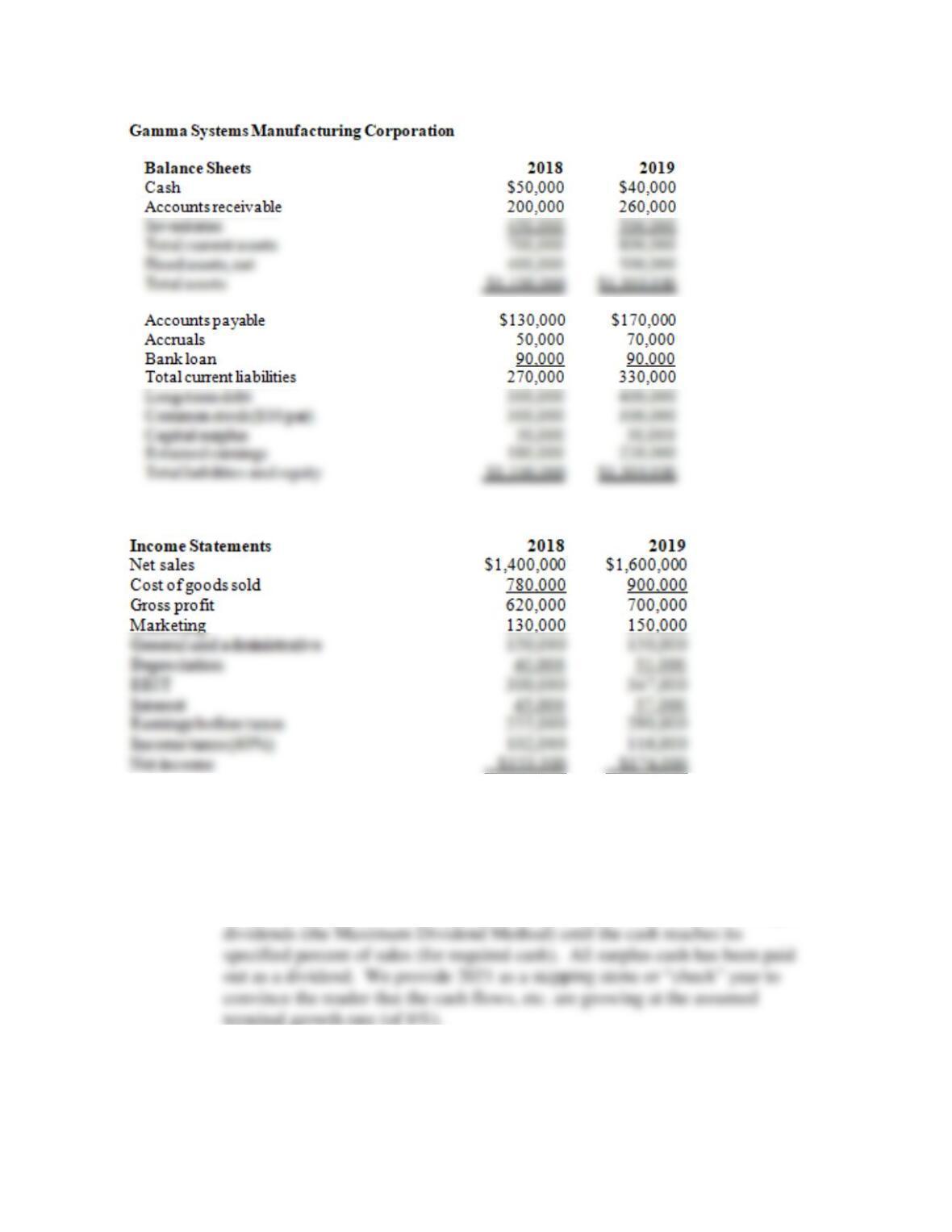
A. Estimate the free cash flows available to the equity investors for 2020.
The following spreadsheet assumes that most accounts are a constant percent
of sales (starting in 2020). We have balanced the balance sheets by raising the
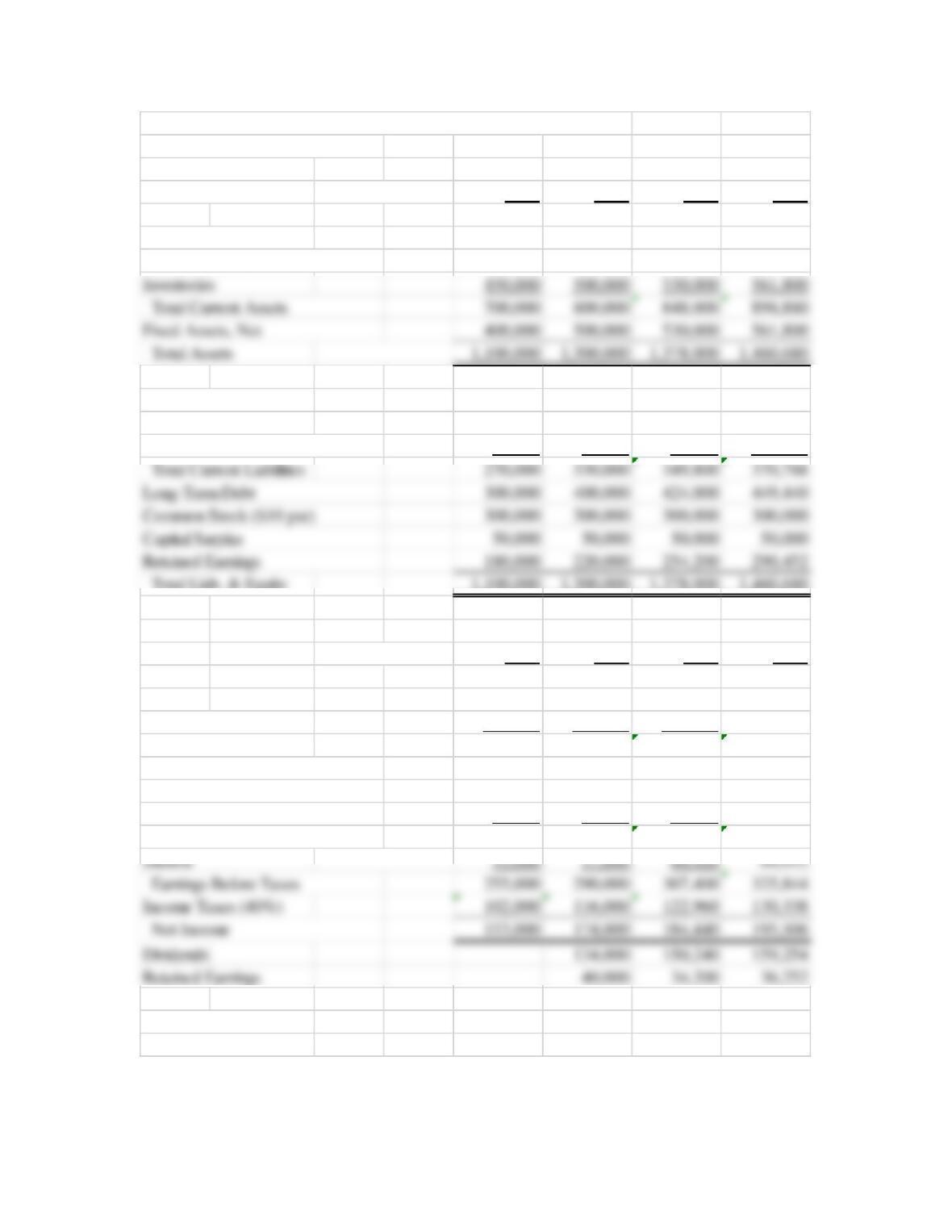
GAMMA SYSTEMS MANUFACTURING CORPORATION
[Chapter 15, Problems 5-7]
Problem 5:
Balance Sheets
2018 2019 2020 2021
Check Year
Cash 50,000 40,000 42,400 44,944
Accounts Receivables 200,000 260,000 275,600 292,136
Accounts Payable 130,000 170,000 180,200 191,012
Accruals
50,000 70,000 74,200 78,652
Bank Loan 90,000 90,000 95,400 101,124
Total Liab. & Equity 1,100,000 1,300,000 1,378,000 1,460,680
2018 2019 2020 2021
Net Sales 1,400,000 1,600,000 1,696,000 1,797,760
Cost of Goods Sold 780,000 900,000 954,000 1,011,240
Gross Profit 620,000 700,000 742,000 786,520
Marketing 130,000 150,000 159,000 168,540
General & Administrative 150,000 150,000 159,000 168,540
Depreciation
040,000 53,000 56,180 59,551
EBIT
300,000 347,000 367,820 389,889
Sales g = 6.00% 6.00%
Growth Rate 6%
Discount Rate 18%
B. Estimate the value of Gamma Systems equity at the end of 2019 by applying
the terminal value perpetuity equation that was presented in Chapter 10.
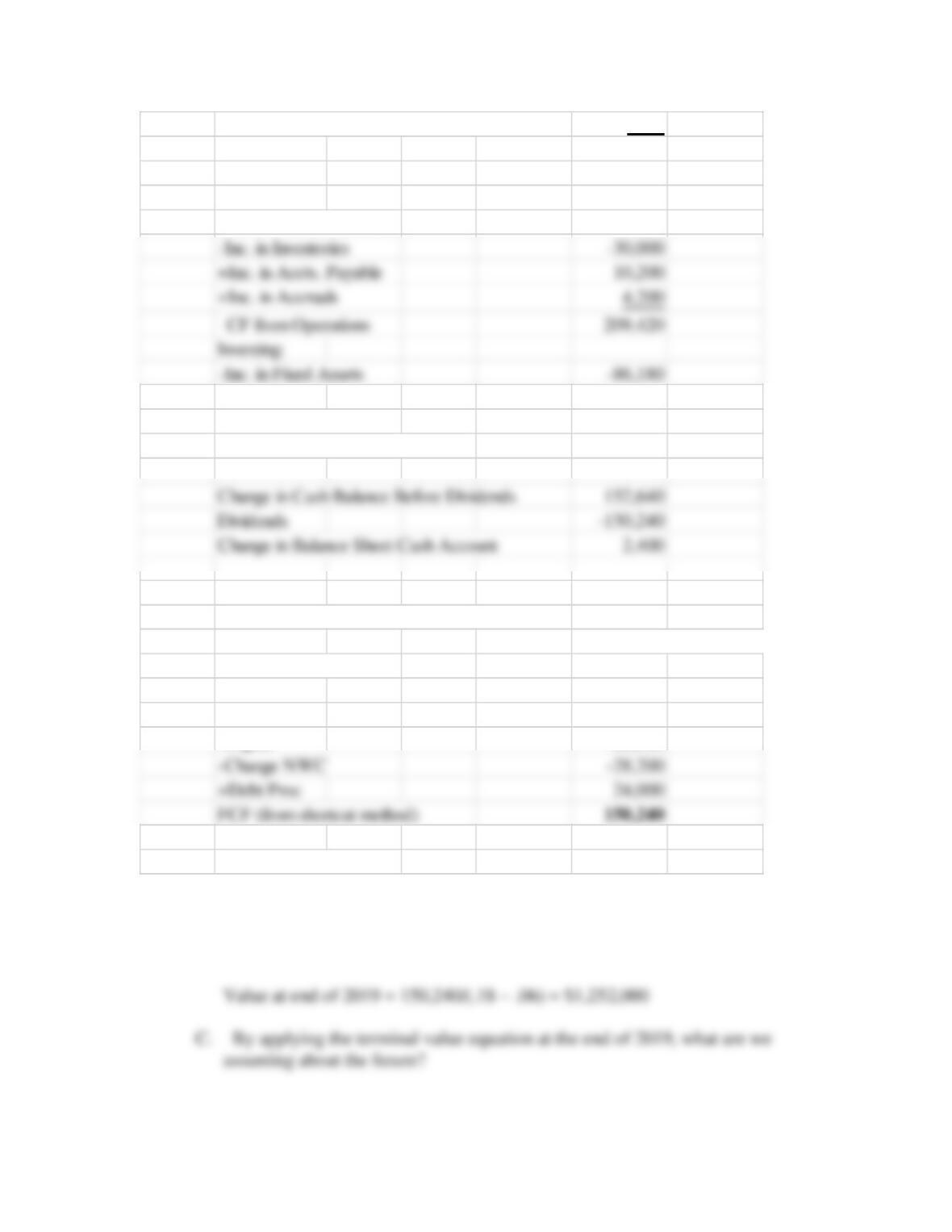
A) Statement of Cash Flows Approach 2020
Operating:
Net Income 184,440
+Depreciation 56,180
–Inc. in Accts. Receivable
–15,600
Financing:
+Increase in Bank Loans 5,400
+Increase in Long–Term Debt 24,000
FCF (from Statement of Cash Flows) 150,240
(Same as Dividends here)
Shortcut Method:
NI 184,440
+Depr 56,180
Value (End of 2019)
1,252,000$
That the VCF will growth smoothly at 6% for the remainder of eternity and
that the required return will remain constant at 18%.
6. [Valuation Sensitivities to Changes in Growth Rates and Discount Rates] Assume
that some of the information relating to the Gamma Systems Manufacturing
Corporation has changed. Using the financial statement data in Problem 5, answer
the following questions.
A. How would your valuation estimate change if the sales growth rate had been 6
percent but the discount rate had been 20 percent?
B. How would your valuation estimate change if the sales growth rate had been 5
percent and the discount rate 18 percent?
To use a 5% terminal growth rate, we must construct a new stepping stone
or “check” year. The remainder is analogous to the solution to Problem 5
above.
C. How would your valuation estimate change if the perpetuity growth rate had
been 7 percent and the discount rate 20 percent?
Value = 146,280/(.20 − .07) = $1,125,231.
GAMMA SYSTEMS MANUFACTURING CORPORATION
Problem 6:
A) 1,073,143$
[Based on growth rate = 6.00% and discount rate = 20%]
B) Balance Sheets
2018 2019 2020 2021
Check Year
Long–Term Debt 300,000 400,000 420,000 441,000
Common Stock ($10 par) 300,000 300,000 300,000 300,000
Capital Surplus 50,000 50,000 50,000 50,000
Retained Earnings 180,000 220,000 248,500 278,425
Total Liab. & Equity 1,100,000 1,300,000 1,365,000 1,433,250
Income Taxes (40%) 102,000 116,000 121,800 127,890
Net Income 153,000 174,000 182,700 191,835
Dividends 134,000 154,200 161,910
Retained Earnings 40,000 28,500 29,925
Sales g = 5.00% 5.00%
Growth Rate 5%
Discount Rate 18%
Value (End of 2019) 1,186,154
GAMMA SYSTEMS MANUFACTURING CORPORATION
C) Balance Sheets
2018 2019 2020 2021
Check Year
Cash 50,000 40,000 42,800 45,796
Accounts Receivables 200,000 260,000 278,200 297,674
Inventories 450,000 500,000 535,000 572,450
Total Current Assets 700,000 800,000 856,000 915,920
Fixed Assets, Net 400,000 500,000 535,000 572,450
Total Assets
1,100,000 1,300,000 1,391,000 1,488,370
0
Accounts Payable 130,000 170,000 181,900 194,633
Accruals 50,000 70,000 74,900 80,143
Gross Profit 620,000 700,000 749,000 801,430
Marketing 130,000 150,000 160,500 171,735
General & Administrative 150,000 150,000 160,500 171,735
Depreciation 40,000 53,000 56,710 60,680
EBIT 300,000 347,000 371,290 397,280
g = 7.00% 7.00%
Growth Rate 7%
Discount Rate 20%
Value 1,125,231
7. [Valuation Impact of Changes in Forecast Period Growth Rates] New information
for the Gamma Systems Manufacturing Corporation has been brought to the
management’s attention. Use the financial statement information in Problem 5 and
take into consideration that sales will grow at a 15 percent rate in 2020 and a 10
percent rate in 2021 before settling down to a 6 percent perpetuity growth rate.
A. Estimate the free cash flows available to equity investors for 2020, 2021, and
2022.
Free cash flow is the same as “dividends” in the MDM used in the spreadsheet
below.
GAMMA SYSTEMS MANUFACTURING CORPORATION
Problem 7:
Balance Sheets 2018 2019 2020 2021 2022 2023
Check Year
Cash 50,000 40,000 46,000 50,600 53,636 56,854
Accounts Receivables 200,000 260,000 299,000 328,900 348,634 369,552
Common Stock ($10 par) 300,000 300,000 300,000 300,000 300,000 300,000
Capital Surplus 50,000 50,000 50,000 50,000 50,000 50,000
Retained Earnings 180,000 220,000 305,500 371,050 414,313 460,172
Total Liab. & Equity 1,100,000 1,300,000 1,495,000 1,644,500 1,743,170 1,847,760
2018 2019 2020 2021 2022 2023
Income Taxes (40%) 102,000 116,000 133,400 146,740 155,544 164,877
Net Income 153,000 174,000 200,100 220,110 233,317 247,316
Dividends 134,000 114,600 154,560 190,054 201,457
Retained Earnings 40,000 85,500 65,550 43,263 45,859
Dividend growth g = 34.87% 22.96% 6.00%
2021 Terminal Value 1,583,780
VCF 114,600 1,738,340
2019 NPV 1,345,567
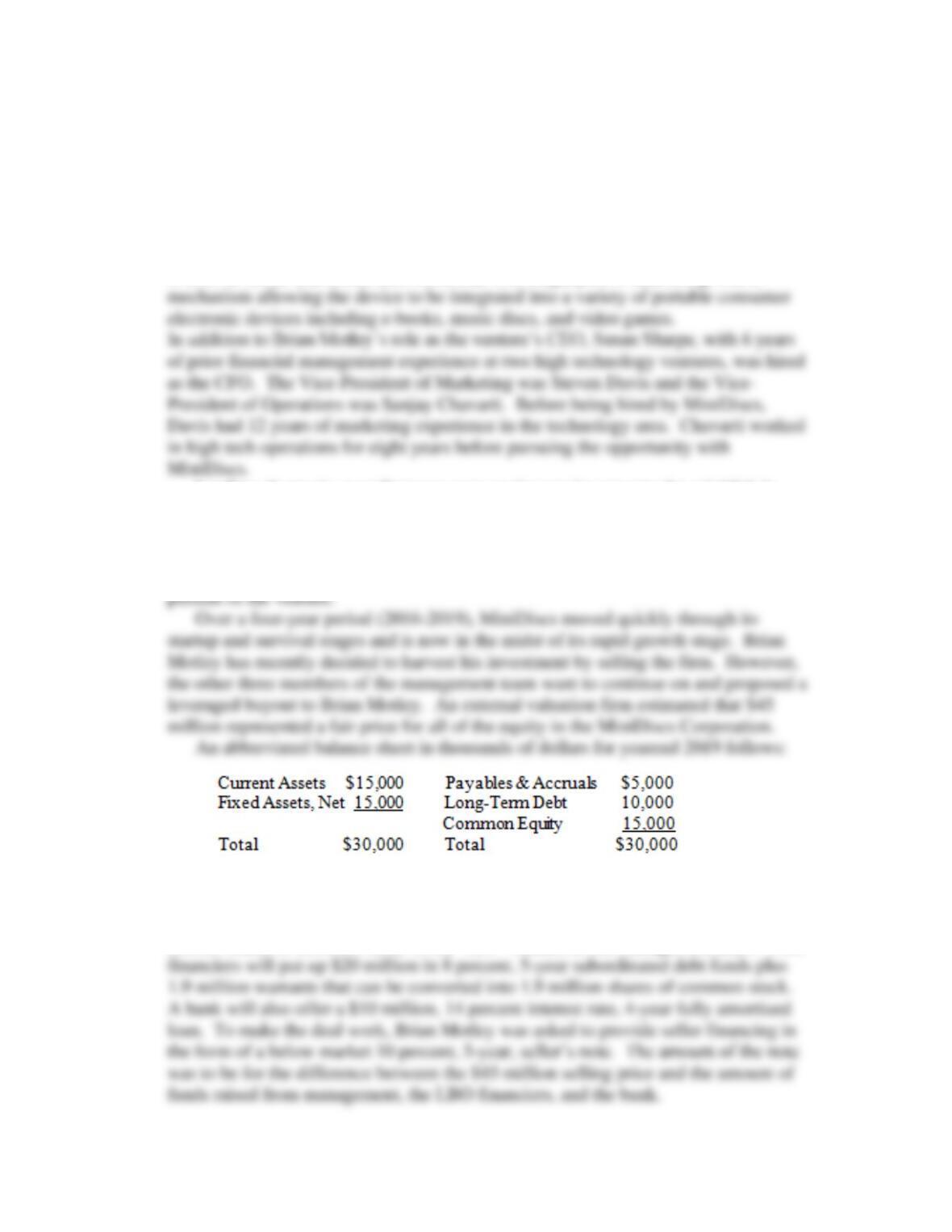
MINI CASE: MINIDISCS CORPORATION
Brian Motley founded the MiniDiscs Corporation at the end of 2014. After nearly
one year of development, the venture produced an optical storage disk about the size
of a silver dollar that could store more than 500 megabytes of data along with a
Leading electronic manufacturers were anxious to incorporate the minidisk in
their products. Brian Motley obtained $7 million financing at the end of 2015 from
venture investors in exchange for 43 percent of the stock in the venture. After this
round of venture financing, Brian retained 50 percent ownership in MiniDiscs and the
other three members of the management team (Sharpe, Davis, and Chavarti) owned 7
It is the beginning of 2020, and the management team has $5 million of their own
capital, including their share of the sales price, available to purchase all of the
venture’s existing equity capital. The intent is to retire all of the old stock and issue 2
million shares of common stock in the “new” venture to the management team. LBO
In exchange for the seller financing by Brian Motley, the existing venture
capitalists agreed to reduce their ownership rights from 43 percent to 40 percent. The
currently at 16 percent.
A. What will be the dollar amount of seller financing that Brian Motley will need to
provide to complete the financing of the $45 million selling price?
Management team = $5 million
B. How much cash will be available to distribute to the existing owners of the
MiniDiscs Corporation? What will be the dollar breakdown for Brian Motley, the
management team, and the venture capitalists?
Original Percent Exit Percent
Equity Owners Ownership Ownership
Brian Motley 50% 55%
Management Team 7 5
Venture Investors 43 40
100% 100%
C. What compound rate of return did Motley earn on his $1 million end of 2014
investment?
The $1million original investment bought only 50% of the 2019 equity value. The
additional $10 million below-market loan (negative NPV loan) was the
D. What compound rate of return did the venture capitalists earn on their $7 million
investment at the end of 2015?
E. After five years of operating as a private venture owing to the LBO, assume that
the common equity in the MiniDiscs Corporation could be sold for $60 million at
the end of 2024. What compound rate of return would the management team earn
on its $5 million investment?
The VCs were given warrants to purchase 1.9 million shares of stock. Thus, at
exit there would be 3.9 million total shares of common stock outstanding.
F. Assume that when MiniDiscs is sold at the end of 2024 for $60 million that the
LBO financiers will have their debt retired and will sell their share of interest in
the venture. What compound rate of return would the LBO financiers receive?
As the exercise price of the warrants is not specified, we will provide two possible
scenarios:
1) The warrants are exercised by surrendering the VC’s claim to the principal
on the subordinated debt it holds. This structure is like assuming the bond
2) The warrants have some trivial (close to zero) exercise price that is negligible
for the purpose of the analysis (as was the assumption in the example solution
presented in Section 15.5 of the textbook) and the $20,000,000 in bond