Chapter 15 – Budgeting and Controlling Operations and Taxes
15–21
CHAPTER OUTLINE AND TEACHING NOTES
(1) Normally, deductions are classified
2. Inventory valuation
a. Three methods of computing inventory:
(1) First-in, first-out (FIFO) method.
3. Interest payments
a. The U.S. Revenue Code favors the use
4. Business lunches, entertainment, and travel
a. Allowances for these are subject to fre-
quent changes.
Chapter 15 – Budgeting and Controlling Operations and Taxes
15–22
CHAPTER OUTLINE AND TEACHING NOTES
5. Automobile, home, and computer expenses
a. Certain home expenses can be de-
ducted from income taxes, with re-
strictions, if they are business related.
b. For an automobile, you can either de-
common sense.
REAL WORLD EXAMPLE 15.5
The IRS rule for a home office is that the home must
be the principal place of business for your trade or busi-
ness, or a place of business used by clients, patients, or
customers.
X. EMPLOYMENT- RELATED TAXES –
A. Employers are legally required to provide their
employees:
1. With Social Security and Medicare, unemploy-
ment compensation insurance, and industrial in-
Chapter 15 – Budgeting and Controlling Operations and Taxes
15–23
CHAPTER OUTLINE AND TEACHING NOTES
3. The Employee Retirement Income Security Act
B. Income Tax Withholding
1. The IRS requires you to withhold the appropri-
ate amount of income tax from each em-
ployee’s earnings during each pay period,
based on his or her total wages number of
REAL WORLD EXAMPLE 15.6
Illegal workers pay taxes to the tune of over one mil-
lion filers, in hopes that being good citizens will give them
a better chance of becoming legal.
C. Social Security/Medicare Taxes
1. As shown in Chapter 10, employers must
withhold a percentage of each employee’s in-
come for Social Security taxes, up to maxi-
Chapter 15 – Budgeting and Controlling Operations and Taxes
15–24
CHAPTER OUTLINE AND TEACHING NOTES
3. Self-employed people must pay the com-
D. Unemployment Compensation Insurance has
two parts:
1. A small basic amount is paid to the U.S. gov-
ernment as a FEDERAL UNEMPLOYMENT
XI. PERSONAL TAXES PAID BY OWNERS
Learning Objective 7.
Explain how the ownership of the business results in
direct taxation of the owner.
A. Taxes on Amounts Withdrawn from the Busi-
ness
1. Individual income taxes are paid on salaries
and bonuses received from the business.
2. When you withdraw cash from a proprietor-
Chapter 15 – Budgeting and Controlling Operations and Taxes
15–25
CHAPTER OUTLINE AND TEACHING NOTES
5. Payment to pension and profit-sharing plans
are deductible by the business, but are not
taxable to the recipients until they are re-
ceived.
B. Taxes on Amounts Received from Sale of the
Business
1. Usually, when entrepreneurs sell their com-
panies, the contracts contain the following
provisions:
2. Under the Tax Reform Act of 1986, most
sales of assets are subject to double taxa-
3. The form in which the proceeds are to be re-
4. In summary, the tax consequences from the
sale of a business are that:
a. You pay an immediate capital gains on
XII. RECORD KEEPING AND TAX REPORTING
Learning Objective 8.
Chapter 15 – Budgeting and Controlling Operations and Taxes
15–26
CHAPTER OUTLINE AND TEACHING NOTES
Understand the importance of record keeping and tax
reporting.
A. Reasons for Keeping Business Records
2. They help you manage your business better.
B. Maintaining Tax Records
1. As shown in Chapter 5, you should set up the
for up to three years after a tax return is filed.
C. What Records to Keep?
1. The Online Women’s Business Center rec-
2. Five major tax-saving ideas for small busi-
ness owners:
a. Contribute to a retirement plan.
D. Reporting Your Taxes
1. All federal, state, and local governments hav-
ing jurisdiction over your business, require
XIII. CREDIT MANAGEMENT
Learning Objective 9.
Chapter 15 – Budgeting and Controlling Operations and Taxes
15–27
CHAPTER OUTLINE AND TEACHING NOTES
Discuss some factors and problems involved in grant-
ing credit.
A. CREDIT MANAGEMENT involves setting and ad-
ministering credit policies and practices including:
1. Deciding how customers will pay for pur-
chases.
B. Methods of Payment
1. Cash payments make record keeping easier,
and there are no bad debts.
2. Checks
a. Are treated the same as cash in record-
3. Credit
a. Types of credit
(1) Accounts paid off every month.
(2) Revolving charge accounts, as De-
partment store cards.
4. Debit cards
Chapter 15 – Budgeting and Controlling Operations and Taxes
15–28
CHAPTER OUTLINE AND TEACHING NOTES
a. A DEBIT CARD is usually plastic and
enables the owner to withdraw money
from ATMs, or to have the cost of pur-
chases charged directly to the holder’s
bank account.
5. Peer to Peer Payments are payments made
by consumer to another or to a small
business via Android phones or other
C. Setting Credit Policies
1. Processing fees vary from card company to
banks.
2. Any credit policy should be flexible to allow
for changing circumstances.
3. Some Credit policies:
a. Liberal extension of credit with liberal
Chapter 15 – Budgeting and Controlling Operations and Taxes
15–29
CHAPTER OUTLINE AND TEACHING NOTES
4. Being liberal with credit increases sales, but
increases collection costs and bad-debt
losses.
D. Carrying Out Credit Policies
E. Classifying Credit Risks
1. You should begin by classifying credit risk:
food, fair, or weak, determined by information
F. Investigating Customers’ Creditworthiness
1. A major cause of bad-debt losses is making
credit decisions without adequate investiga-
tion.
G. Establishing Collection Procedures
1. Collecting unpaid accounts should include
systematic, regular, and timely follow-up.
Chapter 15 – Budgeting and Controlling Operations and Taxes
15–30
LEARNING OBJECTIVES REVISITED
1. Explain how managers exercise control in a small business.
● The control process consists of:
2. Tell what a budget is, explain the different types, and tell how they are prepared and
used.
● A budget is a detailed statement of financial results expected for a given future period.
3. Discuss how information on actual performance can be obtained and used.
● Information can be obtained by observation or from oral or written reports.
4. Explain how ratios can be used to evaluate a firm’s financial condition.
● Ratios can be used to compare the company’s current and past performance, as well as its
performance relative to competitors.
5. Explain how the U.S. tax system operates.
● Federal, state, and local governments impose taxes on individuals and businesses.
Chapter 15 – Budgeting and Controlling Operations and Taxes
15–31
6. Name and describe the taxes imposed on the small business itself.
● Taxes paid for the right to operate the business, including fees and permits.
7. Explain how the ownership of the business results in direct taxation of the owner.
● A partnership or proprietorship avoids the higher taxation of the corporate form.
8. Understand the importance of record keeping and tax reporting.
● Maintain complete and accurate tax records from the start of operations.
9. Discuss some factors and problems involved in granting credit.
● A credit policy should be flexible and help increase revenues and profits.
KEY TERMS USED IN THIS CHAPTER
The acid test (quick) ratio is the ratio of current assets, less inventory, to current liabilities.
An audit is a formalized examination and/or review of a company’s financial records.
Chapter 15 – Budgeting and Controlling Operations and Taxes
A cash flow budget forecasts the amount of cash receipts and cash needed to pay expenses and make
other purchases.
Control is the process of assuring that organizational goals are achieved.
Federal unemployment tax is a tax paid to the federal government to administer the unemployment insur-
ance program.
Feedback is response a receiver gives through further communication with the sender of the message or
some other person.
Indirect taxes are not paid by a person or firm, but by someone else.
An operating budget forecasts sales and allocates expenses for achieving them.
Peer-to-Peer Payment Products are payments made by one consumer to another or to a small business.
The sender is always a consumer.
NOTES FOR DISCUSSION QUESTIONS
1. What is control? List the steps in an effective control process.
Each day, we exercise controls over our activities and also are subject to controls. We control the
Chapter 15 – Budgeting and Controlling Operations and Taxes
15–33
2. What are performance standards? Why are they used? List some examples.
Performance standards tell employees—in advance—what level of performance is expected of
3. What is budgetary control? How can it be used by a small business?
Budgetary control is a system of budgets used to control a company’s activities, comparing actual
4. How can information about actual performance be obtained in a small firm?
Information on actual performance comes through some form of feedback: observation, oral re-
ports, written memos or reports, and other methods. Observation will probably be most satisfactory be-
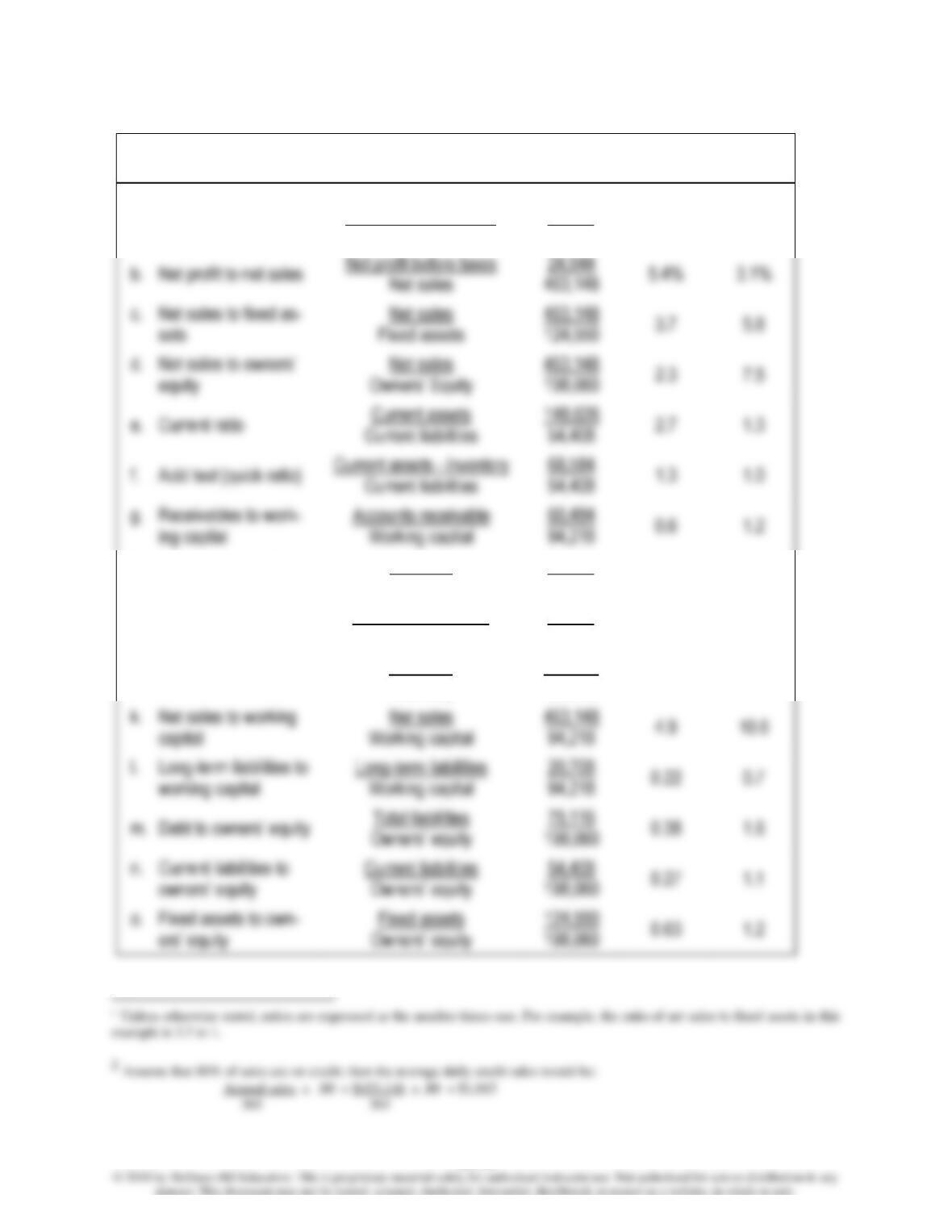
5. Compute the ratios listed in Table 15.1 for The Model Company, using the data in Figures 14.1
and 14.2.
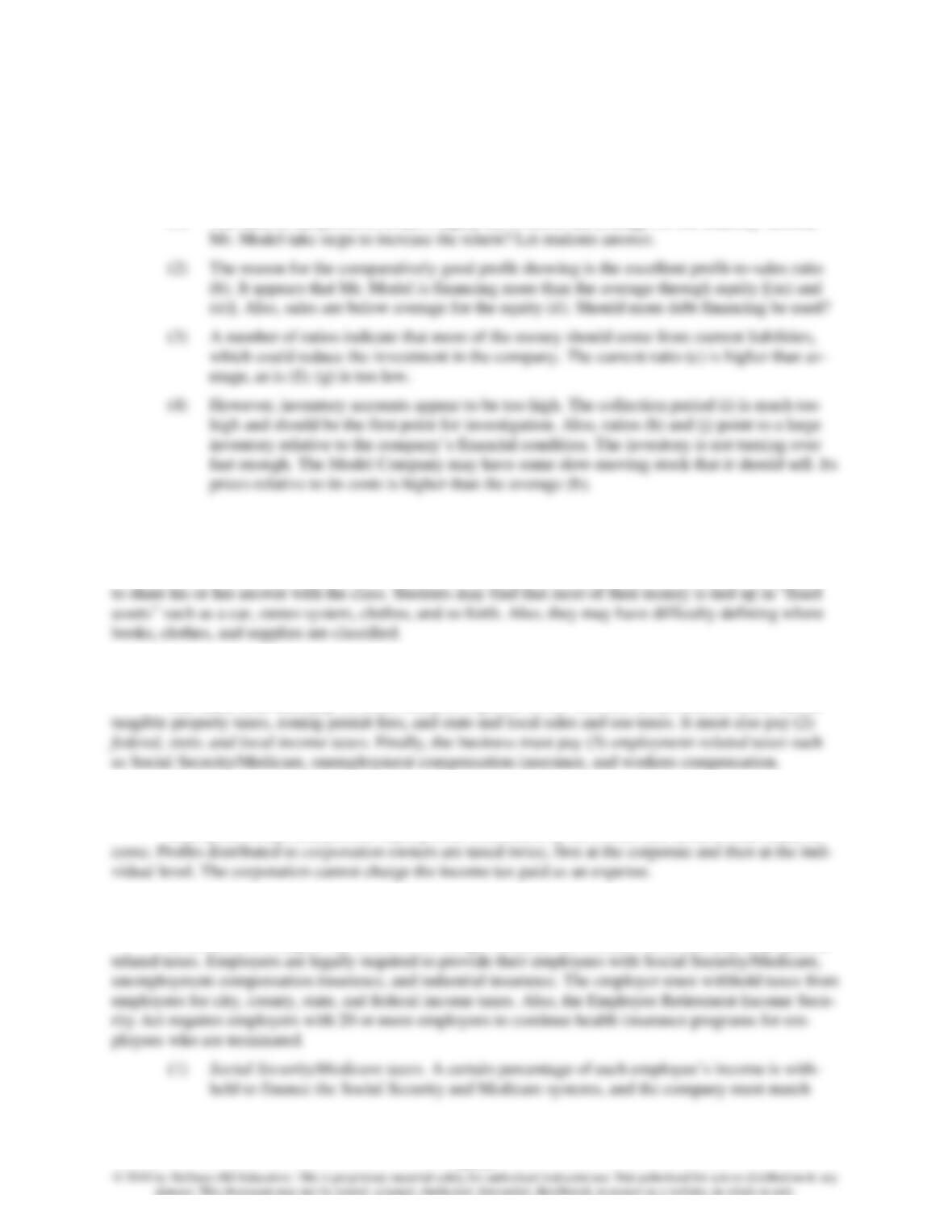
The figures used and the ratios themselves are shown in the table below.
Chapter 15 – Budgeting and Controlling Operations and Taxes
15–34
Ratios for the Model Company
Ratio
Formula
Model 1
Company
Industry
Average
a. Net profit to owners’
equity
Net profit before taxes
Owners’ equity
24,944
198,060
12.6%
18.4%
Net sales
5.4%
sets
Net sales
463,148
3.7
5.8
148,626
54,408
2.7
1.3
68,584
54,408
1.3
1.0
g. Receivables to work-
ing capital
Working capital
60,484
94,218
0.6
1.2
h. Inventory to working
capital
Inventory
Working capital
80,042
94,218
0.85
0.4
I. Collection period
Accounts receivable
Average daily credit sales2
60,484
1,015
60 days
43 days
j. Net sales to inventory
Net sales
Inventory
463,148
80,042
5.8
22.0
capital
Net sales
Working capital
463,148
94,218
4.9
10.0
working capital
Working capital
20,708
94,218
0.22
0.7
75,116
0.38
1.6
o. Fixed assets to own-
124,550
0.63
1.2
Chapter 15 – Budgeting and Controlling Operations and Taxes
15–35
6. Evaluate the financial condition of The Model Company.
Students should be able to observe some items that are out of line with the industry. Checks
should be made to determine whether changes should be made in those areas. Some points that should be
observed, however, are that:
(1) The ratio of net profit to owner’s equity (a) is below the average for the industry. Should
7. Evaluate your personal financial situation and operations, using material developed in this chap-
ter.
The students will have to answer this one on their own. You might ask if any one of them wants
8. Name the three main types of taxes a small firm must pay.
The small firm must pay (1) taxes and fees imposed on the business itself, such as excise and in-
9. How does the form of a business affect its taxes?
In proprietorships and partnerships, profits withdrawn by the owners are taxed as individual in-
10. Name and explain the three types of employment-related taxes.
In addition to acting as tax collector for the government, the business must also pay employment-
Chapter 15 – Budgeting and Controlling Operations and Taxes
15–36
ployees who are harmed or killed on the job.
11. Why are records so important for tax purposes?
12. What is credit management, and why is it so important to small business? Why is the acceptance
of credit cards by small businesses increasing?
Credit management involves (1) deciding how customers will pay for purchases, (2) formulating
NOTES FOR CASE QUESTIONS
CASE 15.1: Theme Restaurants
1. Do you think theme restaurants are a permanent part of the restaurant industry? Why?
Restaurants have one of the highest failure rates of all small businesses. Customers are unforgiv-
2. What suggestions would you make to improve the attraction of these restaurants?
Nowhere in the case is product quality mentioned. You can draw customers in with celebrity vis-
3. Would you like to own and operate a theme restaurant? Why?
Chapter 15 – Budgeting and Controlling Operations and Taxes
15–37
CASE 15.2: How to Deal with Cash Flow Problems
1. Which of the above can you quantify?
2. Which of the above do you think is the most important point? Why?
Student answer will vary; however, all should have reasons.
3. Which of the above can be compared to a budget? Which budget?
The cash balances can be compared to a cash flow budget; accounts receivable turnover, to an op-
4. What other suggestions do you have? Explain.
BONUS EXERCISE
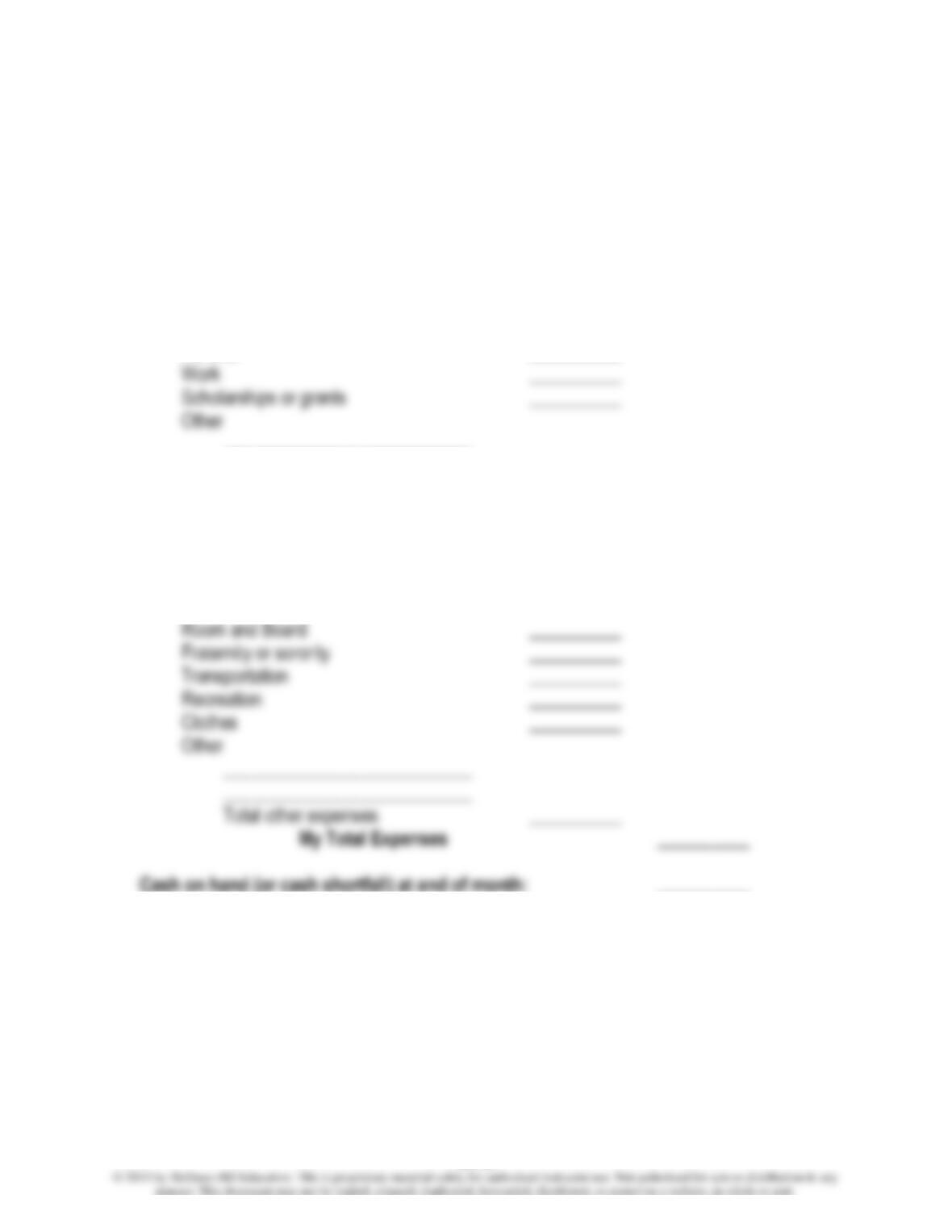
15.1 Preparing a Personal Income Statement
Have students prepare a personal income statement (Use Handout 15-A: Preparing a Personal
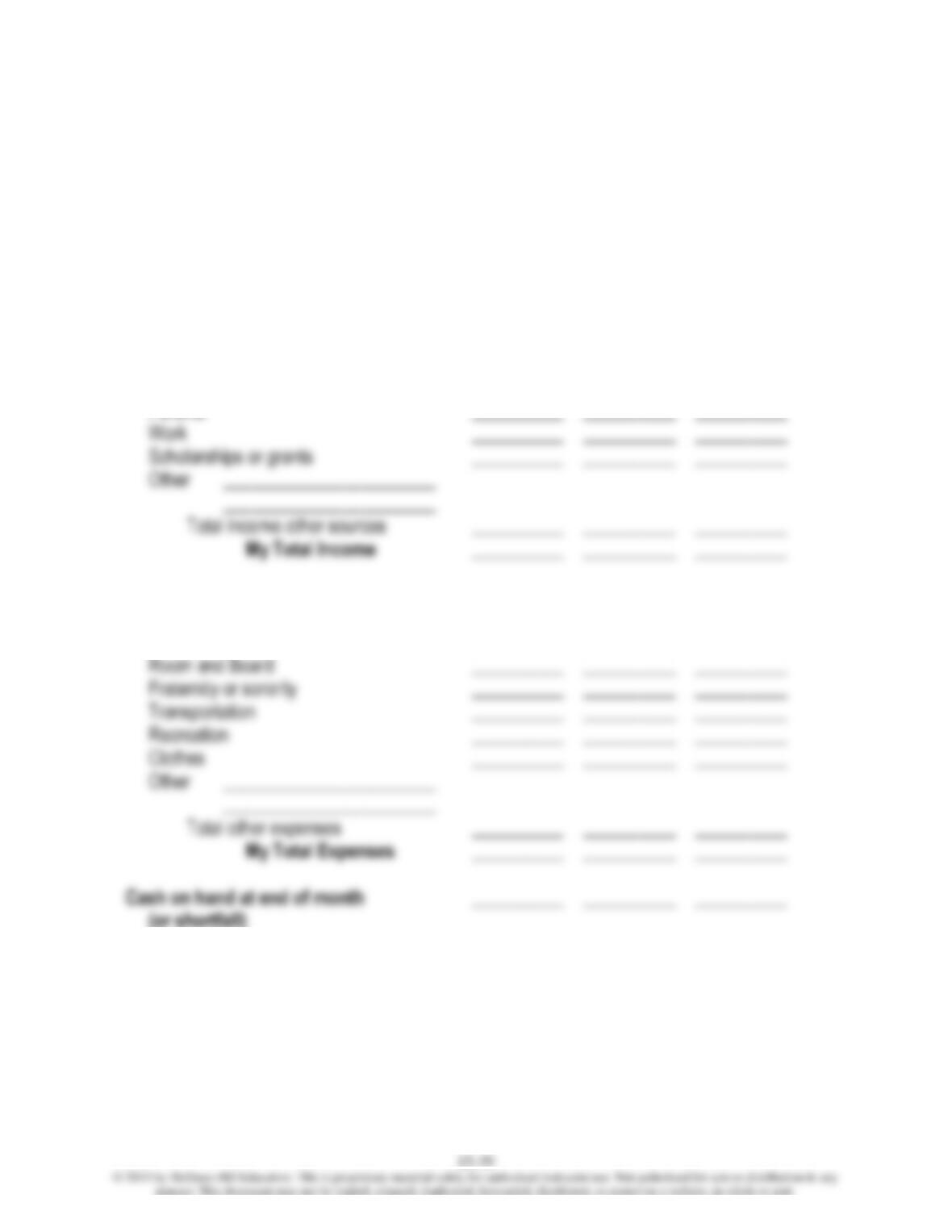
15.1 Preparing a Personal Budget
Chapter 15 – Budgeting and Controlling Operations and Taxes
15–38
HANDOUT 15-A
Preparing a Personal Income Statement
PERSONAL INCOME STATEMENT
Time Period ___________________________
(month, quarter, semester, year)
VALUE TOTAL
My Income from:
Parents __________
___________________________
___________________________
Total income other sources __________
My Total Income __________
My Outgo for:
Tuition and fees __________
Books and supplies __________
Chapter 15 – Budgeting and Controlling Operations and Taxes
HANDOUT 15-B
Preparing a Personal Budget
PERSONAL BUDGET
Time Period ___________________________
(month, quarter, semester, year)
TARGET ACTUAL
VALUE TOTAL DIFFERENCE
My Income from:
Parents __________ __________ __________
My Outgo for:
Tuition and fees __________ __________ __________
Books and supplies __________ __________ __________