Chapter 14
SECURITY STRUCTURES AND DETERMINING ENTERPRISE VALUES
FOCUS
In this chapter, we discuss important concepts in structuring securities a venture uses to
raise funds. We introduce the notion of primitive securities (like bonds and common
stocks) and consider other more complex securities (like warrants and convertible
preferred) that derive their value from the primitive securities. We introduce the
enterprise valuation method, a straightforward technique for valuing a venture using
complex financial securities.
LEARNING OBJECTIVES
LO 14.1: Discuss why common stock or common equity in a venture reflects residual
ownership.
LO 14.2: Describe characteristics of preferred stock or preferred equity and why
convertible preferreds are often issued.
CHAPTER OUTLINE
14.1 COMMON STOCK OR COMMON EQUITY
14.2 PREFERRED STOCK OP PREFERRED EQUITY
A. Selected Characteristics
14.3 CONVERTIBLE DEBT
14.4 WARRANTS AND OPTIONS
ENTERPRISE METHOD
SUMMARY
LEARNING SUPPLEMENT 14A:
Alternative Enterprise Valuation Method
LEARNING SUPPLEMENT 14B:
Application of Black-Scholes Option-Pricing Formula
DISCUSSION QUESTIONS AND ANSWERS
1. What is common stock or common equity? What is the purpose of preemptive rights?
Common stock: the least senior claim on a venture’s assets (residual ownership)
2. What is preferred stock? What is participating preferred stock, and what is meant by
paid in kind (PIK) preferred stock?
Preferred stock: equity claim senior to common stock and providing preference on
dividends and liquidation proceeds
3. What are the basic design features for financial securities used in venture investing?
Typically, venture investing securities need to address the type of financial claim
4. Why is the conversion feature in convertible preferred important for venture
investors?
The conversion features allows the venture investor to participate in the venture’s
5. What is meant by a (a) full ratchet clause, and (b) down (reset) round?
A full ratchet clause provides that existing investors will receive enough post-
6. Which is more favorable to the founders, the Market Price Formula (MPF) or the
Conversion Price Formula (CPF)?
It depends. However in many cases, the MPF is typically more favorable because it
7. How does convertible debt differ from convertible preferred stock?
Convertible debt is debt with the option to exchange it into stock.
8. What are convertible notes? Why are convertible notes issued, and who typically
issues them?
Convertible notes are debt allowing for conversion into stock at a price set by a
future financing round.
9. Why are options to buy additional shares of stock used in venture financing? What
are warrants?
Options to buy additional shares at specified prices are common “sweeteners” or
“equitykickers” use to increase the attractiveness of a securities offering. Options are
10. How do (a) American-style options, (b) European-style options, and (c) Bermudan-
style options differ?
American-Style Option: an option that can be exercised at any time until expiration
11. How are put and call options similar? How are they different?
12. What are the “factors” that influence the values of American-style options?
The factors are:
• Underlying Asset
13. Why is price protection an issue when convertibles or warrants are used?
If an investor has a fixed conversion or exercise price, then new issues at prices below
14. Why is it important that convertible securities also be callable (redeemable)?
It is important for convertible securities to also be callable because they can “hang”
15. Is the sale of an out-of-the-money warrant a future sale of equity at a favorable price?
It is not a guaranteed sale at all. It is a contingent “sale” when the venture’s value per
16. What is the enterprise (entity) method of valuation and how does it differ from the
equity methods of Chapters 10 and 11?
The enterprise method attempts to value the entire firm, value to debt holders and
17. Describe how the enterprise valuation cash flow is determined. That is, identify the
components included in determining the enterprise valuation cash flow.
Enterprise Valuation Cash Flow =
18. What is meant by (a) NOPAT, and (b) EBIAT? How do they compare with each
other?
NOPAT is net operating profit after taxes
19. Why is the weighted average cost of capital (WACC) used as the discount rate in the
enterprise method?
20. How do debt investors get paid in the enterprise method?
The enterprise method values all possible payments to investors and then subtracts the
21. From the Headlines – Fuel3D: What would you need if you wanted to conduct an
enterprise valuation for a hypothetical Round D for Fuel3D? Discuss the relationship
between Fuel3D and MakerBot. How might it affect the terminal value used in the
enterprise valuation?
Answers will vary: An enterprise valuation of Fuel3D would typically involve
INTERNET ACTIVITIES
1. Web surfing exercise: Search the web for a direct offering of a convertible preferred
security. Possible search words include “direct public offering” or “small corporate
EXERCISES/PROBLEMS AND ANSWERS
1. [Preferred Stock Characteristics] A share of a venture’s preferred stock is convertible
into 1.5 shares of its common stock. The dividend on the preferred stock is $.50 per
share.
A. If the firm’s common stock is currently trading at $9.75, what is the conversion
value of a share of the preferred stock?
B. What would be the dividend yield on the preferred stock based on its conversion
value?
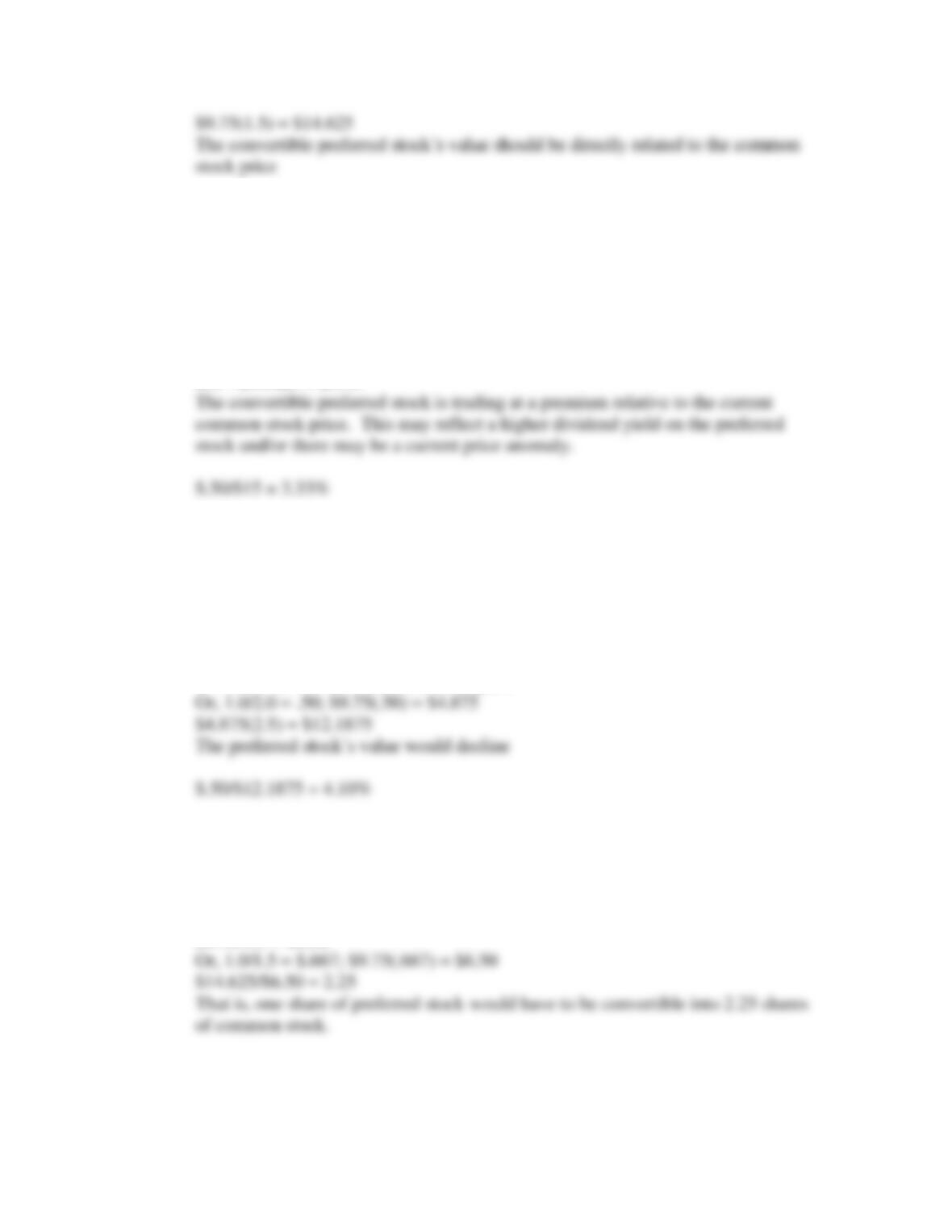
$.50/$14.625 = 3.42%
C. What explanation would you give if the venture’s preferred stock currently trades
at $15? What would be the dividend yield?
D. If the venture doubles the number of shares of its common stock that is
outstanding (and cutting its stock price in half) but increases the conversion terms
on its preferred stock to 2.5 shares of common stock, what would be the
conversion value of a share of preferred stock after the new common stock issue?
What would be the dividend yield on the preferred stock based on this new
conversion value?
$9.75/2 = $4.875 new common stock price
E. If the venture increased its common stock offering by 50 percent (instead of 100
percent), what common stock conversion ratio would be needed on a share of
preferred stock to keep its conversion value the same as it was before the new
common stock issue?
2. [convertible Preferred Stock Concepts] The CCC (triple C) Venture has issued
convertible preferred stock to its venture investors. Each share of preferred stock is
convertible into .80 shares of common stock and pays an annual cash dividend of
$.25.
A. If each share of preferred stock has a market value of $4.00, what is the minimum
price that a share of the CCC Venture’s common stock should be selling for
(ignore the dividend yield on the preferred stock)?
$4.00/.80 = $5.00
Actual conversion value: $3.00(.80) = $2.40 implied value of preferred stock
Even considering the expected $.25 dividend on the preferred stock results in a
value of $2.65 ($2.40 + $.25). Thus, there is an unexplainable current price
3. [Conversion Price and Market Price Formulas] Calculate the conversion price
formula (CPF) and market price formula (MPF) prices for an offering involving an
existing conversion price of $1, a hypothesized market price of $2, and a new offering
price of $.95 for 1,000 shares with 2,000 shares outstanding prior to the new issue.
Relate the new conversion price to the implied new conversion ratio.
CPF = [(Shares before issue)(Old Conversion Price) + (New Issue Price)(New
Shares)]/(Total shares after issue)
4. [Conversion Price and Market Price Formulas] Show how your answers for Problem
3 would change if the new offering price was $.80 for 1,500 shares. Assume other
things remain the same.

5. [Stock Option Concepts] Draw the payoff diagram for the following options:
A. Call option to buy a venture’s stock at $3
6. [Stock Option Concepts] Draw the payoff for a portfolio of a share of venture equity
and a short call option to buy that share at $5.
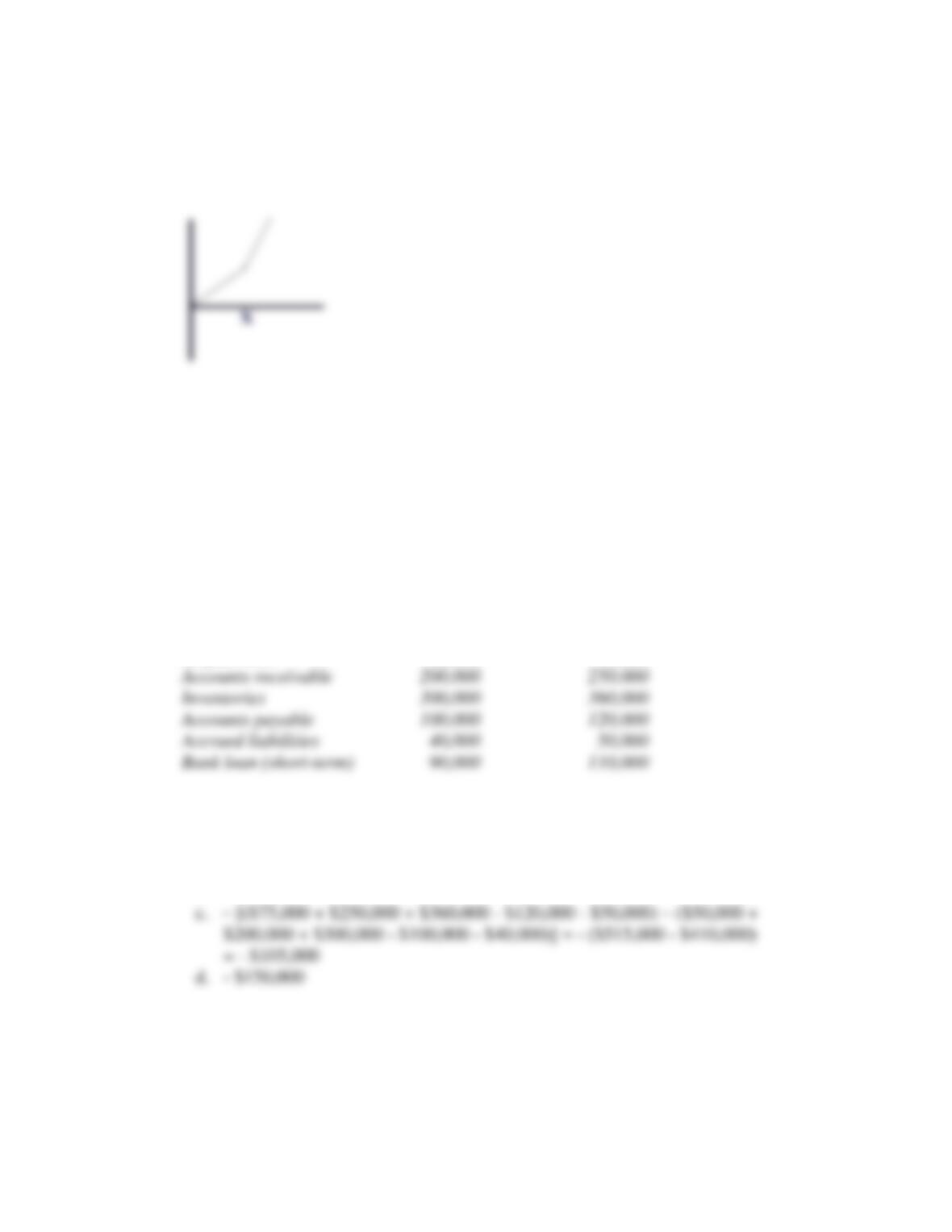
7. [Stock Unit Concepts] Sometimes the combination of a share and a warrant is called
a “stock unit.” What does the payoff diagram look like for such an investment?
8. [Enterprise Valuation Cash Flows] Find the enterprise valuation cash flow expected
for the current year given the following information:
Capital expenditures (CAPEX) = $150,000
Depreciation and amortization expenses = $40,000
Earnings before interest and taxes = $400,000
Effective income tax rate = 30%
Last Year Current Year
Required cash $50,000 $75,000
Surplus cash 20,000 40,000
Solution:
Enterprise Valuation Cash Flow =
a. $400,000(1 – .30) = $280,000
b. + $40,000
Enterprise Valuation Cash Flow = $280,000 + $40,000 – $105,000 – $150,000
= $65,000
9. [Enterprise Valuation Cash Flows] Rework Problem 8 assuming that the earnings
before interest and taxes are only $320,000 while CAPEX is $110,000. Assume the
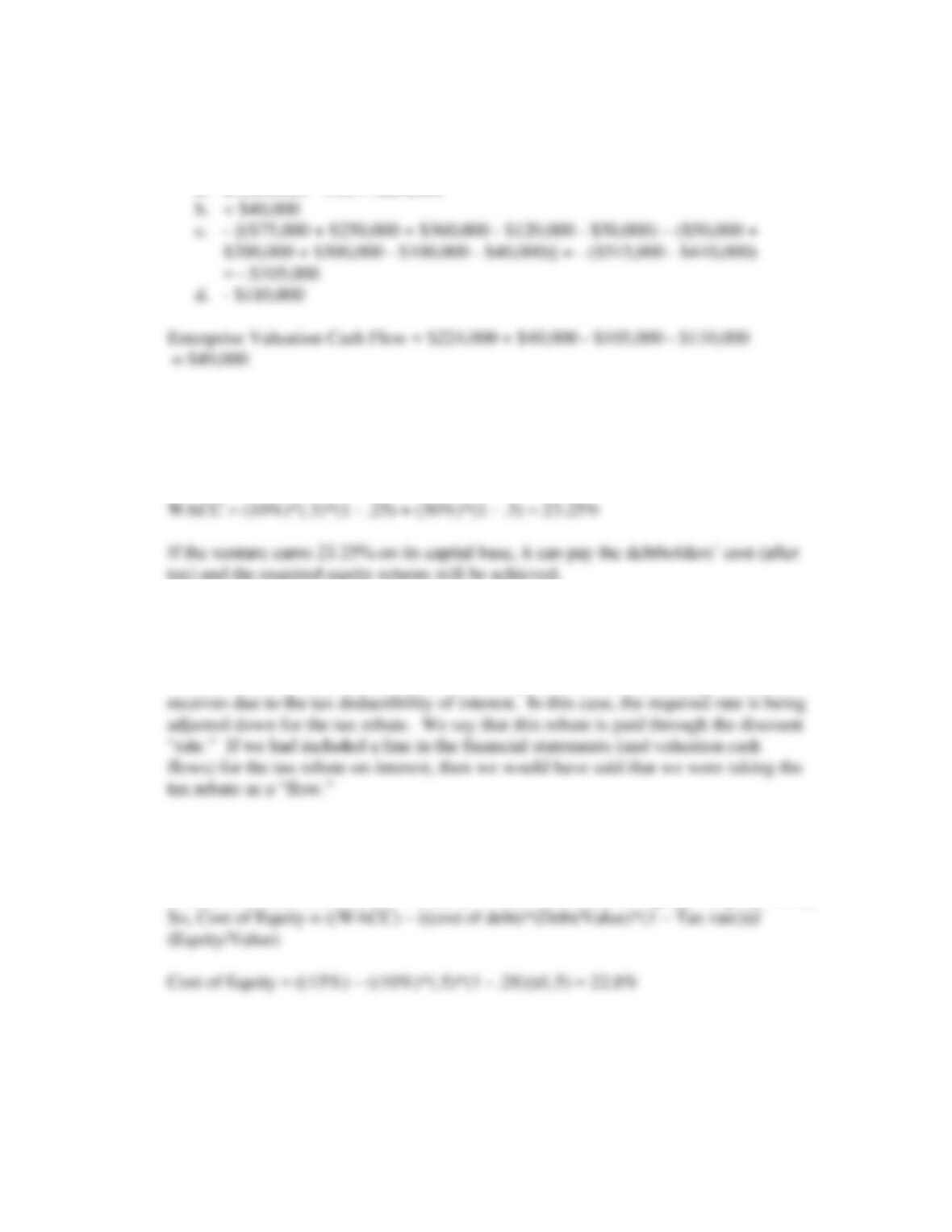
other information remains the same.
Enterprise Valuation Cash Flow =
10. [WACC Calculations] Calculate the after-tax WACC for a firm with a 25 percent tax
rate, a 10 percent cost of debt, a 30 percent cost of equity and a target debt-to-value
of .30. Explain how investing to provide the WACC returns keeps the debt and equity
investors happy. (Review Chapter 7)
11. [WACC Concepts] Why is the (1-tax rate) in the WACC? How does the government
pay the tax rebate on interest – through a flow or in the rate? (Review Chapter 7)
The “(1–tax rate)” is included in the WACC to provide for the tax savings the firm
12. [WACC Concepts] Given a WACC of 15 percent, a target debt-to-value of .5, a tax rate
of 28 percent and a cost of debt of 10 percent, what is the implied cost of equity?
WACC = (cost of debt)*(Debt/Value)*(1 – Tax rate) + (cost of equity)*(Equity/Value)
13. [Enterprise and Equity Value Concepts] Assume a venture has a perpetuity enterprise
value cash flow of $800,000. Cash flows are expected to continue to grow at 8
percent annually and the venture’s WACC is 15 percent.
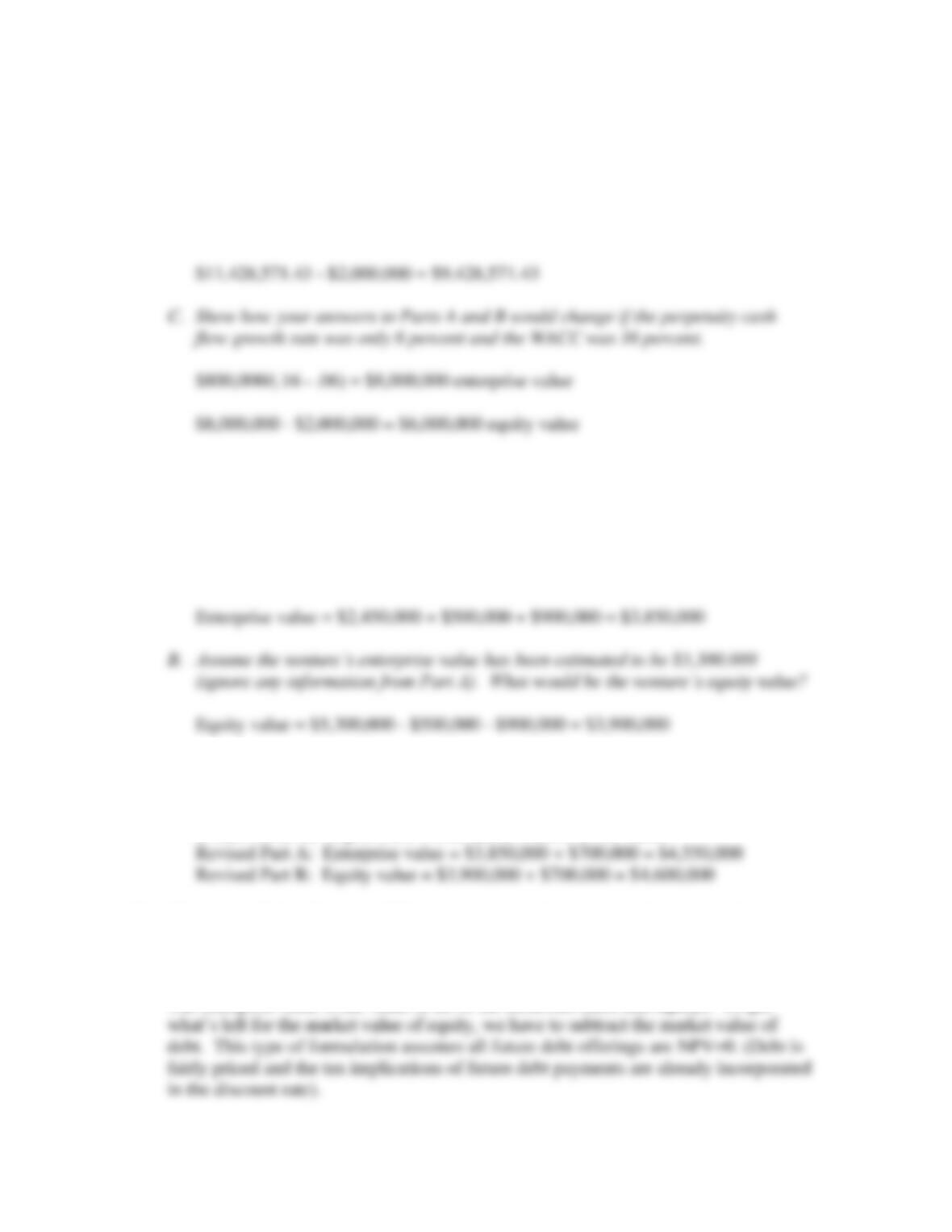
A. Calculate the venture’s enterprise value.
$800,000/(.15 – .08) = $11,428,571.43
B. If the venture has $2,000,000 in interest-bearing debt obligations, what would be
the venture’s equity value?
14. [Enterprise and Equity Value Concepts] A venture has a $500,000 bank loan
outstanding, a long-term debt obligation of $900,000, accounts payable of $200,000,
and accounts receivable of $350,000.
A. If the venture’s equity value is $2,450,000, what would be the associated
enterprise value?
C. Now assume that the venture has surplus cash of $700,000. Show how your
answers (it at all) would change for Parts A and B.
In each case, the surplus cash would add $700,000 to the value:
15. [Enterprise Value Concepts] Why is the market value of currently issued debt
subtracted from the enterprise value (in a debt-and-equity-only firm) to arrive at the
value of equity? Why are future debt issues ignored by the process?