Chapter 14 – Basic Financial Planning
14–13
CHAPTER OUTLINE AND TEACHING NOTES
Step 5: Compare Estimated Profit with
Profit Goal
Step 6: List Possible Alternatives to Im-
prove Profits
A. Change the planned sales income by:
REAL WORLD EXAMPLE 14.5
When Bert Olson stopped using pesticides on his farm and
switched to organic farming, profits increased as consumers’
demand for organically grown foods grew.
4. Increasing or decreasing the
planned price of the units. The
B. Decrease the planned expenses by:
1. Establishing a better control sys-
Chapter 14 – Basic Financial Planning
14–14
CHAPTER OUTLINE AND TEACHING NOTES
2. Increasing productivity of people
and machines through improving
C. Reduce costs per unit or add other
products or services by:
1. Adding a summer product to a
winter line of products.
Step 7: Determine How Expenses Vary with
Changes in Sales Volume realizing
that:
A. An analysis of past costs is helpful in
projecting future expenses, be aware
That the relationships exist only be-
Chapter 14 – Basic Financial Planning
14–15
CHAPTER OUTLINE AND TEACHING NOTES
Step 8: Determine How Profits Vary with
Changes in Sales Volume
1. Calculate profit at several sales levels
REAL WORLD EXAMPLE 14.8
By adding Angus beef menu items, fast-food outlets have
been able to increase demand and raise prices. However, the
cost of the beef has also increased, changing the breakeven
point.
REAL WORLD EXAMPLE 14.9
Carpe Diem, the specialty coffee store featured in the
opening profile, calculates how many cups of coffee must be
sold for expenses and revenues to be equal.
Step 9: Analyze Alternatives from a Profit
Standpoint such as:
1. Change sales price.
Step 10: Select and Implement the Plan
1. This section of the plan is based on
your judgement:
2. The results of analyses.
Chapter 14 – Basic Financial Planning
14–16
CHAPTER OUTLINE AND TEACHING NOTES
LEARNING OBJECTIVES REVISITED
1. Explain the need for profit planning for a small business.
● Small business owners often fail to plan and don’t even know whether or not they are mak-
2. Discuss what causes changes in the financial position of a company.
● Every time a product is sold, money comes in, inventory is bought, or credit is given, assets
3. Understand the financial structure of a business.
● A company’s financial structure consists of its assets, liabilities, and owners’ equity.
Chapter 14 – Basic Financial Planning
14–17
● The total liabilities plus owners’ equity always equals the total assets of the firm.
4. Consider Cost of Goods Sold to determine business profits.
• Cost of Goods Sold includes all direct and indirect costs of production.
5. Learn how to plan to make a profit in a small business.
● The business must have a profit target.
● Detailed profit planning includes:
○ Establish the profit goal.
6. Plan for a profit for an actual small business.
● Review the profit plan for the hypothetical company given in the chapter.
KEY TERMS USED IN THIS CHAPTER
Accounting records are records of a firm’s financial position that reflect any changes in that position.
Accounts payable are obligations to pay, resulting from purchasing goods or services.
Chapter 14 – Basic Financial Planning
The breakeven point is that volume of sales where total revenue and expenses are equal so there is neither
profit nor loss.
Cost of Goods Sold is the total cost in terms of raw materials, labor, and overhead of the business that is
allocated to production.
Expenses are the costs of labor, goods, and services.
The financial structure describes the relative proportions of a firm’s assets, liabilities, and owners’ eq-
uity.
NOTES FOR DISCUSSION QUESTIONS
1. Why is planning for profit so important to a small business?
As the text states, profit cannot be left to chance. It is important to plan for profit to insure that
2. In analyzing the changing financial position of a small business, what things should you look for?
Since a firm’s financial position is constantly changing, the owner should look for changes in a
Chapter 14 – Basic Financial Planning
3. “If a small firm is making a profit, there’s no danger of its failing.” Do you agree? Why or why
not?
This statement is false—profits are not necessarily cash. Accounts receivable may reflect profits,
4. What is a firm’s financial structure? What are the components of this structure?
The firm’s financial structure is reflected in its assets, liabilities, and equity accounts at a given
5. Explain each of the following: (a) assets, (b) current assets, (c) fixed assets, (d) liabilities, (e)
current liabilities, (f) long-term liabilities, (g) owners’ equity, (h) retained earnings, (i) income (profit
and loss) statement, (j) balance sheet, (k) profit, and (l) cost of goods sold..
(a) Assets are the physical, financial, or other items of value that a company owns.
(b) Current assets are those that are expected to change from one form to another within one
year.
6. What steps are needed in profit planning?
The steps in profit planning are:
Chapter 14 – Basic Financial Planning
14–20
(1) Establish the profit goal.
(2) Determine the sales volume needed.
7. How do you establish a profit goal?
The profit goal should be high enough to provide a reasonable salary for yourself, plus an ade-
8. How do you determine planned volume of sales? How does profit change with volume of product
sold?
The forecast must be adjusted for production capabilities, costs, and financial conditions such as
the company’s ability to finance needed investments. Also, the planned volume is based on a certain level
9. How do you determine planned expenses? Variable expenses? Fixed expenses?
Collect last year’s actual expenses and adjust for changes in expected sales volume and economic
conditions for the coming year. Then adjust those figures for changes in planned sales activity to promote
10. What are some alternatives that could improve planned profits? Explain each.
Chapter 14 – Basic Financial Planning
14–21
Step 6 lists some possible alternatives for improving a company’s profit. They are to (1) change
the planned sales volume by increasing the planned volume of units sold and/or increasing or decreasing
NOTES FOR CASE QUESTIONS
CASE 14.1: Eillen Dorsey and Walter Hill, Jr., Use Financial Planning
1. Evaluate the way Dorsey and Hill did their financial planning.
Dorsey and Hill started their business by investing their own funds. Before obtaining additional
2. Do you think their early personal financial planning influenced their professional financial plan-
ning? Explain.
Dorsey’s parents taught her the value of commitment and hard work. The importance of saving
3. To what extent do you think the two entrepreneurs will succeed in their venture? Explain.
CASE 14.2: The Need for a Cash Budget
1. What are the advantages and weaknesses of the minimum-cash-balance practice?
The owner has already stated the advantage: enabling the firm to pay its bills on time. The disad-
2. There is a saying, “If it ain’t broke, don’t fix it.” In view of the firm’s present success in paying
bills promptly, should it be encouraged to use a cash budget? Defend your answer.
3
BONUS EXERCISES
14.1 Ethics Discussion Starters
This exercise presents a situation that raises ethical questions in a business. Have students dis-
cuss the situation: (a) from the strictly legal viewpoint, (b) from a moral and ethical viewpoint, and (c)
from the point of view of what is best in the long run for the company.
Situation: You are an accountant in a large firm. Your boss tells you to use a controversial ac-
counting practice, which will make the company’s profits seem higher. She tells you it is only to impress
stockholders and will not be used in statements submitted to the IRS. What would you do?

Chapter 14 – Basic Financial Planning
14–22
14.2 The Pizza Stand
Chapter 14 – Basic Financial Planning
14–23
HANDOUT 14-A
The Pizza Stand
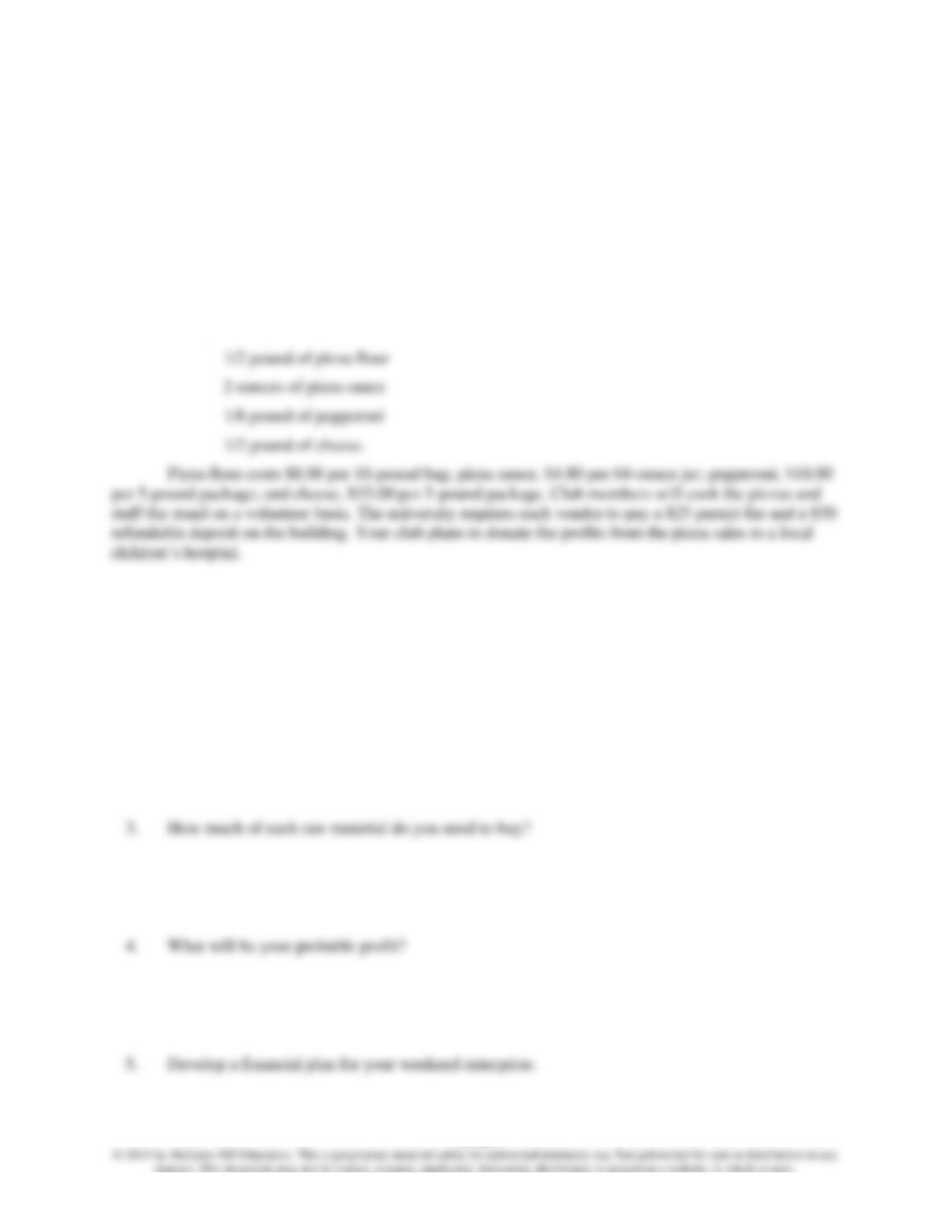
A student organization has been given permission to operate a pizza stand during the upcoming
homecoming weekend. The stand will be located just outside the football stadium, making it accessible
during the ball game. The location is also convenient for visitors as they tour the campus at other times
during the weekend. An estimated 2,500 visitors will be on campus, in addition to the campus population
of 1,500.
Each pizza requires:
1. How many pizzas can you anticipate selling?
2. What price should you charge per pizza?