Chapter 11 Personal Finance
CHAPTER OUTLINE
Learning Objectives
Risk
Identification of Risk Exposure
Risk Management
Life, Health, Property, and Liability Insurance
Financial Planning Goals
Investments
Cash Equivalents
Certificates of Deposit
Investment Strategies
Short-Term Investment Strategies
Long-Term Investment Strategies
REVIEW AND DISCUSSION QUESTIONS
1. Compare the risk of buying a U.S. Government bond to that of buying a corporate bond. A U.S.
2. Compare speculative risk and pure risk. Speculative risk is risk in which there is a possible gain or loss.
3. How can a business owner identify risk exposure? The owner can make a list of those business areas that
4. What are some programs that an entrepreneur can use to reduce risk? To reduce risk, the
6. List and describe some investment vehicles that a small business owner might select. Certificates of
and corporate bonds.
7. What is the difference between the coupon rate and the current market interest rate of a bond? The
8. If the coupon rate on a bond is 8 percent and current market interest rates are 6 percent, should this
bond be selling at a premium or a discount? The bond should be selling at a premium. The holder of the
9. How do we determine the book value of a stock? We begin with the accounting equation which is Assets
book value of the preferred stock from stockholder’s equity prior to making the calculation.
10. Compare cumulative, convertible, and callable preferred stock. Cumulative preferred stock has to pay
dividends in arrears for those years the corporation missed paying a dividend, if they declare a dividend
11. What is the difference between a mutual fund and a mutual fund family? A mutual fund is involved in
collecting funds of investors and using these funds to purchase large blocks of stock, bonds, or other
12. List and briefly describe three different types of mutual funds. The student may list any three of the
banker’s acceptances.
commission when the fund is initially purchased. They do not charge a commission on the sale of the fund.
14. Compare short-term and long-term investment strategies. Short-term investment strategies are those
15. What is the difference between a contribution and a benefit-oriented retirement plan? A contribution-
oriented retirement plan provides benefits to the retiree based on the account balance that has been
16. What are the basic factors that should be considered when establishing an individual retirement
plan? Determine what the desired minimum annual income should be upon retirement (your goal).
17. How may a small-business owner plan for the use, conservation, and transfer of wealth as efficiently
as possible? The small business owner must provide written documents that provide direction to others as
to how assets will be distributed upon death. The primary vehicle used is a will. The will provides specific
18. What is the role of trusts in estate planning? Trusts are legal arrangements that divide legal and
beneficial interests among two or more people. It is a separate entity similar to a corporation that has a legal
EXERCISES AND PROBLEMS
1. You have a friend, Icahn Betitall, who just started a small business. He is paying a hefty premium
for insurance. Icahn’s insurance agent told him that he is insuring against the risk of loss on fire,
theft, liability, and business interruption. Icahn also has policies for life, health, and automobiles.
Icahn is planning a trip to Las Vegas. He plans to contact his agent and obtain a policy on the risk of
losing his money at the blackjack table.
a. What will you tell Icahn about being able to purchase such a policy? You will tell Icahn that
b. What are several methods that Icahn can choose to manage his risk exposure in Las Vegas?
2. Your city is expanding. There have been several problems with street flooding, which is affecting
your business. You decided to attend a city council meeting, during which there is a discussion of
building storm and sewer lines in advance of home construction. At the meeting, Tom Frank the city
manager states, that the city is prohibited by law from financing these projects through a sales or
property tax. He says that after the new homes are built, the city will be able to charge a monthly
sewer fee to each homeowner and business. He asked for suggestions on financing the new sewer
system.
a. What would you propose the city do to raise this money? The proposal would be for the city to
b. Why is this investment vehicle attractive to investors? Interest payments made on municipal
3. Grandpa Russ thinks he needs a fixed income for the next 10 years. He currently has $10,000 in CDs
which are maturing at the end of this month. The CDs can be renewed for one year at 4½ percent.
Russ calls his broker, Ben Seller, and learns that his $10,000 can be put to better use by purchasing
debentures issued by Grab-n-Run Inc. These bonds are 10-year bonds with a coupon rate of 8
percent, which is paid semi-annually. The current market interest rate is 6 percent for bonds of a
similar nature. The broker tells Grandpa Russ that he may buy each bond for $1,400. Grandpa
knows that he will have to pay a premium, but he believes that a $400 premium is too high.
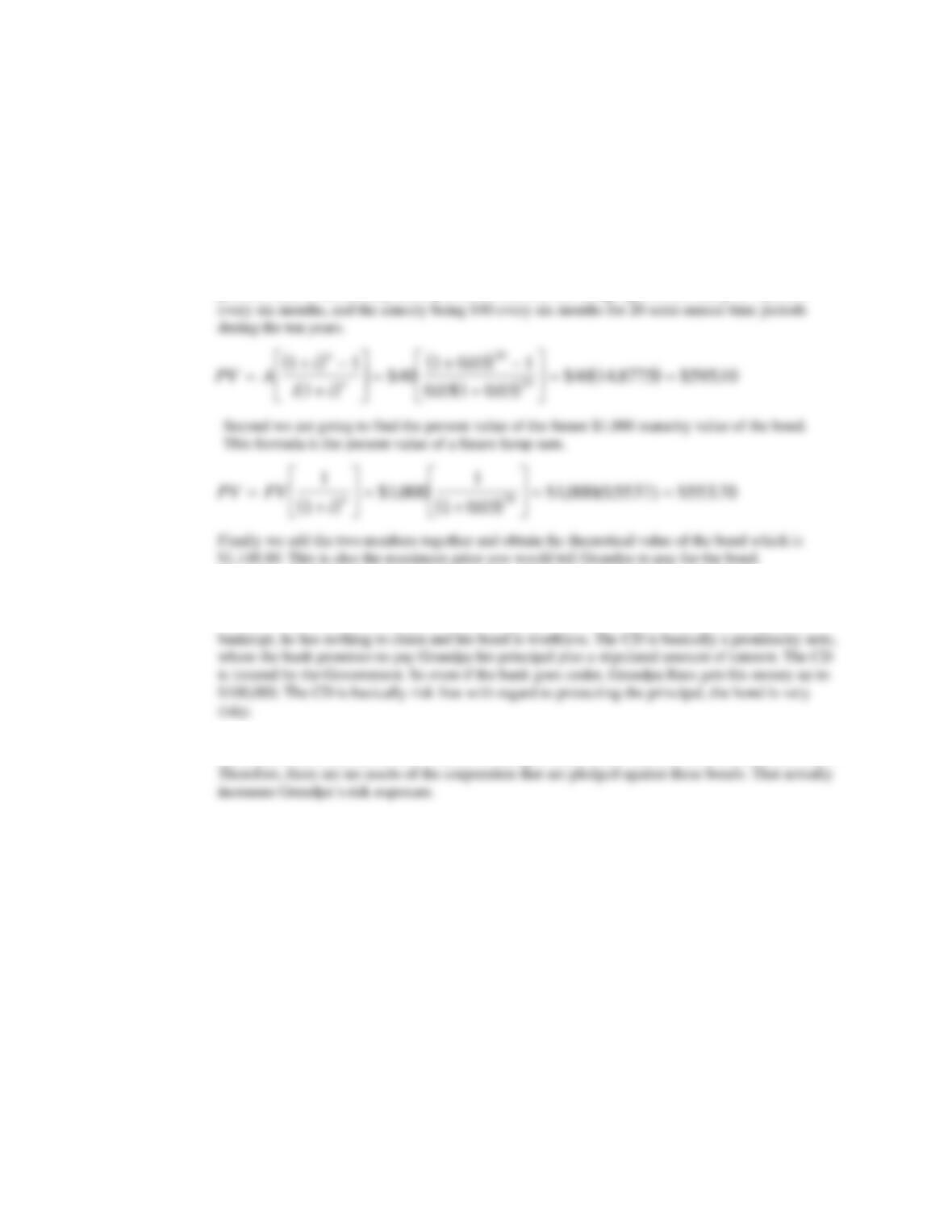
a. What is the maximum price you would tell Grandpa to pay for each bond? This is a three part
solution. First we have to find the present value of the interest payments. We are going to find the
present value of an ordinary annuity with the interest rate being 6 percent annually or 3 percent
b. Compare the risk of the CD with the risk of the bond. As a bondholder, Grandpa Russ is a
creditor of the company. Basically he gets in line with all of the other creditors to get paid. As a
creditor he has a claim on the assets of the company. If there are no assets, and the company is
c. What else would you advise Grandpa with regard to this type of investment? The particular
bond that the broker, Ben Seller, is recommending is a debenture. Debentures are unsecured bonds.
4. Sarah Mix is a single, 30-year-old business owner who has $500 a month to invest. This money is in
excess of the contribution to her company pension plan. Sarah hears that many of her friends are
investing in mutual funds. Her grandfather, Grandpa Russ, invested in the stock market, and lost
everything. He advises her to invest only in bonds. Her uncle, Sam, thinks that she should invest in
stock mutual funds, but only in conservatively managed funds that invest in U.S. blue-chip stocks.
Sarah notes that her Grandpa is 70 years old and her uncle is 55 years old. Her friend Jane, who is
also 30 years old, said she only invests in small capital growth funds.
a. What would you advise Sarah to invest in? Because Sarah is young, she should definitely invest
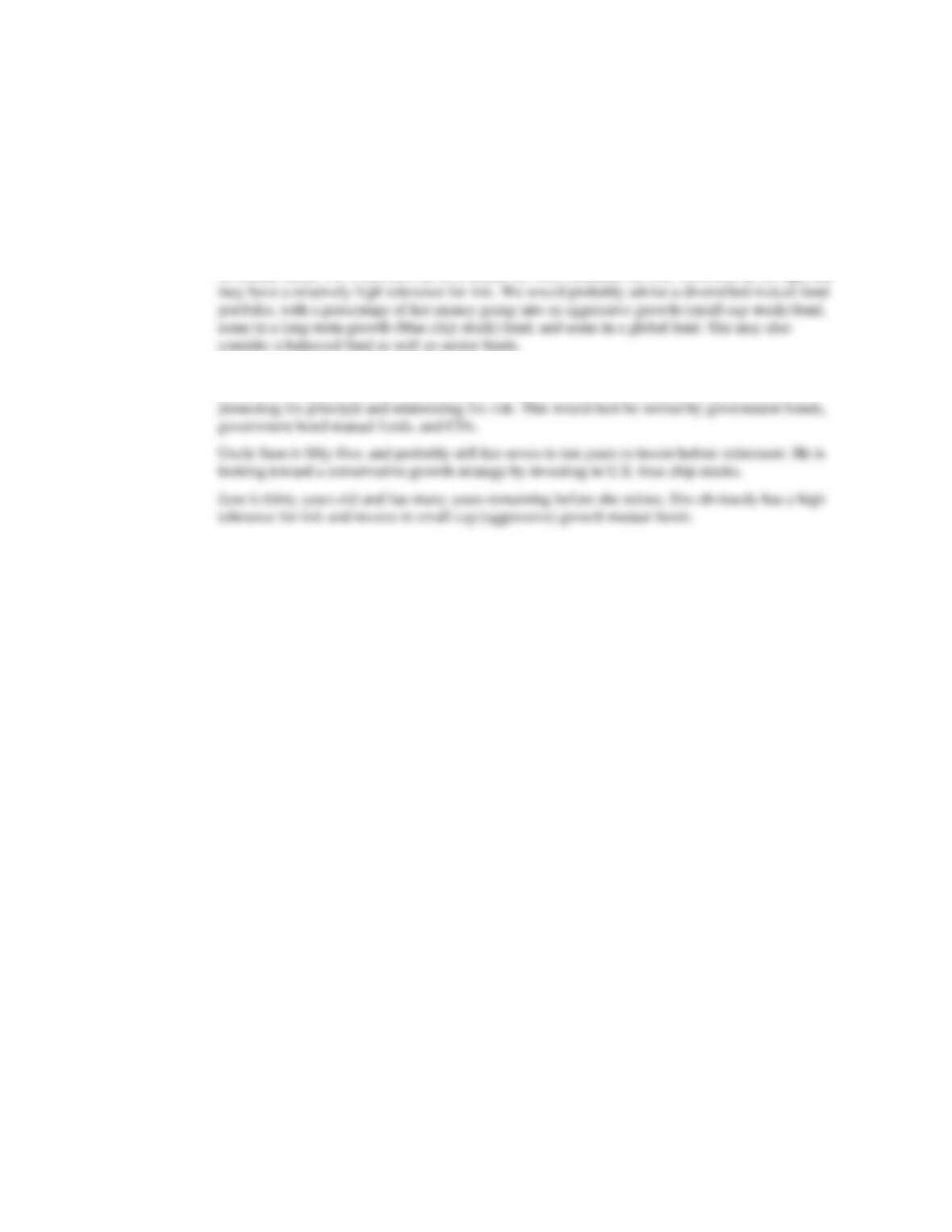
b. Why do you think these people have different investment strategies? Grandpa Russ is seventy
years old and typically would have a very low risk tolerance. He would primarily be interested in
5. Sarah Mix decides to invest in three funds, with $200 going into a small capital growth fund, $150
going into a large capital growth fund, and $150 into an international fund. She tracked the price
she paid for stock in these funds over a six-month period as shown in 11–3.
Mont h
Lar ge
Cap
Smal l
Cap
I nt er nat i onal
1 35. 45 27. 00 29. 00
Table 11-3 Price Per Share in Dollars
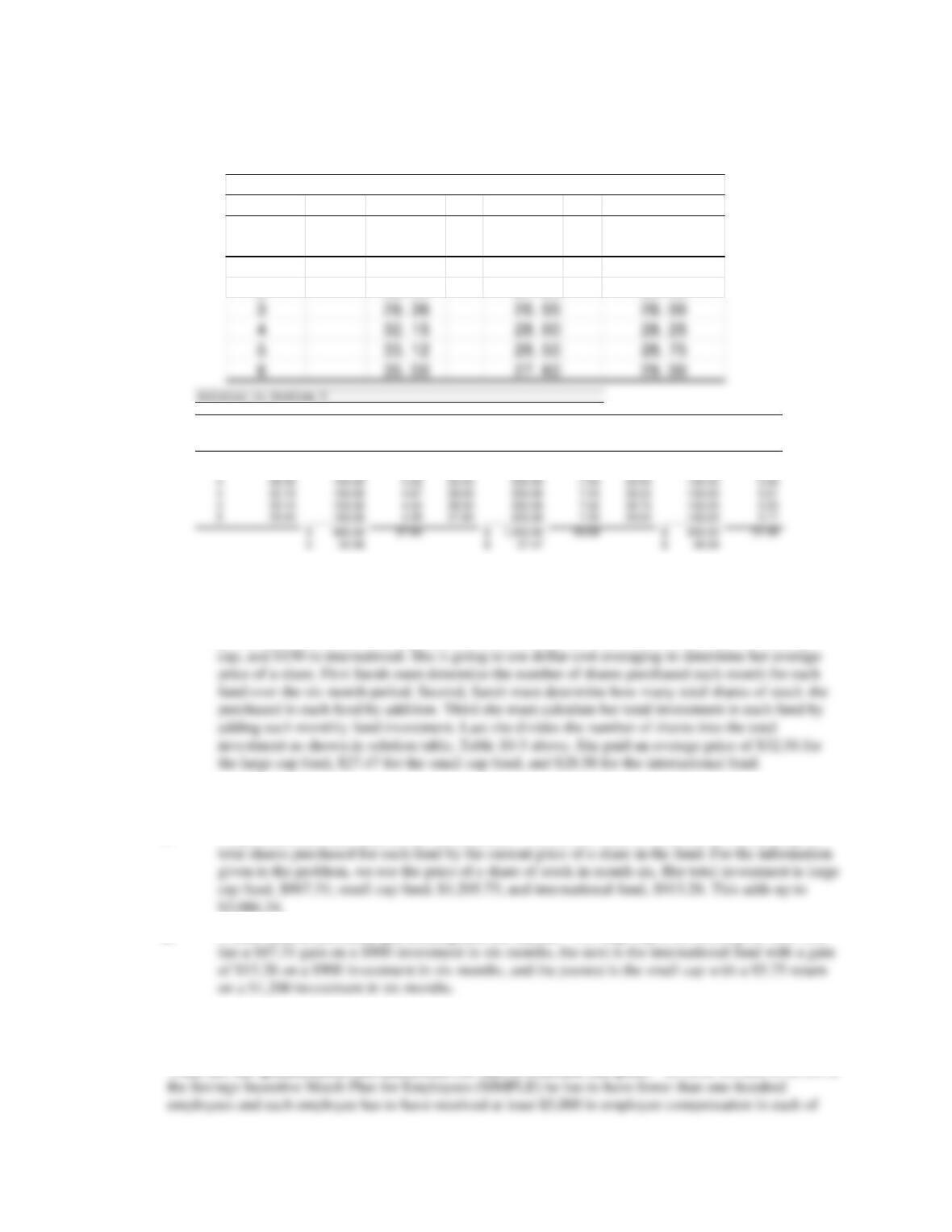
a. What was the average price paid per share in each mutual fund? This is a carryover from
problem 4. Sarah invests $500 per month in mutual funds, with $200 in small cap, $150 in large
b. How much has Sarah invested in mutual funds? Sarah invested $500 per month for six months
and has invested $3,000 in the mutual funds
c. What is the current value of her investment? The current value is obtained by multiplying her
d. Which fund is currently performing best for Sarah? The large cap is performing the best. She
6. Larry Kraft owns a restaurant that is open 7 days a week. He has 25 full-time employees, but he has
fairly high employee turnover. He believes that he can stabilize his workforce if he has a pension plan
for his employees. Larry hears about a new small business retirement plan called the SIMPLE IRA.
Month
Large Cap
Monthly
Investment
Shares
Purchased
Small
Cap
Monthly
Investment
Shares
Purchased
International
Monthly
Investment
Shares
Purchased
1 35.45$ 150.00$ 4.23 27.00$ 200.00$ 7.41 29.00$ 150.00$ 5.17
2 32.35 150.00 4.64 27.25 200.00 7.34 28.50 150.00 5.26
Portfolio Month 6 967.31$ 1,205.75$ 913.28$
Total Investment 3,000.00$
Total Value 3,086.34$
7. Larry Kraft plans to open six more restaurants during the next five years. He believes that he will
then have 125 employees.
a. What recommendations would you make for Larry at this time? Larry could establish a 401k
or a money purchase plan for his employees. We would recommend the 401k because of its
b. Could Larry set up a tax-sheltered annuity pension plan for his company? No. TSA’s are
reserved for not for profit organizations such as schools, churches, and charitable organizations.
8. Larry has expanded his business. When he met with his accountant at the end of the year, he learned
that his total assets are in excess of $1 million. His accountant asked Larry if he had a will, and Larry
said he had been too busy to develop one. His accountant strongly recommended that Larry contact
an estate planning attorney.
a. What advise do you think the estate planner will give Larry with respect to establishing a
will? He will tell Larry to establish the will because he doesn’t want him to die intestate. The
b. What do you advise? We would recommend that Larry put his assets into a revocable living trust.
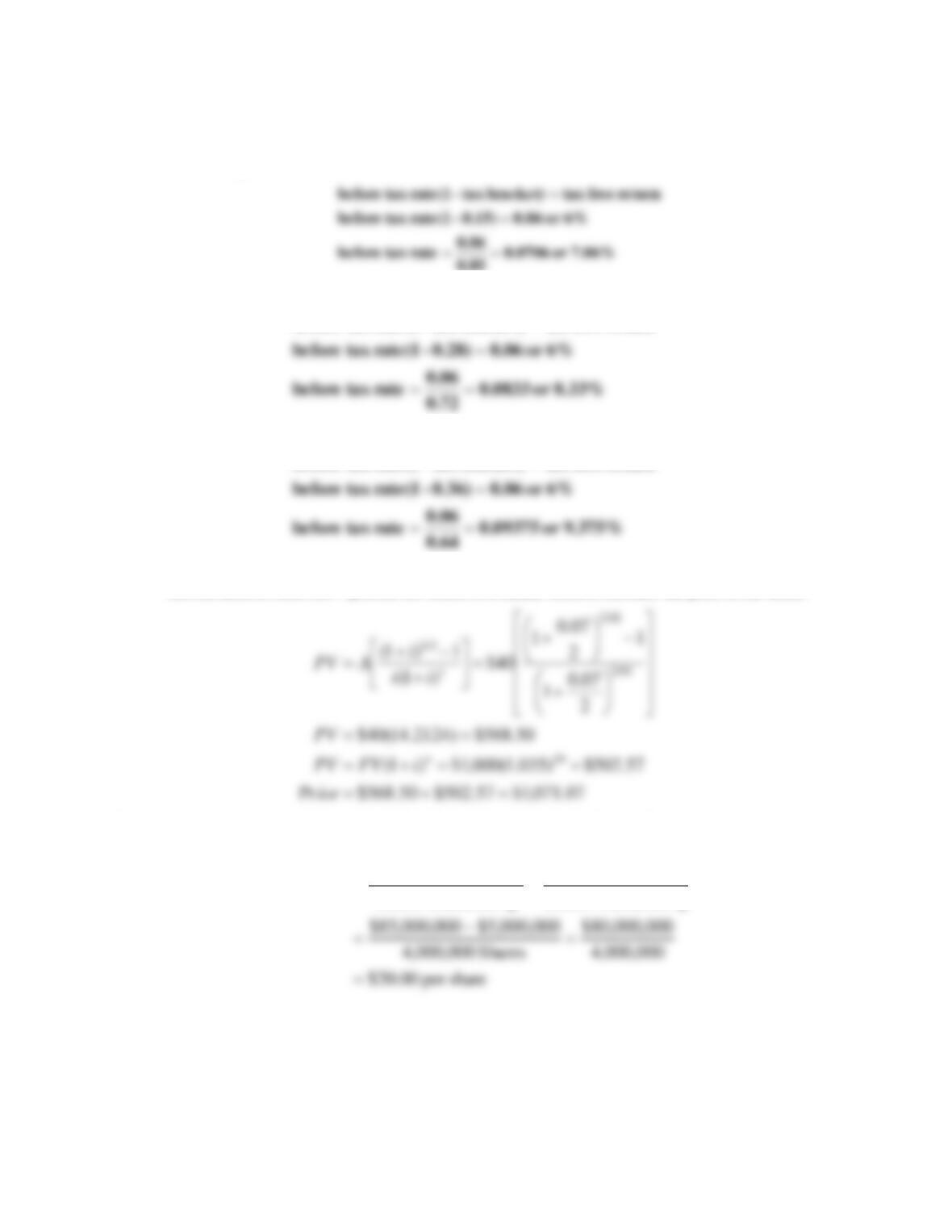
9. You purchase a tax-free municipal bond paying an annual rate of 6 percent. Find the before-tax rate
if you are in the
a. 15 percent tax bracket
b. 28 percent tax bracket
return freetax bracket)tax –rate(1tax before
=
c. 36 percent tax bracket
10. A ten-year bond with a $1,000 face value has a coupon rate of 8 percent that it pays semiannually. If
current interest rates are 7 percent for bonds of a similar nature, calculate the price of the bond.
11. A corporation has total assets of $85 million and total liabilities of $5 million. If the corporation has 4
million shares of common stock outstanding, what is the book value per share of common stock?
gOutstandin Shares
sLiabilitie – Assets
gOutstandin Shares
Equity sr’Stockholde
ValueBook
==
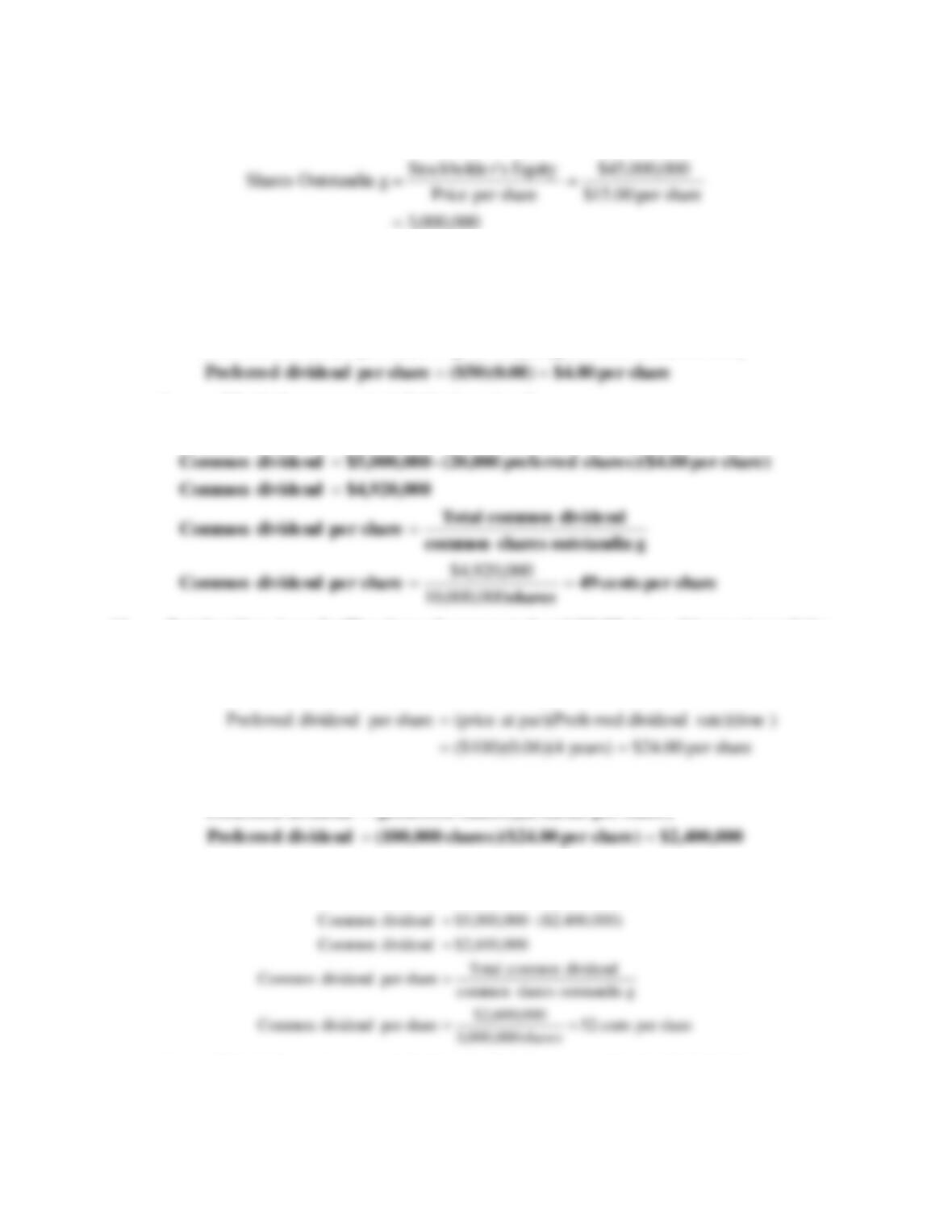
12. The book value of a company is $15 per share and the total common stockholders’ equity is $45
million. How many shares of common stock has this corporation issued?
13. ABC Corp. issues 10 million shares of common stock and 20,000 shares of 8 percent preferred stock
at $50 par. The corporation makes an annual profit of $10 million, and the board of directors
declares a $5-million-dollar stock dividend.
a. What is the preferred stock dividend per share?
( )( )
rate dividend preferredparat priceshareper dividend Preferred
=
b. What is the common stock dividend per share?
dividend preferred–dividend totaldividend Common
=
14. Best-Cost Corp. issues 5 million shares of common stock and 100,000 shares of 6 percent cumulative
preferred stock at $100 par. The corporation has not paid any dividend during the past three years.
The board of directors decides to pay $5 million in dividends for the current year.
a. How much in dividends is paid for each share of preferred stock?
b. What is the total amount of dividends paid to preferred stockholders?
c. How much is the dividend payment for each share of common stock? 52 cents per share
dividend preferred–dividend totaldividendCommon
=
d. What is the total amount of dividends paid to common stockholders? $2,600,000
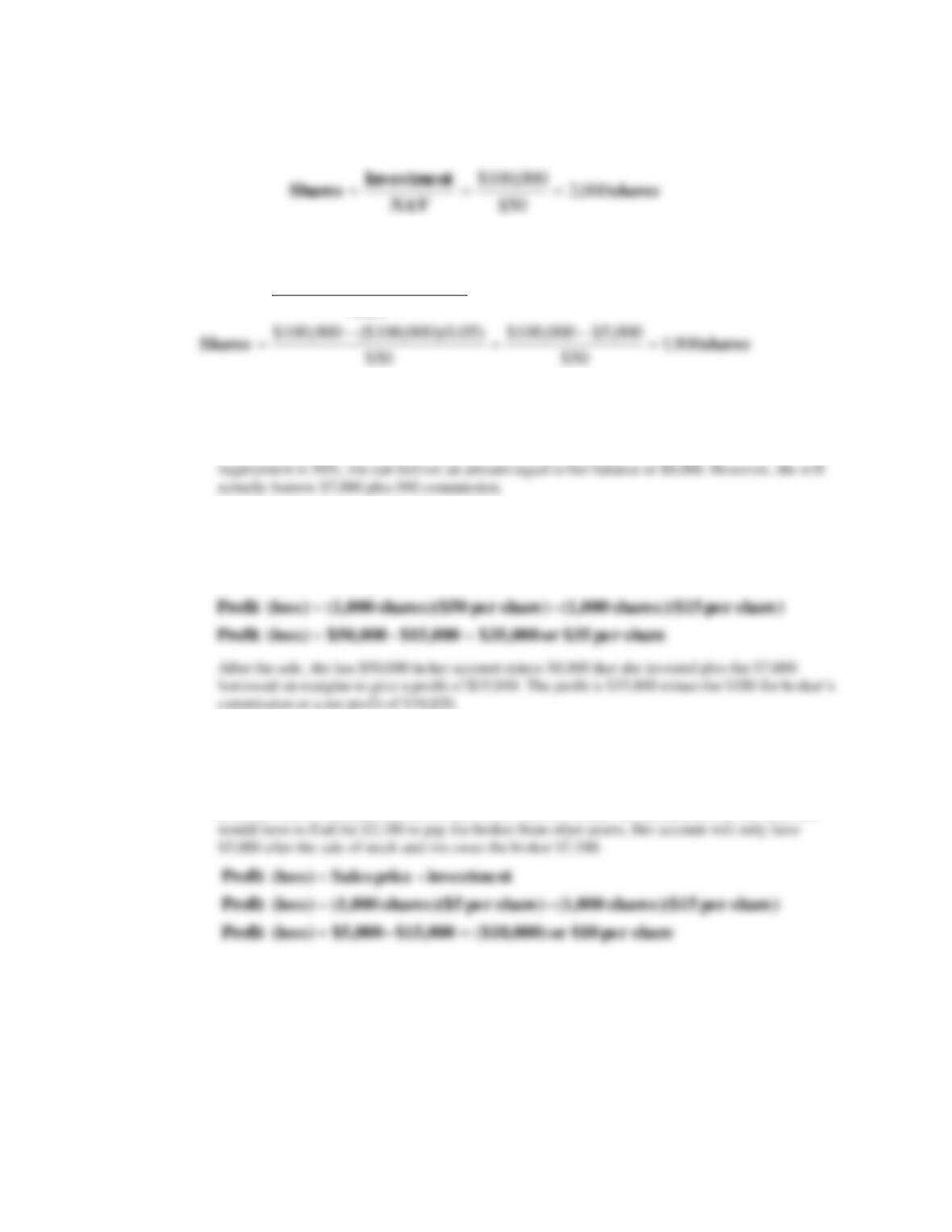
15. David Nash has $100,000 to invest in a mutual fund.
a. How many shares will he purchase in a no-load mutual fund whose NAV is $50 per share?
b. How many shares will he purchase in a loaded mutual fund whose NAV is $50 per share and
which has a front-loaded sales charge of 5 percent?
=commission–Investment
Shares
16. Shakee Venture wants to purchase 1,000 shares of an Internet technology stock for $15 a share. She
figures that she needs $15,000 plus $90 brokerage commission to purchase or sell the stock. She
currently has $8,000 of liquidity in her money market account.
a. What can Shakee borrow on margin in order to make the transaction? Since the margin
b. If the stock jumps to $50 per share within a week, how much will Shakee realize in profit
after paying her broker? Since she can pay the broker back from sales price, she has profit as
shown below.
investment–price Sales(loss)Profit
=
c. If the stock dropped to $5 per share, rather than increasing to $50, and the broker put in the
margin call, how much must Shakee pay the broker? She has to pay the broker back the $7,000
borrowed to purchase the stock + $90 commission.
d. Based on beginning account balance of $8,000, what is Shakee’s loss? She lost a total of
$10,000. NOTE: Because she borrowed $7,090 from the broker for the purchase of the stock she
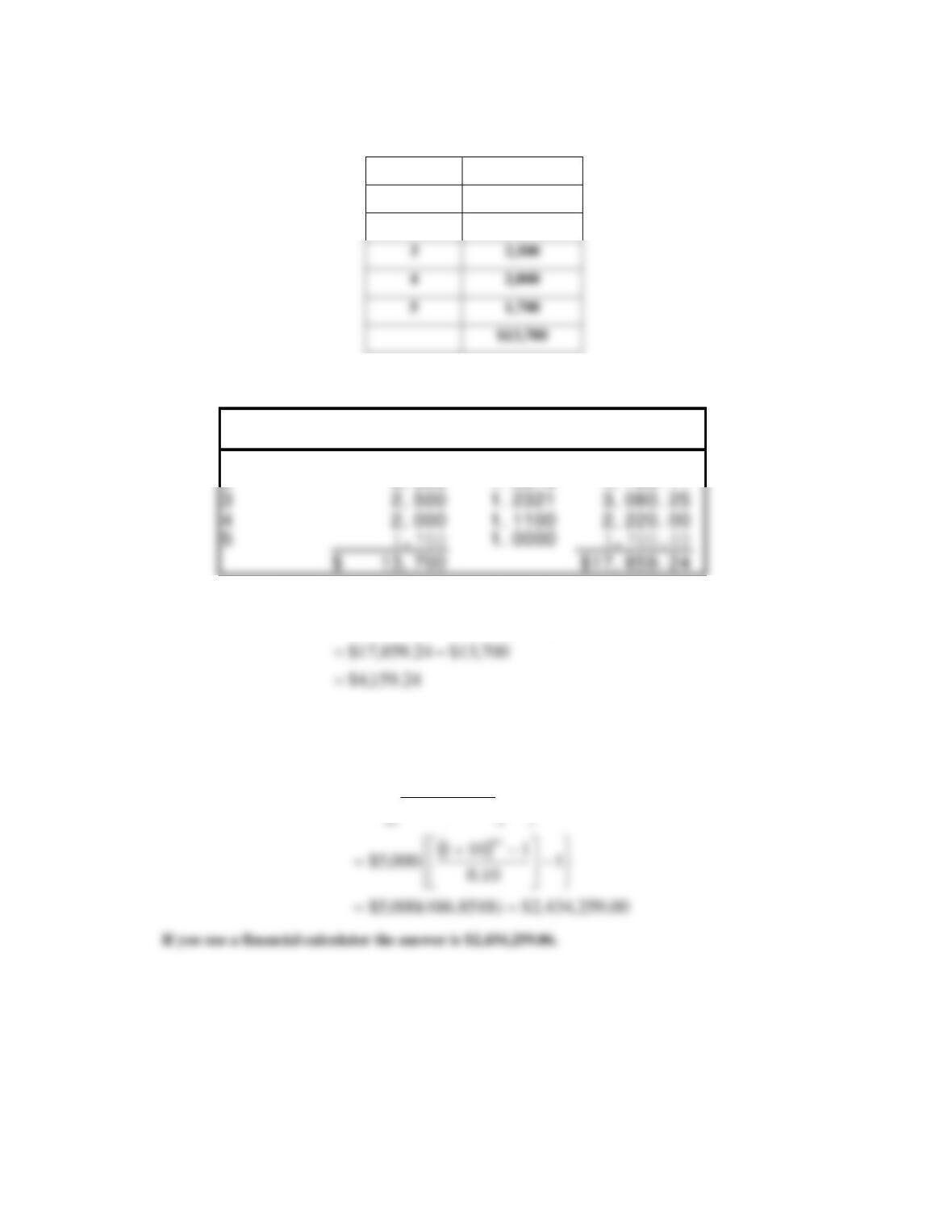
17. You deposit the following at the end of each year into a growth mutual fund that earns 11 percent
per year.
Year
Deposit
1
$4,000
2
3,500
3
2,500
4
2,000
5
1,700
$13,700
a. How much should the fund be worth at the end of five years? $17,859.28
b. How much interest will you have earned in total?
deposited) ismoney (when PV –FV earnedInterest
=
18. Starting in 2012, Ira Roth places $5,000 in a Roth IRA at the beginning of each year for the next 40
years. Ira believes the account will earn 10 percent a year compounded yearly. How much will he
have in his account in 40 years?
( )
( )
1
11
1
−
−+
=
+
i
i
AFV n
Ret ur n= 11. 00%
Year Deposit Factor FV
1 $4,000
4, 000$ 1. 5181 6, 072. 28$
4 2,000
19. N. Ebriate, a college student at a party university, decides to forego beer drinking and invest the
$100 he saves at the end of each month in a mutual fund that is currently earning 11 percent annually.
He has a job where he has earned income and invests this money in a Roth IRA.
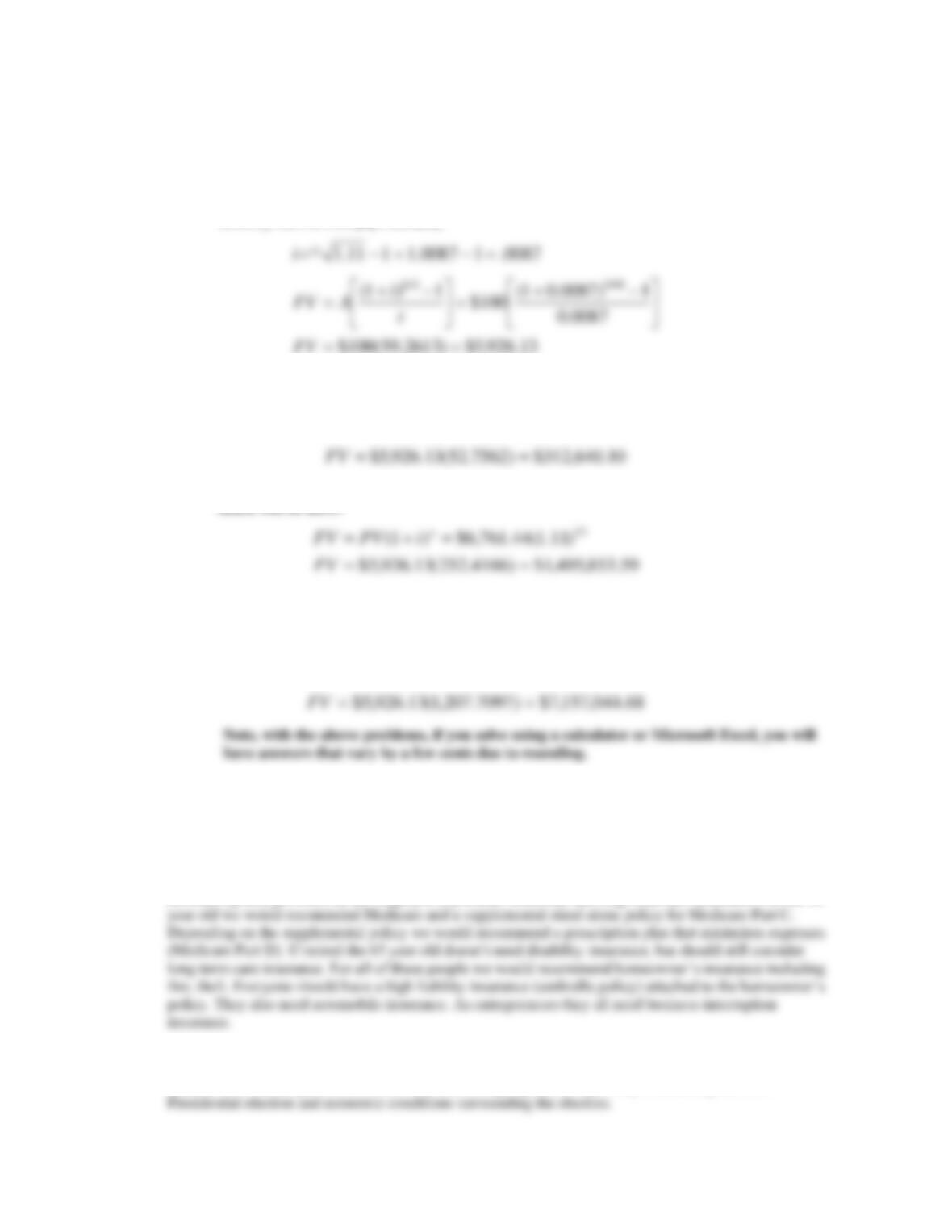
a. How much will he have in his fund in four years upon graduation? This is a future value of an
ordinary annuity problem, but the interest rate has to be calculated separately as his invests
b. If he graduates at the age of 22 and leaves this investment in the mutual fund without adding
any additional funds, how much will he have at age 60? This is the future value of a lump sum.
)11.1(13.926,5$)1( 38
=+=
iPVFV n
c. If he really enjoys his work and decides to leave the money in the fund until age 75, how
d. If he never touches this mutual fund and dies at the age of 90, how much will he leave in his
estate from only this investment?
)11.1(44.761,6$)1( 68
=+=
iPVFV n
RECOMMENDED GROUP ACTIVITIES
1. Given three entrepreneurs: one is in her early 20s, two is in his mid-40s, and the third is just
approaching 65. Each one is married with two children. What type of health and casualty insurance
would you recommend to these individuals? For health insurance we would recommend a group health
2. In pension planning, some people rely on the Social Security system for their entire retirement
program. Using two groups, have one argue for Social Security and have one argue against the
system. This should provide for some very interesting arguments especially considering the 2008
3. The current Social Security System takes a 6.2 percent payment from the employee and a 6.2 percent
payment from the employer for a total of 12.4 percent of income. Assume the groups average current
age and average income. If you have the option of investing 12.4 percent of your income in a self–
directed IRA, how much will you have in your individual retirement program at the retirement age
of 67 if you invest your money in the DOW? Would you rather have the current system or one which
is self-directed? This again depends on the age of the groups in the classroom. The authors have had
CASE STUDY PROBLEMS
1. How much of the Gilbert’s success do you attribute to their persistence? They were very persistent in
2. How important do you believe the Gilbert’s investments and understanding of time value of money
contributed to their overall success? We consider this to be one of the primary factors involved in their