Chapter 10 Capital Budgeting
CHAPTER OUTLINE
Learning Objectives
Capital Budgeting
Factors Affecting Capital Budgeting
Formulating a Proposal
Costs in Capital Budgeting
Benefits in Capital Budgeting
Evaluating the Data (Techniques of Capital Budgeting)
Payback
Net Present Value or NPV
Profitability Index or PI
Internal Rate of Return, or IRR
Accounting Rate of Return, or ARR
Lowest Total Cost
REVIEW AND DISCUSSION QUESTIONS
1. What distinguishes a capital investment from other investments?
2. List and briefly explain the five-step capital budgeting process.
• Formulating a proposal that involves identifying costs and benefits of the proposal.
3. What are the various costs that must be evaluated in a capital budgeting decision?
Start-up costs that are all costs incurred to get the project under way. Working capital commitment costs
4. What are some of the tax-factor benefits of capital budgeting?
Tax factor benefits include annual depreciation of assets, interest on loans and investment tax credits. All of
5. List the advantages and disadvantages of the payback method. Advantages are that it is easy to
compute and simple to explain. It readily compares investments that have unequal initial costs.
6. How does a company determine the interest rate it will use in making a net present value (NPV)
decision? It uses the weighted average cost of capital. The company uses the cost of debt that the lender
7. What are three components used by a lender in determining the interest rate charged for a loan?
The three components are the real rate of return, the inflation premium, and the risk premium.
8. What is the actual cost of capital to the borrower?
stock.
9. Describe the process of calculating NPV.
The process involves, first calculating the present value of the benefits and from it, subtracting the present
10. List two advantages of using NPV.
All cash flows that will be paid and received in the future can be discounted back to the present in order to
11. What is the relationship between NPV and profitability index (PI)?
If the NPV is greater than zero, the PI will be greater than one. Both of these conditions would indicate that
12. What are the advantages of the PI method of capital budgeting?
PI is very easy to calculate once you have determined both the present value of the benefits and the present
value of the costs. It is easy to explain because it provides a clear picture of cost benefit analysis.
13. How does the accounting rate of return (ARR) differ from the internal rate of return (IRR)?
The accounting rate of return is calculated by taking the average annual income from a project and dividing
14. Discuss the method of capital budgeting that you would use in your own business. Justify your
decision.
Although we would normally use net present value for our own business, we would expect this question to
15. What are the differences between mutually exclusive, non-mutually exclusive, and capital rationing
decisions?
Mutually exclusive means that given an array of projects, we only select one, and the others are
16. What is the three-step process of controlling?
• Establish standards for measurement of the project.
EXERCISES AND PROBLEMS
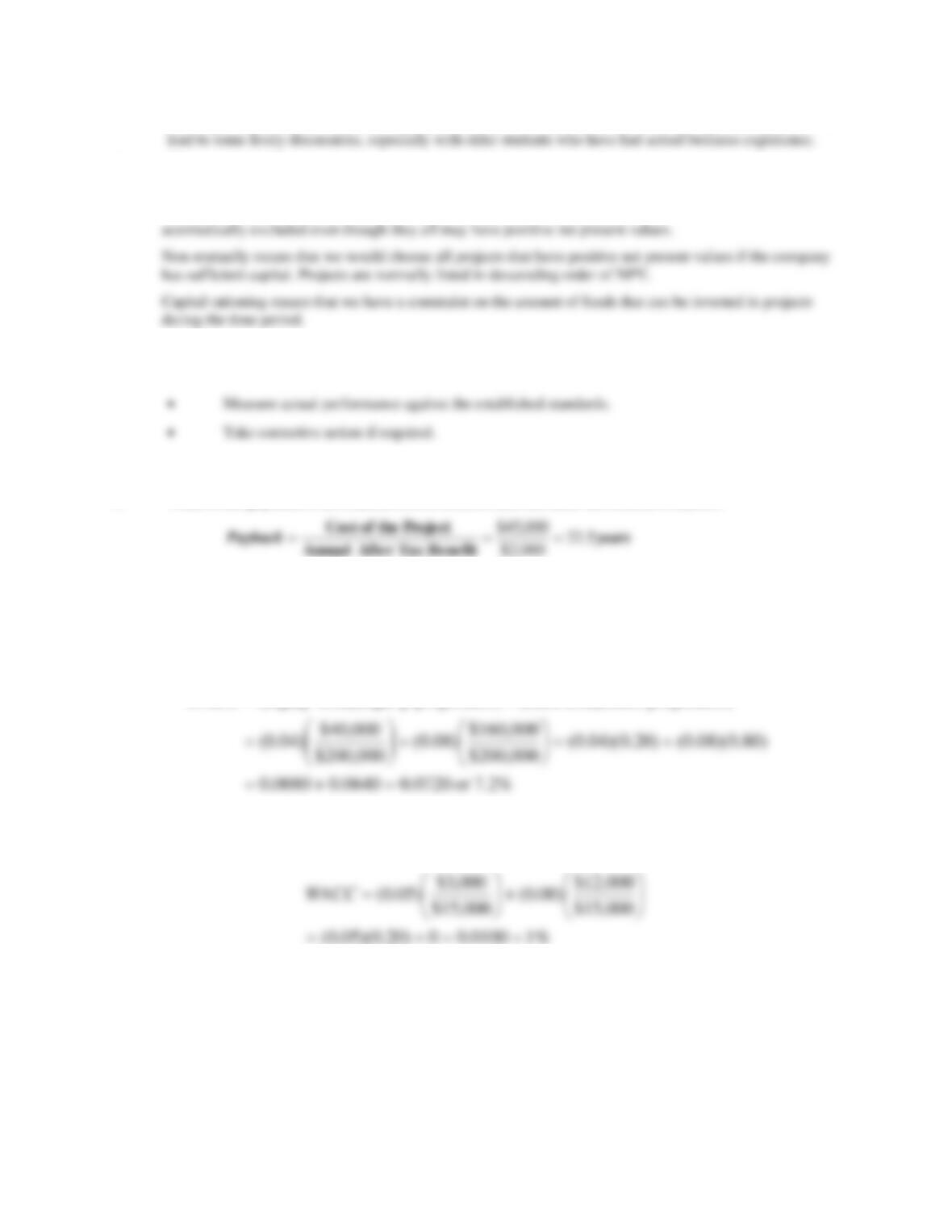
1. What is the payback if investment cost is $45,000 and the after tax benefit is $2,000?
2. An interest payment of $650 in a 20 percent tax bracket would result in a tax savings of _____.
Tax savings = $650 times .20 = $130
3. Joe Morton buys a piece of equipment for $200,000. He puts down $40,000 and finances $160,000.
Joe’s opportunity cost is 4 percent and the lender’s interest rate is 8 percent. Find the weighted
average cost of capital (WACC).
4. Lisa Camry bought a $15,000 car with a $3,000 down payment. The balance is financed by a
manufacturer’s sale offering 0-percent annual interest. If Lisa’s opportunity cost is 5 percent, what is
her WACC?
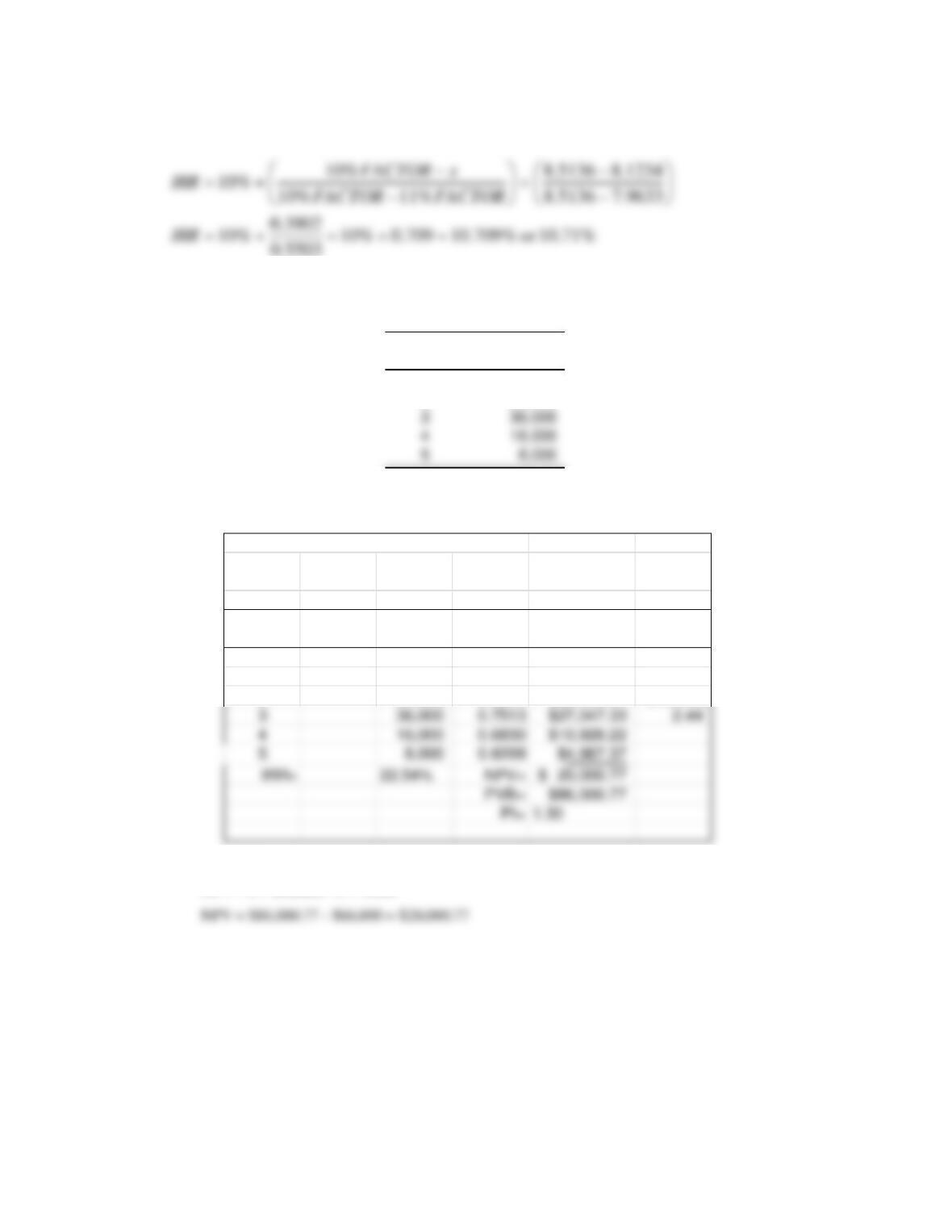
5. If the 10 percent present value ordinary annuity factor (PVAF) is 8.5136 and the 11 percent PVAF is
7.9633, a PVAF of 8.1234 correlates to an internal rate of return of _______.
6. The Ohm Depot Co. is currently considering the purchase of a new machine that would increase the
speed of manufacturing electronic equipment and save money. The net cost of the new machine is
$66,000. The annual cash flows have the following projections:
If the cost of capital is 10 percent find the following:
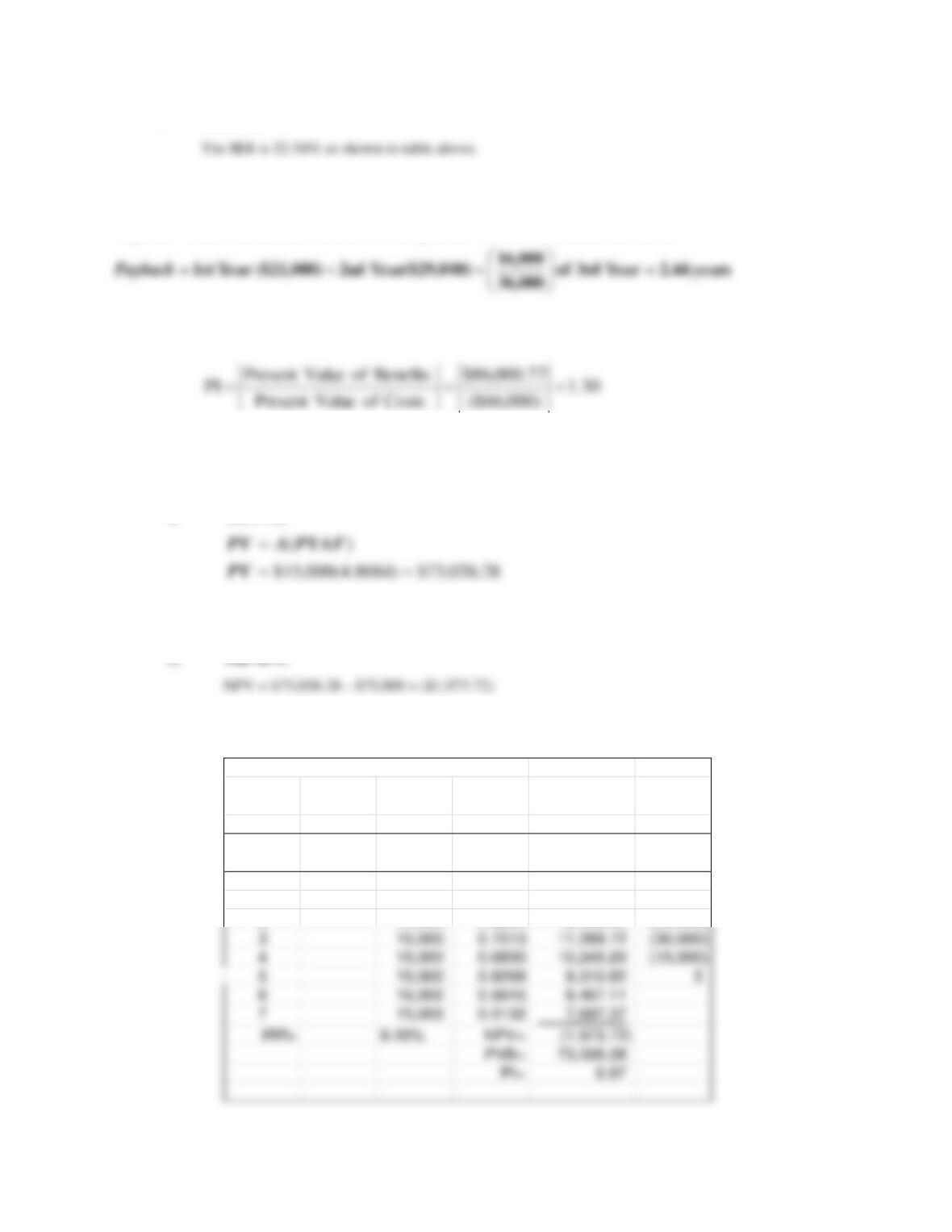
a. The PVB = $86,000.77 as shown below.
Answers to problem 6a, b, c, d &e
Cost of
capital =
10.00%
Year Amount
PV factor
Present
Value
Payback
in Years
0 (66,000)
1.0000 $ (66,000.00) (66,000)
1 21,000 0.9091 $19,090.91 (45,000)
2 29,000 0.8264 $23,966.94 (16,000)
b. The NPV.
Year Amount
1 21,000
2 29,000
c. The IRR.
d. Payback.
($66,000) investment ofcost the equal to flows cash annualfor Time
=
Payback
e. PI.
7. Kay Sadilla is considering investing in a franchise that will require an initial outlay of $75,000. She
conducted market research and found that after–tax cash flows on the investment should be about
$15,000 per year for the next 7 years. The franchiser stated that Kay would generate a 20 percent
return. Her cost of capital is 10 percent. Find the following:
b) The PVC.
This is given as $75,000
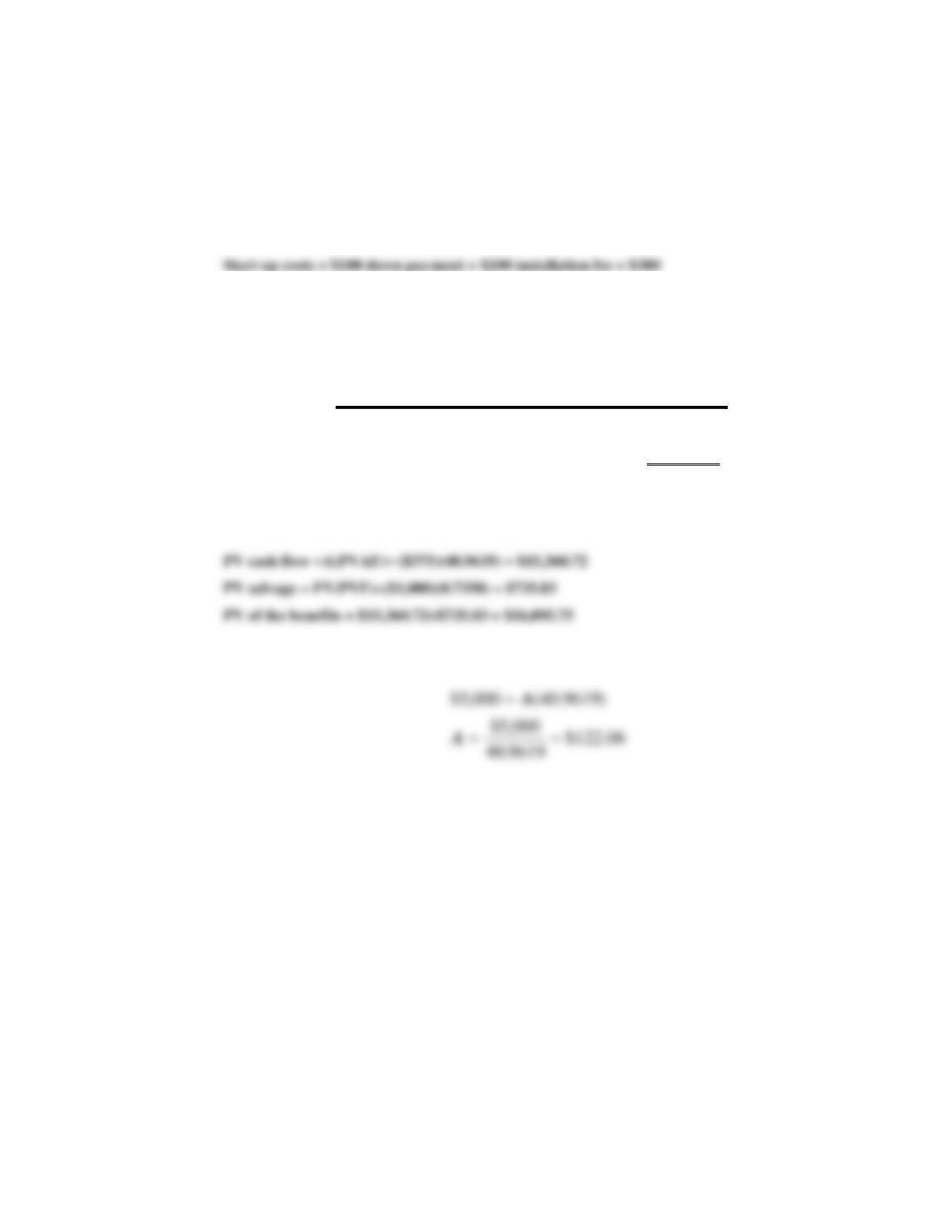
d) The IRR.
The IRR is 9.2% See Table below for Excel Solutions:
Answers to problem 7 a, b, c, d &e
Cost of
capital =
10.00%
Year Amount
PV factor
Present
Value
Payback
in Years
0 (75,000)
1.0000 $ (75,000.00) (75,000)
1 15,000 0.9091 13,636.36 (60,000)
8. Meg O’Byte wants to buy a new computer for her business for Internet access on a cable modem.
The computer system cost is $5,100. The cable company charges $200 (including the cable modem)
for installation and has a $50 a month usage fee for business, paid at the end of the month. Meg
expects to buy the system with a $100 down payment, financing the balance at 8 percent over the next
4 years. She will sell the computer for $1,000 when she upgrades. She expects a $500 a month
increase in cash flow and is in the 25 percent tax bracket.
a) The start-up costs are ______________.
b) The PVC is ___________.
c) The PVB is ________________.
Cash flow = $500(1-tax rate)=$500(1-.25)=$500(.75) = $375
d) The monthly payment for the computer is _____.
)(
=
PVAFAPVOA
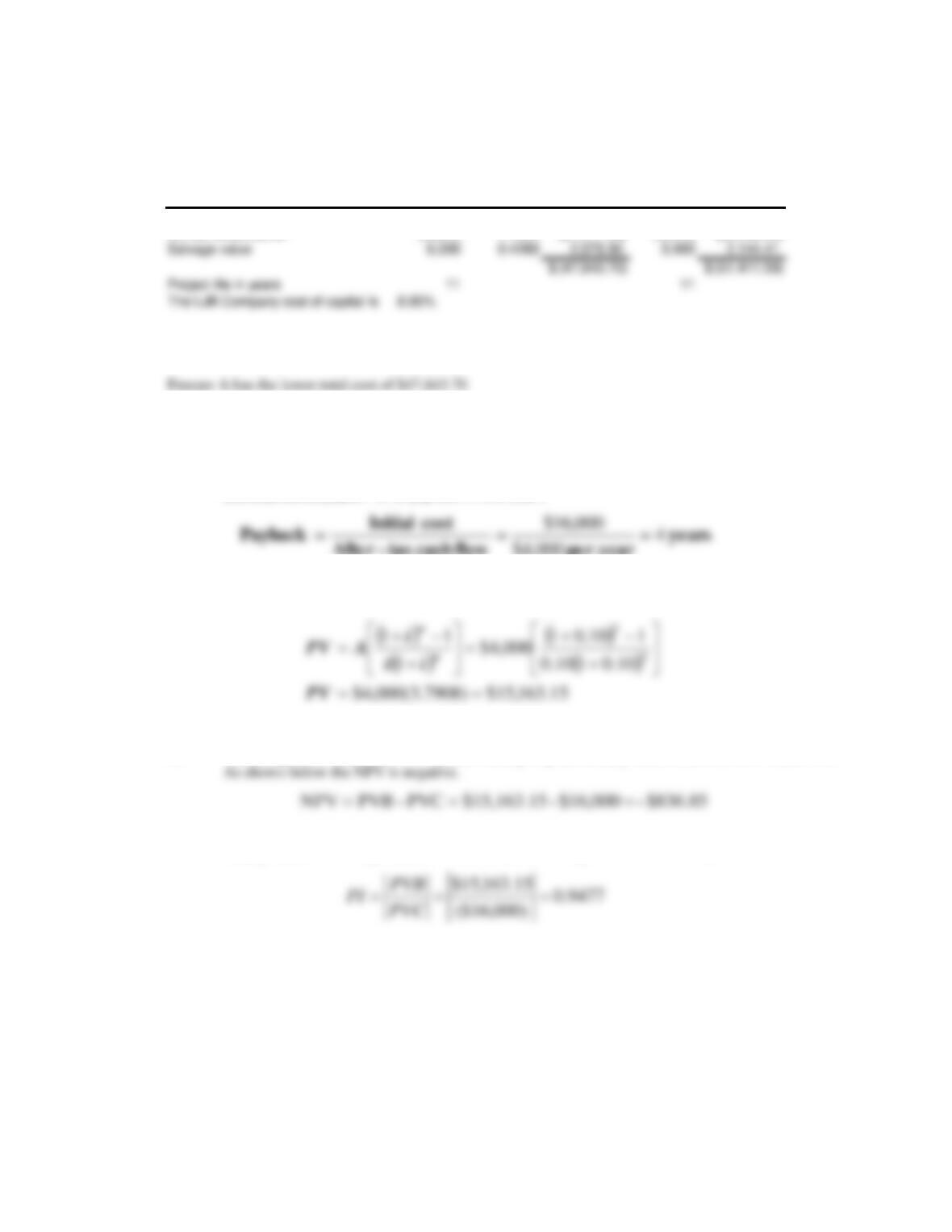
Answer to problem 8b
Cost of
Capital=
8.00%
Item Cost PV factor
Present
Value
Install Cable 200.00$ 1 200.00$
Computer 5,100.00 1 5,100.00
Cable Usage Fee 50.00 40.9619 2,048.10
7,348.10$
9. The LJB Company must replace a freezer and is trying to decide between two alternatives:
Which investment provides LJB with the lowest total cost?
10. Manny Kurr is considering the purchase of a beauty salon. The initial cost of this purchase is
$16,000. The after-tax cash flows from this investment should be $4,000 per year for the next 5 years.
His opportunity cost of capital is 10 percent. Please calculate the following:
a) Payback—Should Manny buy the beauty salon based on payback if his required payback is
yearper flow cashtax –After
000,4$
b) The present value of the benefits (PVB) This is an ordinary annuity problem. Using a calculator
you will get $15,163.15 and using table B-5, you would get $15,163.20
c) The present value of the costs (PVC). $16,000
d) The net present value (NPV)—Should Manny buy the beauty salon based on NPV rules? No.
e) Profitability index (PI)—What does the profitability index mean in terms of buying the
beauty salon? Don’t buy because PI is less than 1. Do buy if the PI is more than 1.
Answer to question 9
Item Freezer A PV Factor
Present
Value
Freezer B
Present
Value
Investment required ($29,000) 1.0000 (29,000.00)$ ($25,000) (25,000.00)$
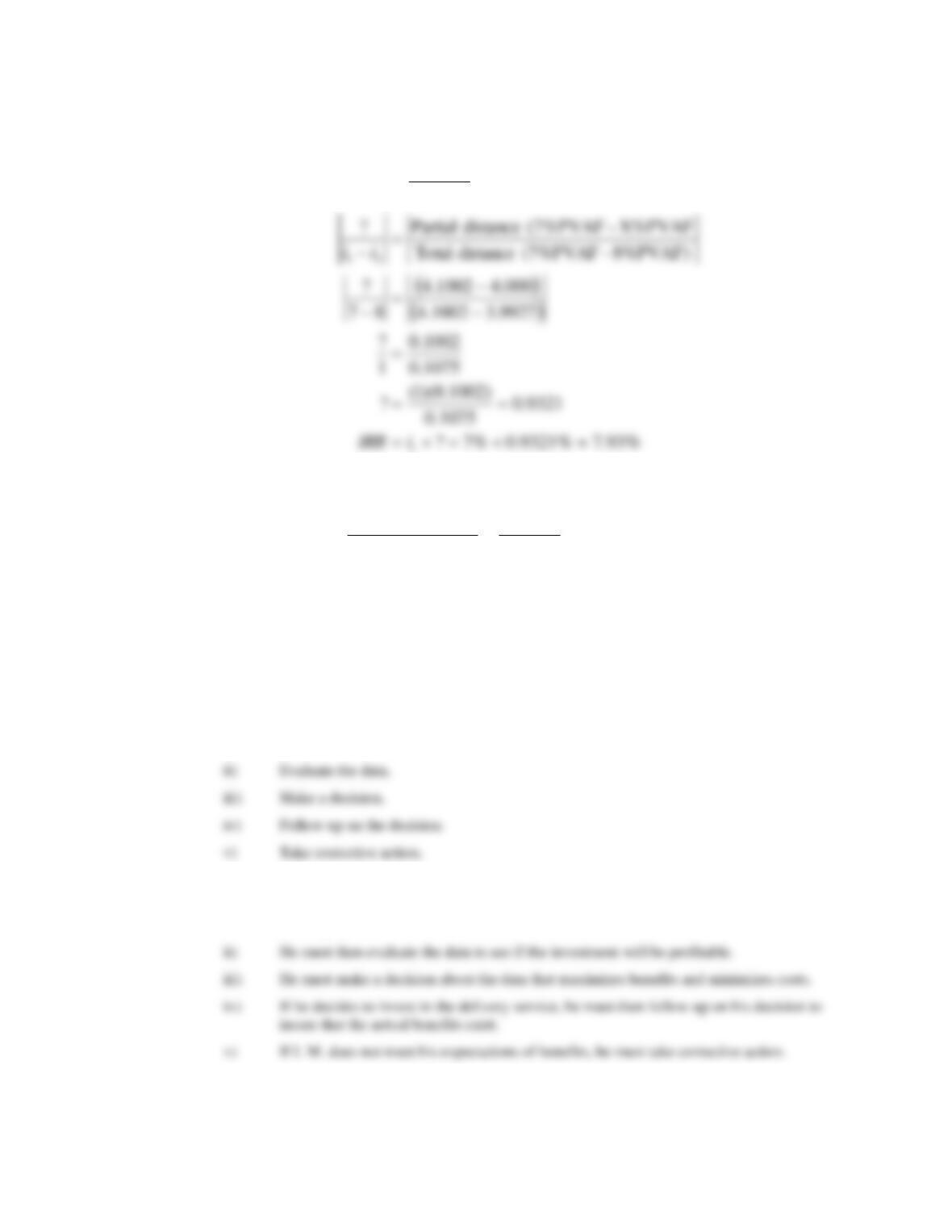
f) Internal rate of return (IRR) (Hint: use interpolation)—Should Manny buy the beauty salon
based on IRR rules? No. As shown below, the IRR is 7.93% and his cost of capital is 10%.
00.4
$4,000
$16,000
factor IRR
==
g) Accounting rate of return (ARR)—Should Manny buy the beauty salon based on the ARR?
Yes, but as all of the above show, this is not a good method of evaluating an investment.
25%or
cost total
flow cash period 25.
000,16$
000,4$ ===ARR
11. I. M. Aruban has a sandwich shop in a downtown business district. Several of his customers have
said that they would purchase from his shop more often if he offered a delivery service. I. M. is
considering establishing a delivery service to meet the needs of his market. He believes that he will
have to purchase a fax machine, install a new phone line for the fax machine, purchase a delivery
van, and hire at least one delivery person. I. M. asks your advice in determining whether or not he
should take on the delivery service venture.
a) What steps would you recommend that I. M. use in reaching a profitable decision? I. M.
should go through the five-step process used in capital budgeting which is:
i) Formulate a proposal.
b) Explain to I. M. what each step involves. For I. M. he should:
i) To formulate his proposal he must determine the costs and benefits of a sandwich
delivery service.
12. You decide to help I. M. with his analysis. A good fax machine will cost $500 and functions properly
for five years. The phone company charges $300 for installing a new line and $60 a month for the
line. A new delivery van costs $20,000 and can be financed for 60 months with a $4,000 down
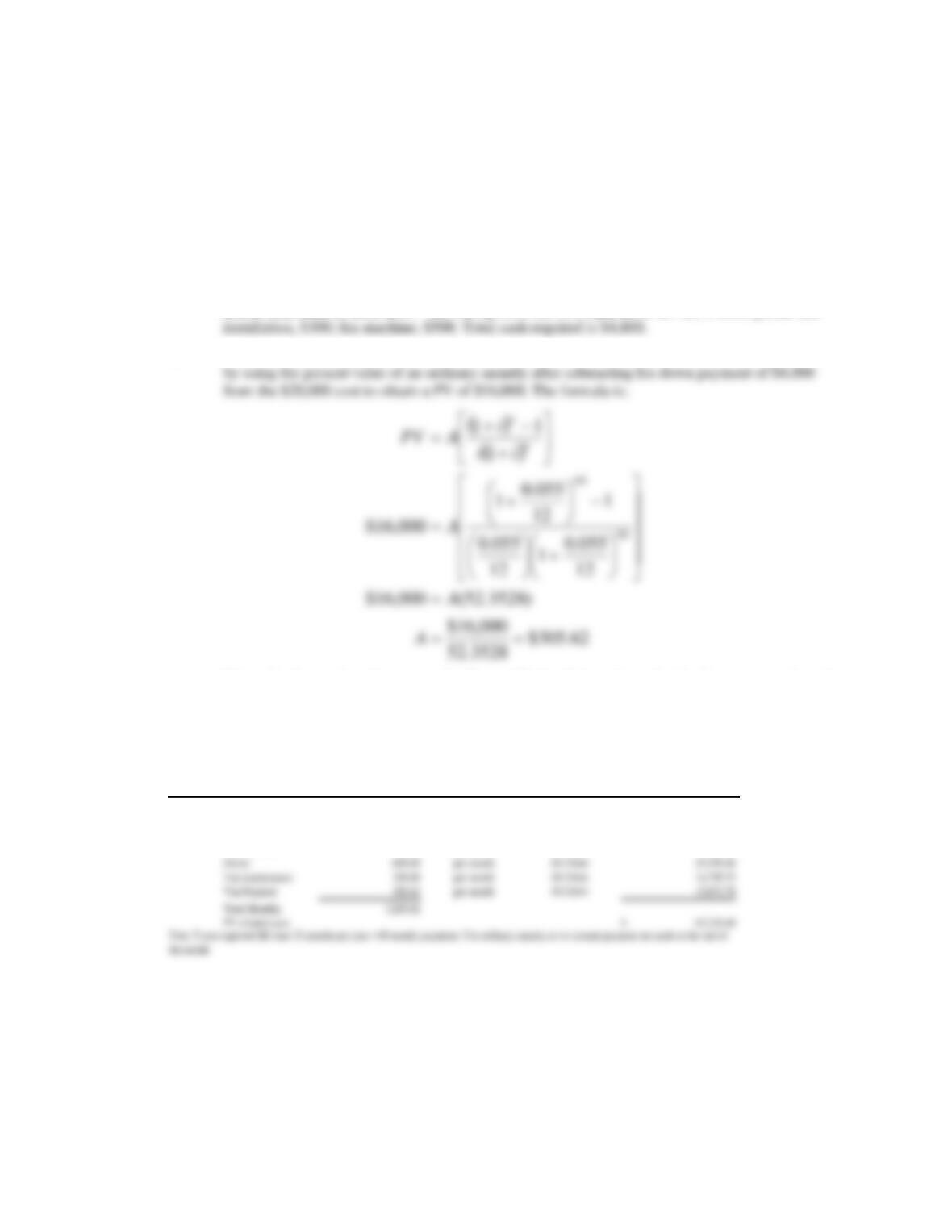
payment. I. M.’s bank will finance the van at 5.5 percent compounded monthly. You calculated his
weighted average cost of capital at 8 percent. You found that a 5-year-old van of this model sells for
$5,000. After discussing the business venture with several retired restaurant owners at the local
SCORE office, you believe that I. M., after paying his food costs, will increase his breakfast and
lunch trade by $2,000 a month. I. M. can hire a part time driver for $600 a month. The vehicle
depreciates straight line for five years, or $3,000 per year. I. M. is a sole proprietor and is in a 20
percent tax bracket. You estimate it will cost I. M. $300 a month to pay for maintenance, upkeep, and
insurance on the van.
a) If I. M. decides to establish a delivery service and pays for the fax machine in cash, how
b) What is the monthly payment for the delivery van? I. M. has to calculate his monthly payment
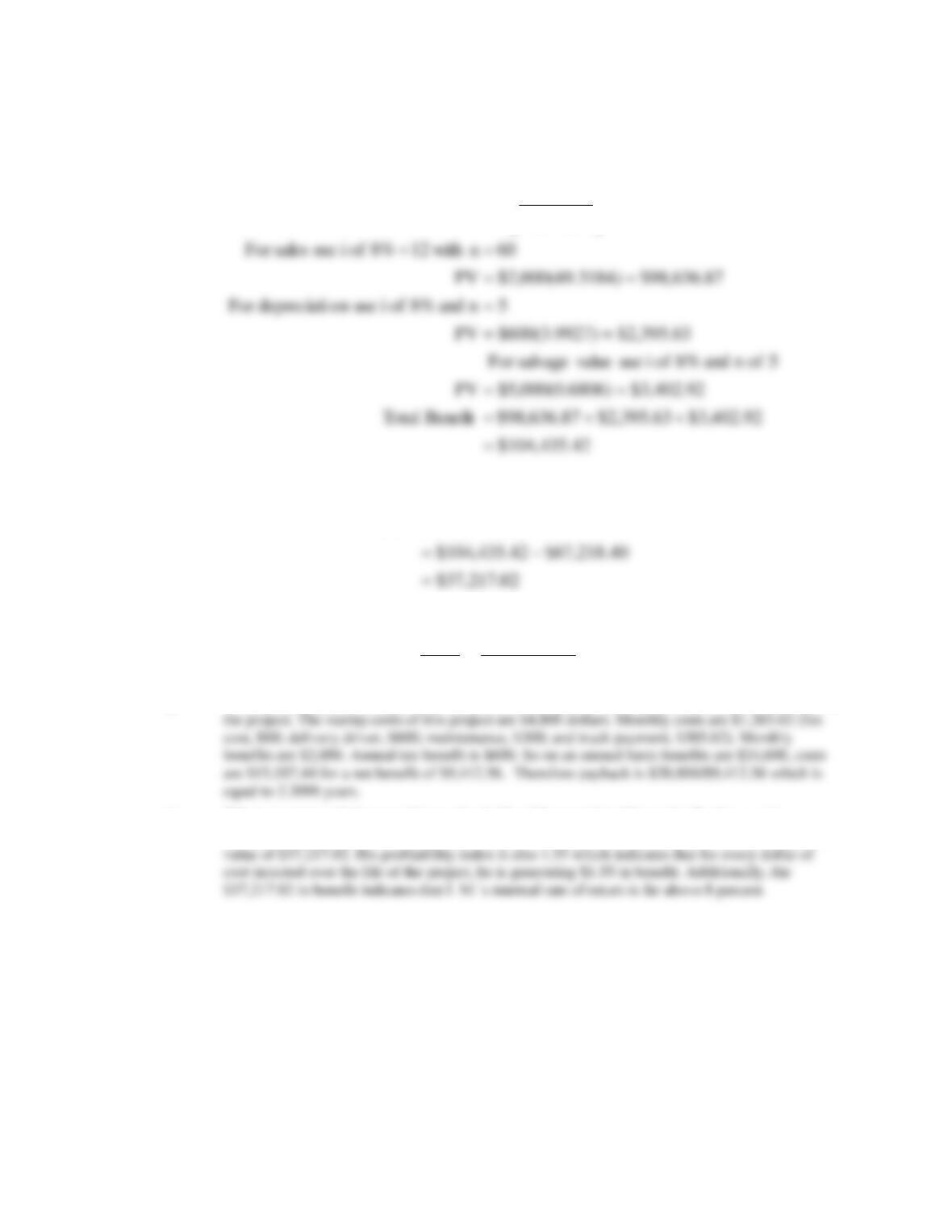
c) Using the time value of money and a 5-year life for this project, what is the present value of
all of I. M.’s costs? This is a problem that involves separating items by time period, summing the
items, which will have the same present value factor, and then calculating the present value. We
then sum all present values to determine total costs.
Solution to problem 12c
Item Cost Time Period PV factor PV of Costs
FAX 500.00 Now 1 500.00$
Installation 300.00 Now 1 300.00
Van down payment 4,000.00 Now 1 4,000.00
FAX service 60.00 per month 49.31844 2,959.11
d) Using the time value of money, and a 5-year life for this project, what is the present value of
all of I. M.’s benefits? To calculate these items we must use the present value of an ordinary
annuity formula for sales and depreciation and the future value of a lumps sum for salvage.
( )
( )
1
11
+
−+
=n
n
ii
i
APV
e) What is the NPV of the delivery service?
−= PVCPVBNPV
f) What is the PI of the delivery service?
55.1
40.218,67$
42.435,104$=== PVC
PVB
PI
g) What is the payback? Payback is the cost of the project divided by the annual after tax benefit of
h) What recommendation would you give I. M. with regard to this project? We would
recommend the project. At a weighted average cost of capital of 8 percent, the NPV has a positive
13. Herb E. Vore is considering investing in a Salad Stop franchise that will require an initial outlay of
$100,000. He conducted market research and found that after tax cash flows on this investment
should be about $20,000 a year for the next 7 years. The franchiser stated that Herb will generate a
20 percent rate of return. He currently has his money in a mutual fund which has grown at an
average annual rate of 10 percent. He tells the franchiser that money has a time value and the actual
rate of return according to his calculations is much less than 20 percent.
a) Do you agree with the franchiser or with Herb? We agree with Herb.
b) What rate of return is the franchiser using and what method did Salad Stop use to calculate
it? The franchiser is using the accounting rate of return which takes the after tax cash flow of
c) What rate of return is Herb using and what method did he use? Herb is using the 10 percent
that he could earn on his $100,000 in order to determine the present value of the cash flow. He is
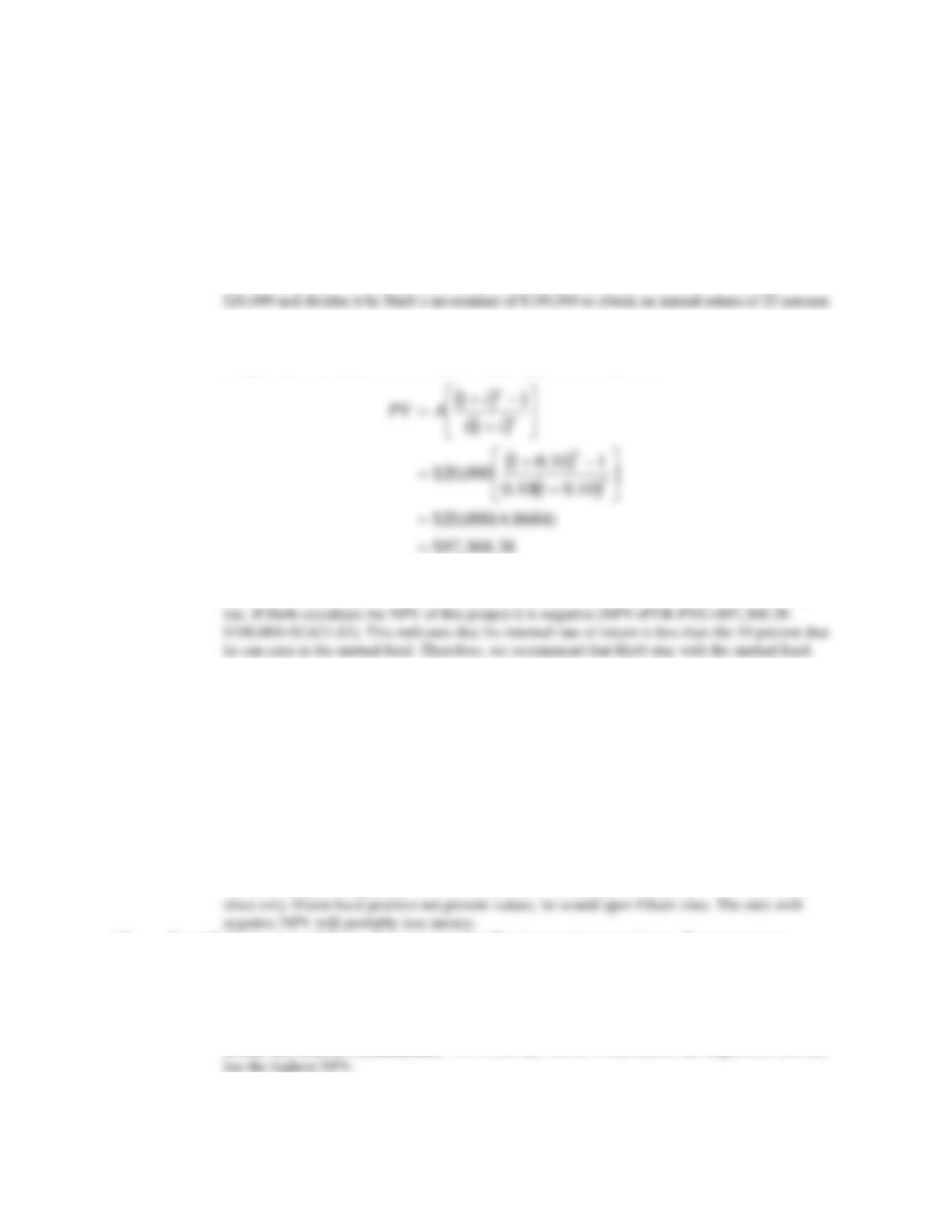
using the present value of an ordinary annuity, Appendix B, Table 8-5.
d) Should Herb make the investment? Explain your answer. No. The present value of the
benefits for seven years is only $97,368.38 which is less than the $100,000 that Herb currently
14. Carni Vore represents a meat sandwich restaurant chain that is expanding into a
new, large metropolitan area. He currently has $2 million to invest and wants to
open several restaurants. He found that each site will require a cash outlay of
$230,000 for leasing, equipment, and initial inventory. Carni is currently looking
at 20 sites. The first 15 sites have positive net present values; sites 16 through 20
have negative net present values.
a) What is the maximum number of restaurants that Carni can establish for
his company? Explain. This is a capital rationing problem. Carni must divide the $230,000
into the $2,000,000 and he has 8.69 or eight sights, because you can’t invest in 0.69 sights.
b) How many restaurants can Carni open if his employer increases his budget
to $5 million? Explain. If he has $5,000,000 he can open as many as 21 sites. However,
15. Carni’s boss stated that after reviewing first-quarter earnings, the company
decided to invest in only one store in the city. After evaluating the performance of
the store, the company will determine if it wants to increase its presence in the
area.
a) If you were Carni, what method of evaluation would you use to recommend
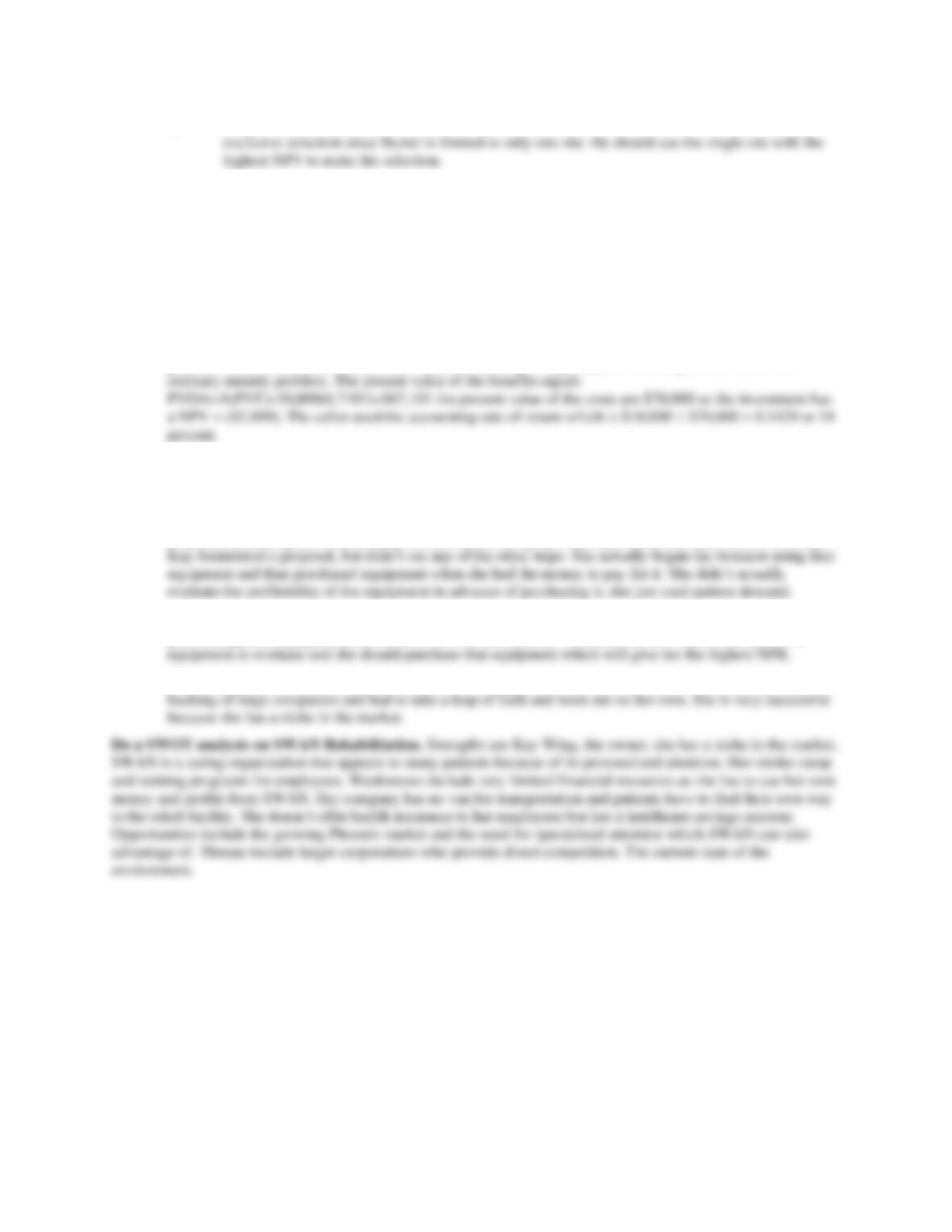
b) Explain how you would determine which site to invest in. This is a mutually
RECOMMENDED GROUP ACTIVITY
1. You have a business that requires the replacement of two 50,000–BTU heating units. Compare the
total costs of these units from three manufacturers. Assume that the heaters will be placed in use and
will last 10 years. Which company provides heaters with the lowest total cost? This problem should be
solved by student groups using resources in the local area.
2. Your group receives a phone proposal to invest in a new business. The caller informs you that it will
take a $70,000 down payment and the investment will return $10,000 a year for the next 10 years. He
tells you that the investment will return 14 percent. If current interest rates are 8 percent, what is the
present value of this investment? How did the caller get 14 percent? This is a present value of an
CASE STUDY QUESTIONS
1. What steps should a business take in making a capital budgeting decision? What steps did Kay take
in making a capital budgeting decision? Compare your answers. The five step process is: Formulating a
proposal, evaluating the data, making a decision, following up with a post audit and take corrective action.
2. Which method of making capital budgeting decisions do you believe would work best for Kay in
purchasing new equipment for SWAN? We recommend NPV because she now has several pieces of
3. What barriers to entry did Kay face when she went into business for herself? She couldn’t get the