
Instructor Resource
Neck, Neck, & Murray, Entrepreneurship: The Practice and Mindset
SAGE Publications, 2018
1
Experiential Exercises
Chapter 6: Using Design Thinking
Source: Teaching Entrepreneurship: A Practice-Based Approach (p. 200–204), by H. Neck, P.
Greene, & C. Brush, 2014, Northampton, MA: Elgar.
Exercise: Ideaspace
Author: Heidi Neck
Description
The Ideaspace exercise is designed to help students shape new ideas into more innovative and
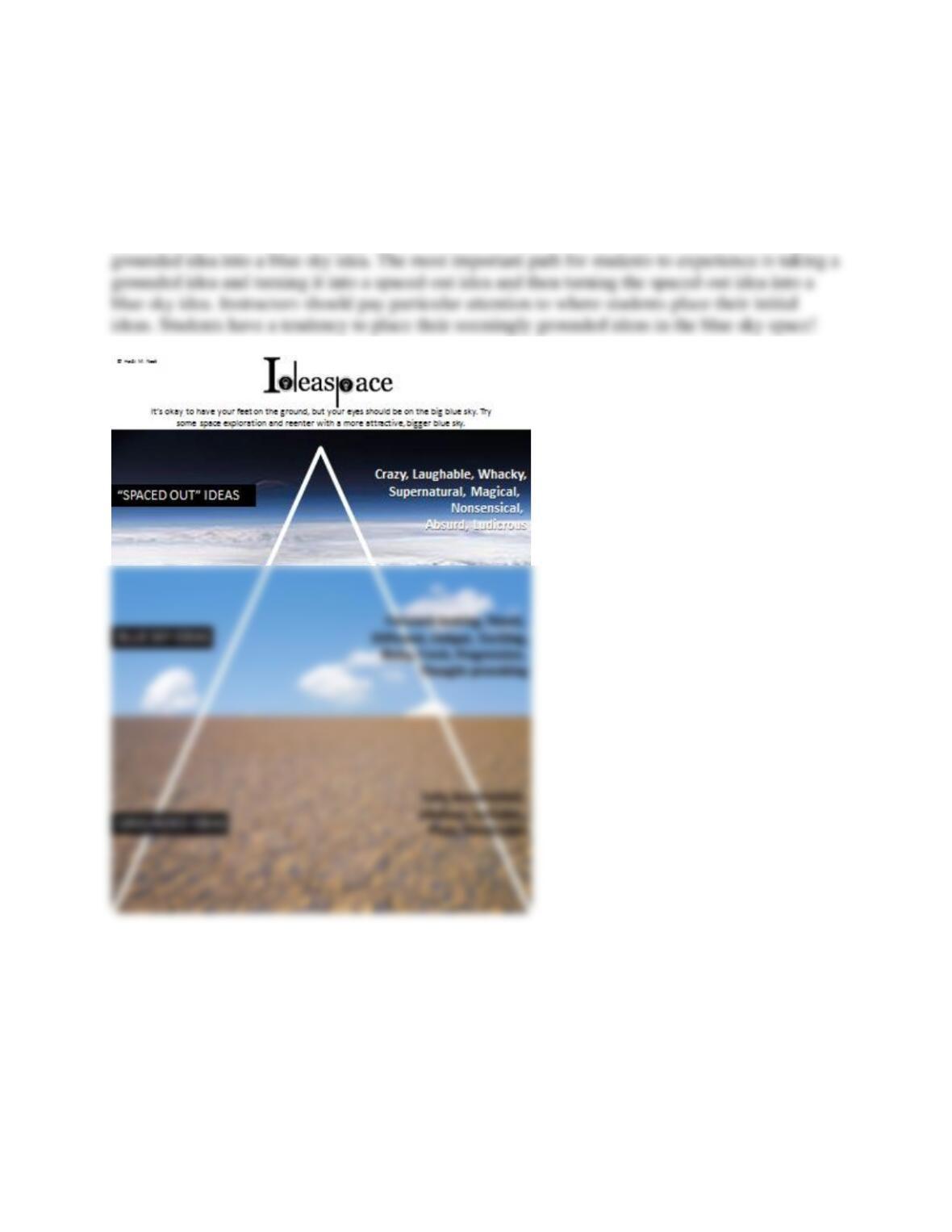
interesting opportunities. There are three types or categories of ideas in the exercise: grounded,
blue sky, and spaced-out. Grounded ideas are safe, incremental, obvious, imitable, plain, and
Ideaspace is an exercise in lateral thinking. Specific principles of lateral thinking emerge during
the exercise:
• Changing direction and nonlinearity are often necessary to develop innovative solutions
to problems.
Learning Objectives
• Develop and shape ideas into stronger opportunities.
• Acquire a level of comfort with “crazy” ideas.
• Practice lateral thinking.
Materials List
Ideaspace image (shown in the figure below should be used as a handout).
• Flip chart paper or whiteboard space.
• Sticky notes.

Instructor Resource
Neck, Neck, & Murray, Entrepreneurship: The Practice and Mindset
SAGE Publications, 2018
2
• Pens or markers.
Pre-Work Required by Students
It is expected that students have gone through some type of general ideation exercise or have at
Theoretical Foundations
Bono, E. de. (1970). Lateral thinking. New York: Harper & Row.
Time Plan (40 Minutes)
The minimum time needed is 40 minutes (as depicted in the timing below), but 60 minutes is
suggested to benefit from a more immersive practice.
Introduction and exercise setup 0:00–0:10 (10 minutes)
Introduce the exercise by showing the Ideaspace graphic, either in handout form or as a
Here is an example that can be shared with students:
Problem: Students not reading and analyzing lengthy case studies.
Grounded idea: Video cases.
Transformation of the grounded idea to a spaced-out idea: Teleport to the decision
consequence.
The great thing about case studies is that students are forced to analyze the information presented
in the case and make a decision. The problem is that students never really see their decision in

Instructor Resource
Neck, Neck, & Murray, Entrepreneurship: The Practice and Mindset
SAGE Publications, 2018
3
Transformation of the spaced-out idea to a blue sky idea: mega-multiplayer video game.
Imagine a business video game filled with avatars and real interaction in a virtual world.
Exercise 0:10–0:30 (20 minutes)
Before starting the exercise, it is assumed that students have a few ideas they are working on to
Step 1: Groups should decide on one to three ideas they would like to shape. Write each idea on
a sticky note provided. Please don’t evaluate your ideas at this point. They are just ideas and
Step 2: On the flip chart provided draw a triangle with three different areas similar to the
Ideaspace handout. Quickly talk through the ideas brought into the exercise and place them in
one of the three spaces on the Ideaspace triangle. For each idea the group must determine if it’s a
grounded, blue sky, or spaced-out idea.
Step 3: Now the fun starts! This step separates the Ideaspace exercise from more traditional
brainstorming approaches. This step is where the bulk of your allotted time should be spent! Start
Presentations 0:30–0:40 (10 minutes)
Have select teams present their new, blue sky ideas and illustrate how the idea was shaped.
Key Takeaways
Lateral thinking is a way of shaping ideas into bolder, more innovative solutions.
Instructor Resource
Neck, Neck, & Murray, Entrepreneurship: The Practice and Mindset
SAGE Publications, 2018
4
Teaching Tips
This is not an easy exercise; therefore, the instructor needs to interact with the groups to help
them move from one area to the next. Creating blue sky ideas is not easy, which is why this
exercise is so important. Bringing an idea down from spaced-out is much easier than turning a