
Instructor Resource
Neck, Neck, & Murray, Entrepreneurship: The Practice and Mindset
SAGE Publications, 2018
1
Experiential Exercises
Chapter 5: Generating New Ideas
Source: Teaching Entrepreneurship: A Practice-Based Approach, by H. Neck, P. Greene, & C.
Brush, 2014, Northampton, MA: Elgar.
Exercise: Mind Dumping for Ideation
Authors: Heidi Neck and Dennis Ceru
Description
The Mind Dumping exercise jump starts the creative aspect of the entrepreneurial method—
specifically ideation as a nonjudgmental exercise designed to generate many ideas, some
nonpractical, from which to build and branch out to more practical potential opportunities that
create significant value. It relates to the search strategy technique that we discussed in Section
4.2.
Learning Objectives
• Practice techniques for creating and developing new ideas.
• Build skills in free association that are necessary for the creative process.
• Get comfortable with starting with “raw” or “seed” ideas rather than feeling the pressure
to produce big opportunities.
Materials List
“Student Mind Dump Worksheet” (see below). Each student should be given at least three
worksheets.
Pre-Work Required by Students
None.
Theoretical Foundations
Time Plan (2 hours)
The exercise has six parts: (1) set up the challenge, (2) gather stimuli, (3) multiply the stimuli,
1. Set up the challenge 0:00–0:15 (15 minutes)
The instructor may identify one challenge for all students to work on or students may work on
individual challenges. Examples of challenges that all students can work on are
Instructor Resource
Neck, Neck, & Murray, Entrepreneurship: The Practice and Mindset
SAGE Publications, 2018
2
• How might we reimagine business education?
• How might we solve the problem of waste on campus?
• How might we create a better coffee mug?
2. Gather stimuli 0:15–0:25 (10 minutes)
a. Address the types of stimuli and their importance to the idea generation process.
i. What is the role of stimuli and why are they important?
ii. Ask: “If you were developing a new coffee mug, what could your stimuli be?”
b. The purpose of stimuli is to surround yourself with artifacts that can help you stimulate
new ideas. Artifacts do not have to be things or people; words work.
c. Quickly play a word association game: “If I say boy, you say . . .? I say cat, you say . . .?
I say red, you say . . .?” This is called word association, and it uses words as stimuli to
get to the next word. We’ll do something similar in this exercise.
d. For the next 3 minutes, write down one word or very short phrase that comes to mind
when you think about the challenge that sits before you. This is not the time to be thinking
3. Multiply stimuli 0:25–0:40 (15 minutes)
a. The free association that was used above is considered “habit” for many. It’s part of most
brainstorming sessions that we do in groups or simply as individuals. The next step,
Instructor Resource
Neck, Neck, & Murray, Entrepreneurship: The Practice and Mindset
SAGE Publications, 2018
You may need to repeat and clarify this a few times. In essence, the students are
associating on their associations.
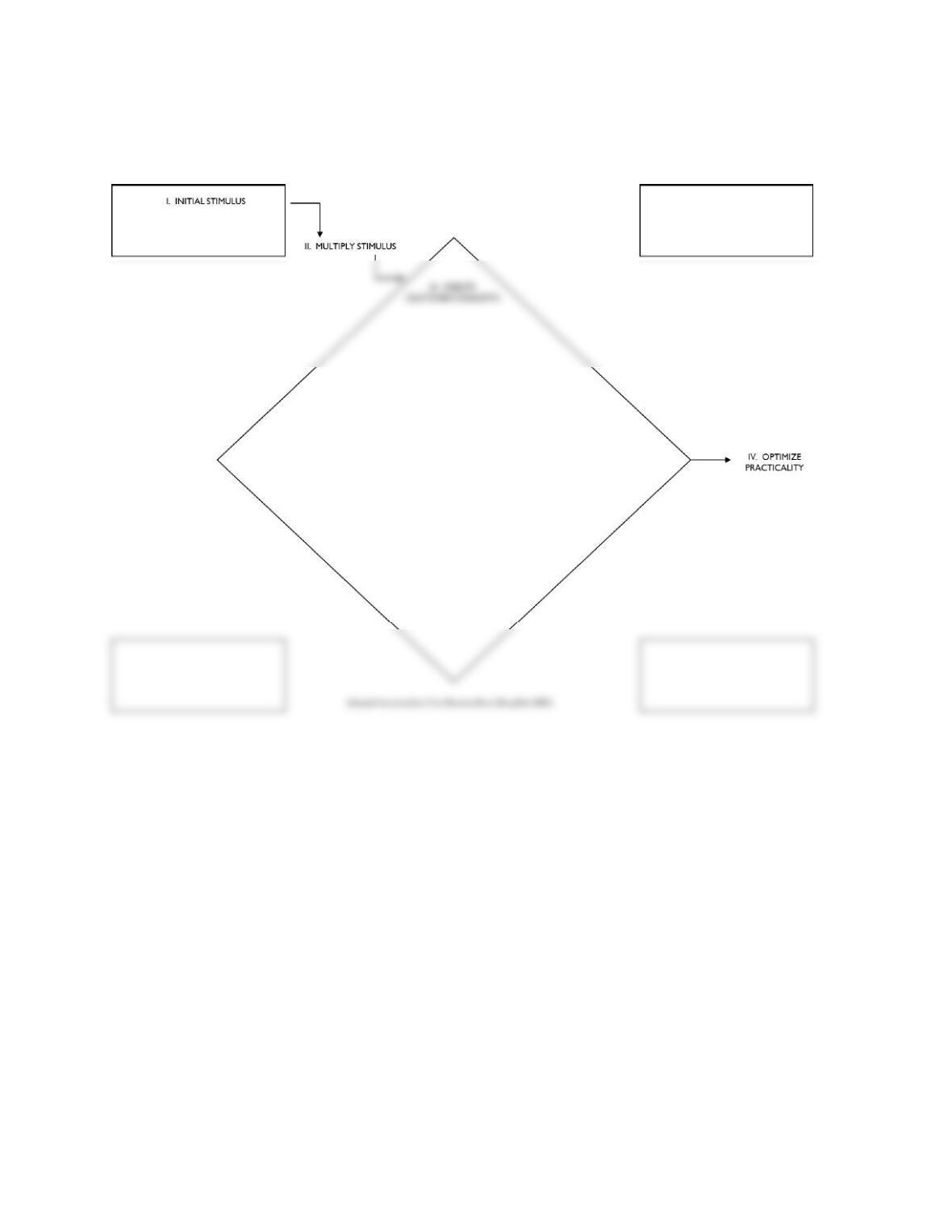
b. Randomly pick four stickies and place one in each of the four corners of the mind dump
worksheet.
c. Free-associate on these four stimuli for 1–2 minutes.
d. Repeat at least three times (using three different mind dump worksheets) using a variety
of methods. Options are:
4. Create raw or seed ideas 0:40–0:55 (15 minutes)
a. Now it’s time to create seed—or raw—ideas. The goal is to create as many ideas as
doesn’t matter as long as you are generating lots of ideas.
b. You have to let the words work for you and contribute to the idea generation process.
Don’t just write an idea that you probably had before you started; the seed ideas must
5. Elaborate one solution 0:55–1:40 (45 minutes, including break)
If time permits, students may begin working together to develop stronger concepts. We
encourage you to give students a break before moving to this stage in the same class session.
a. Break into groups of four to five. Each team member should share their favorite idea.
4
6. Wrap up—what did you learn? 1:40–2:00 (15 minutes)
a. Reflections? What was easy and what was difficult for you?
b. What is the role of creativity in entrepreneurship? How important is creativity to the
entrepreneurial mindset? And what is the role of structure and process in creativity? Can
structure and process stifle or enable creativity?
Key Takeaways
• Judgment slows down or stops the creative process; by side-stepping judgment or
evaluation, the mind is opened to new and fresh thinking.
Teaching Tips
• Pay careful attention to timing – it is essential to move students through the “mind
dumping” quickly to promote rapid-fire non-judgmental ideation.
• The number of “stickies” generated in the first part of the exercise (free association on
Attribution
Derived and adapted from Jump start your business brain, by D. Hall, 2001,
Cincinnati, OH: Clerisy Press.
Instructor Resource
Neck, Neck, & Murray, Entrepreneurship: The Practice and Mindset
SAGE Publications, 2018
5
Student Mind Dump Worksheet