
Instructor Resource
Neck, Neck, & Murray, Entrepreneurship: The Practice and Mindset
SAGE Publications, 2018
1
Experiential Exercises
Chapter 3: Developing an Entrepreneurial Mindset
Source: Teaching Entrepreneurship: A Practice-Based Approach (p 209–213), by H. Neck, P.
Greene, & C. Brush, 2014, Northampton, MA: Elgar.
Exercise: Self-Understanding for Opportunity Creation
Authors: Andrew Corbett and Candida Brush
Description
A strong understanding of self is critical for entrepreneurs. Being able to not only recognize but
also synthesize one’s interests, desires, skills, and network is a critical building block for
entrepreneurial activity (Fiet, 2002; Nixon et al., 2006). This exercise offers students an
Learning Objectives
Reflect on your accomplishments, things you are proud of, and think about what knowledge,
skills, and capabilities were gained from these accomplishments.
Discuss the process of determining these accomplishments.
Connect your knowledge, abilities, and desires as a foundation for venture ideas.
Materials List
The instructor needs to develop two relatively short-form handouts that ask students to think
about (1) their personal accomplishments and (2) their knowledge, skills, and abilities. Details
for each of these are below:
1. Accomplishments: “Please list at least five of your most significant personal
accomplishments. Since we are using these accomplishments as the basis for
entrepreneurial idea generation and potentially a future business, all accomplishments
should be based upon something that you (1) are proud to have accomplished, (2)
enjoyed accomplishing, and (3) think that you did very well.
The accomplishments should not only be work related (developing a new product or rolling out a
2
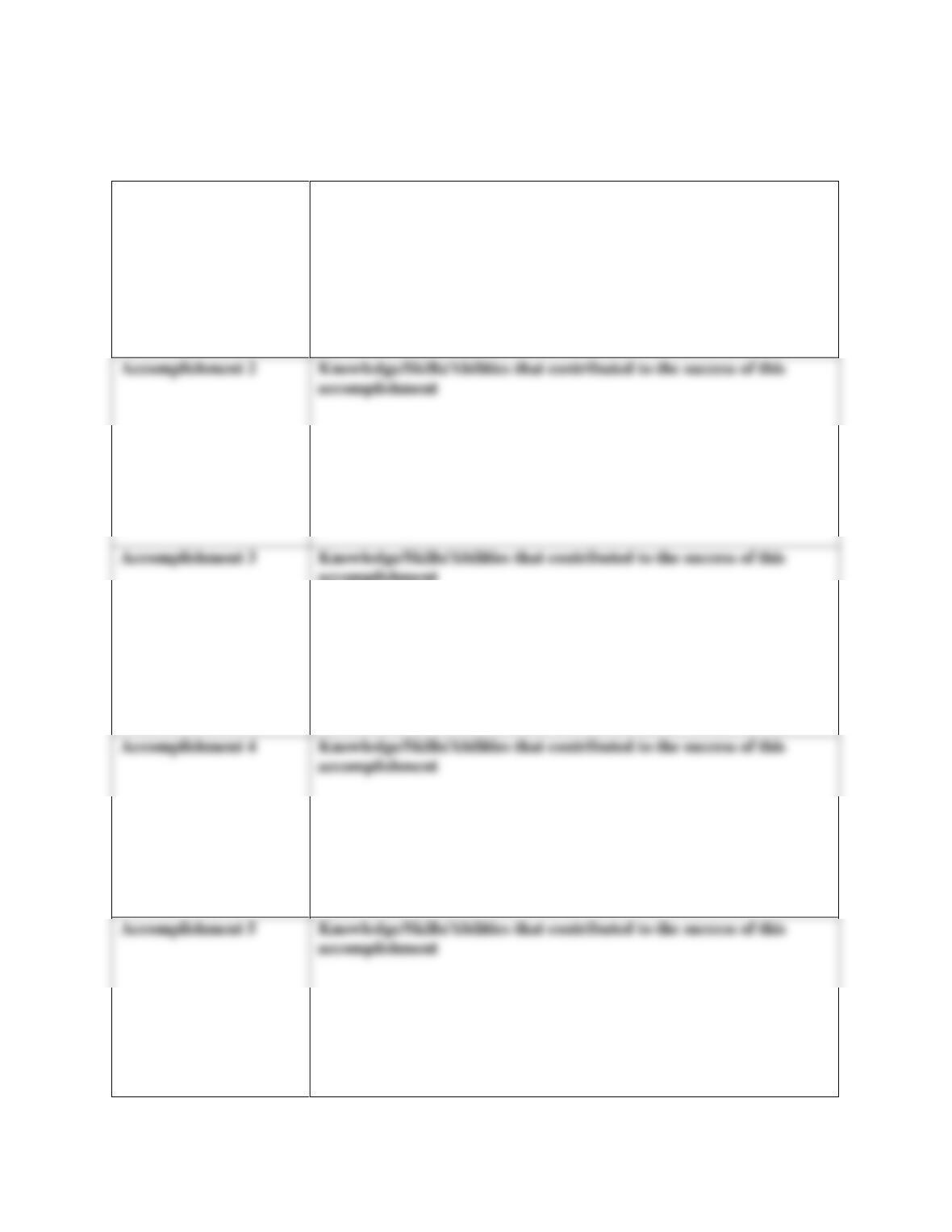
2. KSAs: Knowledge, skills, and abilities (KSAs) are classic concepts deconstructed and
used throughout management education and training. In this case we want to break down
the KSAs that led to the listed accomplishments. The second handout simply makes space
for each student to list the accomplishments from the first handout and leaves room for a
detailed description of the knowledge, skills, and abilities that were needed to achieve the
accomplishment. Students should complete this for each accomplishment.
Students should now spend some time reflecting on the accomplishments and KSAs that underlie
them by highlighting or circling the KSAs that they believe had the most influence on their
success.
“Take a look at all you have now done in these two short exercises. You are likely to see overlap,
connections, or interesting combinations. Are there indicators of categories where you think you
possess unique experience? Do you have special understanding of a specific activity or set of
activities or a specific category of knowledge that has been a recurring theme throughout your
accomplishments?”
Pre-Work Required by Students
Students need to complete the self-understanding handout prior (see end of this teaching note) to
coming to class. On arrival the students should have a foundation from which they can begin to
develop entrepreneurial ideas based upon who they are, what they can do, and who they know.
They should bring the completed worksheet to class.
Theoretical Foundations
Fiet, J. (1996). The informational basis for entrepreneurial discovery. Small Business Economics,
8, 419–430.

Instructor Resource
Neck, Neck, & Murray, Entrepreneurship: The Practice and Mindset
SAGE Publications, 2018
3
Time Plan (75 Minutes)
Introduction and (re-)reflection 0:00–0:05 (5 minutes)
Start the session by introducing the objectives of the session; then provide 2–3 minutes for the
students silently and individually to reexamine their worksheets in class to familiarize
themselves with what they did and to get their minds back into the exercise.
Discussion 0:05–0:20 (15 minutes)
Begin the discussion by asking students to share their observations about their reflections:
Who found this process difficult? Why?
Who found it easy?
Enjoyable?
How did you approach this exercise?
Was it hard to identify skills, capabilities, or knowledge?
What criteria did you use to determine the capabilities, skills, or knowledge?
Transition 0:20–0:25 (5 minutes)
To make a connection between self-understanding and entrepreneurship, ask: What are the
connections between self-understanding and entrepreneurship?
Group work 0:25–0:45 (20 minutes)
Students should then be put into groups to share their themes, KSAs, and desires. Many
entrepreneurship courses require students to work in teams on either feasibility plans or business
planning. This class session serves as a great way for students to kick off their work together and
develop their “group means.” Groups can be composed randomly or, if students have e-mailed
their key themes to the instructor in advance of the class, they can be predetermined based on
commonalities in KSAs. The group assignment should cover the following:
Report-out from group work 0:45–1:05 (20 minutes)
The group report may include the following activities and discussion questions:
Instructor Resource
Neck, Neck, & Murray, Entrepreneurship: The Practice and Mindset
SAGE Publications, 2018
4
Ask all the teams to present their ideas without discussion.
Debrief on the process: How long did it take to identify similarities or differences?
Wrap-up 1:05–1:15 (10 minutes)
A final wrap-up should focus again on the importance of self-understanding and how it provides
Post-Work
A follow-up discussion in the next class can focus on how the students or student groups are
going to use their combined network (from their network worksheet) to help them investigate the
feasibility of their proposed venture concept.
Key Takeaways
• This exercise helps students reflect on the importance of understanding oneself in relation
Teaching Tips
Ideally, if students can e-mail their three key themes to the instructor before class, this can serve
as the basis for forming groups (based on common KSAs), which is often more productive.
In making the connection between self-understanding and entrepreneurial ventures, instructors
can bring in a few brief slides to explain the bird-in–hand principle from Sarasvathy’s (2001)
effectuation work. The goal is to reinforce that anyone can develop and create by starting with
their means: Who am I? What do I know? Who do I know?
You should remind your students prior to completing their handouts that awards are not
Attribution

Instructor Resource
Neck, Neck, & Murray, Entrepreneurship: The Practice and Mindset
SAGE Publications, 2018
5
Worksheet:
Instructor Resource
Neck, Neck, & Murray, Entrepreneurship: The Practice and Mindset
SAGE Publications, 2018
6
Charting Your Personal Accomplishments with Skills and Abilities
Accomplishment 1
Knowledge/Skills/Abilities that contributed to the success of this
accomplishment
accomplishment