Section 4.5 Systems of Linear Equations in Three Variables
44. Let x = the number of $2 packages sold.
Let y = the number of $3 packages sold.
Let z = the number of $4 packages sold.
12
612 24162
2 3 4 35
xyz
xyz
xy z
++=
++=
++ =
The system of two equations in two variables is as
follows.
61890
2 11
yz
yz
+=
+=
Multiply the second equation by –6 and add to the
first equation.
Back-substitute 3 for y and 4 for z in one of the
original equations in three variables.
12
34 12
7 12
5
xyz
x
x
x
++=
++ =
+=
=
There were 5 $2 packages, 3 $3 packages, and 4 $4
45. Let A = the number of servings of A.
Let B = the number of servings of B.
Let C = the number of servings of C.
40 200 400 660
5 2 4 25
30 10 300 425
ABC
AB C
ABC
++ =
++ =
++=
2 276 275
BC
−+ =
The system of two equations in two variables
becomes:
184 368 460
2 276 275
BC
BC
+=
−+ =
Multiply the second equation by 92 and eliminate B.
1
2
B
=
Back-substitute 1 for C and
1
2
for B in one of the
original equations in three variables.
()
524 25
1
52 4125
2
ABC
A
++=
++=
Chapter 4 Systems of Linear Equations
46. Let C = the number of Children’s desks.
Let O = the number of Office desks.
Let D = the number of Deluxe desks.
Multiply the third equation by –2 and add to the
second.
2 3 100
224 130
30
COD
COD
OD
++=
−− − =−
−− =−
The system of two equations in two variables is as
follows.
230
30
OD
OD
−=−
−− =−
Add the equations to eliminate O.
Back-substitute 20 for D and 10 for O in one of the
original equations in three variables.
()
2 65
10 2 20 65
10 40 65
50 65
15
CO D
C
C
C
C
++ =
++ =
++ =
+=
=
Each week, the company should produce 15
Children’s models, 10 Office models and 20 Deluxe
models.
55. does not make sense; Explanations will vary. Sample
explanation: A system of linear equations in three
variables can contain an equation of the form
number of other ordered triples which satisfy the
equation.
59. false; Changes to make the statement true will vary.
A sample change is: The equation is not satisfied by
the given point.
()
6
2356
235 6
06,false
xyz−−=−
−− − =−
+−=−
=−
()
Rewrite the system in standard form as
180
2175
2185
xyz
xy
xz
++=
+=
+=
Multiply the first equation by
1−
and add to the
second equation to obtain an equation with two
variables.
180
2 175
xyz
xy
−− − =−
+=
Section 4.5 Systems of Linear Equations in Three Variables
63. Let t = the number of triangles.
Let r = the number of rectangles.
Let p = the number of pentagons.
From the problem, we have the following three
equations.
40
34 5 153
25 72
tr p
trp
rp
++ =
++ =
+=
Multiply the first equation by –3 and add it to the
second to eliminate t.
Multiply the second equation by –2 and add to
eliminate r.
25 72
24 66
6
rp
rp
p
+=
−− =−
=
Back-substitute 6 for p in one of the equations in
two variables.
233
rp
+=
28
260
30
xyz
x
x
−+=
=
=
The height of the table is 30 centimeters.
65.
33
4
yx
=− +
Use the slope and the y–intercept to graph the line.
26
yx
=+
Use the slope and the y–intercept to graph the line.
Chapter 4 Systems of Linear Equations
Chapter 4 Review Exercises
1.
() ( )
49
41 5 9
45 9
99, true
xy−=
−− =
+=
=
2.
() ()
23 4
25 32 4
10 6 4
44, true
xy+=−
−+ =−
−+=−
−=−
{
}
3.
2
13 2
22, true
xy+=
−+ =
=
{
}
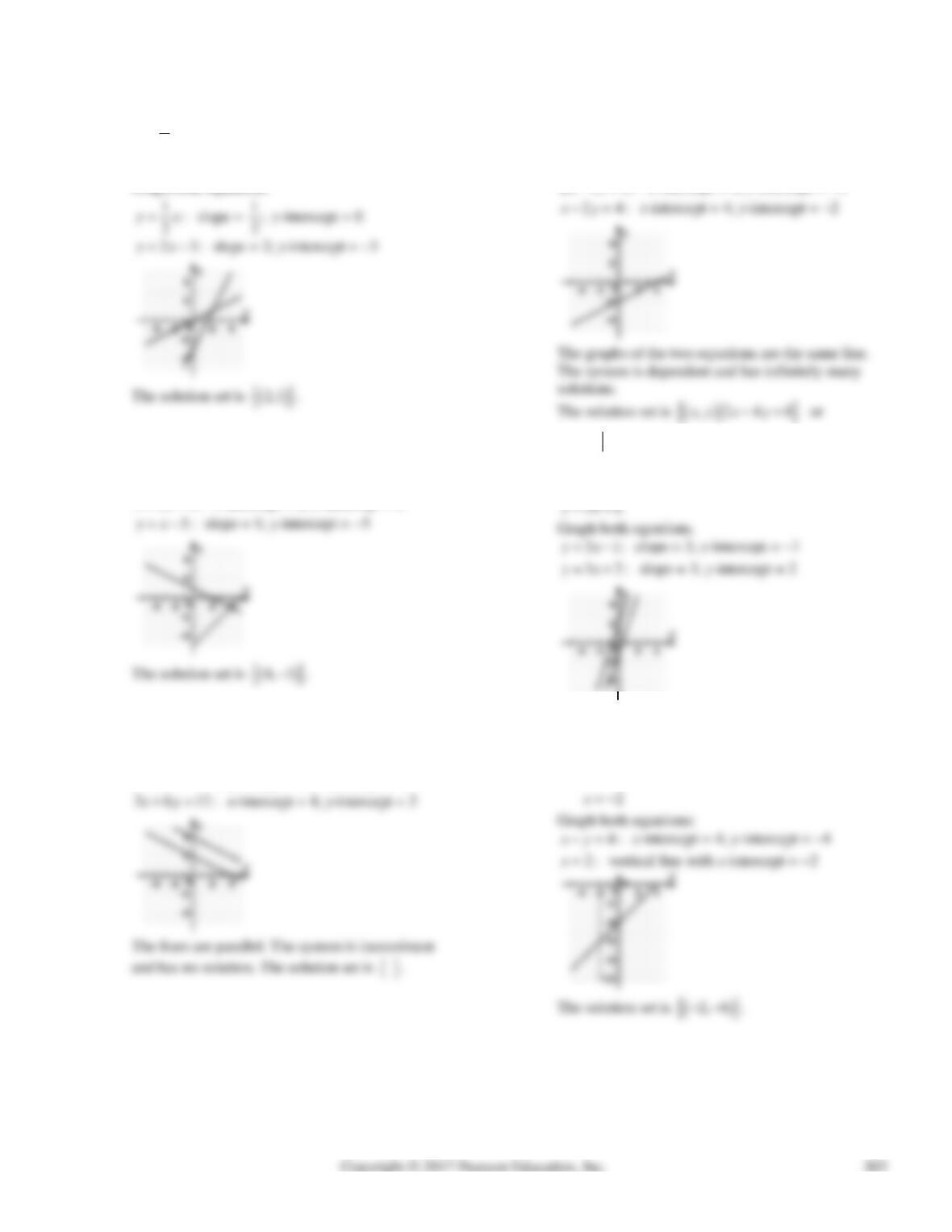
25
xy+=−
6:xy−= x-intercept = 6, y-intercept = −6
x
y
-4 -2 2 4
-4
-2
2
4
0
The solution set is
()
{
}
4, 2 .−
x
y
-4 -2 2 4
-4
-2
2
4
0
32 6:xy−=
x-intercept = 2; y–intercept = −3
x
y
-4 -2 2 4
-2
2
4
0
Chapter 4 Review Exercises
7.
1
2
23
yx
yx
=
=−
Graph both equations.
8.
22
5
xy
yx
+=
=−
Graph both equations.
22:xy+=
x-intercept = 2; y–intercept = 1
9.
28
36 12
xy
xy
+=
+=
Graph both equations.
28:xy+=
x-intercept = 8; y–intercept = 4
{
}
10.
24 8
24
xy
xy
−=
−=
Graph both equations.
24 8:xy−=
x-intercept = 4; y–intercept = −2
()
{
}
,24.
xy x y
−=
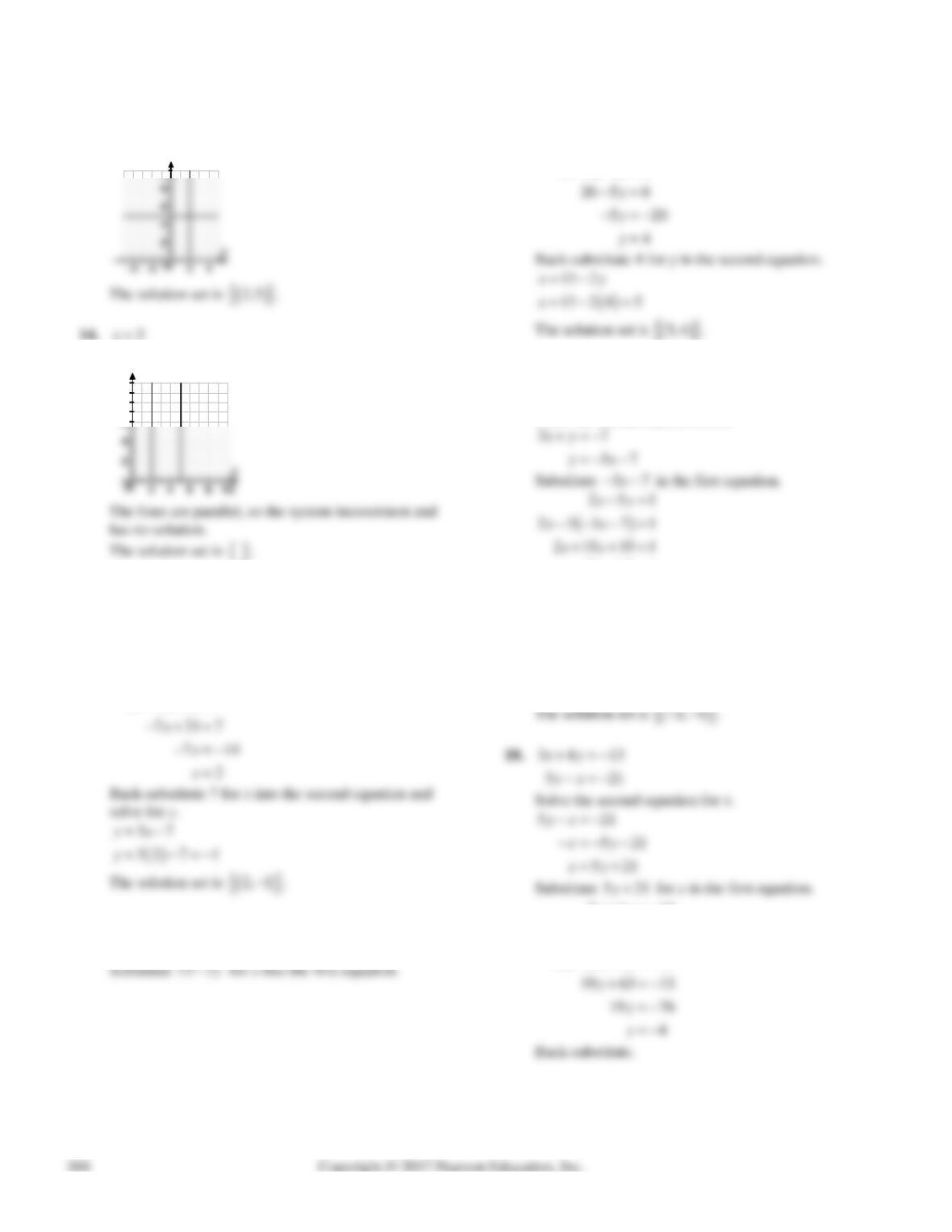
11.
31
yx
=−
The lines are parallel, so the system is inconsistent
and has no solution. The solution set is
{
}
.
12.
4
xy
−=
Chapter 4 Systems of Linear Equations
13.
2
5
x
y
=
=
y
10
5
x
=
y
6
8
10
15.
23 7
37
xy
yx
−=
=−
Substitute
37
x
−
for y in the first equation.
()
23 7
23377
29217
xy
xx
xx
−=
−−=
−+=
16.
26
13 2
xy
xy
−=
=−
()
26
213 2 6
26 4 6
xy
yy
yy
−=
−−=
−−=
17.
251
37
xy
xy
−=
+=−
Solve the second equation for y.
17 35 1
17 34
2
x
x
x
+=
=−
=−
Back-substitute in the equation 37yx=− − .
()
37
32 7 1
yx
y
=− −
=− − − =−
()
34 13
35 21 4 13
15 63 4 13
xy
yy
yy
+=−
++=−
++ =−
Chapter 4 Review Exercises
34 13
xy
+=−
The solution set is
()
{
}
1, 4 .−
19.
39 3
261
yx
yx
=−
=−
Substitute
261
x
−
for y in the first equation.
{
}
20.
45
12 3 15
xy
xy
+=
+=
Solve the first equation for y.
Substitute
45
x
−+
for y in the second equation.
12 3 15
xy
+=
21.
4210
23
xy
yx
−=
=+
Substitute
23
x
+
for y in the first equation.
4210
xy
−=
22.
40
x
−=
()
92 0
94 2 0
36 2 0
236
xy
y
y
y
−=
−=
−=
−=−
1
2
yx
=
Substitute
1
2
x for y in the second equation.
72 8
1
72 8
2
xy
xx
+=−
+=−
2
24. a. Demand model: 50 2000px=− +
Supply model: 50px=
Use the substitution method.
Chapter 4 Systems of Linear Equations
Back-substitute 20 for x and find p.
50
50(20) 1000
px
p
=
==
25.
6
28
xy
xy
+=
+=
Multiply the first equation by −1 and add the result
to the second equation to eliminate the y-terms.
6xy−− =−
{
}
26.
34 1
12 11
xy
xy
−=
−=−
Multiply the first equation by −4 and add the result
to the second equation.
12 16 4xy−+ =−
12 11
xy
−=−
27.
37 13
65 7
xy
xy
−=
+=
()
37113
3713
36
2
x
x
x
x
−−=
+=
=
=
Back-substitute.
()
84 16
84216
8816
824
3
xy
x
x
x
x
−=
−=
−=
=
=
()
5218
528
510
2
x
x
x
x
−=
−=
=
=
The solution set is
()
{
}
2,1 .
Chapter 4 Review Exercises
30.
27 0
72 0
xy
xy
+=
+=
Multiply the first equation by 7.
Multiply the second equation by −2.
14 49 0
xy
+=
{
}
A
31.
34
32 3
xy
xy
+=−
+=
Multiply the first equation by −3.
39 12xy−− =
−3.
26 8xy+=−
96 9
xy
−− =−
7
x
−
= −17
x =
17
7
The solution set is
17 15
,.
77
−
33.
34 1
68 2
xy
xy
−=−
−+ =
Multiply the first equation by 2.
68 2xy−=−
28 24xy−=
Multiply this equation by 3.
Multiply the second equation by −2.
624 72xy−=
610 4
yy
−− =−
The solution set is
()
{
}
4, 2 .−
35.
57 2
34
xy
xy
−=
=
Rewrite the second equation in the form
.
A
xByC+=
34 0xy−=
Multiply this equation by −5.
Multiply the first equation by 3.
Chapter 4 Systems of Linear Equations
Back-substitute.
The solution set is
()
{
}
8, 6 .−−
36.
34 8
23 5
xy
xy
+=−
+=−
Multiply the first equation by 2.
Multiply the second equation by −3.
68 16xy+=−
37.
68 39
22
xy
yx
+=
=−
Substitute
22
x
−
for y in the first equation.
68 39
xy
+=
2
the system.
22
5
22523
2
yx
y
=−
=−=−=
38.
27
xy
+=
2
y
=
Back-substitute.
()
27
22 7
47
3
xy
x
x
x
+=
+=
+=
=
1
232
2
y
=−=−
The solution set is
1,2 .
2
−
()
32 6 7
66 7
07
yy
yy
−=
−=
=
The false statement indicates that the system has no
Chapter 4 Review Exercises
41.
70
73 0
y
xy
−=
−=
Solve the first equation for y.
70
7
y
y
−=
=
42. Let x=the selling price for Klint’s work.
Let
y=
the selling price for Picasso’s work.
239
31
xy
xy
+=
−=
Add the equations to eliminate y and solve for x.
239
xy
+=
43. Let x = the cholesterol content of one ounce of shrimp
(in milligrams).
Let y = the cholesterol content in one ounce of scallops.
32 156
53 30045
xy
xy
+=
+= −
3 2 156
3(42) 2 156
126 2 156
230
xy
y
y
y
+=
+=
+=
=
43 21
xy
−=
Multiply the first equation by −2.
44 56xy−+ =−
43 21xy−=
735
5
y
y
−=−
=
Let y = the width of the garden.
The perimeter of the garden is 24 yards, so
2 2 24.xy+=
Since there are two lengths and two widths to be
fenced, the information about the cost of fencing
leads to the equation
() ()
32 22 62.xy+=
5
y
=
The length of the garden is 7 yards and the width is
5 yards.
Chapter 4 Systems of Linear Equations
46. Let x = daily cost for room.
Let y = daily cost for car.
First plan: 32 360xy+=
Second plan: 43 500xy+=
Multiply the first equation by 3.
47. Let x = the number of gigabytes used.
Let y = the total monthly cost.
Plan A: 20yx=
48. Let x = the number orchestra tickets.
Let y = the number balcony tickets.
9
90 60 720
xy
xy
+=
+=
Solve the first equation for y.
9
9
xy
yx
+=
=− +