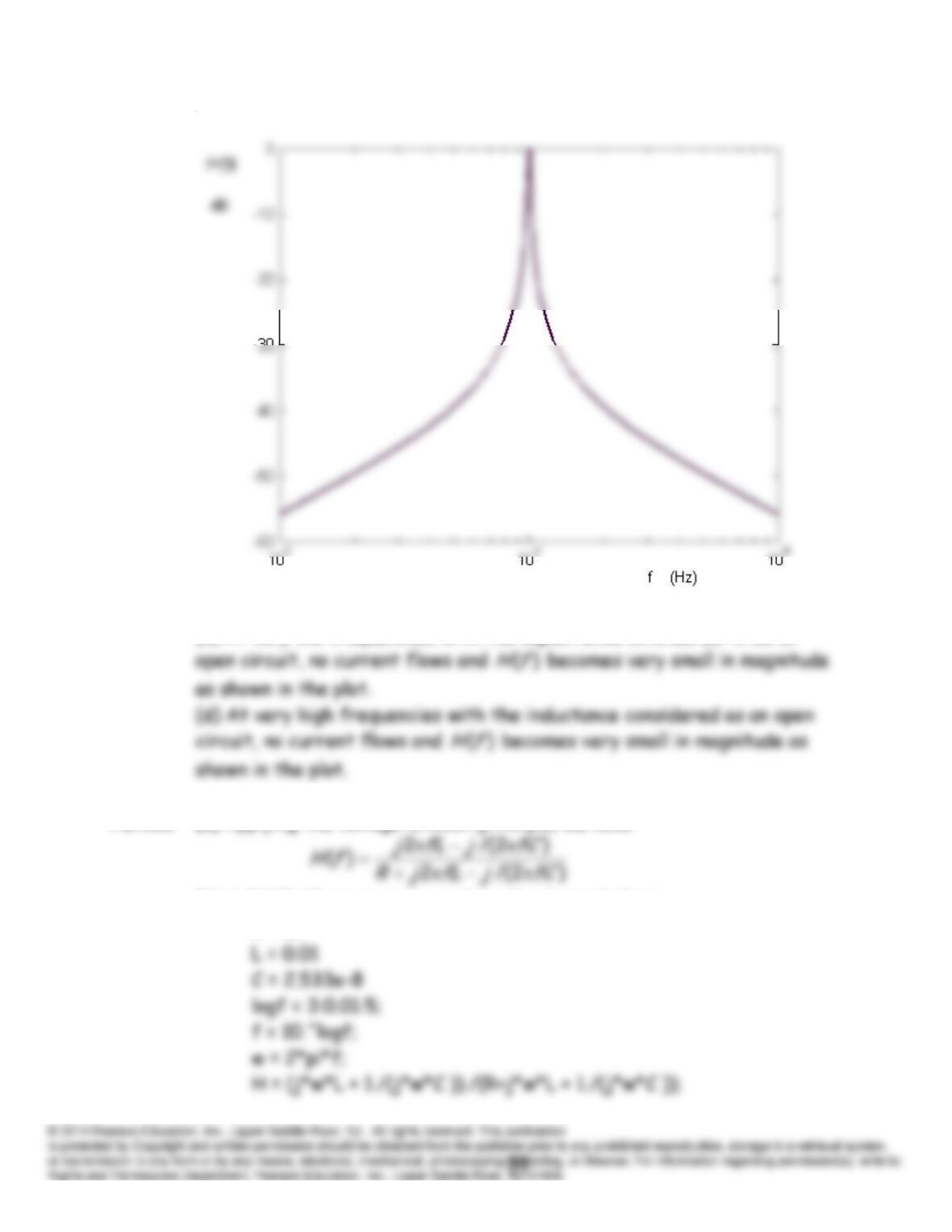
(c) At very low frequencies, with the capacitance considered to be an
P6.101 (a) Applying the voltage-division principle, we have
(b) A MATLAB program to produce the desired plot is
R = 10
semilogx(f,20*log10(abs(H)))
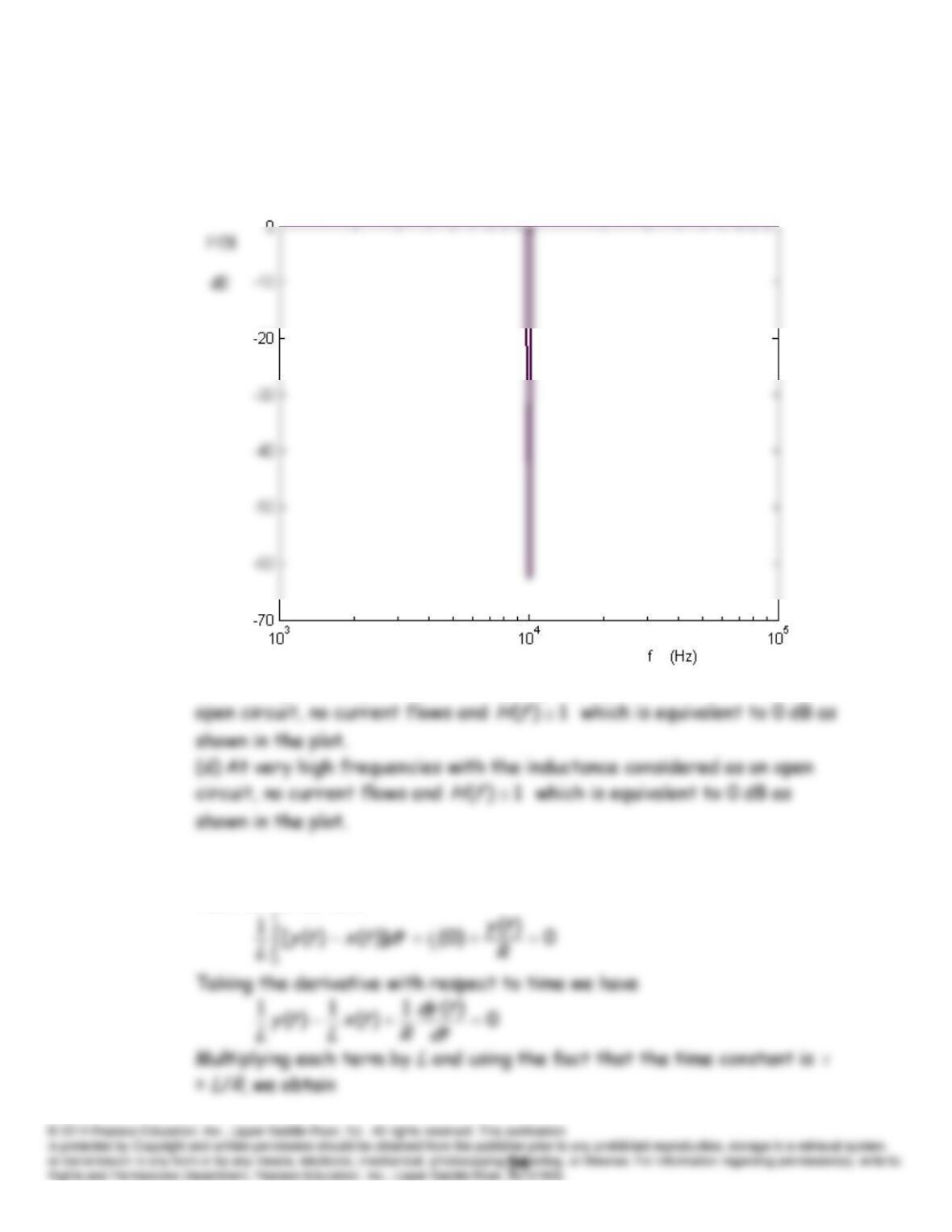
The resulting plot is
(c) At very low frequencies, with the capacitance considered to be an
P6.102 (a) Writing a current equation at the node joining the inductance and
resistance, we have
Then we approximate the derivative and write the following
approximation to the differential equation.
Solving for
y
(
n
), we obtain the equation for the digital filter:
(b) For the values given the time constant is
ms. 20/
RL
τ
The step
input is
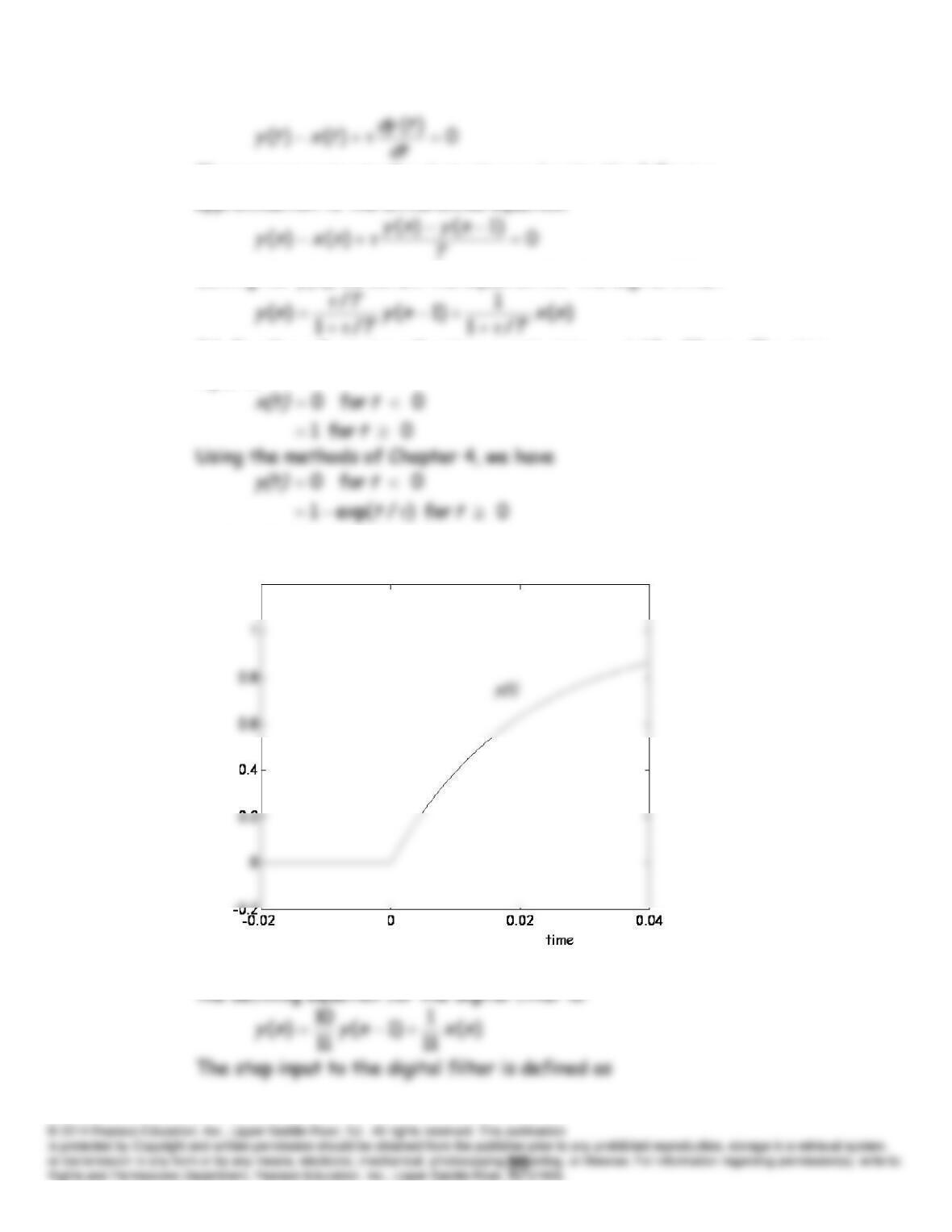
A plot of
y
(
t
) versus
t
is:
(c) The sampling interval is T = 1/500 = 2 ms, and we have /T = 10. Thus
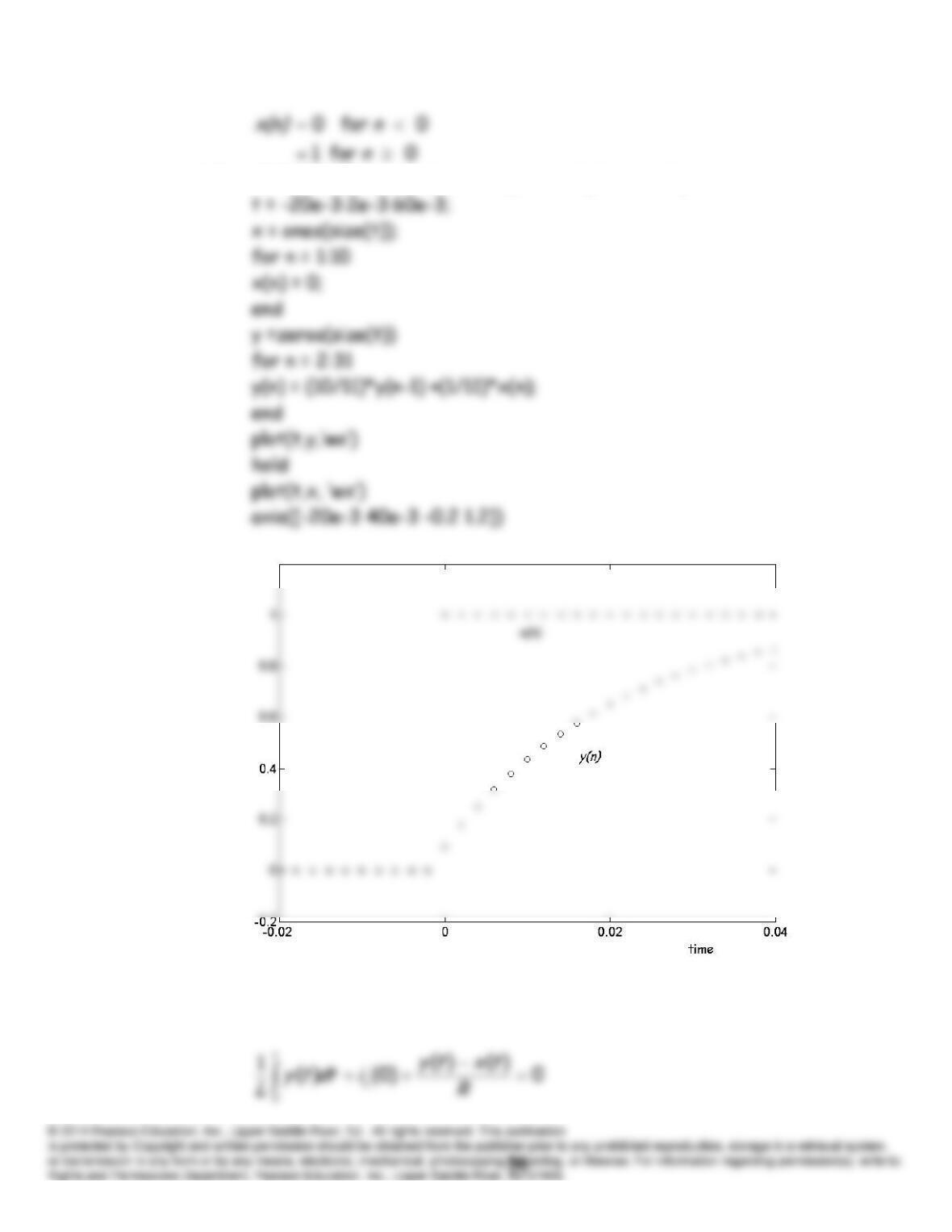
A list of MATLAB commands to compute and plot x and y is:
P6.103 (a) Writing a current equation at the node joining the inductance and
resistance, we have
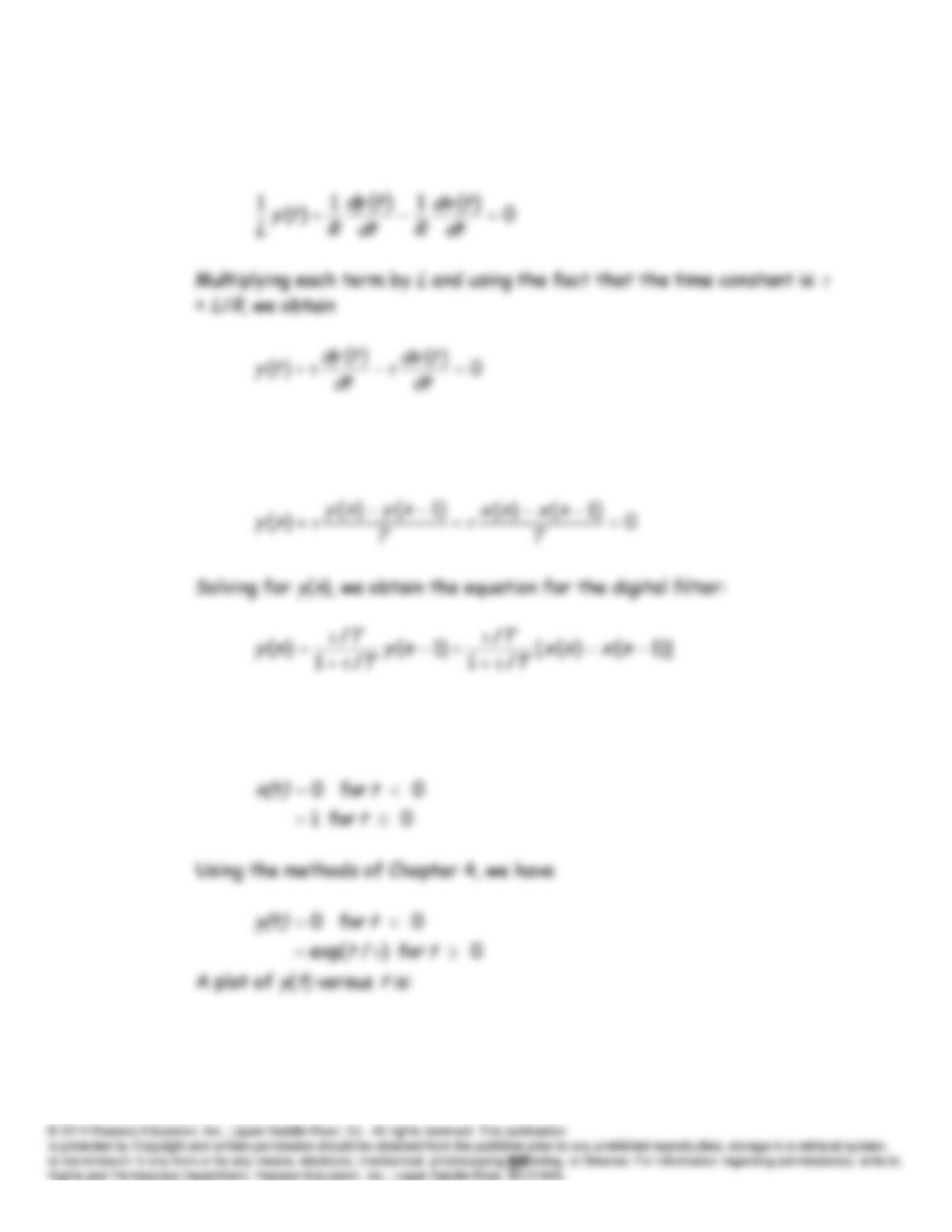
Taking the derivative with respect to time we have
Then we approximate the derivatives and write the following
approximation to the differential equation.
(b) For the values given the time constant is
ms. 20/
RL
τ
The step
input is
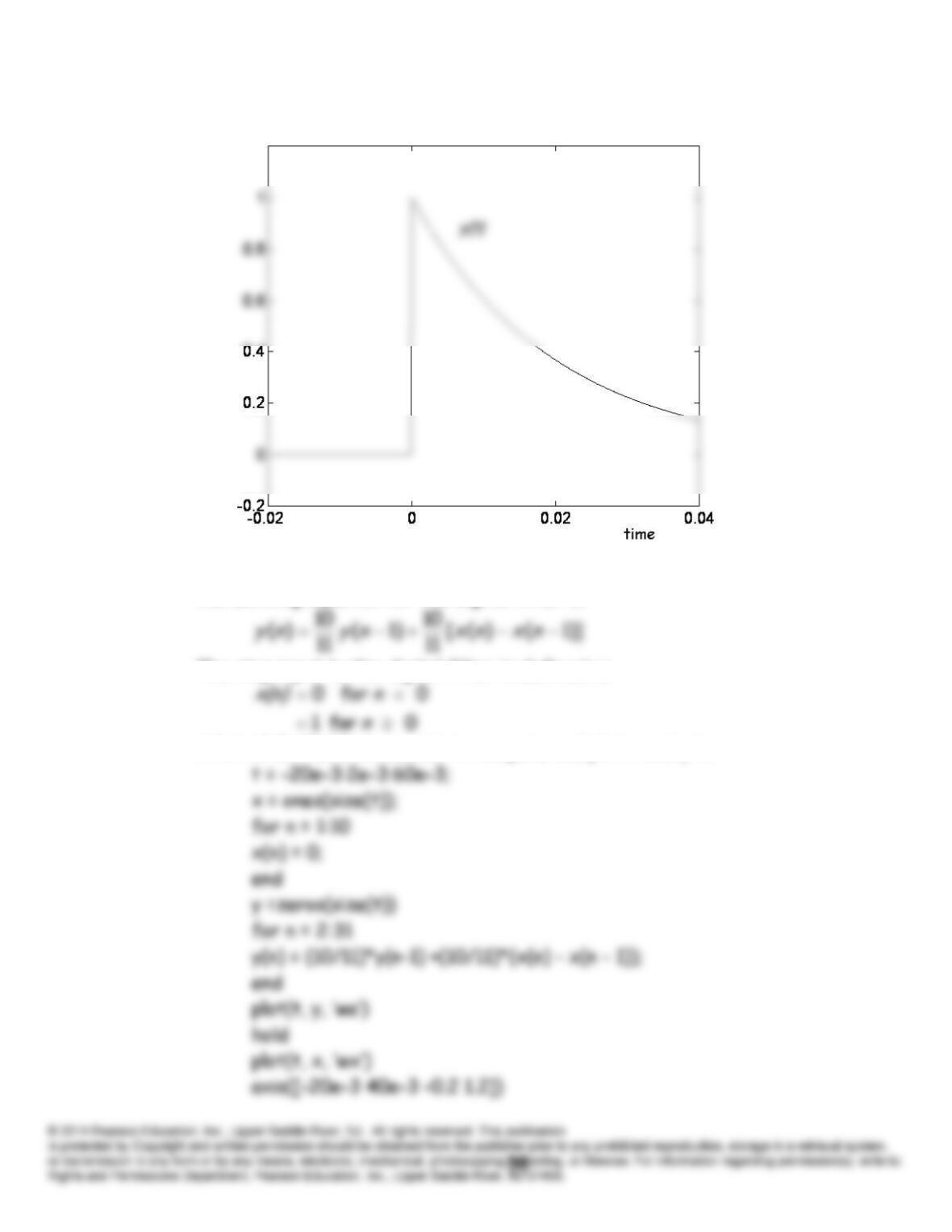
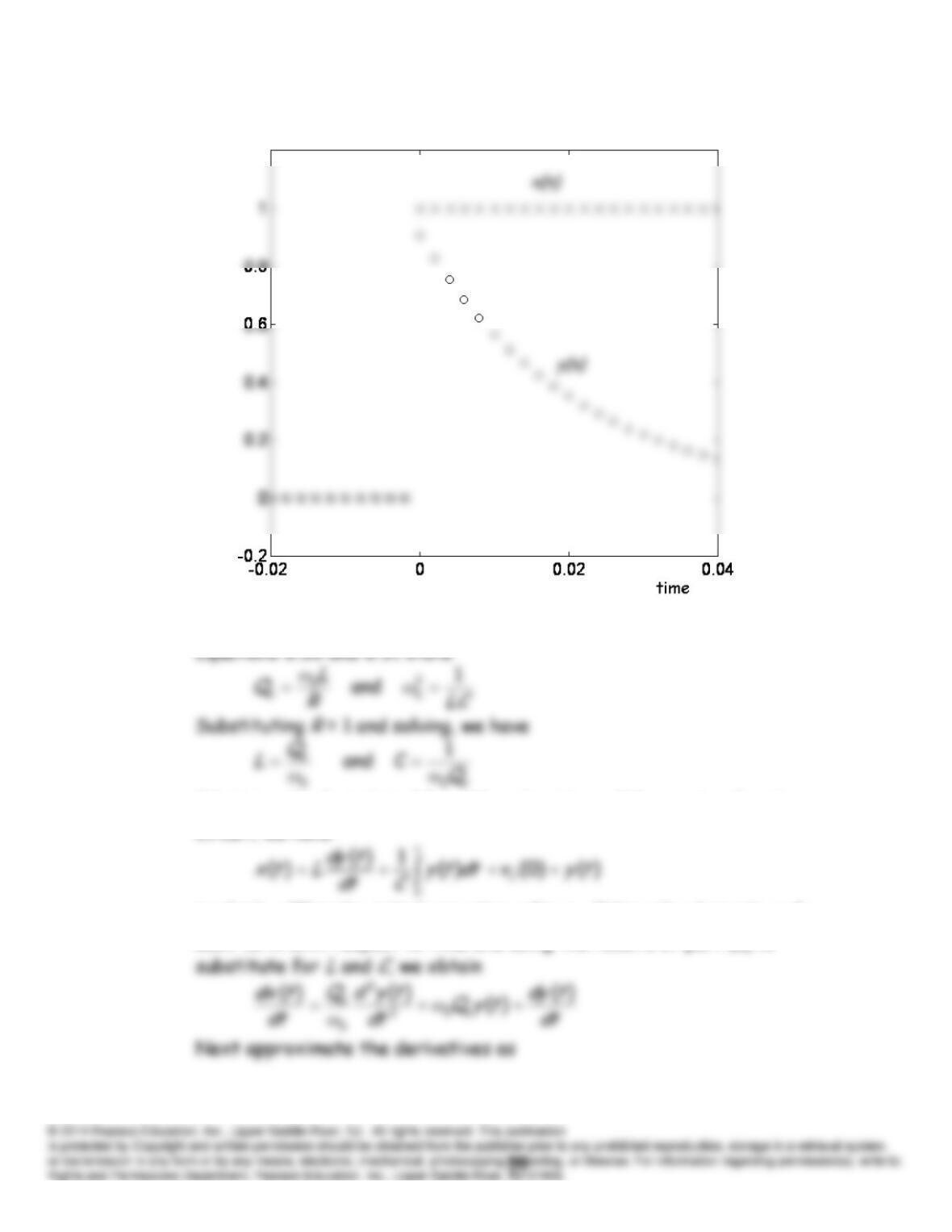
(c) The sampling interval is T = 1/500 = 2 ms, and we have /T = 10. Thus
the defining equation for the digital filter is:
The step input to the digital filter is defined as
A list of MATLAB commands to compute and plot x and y is:
P6.104* (a) Refer to Figure P6.104 in the book. This is a series
RLC
circuit.
(b) Using the fact that
i
(
t
) =
y
(
t
), and writing a KVL equation for the
circuit, we have
in which
vC
(0) is the initial capacitor voltage. Taking the derivative of
each term with respect to time and using the results of part (a) to
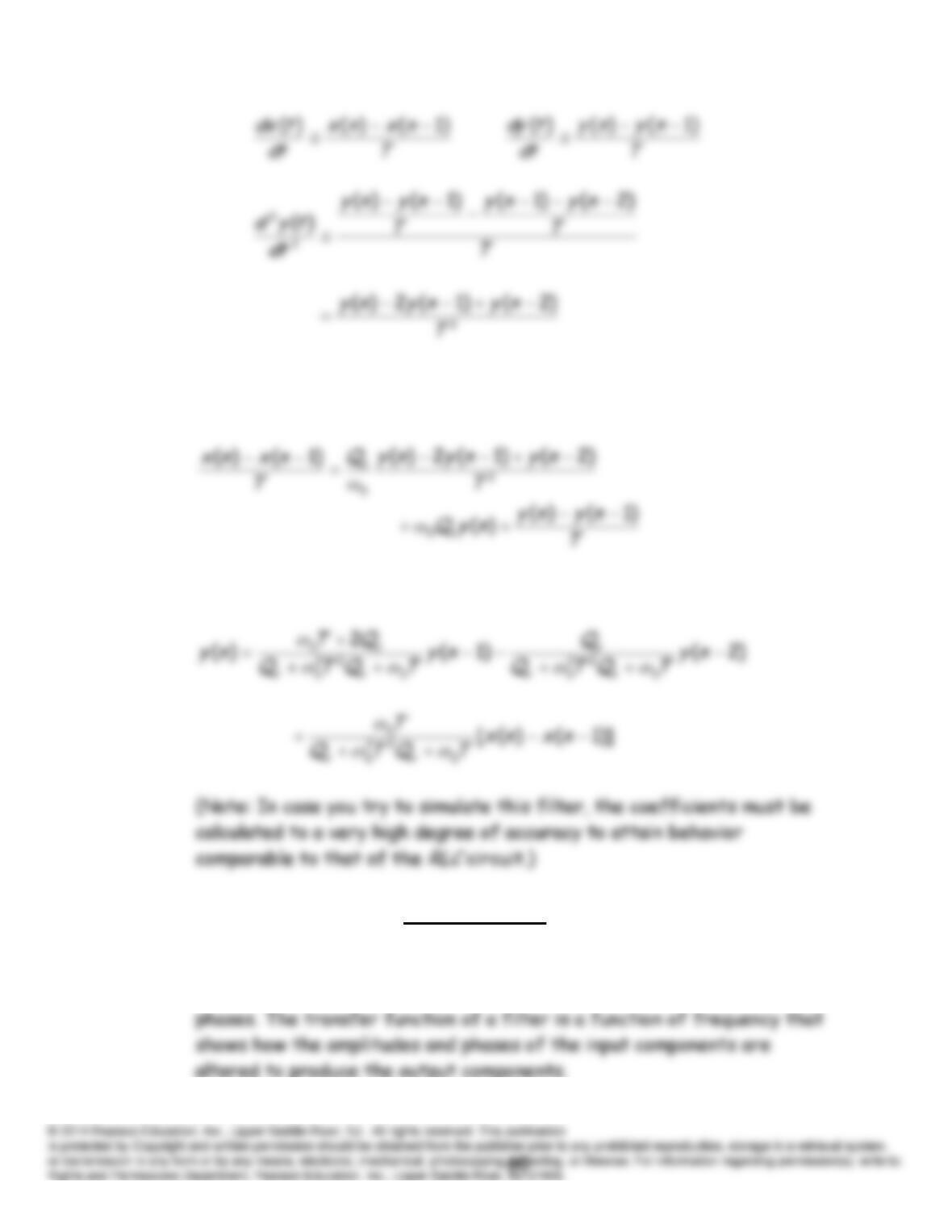
This yields the discrete equation
Solving for
y
(
n
) yields the equation for the equivalent digital filter.
Practice Test
T6.1 All real-world signals (which are usually time-varying currents or
voltages) are sums of sinewaves of various frequencies, amplitudes, and
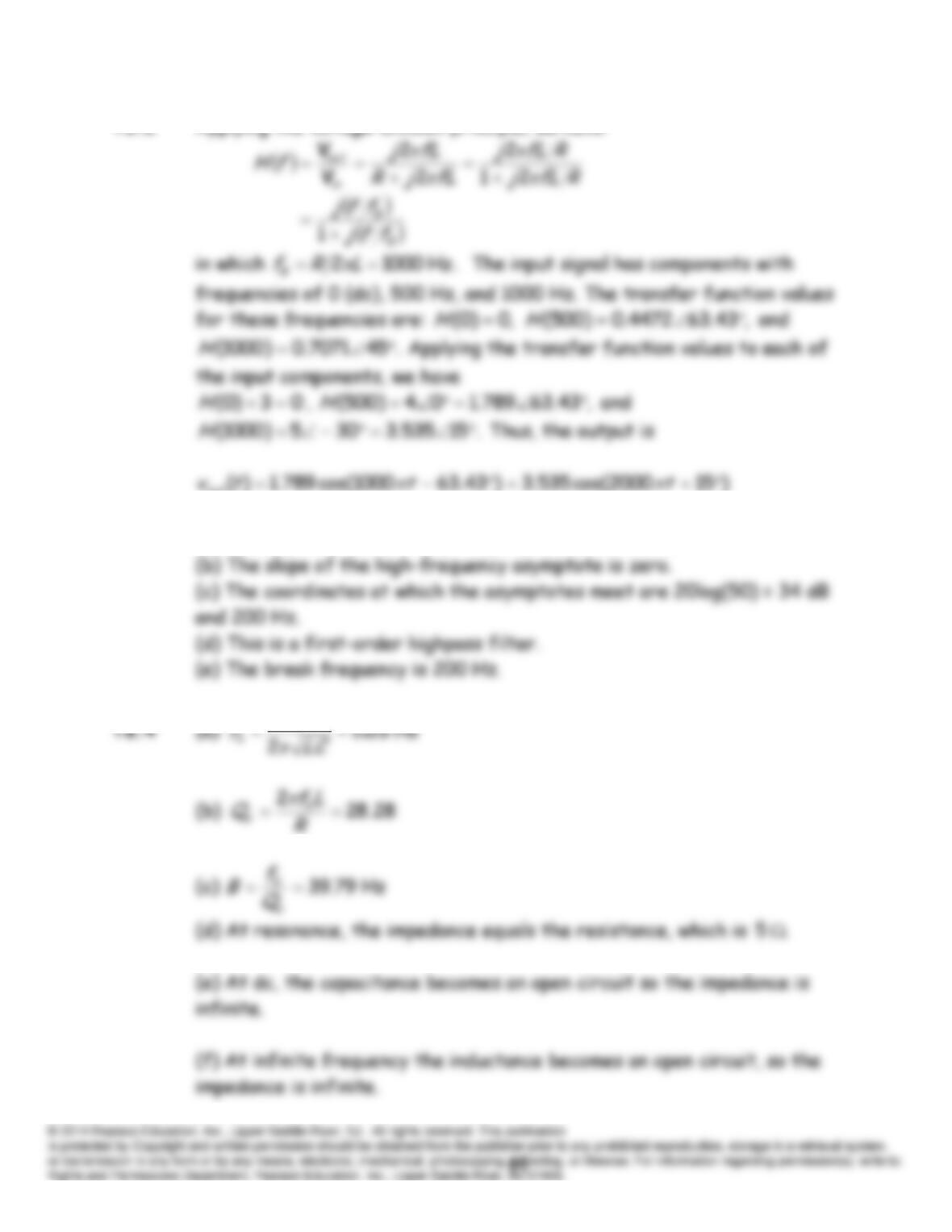
T6.2 Applying the voltage-division principle, we have:
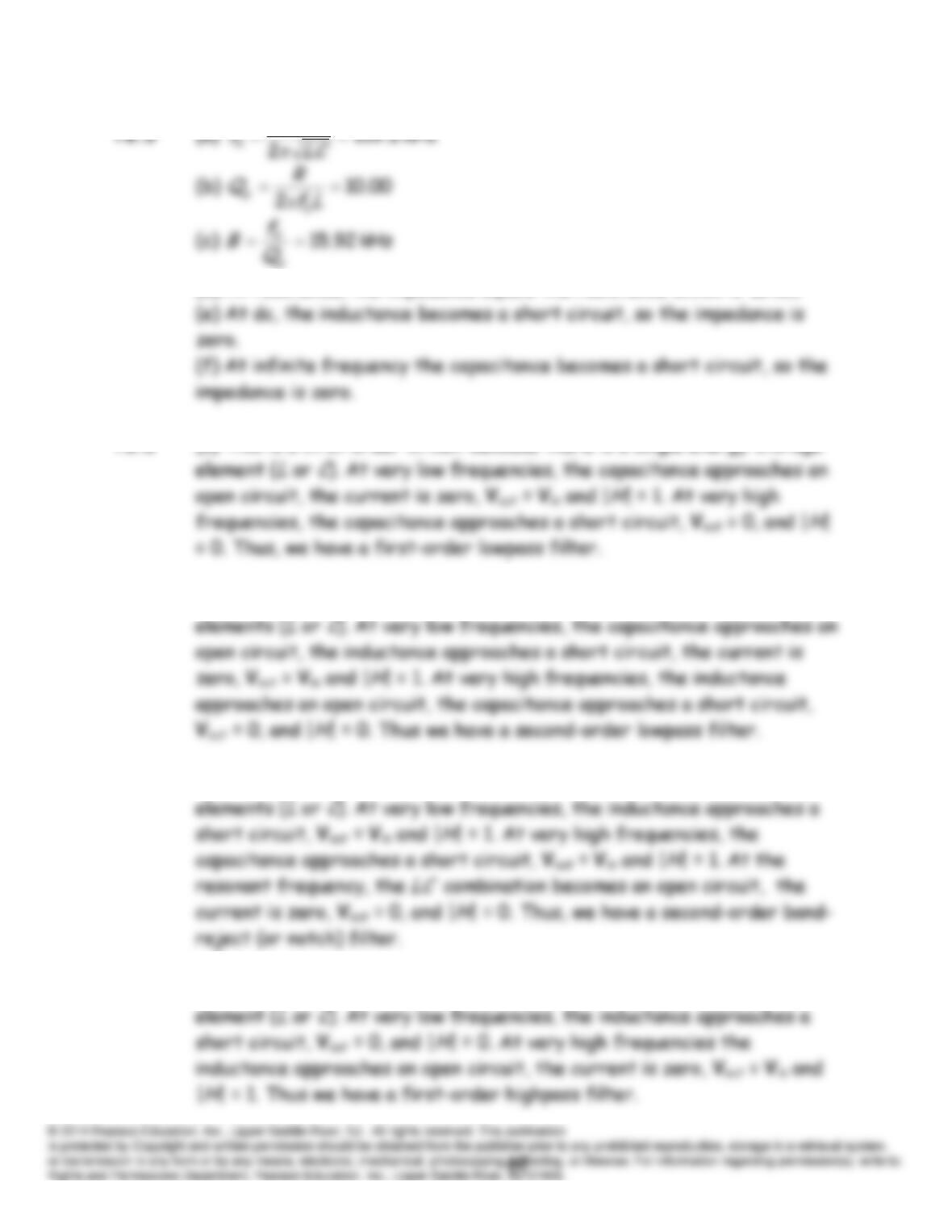
T6.3 (a) The slope of the low-frequency asymptote is +20 dB/decade.
1
1
(d) At resonance, the impedance equals the resistance which is
.k 10
T6.6 (a) This is a first-order circuit because there is a single energy-storage
(b) This is a second-order circuit because there are two energy-storage
(c) This is a second-order circuit because there are two energy-storage
(d) This is a first-order circuit because there is a single energy-storage
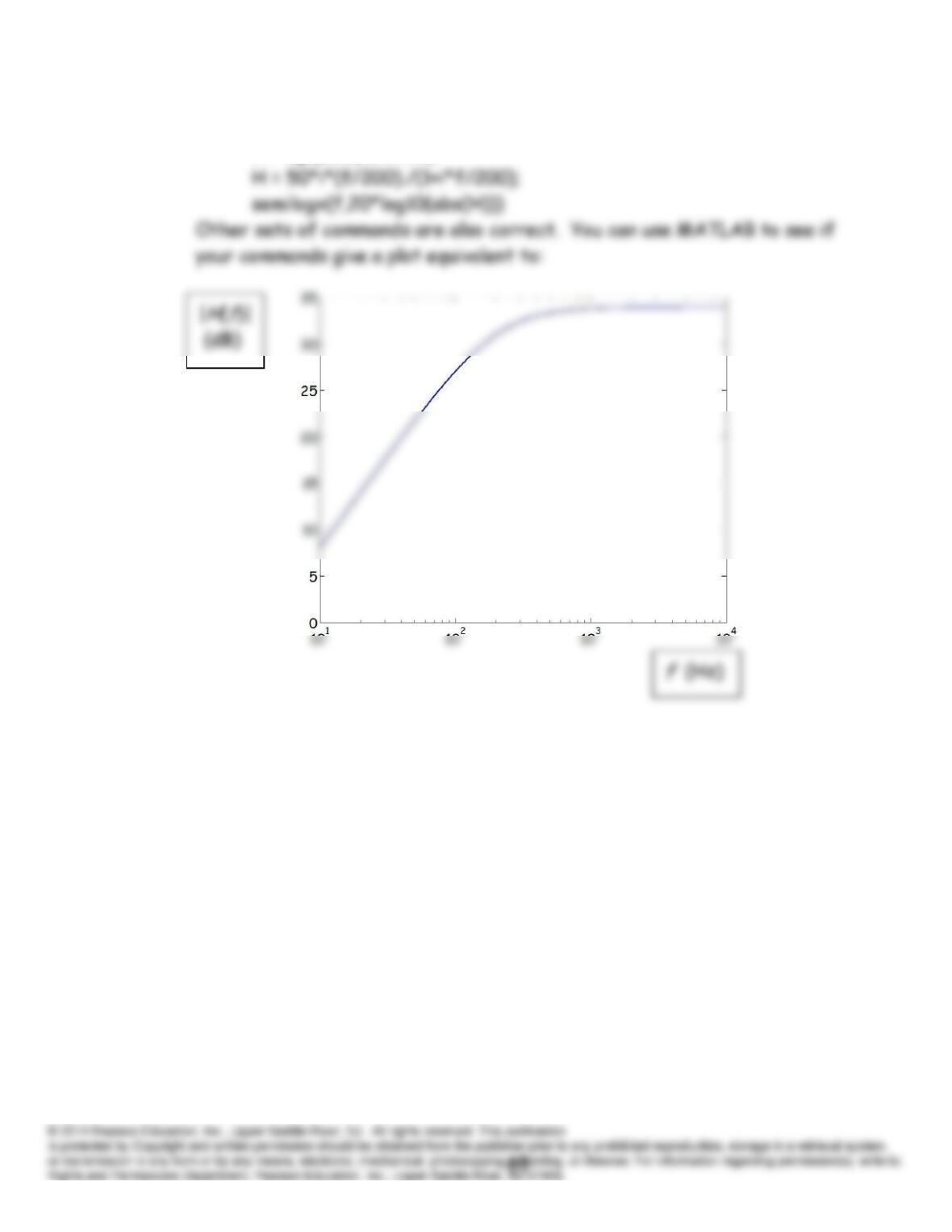
T6.7 One set of commands is:
f = logspace(1,4,400);