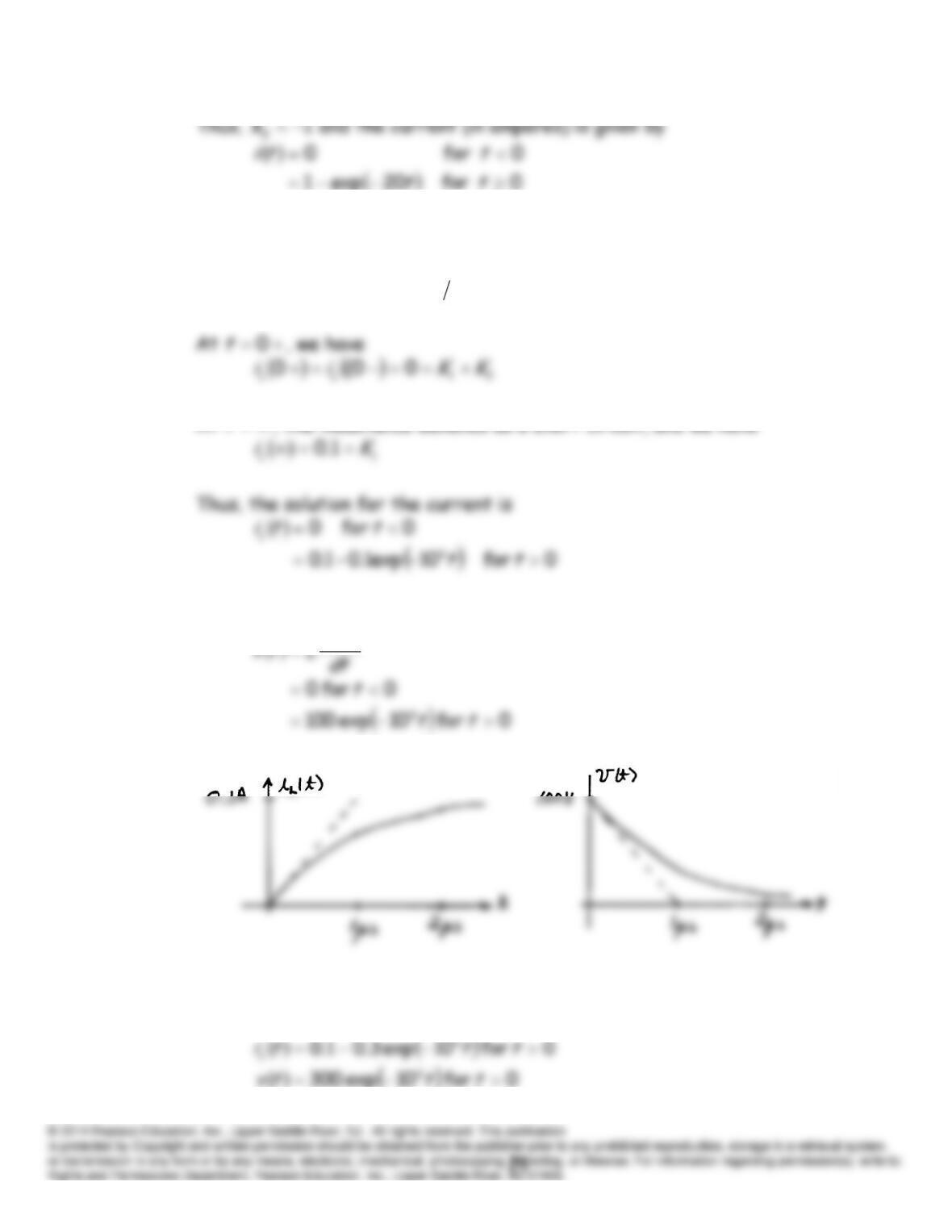
P4.34 The general form of the solution is
LtRKKtiL
exp
21
At
t
, the inductance behaves as a short circuit, and we have
The voltage is
tdi
P4.35* The solution is similar to that for Problem P4.34.
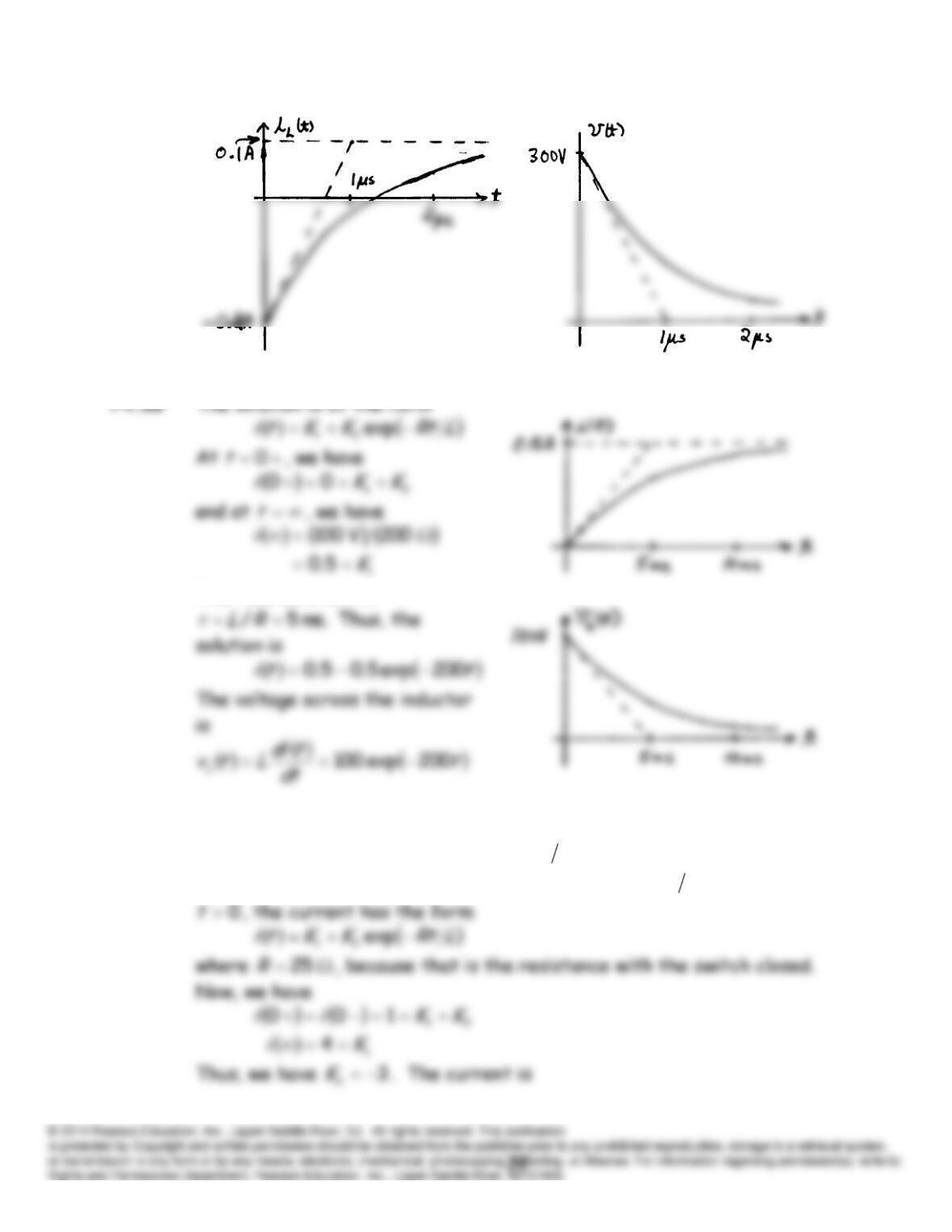
The time constant is
P4.37 In steady state, the inductor acts as a short circuit. With the switch
open, the steady-state current is
A 1 100V 100
. With the switch
closed, the current eventually approaches
A 4 25V 100
i
. For
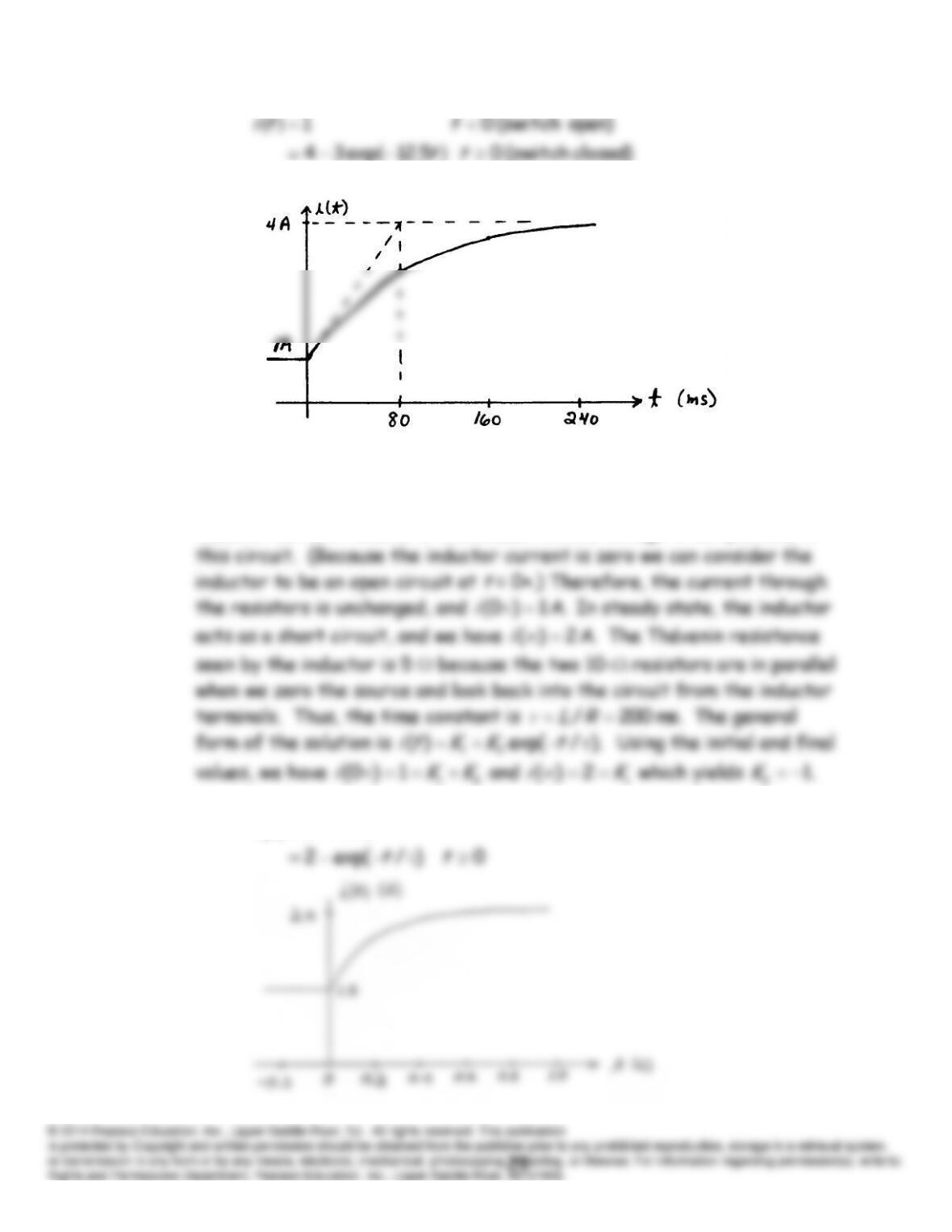
P4.38 Before the switch closes, 1 A of current circulates through the source
and the two 10- resistors. Immediately after the switch closes, the
inductor current remains 0 A, because infinite voltage is not possible in
Thus, the current is
01)(
tti
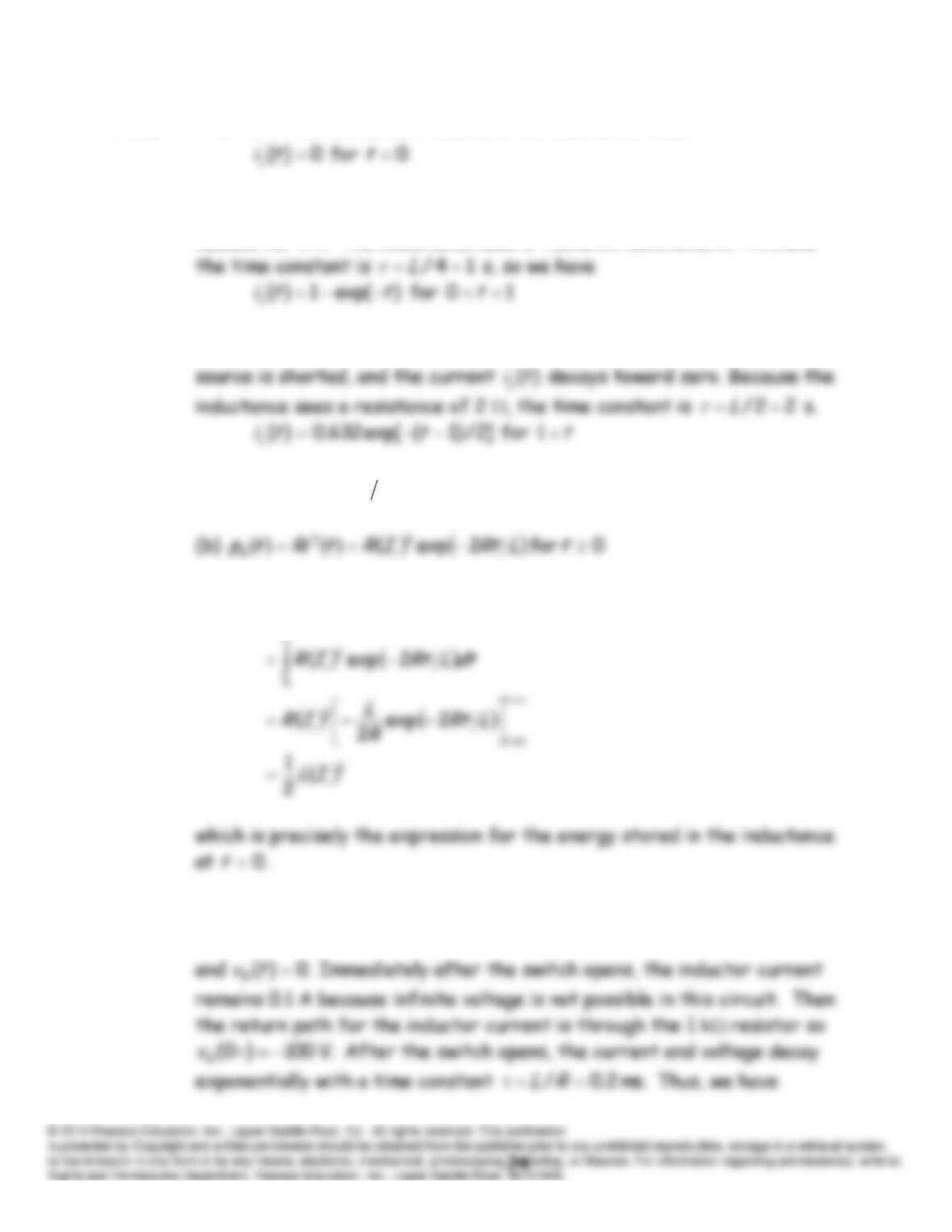
P4.39 Prior to
,0
t
the current source is shorted, so we have
After the switch opens at
,0
t
the current
)(
tiL
increases from zero,
headed for 1 A. The inductance sees a Thévenin resistance of 4 , and
At
,1
t
the current reaches 0.632 A. Then, the switch closes, the
P4.40 (a)
0 for exp
tLRtIti i
(c)
P4.41 With the circuit in steady state before the switch opens, the inductor
acts as a short circuit, the current through the inductor is
A, 1.0)(
tiL
0
R
dttpW
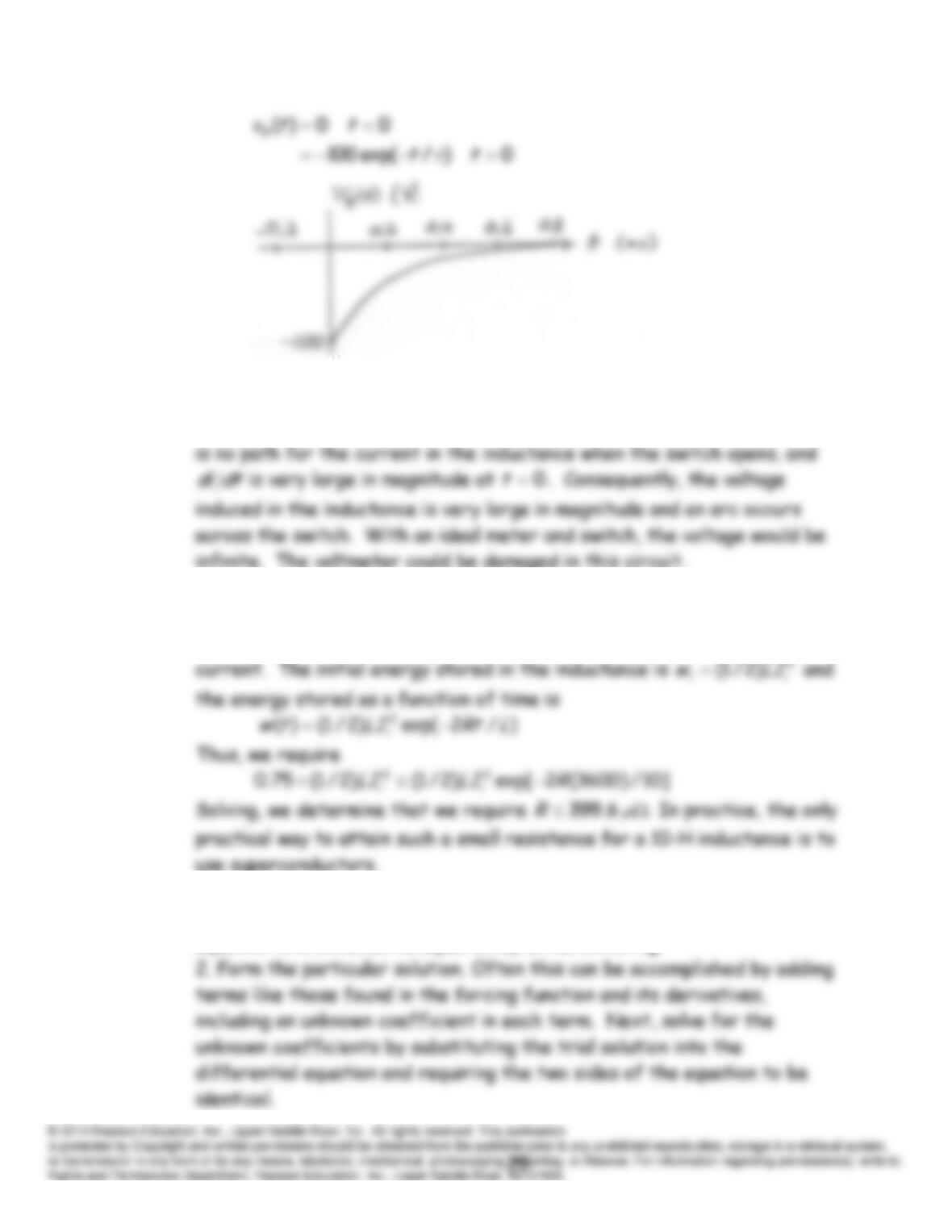
P4.42 In steady state, with the switch closed, the current is
ti
2 A for
t
< 0.
The resistance of a voltmeter is very high — ideally infinite. Thus, there
P4.43* The current in a circuit consisting of an inductance
L
and series
resistance
R
is given by
)/exp()(
LRtIti i
in which
Ii
is the initial
P4.44 1. Write the circuit equation and, if it includes an integral, reduce the
equation to a differential equation by differentiating.
P4.45* Applying KVL, we obtain the differential equation:
in which
A
is a constant to be determined. Substituting Equation (2) into
P4.46 The differential equation is obtained by applying KVL for the node at the
top end of the capacitance:
We try a particular solution of the form
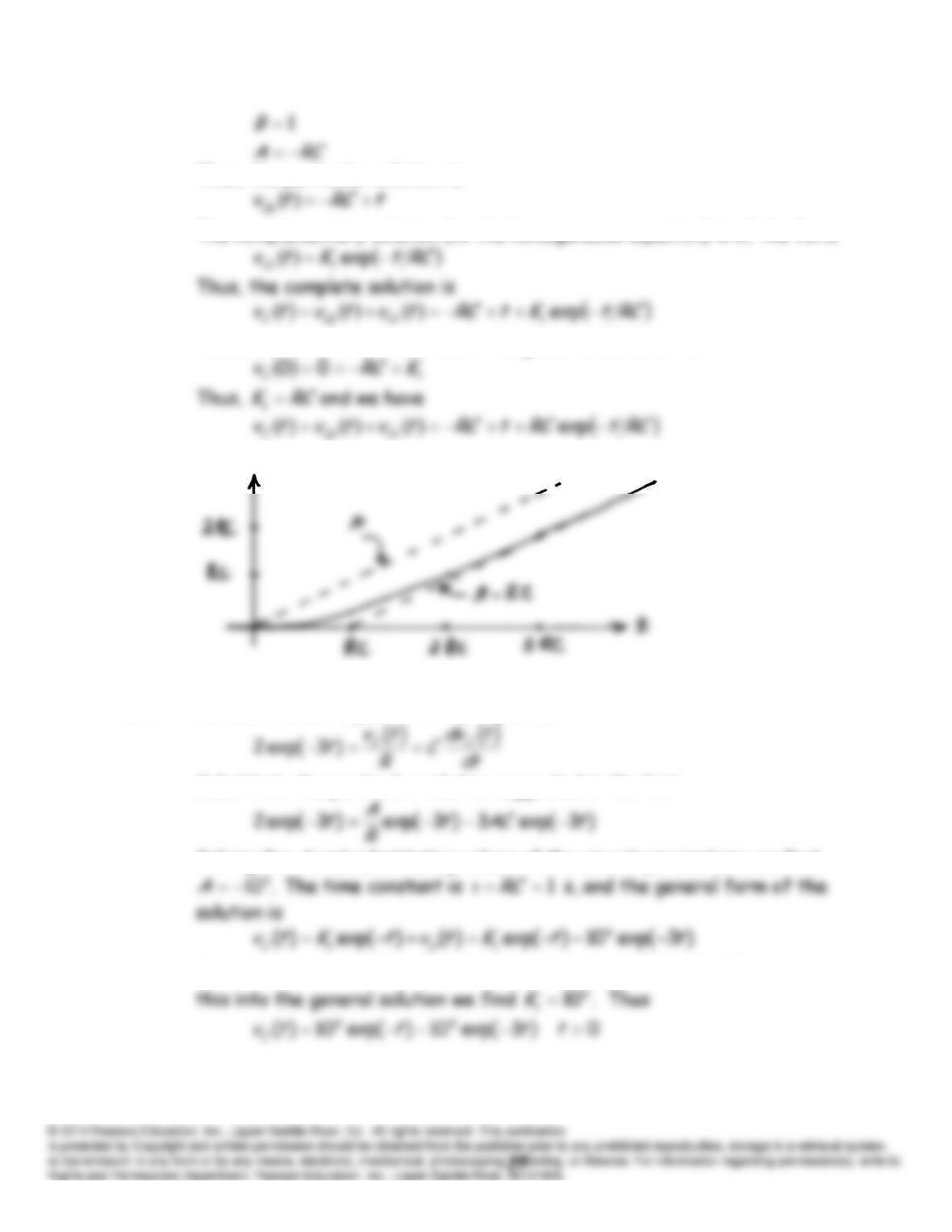
Thus, the particular solution is
The complementary solution (to the homogeneous equation) is of the form
However, the solution must meet the given initial condition:
P4.47* Write a current equation at the top node:
Substitute the particular solution suggested in the hint:
Solving for
A
and substituting values of the circuit parameters, we find
However because of the closed switch, we have
.0)0(
C
v
Substituting
P4.48* Write a current equation at the top node:
Differentiate each term with respect to time to obtain a differential
Substitute the particular solution suggested in the hint:
Solving for
A
and
B
and substituting values of the circuit parameters, we
P4.49 Using KVL, we obtain the differential equation
tvtRi
tdi
L
Equating coefficients of sines yields
P4.50 Applying KVL to the circuit, we have
tvtRi
dt
tdi
L
P4.51. Applying KVL, we obtain the differential equation:
we try a particular solution of the form:
which yields
P4.52 Usually, the particular solution includes terms with the same functional
forms as the terms found in the forcing function and its derivatives. In
Substituting into the differential equation, we have
We require the two sides of the equation to be identical. Equating
coefficients of like terms, we have
P4.53 The particular solution includes terms with the same functional forms as
the terms found in the forcing function and its derivatives. In this case,
there are three different types of terms in the forcing function and its
P4.54 (a)
)2exp(32
)(
ti
dt
tdi
(c) A particular solution of the form
)2exp()(
tKti p
does not work
P4.55 (a)
)10exp(105
1050
)()(
1026
3
6
t
tv
dt
tdv
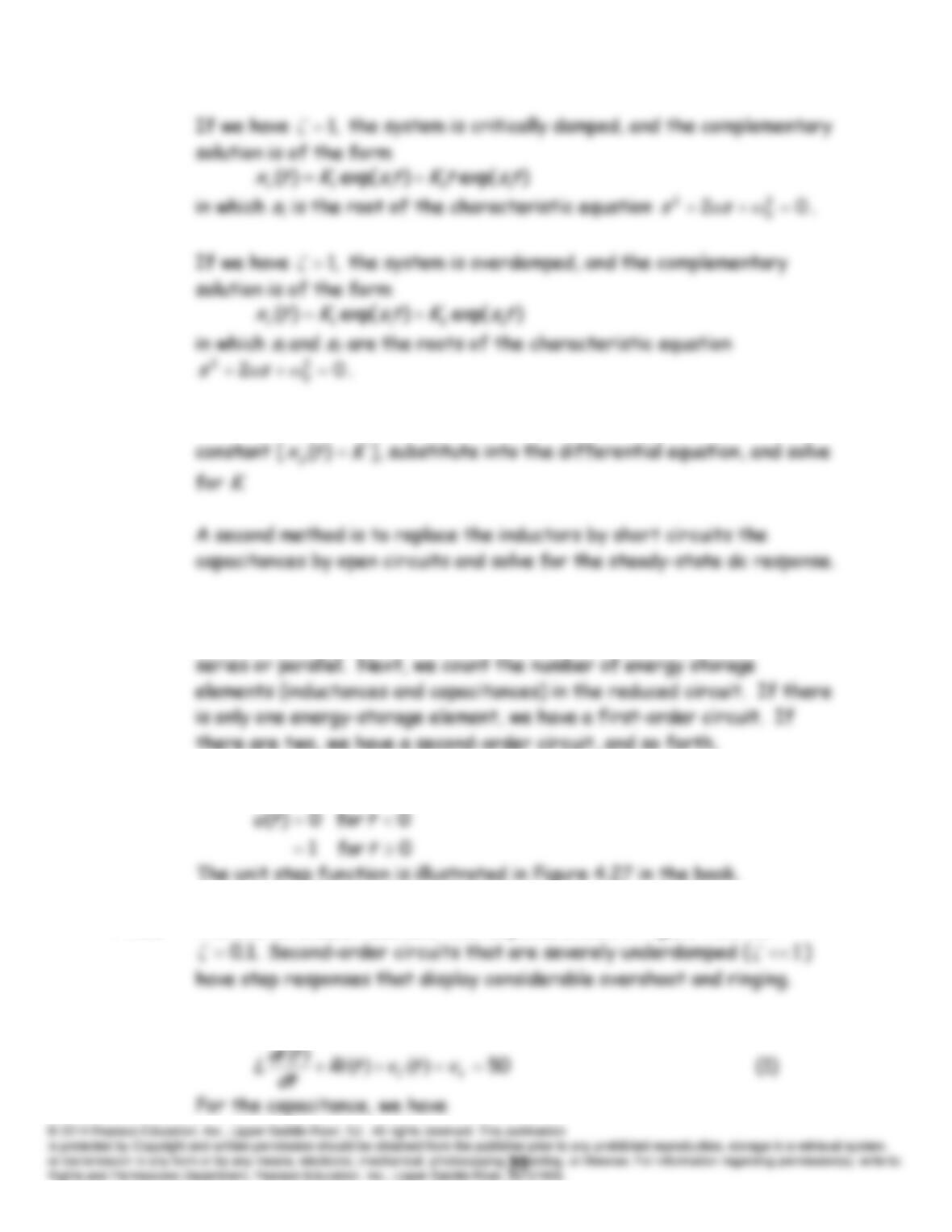
P4.56 First, we write the differential equation for the system and put it in the
P4.57 One way to determine the particular solution is to assume that it is a
P4.58 We look at a circuit diagram and combine all of the inductors that are in
series or parallel. Then, we combine all of the capacitances that are in
P4.59 The unit step function is defined by
P4.60 The sketch should resemble the response shown in Figure 4.29 for
P4.61* Applying KVL to the circuit, we obtain
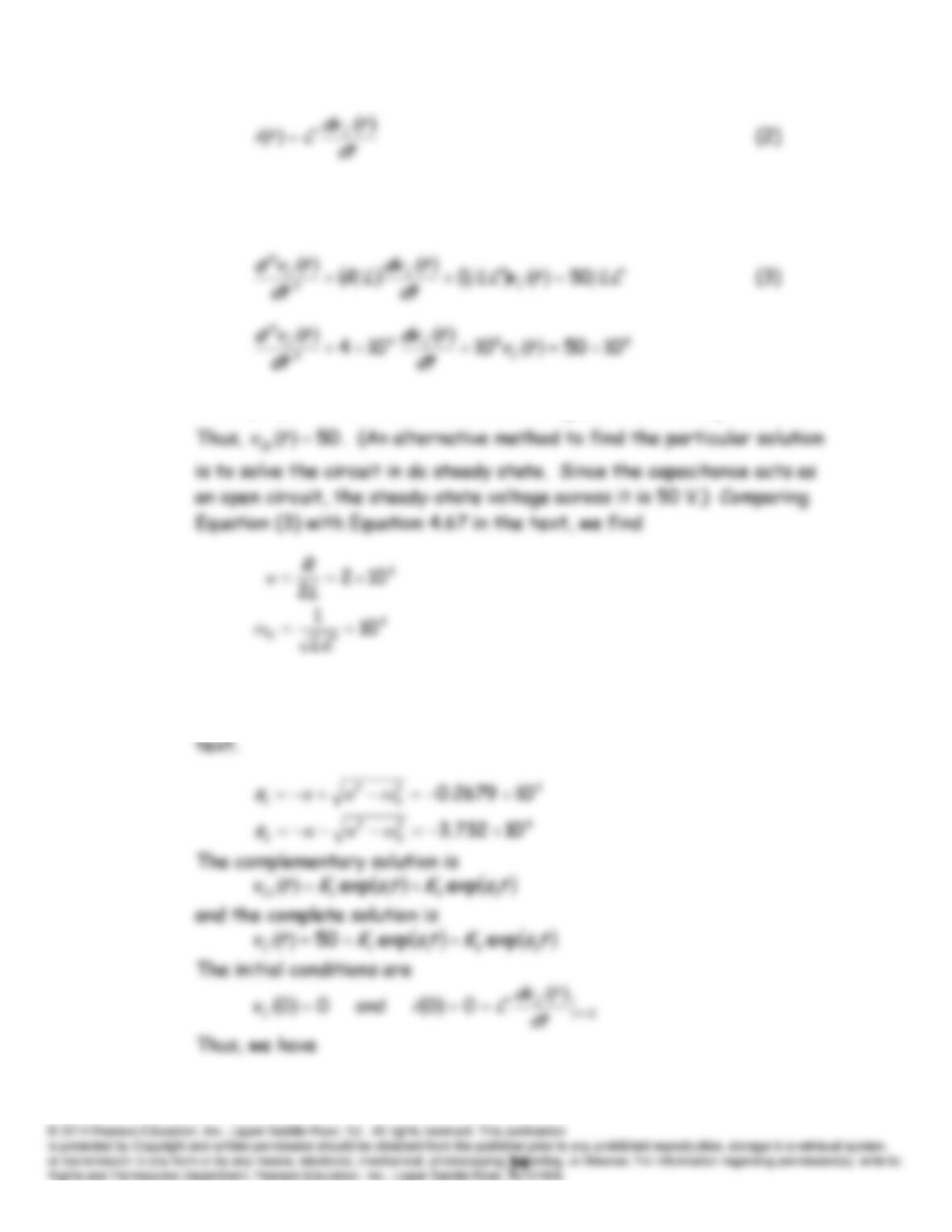
Using Equation (2) to substitute into Equation (1) and rearranging, we
have
We try a particular solution of the form
AtvCp
, resulting in
50
A
.
Since we have
0
ωα
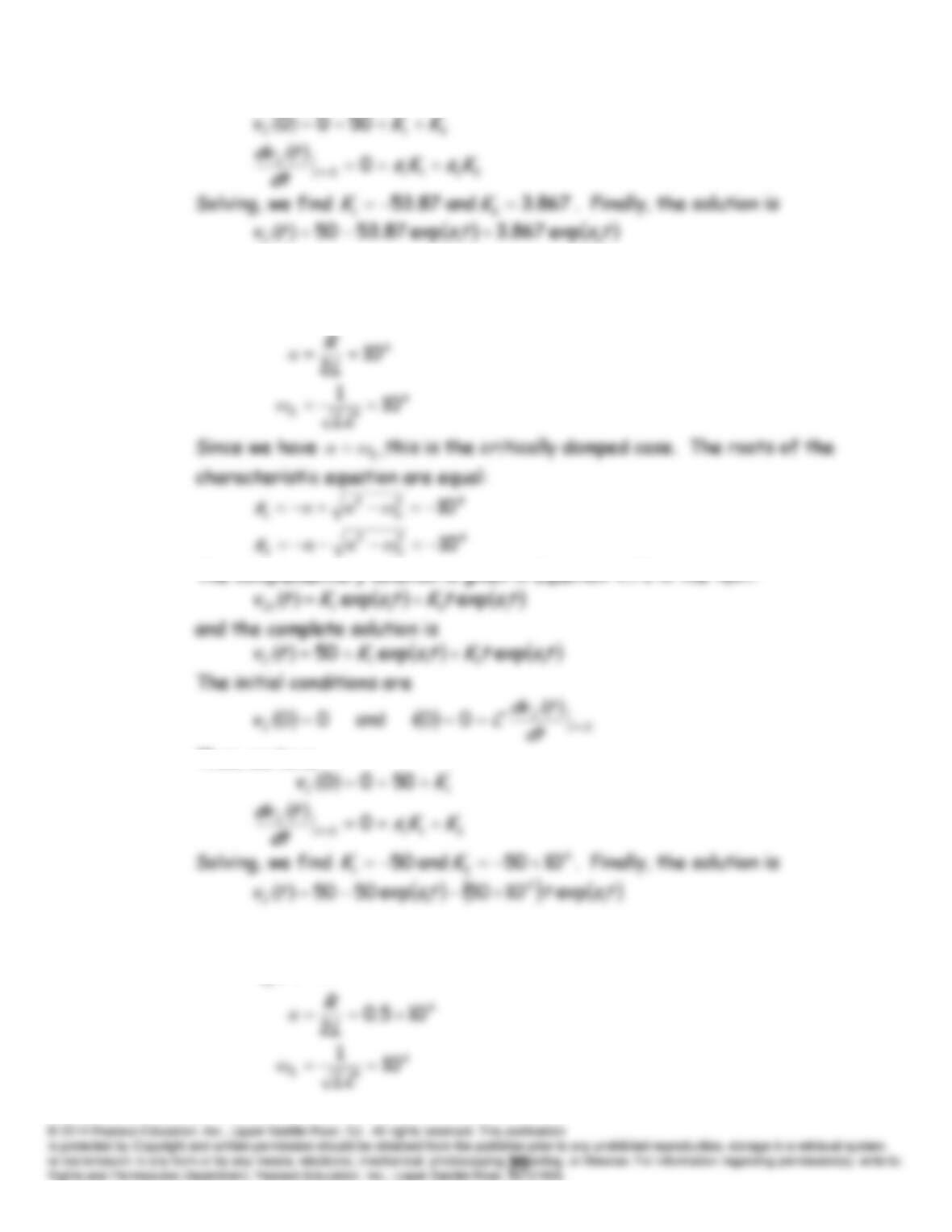
, this is the overdamped case. The roots of the
characteristic equation are found from Equations 4.72 and 4.73 in the
P4.62* As in the solution to P4.61, we have
50
tvCp
Thus, we have
P4.63* As in the solution to P4.61, we have
50
tv Cp