The Fourier Transform
Assessment Problems
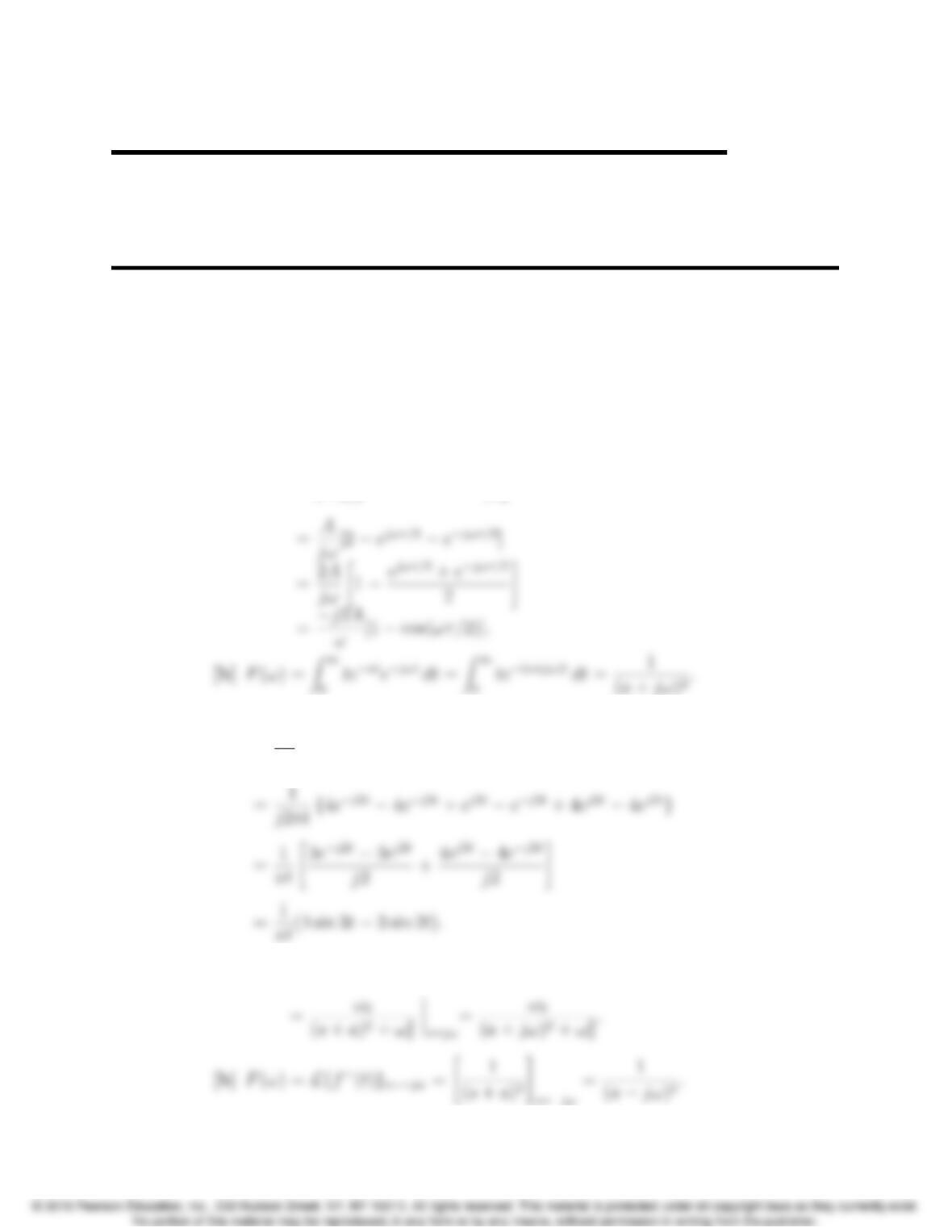
AP 17.1 [a] F(!)=Z0
τ/2(Aejωt)dt +Zτ/2
0Aejωtdt
AP 17.2
f(t)= 1
2⇡⇢Z2
34ejtωd!+Z2
2ejtωd!+Z3
24ejtωd!
AP 17.3 [a] F(!)=F(s)|s=jω=L{eatsin!0t}s=jω
17–1
17
17–2 CHAPTER 17. The Fourier Transform
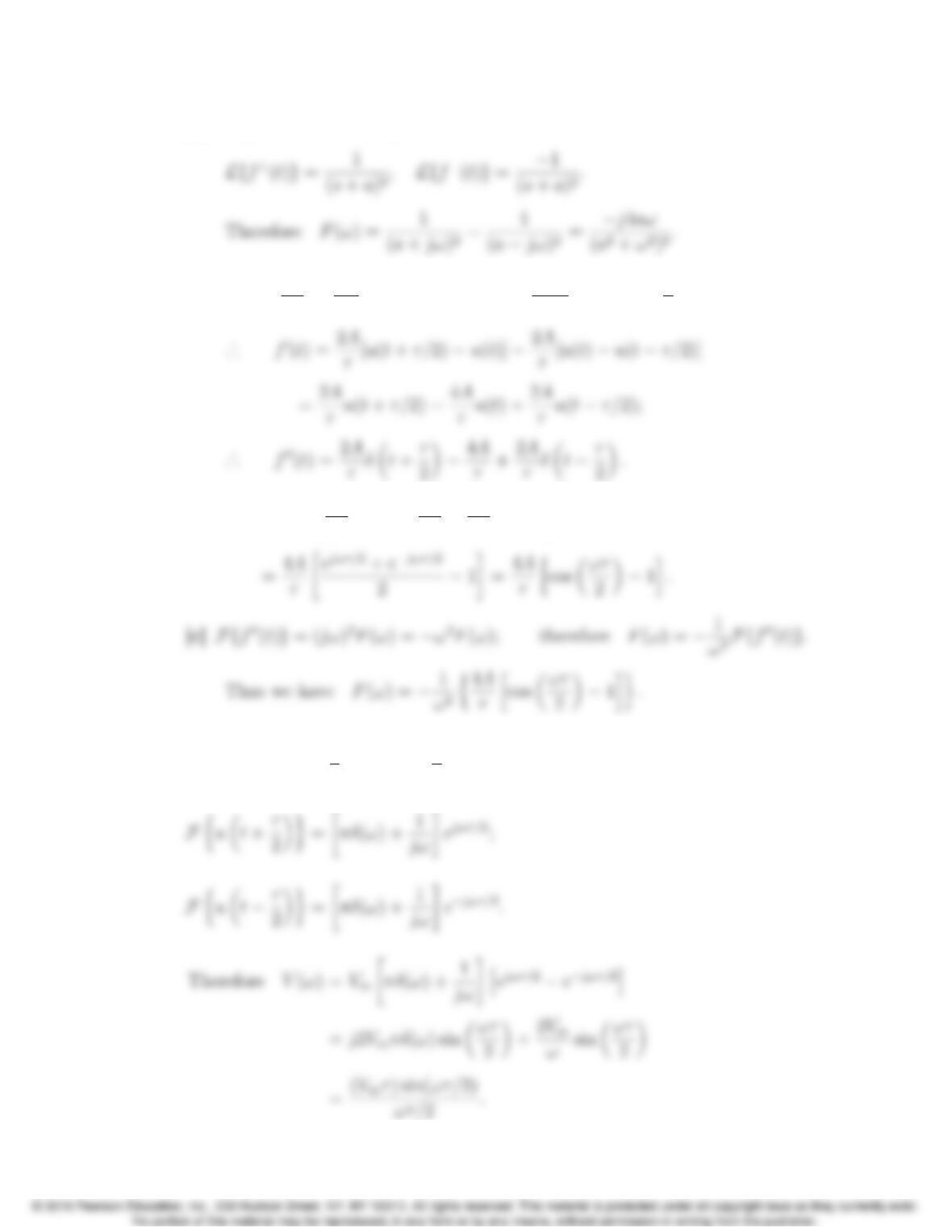
[c] f+(t)=teat,f
(t)=teat;
AP 17.4 [a] f0(t)=2A
⌧,⌧
2<t<0; f0(t)=2A
⌧,0<t<⌧
2;
[b] F{f00(t)}=2A
⌧ejωτ/24A
⌧+2A
⌧ejωτ/2
AP 17.5
v(t)=Vmu✓t+⌧
2◆u✓t⌧
2◆;
Problems 17–3
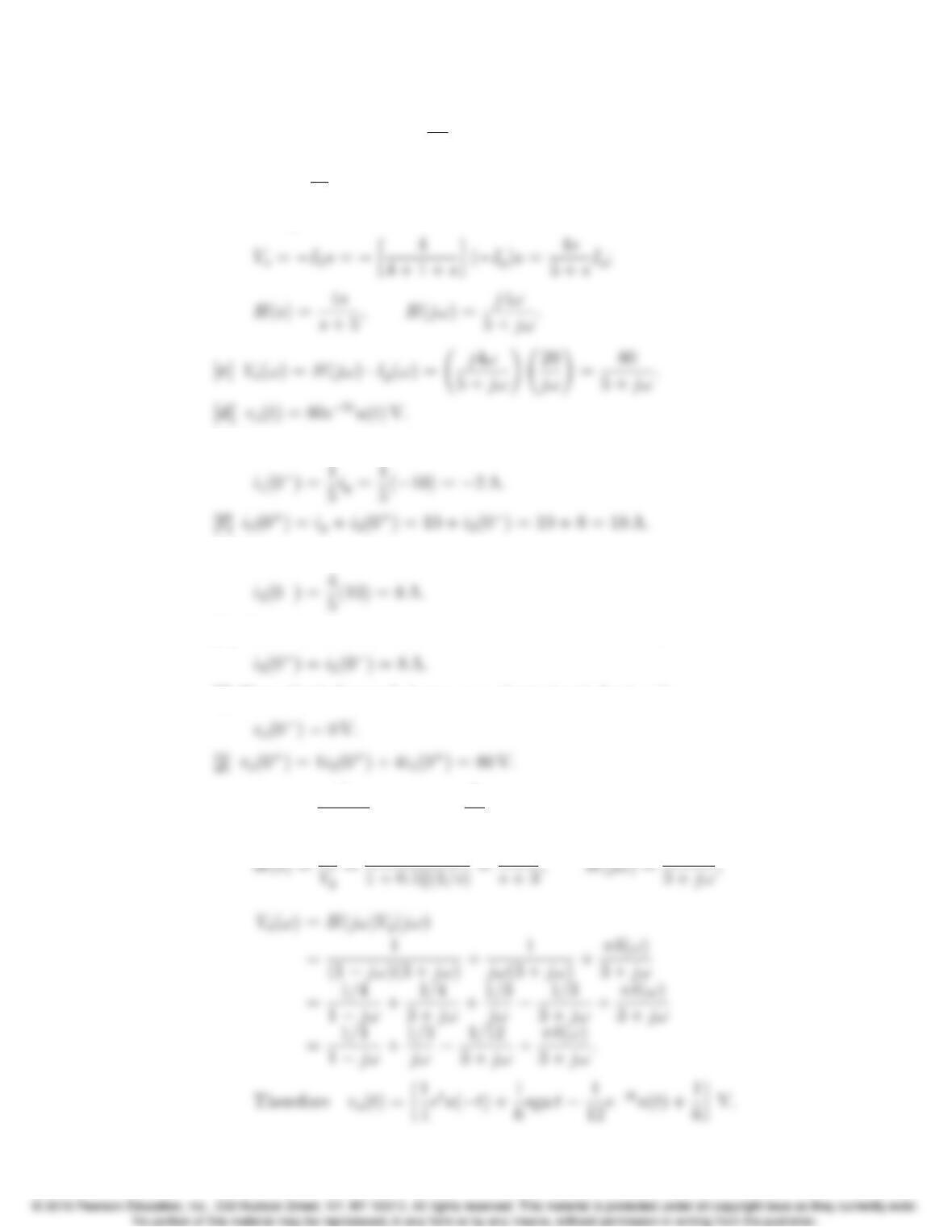
AP 17.6 [a] Ig(!)=F{10sgn t}=20
j!.
[b] H(s)=Vo
Ig
.
Using current division and Ohm’s law,
[e] Using current division,
[g] Using current division,
[h] Since the current in an inductor must be continuous,
[i] Since the inductor behaves as a short circuit for t<0,
AP 17.7 [a] Vg(!)= 1
1j!+⇡(!)+ 1
j!;
17–4 CHAPTER 17. The Fourier Transform
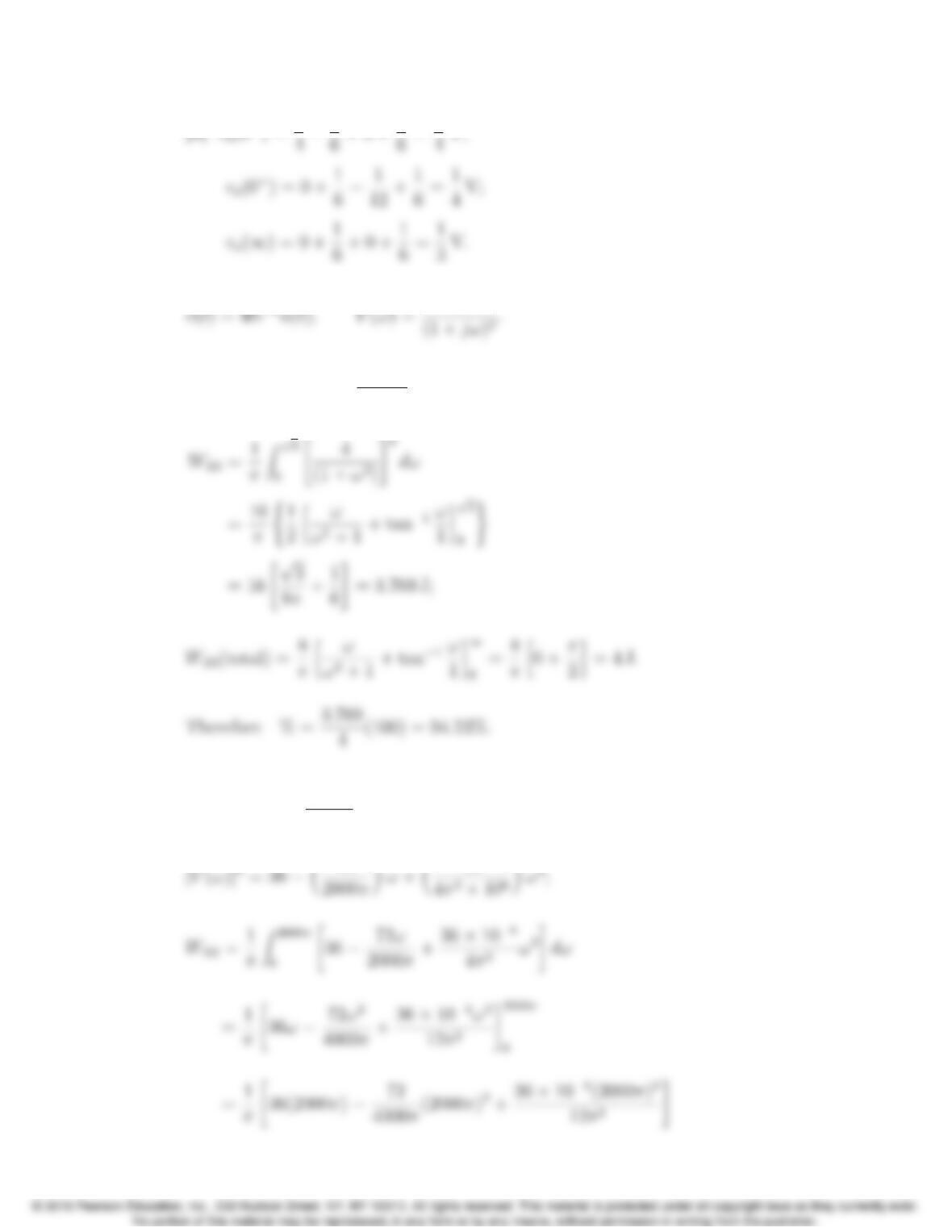
AP 17.8
Therefore |V(!)|=4
1+!2.
AP 17.9
|V(!)|=6✓6
2000⇡◆!,0!2000⇡;
Problems 17–5
17–6 CHAPTER 17. The Fourier Transform
Problems
P 17.1 [a] F(!)=Zτ/2
τ/2
2A
⌧tejωtdt
[b] Using L’Hopital’s rule,
F(0) = lim
ω!02A“!⌧(⌧/2)[sin(!⌧/2)] + ⌧cos(!⌧/2) 2(⌧/2) cos(!⌧ /2)
2!⌧ #
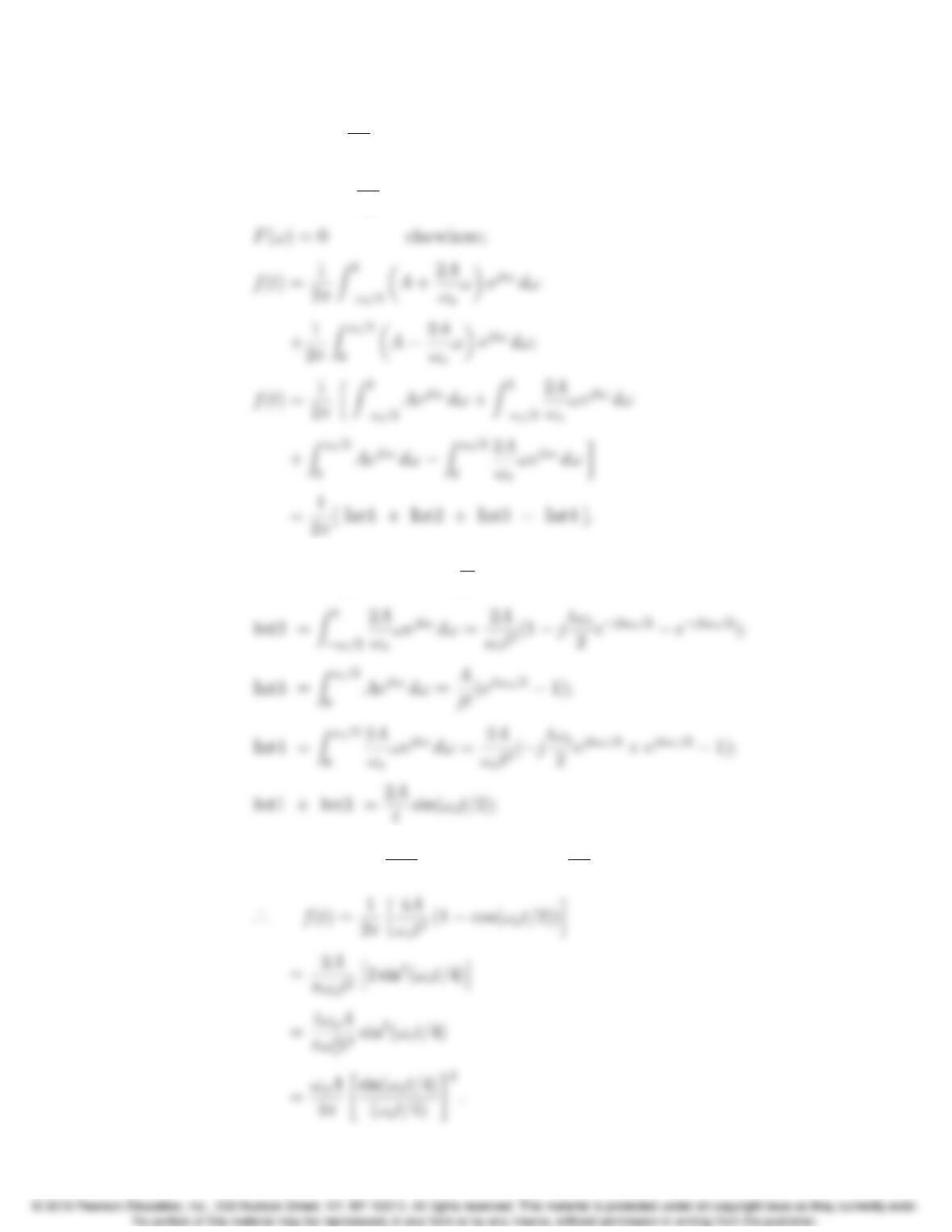
[c] When A= 10 and ⌧=0.1
Problems 17–7
P 17.2 [a] F(!)=A+2A
!o
!,!o/2!0;
F(!)=A2A
!o
!,0!!o/2;
Int1 = Z0
ωo/2Aejtωd!=A
jt(1 ejtωo/2);
Int2 Int4 = 4A
!ot2[1 cos(!ot/2)] 2A
tsin(!ot/2);
17–8 CHAPTER 17. The Fourier Transform
[c] A=5⇡;!o= 100 rad/s;
[b] F(!)=Z0
τ/2✓2A
⌧t+A◆ejωtdt +Zτ/2
0✓2A
⌧t+A◆ejωtdt
P 17.4 F{sin !0t}=F(ejω0t
2j)F(ejω0t
2j)
P 17.5 [a] F(s)=L{teat}=1
(s+a)2.
Problems 17–9
[b] F(s)=L{t3eat}=6
(s+a)4.
[c] F(s)=L{eat cos !0t}=s+a
(s+a)2+!2
0
=0.5
(s+a)j!0
+0.5
(s+a)+j!0
.
[d] F(s)=L{eat sin !0t}=!0
(s+a)2+!2
0
=j0.5
(s+a)j!0
+j0.5
(s+a)+j!0
.
P 17.6 f(t)= 1
2⇡Z1
1
[A(!)+jB(!)][cos t!+jsin t!]d!
P 17.7 By hypothesis, f(t)=f(t).From Problem 17.6, we have
17–10 CHAPTER 17. The Fourier Transform
P 17.8 F(!)=j2
!; therefore B(!)=2
!; thus we have
0
Therefore,
P 17.9 From Problem 17.5[c] we have
P 17.10 A(!)=Z0
1
f(t)cos!t dt +Z1
0f(t)cos!t dt =0
Problems 17–11
P 17.11 A(!)=Z1
1
f(t)cos!t dt
P 17.12 [a] F(df (t)
dt )=Z1
1
df (t)
dt ejωtdt.
[c] To find F(d2f(t)
dt2),let g(t)=df (t)
dt .
P 17.13 [a] F⇢Zt
1
f(x)dx=Z1
1 Zt
1
f(x)dxejωtdt.
17–12 CHAPTER 17. The Fourier Transform
Therefore,
P 17.14 [a] F{f(at)}=Z1
1
f(at)ejωtdt.
Therefore,
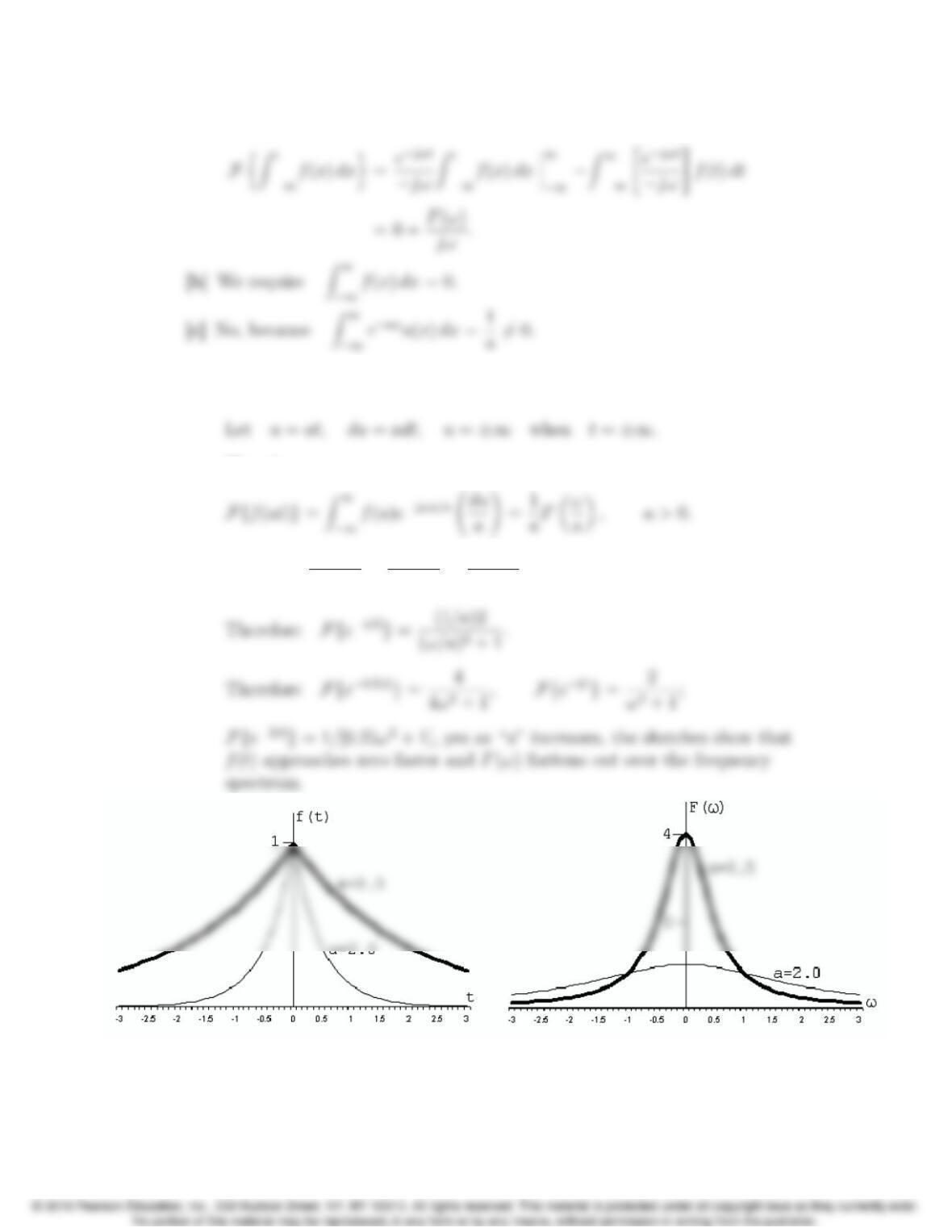
[b] F{e|t|}=1
1+j!+1
1j!=2
1+!2.
Problems 17–13
P 17.15 [a] F{f(ta)}=Z1
1
f(ta)ejωtdt.
Let u=ta, then du =dt, t =u+a, and u=±1when t=±1.
Therefore,
P 17.16 Y(!)=Z1
1 Z1
1
x()h(t)dejωtdt
Therefore Y(!)=Z1
1
x()Z1
1
h(u)ejω(u+λ)dud
P 17.17 F{f1(t)f2(t)}=Z1
1 1
2⇡Z1
1
F1(u)ejtuduf2(t)ejωtdt
P 17.18 (i) F{eatu(t)}=1
a+j!=F(!); dF (!)
d!=j
(a+j!)2.
17–14 CHAPTER 17. The Fourier Transform
(ii) F{|t|ea|t|}=F{teatu(t)}F{teatu(t)}
(iii) F{tea|t|}=F{teatu(t)}+F{teatu(t)}
P 17.19 [a] f1(t) = cos !0t, F1(u)=⇡[(u+!0)+(u!0)];
f2(t)=1,⌧/2<t<⌧/2,and f2(t) = 0 elsewhere;
Using convolution,
F(!)= 1
2⇡Z1
1
F1(u)F2(!u)du
[b] As ⌧increases, the amplitude of F(!) increases at !=±!0and at the
same time the width of the frequency band of F(!) approaches zero as !
deviates from ±!0.
Problems 17–15
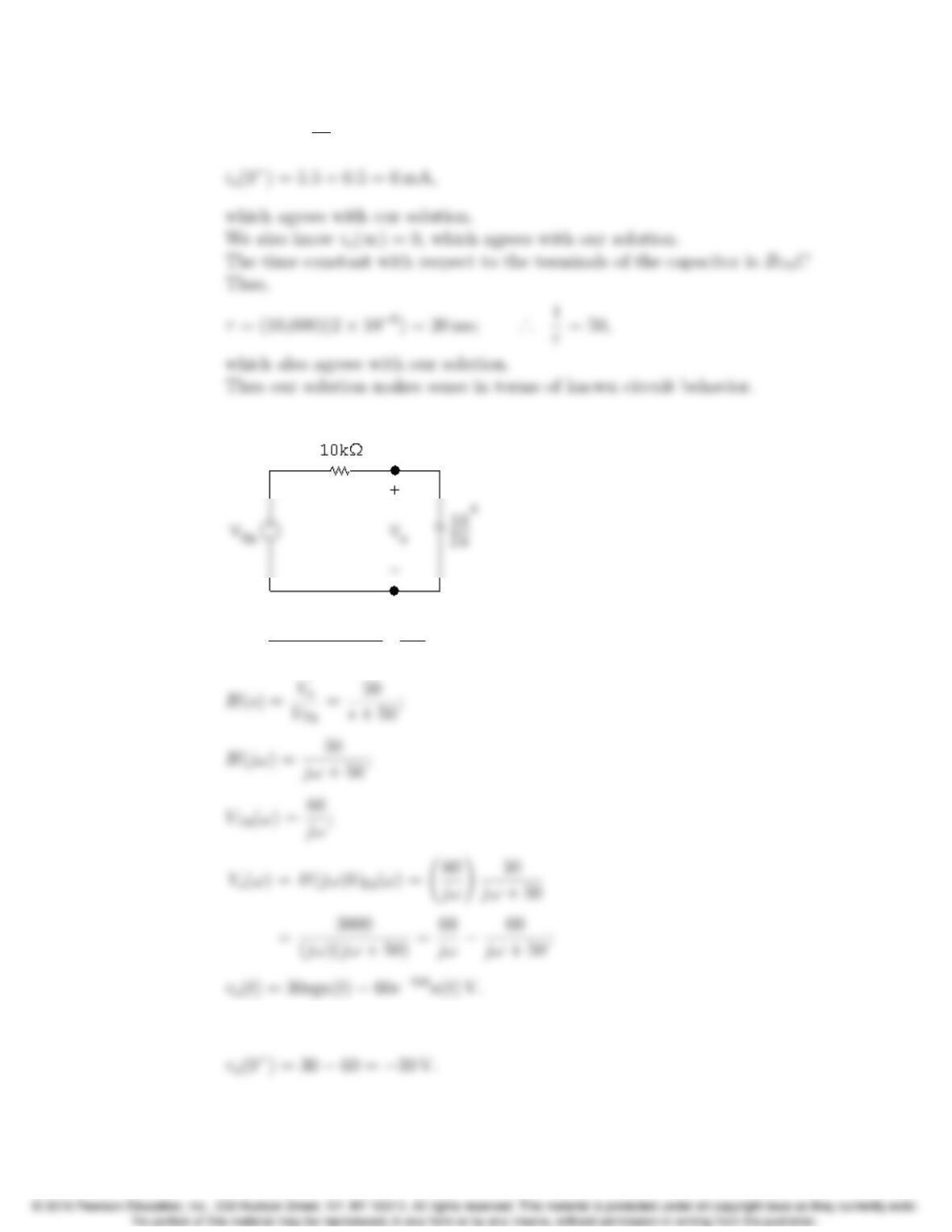
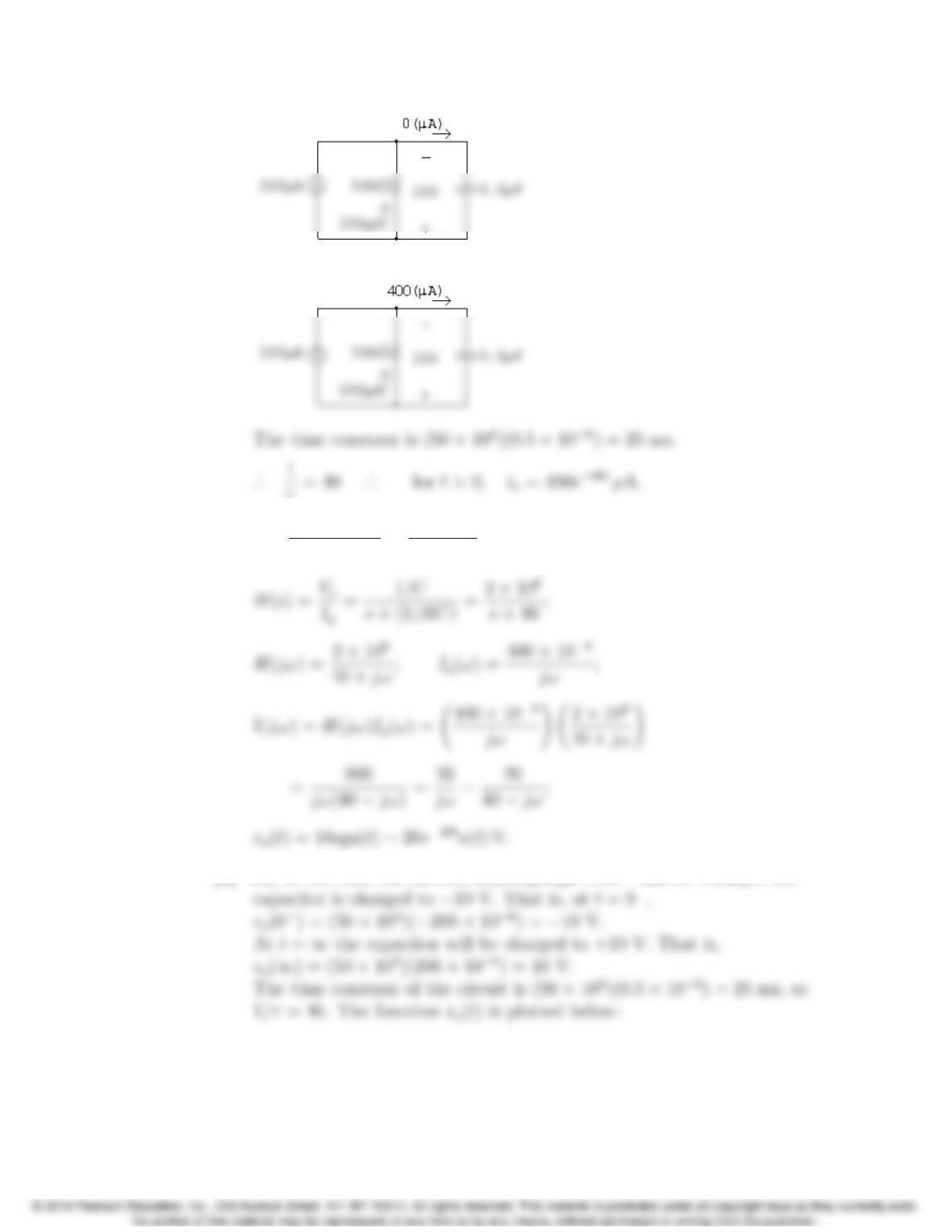
P 17.20 [a] Find the Th´evenin equivalent with respect to the terminals of the
capacitor:
vTh =5
[b] At t=0
the circuit is
At t=0
+the circuit is
17–16 CHAPTER 17. The Fourier Transform
i60k(0+)=30
60 =0.5 mA;
P 17.21 [a] From the solution of Problem 17.20 we have
Vo=VTh
104+ (106/2s)·106
2s;
[b] vo(0)=30 V;
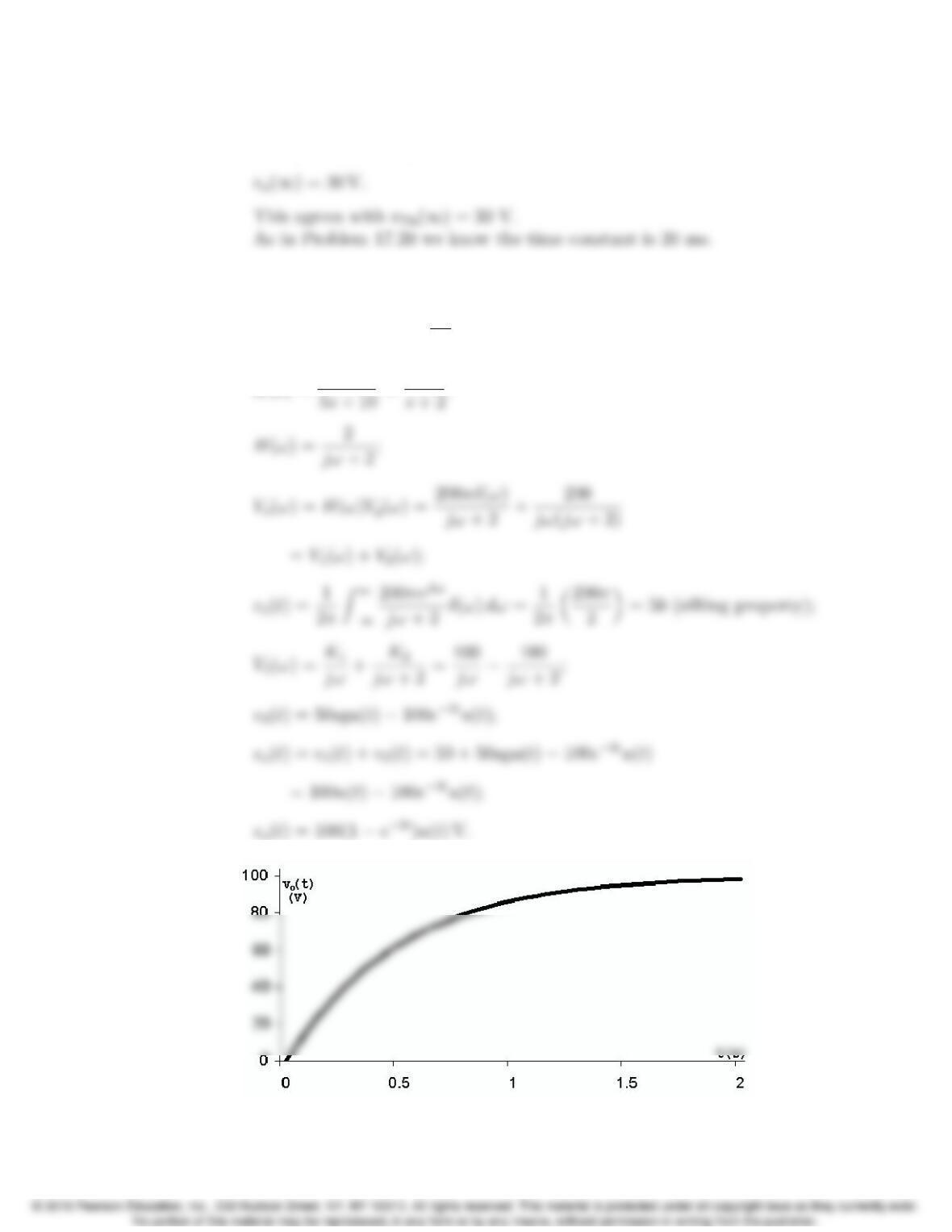
Problems 17–17
This makes sense because there cannot be an instantaneous change in the
voltage across a capacitor.
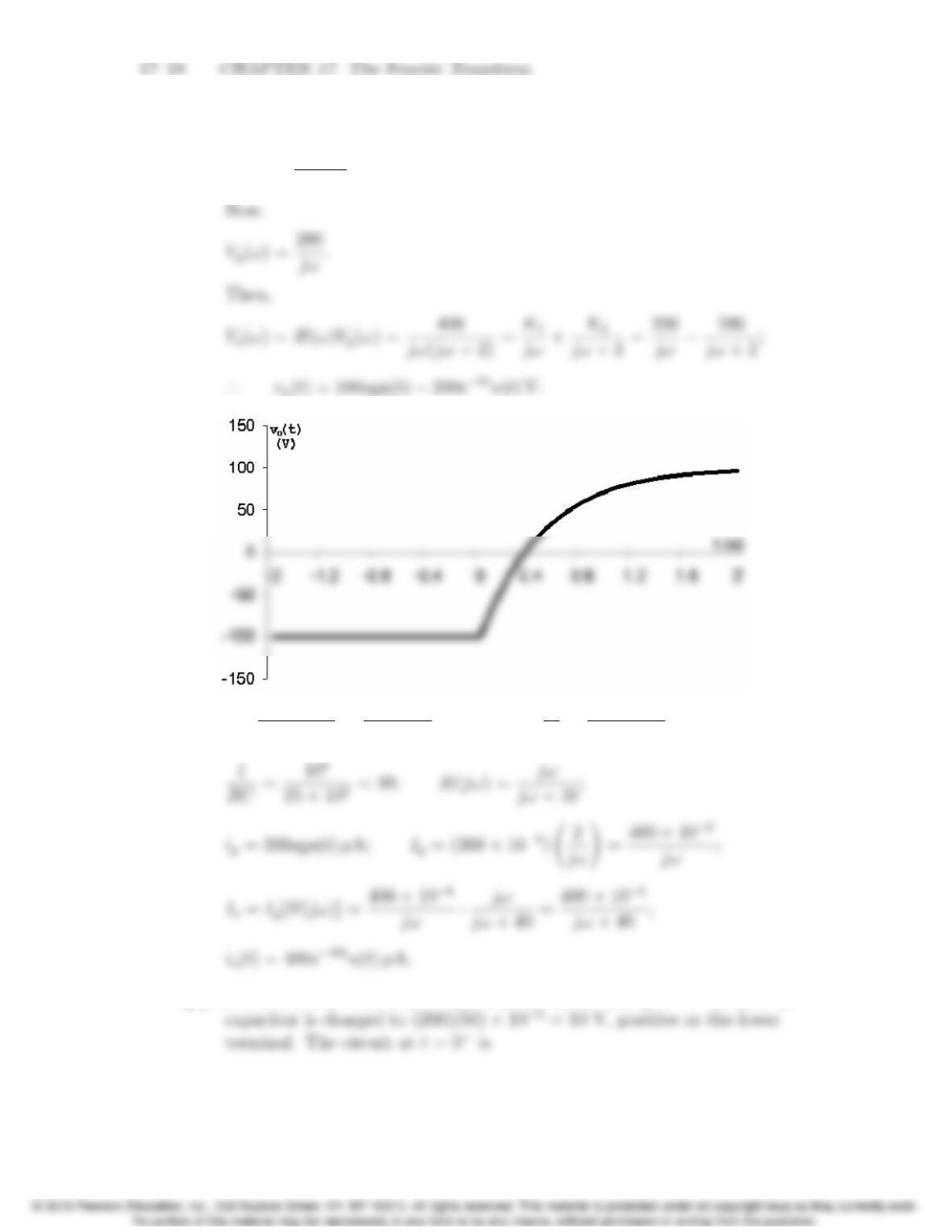
P 17.22 [a] vg= 100u(t);
Vg(!) = 100 “⇡(!)+ 1
j!#;
H(s)= 10
[b]
P 17.23 [a] From the solution to Problem 17.22
H(!)= 2
j!+2.
[b]
P 17.24 [a] Io=IgR
R+1/sC =RCsIg
RCs +1;H(s)=Io
Ig
=s
s+1/RC ;
[b] Yes, at the time the source current jumps from 200 µA to +200 µA the
Problems 17–19
At t=0
+the circuit is
⌧= 40 ·
P 17.25 [a] Vo=IgR(1/sC)
R+ (1/sC)=IgR
RCs +1;
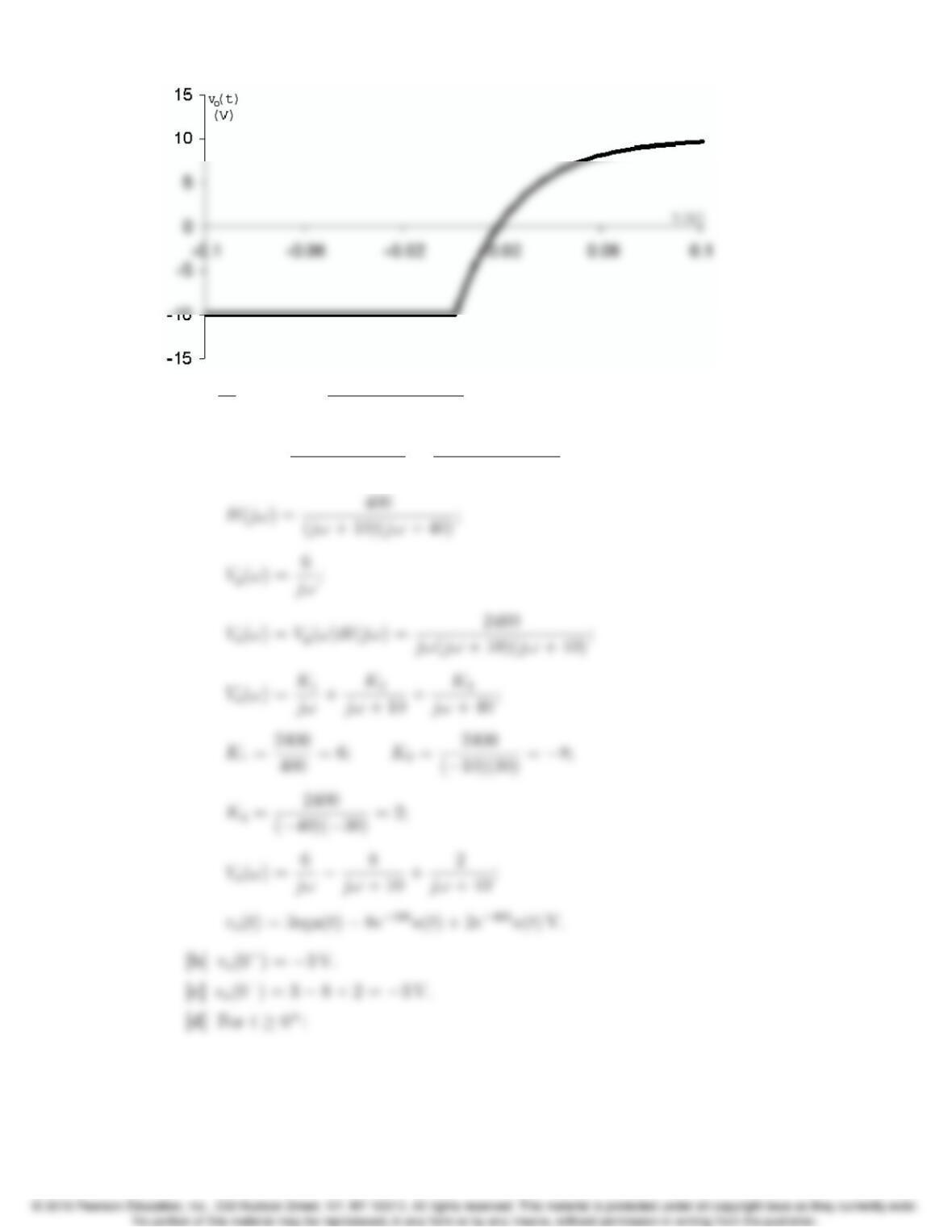
[b] Yes, at the time the current source jumps from 200 to +200 µA the
17–20 CHAPTER 17. The Fourier Transform
P 17.26 [a] Vo
Vg
=H(s)= 4/s
0.5+0.01s+4/s;
H(s)= 400
s2+50s+ 400 =400
(s+ 10)(s+ 40);