50
rot
P
(b) We have
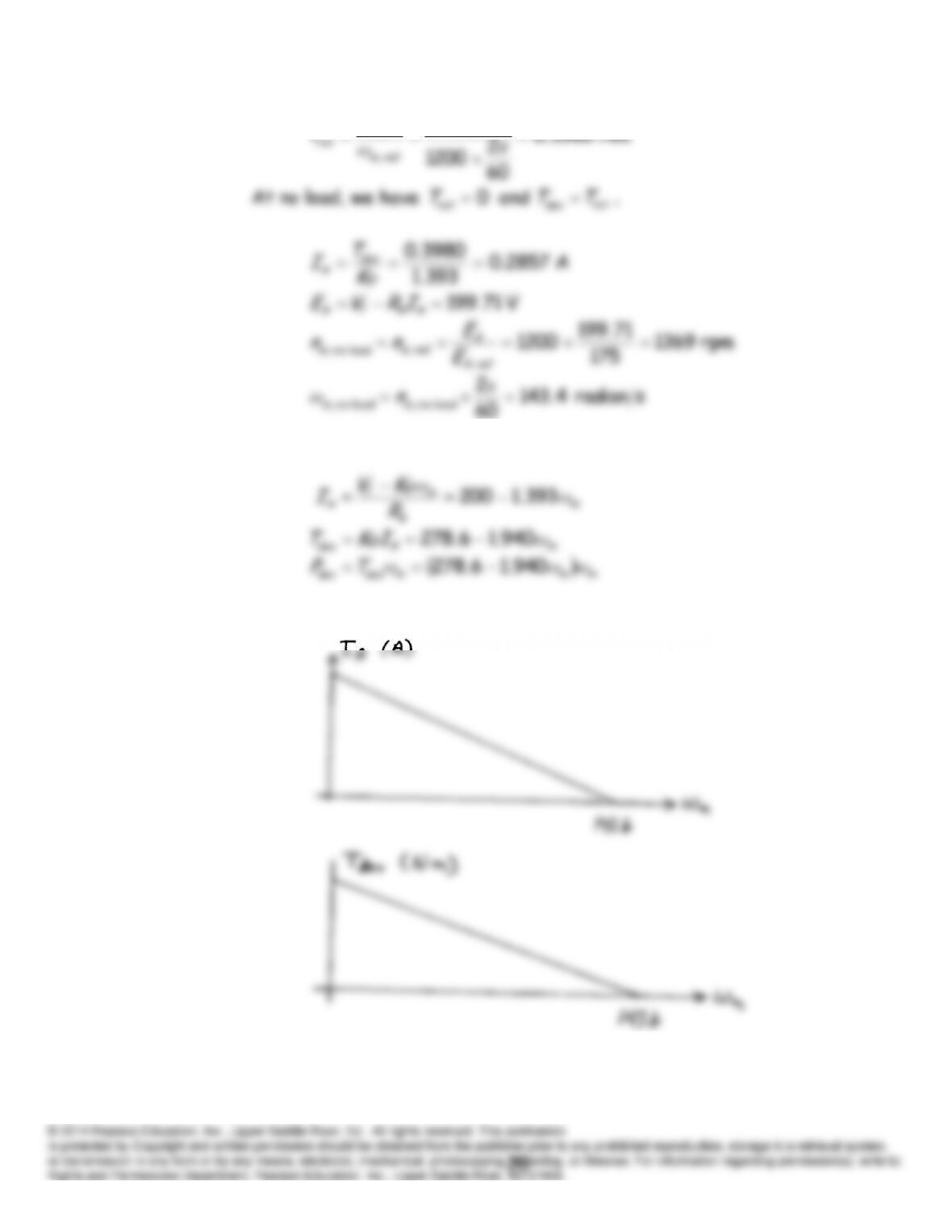
The plots are:
P16.41* We have
m
T
A
T
KV
EV
I
φω
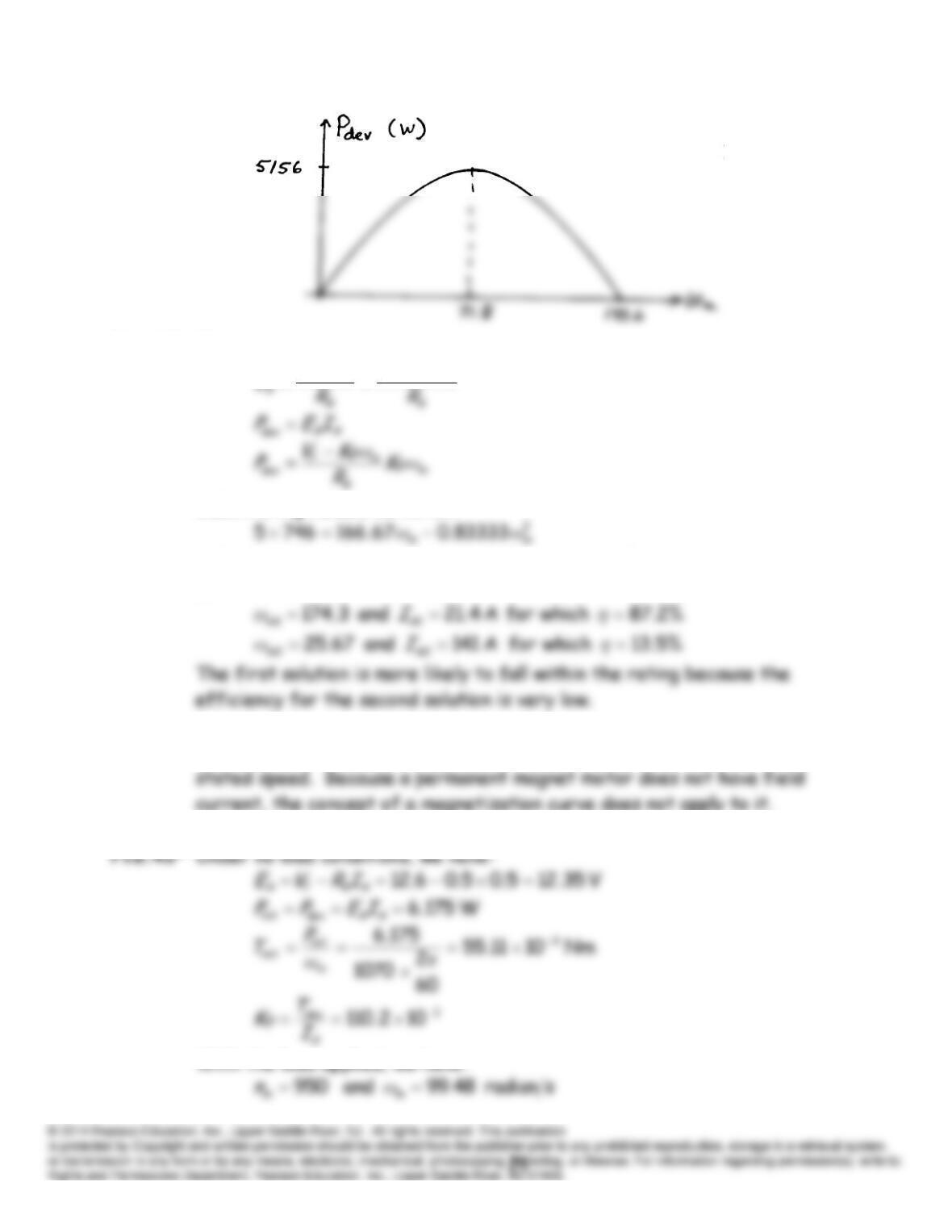
Substituting values, we obtain
Solving, we find the two roots and the corresponding armature currents
as
P16.42* The magnetization curve is a plot of
EA
versus the field current
IF
at a
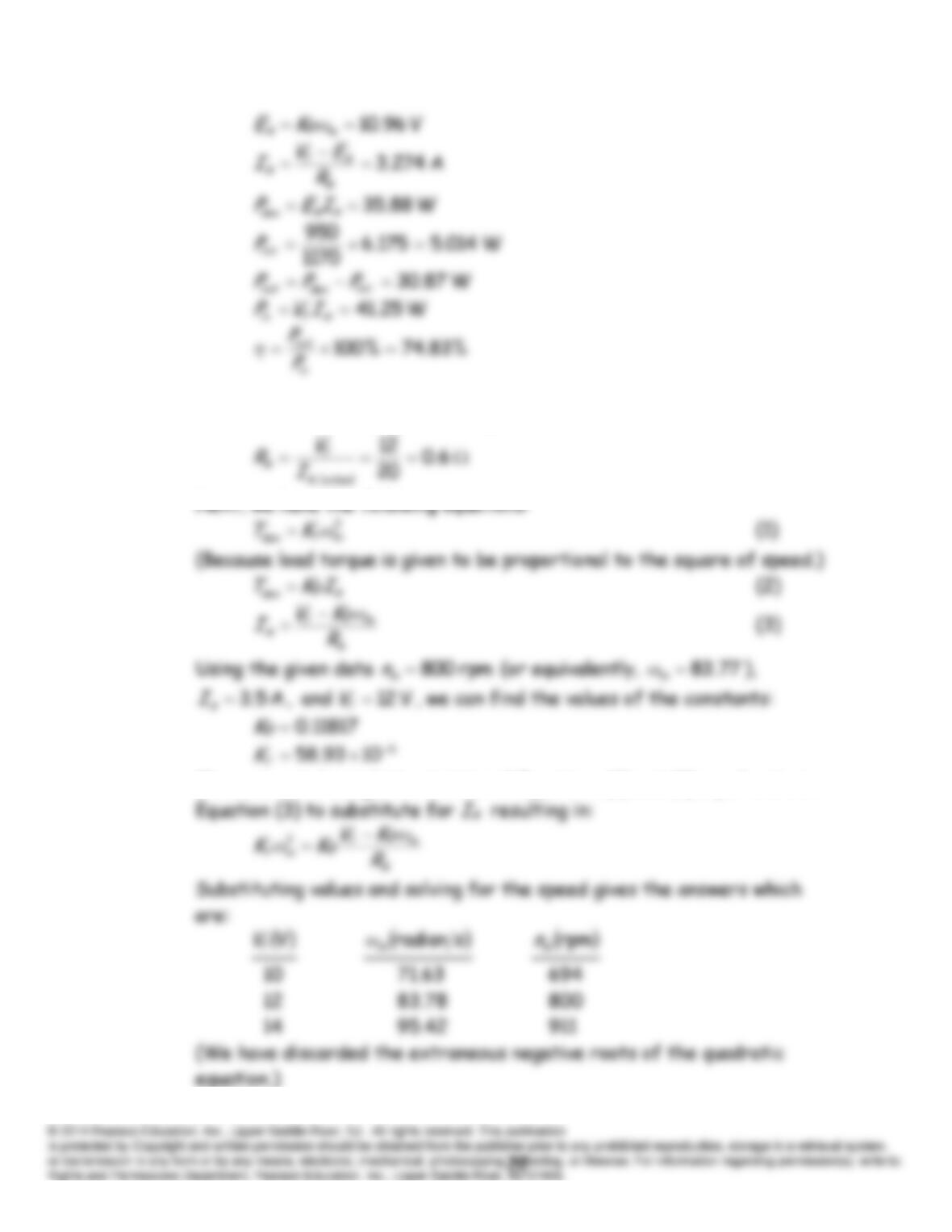
P16.44 With a locked rotor,
0 and 0
A
mE
ω
. Then, we have
Then, we set the right hand sides of Equations (1) and (2) equal and use
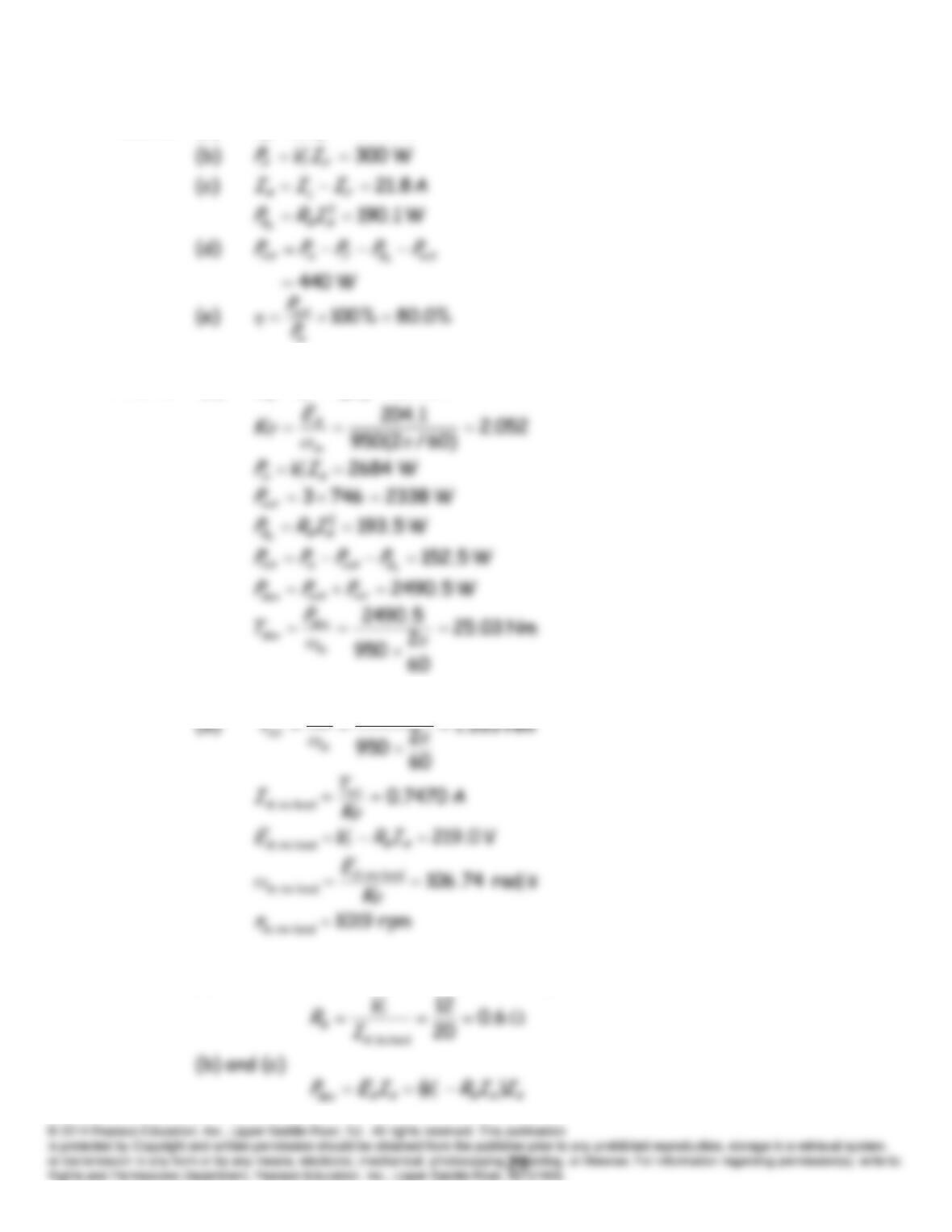
P16.45 (a)
W 4660
in
L
TIVP
P16.46 (a)
V 1.204
AA
T
AIRVE
5.152
rot
P
P16.47 (a) With a locked rotor,
0 and 0
A
mE
ω
. Then we have
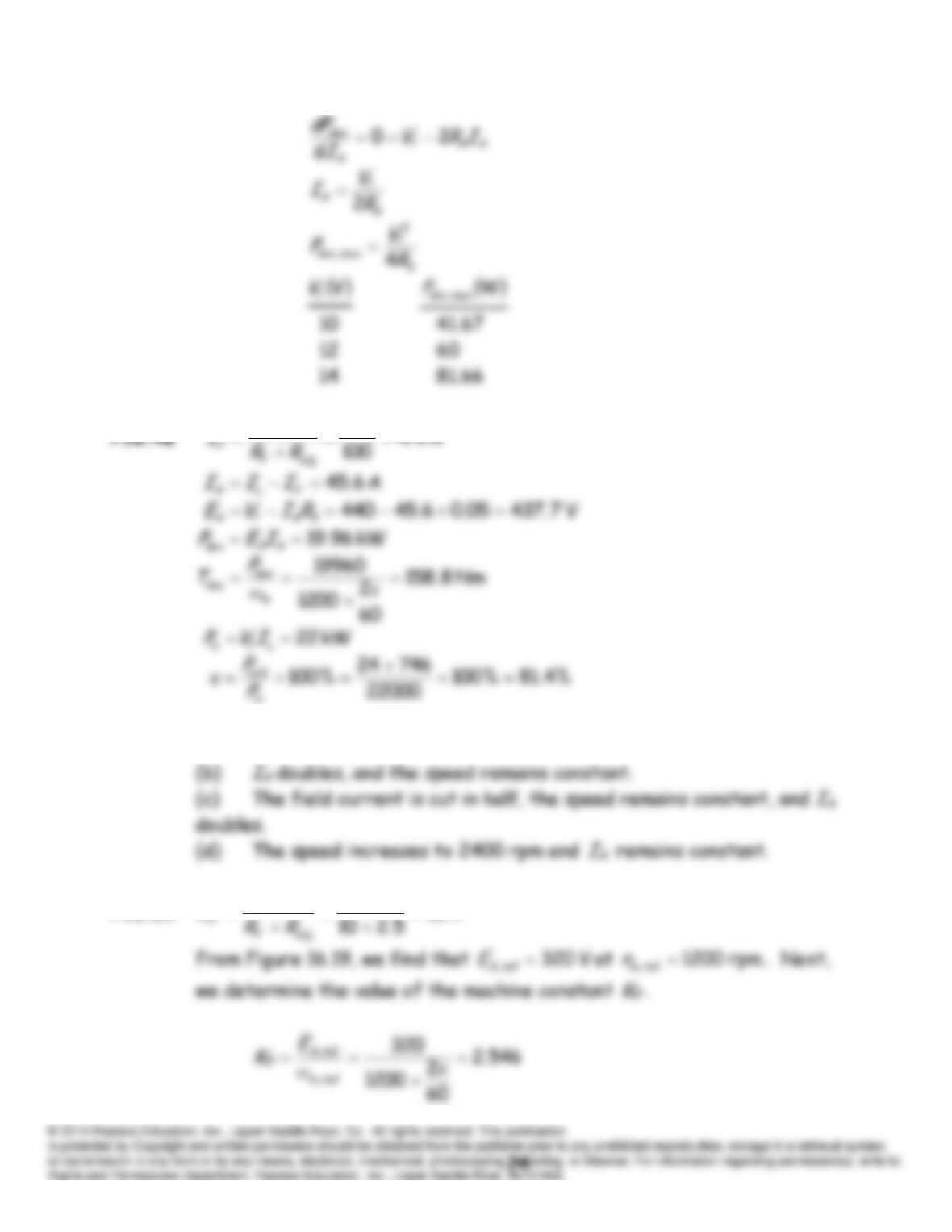
440
V
T
P16.49 (a)
IA
doubles, and the speed remains constant.
P16.50
A 16
200
V
I
T
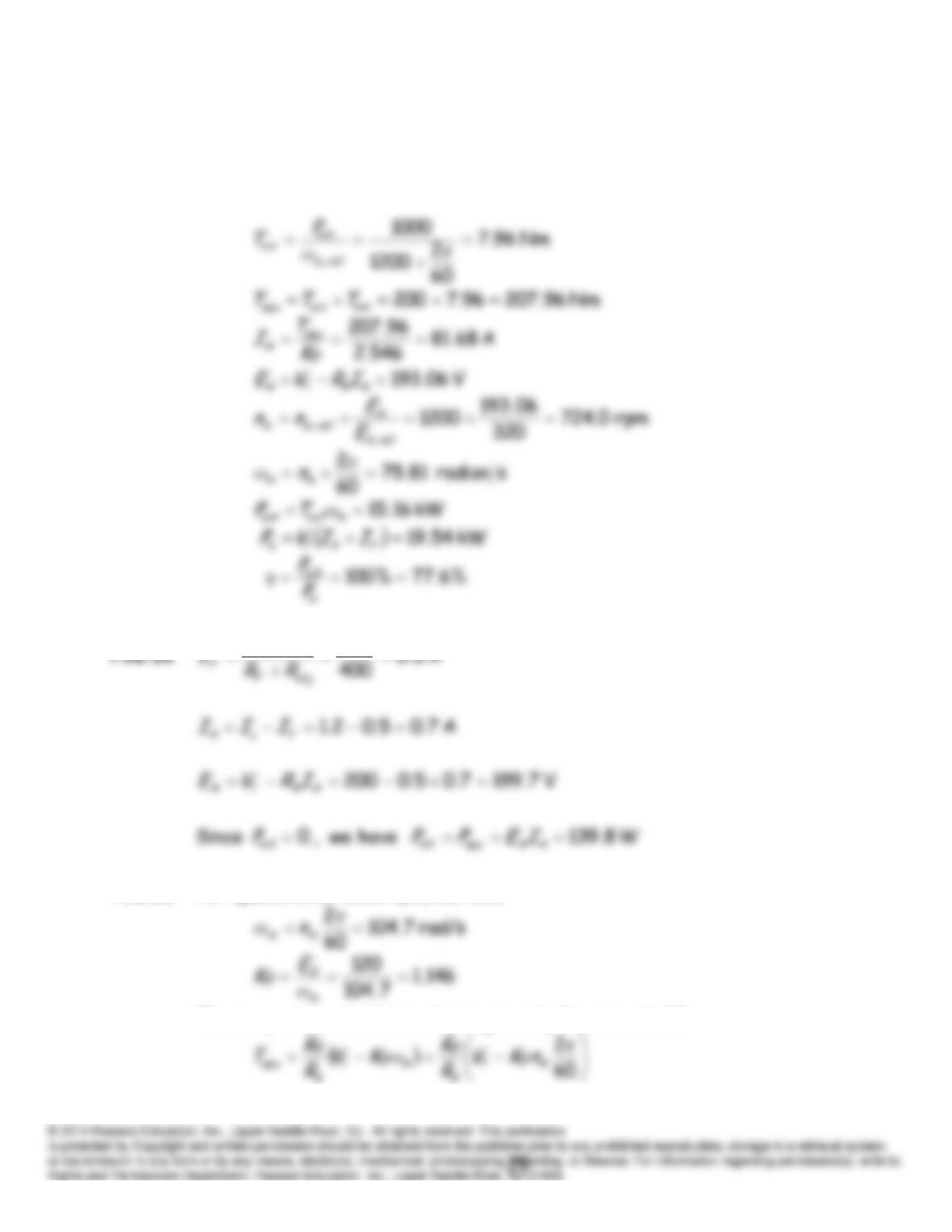
We assume that the rotational power loss is proportional to speed, which
is equivalent to assuming constant torque.
200
V
T
P16.52 For operation at 1000 rpm, we have
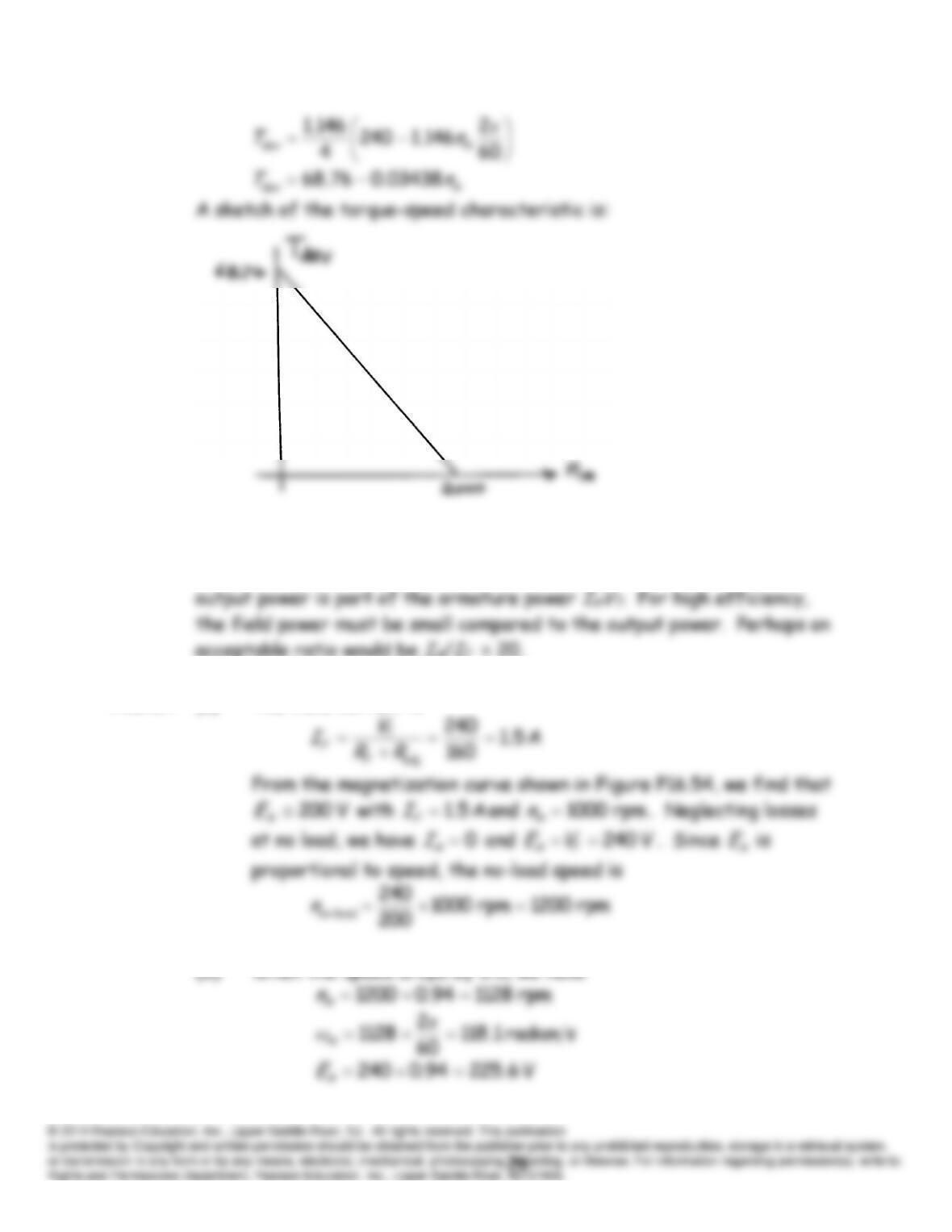
The torque-speed relationship is given by Equation 16.27:
Substituting values, we obtain
P16.53 Under full-load in a well designed machine,
IA
should be much larger than
IF
because all of the field power
IFVT
is converted to heat while the
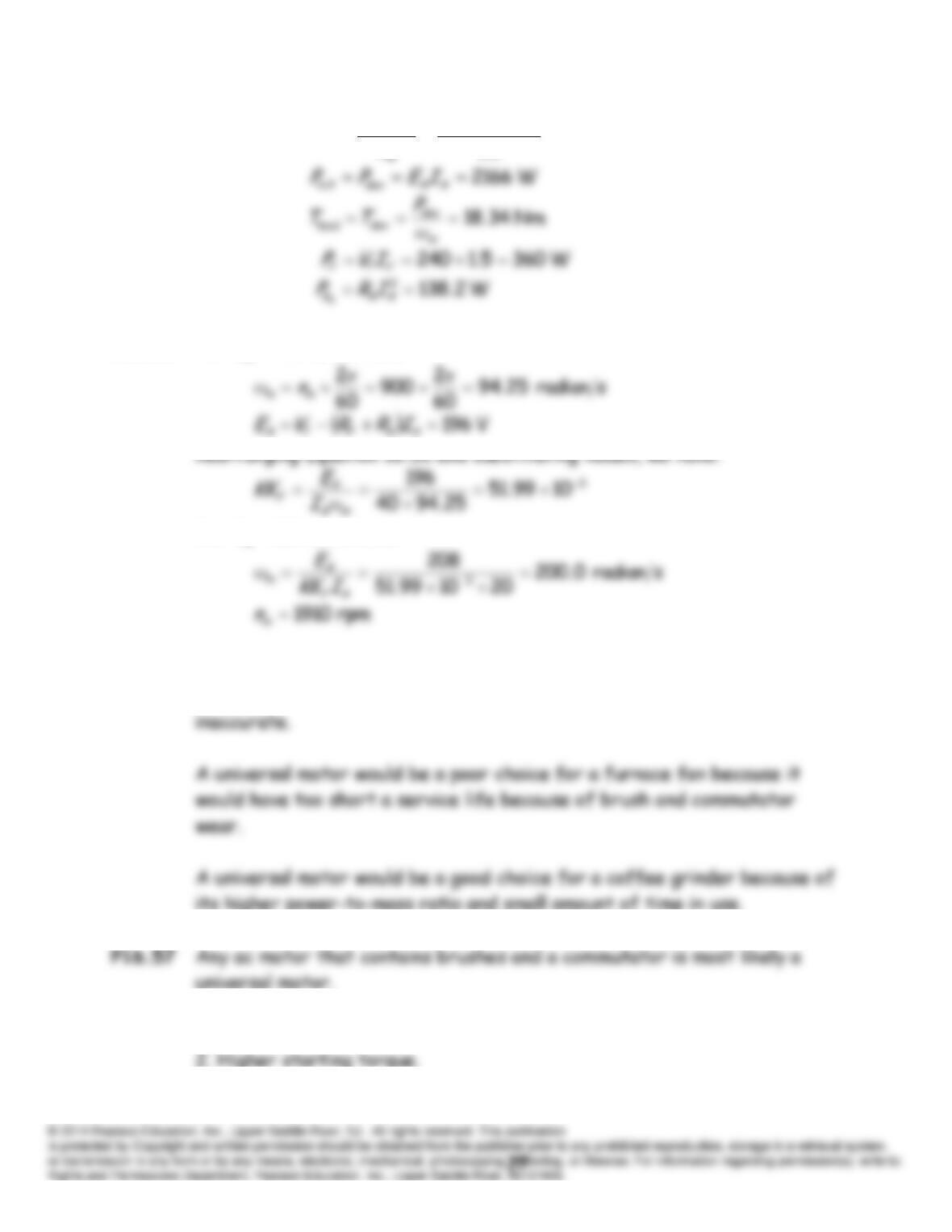
P16.54 (a) The field current is
A 6.9
1.5
6.225240
A
T
AR
EV
I
P16.55* For
A 40
A
I
, we have:
For
A 20
A
I
, we have:
P16.56 A universal motor would be a poor choice for a clock because the speed is
variable with the output torque required. The clock would be very
P16.58 1. Higher power-to-mass ratio.
P16.59 For
A 25
I
, we have:
AA
F
T
AIRRVE
Rearranging Equation 16.30 and substituting values, we have:
3
1012.85
7.12525
5.267
m
A
A
FI
E
KK
Now when the output torque is increased by a factor of 2, we have:
From Equation 16.31, we have:
P16.60 For
A 25
I
, we have:
P16.61 For
A 40
I
, we have:
Rearranging Equation 16.30 and substituting values, we have:
From Equation 16.31, we have:
P16.62 (a) According to Equation 16.34 for a series connected motor, we
Since the rotational losses are negligible, we have
dev
out
TT
. Thus,
torque is inversely proportional to speed squared so we can write:
(b) In theory, the no-load speed is infinite. Of course, rotational
P16.63 We have:
W 440020220
in
A
TIVP
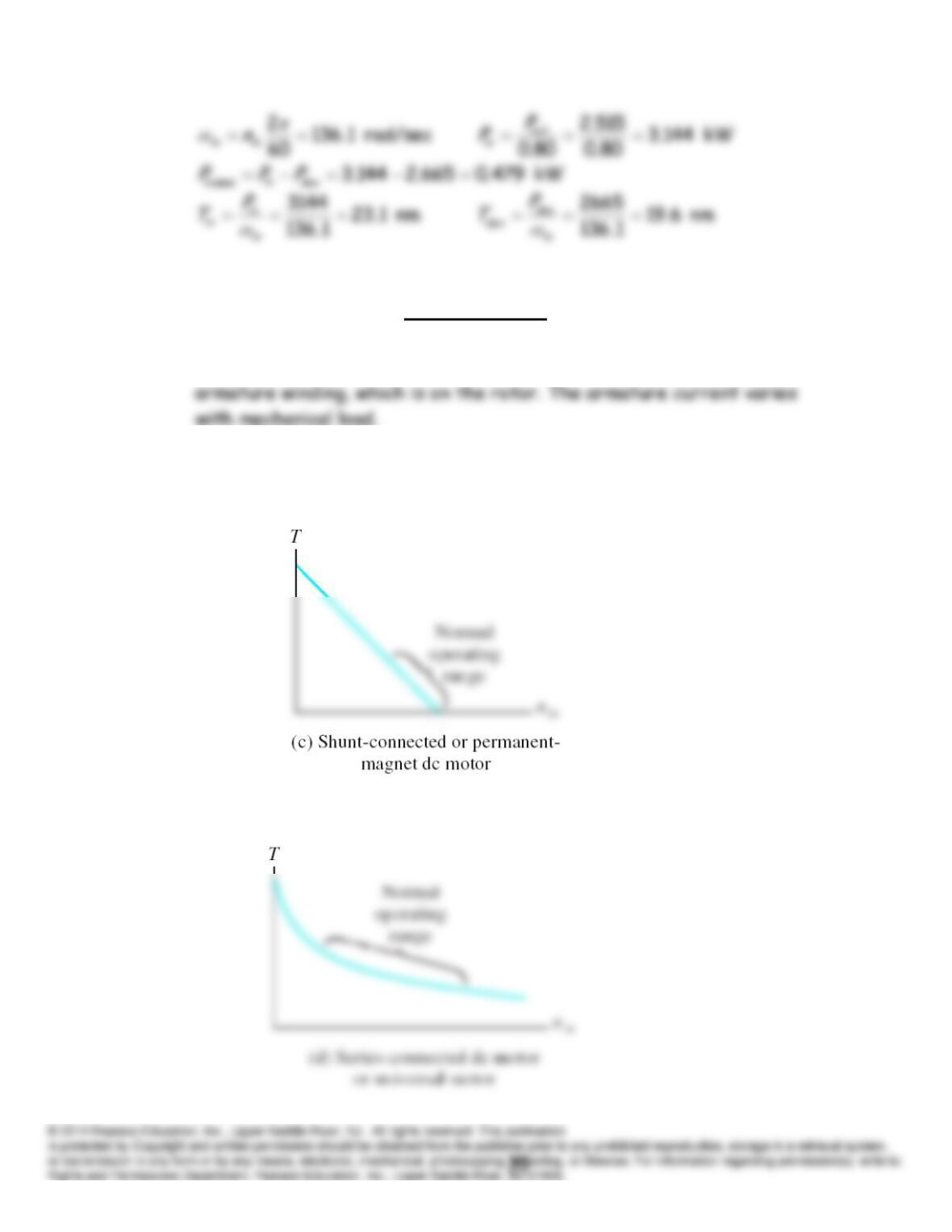
P16.64* See Figures 16.26, 16.27 and 16.28 in the book.
P16.65* Equation 16.34 gives the developed torque of the series motor.
Thus, speed for a constant torque load is proportional to the applied
A
After adding series resistance, we have:
P16.67 (a)
A 16
5.210
200
adj
RR
V
I
F
T
F
For this field current at a speed of 1200 rpm, from the magnetization
(b) With zero speed, we have
EA
= 0. Thus the initial armature current is
A
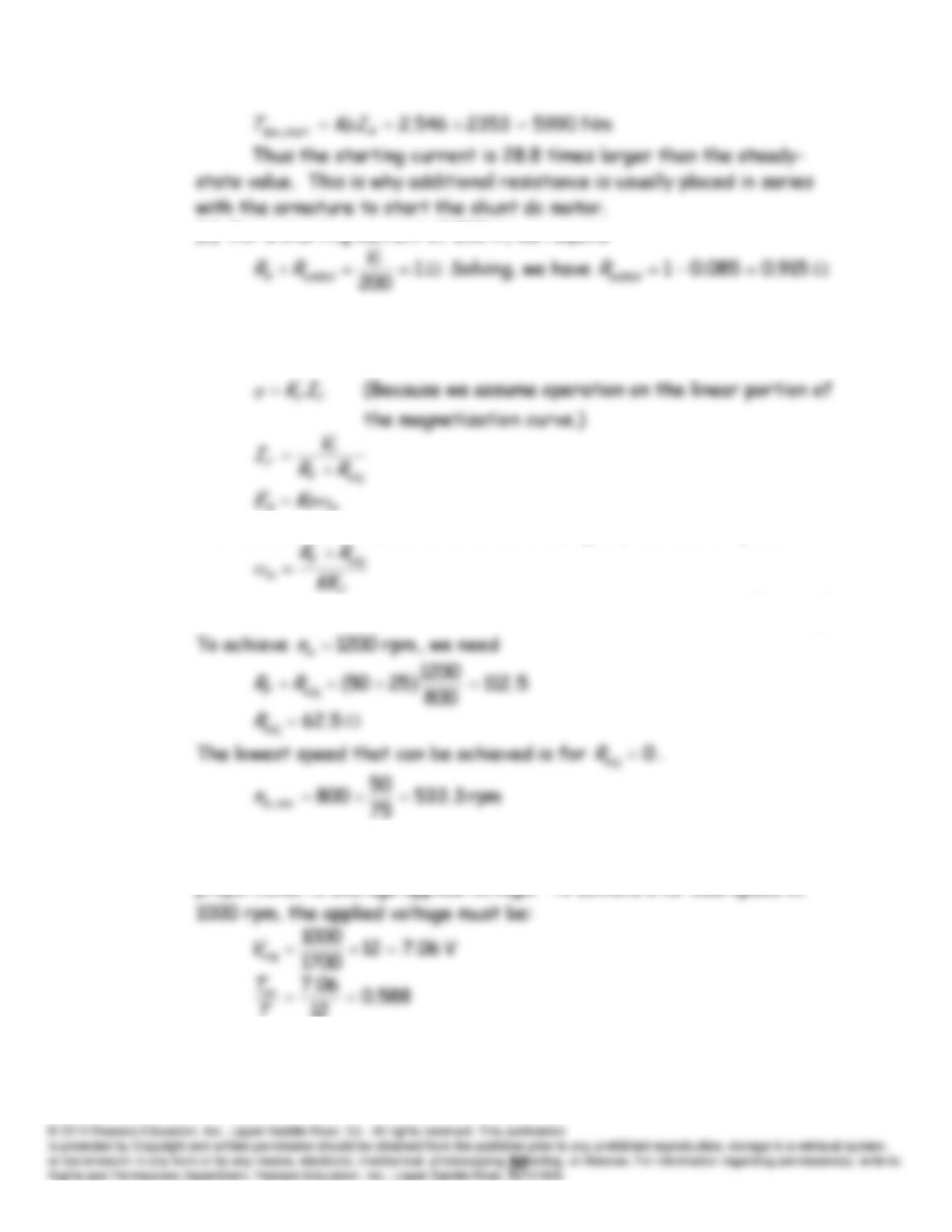
(c) For a starting current of 200 A, we require
P16.68 For this shunt-connected machine, we have
T
AVE
(Because
0
A
R
.)
m
AKE
From these equations, we obtain the following expression for speed:
Thus, speed (either
m
ω
or
m
n
) is proportional to the resistance
adj
RRF
.
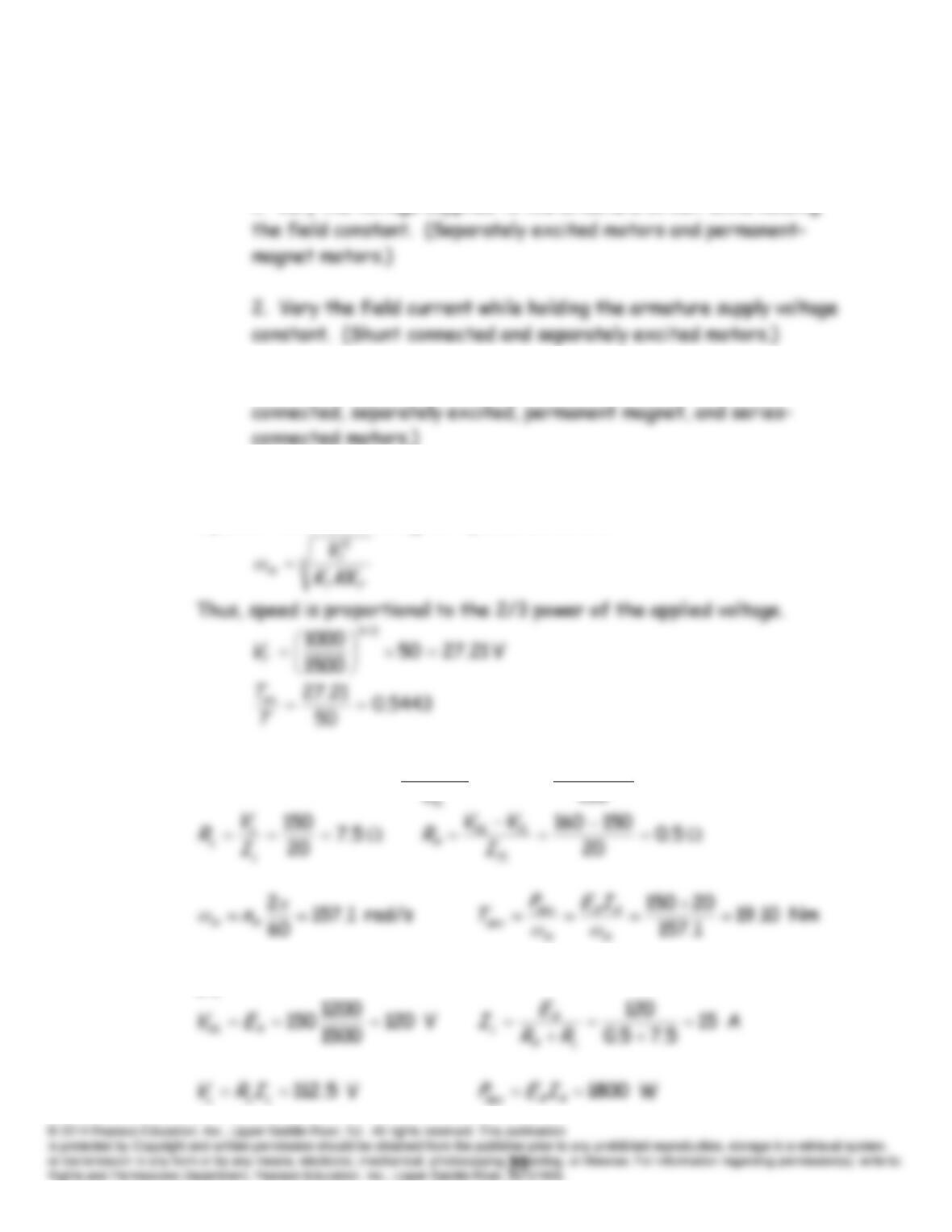
P16.69 Neglecting rotational losses, the no-load speed of a PM motor is
proportional to average applied voltage. To achieve a no-load speed of
12
T
P16.70 Three methods to control the speed of dc motors and the types of
motors for which each is practical are:
1. Vary the voltage supplied to the armature circuit while holding
3. Insert resistance in series with the armature circuit. (Shunt
P16.71 We have
m
T
load KTT
ω
dev
and
0
F
ARR
. Substituting this into
Equation 16.34 and solving for speed, we obtain:
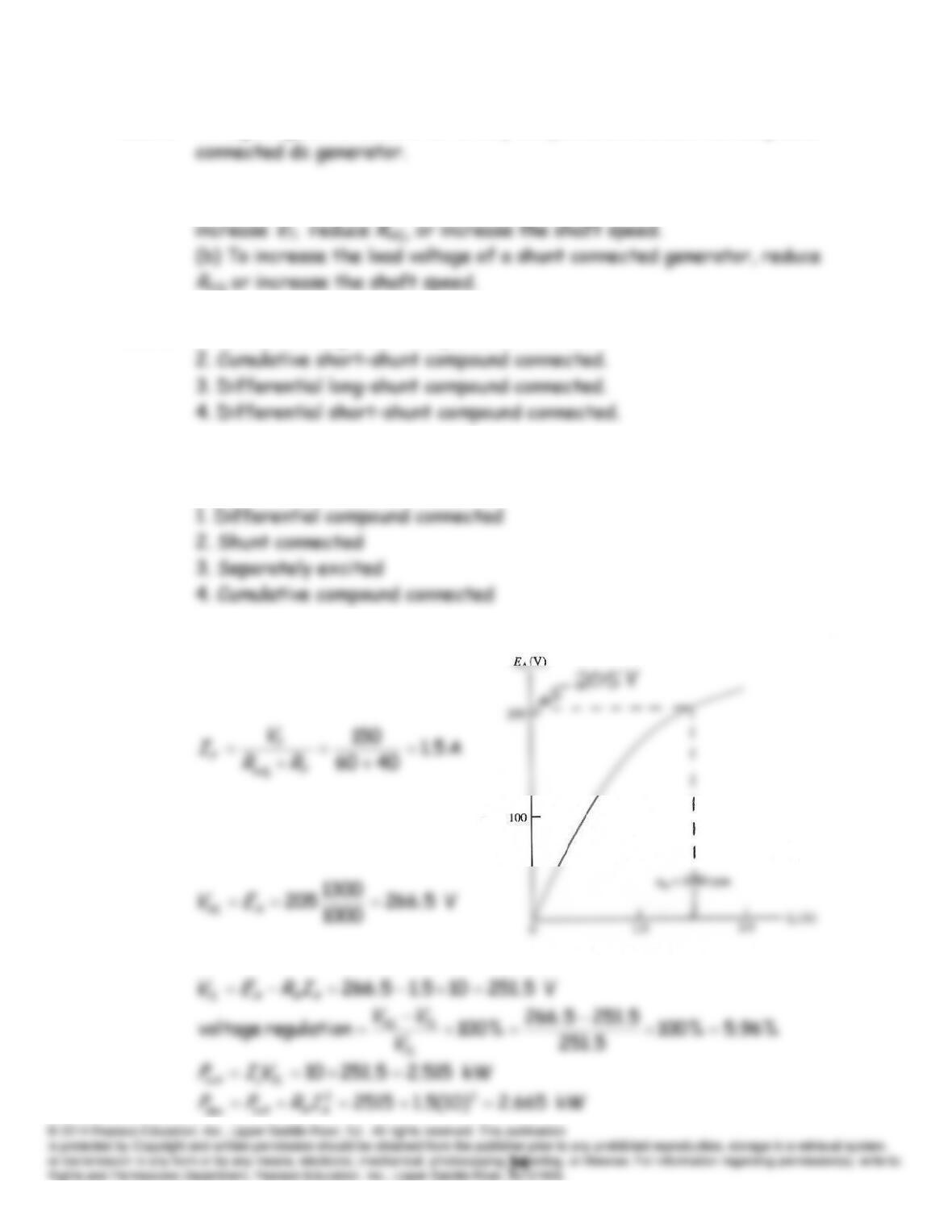
P16.72* (a)
%667.6%100
150160
%100 regulation voltage
FLNL
VV
(b)
P16.73 Voltage regulation is zero for a fully compensated cumulative compound
P16.74 (a) To increase the load voltage of a separately-excited generator,
P16.75 1. Cumulative long-shunt compound connected.
P16.76 From highest to lowest voltage regulation the generators shown in Figure
16.30 are:
P16.77
Practice Test
T16.1 The windings are the field winding, which is on the stator, and the
T16.2 See Figure 16.5(c) in the book. The speed becomes very high, and the
machine can be destroyed.
T16.3 See Figure 16.5(d) in the book.
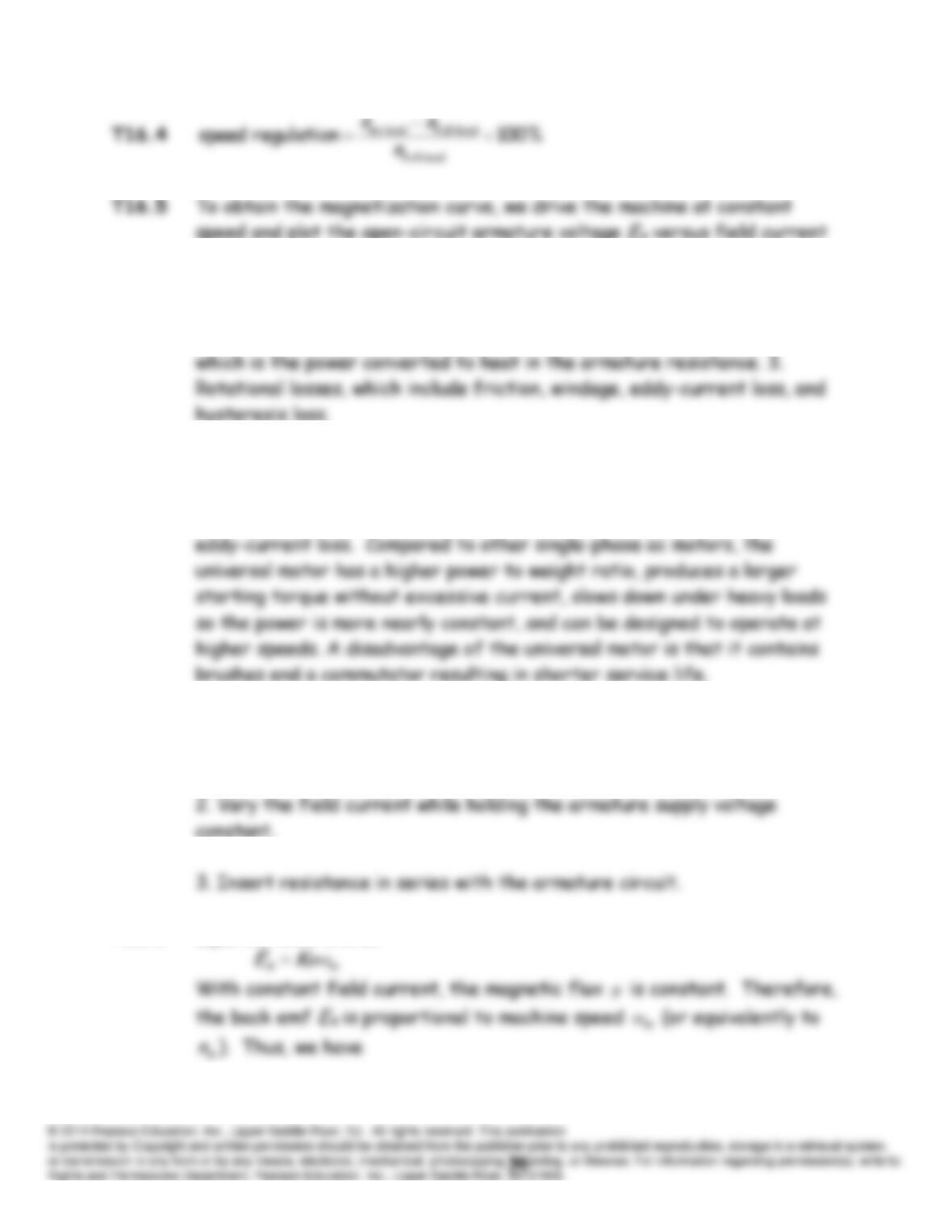
IF
.
T16.6 Power losses in a shunt-connected dc motor are 1. Field loss, which is the
power consumed in the resistances of the field circuit. 2. Armature loss,
T16.7 A universal motor is an ac motor that similar in construction to a series–
connected dc motor. In principle, it can be operated from either ac or dc
sources. The stator of a universal motor is usually laminated to reduce
T16.8 1. Vary the voltage supplied to the armature circuit while holding the
field constant.
T16.9 Equation 16.15 states
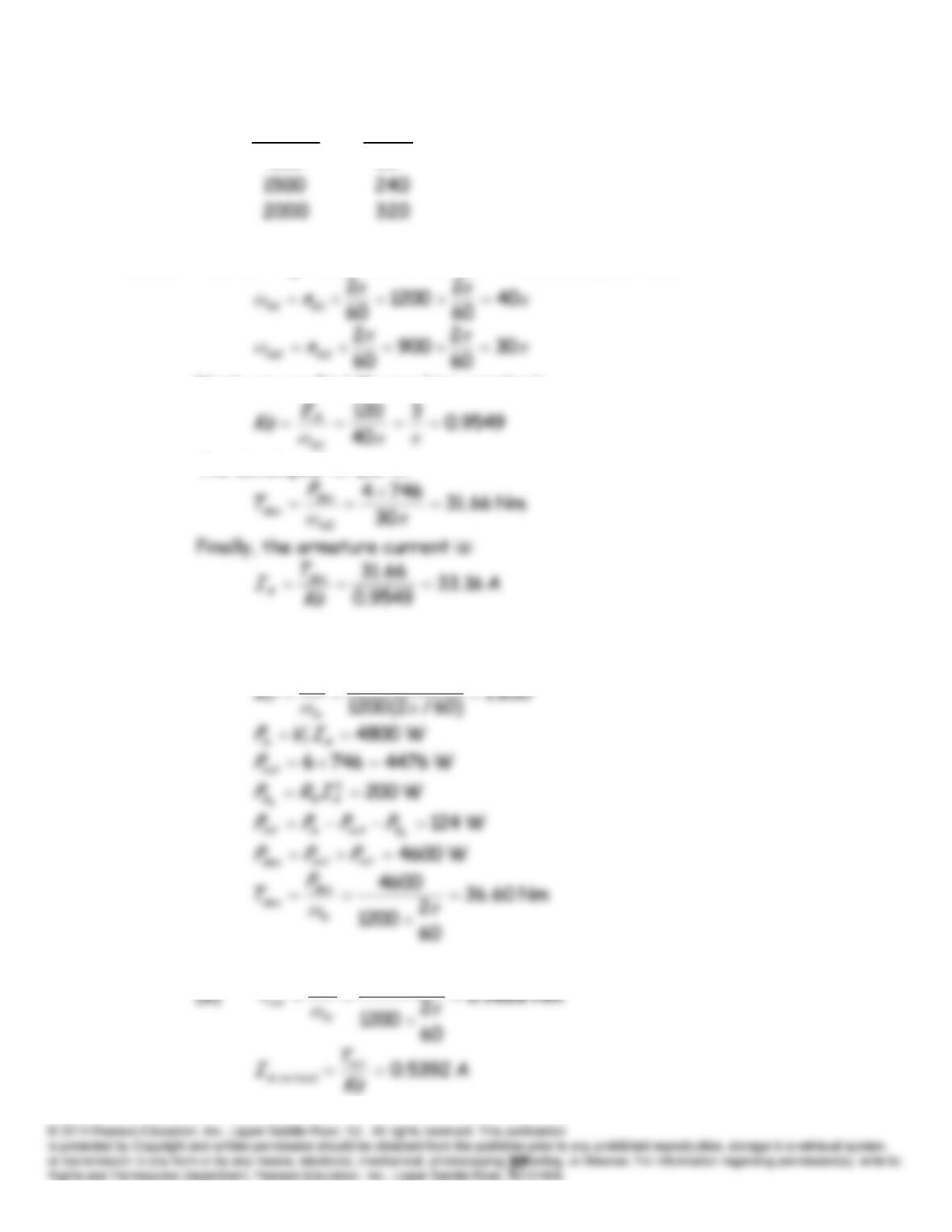
rpm
m
n
V
A
E
500 80
T16.10 Converting the speeds from rpm to radians/s, we have:
Next, we can find the machine constant:
The developed torque is:
T16.11 (a)
V 230
AA
T
AIRVE
230
A
E
124
rot
P
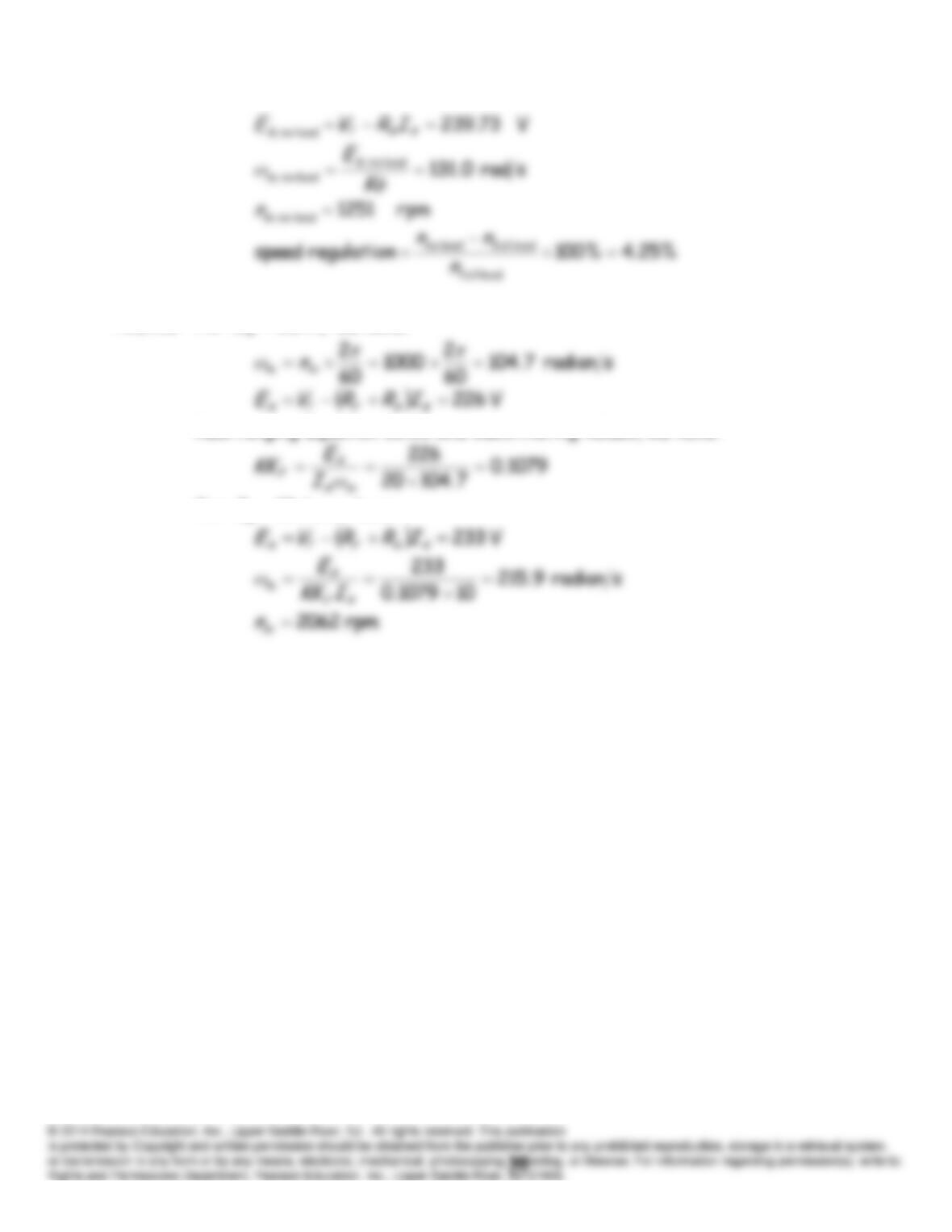
T16.12 For
A 20
I
, we have:
Rearranging Equation 16.30 and substituting values, we have:
For
A 10
A
I
, we have: