Problems 16–21
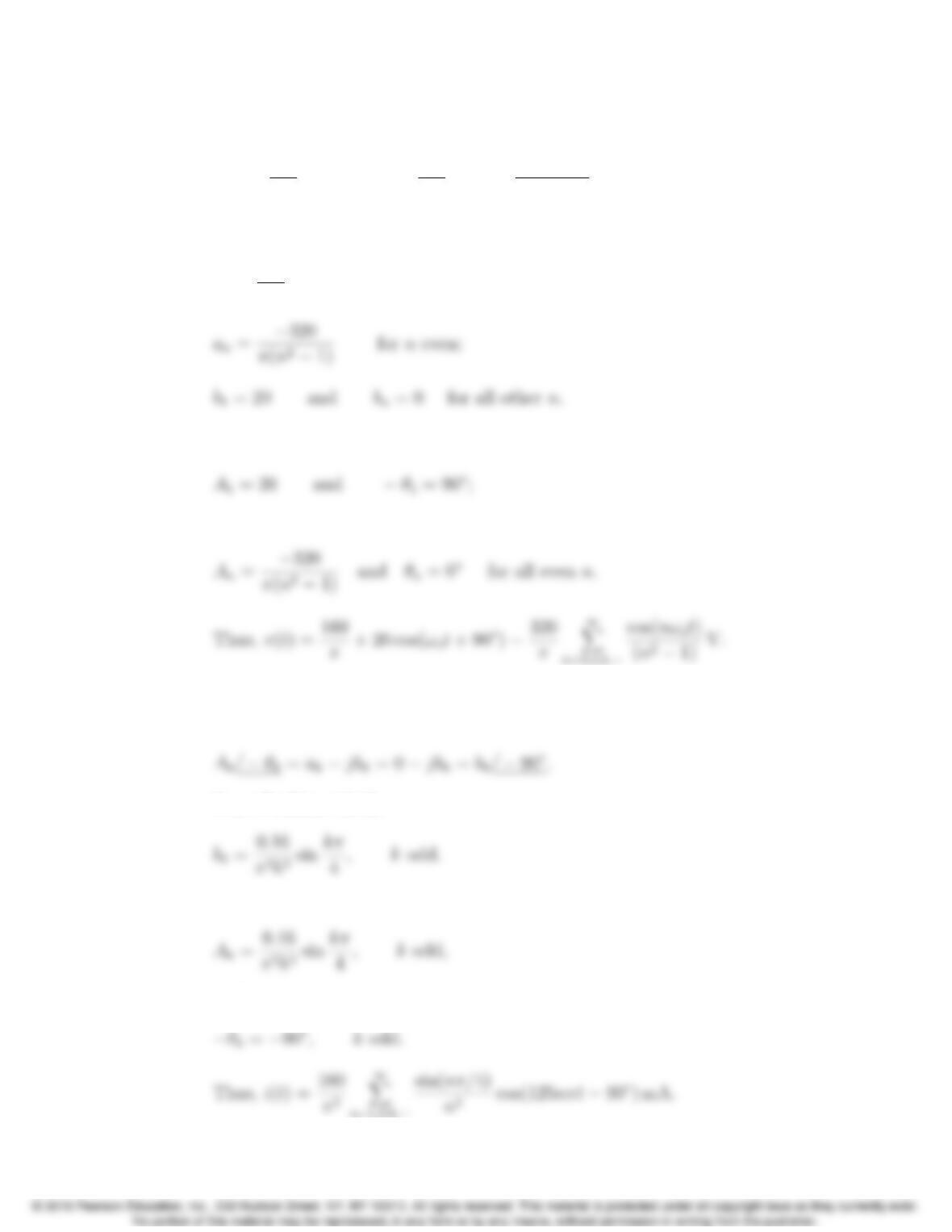
P 16.19 From Problem 16.2,
v(t)=160
π+ 20 sin ωot−320
π
1
X
n=2,4,6,···
cos(nωot)
(n2−1) V.
Therefore,
av=160
πV;
Therefore,
and
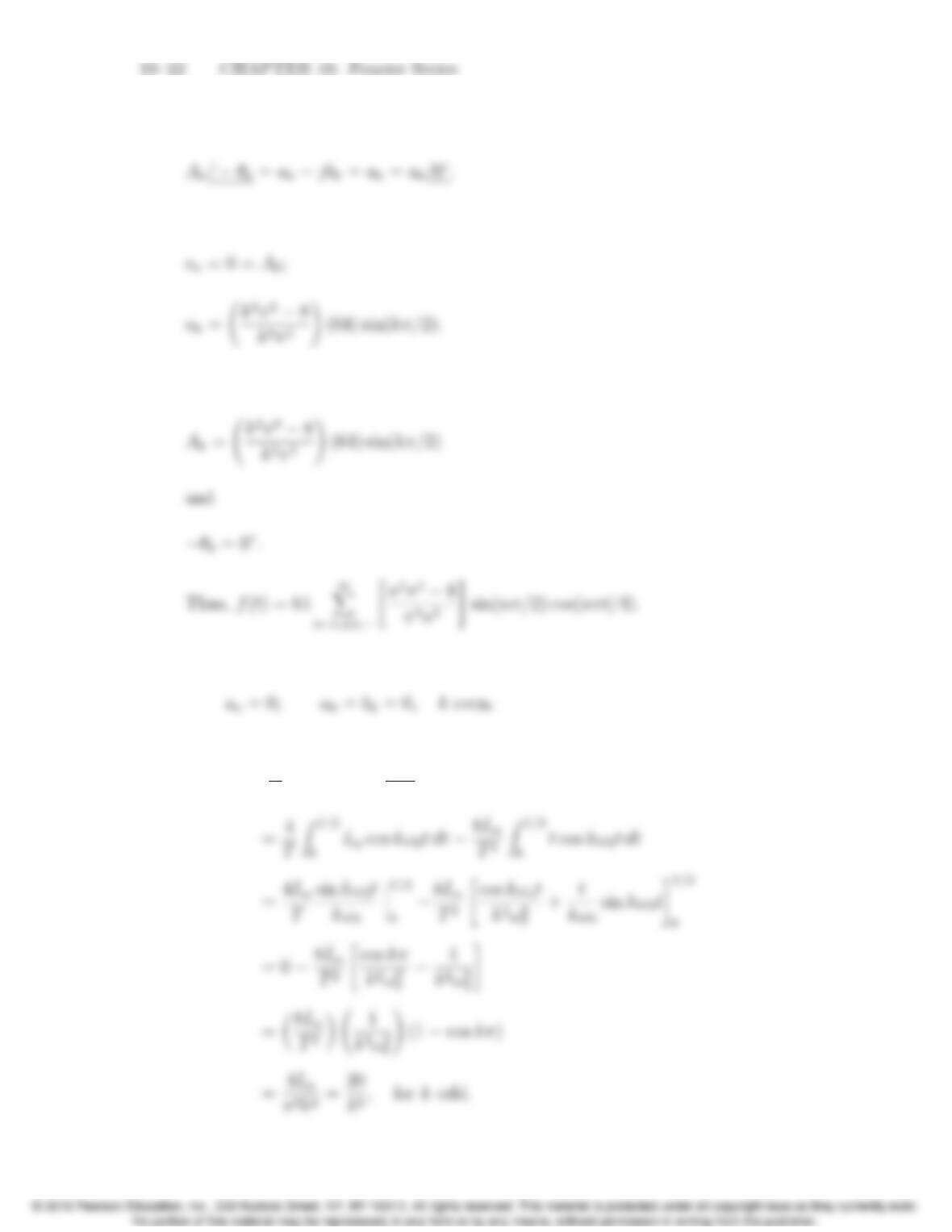
P 16.20 The periodic function in Problem 16.12 is odd, so av= 0 and ak= 0 for all k.
Thus,
From Problem 16.12,
Therefore,
and
P 16.21 The periodic function in Problem 16.15 is even, so bk= 0 for all k. Thus,
From Problem 16.15,
Therefore,
P 16.22 [a] The current has half-wave symmetry. Therefore,
For kodd,
ak=4
TZT/2
0✓Im−2Im
Tt◆cos kωot dt
Problems 16–23
bk=4
TZT/2
0✓Im−2Im
Tt◆sin kωot dt
=4Im
TZT/2
0sin kω0t dt −8Im
T2ZT/2
0tsin kω0t dt
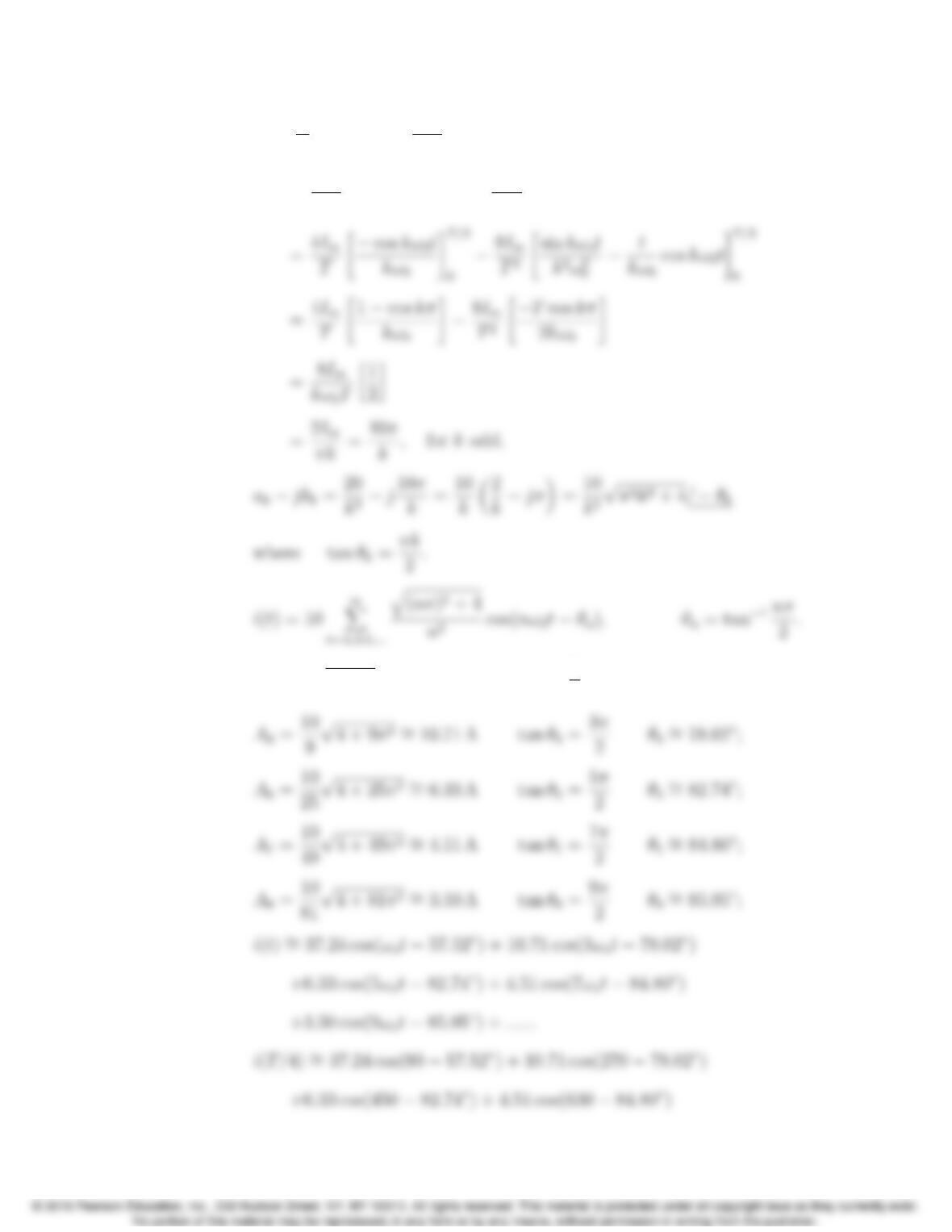
[b] A1= 10√4+π2∼
=37.24 A tan θ1=π
2θ1∼
=57.52;
16–24 CHAPTER 16. Fourier Series
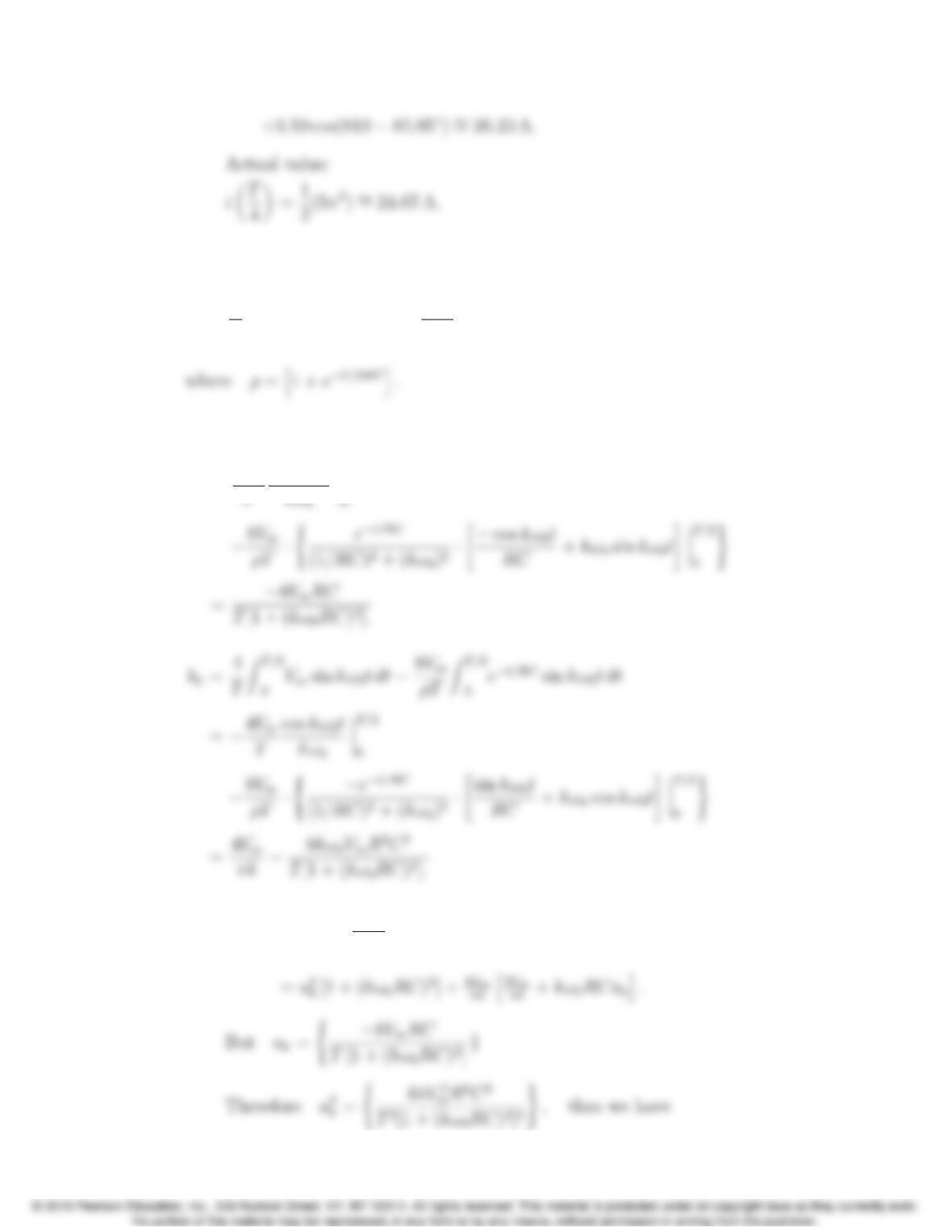
P 16.23 The function has half-wave symmetry, thus ak=bk= 0 for k-even, av= 0; for
k-odd
ak=4
TZT/2
0Vmcos kω0t dt −8Vm
ρTZT/2
0et/RC cos kω0t dt
Upon integrating we get
ak=4Vm
sin kω0t
T/2
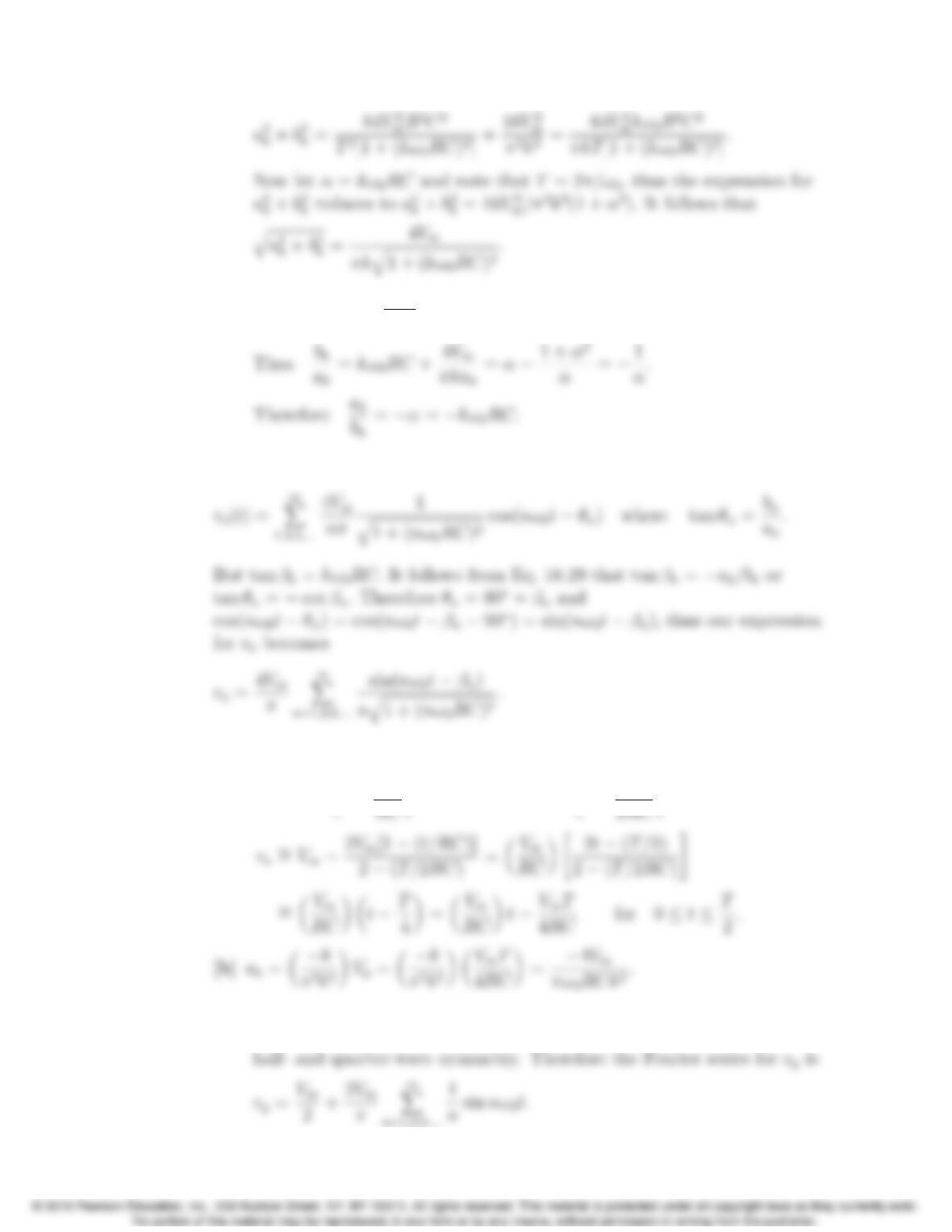
P 16.24 [a] a2
k+b2
k=a2
k+✓4Vm
πk+kω0RCak◆2
Problems 16–25
[b] bk=kω0RCak+4Vm
πk.
P 16.25 Since av= 0 (half-wave symmetry), Eq. 16.20 gives us
P 16.26 [a] ex∼
=1−xfor small x; therefore
et/RC ∼
=✓1−t
=✓1−T
P 16.27 [a] Express vgas a constant plus a symmetrical square wave. The constant is
Vm/2 and the square wave has an amplitude of Vm/2,is odd, and has
16–26 CHAPTER 16. Fourier Series
The dc component of the current is Vm/2Rand the kth harmonic phase
current is
Thus the Fourier series for the steady-state current is
[b]
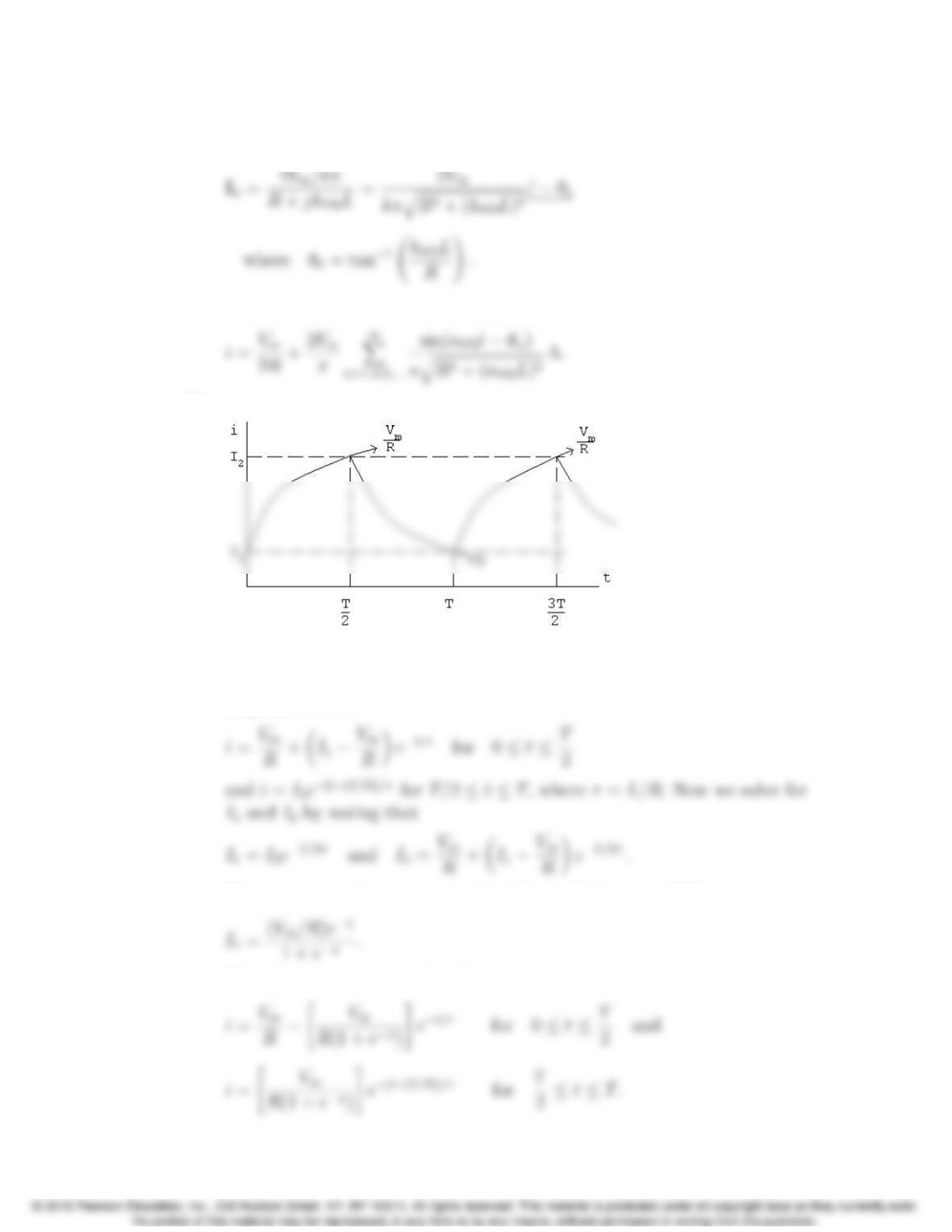
The steady-state current will alternate between I1and I2in exponential
traces as shown. Assuming t= 0 at the instant iincreases toward
(Vm/R),we have
These two equations are now solved for I1.Letting x=T/2τ,we get
Therefore the equations for ibecome
Problems 16–27
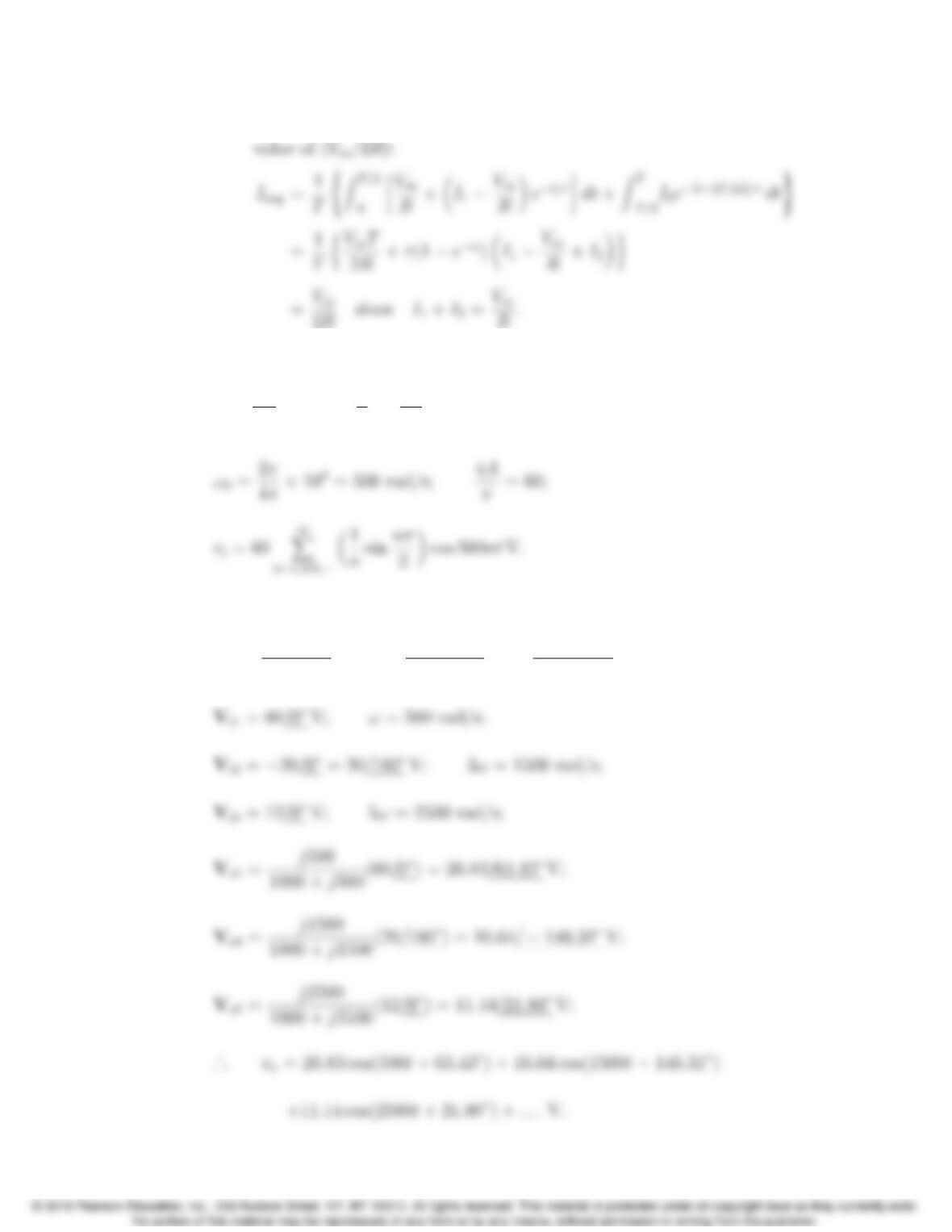
A check on the validity of these expressions shows they yield an average
P 16.28 From the result of Problem 16.13(a),
vi=4A
π
1
X
n=1,3,5,··· ✓1
nsin nπ
2◆cos nω0t;
From the circuit
Vo=Vi
R+jωL·jωL=jω
R/L +jωVi=jω
1000 + jωVi;
16–28 CHAPTER 16. Fourier Series
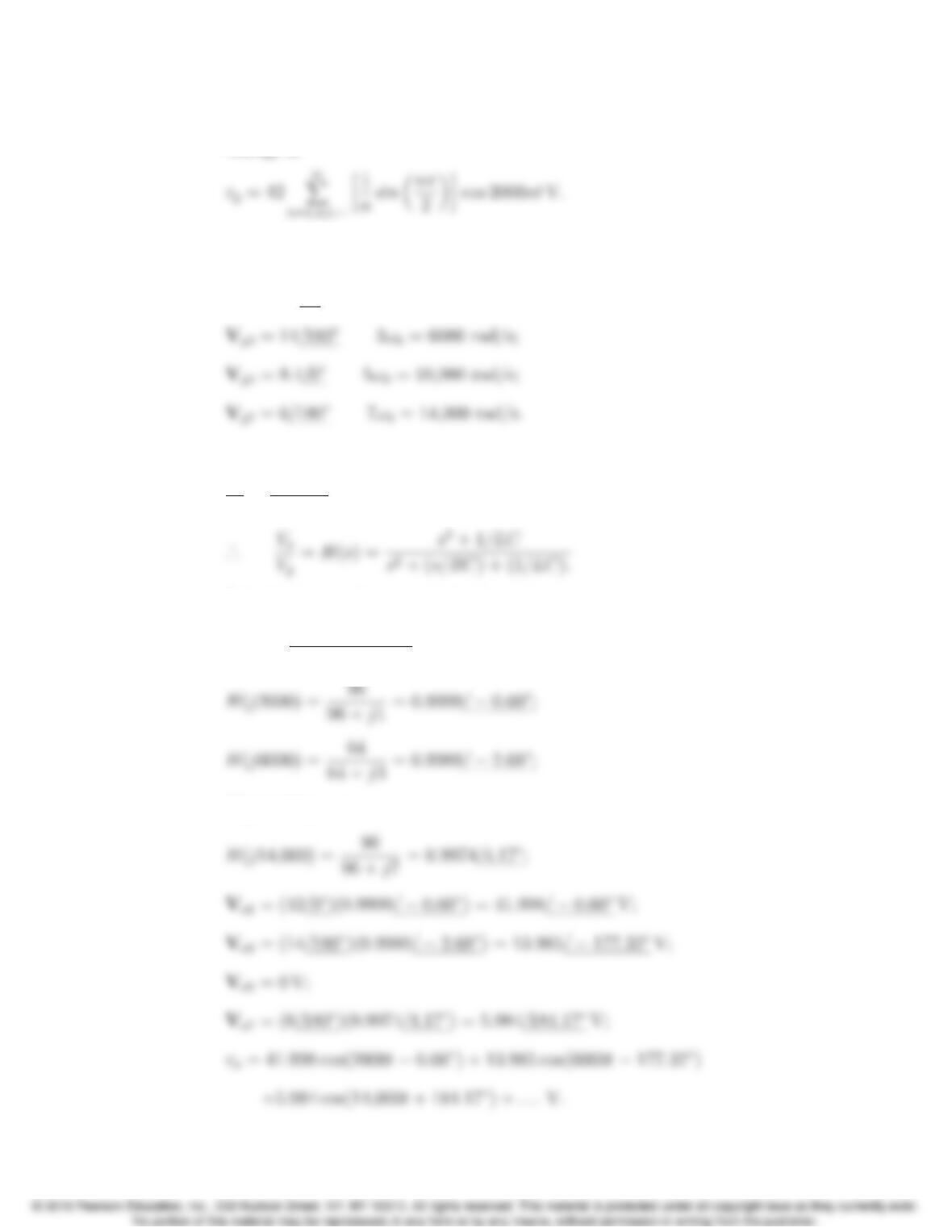
P 16.29 [a] From the solution to Problem 16.13(a) the Fourier series for the input
voltage is
Employing the technique used in solving Assessment Problem 16.6 we
have
Vg1= 42/0ω0= 2000 rad/s;
From the circuit in Fig. P16.29 we have
Vo
R+Vo−Vg
sL +(Vo−Vg)sC = 0;
Substituting in the numerical values gives
H(s)= s2+10
8
s2+ 500s+10
8;
H(j10,000) = 0;
Problems 16–29
P 16.30 [a] V0−Vg
16s+V0(12.5×10⁶s)+ V0
1000 = 0;
H(0) = 103;
H(j4ω0)=5.5×10⁷/−178.48;
16–30 CHAPTER 16. Fourier Series
= 216.45 ×10³+1.27 ×10³cos(240πt+6.11)
P 16.31 The function is odd with half-wave and quarter-wave symmetry. Therefore,
ak=0,for all k; the function is odd;
Int1 = 500ZT/10
0tsin kωot dt
Problems 16–31
·
.. Int1 + Int2 = 500
k2ω2
o
sin kπ
5.
From the circuit,
H(s)=Vo
Ig
=Zeq;
Therefore,
We want the output for the third harmonic:
Therefore,
16–32 CHAPTER 16. Fourier Series
P 16.32 ωo=2π
T=2π
10π×106= 200 krad/s;
15th harmonic input:
vg15 = (150)(1/15) sin(15π/2) cos 15ωot=−10 cos 3 ×10⁶tV;
25th harmonic input:
vg25 = (150)(1/25) sin(25π/2) cos 5 ×10⁶t= 6 cos 5 ×10⁶tV;
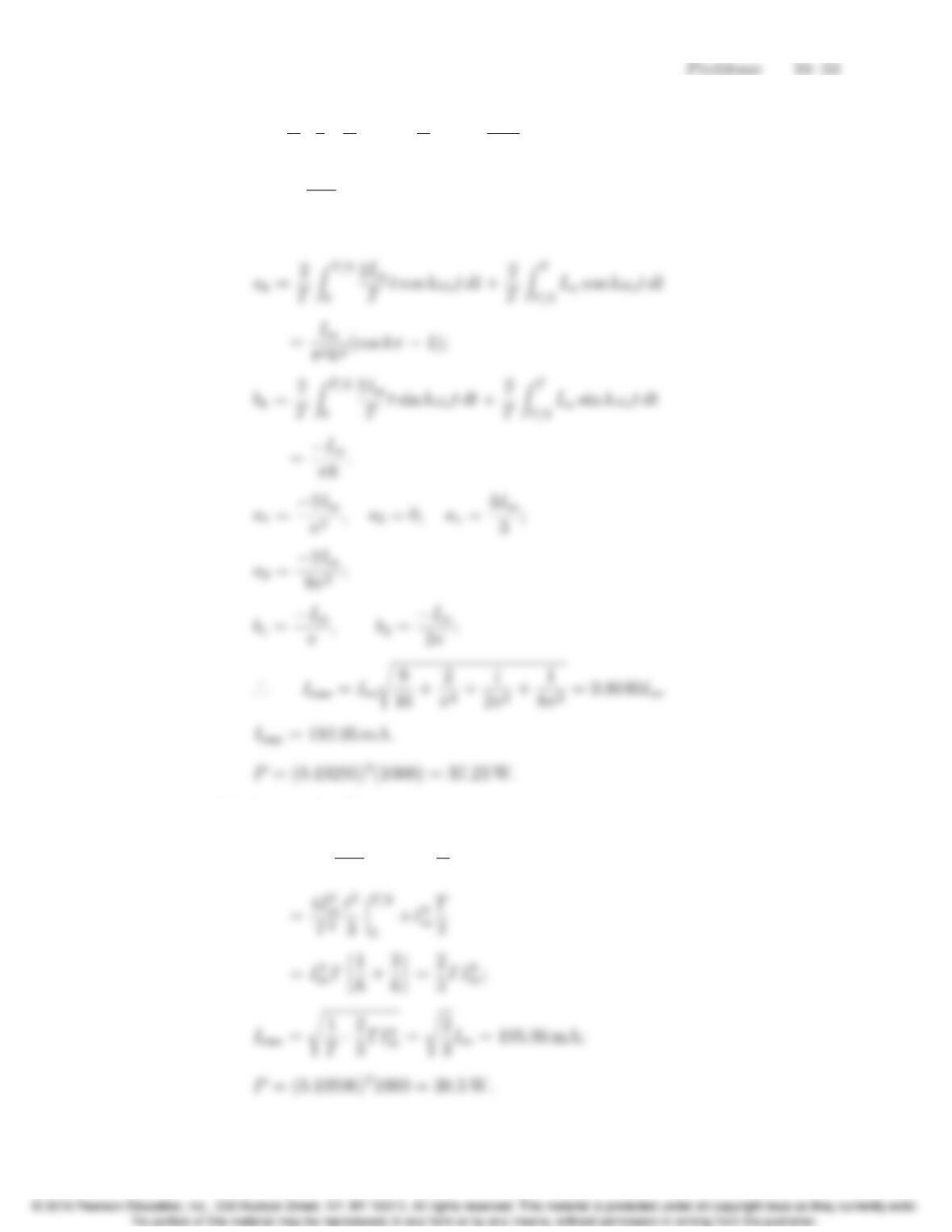
P 16.33 [a] av=1
T1
2✓1
T◆Im+T
2Im=3Vm
4;
i(t)=2Im
Tt, 0≤t≤T/2;
i(t)=Im,T/2≤t≤T.
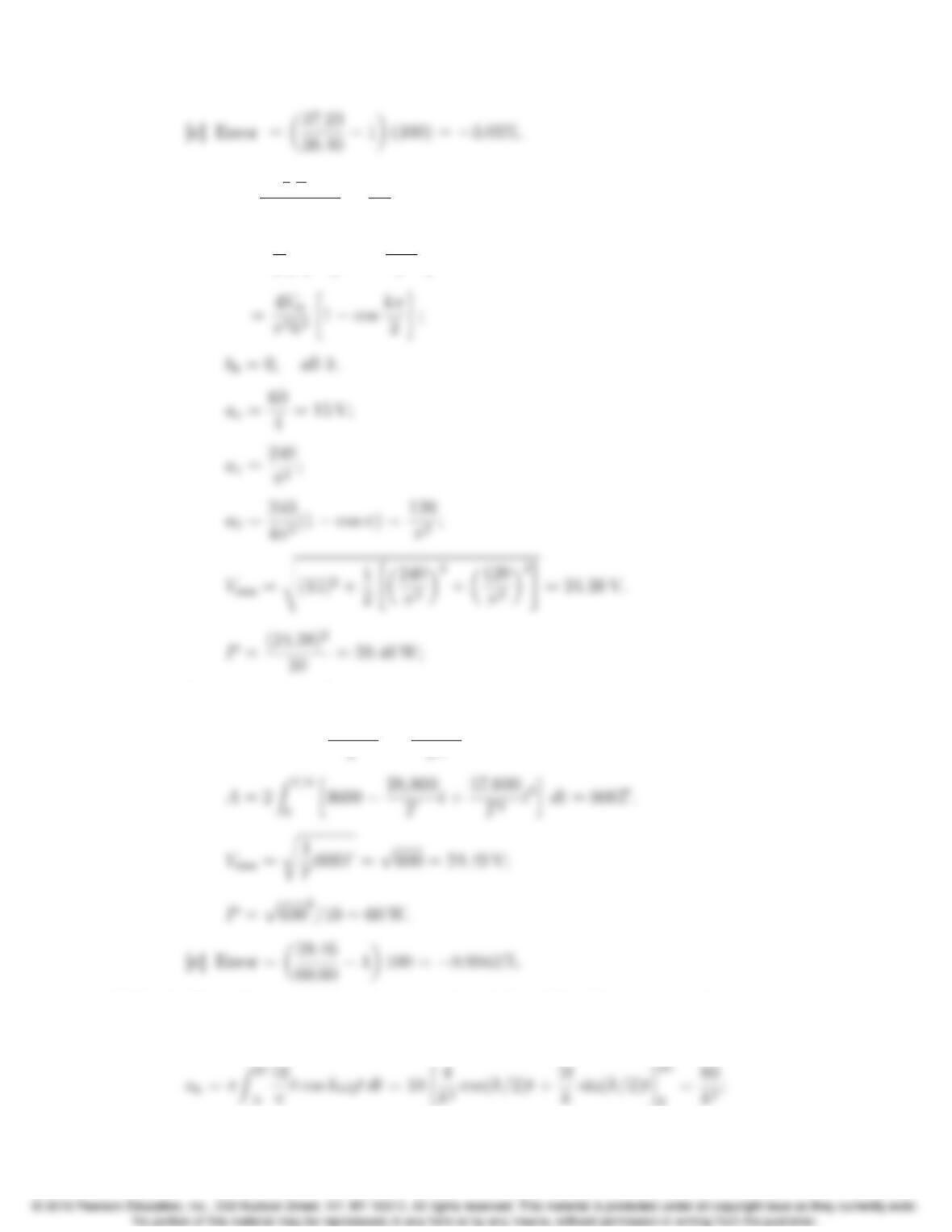
[b] Area under i2:
A=ZT/2
0
4I2
m
T2t dt +I2
m
T
2
16–34 CHAPTER 16. Fourier Series
P 16.34 [a] av=2⇣1
2
T
4Vm⌘
T=Vm
4;
ak=4
TZT/4
0Vm−4Vm
Ttcos kωot dt
[b] Area under v2;0≤t≤T/4
v2= 3600 −28,800
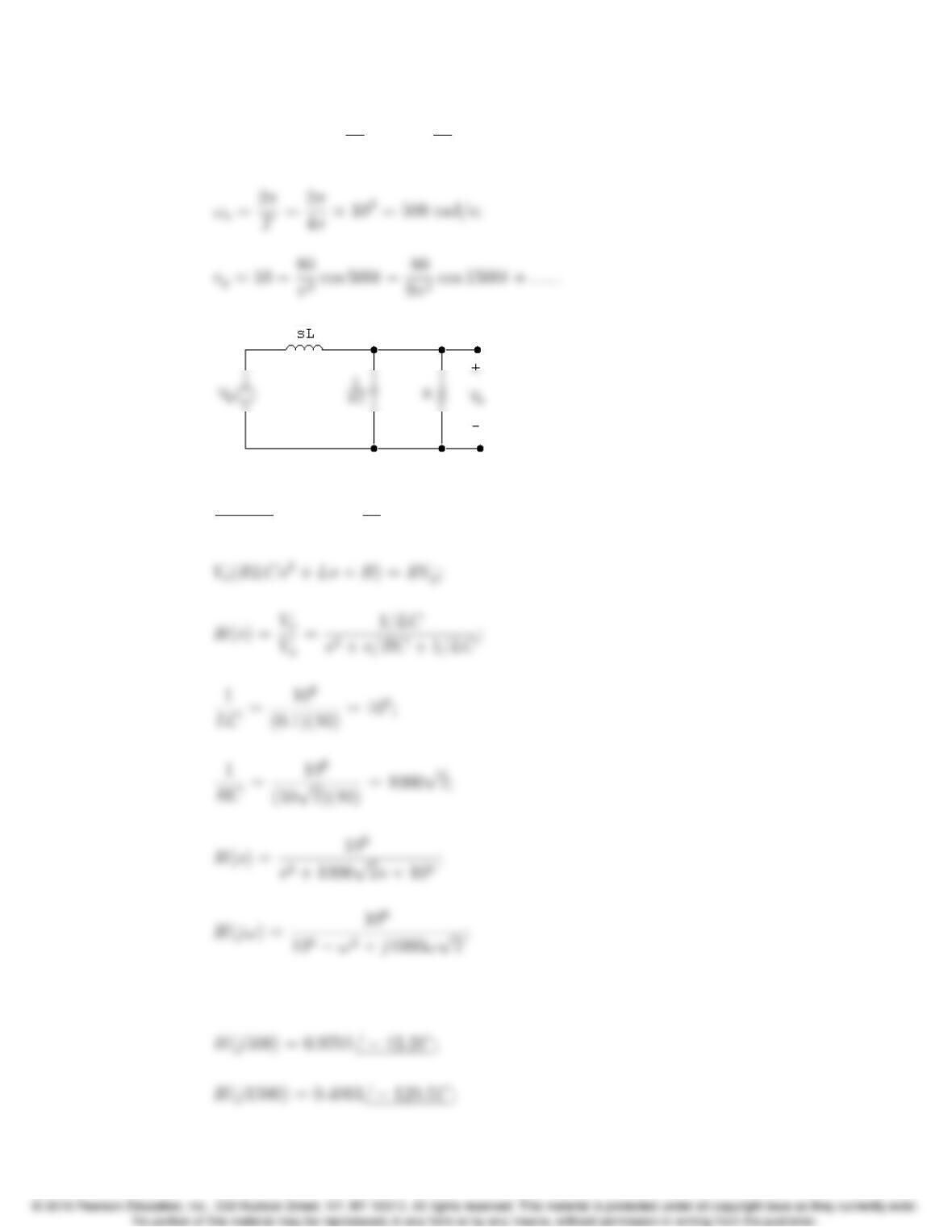
P 16.35 The voltage waveform is even, so bk= 0 for all k. The average value is
av=0.5(20)(4π)/4π= 10.
Problems 16–35
·
.. v
g= 10 −80
π2
1
X
n=1,3,5,…
1
n2cos nωotV;
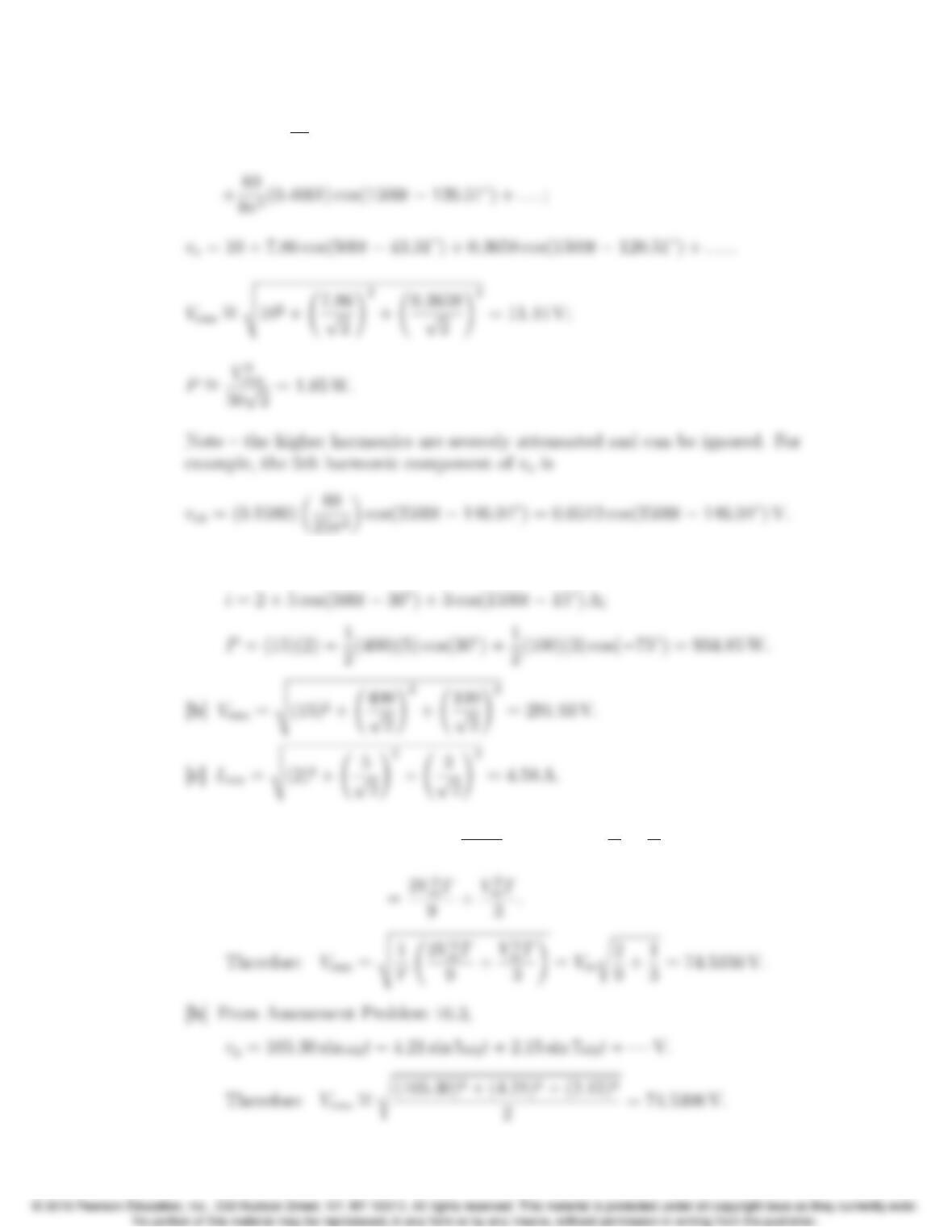
Vo−Vg
sL +sCVo+Vo
R= 0;
H(j0) = 1;
16–36 CHAPTER 16. Fourier Series
vo= 10(1) + 80
π2(0.9701) cos(500t−43.31)
P 16.36 [a] v= 15 + 400 cos 500t+ 100 cos(1500t−90) V;
P 16.37 [a] Area under v2=A=4
ZT/6
0
36V2
m
T2t2dt +2V2
m✓T
3−T
6◆
Problems 16–37
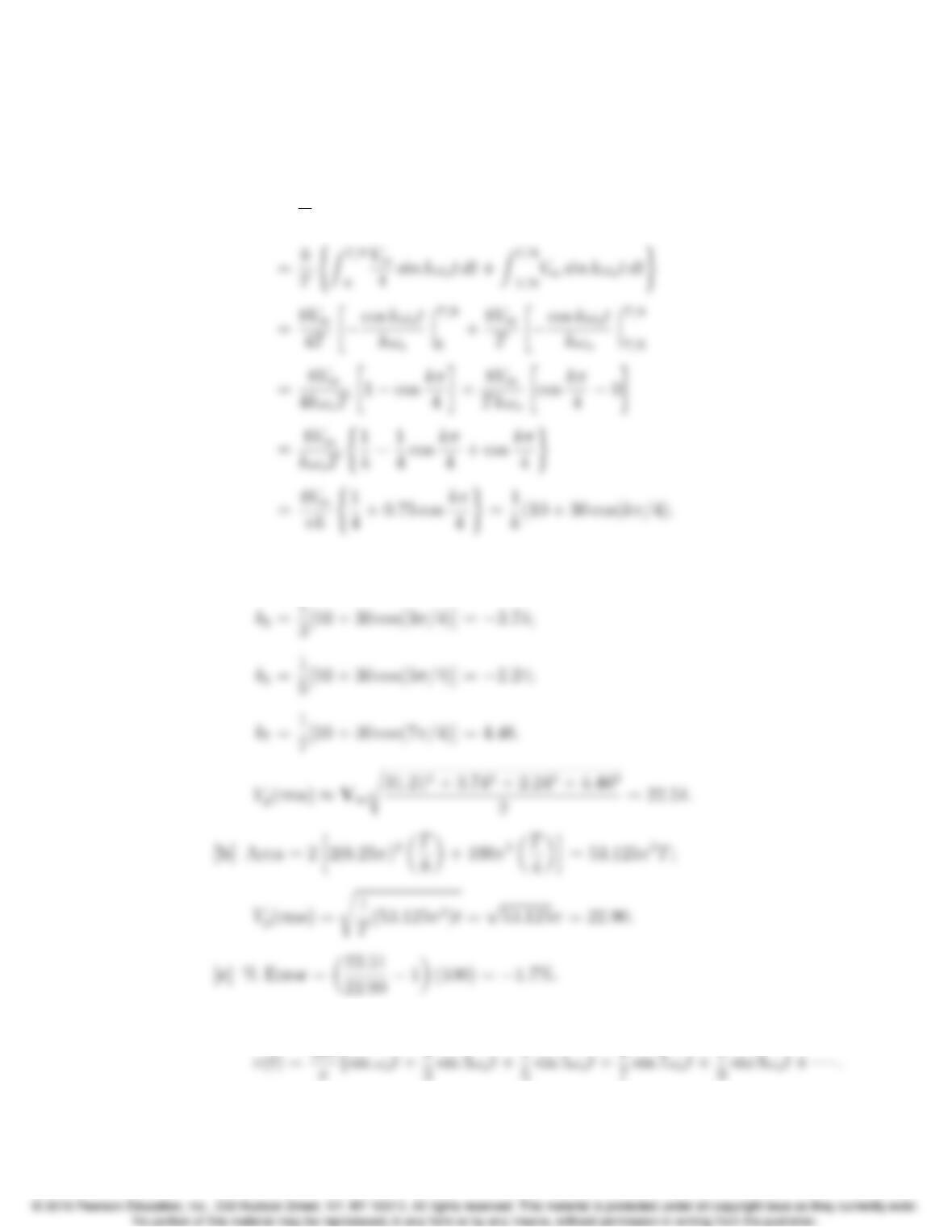
P 16.38 [a] vhas half-wave symmetry, quarter-wave symmetry, and is odd
·
.. a
v=0,a
k= 0 all k, bk=0,for keven.
bk=8
TZT/4
0f(t) sin kωot dt, k-odd
b1= 10 + 30 cos(π/4) = 31.21;
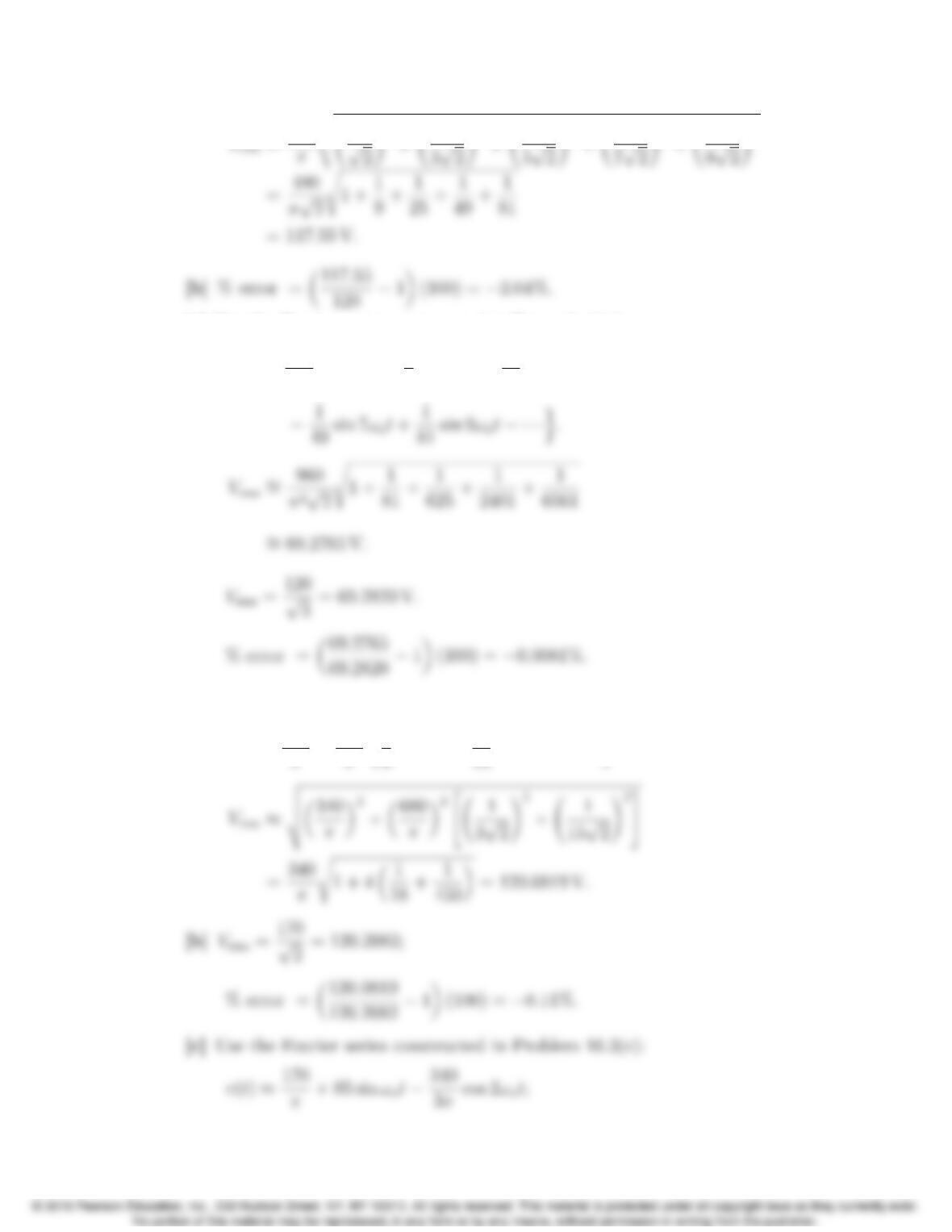
P 16.39 [a] Use the Fourier series constructed in Problem 16.3(a):
16–38 CHAPTER 16. Fourier Series
u
u
t 1
[c] Use the Fourier series constructed in Example 16.2:
v(t)=960
π2⇢sin ωot+1
9sin 3ωot+1
25 sin 5ωot
P 16.40 [a] Use the Fourier series constructed in Problem 16.3(b):
v(t)≈340
.