CHAPTER 1
Exercises
E1.1 Charge = Current Time = (2 A) (10 s) = 20 C
E1.3 Because
i
2 has a positive value, positive charge moves in the same
E1.4 Energy = Charge Voltage = (2 C) (20 V) = 40 J
E1.5
iab
enters terminal
a
. Furthermore,
vab
is positive at terminal
a
. Thus
E1.6 (a)
20)()()(
ttitvtp aaa
10
E1.7 (a) Sum of currents leaving = Sum of currents entering
E1.9 Go clockwise around the loop consisting of elements
A
,
B
, and
C
:
E1.11 The resistance of a wire is given by
A
L
R
ρ
. Using
4/
2
dA
and
substituting values, we have:
RVP
2
E1.13
RVP
2
V 8.15100025.0
PRV
E1.14 Using KCL at the top node of the circuit, we have
i
1 =
i
2. Then, using KVL
E1.15 At the top node we have
iR
=
i
s = 2A. By Ohm’s law we have
vR = RiR
= 80
Problems
P1.1 Broadly, the two objectives of electrical systems are:
P1.2 Eight subdivisions of EE are:
1. Communication systems.
2. Computer systems.
P1.3 Four important reasons that non-electrical engineering majors need to
learn the fundamentals of EE are:
1. To pass the Fundamentals of Engineering Exam.
2. To be able to lead in the design of systems that contain
P1.5 (a) Electrical current is the time rate of flow of net charge through a
(b) The voltage between two points in a circuit is the amount of energy
P1.6 (a) A conductor is analogous to a frictionless pipe.
(b) An open switch is analogous to a closed valve.
P1.7* The reference direction for
ab
i
points from
a
to
b.
Because
ab
i
has a
negative value, the current is equivalent to positive charge moving
P1.8*
A 222 2
ttt
dt
d
dt
tdq
ti
P1.10* The charge flowing through the battery is
coulombs 10432)seconds 360024()amperes 5( 3
Q
(a) Equating gravitational potential energy, which is mass times height
times the acceleration due to gravity, to the energy stored in the battery
P1.11*
coulombs 106.3)seconds 000,36()amperes 10(time current 5
Q
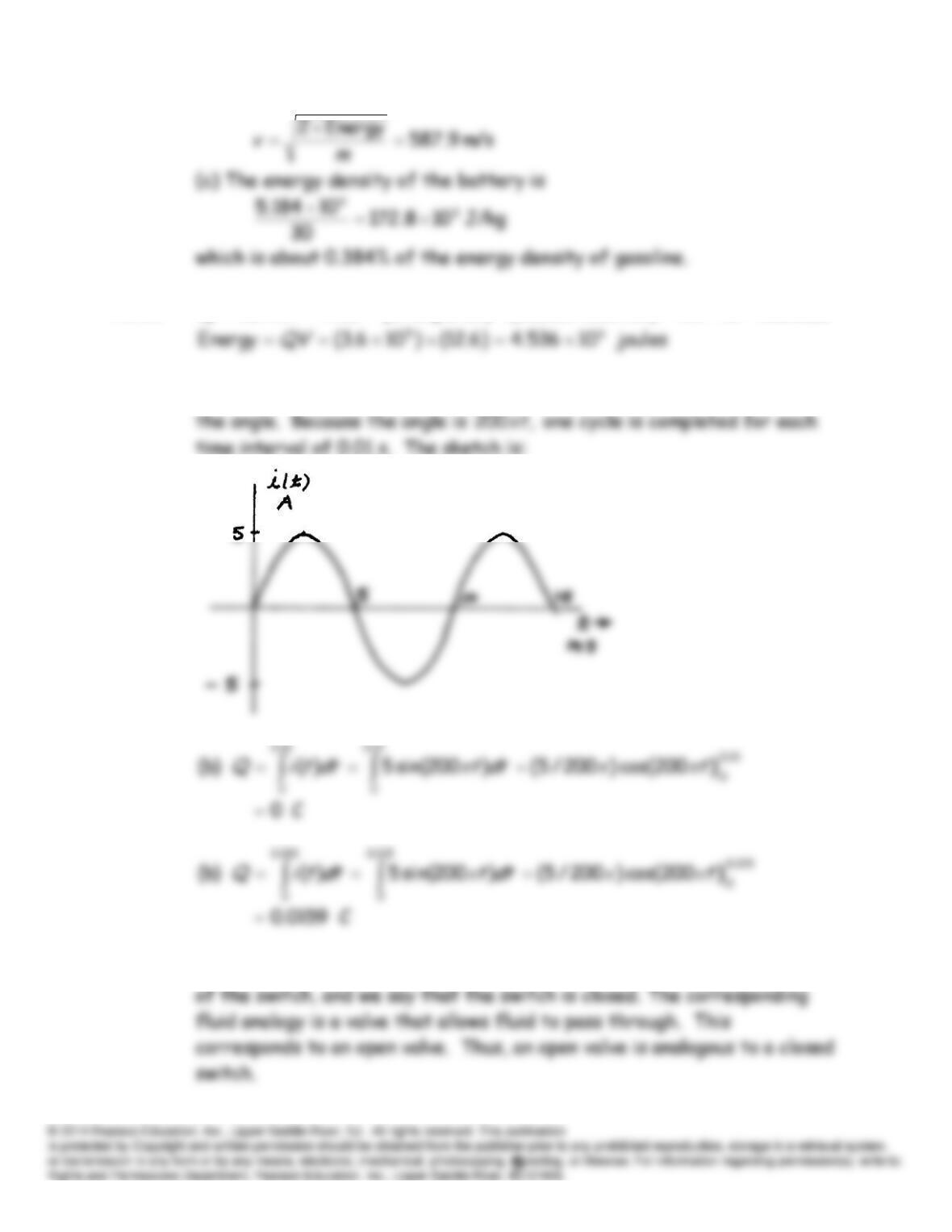
P1.12 (a) The sine function completes one cycle for each
2
radian increase in
P1.13 To cause current to flow, we make contact between the conducting parts
P1.15 The positive reference for
v
is at the head of the arrow, which is
P1.17 The number of electrons passing through a cross section of the wire per
The volume of copper containing this number of electrons is
The cross sectional area of the wire is
Finally, the average velocity of the electrons is
P1.19
coulombs 6)seconds 2()amperes 3(time current
Q
P1.20 If the current is referenced to flow into the positive reference for the
voltage, we say that we have the passive reference configuration. Using
P1.21* (a)
P
–
vaia
= 30 W Energy is being absorbed by the element.
(c)
P1.22*
C 50 V) (12J) (600
VwQ
.
a
.
P1.23 The amount of energy is
J. 100 V) (25C) (4
QVW
Because the
reference polarity for
vab
is positive at terminal
a
and
vab
is positive in
P1.24 Notice that the references are opposite to the passive configuration, so
we have
P1.25*
kWh 500
$/kWh 0.12
$60
Rate
Cost
Energy
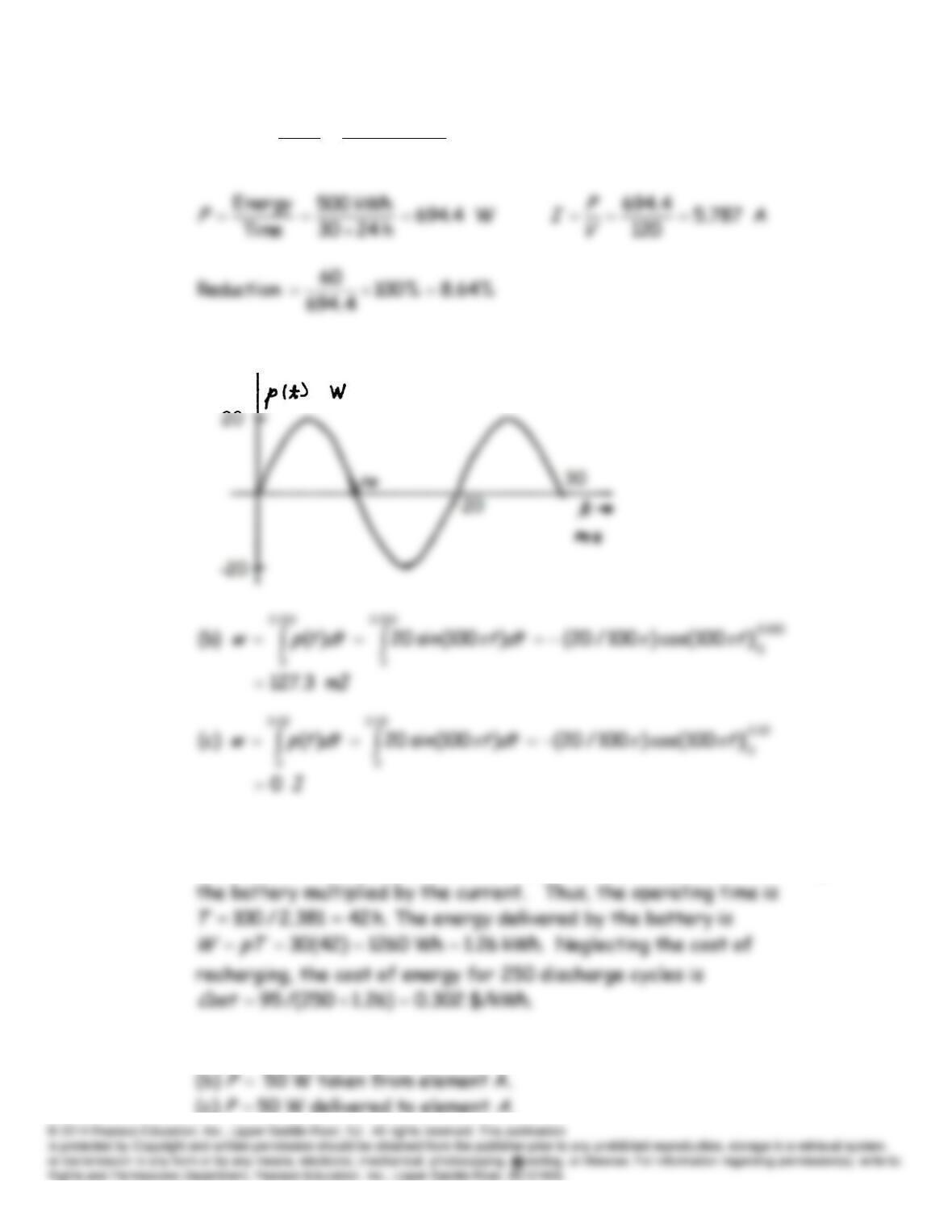
P1.26
W )100sin(20)( a)(
tivtp abab
P1.27 The current supplied to the electronics is
A. 381.26.12/30/
vpi
The ampere-hour rating of the battery is the operating time to discharge
*P1.28 (a)
P
50 W taken from element A.
P1.29 (a)
P
50 W delivered to element
A
.
P1.30 The power that can be delivered by the cell is
W. 45.0
vip
In 10
P1.31 A node is a point that joins two or more circuit elements. All points
joined by ideal conductors are electrically equivalent. Thus, there are
five nodes in the circuit at hand:
1: Joining elements A, B, C, and F
P1.32* At the node joining elements
A
and
B
, we have
.0
b
aii
Thus,
A. 2
a
i
P1.34 The sum of the currents entering a node equals the sum of the currents
P1.36 For a proper fluid analogy to electric circuits, the fluid must be
P1.37*
find we KCL, Applying A. 4 and A, 5 A, 3 A, 2 given are We
h
db
aiiii
P1.38
A. 1 and A, 6 A, 3 A, 2 given are We
h
gca iiii
Applying KCL, we
(b) Because elements
C
and
D
are in series, the currents are equal in
c
dii
P1.40 If one travels around a closed path adding the voltages for which one
P1.41* Applying KCL and KVL, we have
A 1
d
ac iii
A 2
a
bii
P1.42* Summing voltages for the lower left-hand loop, we have
,0105
a
v
P1.43 We are given
V. 5 and V, 12 V, 3 V, 10
h
fb
avvvv
Applying KVL, we
P1.44 (a) Elements
A
and
C
are in parallel.
P1.46 There are two nodes; one at the center of the diagram and the other at
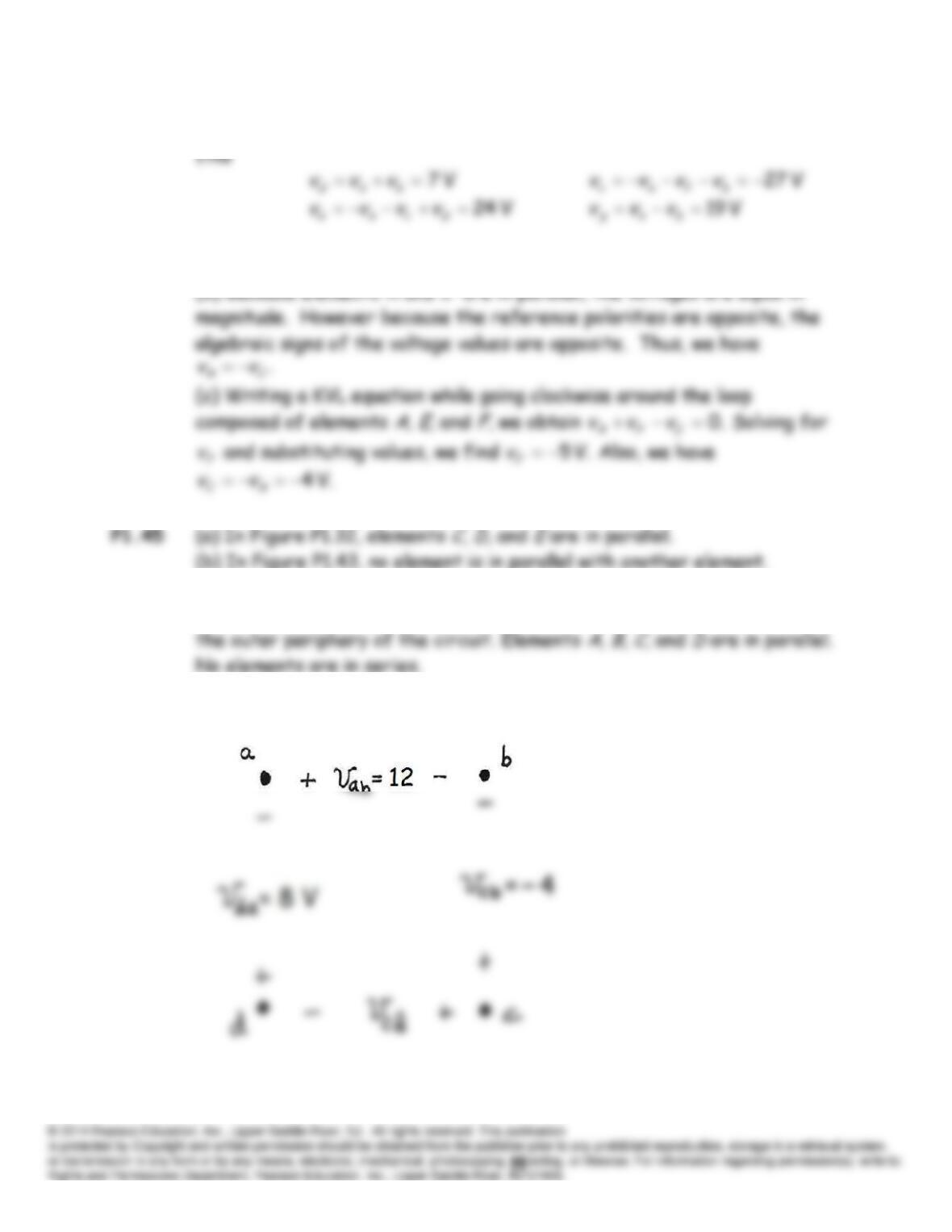
P1.47 The points and the voltages specified in the problem statement are:
Applying KVL to the loop
abca
, substituting values and solving, we obtain:
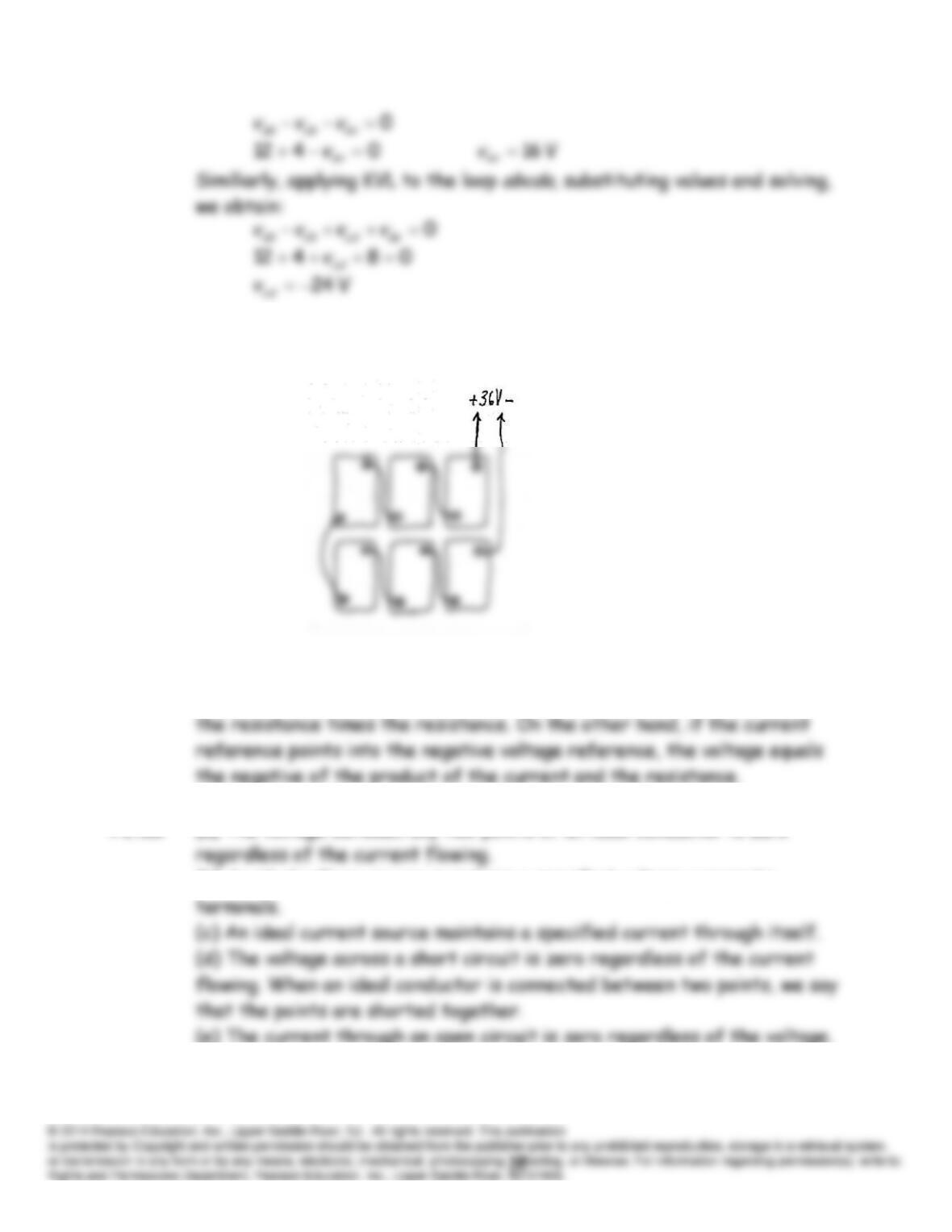
P1.48 Six batteries are needed and they need to be connected in series. A
typical configuration looking down on the tops of the batteries is shown:
P1.49 Provided that the current reference points into the positive voltage
reference, the voltage across a resistance equals the current through
P1.50 (a) The voltage between any two points of an ideal conductor is zero
(b) An ideal voltage source maintains a specified voltage across its
P1.51 Four types of dependent sources and the units for their gain constants
are:
1. Voltage-controlled voltage sources. V/V or unitless.
P1.52 (a) The resistance of the copper wire is given by
ALR CuCu
, and the
(b) Solving for
Al
R
and substituting values, we have
P1.53*
P1.54
P1.55 Equation 1.10 gives the resistance as
A
L
R
ρ