4.3 • Solutions 217
1
22
x
−−
⎡⎤ ⎡⎤ ⎡⎤
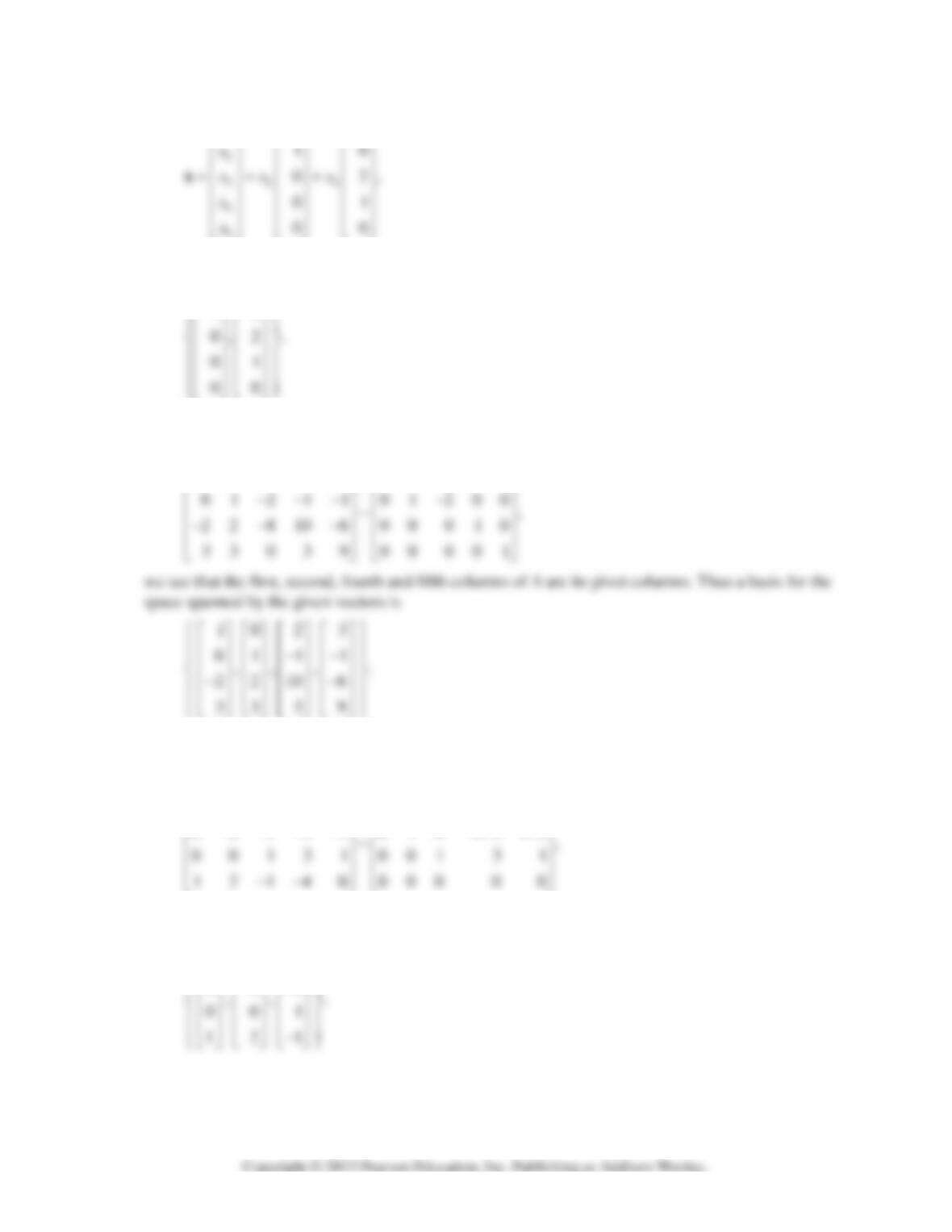
and a basis for Nul A is
22
10
⎧⎫
−−
⎡⎤⎡⎤
⎪⎪
⎢⎥⎢⎥
15. This problem is equivalent to finding a basis for Col A, where
[]
12345
A
=
vv vv v
. Since
the reduced echelon form of A is
10 2 2 3 10 200
⎡⎤⎡⎤
16. This problem is equivalent to finding a basis for Col A, where
[]
12345
A
=
vv vv v
. Since
the reduced echelon form of A is
12352 1005/2 0
001310103/41/2
−−
⎡⎤⎡ ⎤
⎢⎥⎢ ⎥
−−−
we see that the first, second, and third columns of A are its pivot columns. Thus a basis for the space
spanned by the given vectors is
123
001
⎧⎫−
⎡⎤ ⎡ ⎤ ⎡ ⎤
⎪⎪
⎢⎥ ⎢ ⎥ ⎢ ⎥
−
⎪⎪
17. [M] This problem is equivalent to finding a basis for Col A, where
[]
12345
A
=
vv vv v
.
Since the reduced echelon form of A is
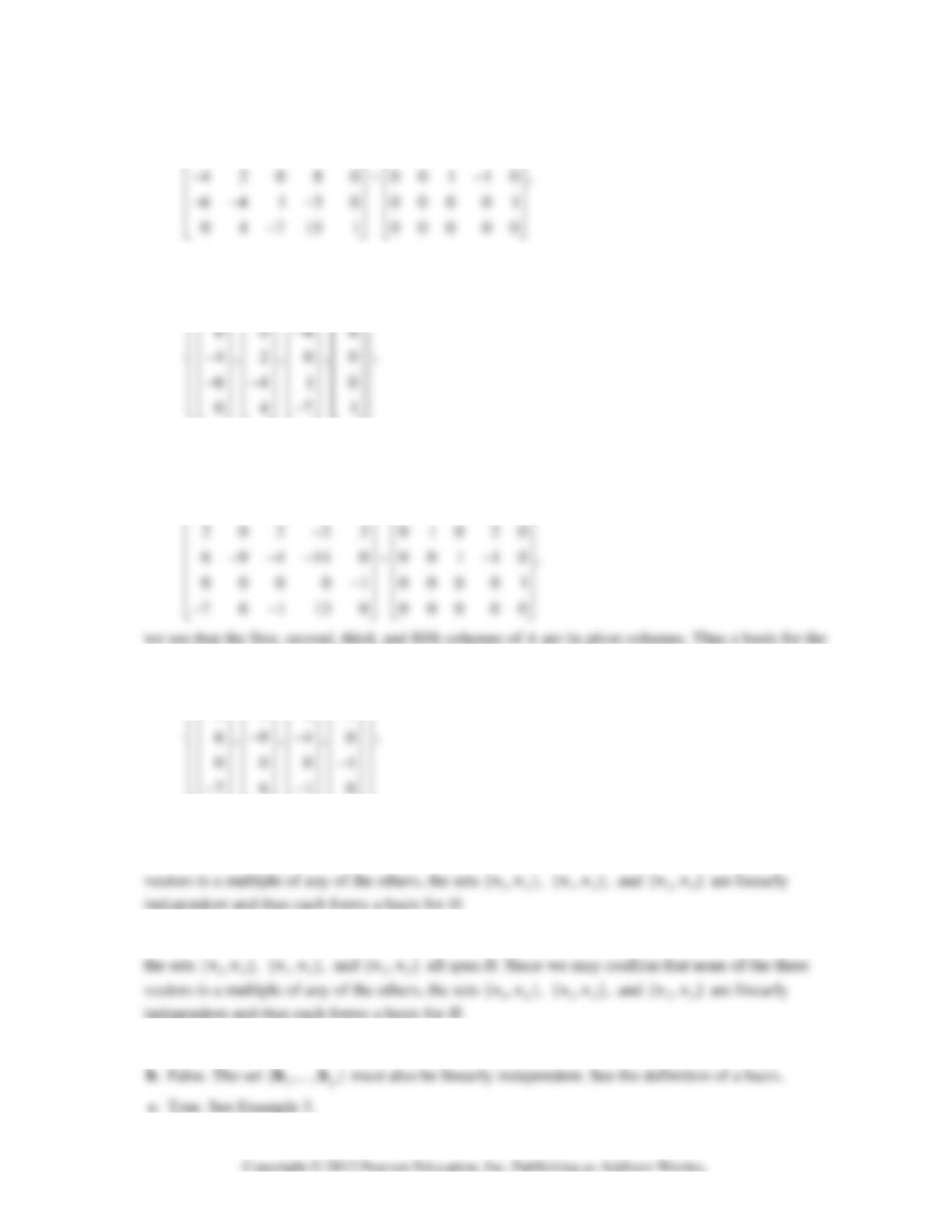
218 CHAPTER 4 • Vector Spaces
24288 10010
00444 01020
−− −
⎡⎤⎡⎤
⎢⎥⎢⎥
−
⎢⎥⎢⎥
we see that the first, second, third, and fifth columns of A are its pivot columns. Thus a basis for the
space spanned by the given vectors is
2428
⎧⎫
−−
⎡⎤⎡⎤⎡⎤⎡⎤
⎪⎪
⎢⎥⎢⎥⎢⎥⎢⎥
18. [M] This problem is equivalent to finding a basis for Col A, where
[]
12345
.
A
=
vv vv v
Since the reduced echelon form of A is
3 3 0 6 6 100 00
−−
⎡⎤⎡⎤
space spanned by the given vectors is
3306
2023
⎧⎫
−−
⎡⎤⎡⎤⎡⎤⎡⎤
⎪⎪
⎢⎥⎢⎥⎢⎥⎢⎥
⎣⎦⎣⎦⎣⎦⎣⎦
⎩⎭
19. Since
123
453 ,+−=vvv0
we see that each of the vectors is a linear combination of the others. Thus
the sets
12
{, },vv
13
{, },vv
and
23
{,}vv
all span H. Since we may confirm that none of the three
20. Since
123
2,−−=vv v 0
we see that each of the vectors is a linear combination of the others. Thus
21. a. False. The zero vector by itself is linearly dependent. See the paragraph preceding Theorem 4.
4.3 • Solutions 219
22. a. False. The subspace spanned by the set must also coincide with H. See the definition of a basis.
b . True. Apply the Spanning Set Theorem to V instead of H. The space V is nonzero because the
spanning set uses nonzero vectors.
23. Let
[]
1234
.
A
=
vvvv
Then A is square and its columns span
4
since
4
25. In order for the set to be a basis for H,
123
{, , }vv v
must be a spanning set for H; that is,
26. Since sin t cos t = (1/2) sin 2t, the set {sin t, sin 2t} spans the subspace. By inspection we note that
this set is linearly independent, so {sin t, sin 2t} is a basis for the subspace.
27. The set {cos
ω
t, sin
ω
t} spans the subspace. By inspection we note that this set is linearly
28. The set
{, }
bt bt
ete
−−
spans the subspace. By inspection we note that this set is linearly independent,
so
{, }
bt bt
ete
−−
is a basis for the subspace.
31. Suppose that
1
{, , }
p
…
vv
is linearly dependent. Then there exist scalars
1
,,
p
cc
…
not all zero with
11
.
pp
cc
+…+ =
vv0
i
32. Suppose that
1
{ ( ), , ( )}
p
TT
…
vv
is linearly dependent. Then there exist scalars
1
,,
p
cc
…
not all zero
with
11
() ( ) .
pp
cT c T
+…+ =
vv0
Since T is linear,
11 1 1
()()()()
pp p p
Tc c cT cT T
+…+ = +…+ = =
vvv v00
i
1
p
33. Neither polynomial is a multiple of the other polynomial. So
12
{, }pp
is a linearly independent set in
3
. Note:
12
{, }pp
is also a linearly independent set in
2
since
1
p
and
2
p
both happen to be in
2
.
35. Let
13
{, }vv
be any linearly independent set in a vector space V, and let
2
v
and
4
v
each be linear
36. [M] Row reduce the following matrices to identify their pivot columns:
10 3 103
224 011
⎡⎤⎡⎤
⎢⎥⎢⎥
−
4.3 • Solutions 221
10 3 2 2 1
−−
⎡⎤
⎢⎥
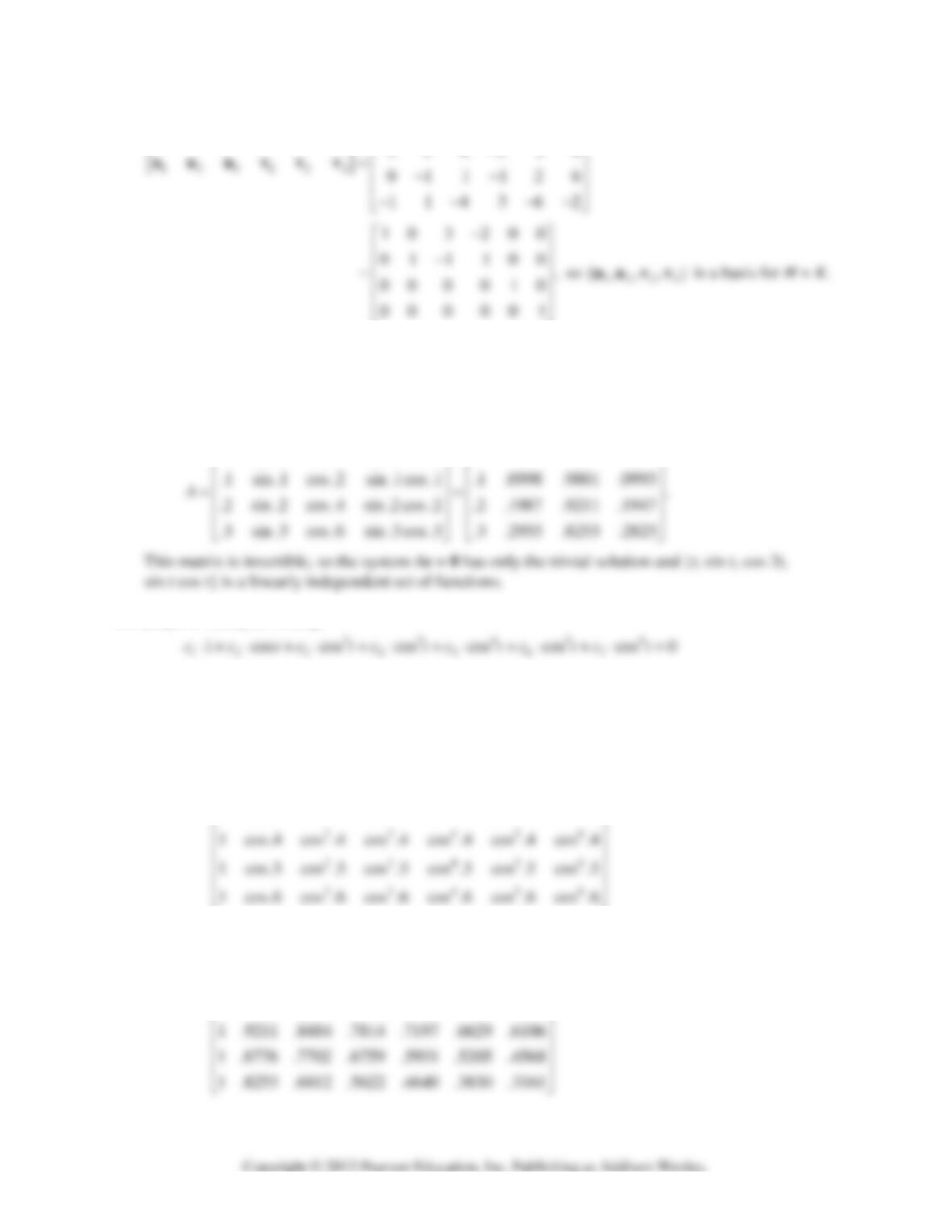
37. [M] For example, writing
12 3 4
sin cos 2 sin cos 0ct c t c t c t t⋅+ ⋅ + + =
with t = 0, .1, .2, .3 gives the following coefficent matrix A for the homogeneous system Ac = 0 (to
four decimal places):
0 sin 0 cos 0 sin 0 cos 0 0 0 1 0
⎡⎤⎡⎤
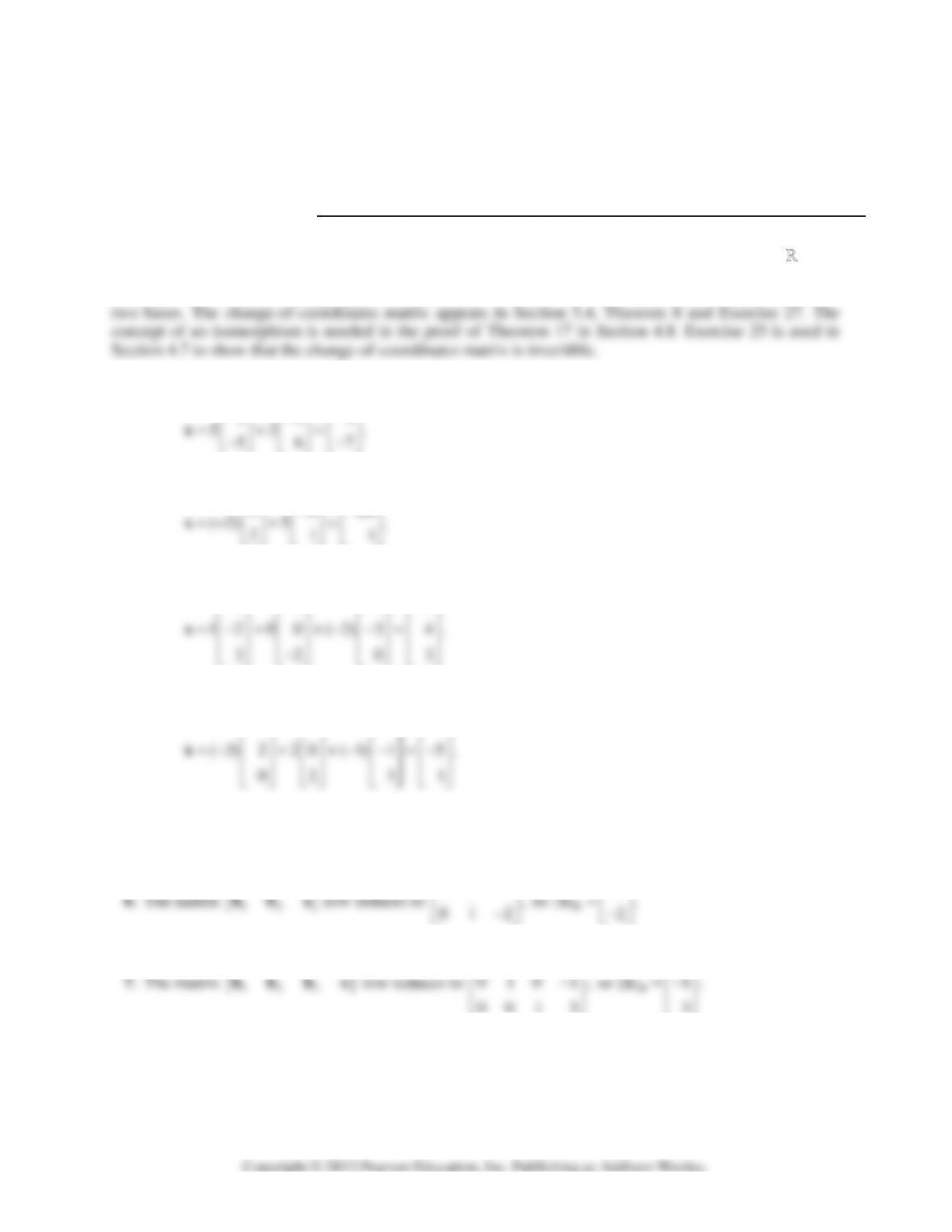
38. [M] For example, writing
with t = 0, .1, .2, .3, .4, .5, .6 gives the following coefficent matrix A for the homogeneous system Ac
= 0 (to four decimal places):
23456
23456
23456
23456
1 cos0 cos 0 cos 0 cos 0 cos 0 cos 0
1 cos.1 cos .1 cos .1 cos .1 cos .1 cos .1
1 cos.2 cos .2 cos .2 cos .2 cos .2 cos .2
1 cos.3 cos .3 cos .3 cos .3 cos .3 cos .3
A=
⎡⎤
⎢⎥
⎢⎥
⎢⎥
⎢⎥
⎢⎥
1111111
1 .9950 .9900 .9851 .9802 .9753 .9704
1 .9801 .9605 .9414 .9226 .9042 .8862
1 .9553 .9127 .8719 .8330 .7958 .7602
⎡
⎢
⎢
⎢
⎢
=
⎤
⎥
⎥
⎥
⎥
⎢⎥
222 CHAPTER 4 • Vector Spaces
This matrix is invertible, so the system Ac = 0 has only the trivial solution and {1, cos t, cos
2
t, cos
3
t,
cos
4
t, cos
5
t, cos
6
t} is a linearly independent set of functions.
4.4 SOLUTIONS
Notes:
Section 4.7 depends heavily on this section, as does Section 5.4. It is possible to cover the
n
parts
of the two later sections, however, if the first half of Section 4.4 (and perhaps Example 7) is covered. The
linearity of the coordinate mapping is used in Section 5.4 to find the matrix of a transformation relative to
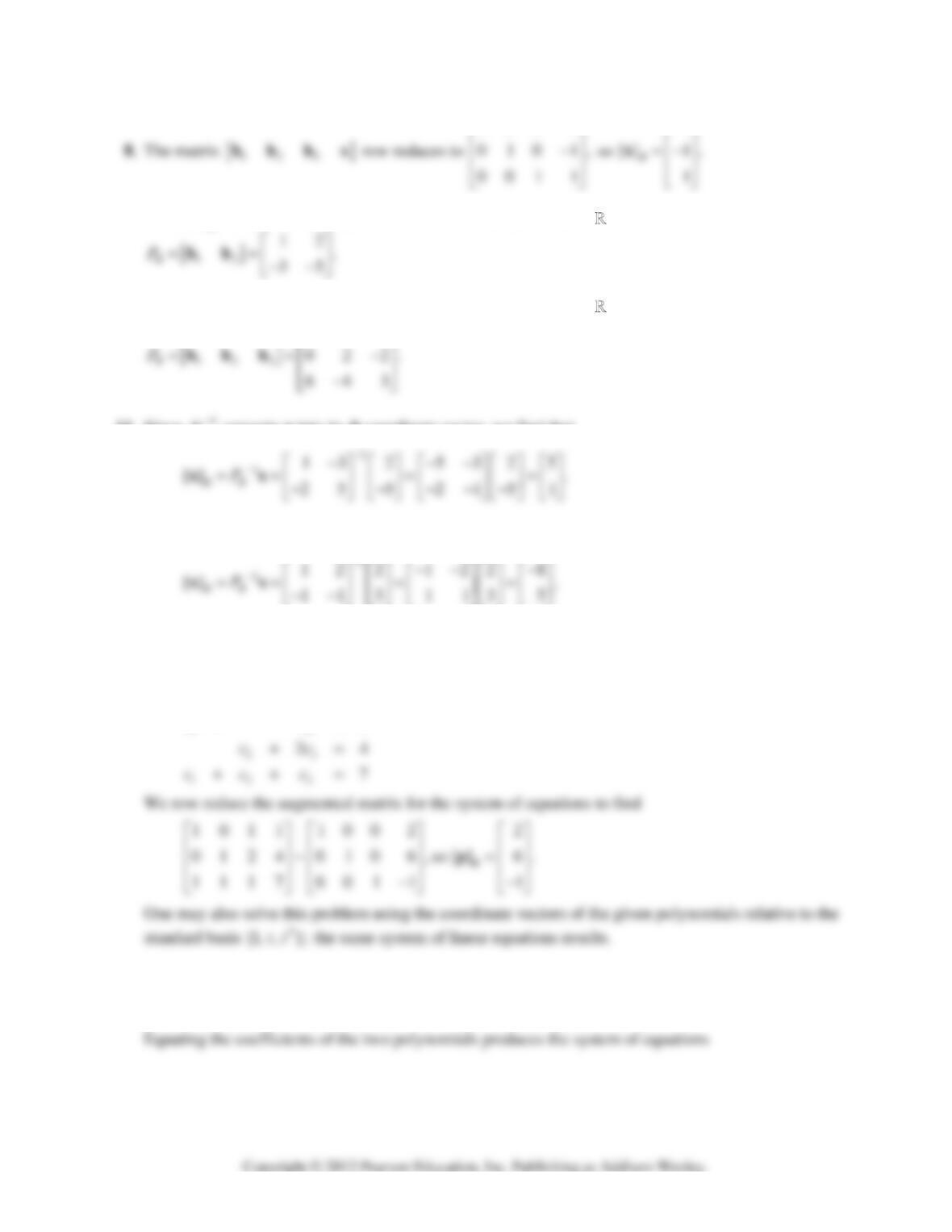
1. We calculate that
2. We calculate that
3. We calculate that
15 47
−
⎡⎤ ⎡⎤ ⎡⎤⎡⎤
4. We calculate that
23 48
−
⎡⎤ ⎡⎤ ⎡⎤⎡⎤
5. The matrix
[]
12
bb x
row reduces to
10 2
,
01 1
⎡
⎤
⎢
⎥
−
⎣
⎦
so
2
[] .
1
B
⎡
⎤
=
⎢
⎥
−
⎣
⎦
x
⎢
⎣
⎢
⎣
10 3
⎡
⎤
3
⎡
⎤
⎢
⎢
⎢
⎢
⎢
⎢
100 1
−
⎡
⎤
⎣
⎦
1
−
⎡
⎤
⎣
⎦
4.4 • Solutions 223
⎢
⎢
⎢
⎣
⎢
⎢
⎢
⎣
100 1
⎡
⎤
1
⎡
⎤
9. The change-of-coordinates matrix from B to the standard basis in
2
is
10. The change-of-coordinates matrix from B to the standard basis in
3
is
⎢
⎢
⎢
⎣
321
⎡
⎤
11. Since
B
P
converts x into its B-coordinate vector, we find that
12. Since
1
B
P
−
converts x into its B-coordinate vector, we find that
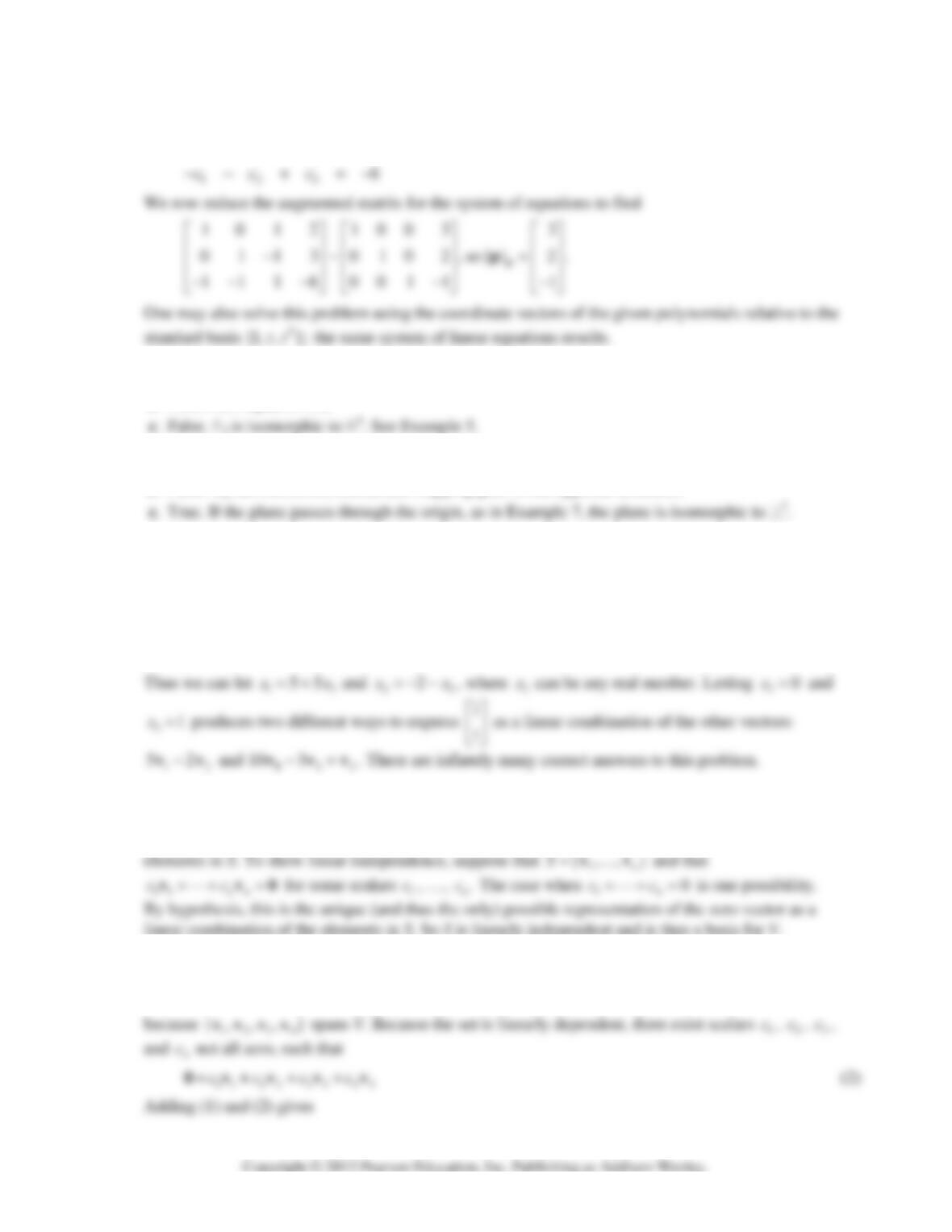
13. We must find
1
c
,
2
c
, and
3
c
such that
22 2 2
123
(1 ) ( ) (1 2 ) ( ) 1 4 7 .ctcttc tt t tt+ + + + ++ = =++
p
Equating the coefficients of the two polynomials produces the system of equations
13
1
cc
+=
14. We must find
1
c
,
2
c
, and
3
c
such that
22 2 2
123
(1 ) ( ) (1 ) ( ) 2 3 6 .ctcttctt t tt−+ −+ −+= =+−
p
224 CHAPTER 4 • Vector Spaces
13
23
2
3
cc
cc
+=
−=
15. a. True. See the definition of the B–coordinate vector.
b . False. See Equation (4).
16. a. True. See Example 2.
b . False. By definition, the coordinate mapping goes in the opposite direction.
17. We must solve the vector equation
123
1231
3871
xx x
−
⎡
⎤⎡⎤⎡⎤⎡⎤
++=
⎢
⎥⎢⎥⎢⎥⎢⎥
−−
⎣
⎦⎣⎦⎣⎦⎣⎦
. We row reduce the augmented
matrix for the system of equations to find
1231 1055
.
3871 0112
−−
⎡⎤⎡⎤
∼
⎢⎥⎢⎥
−− −
⎣⎦⎣⎦
⎡
⎢
⎣
18. For each k,
1
01 0
kkn
= ⋅ +⋅⋅⋅+ ⋅ +⋅⋅⋅+ ⋅bb b b
, so
[] (0,,1,,0) .
kB k
=……=be
19. The set S spans V because every x in V has a representation as a (unique) linear combination of
20. For w in V there exist scalars
1
k
,
2
k
,
3
k
, and
4
k
such that
11 22 33 44
kk k k
=+ + +wvvvv
(1)
4.4 • Solutions 225
22. The matrix of the transformation will be
[]
1
1
1
.
Bn
P
−
−
=⋅⋅⋅bb
23. Suppose that
c
1
⎡⎤
24. Given
1
(, , )
n
yy
=…y
in
n
, let
11 nn
yy
=+⋅⋅⋅+ub b
. Then, by definition,
[]
B
=uy
. Since y was
25. Since the coordinate mapping is one-to-one, the following equations have the same solutions
1
,,
p
cc…
:
11
pp
cc+⋅⋅⋅+ =
uu0
(the zero vector in V ) (4)
26. By definition, w is a linear combination of
1
,,
p
…
uu
if and only if there exist scalars
1
,,
p
cc…
such
that
11
pp
cc= +⋅⋅⋅+
wu u
(7)
226 CHAPTER 4 • Vector Spaces
27. The coordinate mapping produces the coordinate vectors (1, 0, 0, 2), (2, 1, –3, 0), and (0, –1, 2, –1)
respectively. We test for linear independence of these vectors by writing them as columns of a matrix
and row reducing:
120 100
011010
⎡⎤⎡⎤
⎢⎥⎢⎥
−
28. The coordinate mapping produces the coordinate vectors (1, 0, –2, –1), (0, 1, 0, 2), and (1, 1, –2, 0)
respectively. We test for linear independence of these vectors by writing them as columns of a matrix
and row reducing:
10 1 100
⎡⎤⎡⎤
29. The coordinate mapping produces the coordinate vectors (1, –2, 1, 0), (0, 1, –2, 1), and (1, –3, 3, –1)
respectively. We test for linear independence of these vectors by writing them as columns of a matrix
and row reducing:
101 101
⎡⎤⎡⎤
30. The coordinate mapping produces the coordinate vectors (8, –12, 6, –1), (9, –6, 1, 0), and (1, 6, –5,1)
respectively. We test for linear independence of these vectors by writing them as columns of a matrix
and row reducing:
891 101
−
⎡⎤⎡⎤
31. In each part, place the coordinate vectors of the polynomials into the columns of a matrix and reduce
the matrix to echelon form.
1341 1341
−− −−
⎡⎤⎡⎤
Since there is not a pivot in each row, the original four column vectors do not span
3
. By the
isomorphism between
3
and
2
, the given set of polynomials does not span
2
.
0132 122 0
−−
⎡⎤⎡ ⎤
32. a. Place the coordinate vectors of the polynomials into the columns of a matrix and reduce the
10 1 101
⎡⎤⎡⎤
b. Since
[] (1,1,2),
B
=−q
12 3
2.=− + +qpp p
One might do the algebra in
2
or choose to compute
10 11 1
0111 3.
−
⎡⎤⎡⎤⎡⎤
⎢⎥⎢⎥⎢⎥
=
⎢⎥⎢⎥⎢⎥
This combination of the columns of the matrix corresponds to the
33. The coordinate mapping produces the coordinate vectors (3, 7, 0, 0), (5, 1, 0, –2), (0, 1, –2, 0) and
(1, 16, –6, 2) respectively. To determine whether the set of polynomials is a basis for
3
, we
investigate whether the coordinate vectors form a basis for
4
. Writing the vectors as the columns of
a matrix and row reducing
3501 1002
71116 0101
⎡⎤⎡⎤
⎢⎥⎢⎥
−
34. The coordinate mapping produces the coordinate vectors (5, –3, 4, 2), (9, 1, 8, –6), (6, –2, 5, 0), and
(0, 0, 0, 1) respectively. To determine whether the set of polynomials is a basis for
3
, we investigate
whether the coordinate vectors form a basis for
4
. Writing the vectors as the columns of a matrix,
228 CHAPTER 4 • Vector Spaces
5 9 60 103/40
3 1 20 011/40
⎡⎤⎡⎤
⎢⎥⎢⎥
−−
35. To show that x is in
12
Span{ , },
H
=vv
we must show that the vector equation
11 2 2
xx
+=vvx
has a
solution. The augmented matrix
[]
12
vvx
may be row reduced to show
⎡
⎢
11 14 19 1 0 5/ 3
5813 018/3
−
⎡⎤⎡⎤
⎢⎥⎢⎥
−−−
⎣
⎦
36. To show that x is in
123
Span{ , , }
H
=vv v
, we must show that the vector equation
11 2 2 3 3
xx x
++=vvvx
has a solution. The augmented matrix
[]
123
vvvx
may be row
reduced to show
6894 1003
4357 0105
.
−−
⎡⎤⎡⎤
⎢⎥⎢⎥
−
⎢⎥⎢⎥
∼
in H. The solution allows us to find the B-coordinate vector for x: since
⎢
⎢
⎢
⎣
3
⎡
⎤
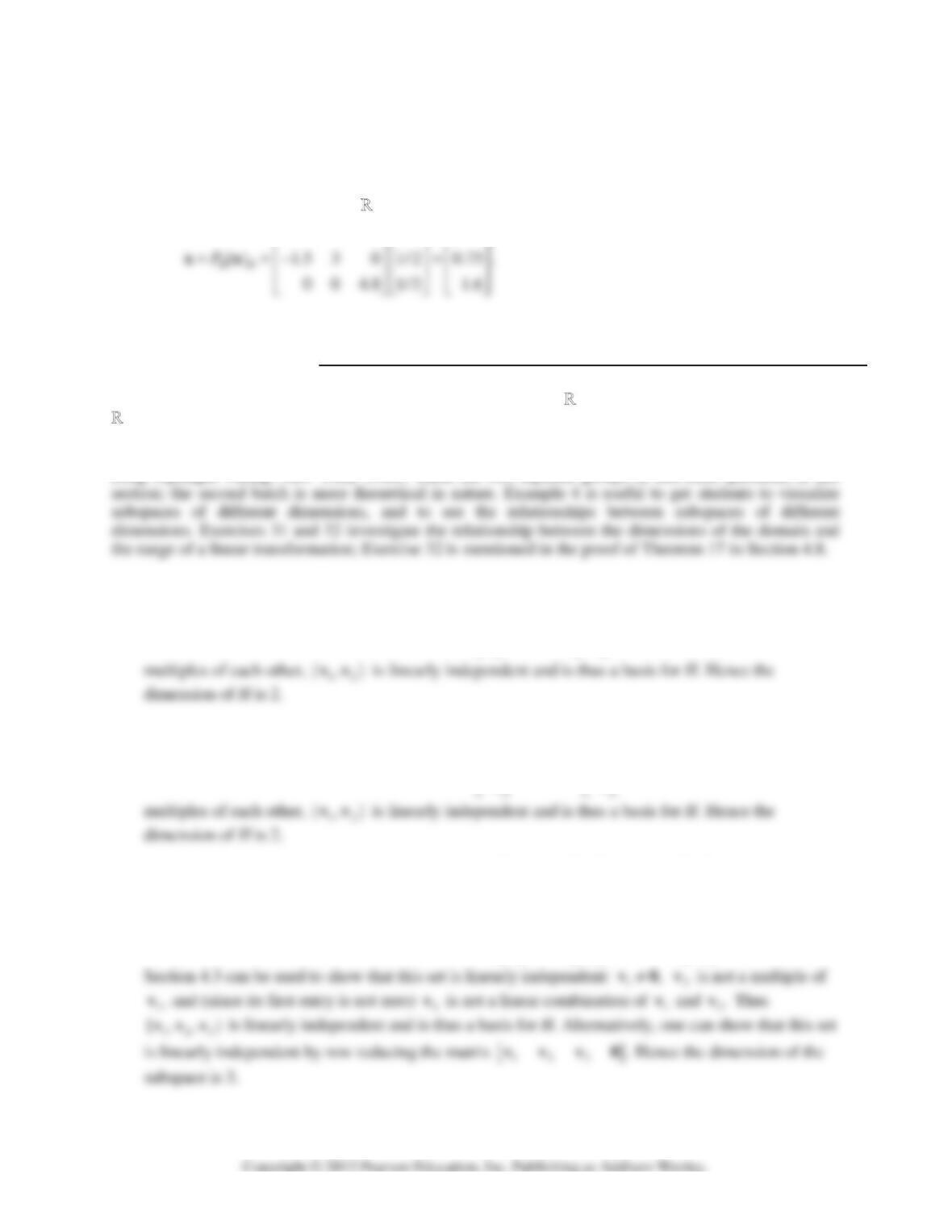
37. We are given that
1/2
[] 1/4,
1/ 6
B
⎡⎤
⎢⎥
=⎢⎥
⎢⎥
⎣⎦
x
where
2.6 0 0
1.5 , 3 , 0 .
004.8
B
⎧
⎫
⎡
⎤⎡⎤⎡ ⎤
⎪
⎪
⎢
⎥⎢⎥⎢ ⎥
=−
⎨
⎬
⎢
⎥⎢⎥⎢ ⎥
⎪
⎪
⎢
⎥⎢⎥⎢ ⎥
⎣
⎦⎣⎦⎣ ⎦
⎩⎭
To find the coordinates of x
relative to the standard basis in
3
, we must find x. We compute that
2.6 0 0 1/ 2 1.3
⎡⎤⎡⎤⎡⎤
4.5 • Solutions 229
38. We are given that
1/2
[] 1/2,
1/3
B
⎡⎤
⎢⎥
=⎢⎥
⎢⎥
⎣⎦
x
where
2.6 0 0
1.5 , 3 , 0 .
004.8
B
⎧
⎫
⎡
⎤⎡⎤⎡ ⎤
⎪
⎪
⎢
⎥⎢⎥⎢ ⎥
=−
⎨
⎬
⎢
⎥⎢⎥⎢ ⎥
⎪
⎪
⎢
⎥⎢⎥⎢ ⎥
⎣
⎦⎣⎦⎣ ⎦
⎩⎭
To find the coordinates of x
relative to the standard basis in
3
, we must find x. We compute that
2.6 0 0 1/ 2 1.3
⎡⎤⎡⎤⎡⎤
4.5 SOLUTIONS
Notes:
Theorem 9 is true because a vector space isomorphic to
n
has the same algebraic properties as
n
; a proof of this result may not be needed to convince the class. The proof of Theorem 9 relies upon the
fact that the coordinate mapping is a linear transformation (which is Theorem 8 in Section 4.4). If you
have skipped this result, you can prove Theorem 9 as is done in Introduction to Linear Algebra by Serge
Lang (Springer-Verlag, New York, 1986). There are two separate groups of true-false questions in this
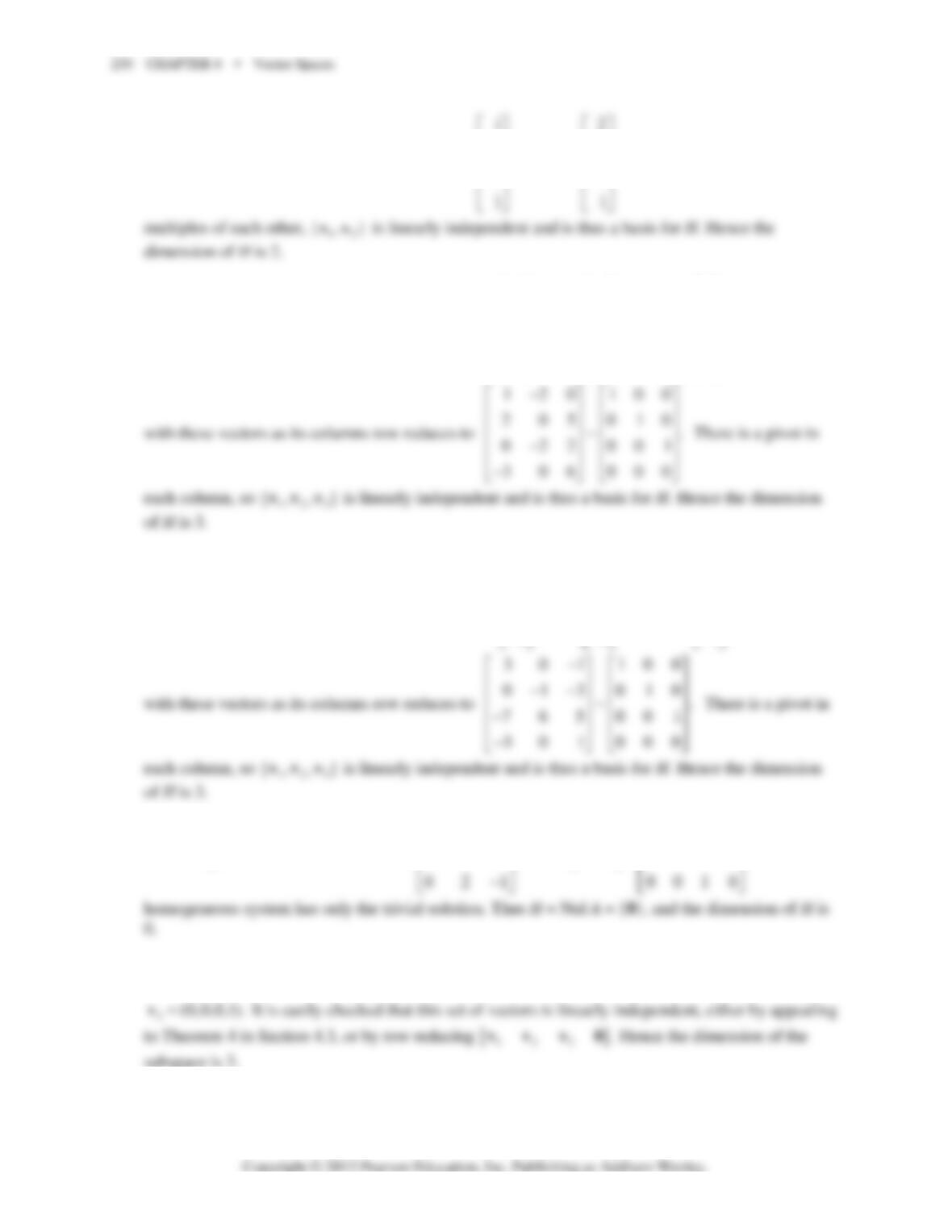
1. This subspace is
12
Span{ , },
H
=vv
where
1
1
1
0
⎡
⎤
⎢
⎥
=
⎢
⎥
⎢
⎥
⎣
⎦
v
and
2
2
1.
3
−
⎡
⎤
⎢
⎥
=
⎢
⎥
⎢
⎥
⎣
⎦
v
Since
1
v
and
2
v
are not
2. This subspace is
12
Span{ , },
H
=vv
where
1
2
0
2
⎡
⎤
⎢
⎥
=
⎢
⎥
⎢
⎥
−
⎣
⎣
v
and
2
0
4.
0
⎡
⎤
⎢
⎥
=−
⎢
⎥
⎢
⎥
v
Since
1
v
and
2
v
are not
3. This subspace is
123
Span{ , , },
H
=vv v
where
1
0
1,
0
1
⎡
⎤
⎢
⎥
⎢
⎥
=
⎢
⎥
⎢
⎥
⎢
⎥
⎣
⎦
v
2
0
1,
1
2
⎡
⎤
⎢
⎥
−
⎢
⎥
=
⎢
⎥
⎢
⎥
⎢
⎥
⎣
⎦
v
and
3
2
0.
3
0
⎡⎤
⎢⎥
⎢⎥
=⎢⎥
−
⎢⎥
⎢⎥
⎣⎦
v
Theorem 4 in
4. This subspace is
12
Span{ , },
H
=vv
where
1
1
3
⎢
⎣
⎢
⎣
⎡
⎤
⎢
⎥
−
⎢
⎥
=
⎢
⎥
v
and
2
0.
1
⎡
⎤
⎢
⎥
⎢
⎥
=
⎢
⎥
−
v
Since
1
v
and
2
v
are not
5. This subspace is
123
Span{ , , },
H
=vv v
where
1
1
2,
0
3
⎡
⎤
⎢
⎥
⎢
⎥
=
⎢
⎥
⎢
⎥
−
⎣
⎦
v
2
2
0,
2
0
−
⎡
⎤
⎢
⎥
⎢
⎥
=
⎢
⎥
−
⎢
⎥
⎣
⎦
v
and
3
0
5.
2
6
⎡⎤
⎢⎥
⎢⎥
=⎢⎥
⎢⎥
⎣⎦
v
The matrix A
⎡
⎢
⎢
⎢
⎢
⎣
6. This subspace is
123
Span{ , , },
H
=vv v
where
1
3
0,
7
3
⎡
⎤
⎢
⎥
⎢
⎥
=
⎢
⎥
−
⎢
⎥
−
⎣
⎣
⎡
⎢
⎢
⎢
⎢
⎣
v
2
0
1,
6
0
⎡
⎤
⎢
⎥
−
⎢
⎥
=
⎢
⎥
⎢
⎥
v
and
3
1
3.
5
1
−
⎡⎤
⎢⎥
−
⎢⎥
=⎢⎥
⎢⎥
v
The matrix A
7. This subspace is H = Nul A, where
131
012.
⎢
⎢
⎣
⎢
⎢
⎣
A
−
⎡
⎤
⎢
⎥
=−
Since
[]
1000
0100,
A
⎡
⎤
⎢
⎥
∼
0
the
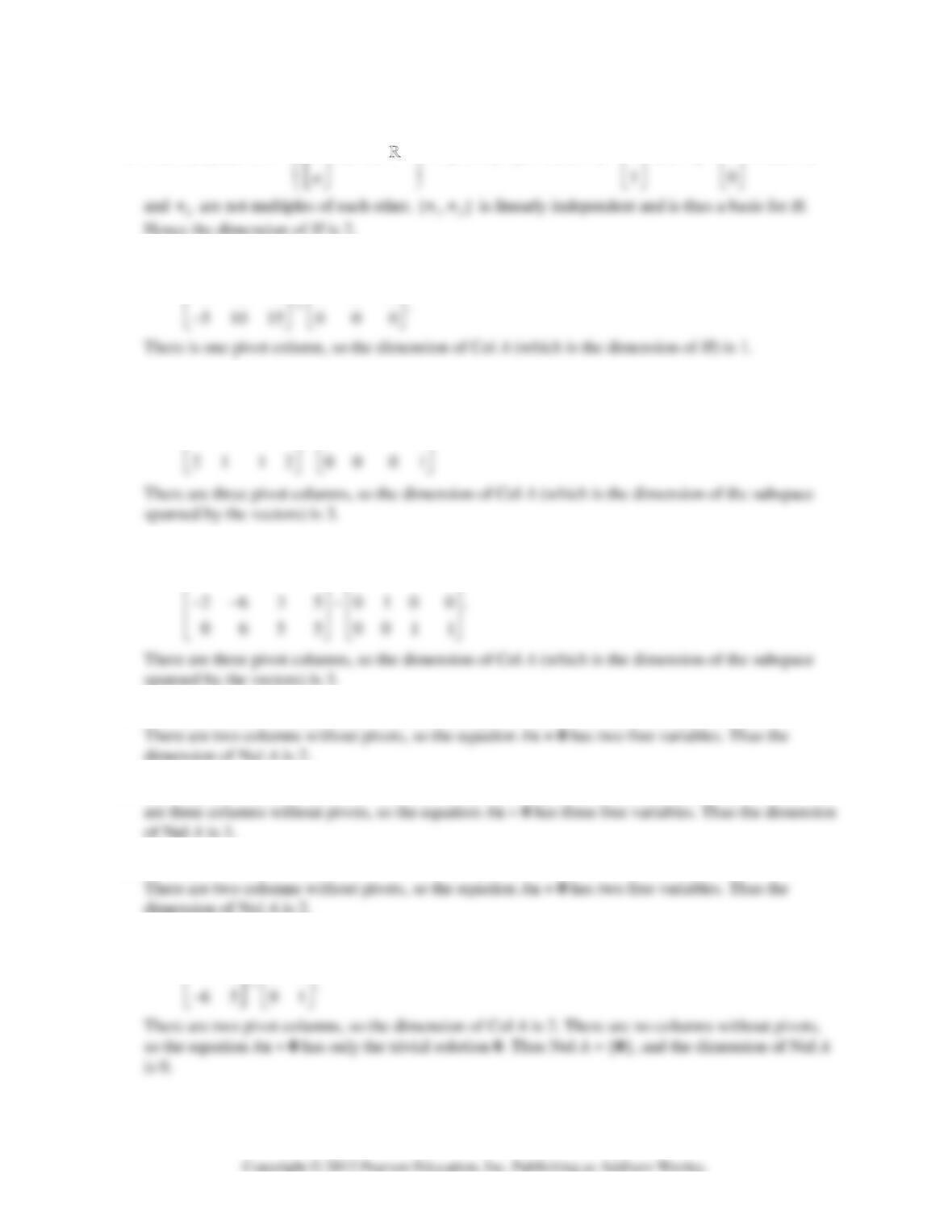
8. From the equation a – 3b + c = 0, it is seen that (a, b, c, d) = b(3, 1, 0, 0) + c(–1, 0, 1, 0) + d(0, 0, 0,
1). Thus the subspace is
123
Span{ , , },
H
=vv v
where
1
(3,1,0,0),=v
2
(1,0,1,0),=−v
and
4.5 • Solutions 231
9. This subspace is
:, in
a
Hbab
⎢
⎢
⎣
⎧⎡⎤
⎪⎢⎥
=⎨⎢⎥
12
Span{ , },
⎫
⎪=
⎬
vv
where
1
1
0
⎡
⎤
⎢
⎥
=
v
and
2
0
1.
⎡⎤
⎢⎥
=⎢⎥
v
Since
1
v
10. The matrix A with these vectors as its columns row reduces to
123 123
−− −−
⎡⎤⎡⎤
11. The matrix A with these vectors as its columns row reduces to
13 2 5 10 10
01 12 01 10.
−
⎡⎤⎡⎤
⎢⎥⎢⎥
−∼ −
12. The matrix A with these vectors as its columns row reduces to
1323 1001
−−− −
⎡⎤⎡⎤
spanned by the vectors) is 3.
13. The matrix A is in echelon form. There are three pivot columns, so the dimension of Col A is 3.
14. The matrix A is in echelon form. There are four pivot columns, so the dimension of Col A is 4. There
15. The matrix A is in echelon form. There are three pivot columns, so the dimension of Col A is 3.
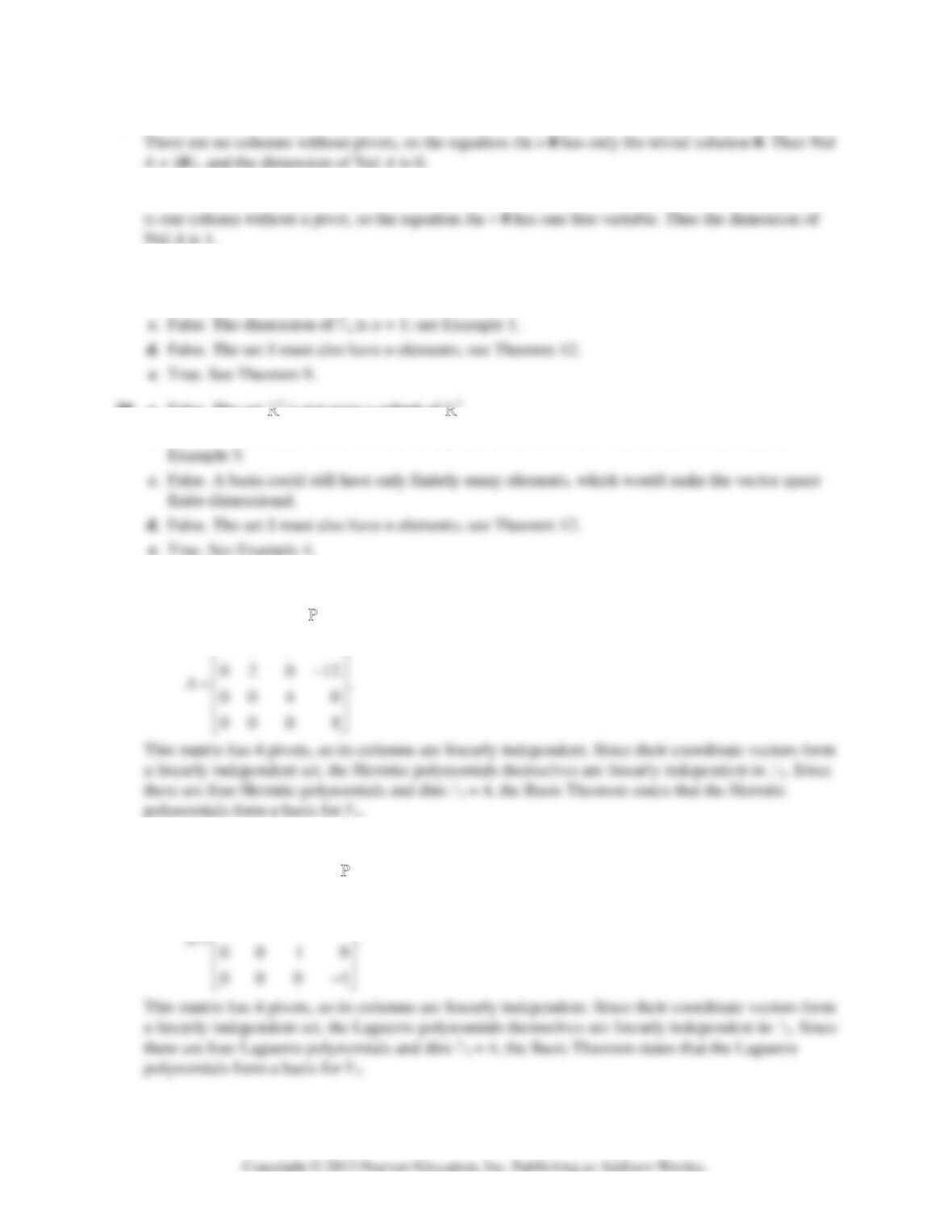
16. The matrix A row reduces to
32 10
⎡⎤⎡⎤
232 CHAPTER 4 • Vector Spaces
17. The matrix A is in echelon form. There are three pivot columns, so the dimension of Col A is 3.
18. The matrix A is in echelon form. There are two pivot columns, so the dimension of Col A is 2. There
19. a. True. See the box before Example 5.
b . False. The plane must pass through the origin; see Example 4.
20. a. False. The set
is not even a subset of
.
b . False. The number of free variables is equal to the dimension of Nul A; see the box before
21. The matrix whose columns are the coordinate vectors of the Hermite polynomials relative to the
standard basis
23
{1, , , }tt t
of
3
is
10 2 0
−
⎡⎤
22. The matrix whose columns are the coordinate vectors of the Laguerre polynomials relative to the
standard basis
23
{1, , , }tt t
of
3
is
112 6
01418
⎡⎤
⎢⎥
−−−
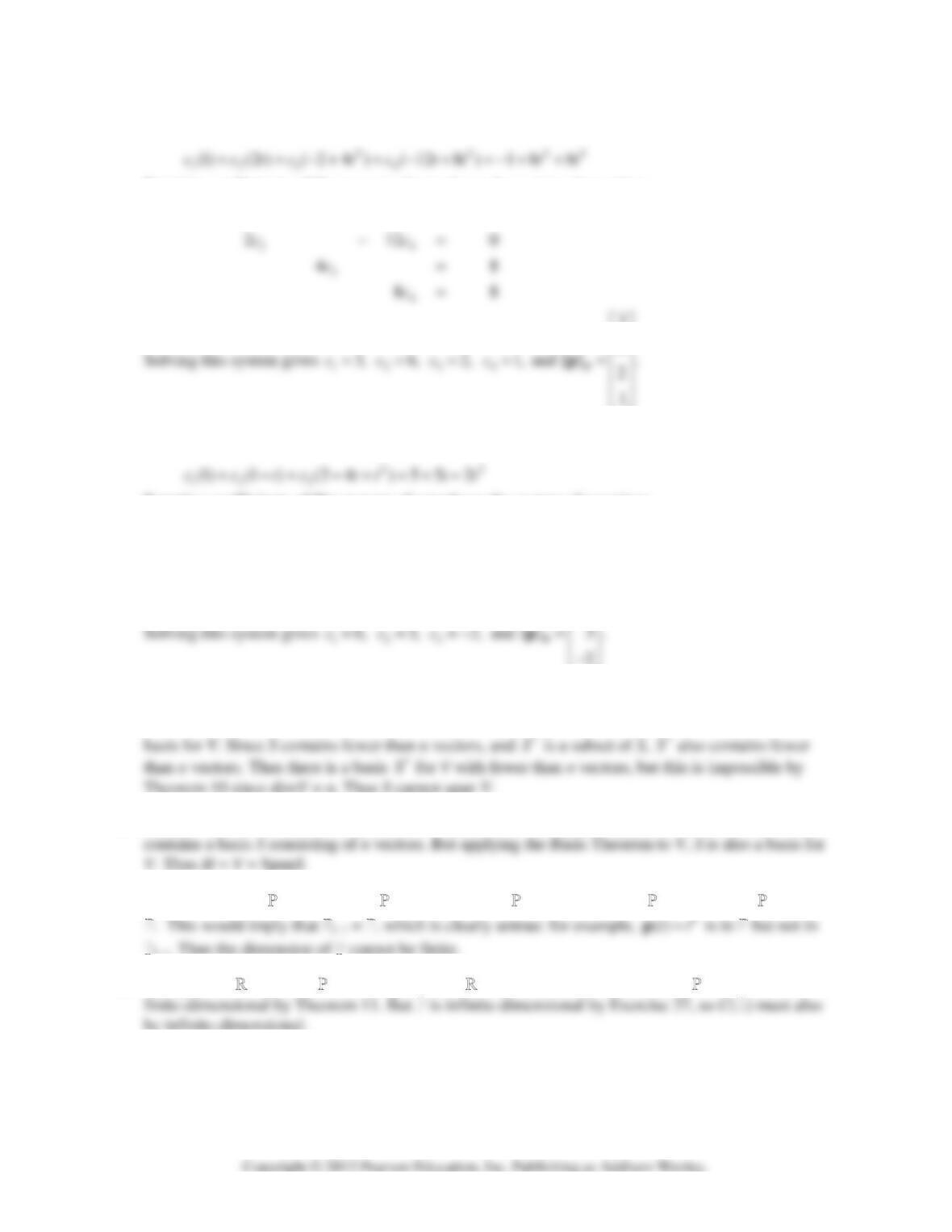
4.5 • Solutions 233
23. The coordinates of
23
() 1 8 8ttt=− + +
p
with respect to B satisfy
Equating coefficients of like powers of t produces the system of equations
13
21
cc
−=−
⎢
⎢
⎢
3
6
⎡
⎤
⎢
⎥
⎣
⎦
24. The coordinates of
2
() 5 5 2ttt=+ −
p
with respect to B satisfy
Equating coefficients of like powers of t produces the system of equations
123
23
3
25
45
2
ccc
cc
c
++=
−− =
=−
⎢
⎢
6
⎡
⎤
⎢
⎥
−
⎣
⎦
25. Note first that n ≥ 1 since S cannot have fewer than 1 vector. Since n ≥ 1, V ≠ 0. Suppose that S spans
V and that S contains fewer than n vectors. By the Spanning Set Theorem, some subset S′ of S is a
26. If dimV = dim H = 0, then V = {0} and H = {0}, so H = V. Suppose that dim V = dim H > 0. Then H
27. Suppose that dim = k < ∞. Now
n
is a subspace of for all n, and dim
k–1
= k, so dim
k–1
= dim
k–1
28. The space C() contains as a subspace. If C() were finite-dimensional, then would also be
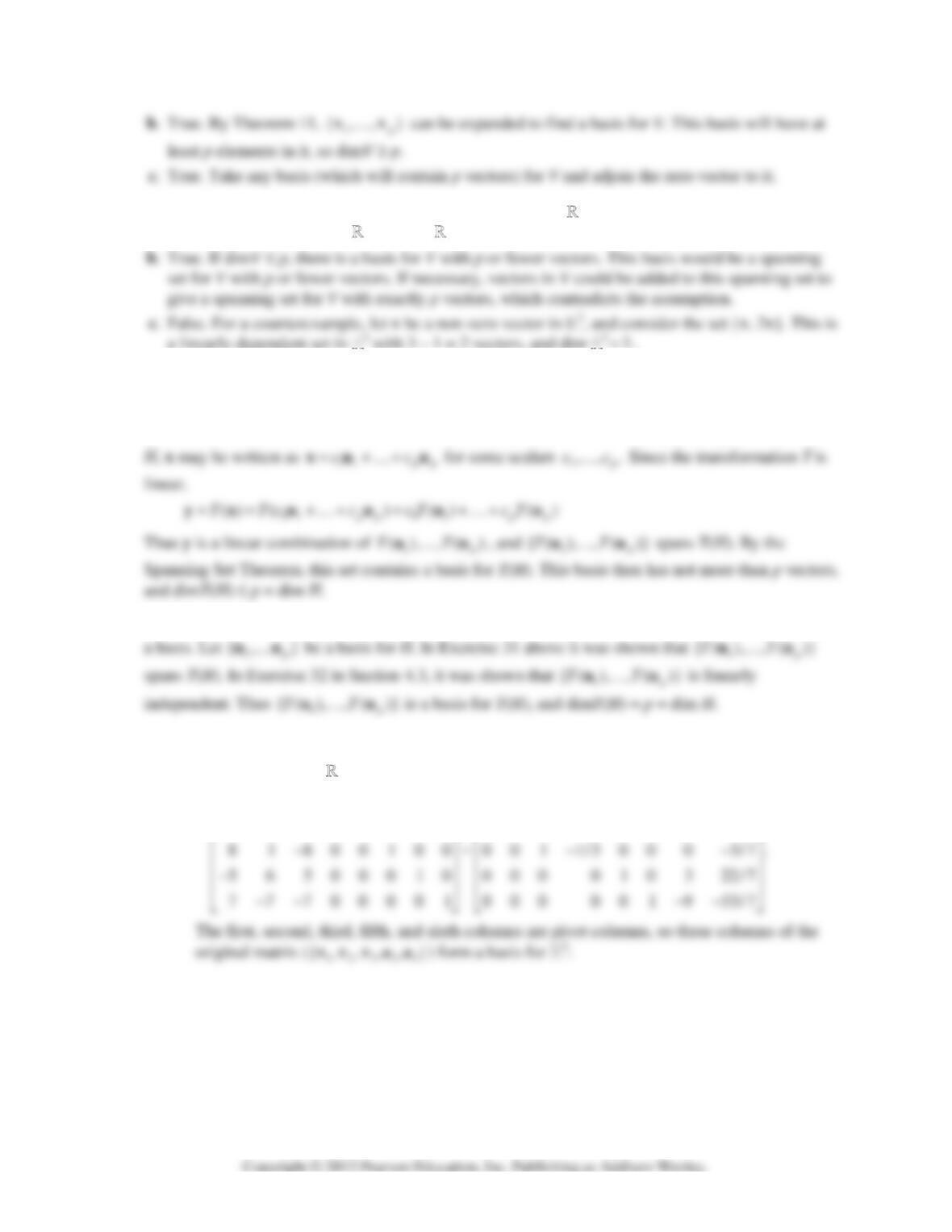
29. a. True. Apply the Spanning Set Theorem to the set
1
{, , }
p
…
vv
and produce a basis for V. This
basis will not have more than p elements in it, so dimV ≤ p.
234 CHAPTER 4 • Vector Spaces
30. a. False. For a counterexample, let v be a non-zero vector in
3
, and consider the set {v, 2v}. This is
a linearly dependent set in
3
, but dim
3
32=>
.
31. Since H is a nonzero subspace of a finite-dimensional vector space V, H is finite-dimensional and has
a basis. Let
1
{, , }
p
…
uu
be a basis for H. We show that the set
1
{ ( ), , ( )}
p
TT…
uu
spans T(H). Let y
be in T(H). Then there is a vector x in H with T(x) = y. Since x is in H and
1
{, , }
p
…
uu
is a basis for
32. Since H is a nonzero subspace of a finite-dimensional vector space V, H is finite-dimensional and has
33. [M]
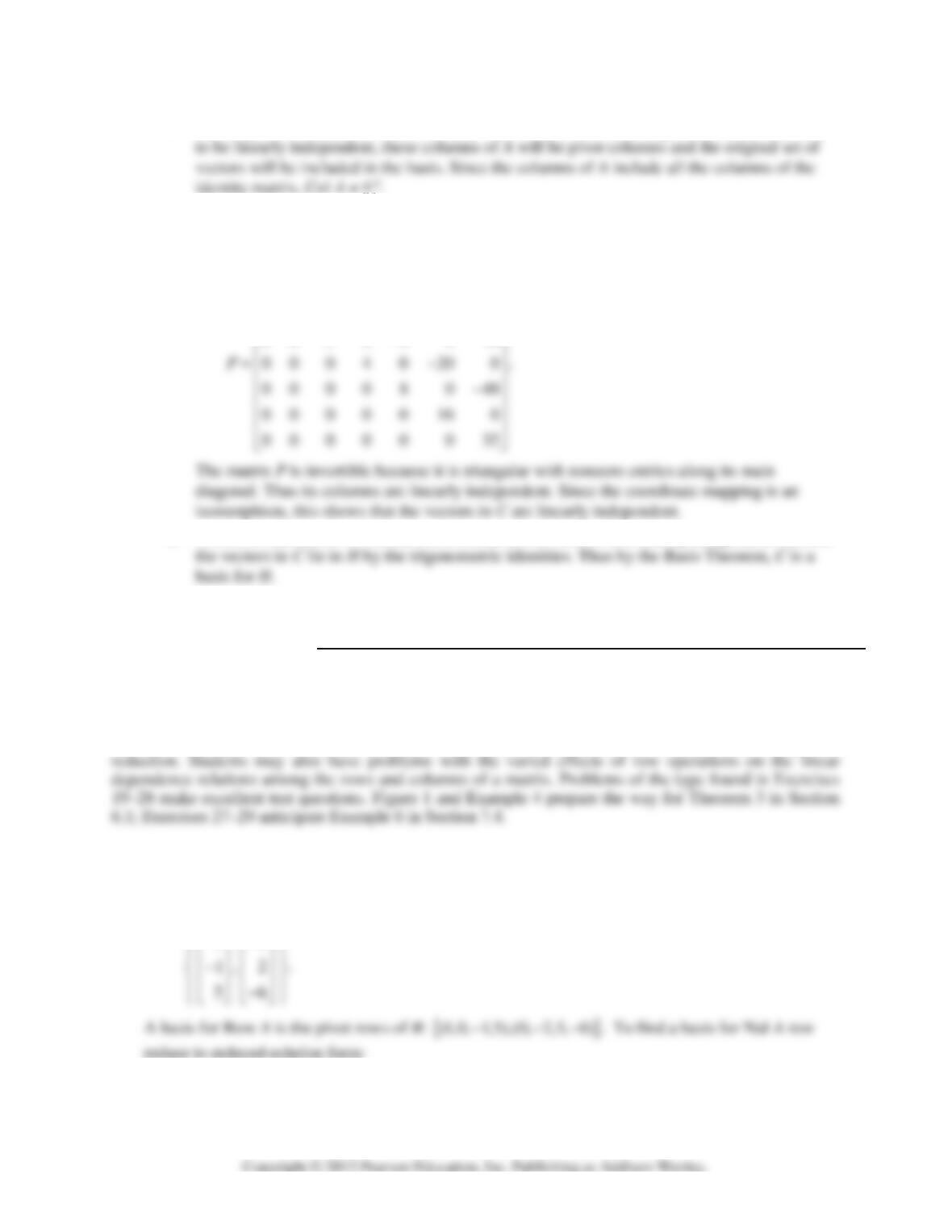
a. To find a basis for
5
which contains the given vectors, we row reduce
9 9 610000 100 1/300 1 3/7
7 4 701000 010 000 1 5/7
−−
⎡⎤⎡ ⎤
⎢⎥⎢ ⎥
−
⎢⎥⎢ ⎥
4.6 • Solutions 235
b. The original vectors are the first k columns of A. Since the set of original vectors is assumed
.
34. [M]
a. The B-coordinate vectors of the vectors in C are the columns of the matrix
10 1 0 1 0 1
01 0 3 0 5 0
00 2 0 8 0 18
−−
⎡⎤
⎢⎥
−
⎢⎥
⎢⎥
−
b. We know that dim H = 7 because B is a basis for H. Now C is a linearly independent set, and
4.6 SOLUTIONS
Notes:
This section puts together most of the ideas from Chapter 4. The Rank Theorem is the main result
in this section. Many students have difficulty with the difference in finding bases for the row space and
the column space of a matrix. The first process uses the nonzero rows of an echelon form of the matrix.
The second process uses the pivots columns of the original matrix, which are usually found through row
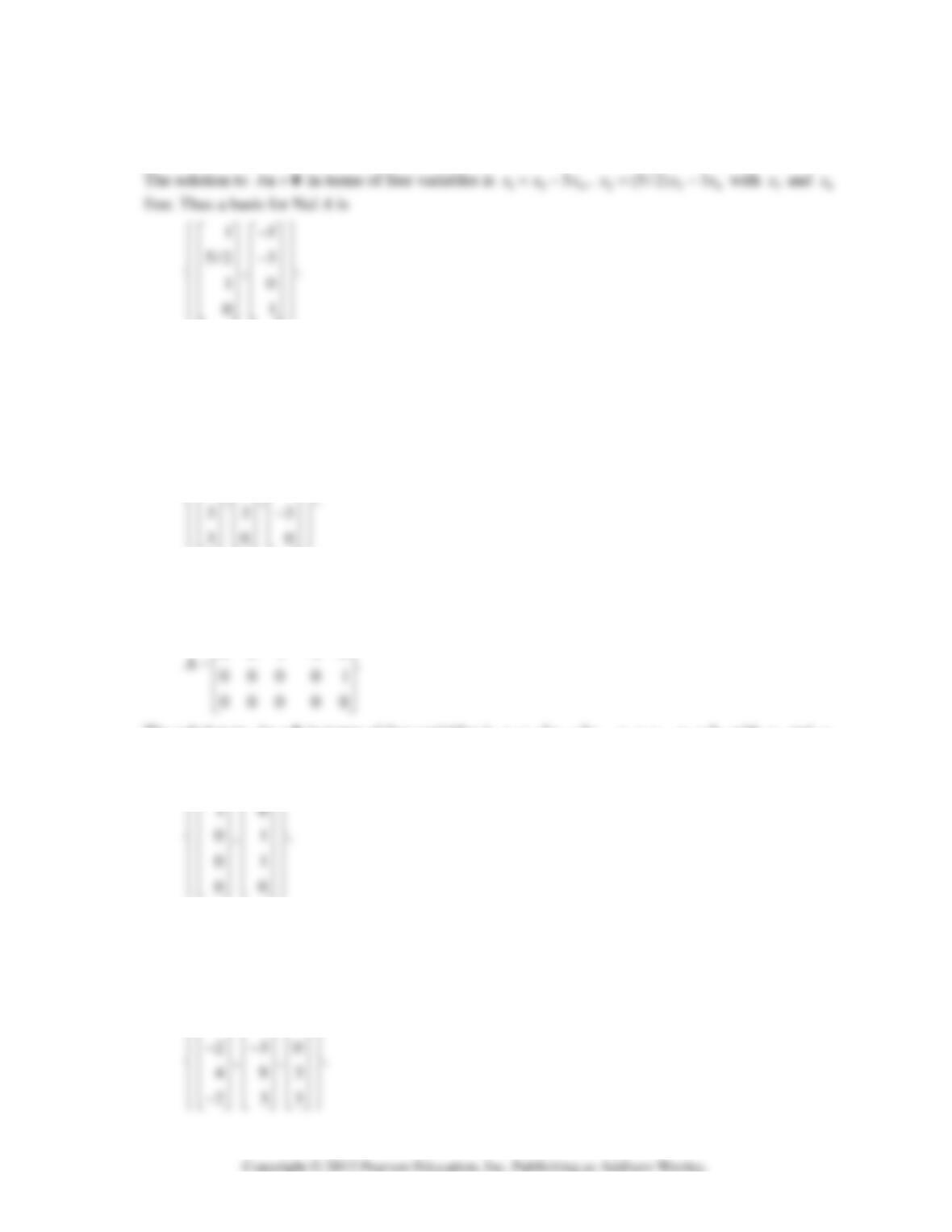
1. The matrix B is in echelon form. There are two pivot columns, so the dimension of Col A is 2. There
are two pivot rows, so the dimension of Row A is 2. There are two columns without pivots, so the
equation Ax = 0 has two free variables. Thus the dimension of Nul A is 2. A basis for Col A is the
pivot columns of A:
14
⎧⎫−
⎡⎤⎡⎤
236 CHAPTER 4 • Vector Spaces
10 1 5
.
01 5/23
A
−
⎡⎤
∼
⎢⎥
−
⎣⎦
2. The matrix B is in echelon form. There are three pivot columns, so the dimension of Col A is 3.
There are three pivot rows, so the dimension of Row A is 3. There are two columns without pivots,
so the equation
A=x0
has two free variables. Thus the dimension of Nul A is 2. A basis for Col A is
the pivot columns
of A:
14 2
26 3
⎧⎫
⎡⎤⎡⎤ ⎡ ⎤
⎪⎪
⎢⎥⎢⎥ ⎢ ⎥
−
⎪⎪
⎢⎥⎢⎥ ⎢ ⎥
⎣⎦⎣⎦ ⎣ ⎦
⎩⎭
A basis for Row A is the pivot rows of B:
{
}
(1,3,4,1,2),(0,0,1,1,1),(0,0,0,0,5).−− −
To find a basis
for Nul A row reduce to reduced echelon form:
130 30
001 10
⎡⎤
⎢⎥
−
The solution to
A=x0
in terms of free variables is
124
33
xxx
=− −
,
34
xx
=
,
5
0
x
=
, with
2
x
and
4
x
free. Thus a basis for Nul A is
33
⎧⎫
−−
⎡⎤⎡⎤
⎪⎪
⎢⎥⎢⎥
3. The matrix B is in echelon form. There are three pivot columns, so the dimension of Col A is 3.
There are three pivot rows, so the dimension of Row A is 3. There are three columns without pivots,
so the equation
A=x0
has three free variables. Thus the dimension of Nul A is 3. A basis for Col A
is the pivot columns of A:
263
⎧⎫
⎡⎤⎡⎤⎡⎤