
BCS-1
Krugman_Econ_5e_BCS_BCS1-BCS16_v1.indd 1 30/01/18 1:52 am
Suggested Solutions for Business
Case Questions for Thought
This section offers suggested answers to the Questions for Thought at the end of each chapter’s Business Case.
CHAPTER 1
1. Explain how each of the twelve principles of
economics is illustrated in this case.
Suggested Solution
1. Principle 1: People must make choices because
resources are scarce. Neither money nor time is
unlimited; they are both scarce resources. Priceline
caters to customers who have chosen to sacrifice some
have earned from the next best use of that seat or
bed—namely, the revenue earned from a paying
Likewise, how much more a customer is willing to
pay for a ticket purchased well in advance of his travel
exploiting opportunities to make themselves better
off. Priceline was successful because its customers—
travelers, airlines, and hotels—were exploiting opportu–
from using Priceline’s networks of hotels to find a
hotel rather than doing the research themselves. They
Principle 6: Because people respond to incentives,
markets move toward equilibrium. Expedia and Orbitz
moved into the online travel service industry in order
to exploit opportunities that had been pioneered by
Priceline. In this way, the market for online travel
services will move toward equilibrium until there
are no more opportunities for new travel service
companies to exploit.
Principle 7: Resources should be used efficiently
trade, markets usually lead to efficiency. It is ineffi-
cient to have planes flying with empty seats and hotels
with unoccupied beds. Thus, introducing a market for
fail because of the public’s temporary fear of flying.
Vast resources would have been wasted as pilots and
support staff lost their jobs, planes were mothballed,
income. In the aftermath of the attacks of September
2001, as people stopped spending on items like travel,
exceeded its spending.
Principle 12: Government policies can change spend-
1. What is the opportunity cost associated with having
a worker wander across the factory floor from task to
task or in search of tools and parts?
BCS-2 SuggeSted SolutionS for BuSineSS CaSe QueStionS for thought
Suggested Solution
1. The opportunity cost of a worker wandering across the
factory floor is forgone output—the output that worker
Suggested Solution
2. Lean production (also known as lean manufactur-
switch to producing more of the types of cars that
3. Before lean manufacturing innovations, Japan mostly
sold consumer electronics to the United States. How
did lean manufacturing innovations alter Japan’s com-
parative advantage vis-à-vis the United States?
Suggested Solution
3. Before the innovations in lean production, Japan had
a comparative advantage vis-à-vis the United States in
consumer electronics. After the innovations, Japan’s
4. How do you think the shift in the location of Toyota’s
production from Japan to the United States has altered
the pattern of comparative advantage in automaking
between the two countries?
Suggested Solution
4. The shift in the location of Toyota’s production from
Japan to the United States means that it is likely that
Japan will no longer have a clear comparative advan-
tage in automaking vis-à-vis the United States.
CHAPTER 3
1. What accounts for the fact that before Uber’s arrival,
there were typically enough taxis available for every-
one who wanted one on good weather days, but not
enough available on bad weather days?
Suggested Solution
1. Before Uber’s arrival fares were set by city regulators.
If everyone who wanted a taxi during good weather
could get one, then we can imply that the price set by
shift of the demand curve) as more people want rides,
and a decrease in supply as more taxi drivers want
to stay warm and dry at home (a leftward shift of
2. How does Uber’s surge pricing solve the problem?
Assess Kalanick’s claim that the price is set to leave as
few people possible without a ride.
2. Uber’s surge pricing solves this problem because it
Kalanick’s claim is true: at any price lower than the
equilibrium price there is a shortage of taxis—more
people want rides than are available.
3. Use a supply and demand diagram to illustrate how
Uber drivers can cause prices to surge by taking coor-
dinated breaks. Why is this strategy unlikely to work
in New York, a large city with an established fleet of
taxis?
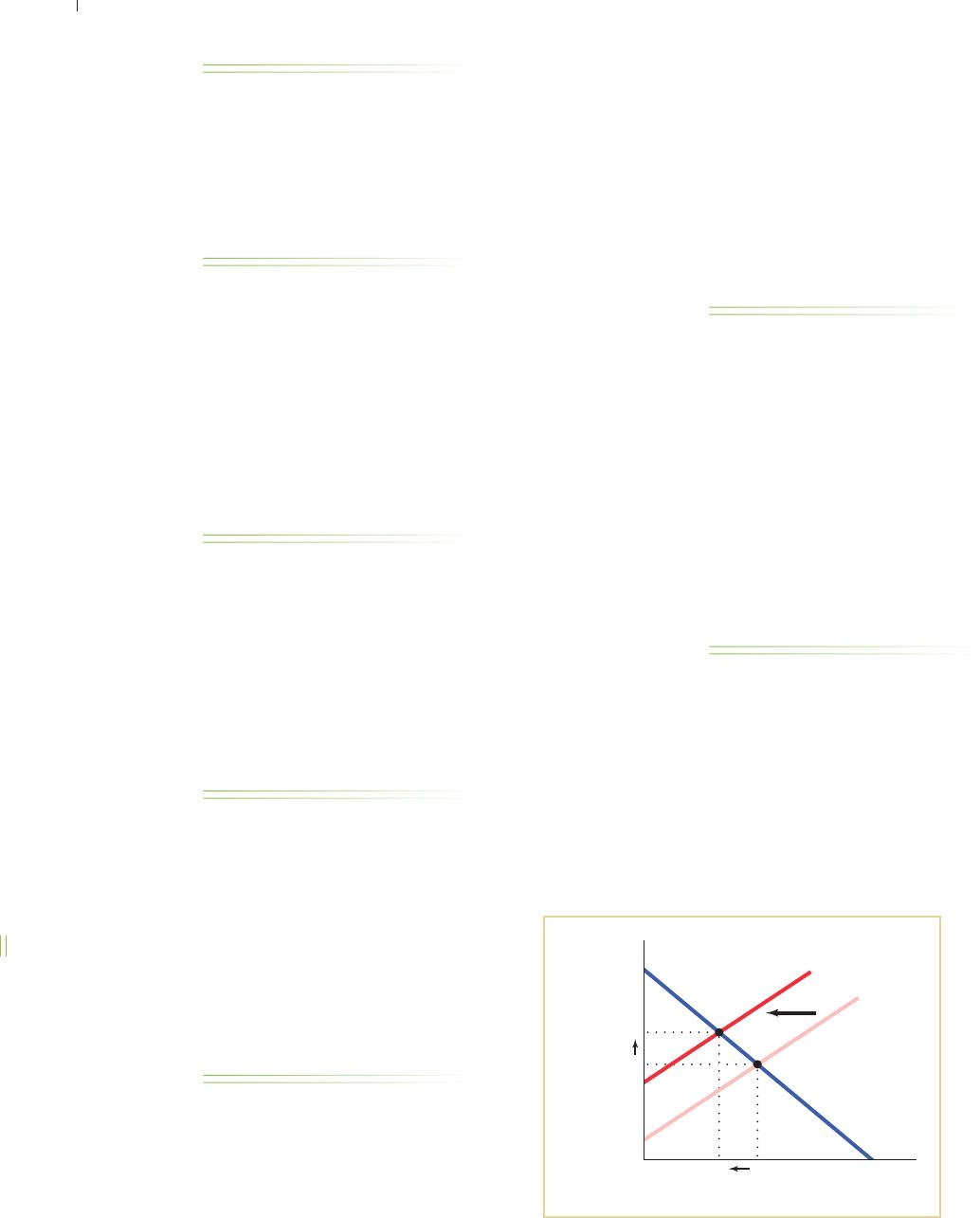
3. By taking coordinated breaks, Uber drivers in San
Diego reduce the quantity supplied at every price.
That is, they shift the supply curve leftward. As a
result, more riders want rides than are available, and
surge pricing kicks in. This is unlikely to work in a
large city with an established fleet of cars like New
York City. First, because it would be too difficult to
coordinate a large enough group of Uber drivers to
affect the price. And second, taxi drivers would take
the fares when Uber drivers took breaks, preventing a
surge in the Uber price.
Price
(dollars per
mile)
P2
P1
E2
E1
S
S (during break time)
D
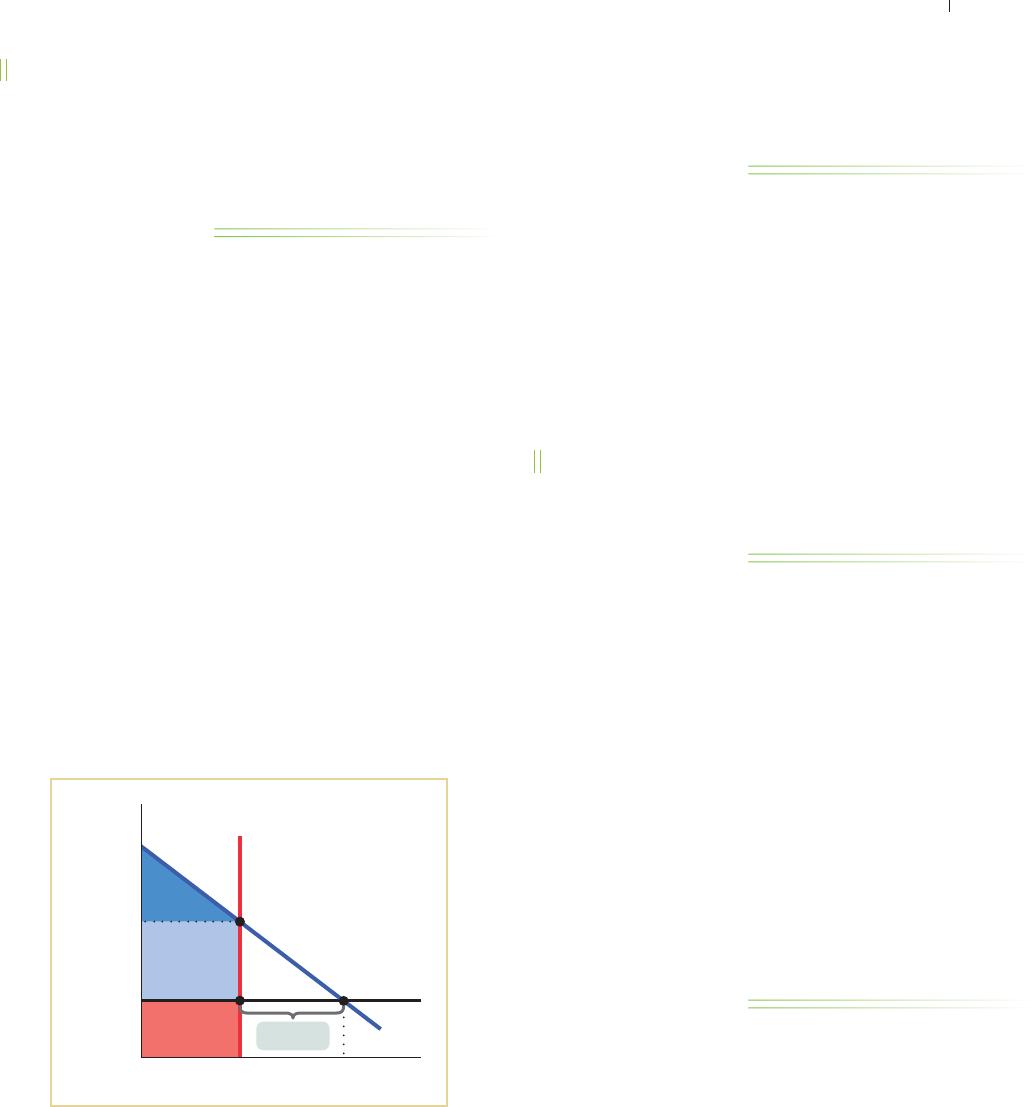
Krugman_Econ_5e_BCS_BCS1-BCS16_v1.indd 3 30/01/18 1:52 am
CHAPTER 4
1. Use the concepts of consumer surplus and producer
surplus to analyze the exchange between Jay-Z and
Beyoncé and their fans in the absence of ticket resell–
ers. (That is, assume that everyone buys a ticket directly
and goes to the concert.) Draw a diagram to illustrate.
Suggested Solution
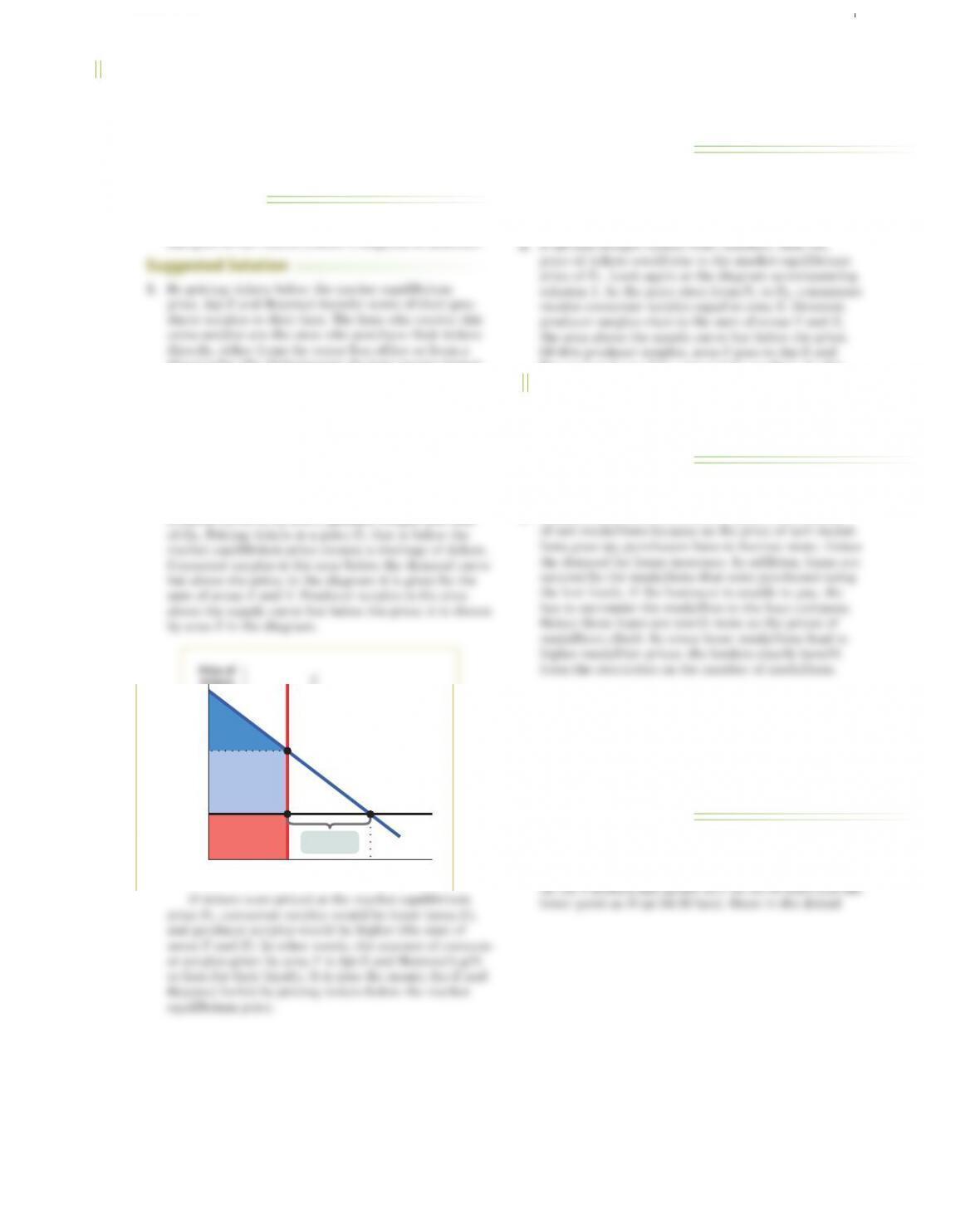
1. By pricing tickets below the market equilibrium
price, Jay–Z and Beyoncé transfer some of their pro–
librium allocation.
In the accompanying diagram, the supply curve for
tickets is drawn as a vertical line: the supply of tickets
for a concert is fixed at the number of seats available
at the venue, here QE. The demand curve is downward-
sloping as lower ticket prices encourage more fans to
buy tickets. The market equilibrium is at point E, with
a market price of PE and a quantity bought and sold
of QE. Pricing tickets at a price PC that is below the
E
X
Y
Z
BA
PE
PC
D
QE Quantity of tickets
Shortage
2. Using the diagram drawn in response to question 1,
explain the effects of resellers on the allocation of con-
sumer surplus and producer surplus among Jay-Z and
Beyoncé and their fans.
Suggested Solution
2. If all fans bought tickets from resellers, then the
price of tickets would rise to the market equilibrium
price of PE. Look again at the diagram accompanying
solution 1. As the price rises from PC to PE, consumers
CHAPTER 5
1. How did lenders benefit from the restriction on the
number of New York City taxi medallions?
Suggested Solution
1. Lenders benefit from the restriction on the number
of taxi medallions because as the price of taxi medal-
2. Use a graph to illustrate the effect of the entry of Uber
on the incomes of taxicab drivers. Assume that Uber
cars cannot pick up fares hailed from the street and
that there are some people who prefer to hail cabs
rather than use an app. How does your graph change
if that restriction is lifted?
Suggested Solution
2. To devise your graph, take Figure 5.9 as it is, then
add to it a vertical line at 9 million rides, and arrows
showing a horizontal shift from the vertical line at
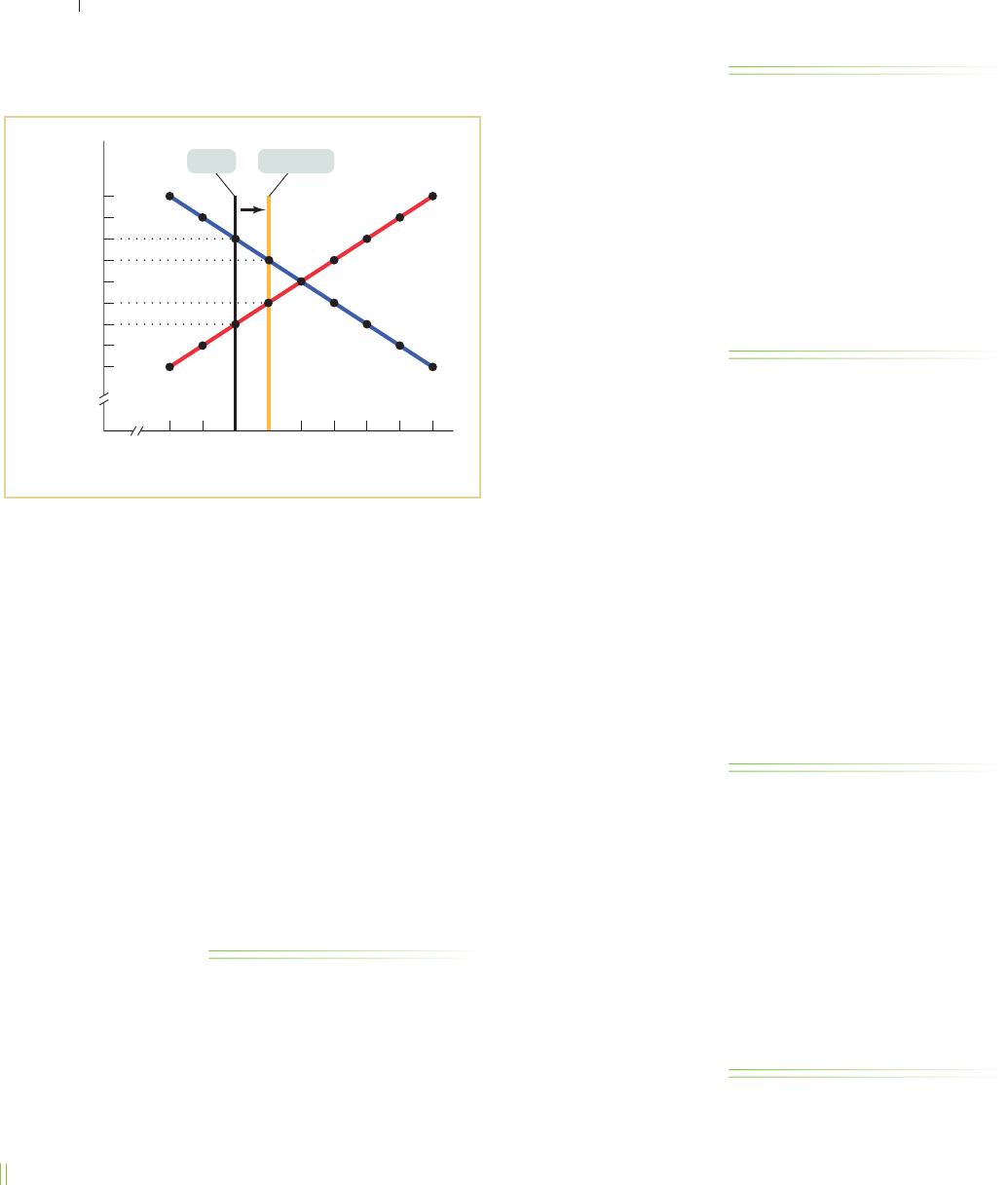
BCS-4 SuggeSted SolutionS for BuSineSS CaSe QueStionS for thought
lines from the vertical axis to points C and D. Label
the shift “Uber Effect” with a balloon.
6 7 90 8 10 11 1312 14
6.00
5.00
4.00
3.50
3.00
D
S
C
E
B
quota rent that medallion holders still receive because
some people still prefer to hail taxicabs rather than use
Uber cars, and the number of taxicabs is still restricted.
However, if the rules are changed and Uber cars are
also allowed to pick up fares hailed from the street, the
market will move to equilibrium E because the quan–
3. Why has the fight between Uber and the taxicab indus–
try turned political?
Suggested Solution
taxicab industry turned political because restrictions
the quota so it can operate.
CHAPTER 6
1. How would you describe the price elasticity of demand
for airline flights given the information in this case?
Suggested Solution
1. The price elasticity of demand for airline flights is
inelastic. We know this because airlines were able to
2. Using the concept of elasticity, explain why airlines
ticket depending on when it is purchased and the day
are willing to spend time shopping for deals as well as
Suggested Solution
2. By creating such variations in prices, the airline indus–
try is trying to appeal to customers who have a high
price elasticity of demand as well as charge higher
prices to those with a low price elasticity of demand.
3. Using the concept of elasticity, explain why airlines
have imposed fees on things such as checked bags.
Why might they try to hide or disguise fees?
Suggested Solution
3. Because airlines know that travelers have a low
disguise these fees to prevent travelers from making
substitutions, like choosing a different airline that
doesn’t charge for such services.
4. Use an elasticity concept to explain under what condi-
4. The airline industry will be able to maintain its profits
if price elasticity of supply is low—that is, if airlines
do not respond to an increase in travel demand by
greatly increasing quantity supplied. If price elasticity
of supply is high, airlines will increase quantity sup–
plied dramatically when demand increases, prices will
fall, and their profits will fall as well.

CHAPTER 7
1. To save energy and reduce carbon emissions, why do
you think that Microsoft instituted a tax rather than
issue a company-wide directive?
Suggested Solution
1. The use of a tax is likely to be more effective in
generating savings and reducing carbon emissions than
2. How is Microsoft behaving like a government? Why is
this preferable to business units acting independently?
Suggested Solution
much like a government collects taxes and spends
units acting independently will only want to fund
projects that benefit their own bottom lines.
3. What is a possible downside to the internal carbon tax
scheme? What trade–offs should Microsoft consider in
determining the size of the carbon tax?
Suggested Solution
3. A possible downside of the tax is that it may distort
business decisions by excessively discouraging energy
use: for example, employees may limit their business
travel, causing the company to miss out on business
opportunities that are in Microsoft’s interests. In
deciding how high the tax should be, Microsoft
must trade off the benefits of energy saving and
carbon-emissions reduction with the costs of discour-
aging energy use when making business decisions.
CHAPTER 8
1. Why do you think it was profitable for Li & Fung to
many countries?
Suggested Solution
1. By sourcing inputs from various suppliers across
many countries, Li & Fung was able to allocate
production to where it is most cost effective.
2. What principle do you think underlies Li & Fung’s
decisions on how to allocate production of a good’s
inputs and its final assembly among various countries?
Suggested Solution
2. Comparative advantage is the principle that under-
lies Li & Fung’s decisions. Inputs that require more
skill or are more capital-intensive can be produced
in countries that have relatively higher-skilled work–
3. Why do you think a retailer prefers to have Li & Fung
arrange international production of its jeans rather
than purchase them directly from a jeans manufac–
turer in mainland China?
Suggested Solution
facturer in mainland China would not benefit from
4. What is the source of Li & Fung’s success? Is it based
on human capital, on ownership of a natural resource,
or on ownership of capital?
Suggested Solution
4. The source of Li & Fung’s success is human capital.
The company understands how to use the principle
of comparative advantage to exploit gains from trade
in the production process. In addition, it is skilled in
providing quality control and logistics.
CHAPTER 9
1. Give an example of a type of rational decision making
illustrated by this case and explain your choice.
Suggested Solution
1. J.C. Penney customers were using the anchoring
behavioral strategy, which is a form of bounded
rationality. They looked to the pre–sale price as a
benchmark to estimate the value of the good and,
therefore, the real savings they were getting once
2. Give an example of a type of irrational decision
making illustrated by this case and explain your
choice.
Suggested Solution
2. J.C. Penney customers who followed the sales-and-

BCS-6 SuggeSted SolutionS for BuSineSS CaSe QueStionS for thought
3. What purpose does Walmart’s price-match guarantee
serve? What do you predict would happen if it dropped
Suggested Solution
3. Walmart’s price-match guarantee means that its
customers can be assured that Walmart’s prices are
indeed low and therefore they do not need to search
for an anchor to verify this. As a result, the local
supermarket or K-Mart would lose their customers
CHAPTER 10
1. How does the McPick 2 promotion resemble a
consumer’s optimal choice problem?
Suggested Solution
1. The $2 price for the McPick 2 resembles a budget con–
straint. And the choice of two items resembles how a con–
2. What feature of this case study illustrates diminishing
marginal utility at work?
Suggested Solution
2. We see diminishing marginal utility illustrated by the
declining popularity of McCafe beverages. For exam-
good mentioned in this case. Cite examples of income
and substitution effects from the case.
Suggested Solution
3. A normal good is a good for which demand rises as
income rises; a meal at a fast casual restaurant like
Chipotle is an example of a normal good. An inferior
good is a good for which demand rises as income
tion effect: consumers substituted meals from other
sources—whether home–cooked meals or meals at
competing, lower priced fast-food chains—in response
to the rise in prices at McDonald’s. The income effect is
illustrated by the increase in demand for meals at fast
run or long-run cost curve? What are the relevant
returns to scale in Amazon’s operations?
Suggested Solution
1. By substituting robots for human workers, Amazon
has reduced its variable costs (labor) and increased its
2. What are the pros and cons of Amazon’s strategy?
Suggested Solution
2. On the “pro” side of Amazon’s strategy is that it
achieves increasing returns to scale and therefore
lower average total cost as sales increase. On the “con”
side, the strategy requires very large up-front (fixed)
costs. Therefore it can cover its total costs only if it
3. What advantage does a robotic system give Amazon over
its rivals? How likely is it that they will catch up with
Amazon? What market factors does it depend upon?
Suggested Solution
Walmart to invest in robotics and make enough sales
that it could reduce its average total cost to the same
level as Amazon? That is the question!
CHAPTER 12
1. From the evidence in the case, what can you infer about
Suggested Solution
1. The retail market for electronics did not satisfy the
conditions for perfect competition because stores like

ing on competition in the retail market for electronics?
On the profitability of brick-and-mortar retailers like
Best Buy? What, on average, will be the effect on the
consumer surplus of purchasers of these items?
Suggested Solution
2. The introduction of these apps will make the retail
market for electronics much more competitive, which
3. Why are some retailers responding by having manu–
facturers make slightly modified or exclusive versions
of products for them? Is this trend likely to increase
or diminish?
Suggested Solution
ers can foil mobile-app comparison shoppers because
no other store will have the same product. This trend
is likely to increase for two reasons: (1) It is a way to
CHAPTER 13
1. What is the source of surplus in this industry? Who
generates it? How is it divided among the various
agents (author, publisher, and retailer)?
Suggested Solution
1. To understand the source of the surplus in this indus–
try, note that the production is the writing of books
by authors. Surplus is created by trade between
authors who write books and readers who enjoy read–
authors write well enough that their books c ommand
a price that allows them to capture some of the market
surplus (and like Douglas Preston, to live a comfort-
able lifestyle). Moreover, efforts by publishers in the
form of editing, advertising, etc., can increase the
share of the surplus going to the author by raising
readers’ willingness to pay for a given book. Total
surplus is higher here than in the fictional world in
which all the books are the same because readers
one), and the retailer.
2. What are the various sources of market power here?
What is at risk for the various parties?
Suggested Solution
2. Successful authors produce a unique product that is
protected by copyright laws. Hence they hold some
market power that allows them to command higher
Amazon has acquired this capacity through its
immensely costly investments in its website and its
delivery system. The ultimate source of Amazon’s
market power is its investors who have bankrolled
these investments on the promise of future profits.
Amazon also has market power through economies
of scale.
As Amazon attempts to capture a larger share
of the market surplus, successful authors and their
publishers are at risk of losing surplus to Amazon.
Moreover, if publishers are at risk of being forced out
of business, successful authors fear that a source of

CHAPTER 14
Suggested Solution
1. They may have wanted to collude because it was rea-
sonable to fear that if one of them raised its price, the
2. How would you determine whether illegal behavior
actually occurred? What might explain these events
other than illegal behavior?
Suggested Solution
2. For the airlines’ actions to have been illegal, it would
have been necessary for the two companies to make
an agreement to coordinate price increases. If one
imposed the surcharge and the other merely followed
suit, their actions would not have been illegal.
3. Explain the dilemma facing the two airlines as well as
their individual executives.
Suggested Solution
a prisoners’ dilemma because the first to confess would
gain immunity. As the defense lawyer said, it was best
CHAPTER 15
1. What explains the complexity of and high rate of
innovation in razors by Gillette and Schick?
Suggested Solution
1. The complexity of razors and pace of innovation in
their features are a reflection of the intense non-price
competition between Schick and Gillette.
2. Why is the razor business so profitable? What explains
the size of the advertising budgets of Schick and
Gillette?
Suggested Solution
2. The business is so profitable because Schick and
cartridges. Schick and Gillette have large advertising
3. What explains the popularity of the Dollar Shave Club?
Suggested Solution
3. The popularity of the Dollar Shave Club can be
explained by its lower prices. For customers who find
that these cheaper models can cannibalize sales of the
newer, more complex ones. But if Schick and Gillette
don’t expand their offerings to include an inexpen–
sive online service, a competitor could, and very well
might, undercut them.
CHAPTER 16
1. What type of externality is present in social networking
platforms, or SNPs? Explain why Friendster and
were unlikely to both survive. Explain why the loser,
Friendster, declined so quickly.
Suggested Solution
1. A social networking platform, or SNP, is an example
of a network externality: the desirability of its use
staying of all other users of that network will fall.
So there will be a cascade of departures.
2. Explain how, in the past few years, the nature of the
externality has been altered by privacy concerns,
especially among teens. Why does this change lead
to greater fragmentation of users across the different
platforms?
Suggested Solution
grandmother, or your future employer, may see your
posts. This ultimately disadvantages Facebook relative
to SNPs that preserve privacy, like Instagram and
Snapchat. Thus, at some point bigger is no longer
better, leading to fragmentation across platforms in
3. Why do SNPs face a persistent dilemma in generating

SuggeSted SolutionS for BuSineSS CaSe QueStionS for thought BCS-9
Suggested Solution
3. SNPs can generate revenue only by using pop–up ads.
form ultimately needs to generate revenue because it
cannot operate indefinitely on borrowed money.
CHAPTER 17
1. Using the concepts you learned in this chapter, explain
the economic incentives behind the huge losses in
Kenyan wildlife.
Suggested Solution
1. Unprotected African wildlife and their grazing areas
grazing area for them. Without some economic incen–
tive to conserve the wildlife and their grazing lands,
2. Compare the economic incentives facing John Hume
with those facing a Kenyan rancher.
Suggested Solution
2. Hume’s ownership of a large ranch and the animals
on it means that he now has property rights on the
3. What regulations should be imposed on a rancher who
sells opportunities to trophy hunt? Relate these to the
concepts in the chapter.
Suggested Solution
3. Regulations should ensure that the rancher, like John
Hume, is committed to the long-term care of the
CHAPTER 18
1. What pattern would you expect to see in the size and
number of newly created companies after 2014 and the
implementation of the ACA?
Suggested Solution
1. After the implementation of the ACA, there should
created companies. Because new companies tend to
be small in any event, the United States should see an
2. Historically, smaller companies and entrepreneurs
have been more innovative than larger companies.
What does this imply for the rate of innovation in the
United States before the ACA? After the ACA?
Suggested Solution
2. With a higher number of small companies created,
and more entrepreneurs freed to follow their objec–
tives, the rate of innovation in the United States should
be higher after the ACA than before its implementa-
tion. The evidence on job/entrepreneur lock indicates
that innovation was diminished in the United States
CHAPTER 19
1. Use the marginal productivity theory of income
poverty line.
Suggested Solution
1. The marginal productivity theory of income distri-
bution is consistent with a low wage—one that falls
below the poverty rate—if workers have a low value of
average Walmart worker had a low value of marginal
product because she had not acquired job skills or
experience.
same labor market can end up being paid different
2. Both Costco and Walmart are hiring workers with a
similar skill set. But that doesn’t mean each worker
is paid the same, even in equilibrium. The quantity
of labor demanded by each firm is a function of
worker productivity within each company. Costco
has recognized that paying above equilibrium wages,
or efficiency wages, has resulted in a more produc–
tive labor force. The equilibrium wage corresponds
to marginal productivity of the last worker hired, not
all workers. By raising wages, Walmart is inducing

BCS-10 SuggeSted SolutionS for BuSineSS CaSe QueStionS for thought
wage will result in sufficient improvement in customer
service, store cleanliness, and the high turnover rate, to
3. Some politicians want to encourage more companies
to adopt a high-wage strategy. What are the possible
positive and negative effects of such a policy?
Suggested Solution
3. If government policy encourages more companies to
act like Walmart, paying higher wages to induce work–
works, the economy as a whole would become more
productive and richer. There are two possible down–
sides. First, what apparently works for Walmart might
not work for everyone, so costs would rise—and this
cost increase would be passed on in the form of higher
CHAPTER 20
1. What is one example of moral hazard by homeowners
in hurricane-prone areas? Explain.
Suggested Solution
1. Homeowners who purchase homes in hurricane-prone
areas under the assumption that their potential losses
would be covered by insurance are engaging in moral
hazard. That is, they took a risky action (purchasing in
such a location) that they may not have undertaken if
they had to incur the losses from hurricane damage on
their own. Another example of moral hazard is offered
by homeowners living in hurricane-prone areas who fail
to invest adequately in hurricane–proofing their homes
2. How does the case illustrate market failure due to
adverse selection?
Suggested Solution
2. Market failure occurred when insurance companies
reduced the number of insurance policies they were
writing in Florida’s hurricane-prone areas. Adverse
selection arose because they were unable to differenti–
ate houses according to the expected cost of a claim—
they couldn’t tell a house that was expected to with–
stand a hurricane with little loss from one that might
incur a high loss. As a result, they couldn’t adjust their
premiums to accurately reflect the risk. Rather than
3. What were the sources of Buchmueller’s innovation
that allowed him to succeed in the presence of moral
hazard and adverse selection?
Suggested Solution
3. Buchmueller innovated by acquiring information
that were verified as hurricane-proof, he did not have
to ascertain whether or not a homeowner had been
underinvesting in hurricane defenses. This avoided
the moral hazard problem. Likewise, by studying
the history of claims, he discovered what were good
risks (newly built, high-value, hurricane-proof homes)
4. Why did Buchmueller purchase insurance policies
from big, global insurance companies to cover up
to 75% of his own losses? What principal does this
illustrate?
Suggested Solution
might have otherwise, allowing him to lower his cost
of capital. This illustrates the principle of diversi–
fication. Because the big insurance companies had
large portfolios that were diversified globally, they
could treat the risk of Florida hurricane losses as
small. Thus they were willing to sell insurance to
Buchmueller’s company at a price Buchmueller was
willing to pay.
CHAPTER 21
1. Why was it profitable for Montgomery Ward to close
some of its stores during the Great Depression?
Suggested Solution
1. It was profitable to close some of its stores because the
not profitable to incur the costs of maintaining stores
in which few sales were made.
2. Use Figure 21–1 to compare the nature of the Great
Depression to the Great Recession. What about the
Great Depression made Montgomery Ward’s deci-
sion not to expand during the 1940s appear rational?
Would the same decision be rational today, in the
aftermath of the Great Recession? Explain.
Suggested Solution
2. Figure 21-1 shows that although the U.S. economy in
and began to recover. In contrast, five years after the
beginning of the Great Depression, world industrial

SuggeSted SolutionS for BuSineSS CaSe QueStionS for thought BCS-11
be rational today given that recessions have been of
shorter duration, as shown by the recovery after the
Great Recession. So, today, the company would be
better off spending its cash instead of holding it. But
instead of opening new stores, Montgomery Ward
could use the cash to invest in new technologies in an
effort to expand sales.
3. The National Retail Federation provides various kinds
of economic data on its website, http://research
.nrffoundation.com. Click on the link “Retail and
Suggested Solution
3. The information supplied in the five categories helps
a better job determining how to respond to the eco–
nomic situation in the 1940s.
(1) Economic Landscape: contains data on consumer
confidence and on GDP, the total value of the
economy’s output. Consumer confidence data gives
(2) Employment Environment: contains a graph of
U.S. employment over time. The strength of the
employment environment indicates whether or not
consumers will have income to spend on retail and
how confident their spending will be.
(3) Unemployment Environment: contains graphs of
the U.S. unemployment rate over time, as well as
graphs of the unemployment rate broken down by
(4) Consumer Income and Savings: contains informa-
tion on the change in income earned by American
consumers. The more income they have, the more
resources they have to spend. A rising income level
means that it is safe for retailers to expand, while a
falling income level means they should cut back.
CHAPTER 22
1. Why would an economic downturn cause problems for
Chinese companies that borrowed heavily?
Suggested Solution
income in the economy declines. This includes income
in the form of wages, profits, interest, and rents. A
Chinese companies were expecting when they bor-
rowed heavily. With lower than expected profit, the
firms will find it difficult to pay back their debt, which
could lead some of them to fail. Companies that fail
2. How do the three statistics that Li Keqiang cited fit
into the three different ways to calculate GDP?
Suggested Solution
2. Railway shipments measure goods being sent to
customers, so they are related to GDP as measured by
3. What business problems might China’s untrustworthy
numbers create?
Suggested Solution
3. It’s hard for governments and businesses to plan
long-term when they don’t have reliable and accurate
information about the state of the economy. Businesses
CHAPTER 23
1. How is the matching of job-seekers and employers
through services like TaskRabbit likely to affect
frictional unemployment?

Suggested Solution
1. Frictional unemployment is created because as people
quit or are let go from their jobs, it takes time to find
new employment. Services like TaskRabbit can fill that
down time and may lead to two possible outcomes.
First, when people can easily find jobs through a ser–
vice such as TaskRabbit, they find work faster and
2. What is the likely effect of such services on the num-
ber of people considered to be in the labor force?
Suggested Solution
2. Services like TaskRabbit provide employment oppor-
These individuals are likely to include discouraged
workers, marginally attached workers, and others.
As these workers move back into the labor force and
find jobs as Taskers, the size of the labor force will
increase.
3. Some analysts suggest that most freelancers have
other jobs, and only do gig economy work on the side.
How does that statement help explain the lack of clear
evidence for a growing gig economy?
Suggested Solution
3. Official employment statistics count an individual
worker only once. If many people work in the gig
economy as a side job, only their primary jobs will
be counted and the employment statistics will not
reflect the gig economy jobs. And as long as many gig
expect employment statistics to reflect an increase in
the size of the gig economy.
CHAPTER 24
retailing. How did this alter the retailing production
function? What would a similar amount of investment
have accomplished without the new technology?
Suggested Solution
1. Bar-code technology resulted in an upward shift of
bar-code technology, investment would have resulted
2. The spread of bar codes was delayed in the United
States because everyone was waiting for someone
else to move. What policy could have been adopted to
address this? Would it have been a good idea?
Suggested Solution
2. A government policy to subsidize the adoption of
bar-code technology could have accelerated its adop–
3. Use the case to explain why international growth
rates var y.
Suggested Solution
3. The case shows how differences in institutions and
government policies affect economic growth, leading to
4. Despite initial barriers, bar codes have spread globally.
What does this imply about differences in economic
growth across countries?
Suggested Solution
convergence in per capita GDP.
CHAPTER 25
1. What market inefficiency is being exploited by
Grameen Bank? What is the source of this inefficiency?
Suggested Solution
1. Grameen Bank is exploiting the inefficiency that arises
from the fact that there are borrowers who want to
2. What tasks of a financial system does microlending
perform?
Suggested Solution
tion costs for people who need funds—for example,
they can borrow from Grameen rather than having
to sell possessions to raise needed funds. It reduces
financial risk, allowing borrowers to overcome
financial uncertainty. And it provides liquid assets,
by allowing lenders to lend to borrowers but in a way
that allows them to get their funds back quickly if they
3. What do you predict is the effect of Grameen Bank’s

SuggeSted SolutionS for BuSineSS CaSe QueStionS for thought BCS-13
Suggested Solution
3. We would expect communities that received Grameen
Bank lending to have a higher growth rate and less
CHAPTER 26
1. Why did a national slump that began with housing
affect companies like General Motors?
Suggested Solution
1. As we learned in the chapter, a fall in current dispos–
consumer spending across America. The broad decline
in consumer spending, in turn, hit auto companies
particularly hard as many Americans decided against
making new car purchases.
2. Why was it reasonable in June 2009 to predict that
auto sales would improve in the nearfuture?
Suggested Solution
2. It was a good bet that things would eventually improve
considerably higher in the future than they were in the
3. How does this story about General Motors help
explain how a slump in housing—a relatively small
part of the U.S. economy—could produce such a deep
national recession?
Suggested Solution
3. The story of GM illustrates how the multiplier process
ers among others. So the story shows how a fall in
investment spending—in this case, housing investment
spending—can have an impact on the economy as a
whole that is larger than the initial decline.
CHAPTER 27
1. Why do you think gas prices rose in the recessions of
the 1970s but fell after the Great Recession?
Suggested Solution
1. The recessions of the 1970s were characterized by
negative supply side shocks from OPEC oil shortages
the recession. Although an increase in oil prices also
preceded the Great Recession, larger negative demand
shocks caused a leftward shift in aggregate demand
placing downward pressure on prices. The decline in
housing prices also caused consumer spending to expe–
rience a substantial decline. In the end, the 1970s were
characterized by negative supply shocks putting upward
pressure on gasoline prices, and the Great Recession
2. What does this say about the causes of the recessions
in each case?
Suggested Solution
2. In both cases, high oil prices were a contributing fac–
tor to the recessions, but in addition to high oil prices,
the Great Recession was largely impacted by a collapse
of the housing bubble. Despite starting with a similar
cause, the effect on the economy depends mostly on
what follows the initial increase. In the case of the
Great Recession, a large negative demand shock caused
3. In the 1970s, Toyota was able to increase its American
sales despite interest rates on auto loans surging as
Suggested Solution
3. Interest rates on car loans reflect both the real interest
rate and future inflation. Because inflation increased
significantly in the 1970s, lenders followed by also
raising rates on car loans. During the Great Recession,
CHAPTER 28
1. How did the political reaction to government funding
for the Solana project differ from the reaction to more
conventional government spending projects such as
roads and schools? What does the case tell us about
how to assess the value of a fiscal stimulus project?
Suggested Solution
1. Unlike roads and schools, the Solana project was con-

BCS-14 SuggeSted SolutionS for BuSineSS CaSe QueStionS for thought
were paid to a non-American firm. Second, the proj-
ect was controversial because the long-term viability
of solar power depended upon future government
discretionary fiscal policy. What does the Solana case
tell us about this issue?
Suggested Solution
2. Solana is a good example of lags in the implemen-
tation of discretionary fiscal policy. Although the
and 2012.
3. Is the depth of a recession a good or a bad time to
undertake an energy project? Why or why not?
Suggested Solution
3. Assuming that a solar plant is a good thing to build, it
was a very good idea to do it while many construction
workers were unemployed and borrowing costs were
very low.
CHAPTER 29
1. Why are gift card owners willing to sell their cards for
a cash amount less than their facevalue?
Suggested Solution
1. A gift card is not as liquid as cash. Cash can be turned
into merchandise in any store; a gift card can be used
only at its issuer.
2. Why do gift cards for retailers like Walmart sell for a
smaller discount than those for the Gap?
Suggested Solution
2. Retailers like Walmart sell necessities, but the Gap
sells non-necessities. There will be a larger pool of
cards for necessities, which drives their discount down
3. Use your answer from Question 2 to explain why cash
Suggested Solution
3. Cash can be used to purchase any good or service,
necessity or non-necessity; it is accepted everywhere.
4. Explain why retailers prefer to reward loyal customers
with gift cards instead of rebatechecks.
Suggested Solution
4. Most customers who receive a rebate check deposit the
check into their checking account, withdraw the cash,
and use it to pay for purchases. However, those pur-
retailers will prefer gift cards.
5. There are now laws restricting retailers’ ability to
impose fees and expiration dates on their gift cards
and mandate greater disclosure of their terms. Why do
you think Congress enacted this legislation?
Suggested Solution
5. Retailers have an incentive to adopt policies that
increase breakage (the amount of a gift card that
accrues to the retailer rather than the cardholder),
such as imposing fees and expiration dates. Not telling
customers about these policies increases breakage. So
Congress has intervened to restrict these practices.
CHAPTER 30
1. PayPal accounts aren’t counted as part of the money
supply. Should they be? Why or why not?
Suggested Solution
1. It depends on how consumers use their PayPal
accounts. Many consumers use PayPal as a means of
transferring money from a checking account or credit
card to pay for goods and services purchased online.
2. In 2010, only around 25% of mobile phones in the
broader pattern of monetary history?

SuggeSted SolutionS for BuSineSS CaSe QueStionS for thought BCS-15
Suggested Solution
2. PayPal had always been a leader in mobile-phone pay-
when the number of smartphones in use was increas–
ing. The broader pattern of monetary history since
the 1960s shows that improvements in banking tech-
nology are born of innovation, whether credit cards,
debit cards, ATMs, or mobile-banking systems. These
innovations typically followed from years of efforts
3. How might future actions by the Federal Open Market
Committee affect the future of PayPal and similar
services?
Suggested Solution
3. PayPal and other money transmitters do not offer
interest rates on funds stored in their accounts. As
the Federal Open Market Committee gradually raises
interest rates, banks will start offering higher interest
rates on saving accounts. The increased competition
from banks will incentivize customers to transfer
money from PayPal to interest-earning bank accounts.
Because there are no costs in transferring money
between PayPal and bank accounts, it will be relatively
CHAPTER 31
1. What was the relationship between inflation and the
Argentine government’s chronic budget deficits?
Suggested Solution
to manage its budget. Unable to borrow on foreign
capital markets, raise taxes, or cut spending, the gov-
ernment was forced to finance its budget deficit by
printing money. As it became more reliant on printing
money to finance spending, Argentina’s inflation rate
2. What were the implications of Argentina’s inability to
get its government deficits under control for Argentine
businesses?
Suggested Solution
2. The high inflation caused by the Argentine govern-
ment’s attempts to fund its budget deficits through
the inflation tax created uncertainty for Argentine
how much their costs would go up might lose money
and go out of business. Businesses unable to plan for
the future and make investments risked atrophy and
3. Why did the Argentine government try to stop
Argentinians from converting pesos into foreign
currency, such as dollars?
Suggested Solution
3. The Argentine government was trying to collect an
inflation tax by using seigniorage to fund the budget
began converting their pesos into foreign curren–
cies, like the dollar, looking for stability. This in turn
reduced the amount of seigniorage the government
was able to capture, forcing them to print even more
money and leading to an even higher inflation rate.
So in an effort to arrest the downward spiral, the
Argentine government tried to stop citizens from
converting their pesos into foreign currency.
CHAPTER 33
1. Why would Abenomics lead to a weaker yen?
Suggested Solution
ing the demand for foreign exchange. That’s basically
what’s happening here, although Abenomics depends
in part on promises to keep money loose—that is,
to keep interest rates low for longer than previously
expected—rather than just cutting rates now.
2. Why is a weaker yen good for the profits of Japanese
auto companies?
Suggested Solution
2. When a company like Toyota or Subaru exports cars
panies a cost advantage, raising their profits.
3. Why did Subaru gain more than Toyota?
Suggested Solution
3. For Toyota, the benefits of a weaker yen apply only to
the part of its production that is exported from Japan.