507
Teaching Unit VI: International Economics. Unit VI entails the content area of Open Economy:
International Trade and Finance (Content Area VII, A-D) 1
I. Plan
Teaching Materials
Instructors Manual Text readings
Gaining from International Trade,
Chapter 17
Chapter 18, Gaining from International Trade
International Finance and the Foreign
Exchange Market
Chapter 18
Chapter 19, International Finance and the
Foreign Exchange Market
Key instructional objectives: Students do the following
1. explain and distinguish between comparative advantage and absolute advantage.
2. identify countries that possess comparative advantage and the gains from trade, given a production
possibility data.
3. identify and explain the international equilibrium price and quantity
a. derive an excess demand schedule/graph
b. derive an excess supply schedule/graph
4. analyze the effects of tariffs and import quotas on international markets and domestic markets.
5. identify the major instruments and arguments of protectionism.
6. use supply and demand analysis to determine exchange rates.
7. identify transactions that determine the demand for and supply of foreign exchange.
Formative Signals: The following content and skill areas have been identified as areas of
weakness for students based upon past objective and free response examinations.
Objective Formative Signals: Based upon
the released objective AP* Micro Economics
examinations, less than 50% of the students
Free response Formative Signals: Past
students have found these to be problematic
areas
508 Part 4/Unit VI
have been able to correctly answer questions to
following
understand the process of by which the
international value of currency appreciates
or depreciates
understand current and capital accounts
analyze monetary/fiscal policies on
exports, imports, and international
value of the dollar.
understand why demand for
II. Teach
Recommended sequence of instruction: Teach international concepts in this sequence
Chapter 18
Gaining from International Trade
1. THE TRADE SECTOR OF THE UNITED STATES, P. 357
2. GAINS FROM SPECIALIZATION AND TRADE, P. 358
Explain why nations trade
3. SUPPLY, DEMAND, AND INTERNATIONAL TRADE, P. 363
Explain the process of constructing an international supply and demand graph for a product.
producer’s benefits from exports
consumer’s benefit from imports
Part 4/Unit VI 509
4. THE ECONOMICS OF TRADE RESTRICTIONS, P. 365
Graph and explain how tariffs and quotas diminish the domestic producer and consumer surplus
5. WHY DO NATIONS ADOPT TRADE RESTRICTIONS, P. 369
6. TRADE BARRIERS AND POPULAR TRADE FALLACIES, P. 372
Summarize arguments for trade restrictions and evaluate validity of arguments.
7. THE CHANGING NATURE OF GLOBAL TRADE, P. 373
Chapter 19
International Finance and the Foreign Exchange Market
1. THE FOREIGN EXCHANGE MARKET, P. 378
2. DETERMINANTS OF THE EXCHANGE RATE, P. 380
3. WHY DO EXCHANGE RATES CHANGE? P. 382
Explain exchange rates, and how they are determined and why they fluctuate
4. INTERNATIONAL FINANCE AND ALTERNATIVE EXCHANGE RATE REGIMES, P.
385
5. BALANCE OF PAYMENTS, P. 387
6. EXCHANGE RATES, CURRENT ACCOUNT BALANCE, AND CAPITAL INFLOW? P.
391
Explain the balance of trade and how the balance of trade determines international
borrowing and lending
Current accounts
510 Part 4/Unit VI
Explain and link foreign trade to the AS/AD model.
Key conceptual questions: Students demonstrate their understanding of the material by
answering the following key conceptual questions
1. Why do nations engage in international trade?
2. Why do nations impose restrictions on international trade?
3. How do exchange rates affect international trade?
4. What is a trade deficit?
5. How can a nation gain from international trade?
6. How is an import demand curve derived?
7. How is an export supply curve derived?
8. How is international equilibrium for a commodity established?
9. Why do nations erect trade barriers?
10. What are arguments against free trade?
11. What are the methods to restrict free trade?
12. Does a consensus exist among economists about the effectiveness of quotas and tariffs?
Explain
13. What is the foreign exchange market?
14. What is an exchange rate?
15. What does it mean to have an appreciated dollar?
16. What does it mean to have a depreciated dollar?
17. What creates demand for U.S. dollars (or a foreign currency)?
18. Who supplies U.S. dollars to the foreign exchange market (or who supplies foreign currency)?
19. What creates the equilibrium exchange rate?
20. What forces create a change in the exchange rate?
21. What information is included in the balance of payments account of a nation?
22. Is a trade deficit a sign of economic weaknesses? Is a trade surplus an indication of economic
strength?
23. How do monetary and fiscal policies influence the exchange rate and the balance of payments
account?
24. What is the effect of international markets on the U.S. economy in terms of price stability,
employment, and economic growth?
III. Assess: Suggestions for determining what and how much students have learned.
Past Objective AP* Test: Based upon released objective examinations, the students have been
required to demonstrate the following content related to this unit of instruction.
recognize short run results of a tariff
recognize results of an increase of a tariff
predict results of the value of the dollar, given changes in demand for U.S. goods
predict the demand for U.S. dollars and the international value of the dollar, given changes
in the demand for U.S. government bonds
predict effects on money supply, interest rate, and international value of the dollar, given
FED market sale of bonds (assumes flexible exchange rate)
Part 4/Unit VI 511
identify the real value of the United States dollar
predict results of an increase in U.S imports
predict results of the value of the international dollar given changes in the demand for the
dollar
Past Free Response AP* Questions: Based upon released free response questions, the students
have been required to demonstrate the following content related to this unit of instruction.
1991, explain how exports and imports are affected by monetary/fiscal policies
1992, explain the impact of the dollar, imports and
exports
1993, explain the impact of increasing wages on price levels, exports and international
value of the dollar
1994, explain the impact that a technological change has in domestic price levels and
512 Part 4/Unit VI
2002, explain movement of capital flows, given a change in international interest rates
between two countries
2002, analyze demand and supply in foreign money market to show changing value of
dollar compared to the value of foreign currency; show how a change international value
of dollar changes imports and exports
2002B, explain how monetary policy affects value of domestic currency in foreign
markets.
Sample Multiple-Choice Questions for Macro Unit VI

Part 4/Unit VI 513
1. Which of the following is true?
(A) In recent decades, the volume of U.S. international trade has been increasing as a share
of the economy.
(B) In recent decades, the volume of U.S. international trade has been decreasing as a share
of the economy.
(C) As transportation costs decline, the volume of international trade will also tend to
decline.
(D) Most international trade is between the governments of different nations.
(E) If one party to an international exchange gains, the other party must lose a similar
amount.
2. In recent years, the largest trading partners of the United States have been
(A) Germany, France, Spain, and the United Kingdom.
(B) Canada, Mexico, China, and Japan.
(C) Canada, Brazil, Argentina, and Chile.
(D) Russia, Venezuela, Saudi Arabia, and Indonesia.
(E) Iraq, China, Japan, and Saudi Arabia.
3. The theory of comparative advantage suggests that nations should produce a good if they
(A) have the lowest rate of inflation.
(B) have the lowest wages.
(C) have the most resources.
(D) can produce more of the good than any other nation.
(E) have the lowest opportunity cost.
4. According to international trade theory, a country can gain
(A) if it protects domestic industries from low-wage foreign producers.
(B) only if the trade harms its trading partners.
(C) by importing goods when they can be obtained more economically from foreign
producers.
(D) if it maximizes the employment in domestic industries that face competition from
foreign producers who have lower costs.
(E) if it trades with high income countries but not low income countries.
514 Part 4/Unit VI
The following chart indicates the production possibilities of food and clothing per worker day in
the United States and South Korea.
Units of Output per Worker Day
United States South Korea
Food 2 1
Clothing 6 2
5. Which of the following is true concerning the absolute and comparative advantage between
the United States and Korea?
(A) U.S. has an absolute advantage in the production of both goods and a comparative
advantage in both goods.
(B) U.S. has an absolute advantage in the production of both goods, but a comparative
advantage in producing clothing.
(C) U.S. has an absolute advantage in both goods; but a comparative advantage in the
production of food.
(D) South Korea has no absolute advantage in either good, but a comparative advantage in
clothing.
(E) South Korea has an absolute advantage and a comparative advantage in the production
of clothing.
6. Which of the following would South Korea accept as being a possible gain in trading with the
United States?
(A) South Korea would export a food unit for 2.5 or more of U.S. clothing.
(B) South Korea would export a unit of food for 2.5 or less of U.S. clothing.
(C) South Korea would import a unit of food for 2.5 or more US clothing.
(D) South Korea would import a unit of food for 2.5 or less of U.S. clothing.
(E) South Korea would find no mutual gains from trade either food or clothing with the U.S.
7. International trade and competition from abroad
(A) provide domestic producers with a strong incentive to improve the quality of their
products and keep their costs low.
(B) will make it more difficult for domestic producers to realize fully the potential gains
from economies of scale in production.
(C) will make it more difficult for domestic consumers in small countries to purchase from
large scale producers.
(D) will benefit some domestic producers at the expense of domestic consumers.
(E) will hurt both domestic consumers and domestic producers.
8. A tax levied on imported goods is called a(n)
(A) excise tax.
(B) quota.
(C) foreign profits tax.
(D) tariff.
(E) trade balance.

Part 4/Unit VI 515
9. An increase in the tariff on foreign-produced automobiles would most likely help
(A) the domestic producers of automobiles.
(B) the domestic consumers of automobiles.
(C) steel producers who sell most of their output to foreign producers of automobiles.
(D) workers in the foreign automobile industry.
(E) consumers looking for alternatives to domestic automobiles.
10. An import quota on a product protects domestic industries by
(A) increasing the foreign supply to the domestic market and thereby lowering the domestic
price.
(B) increasing the domestic supply of the product and thereby increasing its price.
(C) reducing the foreign supply to the domestic market and thereby raising the domestic
price.
(D) decreasing the domestic demand and thereby decreasing its price.
(E) providing the incentive for domestic producers to improve the efficiency of their
operation and thereby reduce their per-unit costs of production.
11. Which of the following is a partially valid economic argument for restricting free trade?
(A) Restrictions on foreign trade will increase employment and permanently reduce
unemployment.
(B) Removal of restrictions that have existed for years will initially cause inflation.
(C) Infant industries need permanent protection to develop and gain productive efficiency.
(D) A nation needs to protect industries that are vital to national defense in case of future
international conflict.
(E) A nation needs to protect all industries to promote domestic employment.
516 Part 4/Unit VI
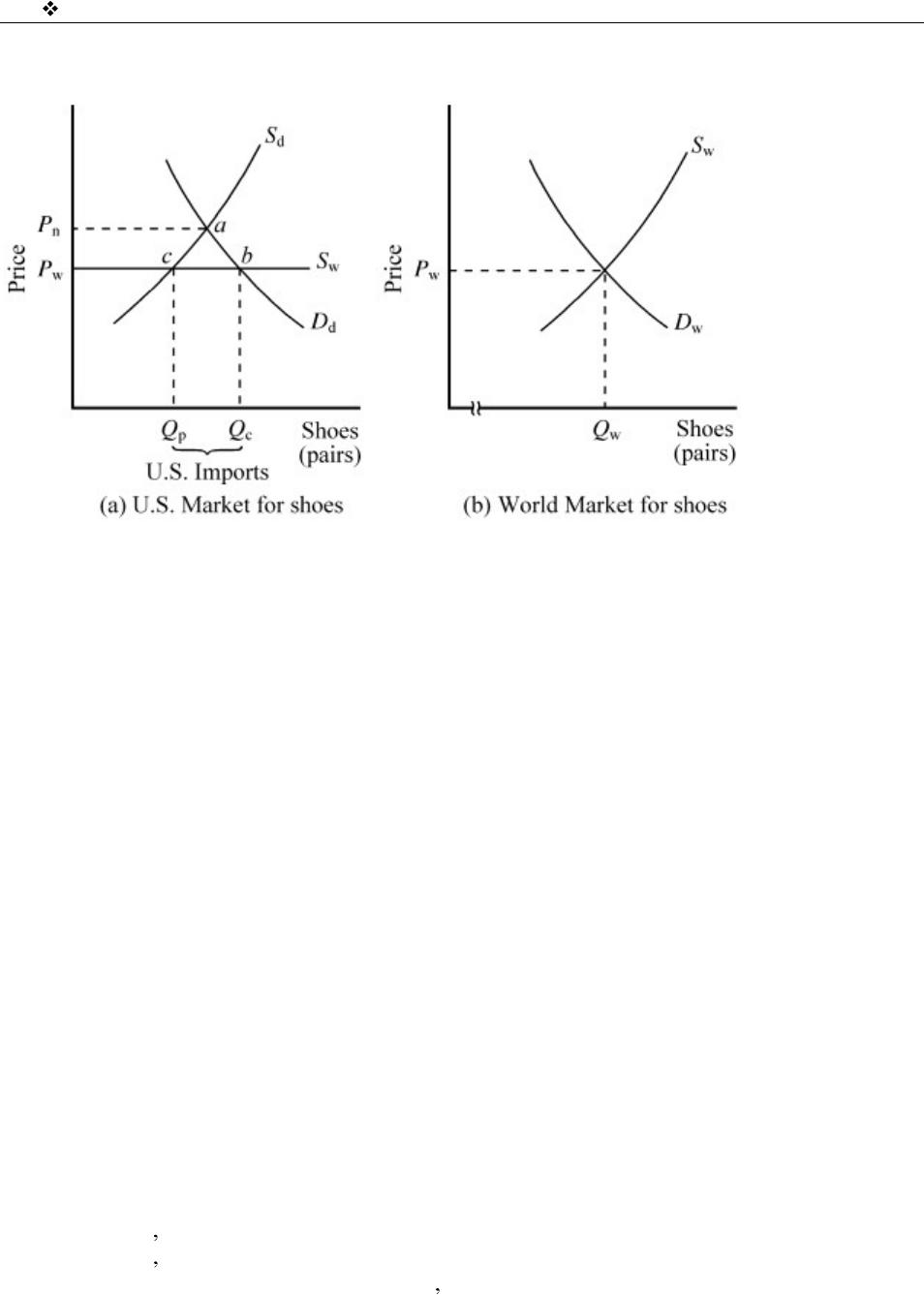
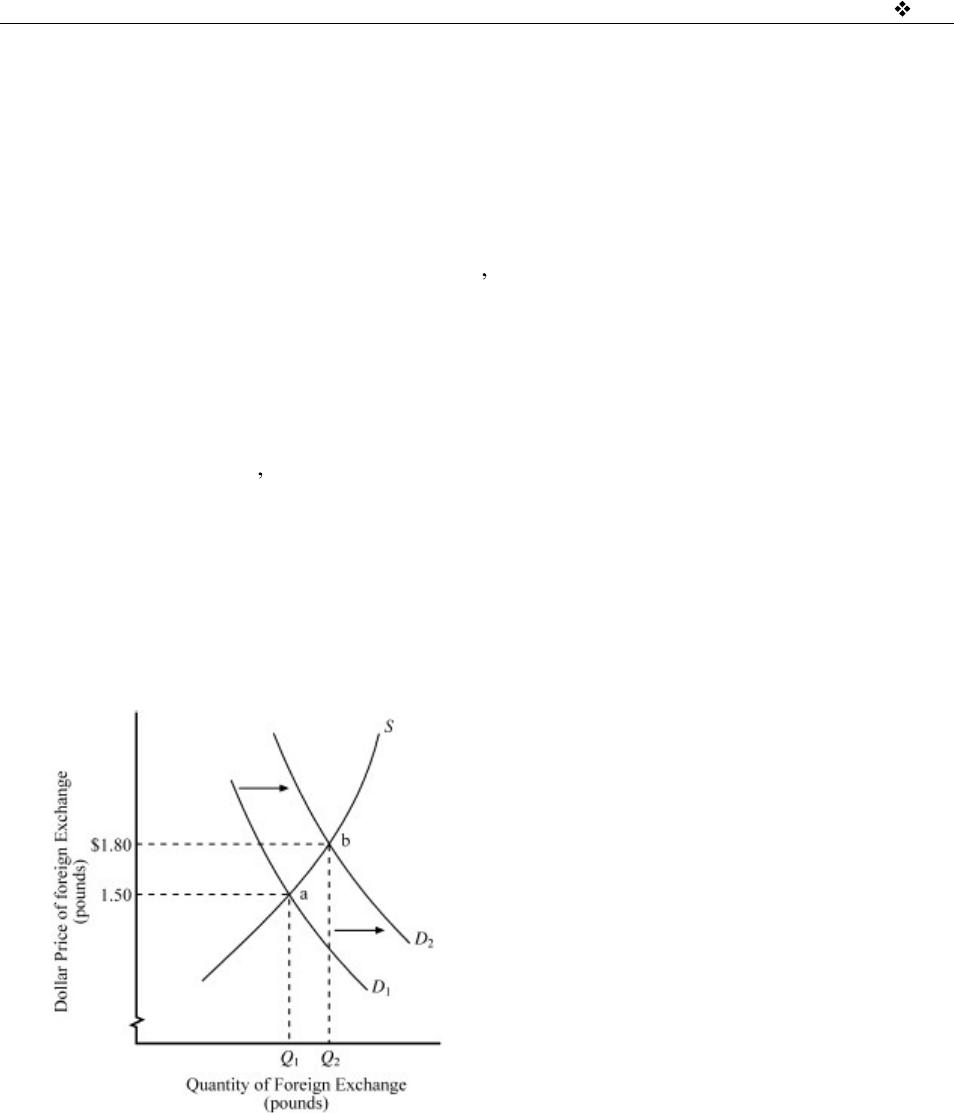
Figure 1
12. Using the information in Figure 1 above, in the absence of trade, the domestic price of shoes
would be Pn. If the United States moved from a no-trade situation to free trade, which of the
following would happen?
(A) The domestic price of shoes would rise, and domestic consumption would fall.
(B) Both the domestic price of shoes and domestic consumption would rise.
(C) Both the domestic price of shoes and domestic consumption would fall.
(D) The domestic price of shoes would fall, and domestic consumption would rise.
(E) The world price of shoes would fall.
13. A Japanese automobile manufacturer building an auto plant in the United States creates a
(A) supply of dollars and demand for yen in the foreign exchange market.
(B) demand for dollars and a supply of yen in the foreign exchange market.
(C) demand for both dollars and yen in the foreign exchange market.
(D) supply of both dollars and yen in the foreign exchange market.
(E) shortage of yen causing the price of yen to fall.
14. If the exchange rate between the U.S. dollar and the Mexican peso went from $1 US = 9 peso
to $1 US = 10 peso then,
(A) American goods have become less expensive for Mexicans.
(B) Mexican goods have become more expensive for Americans.
(C) American goods have become more expensive for Mexicans.
(D) American exports to Mexico are likely to increase.
(E) Mexican goods have become more expensive for Mexicans.
15. If restrictive monetary policy results in a slowdown in the domestic inflation rate and higher
real interest rates, other things constant, the
(A) nation will run a balance of trade surplus.
(B) nation will run a capital account deficit.
(C) nation s currency will appreciate.
(D) nation s currency will depreciate.
(E) foreign exchange value of the nation s currency will be unaffected.
Part 4/Unit VI 517
16. The balance of payments is
(A) the equilibrium result when two countries achieve purchasing power parity.
(B) an account that records changes in exchange rates between two countries.
(C) an account that records all economic transactions between a country and all other
countries, usually within a year.
(D) all of the above.
(E) none of the above.
17. The difference between the value of a country s merchandise exports and merchandise imports
is known as the balance
(A) of payments.
(B) of merchandise trade.
(C) on reserve account.
(D) on capital account.
(E) of exchange rate.
18. If the value of a nation s merchandise exports exceeds merchandise imports, the nation is
running a
(A) capital account deficit.
(B) capital account surplus.
(C) balance of merchandise trade surplus.
(D) balance of merchandise trade deficit.
(E) balance of payments surplus.
Figure 2
19. The figure above illustrates supply and demand for U.S. dollars and British pounds in the
foreign exchange market. Which of the following would cause the demand for foreign
exchange (pounds) to shift from D1 to D2?
(A) an increase in the real interest rate in Britain relative to the United States
(B) higher inflation in Britain than in the United States
(C) higher income growth in Britain than in the United States
(D) an increase in the number of British citizens vacationing in the United States
(E) an increase in the real interest rate in the United States relative to Britain

518 Part 4/Unit VI
20. Cheese experts are discovering that several varieties of Wisconsin cheese are comparable to
many of the best French cheese brands. The result is an increased demand, here and abroad,
for Wisconsin cheese. With regard to the U.S. trade balance, this trend will
(A) increase the U.S. trade deficit because of the rise in the price of Wisconsin cheese.
(B) decrease the U.S. trade deficit because of increased shipments of Wisconsin cheese
abroad.
(C) decrease the U.S. trade surplus because of increased shipments of Wisconsin cheese
abroad.
(D) decrease the demand for the U.S. dollar.
(E) increase the U.S. demand for euros.
21. If Country A has an absolute advantage over Country B in the production of every
commodity,
(A) mutual gains from trade between Country A and Country B would be impossible.
(B) Country B would be able to gain from trade but not country A.
(C) Country A would be able to gain from trade but not country B.
(D) the joint output of the two countries could not be increased through specialization and
exchange.
(E) mutual gains from trade would still be possible.
22. If expansionary monetary policy reduces real interest rates in the United States, which of the
following is most likely to occur?
(A) Net foreign investment will decline, causing the dollar to depreciate and net exports to
increase.
(B) Net foreign investment will decline, causing the dollar to appreciate and net exports to
decrease.
(C) Net foreign investment will increase, causing the dollar to appreciate and net exports to
declin(E)
(D) Net foreign investment will increase, causing the dollar to depreciate and net exports to
increase.
(E) Net foreign investment will increase, causing the dollar to depreciate and net exports to
decrease.
23. Which of the following correctly indicates a potential path for the transmission of
expansionary monetary policy to the goods and services market?
(A) Higher real interest rates will lead to a decrease in both business investment and
consumer purchases of durable items, causing a decrease in aggregate demand.
(B) Lower interest rates lead to a depreciation in the foreign exchange value of the dollar, an
increase in net exports, and an expansion in aggregate demand.
(C) Higher interest rates will tend to increase asset prices, leading to a decrease in wealth
that will decrease consumer spending and aggregate demand.
(D) A reduction in the general level of prices will increase the disposable income of
households and aggregate demand.
(E) An increase in the general level of prices will increase the disposable income of
households and aggregate demand.

Part 4/Unit VI 519
24. The short run sequence of events following an unanticipated shift to restrictive monetary
policy would be
(A) higher interest rates followed by dollar depreciation, higher exports, and lower imports.
(B) higher interest rates followed by dollar depreciation, lower exports, and higher imports.
(C) higher interest rates followed by dollar appreciation, lower exports, and higher imports.
(D) higher interest rates followed by dollar appreciation, higher exports, and lower imports.
(E) lower interest rates followed by dollar appreciation, higher exports, and lower imports.
25. The short run sequence of events following an unanticipated shift to a more expansionary
monetary policy would be
(A) lower interest rates followed by dollar depreciation, and an increase in the current
account deficit.
(B) lower interest rates followed by dollar depreciation, and a decrease in the current
account deficit.
(C) lower interest rates followed by dollar appreciation, and an increase in the current
account deficit.
(D) lower interest rates followed by dollar appreciation, and a decrease in the current
account deficit.
(E) higher interest rates followed by dollar appreciation, and a decrease in the current
account deficit.
Answers to Multiple-Choice Sample Questions for Macro Unit VI
Sample Free–Response Question for Macro Unit VI
1. Assume that Econstan, using the peso as its currency, and McMannistan, using the orue as its
currency, operate on a system of flexible exchange rates and that they are the only trading
partners.
(A) Draw a graph of the foreign exchange market for the Econstan peso.
(i) Explain the effect of an increase in the demand for Econstan goods on the
exchange rate.
(B) If there is a sudden decrease in the real interest rate in Econstan draw a graph and
explain what will happen to the value of the peso in the foreign exchange market.
(i) Explain what will happen to exports from Econstan to McMannistan.
Answers to Free-Response Sample Question for Macro Unit VI
This question would be graded using a 9 point rubric.
520 Part 4/Unit VI
1. (A) One point for a correctly labeled graph of the foreign exchange market with price of a
peso in terms of orue on the vertical axis and quantity of peso s on the horizontal axis.
(B) One point for correctly graphing a decrease in demand