Part 4/Unit IV 469
I. Plan
Teaching Materials
Instructors Manual Text readings
Chapter 13, Money and the Banking
System
Chapter 12, Money and the Banking System
Chapter 14, Modern Macroeconomics and
Monetary Policy
Chapter 13, Modern Macroeconomics and Monetary
Policy
Key instructional objectives: Students do the following
Objectives related to basic money and banking
2. identify and explain the different kinds of money (M1,M2)
4. define and describe the different functions of money.
6. define and describe the different kinds of banks.
8. define the characteristics of a balance sheet
10. describe how deposit expansion and money creation take place within the banking system.
12. describe the limitations of the money multiplier
Objectives related to money market (federal fund rate)
2. define and explain the reasons for holding money and recognize the main determinant of
each.
4. analyze how the change in money supply affects money market interest rates
5. distinguish between the interest rate established in the money market and the real interest
rate established in the loanable fund market
7. compare and contrast the demand and supply functions within the money market and the
loanable fund market.
Computational & graphing skills: Students must complete these tasks
use a balance sheet to explain what happens to excess reserves, required reserves, and
lending ability when demand deposits are made by individuals
use a series of balance sheets to demonstrate the process of multiple deposit expansion and
money creation
Formative Signals: The following content and skill areas have been identified as areas of
weakness for students based upon past objective and free response examinations.
Objective Formative Signals: Based upon
the released objective AP* Micro Economics
examinations, less than 50% of the students
have been able to correctly answer questions to
following
Free response Formative Signals: Past
students have found these to be problematic
areas
explain the money multiplier and how
it works
Part 4/Unit IV 471
II. Teach
Recommended sequence of instruction: Teach market concepts in this sequence
Chapter 13
Money and the Banking System
1. WHAT IS MONEY?, P. 250
Define money and describe its functions
Medium of exchange, store of value, unit of account
2. HOW THE SUPPLY OF MONEY AFFECTS ITS VALUE. P. 251
3. HOW IS THE MONEY SUPPLY MEASURED? P. 252
Define and classify money types
M1, M2
3. THE BUSINESS OF BANKING, P. 254
4. HOW BANKS CREATE MONEY BY EXTENDING LOANS, P. 256
Describe and explain how banks function
Balance sheets
5. THE FEDERAL RESERVE SYSTEM, P. 258
Describe the functions of the Federal Reserve System (FED)
6. AMBIGUITIES IN THE MEANING AND MEASURE MENT OF THE MONEY SUPPLY,
P. 268
472 Part 4/Unit IV
Chapter 27
Investment, the Capital Market, and the Wealth of Nations
Teach, Review or Distributive Student Practice
1. INTEREST RATES, P. 533
2. PRESENT VALUE OF FUTURE INCOME AND COSTS, P. 536
3. PRESENT VALUE,PROFITABILITY AND INVESTMENT, P. 538
Explain how interest rates are determined in the loanable fund market.
Explain present value of future income
PV = R/(1+i)N
Determine interest rate and explain interest rate fluctuations
Chapter 9
An Introduction to Basic Macroeconomic Markets
Teach, Review or Distributive Practice
1. LOANABLE FUND MARKETS, P. 185
Chapter 14
Modern Macroeconomics and Monetary Policy
1. THE DEMAND AND SUPPLY OF MONEY, P. 273
Describe how the money market interest rate (federal fund rate) is established by the FED.
Money demand and nominal interest rates
Money supply as a function of the FED
Key conceptual questions: Students demonstrate their understanding of the material by
answering the following key conceptual questions
1. What is money?
2. How is money defined in the United States?
3. What backs the U.S. dollar?
4. What is a bank?
5. What are the functions of the Federal Reserve System?
6. How is money created and how is money destroyed?
7. What happens to the total money supply when a person deposits in one depository institution a
check drawn on another depository institution?
8. What happens to the overall money supply when a person who sells an U.S. government
security to the Federal Reserve places the proceeds in a depository institution?
9. What is monetary policy and what are the tools of the FED?
10. What is the demand for money curve and how is it related to the interest rate?
11. What determines the supply of money in the money market and how is it related to the interest
rate?
12. How do the supply and demand for money determine the interest rate?
13. What is the federal fund rate? How is the federal fund rate used within the banking system?
14. Compare and contrast the money market with the loanable fund market using the following
concepts
a. demand for funds
b. supply of funds
III. Assess: Suggestions for determining what and how much students have learned.
Past Objective AP* Test: Based upon released objective examinations, the students have been
required to demonstrate the following content related to this unit of instruction.
calculate required reserve ratio, given information related to deposits and excess reserves
information
understand and identify various motives for holding money (transactions vs. speculative,
etc)
Past Free Response AP* Questions: Based upon released free response questions, the students
have been required to demonstrate the following content related to this unit of instruction.
1993, understand money multiplier effect and its limitations
474 Part 4/Unit IV
1996, explain impact of a deposit on bank reserves, loaning ability of banks and total
money supply
2001, given cash deposit in checking account with a required reserve, predict immediate
2007, define federal fund rates; and explain how FED manages the federal rate (by
increasing/decreasing MS), using open market operations; calculate the amount of new
money, given a reserve requirement created by the FED and explain impact on nominal
interest rates; can explain real interest rate using concept of nominal interest rate, rate of
inflation.
2008B Uses a loanable fund market graph to show impact of government borrowing on
real interest rates.
2009 Identifies FED policy to decrease interest rate; graphs effects of change in money
supply within a money market model and identifies effects on nominal interest rates.
2009 Identifies impact on a loanable fund market given restriction of foreign capital
Part 4/Unit IV 475
Sample Multiple-Choice Questions for Macro Unit IV
1. Compared to a barter economy, using money increases efficiency by reducing
(A) transaction costs.
(B) the need to exchange goods.
(C) the need to specialize.
(D) inflation.
(E) GDP.
2. Which of the following assets is most liquid?
(A) funds in a checking account
(B) funds invested in the stock market
(C) a car
(D) a home
(E) a municipal bond
3. Which of the following provides the best explanation of why money is valuable?
(A) Money is valuable because it is declared legal tender by the government issuing it.
(B) Money is valuable because it is scarce relative to the demand for the services it provides.
(C) Money is valuable because it is backed by precious metals, primarily gold and silver.
(D) Money is valuable because it has intrinsic value, independent of its use as a means of
exchange.
(E) Money is valuable because it is issued by the Federal Reserve and not the federal
government.
4. Which of the following is a component of the money supply (M1)?
(A) money held in the vault of the Federal Reserve
(B) checking deposits at banking institutions
(C) gold held by the U.S. Treasury at Fort Knox
(D) time deposits of individuals with a banking institution
(E) outstanding balances on credit card accounts
5. Which of the following is correct?
(A) The major income-earning asset of commercial banks is demand deposits.
(B) The major income-earning asset of commercial banks is time deposits.
(C) Banks expand the money supply when they extend additional loans.
(D) The value of U.S. currency is related to the country s stock of precious metals.
(E) The M1 money supply consists entirely of paper currency and coins.
6. Which of the following can commercial banks count as legal reserves?
(A) U.S. securities owned by the bank
(B) vault cash and deposits of the bank with the Fed
(C) U.S. securities and stocks owned by the bank
(D) checking deposits of customers
(E) savings deposits of customers
7. Assuming a 20 percent legal reserve requirement, a new deposit of $10,000 in a commercial
bank will place that bank in a position to lend out an additional
(A) $2,000.
(B) $8,000.
(C) $10,000.
(D) $20,000.
(E) $50,000.
8. Excess reserves of banks equal
(A) required reserves.
(B) actual reserves minus required reserves.
(C) actual reserves minus demand deposits.
(D) assets minus the liabilities of the banks.
(E) required reserves minus actual reserves.
9. Suppose you withdraw $1000 from your checking account. If the reserve requirement is 20
percent, how does this transaction affect the supply of money and the excess reserves of your
bank?
(A) The money supply decreases by $1000 and your bank s excess reserves are increased by
$1000.
(B) There is no change in the supply of money; your bank s excess reserves are reduced by
$800.
(C) There is no change in the supply of money; your bank s excess reserves are reduced by
$200.
(D) The money supply increases by $1000 and the excess reserves of your bank are reduced
by $800.
(E) The money supply increases by $1000 and the excess reserves of your bank are reduced
by $200.
10. The primary source of revenue for the Federal Reserve is
(A) the interest earned on the bonds held by the Fed.
(B) its annual appropriation from Congress.
(C) the interest earned on discount loans to banks.
(D) the dividends earned on the stocks held by the Fed.
(E) the interest earned on commercial loans.
11. Which of the following would cause the money supply in the United States to expand?
(A) the elimination of the current gold standard
(B) an increase in the discount rate
(C) the sale of bonds by a Federal Reserve Bank
(D) an increase in the world supply of gold
(E) a decrease in reserve requirements

12. Which of the following indicates the primary mechanism by which the money supply
expands?
(A) Customers of commercial banks withdraw cash from their checking accounts.
(B) The U.S. Treasury prints additional currency.
(C) The Fed purchases additional bonds, which increases the reserves available to the
banking system.
(D) The U.S. government decides to sell additional bonds.
(E) The U.S. government purchases additional gold.
13. Suppose the Treasury sells $10 billion of newly issued Treasury bills to the Fed and uses the
proceeds to increase government spending by $10 billion. How will this affect the money
supply and the national debt?
(A) The money supply will increase; the national debt will decline.
(B) The money supply will decline; the national debt will increase.
(C) The money supply will be unaffected; the national debt will increase.
(D) Both the money supply and the national debt will increase.
(E) Neither the money supply nor the national debt will be affected.
14. If expansionary monetary policy reduces real interest rates in the United States, which of the
following is most likely to occur?
(A) Net foreign investment will decline, causing the dollar to depreciate and net exports to
increase.
(B) Net foreign investment will decline, causing the dollar to appreciate and net exports to
decrease.
(C) Net foreign investment will increase, causing the dollar to appreciate and net exports to
decline.
(D) Net foreign investment will increase, causing the dollar to depreciate and net exports to
increase.
(E) Net foreign investment will increase, causing the dollar to depreciate and net exports to
decline.
15. If the Federal Reserve wanted to expand the money supply in order to increase output, it
should
(A) buy government bonds, which will decrease the money supply; this will cause interest
rates to rise and aggregate demand to rise.
(B) sell government bonds, which will increase the money supply; this will cause interest
rates to fall and aggregate demand to rise.
(C) buy government bonds, which will increase the money supply; this will cause interest
rates to fall and aggregate demand to rise.
(D) increase the discount rate, which will raise the market rate of interest; this will cause
both costs and prices to rise.
(E) decrease taxes, which will reduce costs and cause prices to fall.
16. Capital formation has slowed substantially during the past two years and the growth of real
GDP has come to a standstill. Consumer prices are unchanged from a year ago and the
unemployment rate stands at 8.8 percent, well above the rate six months ago. Which of the
following policies would be the most appropriate?
(A) a shift to a more restrictive monetary policy
(B) larger purchases of securities by the Federal Reserve banks
(C) an increase in both corporate and personal income taxes
(D) an increase in the Fed s discount rate
(E) an increase in the reserve requirement
17. Starting from an initial long-run equilibrium, an unanticipated shift to a more expansionary
monetary policy would tend to increase
(A) prices and unemployment in the long run.
(B) real output in the short run but not in the long run.
(C) real output in the long run but not the short run.
(D) real output in both the long run and the short run.
(E) Neither the long run nor the short run real output would change.
18. Which of the following policies would be most likely to cause an increase in short-term real
interest rates?
(A) The Federal Reserve cuts the discount rate.
(B) The Federal Reserve lowers the reserve requirement.
(C) The Federal Reserve sells bonds in the open market.
(D) The federal budget is shifted toward a surplus.
(E) The federal government raises taxes.
19. Which one of the following policies would be most appropriate if the economy is operating
beyond its long-run potential capacity?
(A) an increase in government expenditures, holding taxes constant
(B) a reduction in reserve requirements
(C) a reduction in taxes, holding government expenditures constant
(D) an increase in tariff rates
(E) a shift to a more restrictive monetary policy
20. If there is a long and variable time lag between when a change in monetary policy is
instituted and when it impacts aggregate demand and output, this will
(A) make it easier for the Fed to properly time changes in monetary policy.
(B) make it more difficult for the Fed to properly time changes in monetary policy.
(C) not affect the Fed s ability to time monetary policy changes correctly.
(D) make it easier for the Fed to control inflation and achieve price stability.
(E) make it easier for the Federal Government to coordinate fiscal policy with monetary
policy.
21. The velocity of money is
(A) money supply divided by prices.
(B) spending divided by output.
(C) required monetary reserves divided by income.
(D) GDP divided by the money supply.
(E) 1 divided by the reserve requirement.
22. When the Fed shifts to a more expansionary monetary policy, it often announces that it is
reducing its target federal funds rate. The Fed generally reduces the federal funds rate by
(A) selling bonds in the open market.
(B) raising the discount rate.
(C) increasing the reserves available to commercial banks by buying bonds in the open
market.
(D) selling bonds to the U.S. Treasury.
(E) using price controls to lower the rate.
Use the graph below to answer the following question.
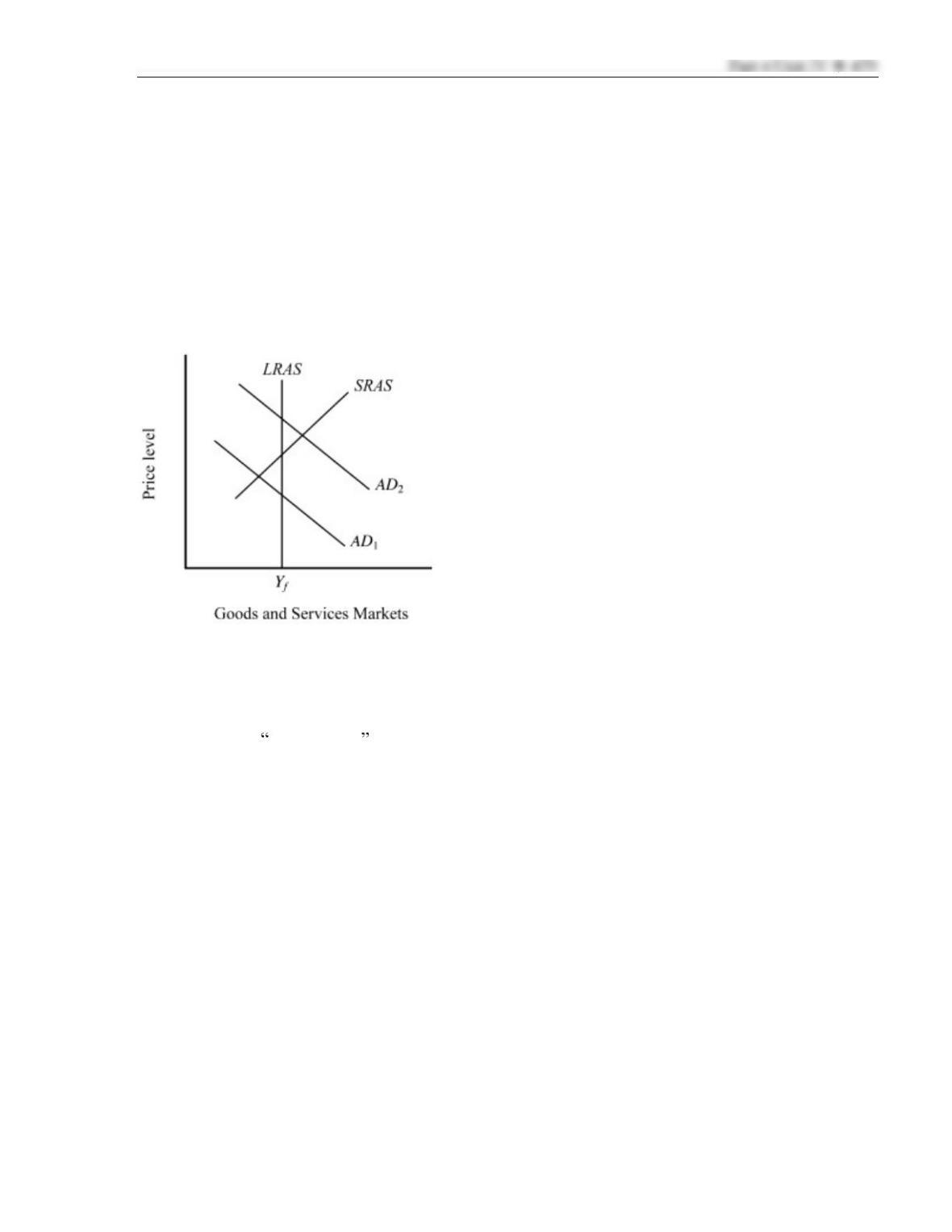
Figure 1
23. If the Fed anticipates that the conditions illustrated by AD1 and SRAS will be present in the
near future, it should
(A) shift to a more restrictive policy.
(B) shift to a more expansionary policy.
(C) take a wait and see attitude.
(D) request that Congress raise tax rates.
(E) refuse to buy any more U.S. securities.
24. If the Fed anticipates that the conditions illustrated by AD2 and SRAS will be present in the
near future, it should
(A) decrease the discount rate.
(B) reduce reserve requirements.
(C) sell U.S. treasury bonds on the open market.
(D) buy U.S. treasury bonds on the open market.
(E) request that Congress lower taxes.
480 Part 4/Unit IV
Use the graph below to answer the following question.
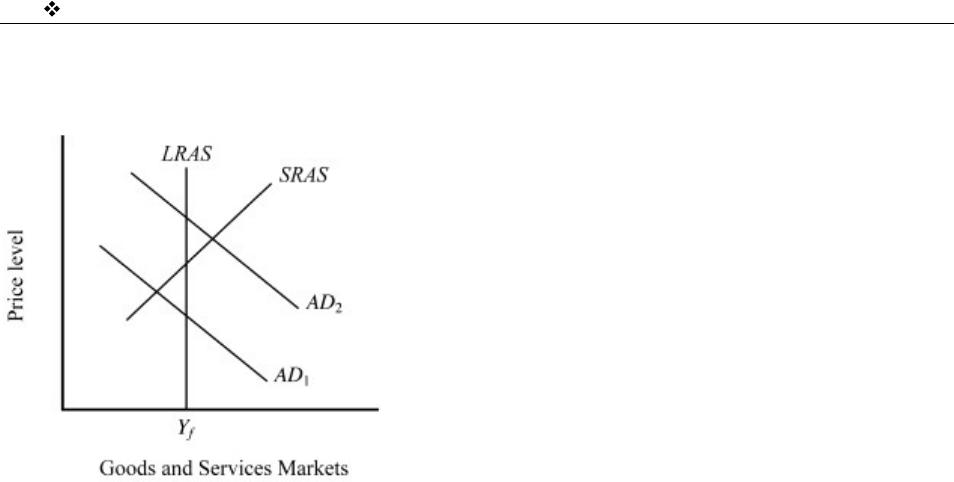
Figure 2
25. Suppose the economy was currently operating at SRAS and AD2. To combat inflation, the Fed
institutes restrictive monetary policy. Suppose that by the time the policy impacts the
economy, AD has already moved to AD1. Which of the following would be true?
(A) The policy would cause the economy to fall further into a recession than it would have if
the Fed had not undertaken the policy.
(B) The policy will help by preventing the recession from becoming worse.
(C) The policy would cause the economy to go into an economic boom.
(D) The policy would cause the economy to move further toward an inflationary episode.
(E) The policy would be ineffective unless it was completely supported by the appropriate
fiscal policy measures.
Part 4/Unit IV 481
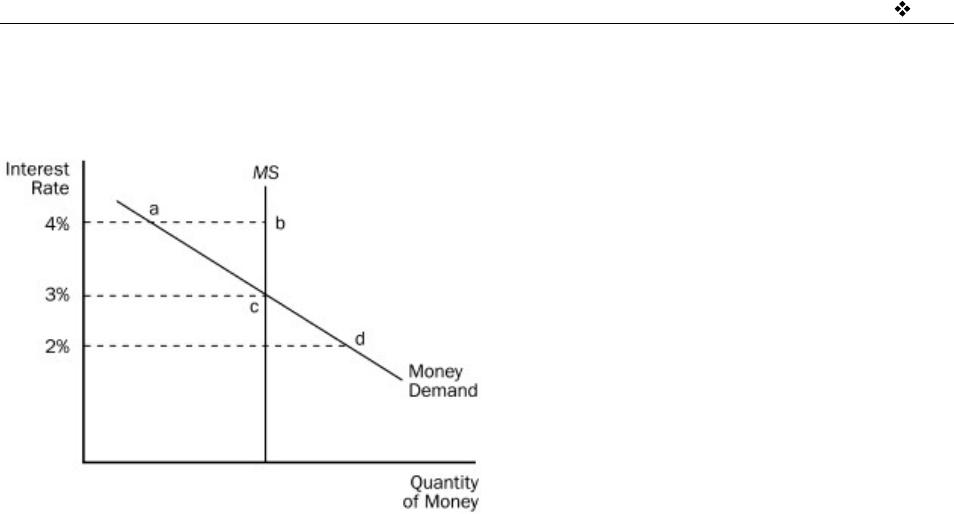
Figure 3
26. Refer to Figure 3. There is
(A) excess money demand at an interest rate of 2 percent.
(B) excess money demand at an interest rate of 3 percent.
(C) excess money demand at an interest rate of 4 percent.
(D) excess money supply at an interest rate of 2 percent.
(E) excess money supply at an interest rate of 3 percent.
27. Refer to Figure 3. At an interest rate of 4 percent there is excess
(A) money demand equal to the distance between a and b.
(B) money demand equal to the distance between b and c.
(C) money supply equal to the distance between b and a.
(D) money supply equal to the distance between c and b.
(E) money supply equal to the distance between c and a.
28. Refer to Figure 3. If an economy found itself at point c and the Federal Reserve sold bonds
(A) money demand would increase and interest rates would rise.
(B) money demand would decrease and interest rates would fall.
(C) money supply would increase and interest rates would fall.
(D) money supply would decrease and interest rates would rise.
(E) money supply would decrease and interest rates would fall.
29. In the money market and the loanable funds market respectively
(A) the federal government influences the supply of money and the supply of loanable
funds.
(B) the Federal Reserve influences the supply of money and the supply of loanable funds.
(C) the federal government influences the demand for money and the supply of loanable
funds.
(D) the Federal Reserve influences the demand for money and the supply of loanable funds.
(E) the Federal Reserve influences the supply of money and the federal government
influences the demand for loanable funds.
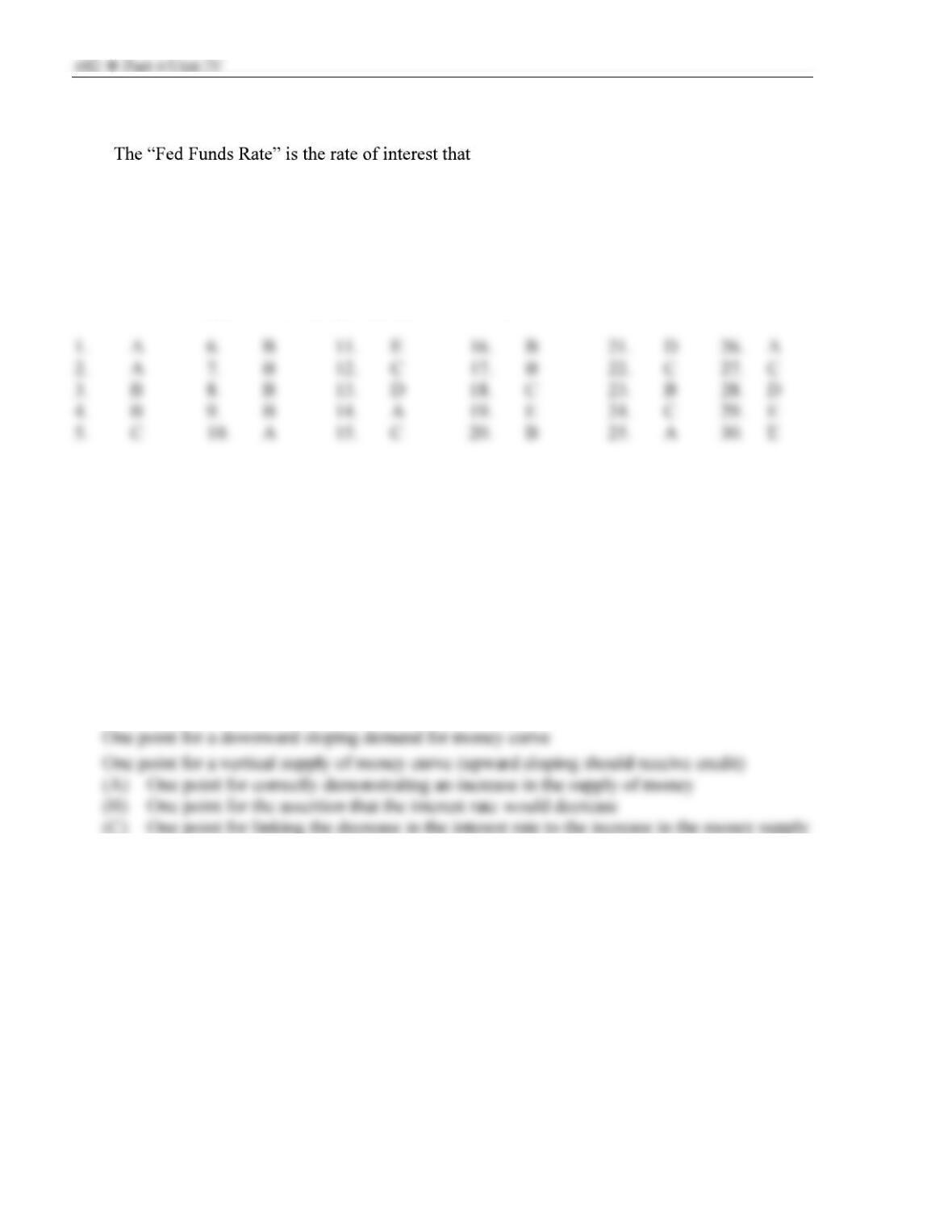
30.
(A) the Federal Reserve charges banks for Fed funds.
(B) the Federal Reserve charges the federal government for Fed funds.
(C) the Federal Reserve charges businesses for Fed funds.
(D) banks charge the Federal Reserve for Fed funds.
(E) banks charge each other for Fed funds.
Answers to Multiple-Choice Sample Questions for Macro Unit IV
Sample Free-Response Question for Macro Unit IV
1. Using a correctly labeled graph of the money market, demonstrate each of the following:
(A) an open market purchase by the Federal Reserve
(B) Explain what would happen to nominal interest rates.
Answers to Free-Response Sample Question for Macro Unit IV
This question would be graded using a 6 point rubric.
1. One point for a correctly labeled graph with interest rate on the vertical axis and quantity of
money on the horizontal axis