458 Part 4/Unit III
2006, use an AS/AD graph to show a short run equilibrium below FE; output and price
levels; evaluate the impact of an increase in an input cost on the AS/AD model and explain
impact on SRAS, output, price level and level of unemployment.
2006B, identical AS/AD scenario as given above in 2006; identify long run adjustments
Sample Multiple-Choice Questions for Macro Unit III
1. Which of the following factors would increase aggregate demand in the goods and services
market?
(A) a decrease in stock prices
(B) an increase in the real interest rate
(C) a decrease in real incomes abroad
(D) increased optimism on the part of consumers and businesses
(E) shift in the federal budget from deficit to surplus
2. Other things constant, an increase in the real interest rate will
(A) cause consumers to reduce their purchases of durable items like appliances and
automobiles.
(B) induce businesses to increase their level of investment.
(C) make borrowing money more attractive.
(D) increase the natural rate of unemployment.
(E) decrease the nominal interest rate.

3. Within the AD/AS model, if consumers and investors become more optimistic about the future
direction of the economy,
(A) aggregate demand will decrease.
(B) aggregate demand will increase.
(C) long-run aggregate supply will increase.
(D) long-run aggregate supply will decrease.
(E) short-run aggregate supply will decrease.
4. How would aggregate demand change if foreign incomes increase and the exchange rate value
of the dollar increases?
(A) Neither change would affect aggregate demand.
(B) The increase in foreign income would decrease aggregate demand; the increase in the
exchange rate would increase aggregate demand.
(C) The increase in foreign income would increase aggregate demand; the increase in the
exchange rate would decrease aggregate demand.
(D) The increase in foreign income would increase aggregate supply; the increase in the
exchange rate would increase aggregate demand.
(E) The increase in foreign income would decrease aggregate supply; the increase in the
exchange rate would increase aggregate demand.
5. Which of the following limits an economy s productive capacity at a point in time?
(A) the amount of money in circulation
(B) the total demand for goods and services
(C) the quantity and quality of productive resources
(D) constitutional restraints that limit budget deficits
(E) the size of the trade deficit
6. Which of the following will most likely cause an increase in the long-run aggregate supply
curve?
(A) a reduction in the general level of prices
(B) an increase in the general level of prices
(C) an improvement in technology that substantially reduces the cost of generating energy
(D) an increase in taxes that makes it more expensive for Americans to import crude oil
(E) an increase in aggregate demand
7. An improvement in technology would shift which of the following curves?
(A) aggregate demand and short-run aggregate supply
(B) aggregate demand and long-run aggregate supply
(C) only the short-run aggregate supply
(D) only the aggregate demand
(E) short-run and long-run aggregate supply
8. An abnormally large grain crop due to highly favorable weather conditions in the Midwest is
an example of a(n)
(A) technological improvement that will increase long-run aggregate supply.
(B) supply shock that will increase short-run aggregate supply.
(C) demand shock that will decrease aggregate demand.
(D) unexpected development that will reduce the natural rate of unemployment.
(E) unexpected development that will lead to excess supply and widespread unemployment.
9. During the past 50 years, the production possibilities of the United States have expanded,
increasing both short-run and long-run aggregate supply. Other things constant, this would
lead to
(A) an expansion in output and an increase in prices.
(B) an expansion in output and a decrease in prices.
(C) a reduction in output and an increase in prices.
(D) a reduction in output and a decrease in prices.
(E) no change in output and a decrease in prices.
10. When an economy experiences long-run economic growth, a larger output can be achieved
(A) only if there is a reduction in the natural rate of unemployment.
(B) only if the economy s actual unemployment is less than the natural rate.
(C) if prices increase.
(D) even though unemployment remains at its natural rate.
(E) only if aggregate demand increases.
11. Which of the following would be most likely to cause a recession in the United States?
(A) a decrease in real resource prices
(B) a reduction in the world price of oil
(C) a technological improvement that reduces the cost of generating energy
(D) an unexpected recession in Mexico and Canada
(E) a reduction in real interest rates in the United States
12. When an economy is temporarily operating at an output that is beyond its full-employment
rate,
(A) excess supply in resource markets will eventually lead to lower resource prices, which
will decrease costs and direct the economy toward full employment.
(B) strong demand in resource markets will lead to higher resource prices, which will
increase costs and direct the economy toward full employment.
(C) lower wages and prices will quickly restore full employment.
(D) only restrictive fiscal policy will direct the economy back to full employment.
(E) only restrictive monetary policy will direct the economy back to full employment.
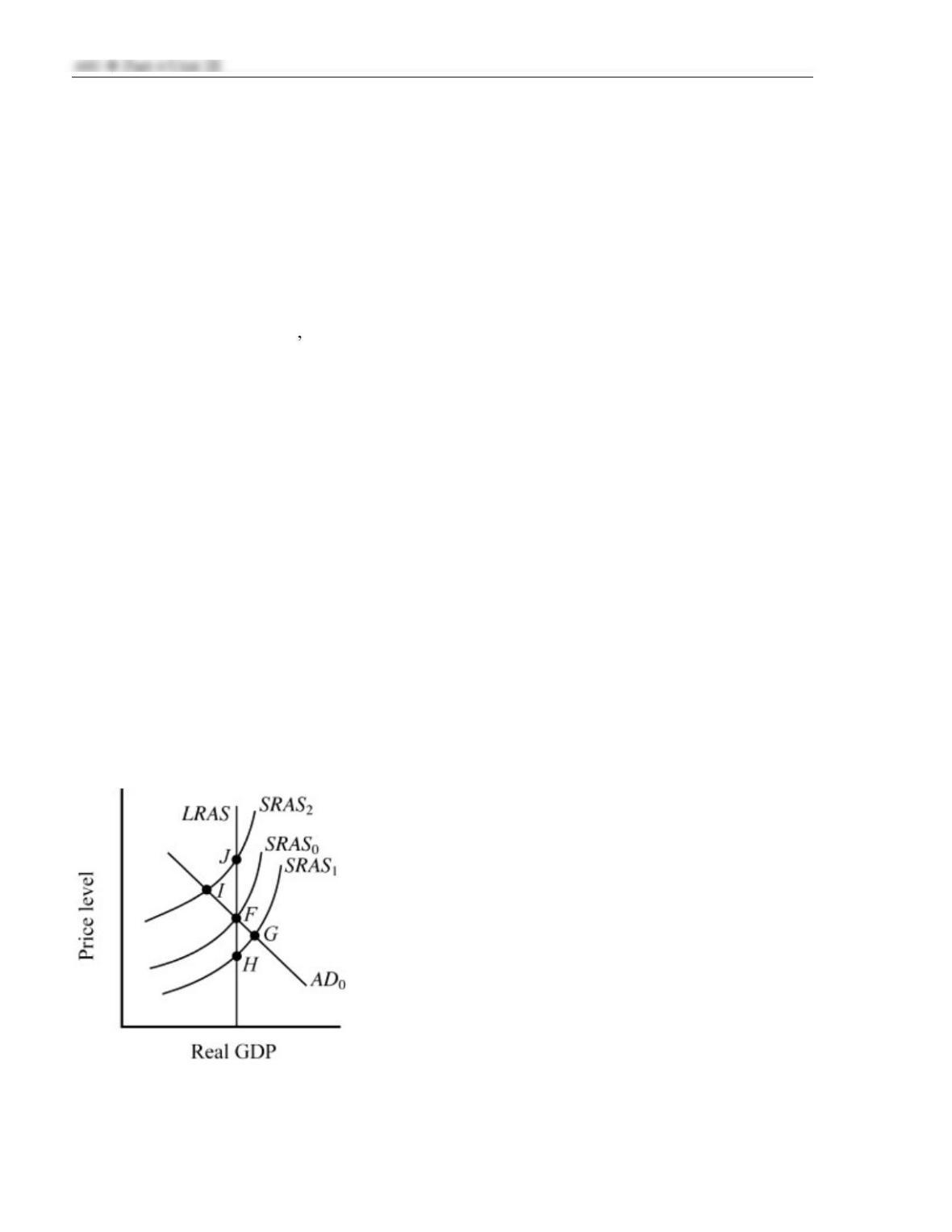
Figure 1
13. Referring to Figure 1, starting from long-run equilibrium at point F, at which of the following
points would short-run equilibrium occur following a drought in the Midwestern states?
(A) I
(B) F
(C) G
(D) H
(E)
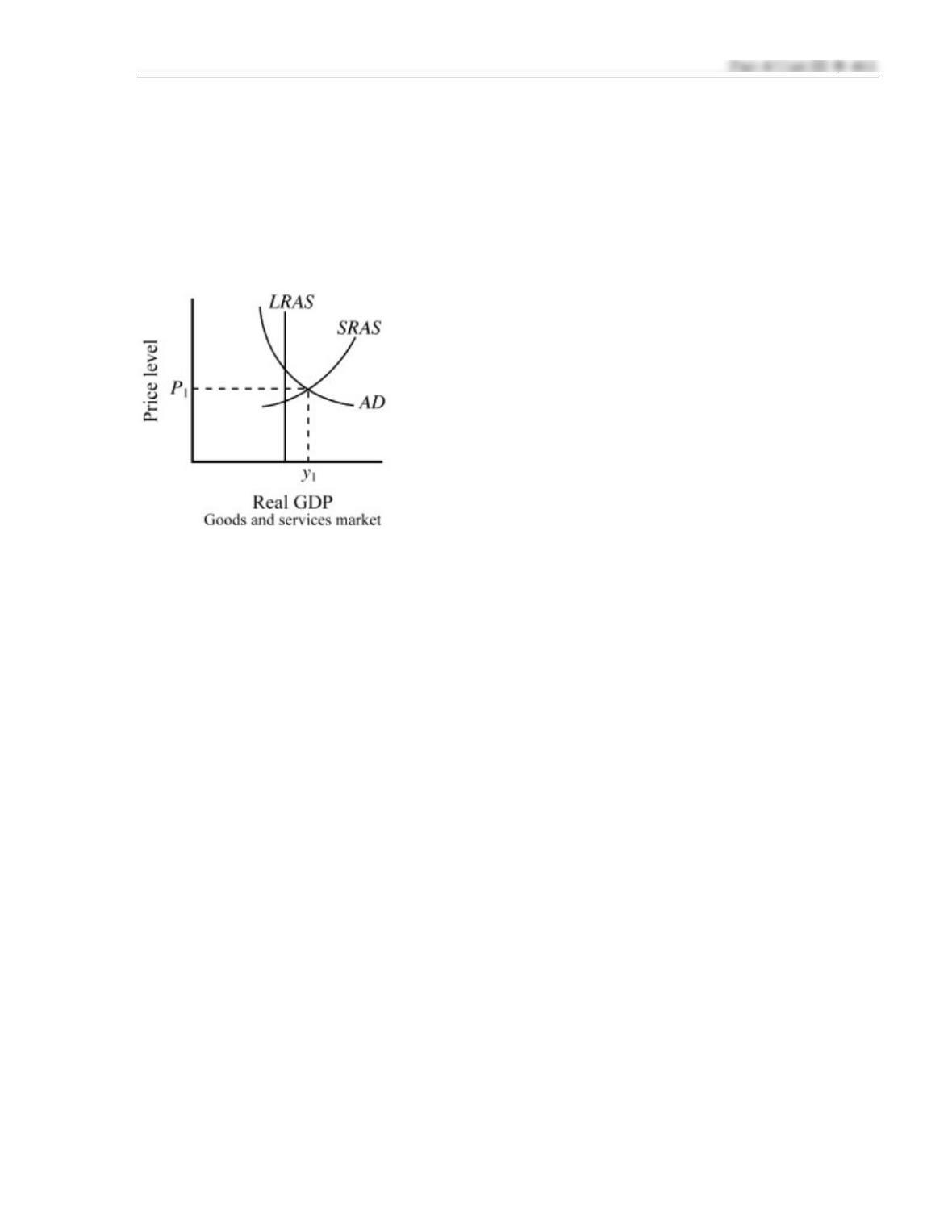
Figure 2
14. Given the aggregate demand and aggregate supply conditions depicted in Figure 2, which of
the following is the most likely occurrence?
(A) a decrease in resource prices that will shift SRAS to the left and reduce real GDP back to
the full-employment level
(B) an increase in resource prices that will shift SRAS to the left and reduce real GDP back
to the full-employment level
(C) a decrease in resource prices that will shift LRAS to the right until it equals y1
(D) lower real interest rates that will increase LRAS until it equals y1
(E) an increase in resource prices that will stimulate aggregate demand and lead to an output
greater than y1
462 Part 4/Unit III
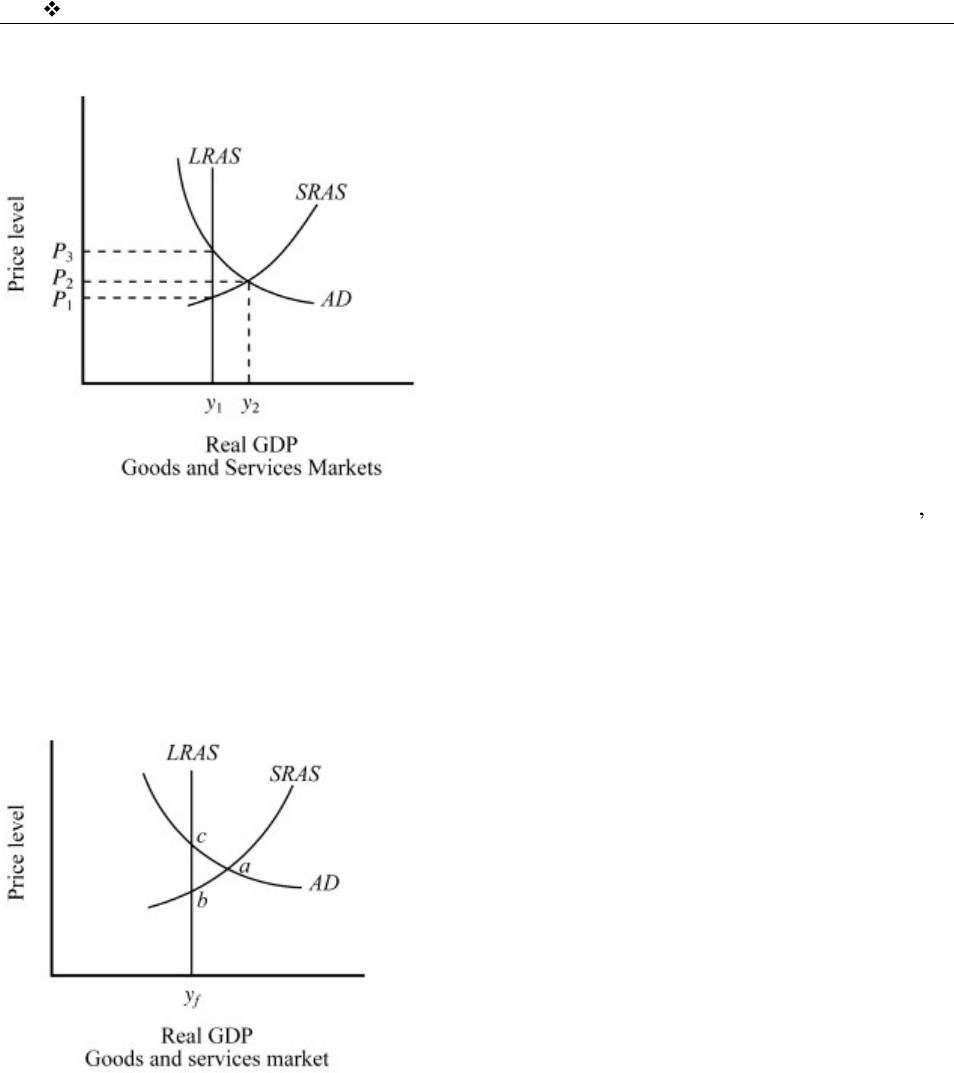
Figure 3
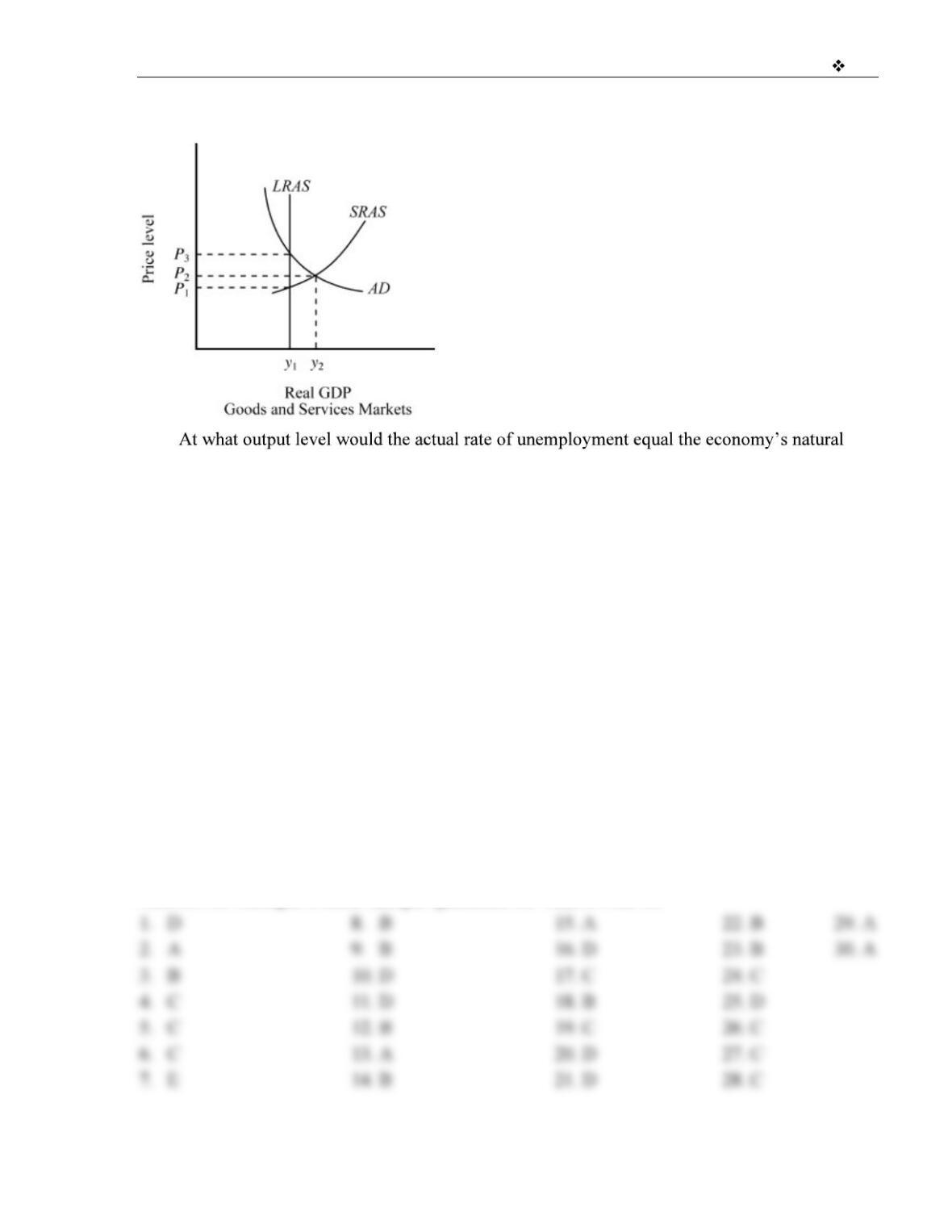
15. In Figure 3, at what output level would the actual rate of unemployment equal the economy s
natural rate of unemployment?
(A) y1
(B) y2
(C) at an output between y1 and y2
(D) at any output greater than y2
(E) at any output less than y1
Figure 4
16. Currently, the economy depicted in Figure 4 is in
(A) long-run equilibrium at point b.
(B) short-run equilibrium at point c.
(C) long-run equilibrium at point a.
(D) short-run equilibrium at point a.
(E) short-run equilibrium at point b.
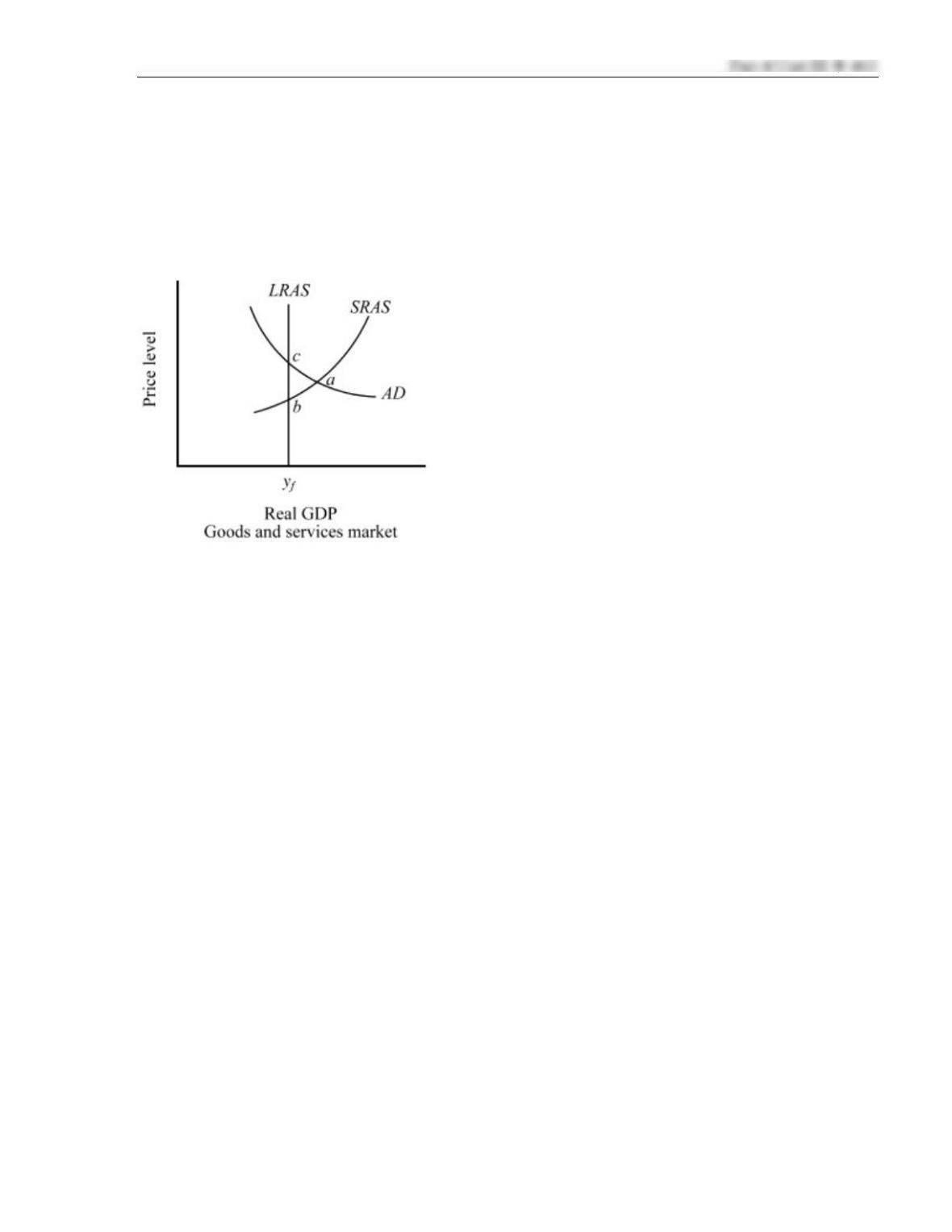
17. In Figure 4, if the economy were operating at point a, resource prices would tend to
(A) decrease and move the economy toward point c.
(B) decrease and move the economy toward point b.
(C) increase and move the economy toward point c.
(D) increase and move the economy toward point b.
(E) increase but keep the economy at point a.
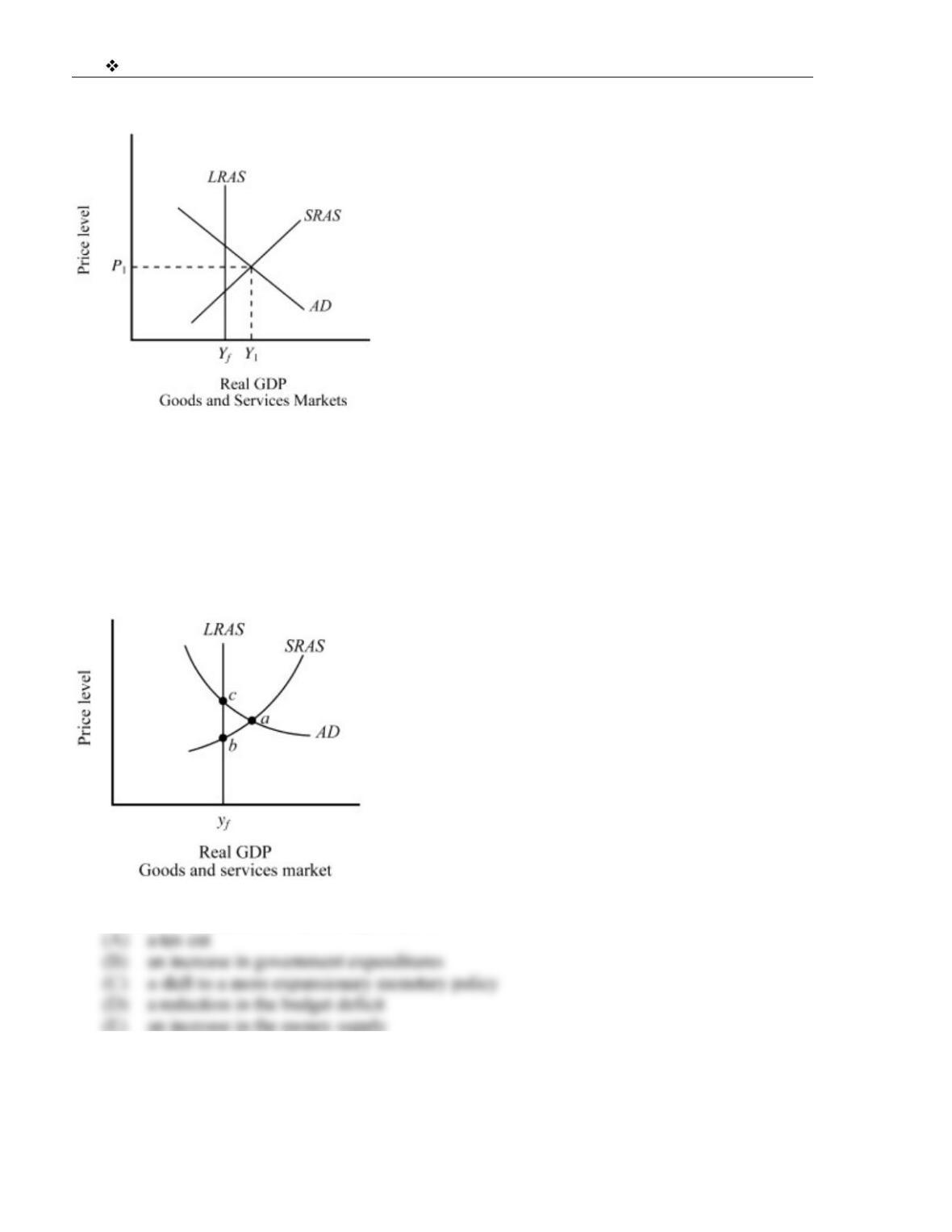
Figure 5
18. In Figure 5, if an economy operates in the short run at point a, restrictive fiscal policy will
(A) increase AD and move the economy toward point c.
(B) decrease AD and move the economy toward point b.
(C) decrease AD and move the economy toward point c.
(D) increase SRAS and move the economy toward point b.
(E) decrease SRAS and move the economy toward point c.
464 Part 4/Unit III
Figure 6
19. Given the conditions depicted in Figure 6, which of the following would tend to be favored by
a Keynesian economist?
(A) an increase in government expenditures
(B) a decrease in taxes
(C) an increase in taxes
(D) an increase in the growth rate of the money supply
(E) an increase in the budget deficit
Figure 7
20. In Figure 7, if the economy is currently operating at point a, which of the following would a
Keynesian economist be most likely to favor?
Part 4/Unit III 465
Figure 8
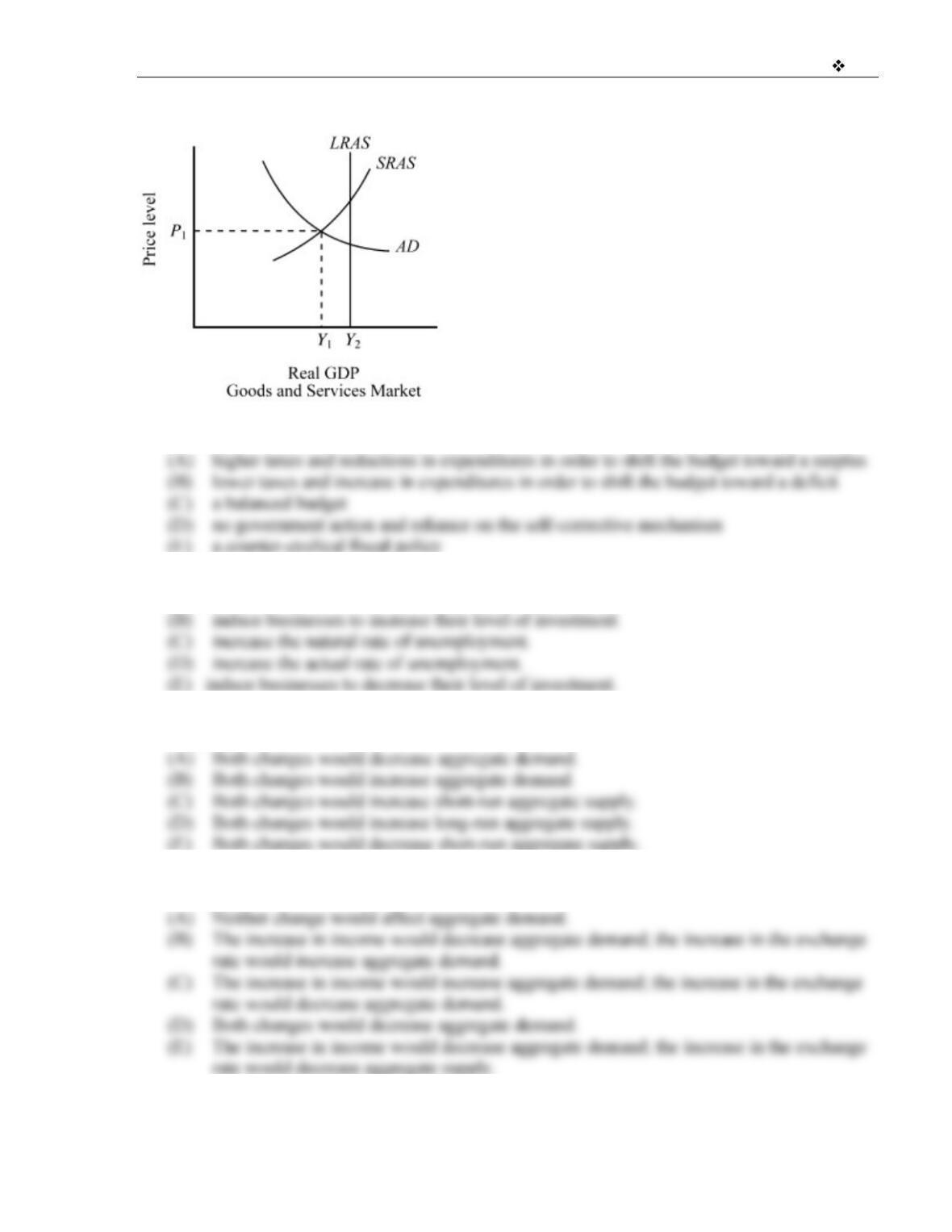
21. In Figure 8, if an economy is currently operating at Y1, which of the following would a new
classical economist be most likely to favor?
22. Other things constant, a reduction in the real interest rate will
(A) cause consumers to cut back on their purchases of durable items like automobiles.
23. What would be the effect of a decrease in the real interest rate and an increase in the expected
inflation rate?
24. How would aggregate demand change if foreign incomes increase and the exchange rate value
of the dollar increases?
466 Part 4/Unit III
25. Which of the following will lead to a decrease in aggregate demand in the United States?
(A) a higher price level
(B) a decrease in the real interest rate
(C) rapid growth in real income in Japan and Western Europe
(D) an increase in the exchange rate value of the dollar
(E) a decrease in aggregate supply
26.
potential output is represented by an increase in
(A) prices.
(B) aggregate demand.
(C) long-run aggregate supply.
(D) an increase in the general level of prices.
(E) short-run aggregate supply
27. Which of the following will most likely cause an increase in the long-run aggregate supply
curve?
(A) a reduction in the general level of prices
(B) an increase in the general level of prices
(C) an improvement in technology that substantially reduces the cost of generating energy
(D) an increase in taxes that makes it more expensive for Americans to import crude oil
(E) a reduction in the unemployment rate
Figure 9
28. Given the aggregate demand and aggregate supply conditions depicted in Figure 9, which of
the following is the most likely occurrence?
(A) an increase in resource prices that will stimulate aggregate demand and direct the
economy to long-run equilibrium
(B) a decrease in resource prices that will stimulate aggregate demand and direct the
economy to long-run equilibrium
(C) a decrease in resource prices that will reduce costs and shift SRAS to the right, directing
the economy to long-run equilibrium
(D) a continuation of this price level and output in the long run
(E) a shift in LRAS to the left as the result of an increase in the expected inflation rate
Part 4/Unit III 467
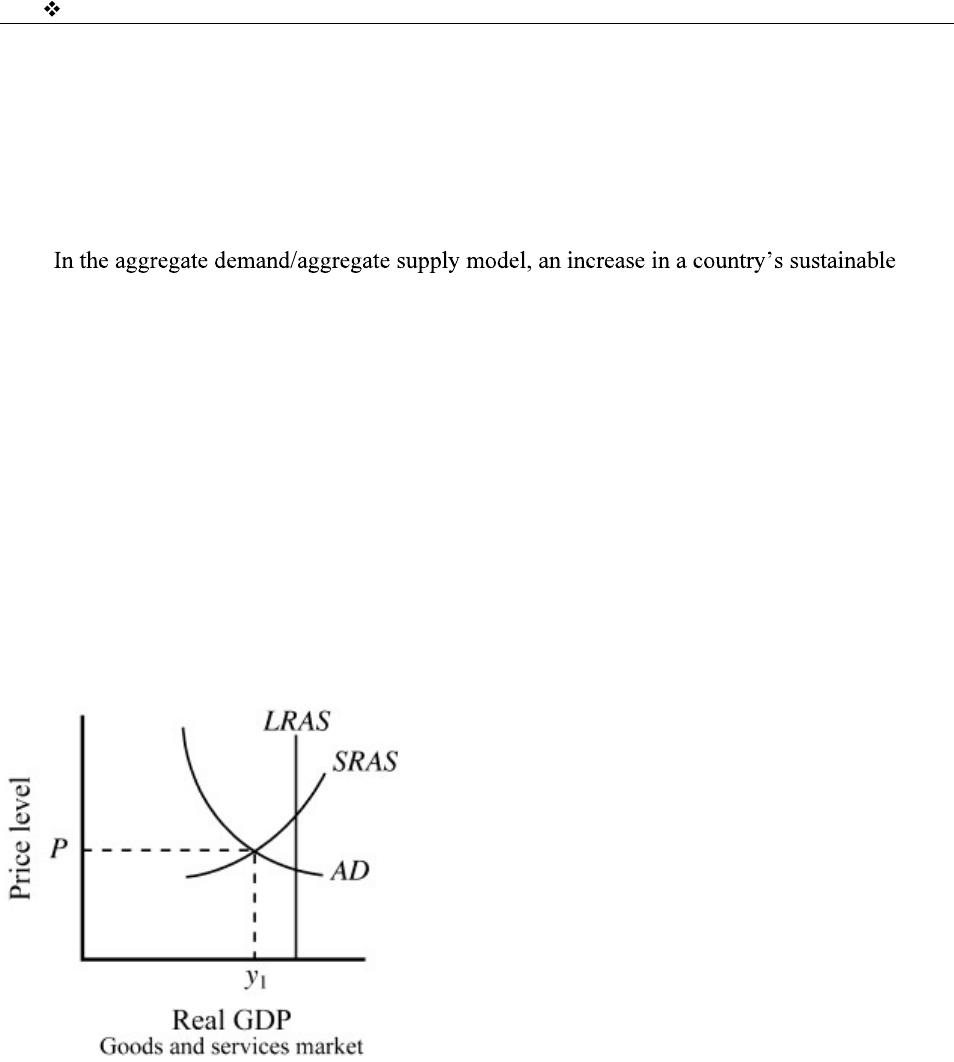
Figure 10
29.
rate of unemployment in Figure 10?
(A) y1
(B) y2
(C) at any output greater than y2
(D) at any output less than y1
(E) only at output levels between y1 and y2
30. According to the loanable funds market model, expansionary fiscal policy will lead to
(A) an increase in the demand for loanable funds, higher real interest rates, an appreciated
dollar, and reduced net exports.
(B) a decrease in the demand for loanable funds, lower real interest rates, an appreciated
dollar, and increased net exports.
(C) an increase in the supply of loanable funds, higher real interest rates, an appreciated
dollar, and reduced net exports.
(D) a decrease in the supply of loanable funds, lower real interest rates, an appreciated
dollar, and reduced net exports.
(E) a decrease in the demand for loanable funds, a decrease in the supply of loanable funds,
an indeterminate effect on real interest rates, an indeterminate effect on the dollar, and
an indeterminate effect on net exports.
Answers to Multiple-Choice Sample Questions for Macro Unit III
468
Sample Free-Response Question for Macro Unit III
1. Draw and label an aggregate supply and aggregate demand diagram showing an economy
operating at a short-run equilibrium below full employment. Use your diagram to answer each
of the following.
(A) Identify the full employment level of output.
(B) Explain what would happen in the long run if no monetary or fiscal policy measure were
undertaken.
Answers to Free-Response Sample Question for Macro Unit III
This question would be graded using a 7 point rubric.
1. One point for a correctly labeled graph with price level on the vertical axis and GDP on the
horizontal axis