
Part 4/Macroeconomics Examination 521
Advancement Placement Level Macroeconomics
Examination
1. Which of the following correctly describes the components of aggregate demand?
(A) consumption expenditures + investment expenditures + government expenditures +
exports + imports
(B) consumption expenditures + investment expenditures + government expenditures +
exports – imports
(C) consumption expenditures + investment expenditures + government expenditures –
exports – imports
(D) consumption expenditures + investment expenditures + government expenditures +
savings + exports – imports
(E) consumption expenditures + investment expenditures + government expenditures +
business expenditures + savings + exports + imports
2. Which of the following formulas is correctly stated?
(A) real interest rate = nominal interest rate + anticipated inflation
(B) nominal interest rate = real interest rate + anticipated inflation
(C) real interest rate = nominal interest rate + actual inflation
(D) nominal interest rate = real interest rate + actual inflation
(E) nominal interest rate = real interest rate – actual inflation
3. Which of the following would NOT affect the size of real GDP?
(A) consumer purchase of a new car for personal use
(B) government purchase of a new car for the military
(C) business purchase of a new car for a delivery vehicle
(D) consumer purchase of a rare renaissance painting
(E) consumer purchase of a haircut
4. If an autonomous increase in spending in an economy of $100 leads to an increase in GDP of
$500, then for that economy the marginal propensity to consume must have been
(A) 4/5.
(B) 5.
(C) 100.
(D) 400.
(E) 500.
5. Within the framework of the Keynesian model, which of the following will have the most
expansionary impact on aggregate demand?
(A) an increase in government spending of $50 billion
(B) an increase in taxes of $50 billion
(C) an increase in the federal budget surplus of $50 billion
(D) a decrease in taxes of $50 billion
(E) an increase in the trade deficit of $50 billion
522 Part 4/ Macroeconomics Examination
6. If a $100 deposit in a bank leads to a $1000 increase in the money supply, the reserve
requirement must have been
(A) 10%.
(B) 20%.
(C) 100%.
(D) 1000%.
(E) Cannot be determined from the information given.
7. Long-run economic growth in a country would be encouraged through which of the following
combinations of events?
Investment Interest rates Savings rate
(A) high high high
(B) high high low
(C) high low low
(D) low low low
(E) high low high
8. Which one of the following people would be considered structurally unemployed?
(A) unemployed auto assembly line worker during a recession
(B) unemployed auto assembly line worker who was replaced with a robot
(C) an auto assembly line worker who quit her job to go back to school full-time to improve
her job skills
(D) a high school student who mows lawns during the summer, but is out of work because it
is winter
(E) a high school economics teacher who is not working during the summer, but plans to go
back and teach in the fall
9. Which combination of events described below would be the most expansionary for an
economy, assuming that they all happened at the same time?
Government Net Reserve
Taxes spending exports requirement
(A) decrease increase increase decrease
(B) increase increase increase decrease
(C) decrease increase decrease decrease
(D) decrease decrease decrease decrease
(E) increase decrease decrease increase
10. Which of the following would be an appropriate fiscal policy measure to combat inflation?
(A) increase money supply
(B) increase government spending
(C) increase taxes
(D) increase the reserve requirement
(E) increase deficit spending
11. Which of the following would be an appropriate monetary policy measure to combat inflation?
(A) increase taxes
(B) decrease taxes
(C) sale of bonds by the Fed
(D) purchase of bonds by the Fed
(E) lower the reserve requirement
Part 4/Macroeconomics Examination 523
12. Over the long run, the rate of growth of real wages is approximately equal to the rate of
(A) inflation.
(B) unemployment.
(C) growth of labor productivity plus the rate of inflation.
(D) growth of labor productivity minus the rate of inflation.
(E) growth of labor productivity.
13. A production possibilities curve is most closely related to which of the following?
(A) short-run aggregate supply curve
(B) long-run aggregate supply curve
(C) aggregate demand curve
(D) Laffer curve
(E) Phillips curve
14. Which of the following combinations of policy moves would be recommended for an
economy experiencing an annual increase in the inflation rate of 6% and an unemployment
rate of 5%?
(A) increase government spending and increase the discount rate
(B) decrease government spending and decrease the reserve requirement
(C) increase income taxes and sell bonds
(D) decrease income taxes and buy bonds
(E) increase government transfer payments and increase the reserve requirement
15. Which of the following correctly describes the transmission mechanism of expansionary
monetary policy?
Money supply Interest rate Investment Aggregate Demand
(A) increase increase increase increase
(B) increase increase increase decrease
(C) increase decrease increase increase
(D) increase decrease decrease decrease
(E) decrease decrease decrease decrease
16. Crowding out describes a relationship among deficits, interest rates, and private spending.
Which of the following describe that relationship?
Deficit Interest rate Private spending
(A) increase increase increase
(B) decrease decrease decrease
(C) increase increase decrease
(D) increase decrease increase
(E) increase decrease decrease
524 Part 4/ Macroeconomics Examination
17. Which of the following correctly describes an implication of the multiplier analysis?
I. It takes time for the multiplier to work. The impact of an independent change in
investment during the first six months will be considerably smaller than the multiplier
analysis implies.
II. When the marginal propensity to consume is 0.8, an independent increase in investment
of $10 billion will increase the real income of a fully employed economy by $50 billion.
III. The multiplier effect may be even larger over time as its effect is supported by the
interest rate and foreign purchases (net exports) effect.
(A) I, II and III are all true.
(B) I is true, II and III are false.
(C) I and II are true, III is false.
(D) I and III are true, II is false.
(E) I, II, and III are all false.
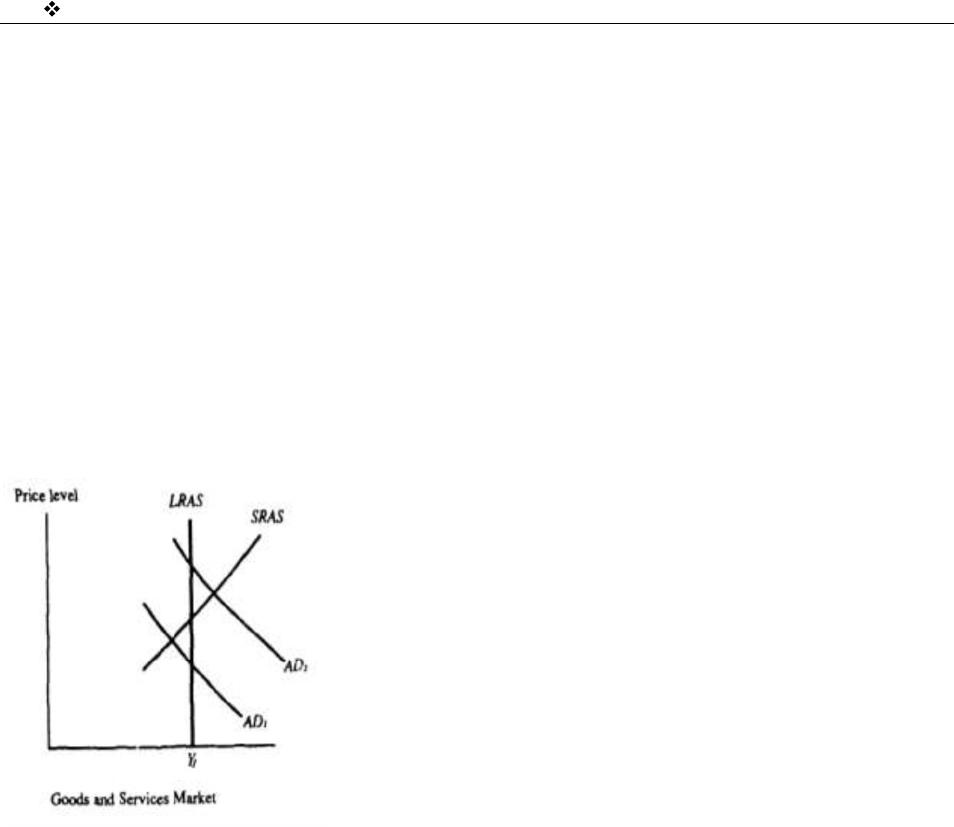
Use the graph below to answer the following question.
18. Suppose the economy was currently operating at SRAS and AD1. To combat the recession, the
Fed institutes expansionary monetary policy. Suppose that by the time the policy impacts the
economy, AD has already moved to AD2. Which of the following would be true?
(A) The policy would cause the recession to worsen.
(B) The policy would cause the economy to experience higher inflation than it would have if
the Fed had not undertaken the policy.
(C) The policy would cause real GDP to decrease.
(D) The policy would cause potential GDP to increase.
(E) As there is no time lapse between implementation of monetary policy and its effect on
the economy, the policy would cause the shift in aggregate demand.

Part 4/Macroeconomics Examination 525
19. In the first half of 1973, prices rose at an annual rate of 8 percent and real output at 4.5
percent, while unemployment fell from 5.0 percent to 4.8 percent. From June 1972 to June
1973, the money supply increased 11 percent, while the U.S. government ran a deficit equal to
2 percent of GDP. Since unemployment was already at or near its natural rate during
1972 73,
(A) greater monetary expansion was necessary to stabilize prices.
(B) the monetary and fiscal policy of the period added to the inflationary pressure already
plaguing the economy.
(C) the $14 billion budget deficit probably caused unemployment to fall and real income to
expand without adding to the inflation problem.
(D) monetary and fiscal policy of the period probably helped stabilize the growth rate of
aggregate demand and promote price stability in the long run.
(E) the expansionary fiscal policy was necessary to stabilize prices.
20. In a typical circular flow model describing the interaction of businesses and households,
which of the following is/are true?
I. Households buy factors of production and goods.
II. Firms buy factors of production and goods.
III. Households buy factors of production.
IV. Firms buy factors of production.
V. Firms buy goods.
VI. Households buy goods.
(A) I only
(B) II only
(C) III and IV only
(D) IV and VI only
(E) V and VI only
21. If Americans suddenly decide to hold more cash in order to conduct transactions and for
precautionary reasons, which of the following is most likely to result?
(A) increase in interest rates
(B) decrease in interest rates
(C) dollar depreciates in value
(D) exports will rise
(E) gross private domestic investment will rise
22. If the federal government and the Federal Reserve both attempt to contract the economy,
which of the following sets correctly describe the probable results of these actions?
(FP = fiscal policy, MP = monetary policy)
Interest rates Price level Output
FP MP FP MP FP MP
(A) increase increase increase increase increase increase
(B) decrease decrease decrease decrease decrease decrease
(C) increase decrease decrease decrease decrease decrease
(D) decrease increase decrease decrease decrease decrease
(E) decrease increase decrease increase decrease increase

526 Part 4/ Macroeconomics Examination
23. The Keynesian model indicates that monetary policy would be less effective if
(A) the velocity of money was constant.
(B) banks failed to maintain excess reserves.
(C) investment demand is elastic.
(D) investment demand is inelastic.
(E) fiscal policy changed in the same direction as monetary policy.
24. Banks create money when they
(A) collect interest on loans to the public.
(B) buy government securities from the Federal Reserve.
(C) permit customers to shift funds from demand deposit accounts to currency.
(D) keep required reserves as vault cash.
(E) loan excess reserves to the public.
25. Which of the following would be hurt the most by unanticipated inflation?
(A) borrowers with fixed rate loans
(B) borrowers with variable rate loans
(C) creditors
(D) Both borrowers and creditors are hurt the same.
(E) Neither borrowers nor creditors are hurt by unanticipated inflation; they both benefit.
26. A graphical representation with unemployment on the horizontal axis and inflation on the
vertical axis is known as
(A) a production possibilities curve.
(B) stagflation.
(C) long-run equilibrium.
(D) natural rate of unemployment and inflation.
(E) a Phillips curve.
27. Stagflation could be caused by which of the following?
(A) increase in aggregate supply
(B) decrease in aggregate supply
(C) increase in aggregate demand
(D) decrease in aggregate demand
(E) Any of these has an equal chance of creating stagflation.
28. If interest rates rise, growth will be slowed because,
(A) firms will invest in more projects with future payoffs thus limiting growth.
(B) firms will invest in fewer projects with future payoffs thus limiting growth.
(C) firms will invest the same amount in projects with future payoffs at all interest levels;
thus, growth will be unaffected.
(D) firms will pay more in dividends and as a result retained earnings will fall.
(E) firms will pay less in dividends and as a result retained earnings will fall.
29. If inflation was 5% and nominal GDP grew by 4% during the last year then, real GDP grew by
(A) 9%.
(B) 5%.
(C) 4%.
(D) 1%.
(E) 1%.
Part 4/Macroeconomics Examination 527
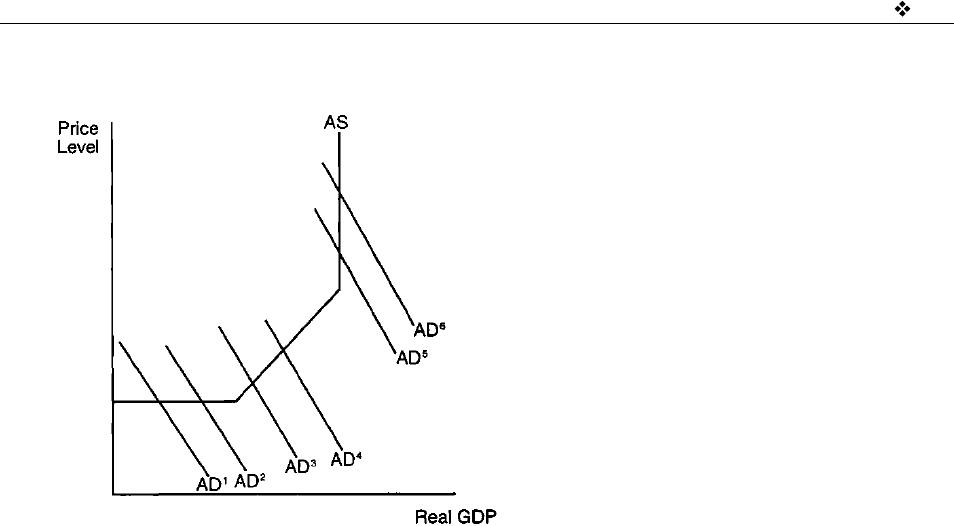
30. Based on the information in the graph above, a movement from _______ to _______ will
result in a non-inflationary expansion of real output.
(A) AD1 to AD2
(B) AD2 to AD3
(C) AD3 to AD4
(D) AD4 to AD5
(E) AD5 to AD6
528 Part 4/ Macroeconomics Examination
Use the graph below to answer the following question.
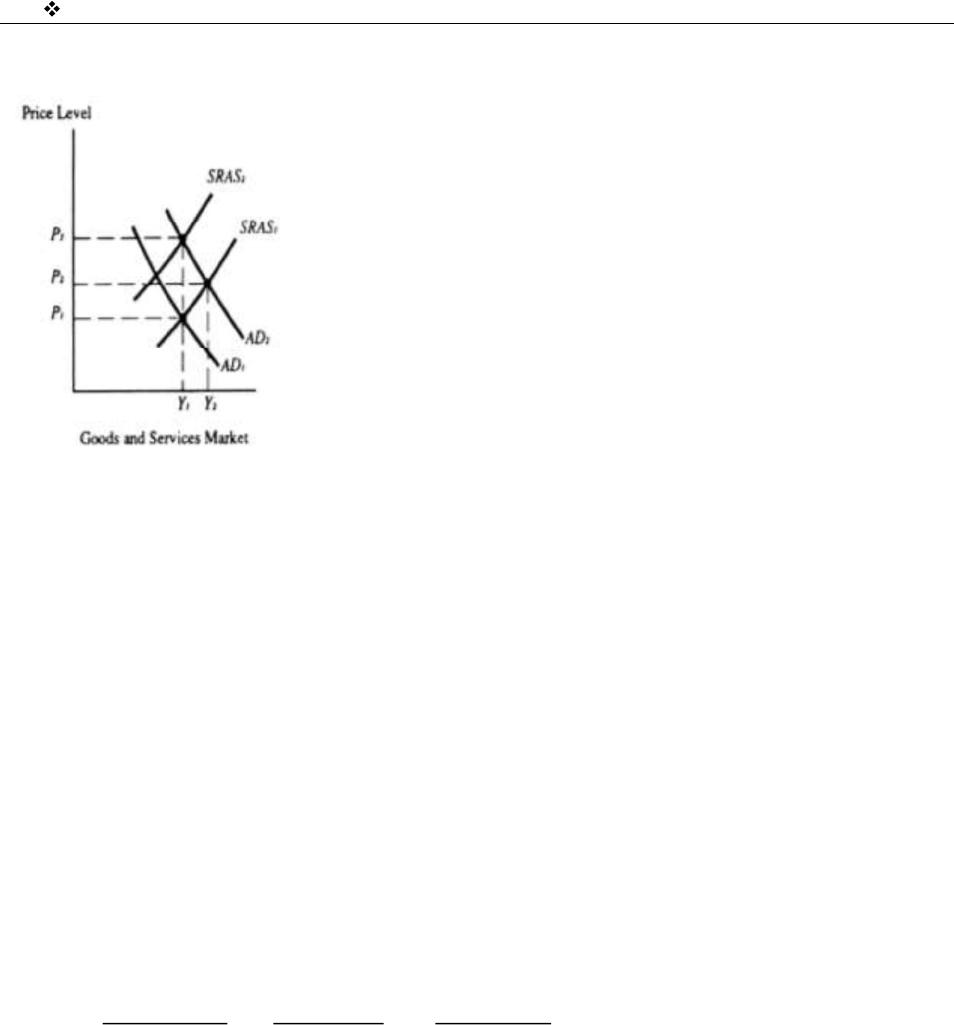
31. AD1 and SRAS1 indicate an economy initially operating at full-employment output level, Y1.
The long-run impact of the Fed unexpectedly shifting to a more expansionary monetary policy
will be
(A) an increase in aggregate demand to AD2 and an expansion in real output to Y2.
(B) an increase in the full employment level of output to Y2.
(C) an increase in aggregate demand to AD2 and a decrease in short-run aggregate supply to
SRAS2 causing the price level to rise to P3 and real output to remain unchanged at Y1.
(D) an increase in aggregate demand to AD2 causing the price level to fall to P1 and real
output to remain unchanged at Y1.
(E) no change; AD and SRAS will stay at AD1 and SRAS1.
32. Which of the following is most likely to cause an increase in the long-run aggregate supply
curve?
(A) an increase in government spending
(B) an increase in interest rates
(C) an increase in taxes
(D) an increase in the literacy level of the population
(E) an increase in aggregate demand
33. In a world with free trade, if the real interest rate in the United States increases relative to the
real interest rate in the rest of the world, which of the following will occur?
Capital Flow U.S. Dollar Net Exports
(A) inflow appreciate increase
(B) outflow appreciate increase
(C) inflow depreciate increase
(D) outflow depreciate decrease
(E) inflow appreciate decrease

Part 4/Macroeconomics Examination 529
34. Which of the following is true of adverse supply shocks?
(A) They can be anticipated and will decrease short-run aggregate supply.
(B) They can be anticipated and will increase short-run aggregate supply.
(C) They cannot be anticipated and will decrease short-run aggregate supply.
(D) They cannot be anticipated and will increase short-run aggregate supply.
(E) They cannot be anticipated and will decrease long-run aggregate supply, but short-run
aggregate supply will be unaffected.
35. All of the following are part of the money supply of the United States, EXCEPT
(A) coins.
(B) currency.
(C) checkable accounts.
(D) credit cards.
(E) demand deposits.
36. If the Federal Reserve sells bonds in the open market, which of the following will result?
(A) a decrease in the demand for money and lower interest rates
(B) an increase in the demand for money and higher interest rates
(C) an increase in the money supply and lower interest rates
(D) a decrease in the money supply and higher interest rates
(E) an increase in the demand for and supply of money and an increase in interest rates
37. Based on the data from the table below we can conclude that:
Output Per Unit of Labor Input
England Portland
Cloth 20 24
Wine 2 12
(A) Portland has a comparative advantage in the production of cloth and wine.
(B) England has a comparative advantage in the production of cloth and wine.
(C) Portland has a comparative advantage in cloth, and England has a comparative
advantage in wine.
(D) England has a comparative advantage in cloth, and Portland has a comparative
advantage in wine.
(E) England has an absolute advantage in the production of cloth and wine.
38. On day 1, it cost $.7354 U.S. to buy 1 Canadian dollar. How many Canadian dollars would $1
U.S. buy?
(A) 1.36
(B) 1.27
(C) 1.11
(D) 0.84
(E) 0.73
39. On the next day (see Question 38), it cost $.845 U.S. to buy 1 Canadian dollar. From this
information we can conclude that
(A) the U.S. dollar got stronger, and U.S. exports will rise.
(B) the U.S. dollar got weaker, and U.S. exports will rise.
(C) the U.S. dollar got stronger, and U.S. exports will fall.
(D) the U.S. dollar got weaker, and U.S. exports will fall.
(E) the U.S. dollar got stronger, and U.S. exports will be unaffected.

530 Part 4/ Macroeconomics Examination
40. Suppose the Fed shifts to a more restrictive monetary policy. How will this action affect the
interest rate, foreign exchange value of the dollar, and the trade deficit?
(A) The interest rate will decrease, the dollar will depreciate, and the trade deficit will
decrease.
(B) The interest rate will increase, the dollar will appreciate, and the trade deficit will
increase.
(C) The interest rate will decrease, the dollar will appreciate, and the trade deficit will
decrease.
(D) The interest rate will increase, the dollar will depreciate and the trade deficit will
decrease.
(E) The interest rate will increase, the dollar will appreciate, and the trade deficit will
decrease.
41. Gross domestic product (GDP)
(A) is the sum of all exchanges of goods and services during a period.
(B) includes financial transactions such as the purchase of stocks or bonds traded during a
period.
(C) includes the purchases of goods at intermediate stages of production.
(D) is the sum of the total spending on all final-user goods and services produced
domestically during a period.
(E) includes all goods and services exchanged during a period.
42. Which of the following would increase GDP?
(Y) Your spouse cleans your house every Thursday.
(Z) You sell your old economics book for $25.
(AA) Your economic textbook is revised, and you buy a new edition.
(A) All three events increase GDP.
(B) Only (X) increases GDP.
(C) Only (Y) increases GDP.
(D) Only (Z) increases GDP.
(E) (X) and (Y) increase GDP. (Z) reduces GDP.
43. Which of the following best illustrates the difference between GDP and GNP?
(A) GDP measures the goods and services consumed by the citizens of a country, while
GNP measures output exported to other countries.
(B) GDP measures output produced by the citizens within a country, while GNP measures
output produced by non-citizens within a country.
(C) GDP measures output produced by the citizens of a country, while GNP measures
output produced within the borders of a country.
(D) GDP measures output produced within the borders of a country, while GNP measures
output produced by the citizens of a country.
(E) GDP measures goods produced by the citizens of a country plus net exports, while GNP
measures only the output of goods and services produced for domestic consumption.
44. When decision makers underestimate inflation, real wages will tend to
(A) rise, and there will be an increase in unemployment.
(B) rise, and there will be a decrease in unemployment.
(C) decline, and there will be an increase in unemployment.
(D) decline, and there will be a decrease in unemployment.
(E) decline, but there will be no impact on the rate of unemployment.

Part 4/Macroeconomics Examination 531
45. Which of the following will most likely occur during the expansionary phase of the business
cycle?
(A) Real GDP rises, and unemployment falls.
(B) Real GDP rises, and unemployment rises.
(C) Real GDP declines, and inflation rises.
(D) Interest rates rise, and the number of business failures rise.
(E) Inflation rises, and employment falls.
46. Frictional unemployment
(A) would be eliminated if the economy were operating at full employment levels of GDP.
(B) would be eliminated if the minimum wage were raised.
(C) is the result of worker skills not matching the jobs available.
(D) is zero when we have achieved the Natural rate of unemployment.
(E) is present even when labor markets are working well.
Use the information in the table to answer the next two questions.
Population 50 million
Number in the labor force 30 million
Number employed full time 20 million
Number unemployed 2 million
47. What is the labor force participation rate of the economy?
(A) 40 percent
(B) 56 percent
(C) 60 percent
(D) 66.7 percent
(E) 93.3 percent
48. What is the unemployment rate of the economy?
(A) 4 percent
(B) 6.7 percent
(C) 7.1 percent
(D) 10 percent
(E) 60 percent
532 Part 4/ Macroeconomics Examination
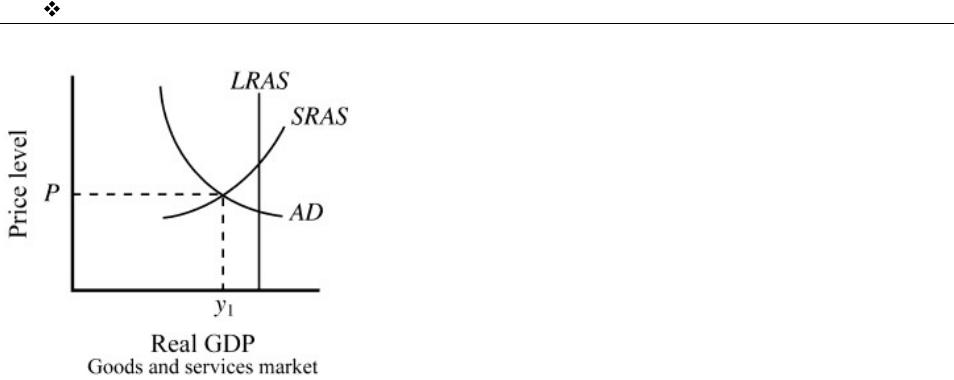
49. Given the aggregate demand and aggregate supply conditions depicted in the diagram above,
which of the following is most likely?
(A) an increase in resource prices, which will stimulate aggregate demand and direct the
economy to potential capacity
(B) a decrease in resource prices, which will increase costs and shift SRAS to the left,
directing the economy to potential capacity
(C) lower resource prices, which will reduce costs and shift SRAS to the right until full-
employment is achieved
(D) a shift in LRAS to the left as the result of an increase in the expected inflation rate
(E) a shift in LRAS to the right as the result of a higher inflationary expectations for the
future
50. If the consumer price index (CPI) was 131 at year-end 2009 and 125 at year-end 2008, then
inflation during 2009 was
(A) zero; prices were stable during 2009.
(B) 4.8 percent.
(C) 6.0 percent.
(D) 31 percent.
(E) 125 percent.
51. Which of the following best expresses the central idea of countercyclical fiscal policy?
(A) Planned deficits are experienced during economic booms and planned surpluses during
economic recessions.
(B) The balanced-budget approach is the proper criterion for determining annual budget
policy.
(C) Deficits are planned during economic recessions, and surpluses are utilized to restrain
inflationary booms.
(D) Deficits are planned during inflationary booms, and surpluses are utilized to restrain
economic recessions.
(E) Actual deficits should equal actual surpluses during a period of deflation.

Part 4/Macroeconomics Examination 533
52. During the Great Depression, Congress and the Hoover administration sought to balance the
budget during 1930 1932. A Keynesian economist would argue that this policy was
(A) inappropriate, because it probably would have inflationary consequences that might
serve to further the people s reluctance to hold money.
(B) appropriate, because it probably would lead to a significant increase in the money
supply and thereby increased employment.
(C) appropriate, because it probably would stimulate economic activity and help end the
depression.
(D) appropriate, because a balanced budget is always appropriate.
(E) inappropriate, because it probably would further depress aggregate demand, economic
activity, and employment.
53. If debit cards become more widely used by consumers and businesses, which of the following
is most likely to happen?
(A) Currency holdings will remain the same, but M1 money supply will fall.
(B) The amount of currency held by the public will increase.
(C) Less money will be held as currency and more money will be held in bank accounts,
which will increase the reserves of banks unless the Fed takes offsetting actions.
(D) Less money will be held as currency and more money will be held in bank accounts,
which will decrease the reserves of banks unless the Fed takes offsetting actions.
(E) The money supply will be unaffected because debit card expenditures are considered the
equivalent of cash.
54. Compared to the no-trade situation, when a country imports a good,
(A) domestic consumers gain, domestic producers of the good lose, and the gains outweigh
the losses.
(B) domestic consumers lose, domestic producers of the good gain, and the gains outweigh
the losses.
(C) domestic consumers gain, domestic producers of the good lose, and the losses outweigh
the gains.
(D) domestic consumers gain, but domestic producers of the good lose an equal amount.
(E) domestic consumers lose, domestic producers lose, and the losses outweigh the gains.
55. International trade can be mutually advantageous because it
(A) allows each trading partner to specialize more fully in the production of those things that
it does best.
(B) reduces the competitiveness of domestic industries and thereby makes it easier for the
domestic producers to raise prices.
(C) permits the trading partners to expand their joint output.
(D) All of the above are true.
(E) Both A and C are true; B is false.
534 Part 4/ Macroeconomics Examination
56. Which of the following correctly indicates a potential path for the transmission of
expansionary monetary policy to the goods and services market?
(A) Higher real interest rates will lead to a decrease in both business investment and
consumer purchases of durable items, causing a decrease in aggregate demand.
(B) Lower interest rates lead to a depreciation in the foreign exchange value of the dollar, an
increase in net exports, and an expansion in aggregate demand.
(C) Lower interest rates lead to an appreciation in the foreign exchange value of the dollar,
an increase in net exports, and an expansion in aggregate demand.
(D) Higher interest rates will tend to increase asset prices, leading to a decrease in wealth
that will decrease consumer spending and aggregate demand.
(E) A reduction in the general level of prices, which will increase the disposable income of
households and aggregate demand.
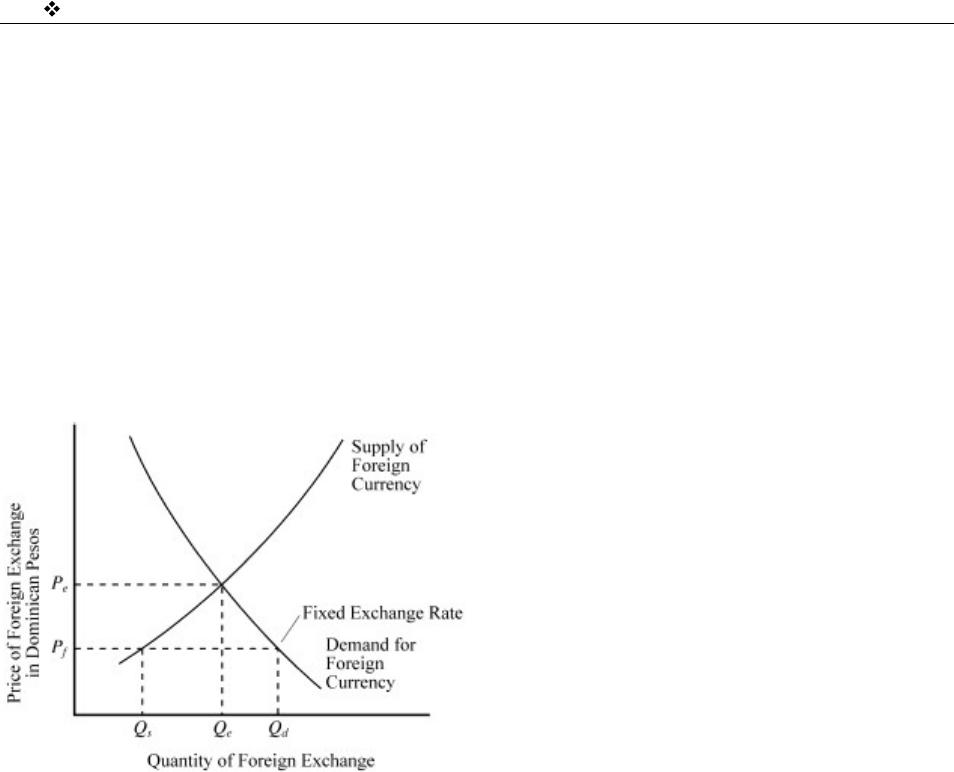
57. In the graph shown, the equilibrium price of Dominican pesos is Pe. If the Dominican
Republic government fixes the price of foreign currency in terms of domestic currency at Pf
(below equilibrium), what does the quantity Qd through Qs represent?
(A) the quantity of Dominican exports
(B) a shortage of foreign exchange
(C) the quantity of Dominican imports
(D) a surplus of foreign exchange
(E) the equilibrium price of the Dominican peso
Part 4/Macroeconomics Examination 535
58. If the federal government uses expansionary fiscal policy to stimulate the economy, the supply
of loanable funds, the demand for loanable funds, and the real interest rate will change in the
short run in which of the following ways?
Supply of Loanable Funds Demand for loanable funds Real interest rate
(A) increase increase increase
(B) decrease decrease decrease
(C) increase decrease indeterminate
(D) increase no change decrease
(E) no change increase increase
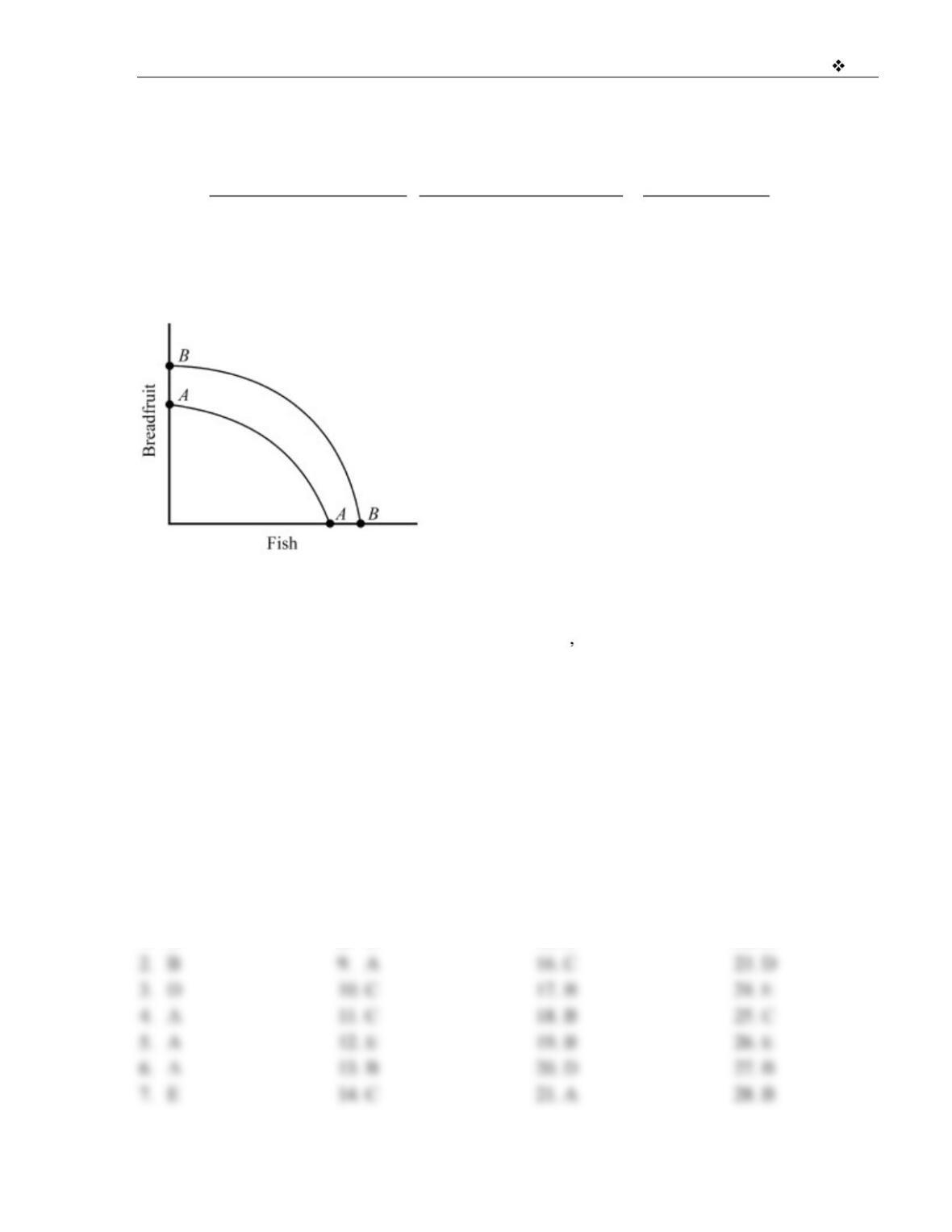
59. Which of the following will most likely shift the production possibilities curve for breadfruit
and fish outward from AA to BB in the figure shown?
(A) an improvement in the form of economic organization
(B) lower investment and a reduction in the country s capital stock
(C) an increase in the price of breadfruit
(D) a decrease in the average number of hours worked
(E) a movement toward a more protectionist stance on international trade
60. The outward bow from the origin shape of the production possibilities curve in the figure
above is best explained by
(A) the crowding-out effect.
(B) increasing opportunity cost.
(C) constant opportunity cost.
(D) decreasing opportunity cost.
(E) comparative advantage.
Advancement Placement Level Macroeconomics Examination Answers
1. B
8. B
15. C
22. D
536 Part 4/ Macroeconomics Examination