
313
Part 3
AP Microeconomics
This section has six parts. Each of the first five parts corresponds to a unit on the AP Microeconom-
ics exam. Each unit part provides a syllabus outline for teaching the unit, information regarding the
concepts covered in the unit and corresponding text material, practice multiple choice and free re-
sponse questions. The last part provides a 60 question practice exam.
314 Part 3/Unit I
Syllabus Outline for the teaching of
AP*
Micro Economics With
James D. Gwartney; Richard L. Stroup; Russell S. Sobel; and David MacPherson. Eco-
nomics Private and Public Choice, 15th Edition. Thomson, Southwestern, 2015
The AP* Micro Economics Instructional Manual is constructed with five instructional teaching
units. Each unit of instruction is correlated with the AP* topical outline. Each proposed unit of
instruction includes the following parts:
1. Plan: The plan includes:
Identification of the teacher materials to teach each unit of instruction
Identification of the key instructional objectives for each unit of instruction
2. Teach: A recommended approach to teaching the economic concepts and skills
3. Assess: Recommendations and test links to assess student understanding of the content and
skills
*AP, Pre-AP, Advanced Placement, and Advanced Placement Program are registered trademarks of The College En-
trance Examination Board, which was not involved in the production of, and does not endorse, this product.
Part 3/Unit I 315
Teaching Unit I: The Economic Problem. The first unit of instruction entails the content area of
Basic Economic Concepts as detailed in the AP* Economics Course Description1 (Content Area I,
A-F)
I. Plan
Teaching Materials
Instructors Manual Text readings
The Economic Approach, Chapter 1
Chapter 1, The Economic Approach
Some Tools of the Economist
Chapter 2
Chapter 2, Some Tools of the Economist
Gaining from International Trade,
Chapter 18 (16)
Chapter 18 (16) , Gaining from International
Trade
Key instructional objectives: Students do the following
1. define scarcity, choice and cost
2. define and compute opportunity cost
3. list and define the axioms of economic reasoning
4. distinguish between positive and normative statements
5. list and define the economic questions facing all nations
6. construct and interpret production possibility schedules and graphs.
7. list and define the assumptions of production possibility schedules and graphs.
8. define how production possibility schedules and graphs illustrate the issues of scarcity,
choice, and cost.
9. define and calculate absolute and comparative advantages for production and exchange.
10. explain and show the affects of trade on a production possibility model.
Computational & graphing skills: Students must complete these tasks
1. Graph a production possibility model
2. Explain the shapes of the production possibility curves.
316 Part 3/Unit I
3. Explain how the production possibilities model shows scarcity, choice, and cost.
4. Interpret selected points on the production possibility model.
Formative Signals: The following content and skill areas have been identified as areas of weak-
ness for students based upon past objective and free response examinations.
Objective Formative Signals: Based upon
the released objective AP* Micro Economics
examinations, less than 50% of the students
have been able to correctly answer questions
related to the following
Free response Formative Signals: Past stu-
dents have found these to be problematic areas
recognize and interpret absolute advantage
and comparative advantages (and terms of
trade) given novel data
(output is constant;
resources vary)
understands and interpret the distinctions
solve comparative advantage problems us-
ing inputs constant with outputs varying
AND with outputs constant and inputs var-
ying.
Part 3/Unit I 317
II. Teach
Recommended sequence of instruction: Teach introductory concepts in this sequence
Chapter 1
The Economic Approach
1. WHAT IS ECONOMICS ABOUT?, P. 4
The Economic Problem
Scarcity, choice, cost
Free lunches vs. trade-offs
2. THE ECONOMIC WAY OF THINKING, P. 7
Use the production possibilities frontier to illustrate the economic problem.
3. POSITIVE AND NORMATIVE ECONOMICS, P. 13
4. PITFALLS TO AVOID IN ECONOMIC THINKING, P. 13
Chapter 2
Some Tools of the Economist
1. WHAT SHALL WE GIVE UP? P. 19
Opportunity cost
Production Possibility model
Increasing vs. constant costs
2. TRADE CREATES VALUE, P. 21
3. THE IMPORTANCE OF PROPERTY RIGHTS, P. 23
Explain the necessary assumptions for trade to occur.
4. PRODUCTION POSSIBILITIES CURVE, P. 28
Technical or productive efficiency
Allocative efficiency
5. TRADE, OUTPUT, AND LIVING STANDARDS, P. 32
6. GAINS FROM SPECIALIZATION AND TRADE, P. 358 (P. 301)
318 Part 3/Unit I
Explain how people gain from specialization and trade.
6. HUMAN INGENUITY AND THE CREATION OF WEALTH, P. 44
7. ECONOMIC ORGANIZATION, P. 45
Make distinctions among the different kinds of economic organization
Capitalism
Command
Mixed economy
Key conceptual questions: Students demonstrate their understanding of the material by answer-
ing the following key conceptual questions
1. What are the economic goals of any society?
2. What are the different methods used to resolve issues related to economic goals?
3. How does a production possibility model illustrate the economic problems of scarcity, choice,
and cost?
4. What are the guideposts to economic thinking?
5. Why do people trade?
III. Assess: Suggestions for determining what and how much students have learned.
Past Objective AP* Test: Based upon released objective examinations, the students have been
required to demonstrate the following content related to this unit of instruction.
Tasks related to what economists study:
understand the study of economics
knows basic assumptions of how markets allocate resources
Tasks related to scarcity, choice, and cost
recognize a novel example of opportunity cost
distinguish between opportunity cost and fixed cost
Tasks related to the production possibility model (graph).
Part 3/Unit I 319
understand the trade-offs of moving from one point to another on a production possibility
curve
illustrate production possibility graph showing movements from one point to another point
understand conditions under which an economy operates on a production possibility frontier;
or inside the production possibility frontier
understand why an economy cannot operate beyond the production possibility frontier
explain increasing costs(bow out) of production possibility frontier
Tasks related to the logic of trade and economic growth
recognize how growth is illustrated with a production possibilities curve
recognize impact of comparative advantage on current production possibilities curve
Past Free Response AP* Questions: Based upon released free response questions, the students
have been required to demonstrate the following content related to this unit of instruction.
1999, 2003, 2008- interpret production possibility diagram and distinguish between abso-
lute and comparative advantages; explain benefits of trade
2000, 2007B, 1998 apply production possibility model to long-run economic growth in-
320 Part 3/Unit I
Sample Multiple-Choice Questions for Micro Unit I
1. The central economic problem faced by all economies of the world is
(A) balancing the budget of the government.
(B) avoiding periods of inflation while maintaining high employment.
(C) regulating big business and big labor.
(D) unlimited wants with limited resources.
(E) balancing the goals of economic growth and environmental protection.
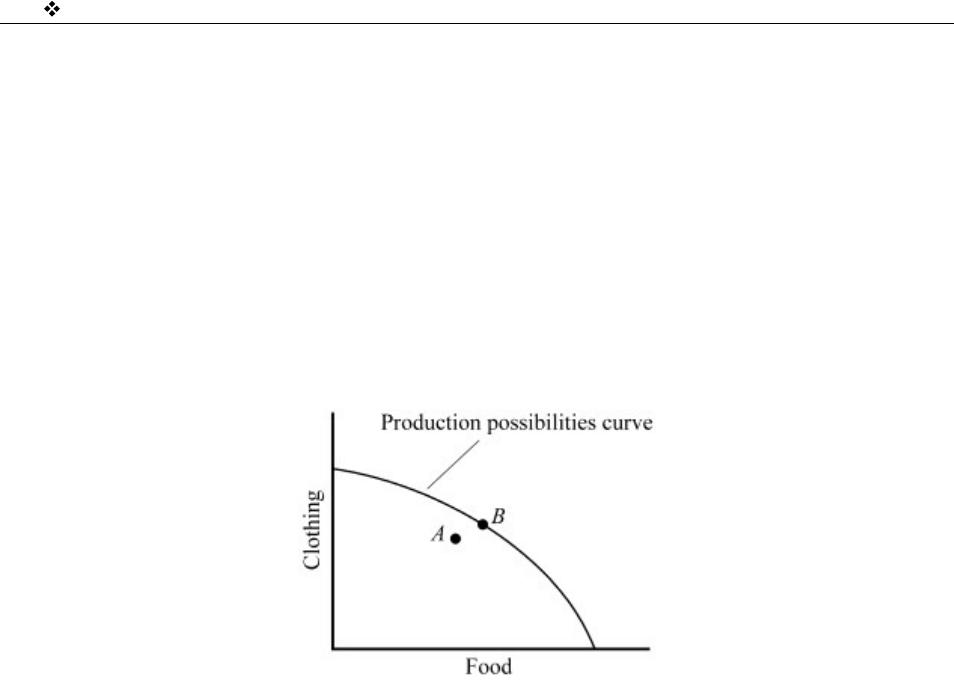
Use this graph when answering the next two questions.
Figure 1
2. The graph in Figure 1 demonstrates
(A) increasing opportunity cost.
(B) constant opportunity cost.
(C) decreasing opportunity cost.
(D) the law of comparative advantage.
(E) the law of absolute advantage.
3. The opportunity cost of moving from point A to point B in Figure 1 is
(A) the loss of some clothing.
(B) the loss of some food.
(C) the gain of some clothing.
(D) the gain of some food.
(E) There is no opportunity cost attached to a movement from point A to point B.

Part 3/Unit I 321
Use the production possibilities data below for Econville and Jimonia to answer the following
questions.
Oranges Apples
Econville 0 16
1 12
2 8
3 4
4 0
Oranges Apples
Jimonia 0 8
1 6
2 4
3 2
4 0
4. Which of the following is correct?
(A) Econville has the comparative advantage in both goods.
(B) Jimonia has the comparative advantage in oranges.
(C) Econville has the comparative advantage in oranges.
(D) Jimonia has a comparative advantage in both goods.
(E) It would be impossible for Econville and Jimonia to gain from trade.
5. Which of the following would be a mutually agreeable rate of exchange?
(A) Jimonia trades one orange to Econville for every one apple.
(B) Jimonia trades one orange to Econville for every two apples.
(C) Jimonia trades one orange to Econville for every three apples.
(D) Jimonia trades one orange to Econville for every four apples.
(E) Jimonia trades four oranges to Econville for every sixteen apples.
6. According to the law of comparative advantage, both Econville and Jimonia could gain if
(A) Econville produced all of the apples and oranges and Jimonia did not produce anything.
(B) Econville specialized in producing apples, Jimonia specialized in producing oranges, and
they traded.
(C) Econville specialized in producing oranges, Jimonia specialized in producing apples, and
they traded.
(D) Jimonia produced all of the apples and oranges and Econville did not produce anything.
(E) Jimonia and Econville were both were self-sufficient and did not trade.

322 Part 3/Unit I
7. Use the table below to choose the correct answer. The table outlines the production possibili-
ties currently facing an economy.
Good Y Good X
1 5
2 4
3 3
4 2
5 1
The opportunity cost of increasing the production of good X from 2 units to 3 units is
(A) 12 units of good Y and constant.
(B) 9 units of good Y and constant.
(C) 1 unit of good Y and constant.
(D) 12 units of good Y and increasing.
(E) 9 units of good Y and increasing.
8. Because of a late night out with friends, Francis decided to sleep in rather than attend his 8
a.m. economics class. According to economic analysis, his choice was
(A) irrational, because economic analysis suggests you should always attend classes for
which you have already paid.
(B) irrational, because oversleeping is not in Francis s self-interest.
(C) rational only if Francis has not missed any other classes.
(D) rational if Francis values sleep more highly than the benefit he expects to receive from
attending the class.
(E) rational if Francis likes his economics class better than the rest of his classes.
Part 3/Unit I 323
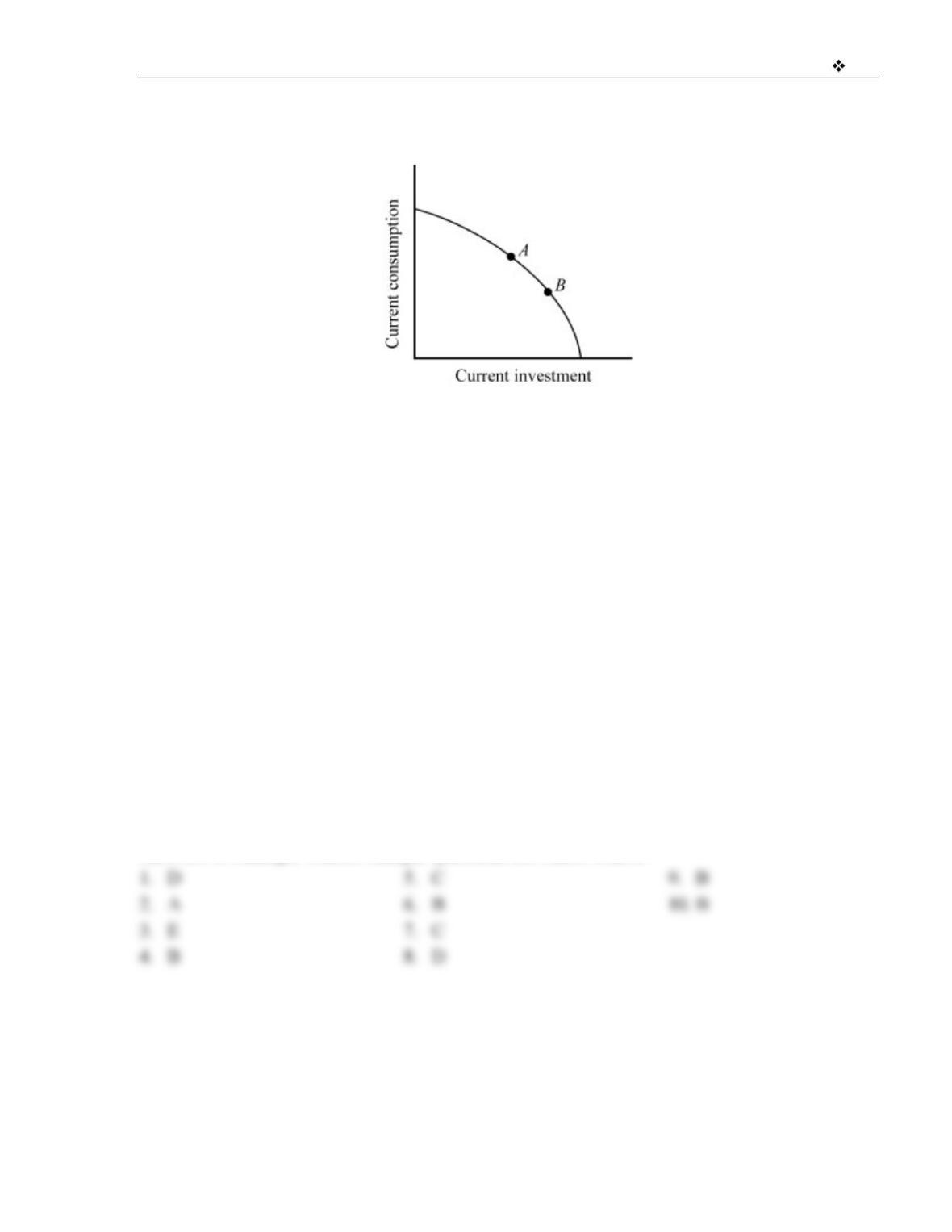
Use this graph when answering the next question.
Figure 2
9. Points A and B in the figure shown above indicate consumption and investment for two econ-
omies. Other things constant, which of the economies is likely to grow more rapidly in the fu-
ture?
(A) economy A
(B) economy B
(C) They can be expected to grow at the same rate.
(D) This is uncertain since growth is not influenced by the factors indicated in this example.
(E) Neither economy will experience growth as they are not maximizing their current invest-
ment.
10. When economists say a good is scarce, they mean
(A) there are only a limited number of consumers who would be interested in purchasing the
good.
(B) the human desire for the good exceeds the amount freely available from nature.
(C) most people in poorer countries do not have enough of the good.
(D) the production of the good has no opportunity cost for society.
(E) there are some things on which it is impossible to put a price, such as human life.
Answers to Multiple-Choice Sample Questions for Micro Unit I
324 Part 3/Unit I
Sample Free–Response Question for Micro Unit I
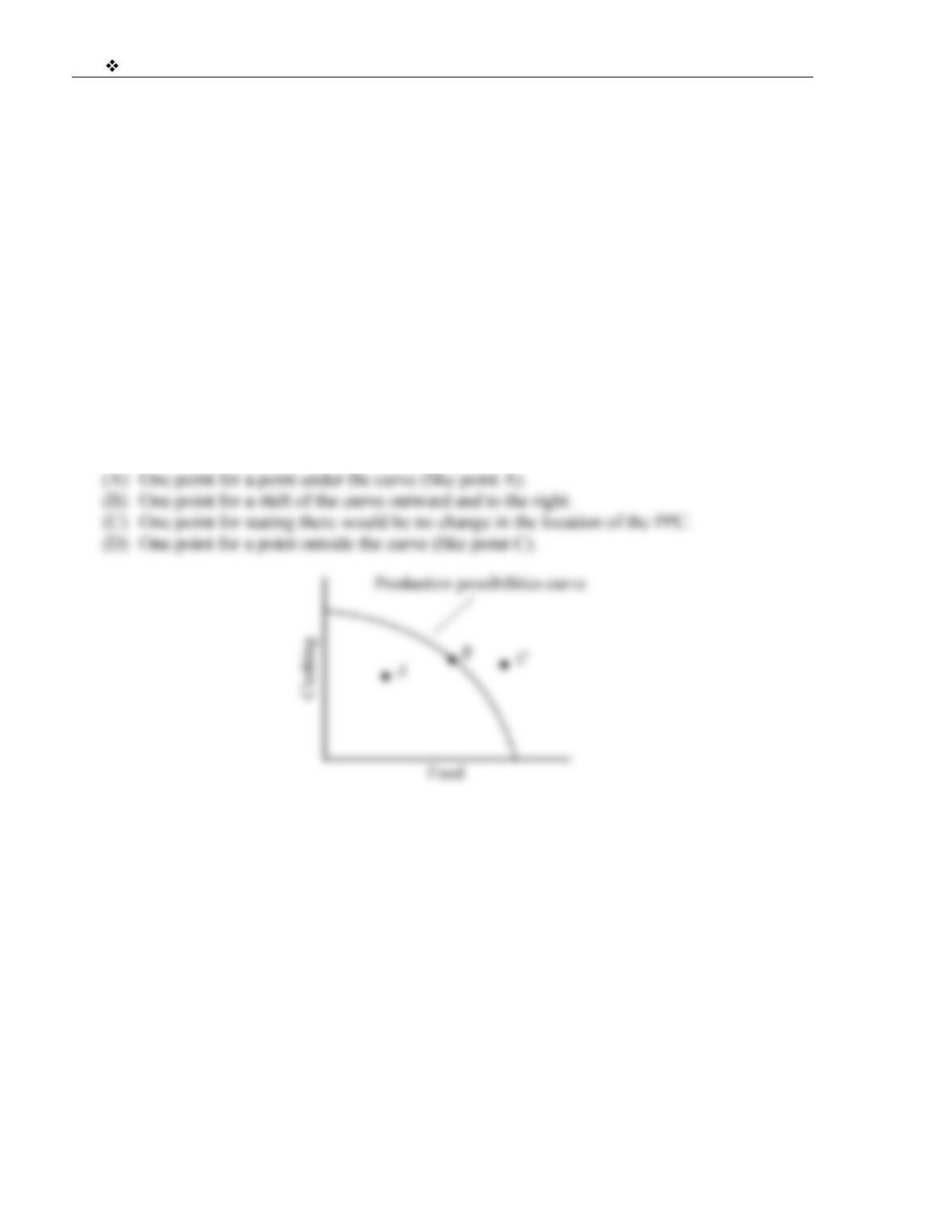
1. Using a correctly labeled graph, draw a production possibility curve for food and clothing that
demonstrates increasing opportunity cost.
(A) How would you use the graph you drew to demonstrate unemployment?
(B) On your graph demonstrate the effect of a technological breakthrough that increases the
productivity of workers.
(C) On your graph demonstrate the effect of an increase in consumer demand for clothing.
(D) On your graph demonstrate a combination of clothing and food production that is not
possible to produce simultaneously, but is able to be produced separately.
Answers to Free-Response Sample Question for Micro Unit I
This question would be graded using a 6-point rubric.
1. One point for a correctly labeled PPC graph with clothing and food on the axis. One point for
a curve bowed concave to the origin.