S-141
interactive activity
9 Appendix
How to Make Decisions
Involving Time:
Understanding Present Value
1. Suppose that a major city’s main thoroughfare, which is also an interstate
highway, will be completely closed to traffic for two years, from January 2018
to December 2019, for reconstruction at a cost of $535 million. If the construc-
tion company were to keep the highway open for traffic during construction, the
highway reconstruction project would take much longer and be more expensive.
Suppose that construction would take four years if the highway were kept open,
at a total cost of $800 million. The state department of transportation had to
make its decision in 2017, one year before the start of construction (so that the
first payment was one year away). So the department of transportation had the
following choices:
(i) Close the highway during construction, at an annual cost of $267.5 million
per year for two years.
(ii) Keep the highway open during construction, at an annual cost of $200 mil-
lion per year for four years.
a. Suppose the interest rate is 10%. Calculate the present value of the costs
incurred under each plan. Which reconstruction plan is less expensive?
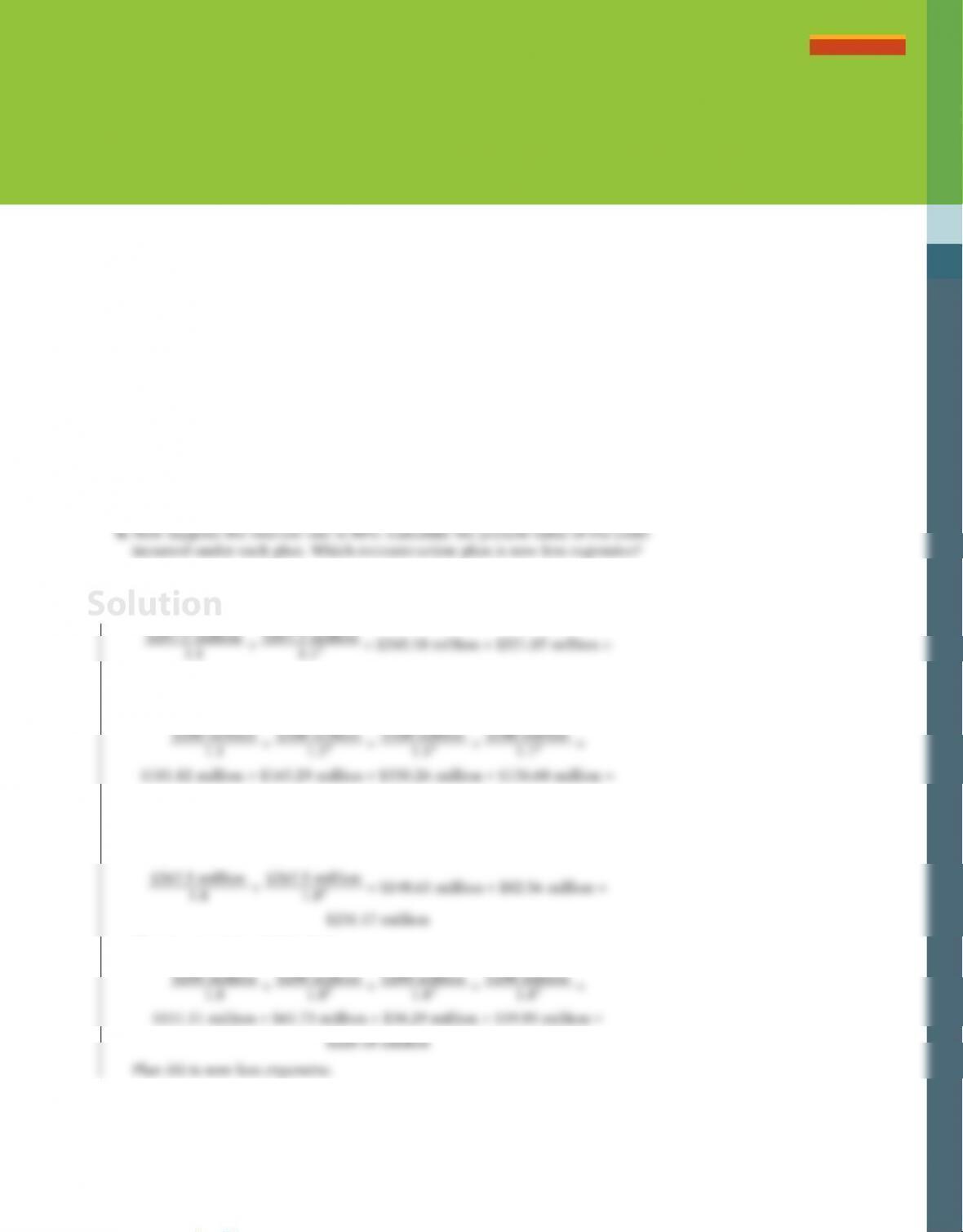
1. a. The present value of plan (i) is:
$464.25 million
The present value of plan (ii) is:
$633.97 million
So plan (i) is less expensive.
b. The present value of plan (i) is:
The present value of plan (ii) is:
Solution
2. You have won the state lottery. There are two ways in which you can receive your
prize. You can either have $1 million in cash now, or you can have $1.2 million
that is paid out as follows: $300,000 now, $300,000 in one year’s time, $300,000
in two years’ time, and $300,000 in three years’ time. The interest rate is 20%.
How would you prefer to receive your prize?
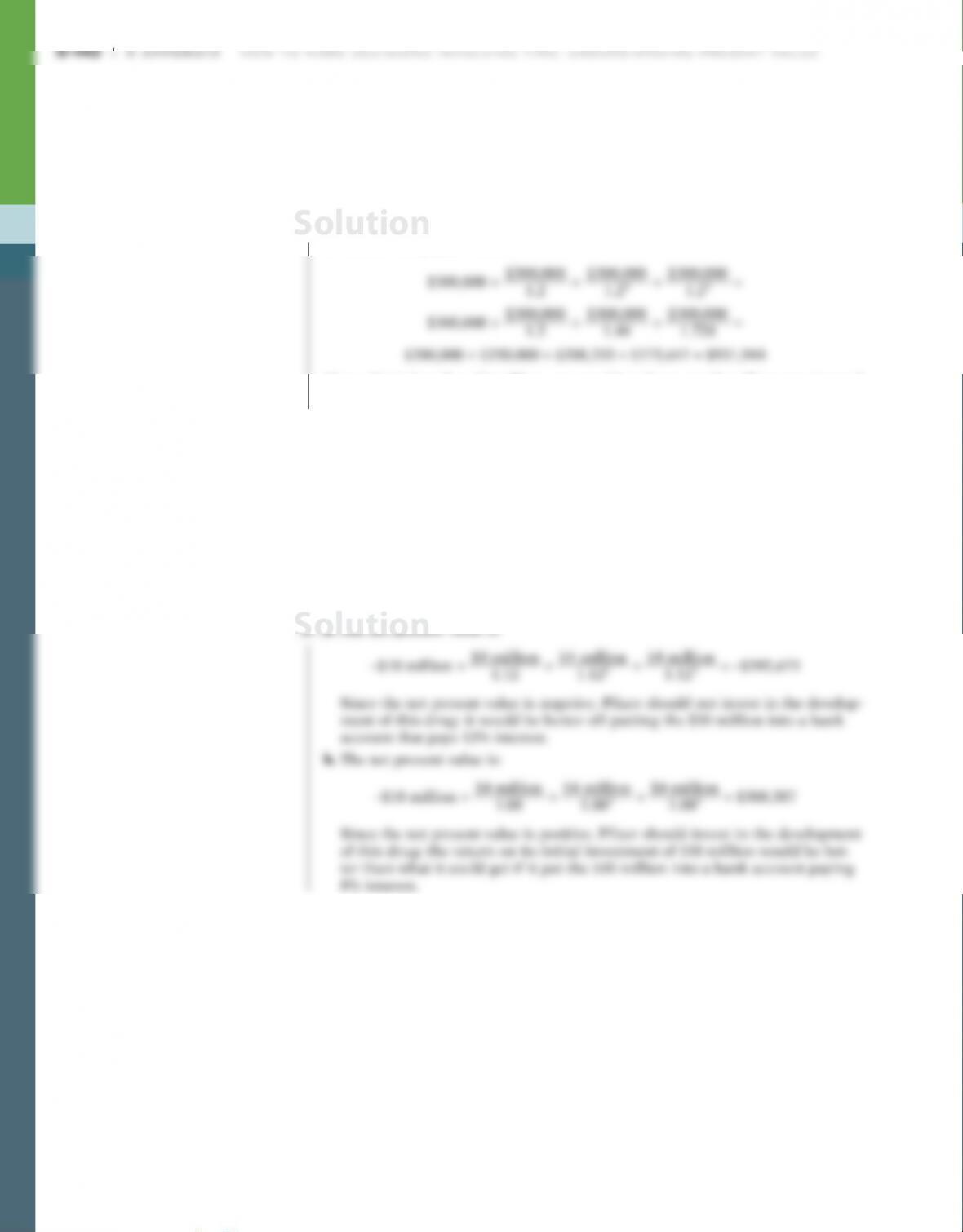
2. If you choose to get $1.2 million paid out over the next three years, the present
value of those payments is:
Since this is less than $1 million, you would prefer to get $1 million now instead
of $1.2 million over four years.
3. The drug company Pfizer is considering whether to invest in the development of
a new cancer drug. Development will require an initial investment of $10 million
now; beginning one year from now, the drug will generate annual profits of
$4 million for three years.
a. If the interest rate is 12%, should Pfizer invest in the development of the new
drug? Why or why not?
b. If the interest rate is 8%, should Pfizer invest in the development of the new
drug? Why or why not?
3. a. The net present value is:
Solution
Solution