The IS–LM/AD–AS Model: A General Framework for Macroeconomic Analysis 153
B. Find long run equilibrium values of P, r and i
1. Substitute Y = 2500 in the AD curve will yield P = 111
2. Substitute Y = 2500 in the IS equation will yield r = 0.05
3. Substitute r = 0.05 in the i = r + πe will yield i = 0.10
C. Find the short run equilibrium values of Y, r and i
IX. Appendix 9.B: An Algebraic Version of the IS–LM Model and the AD-AS Model
A. The labour market
1. The production function is
Y = A(f1N – ½f2N2) (9.B.1)
2. From the production function, the marginal product of labour is
MPN = A(f1 – f2N) (9.B.2)
B. The goods market
1. Desired consumption depends on after-tax income (Y – T) and the real
interest rate
Cd = c0 – cY(Y– T) – crr (9.B.8)
2. Taxes are given by
T = t0+ tY (9.B.9)
154 Chapter 9
C. The asset market
1. The money demand function has the form
Md/P = ℓo + ℓYY – ℓr(r + πe) (9.B.17)
D. General equilibrium in the IS-LM model
1. The intersection of the IS curve and FE line determines the real
interest rate which is found by plugging Y into Eq. (9.B.14)
r = αIS – βISY (9.B.22)
Numerical Problem 6 and Analytical Problems 4 and 5 deal with various aspects of the
algebraic version of the IS–LM model.
E. The AD-AS Model
1. The aggregate demand curve
a. Setting the right-hand sides of Eqs. (9.B.14) and (9.B.19) equal
and solving for Y gives the AD curve
to the right
2. The aggregate supply curve
a. In the short run, prices are fixed, so the short-run aggregate
3. Short-run and long-run equilibrium
a. Short-run equilibrium: AD intersects SRAS
(1) Substitute SRAS, Eq. (9.B.25), into AD, Eq. (9.B.24) to get

The IS–LM/AD–AS Model: A General Framework for Macroeconomic Analysis 155
c. This is the same equilibrium as found in the IS–LM model, Eq.
ADDITIONAL ISSUES FOR CLASSROOM DISCUSSION
Can We Ever Expect to Reach General Equilibrium?
General equilibrium occurs when the asset market, the labour market, and the goods
market are all in balance. Does this ever happen?
Although the economy is constantly moving towards general equilibrium, it may never
arrive. New shocks push the economy out of equilibrium on a regular basis. Some
156 Chapter 9
ANSWERS TO TEXTBOOK PROBLEMS
Review Questions
1. The position of the FE line is determined by the labour market and the production
function. Labour supply and demand determine equilibrium employment. Using
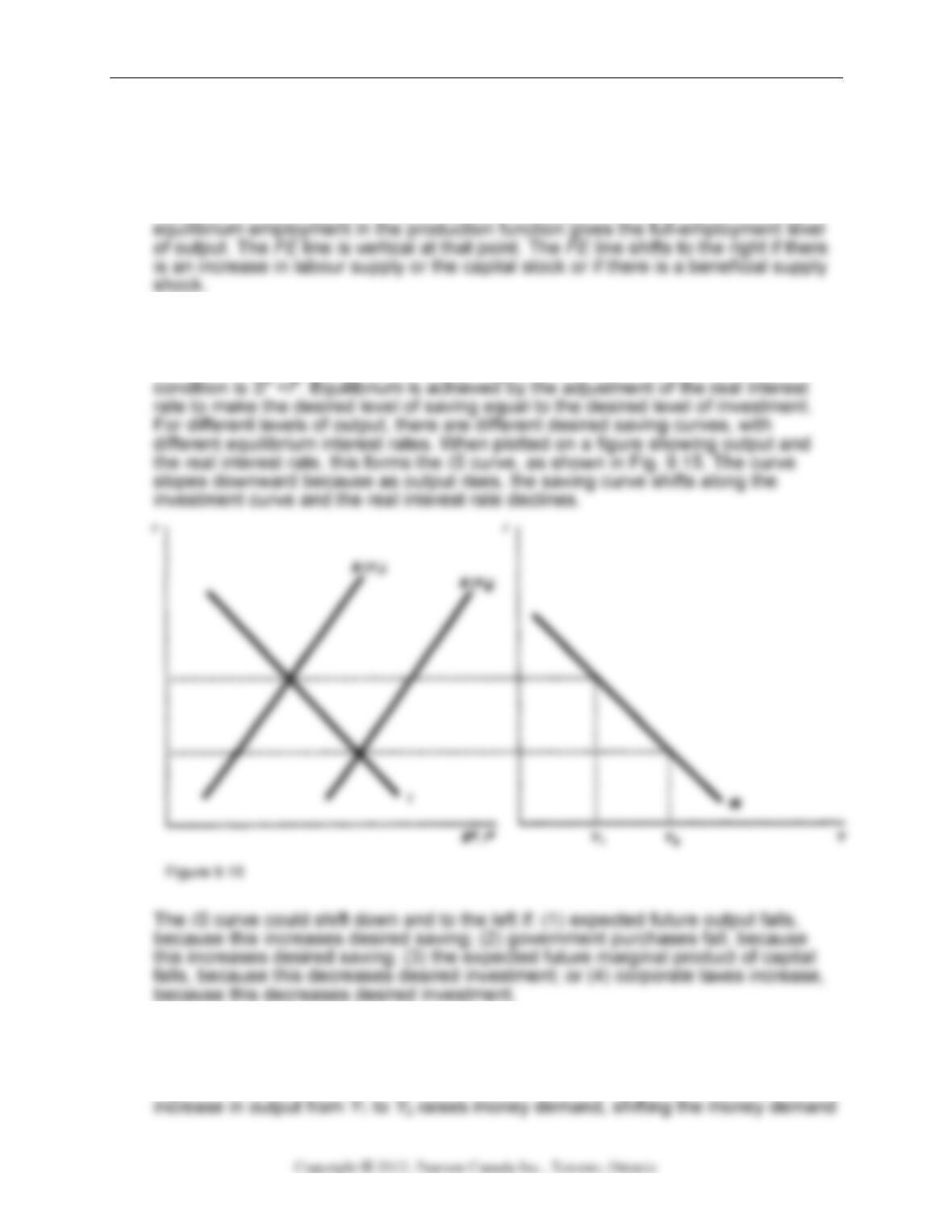
2. The IS curve shows combinations of the real interest rate (r) and output (Y) that
leave the goods market in equilibrium. Equilibrium in the goods market occurs
when the aggregate supply of goods (Y) equals the aggregate demand for goods
(Cd + Id + G). Since desired national saving (Sd) is Y – Cd – G, an equivalent
3. The LM curve shows the combinations of output and the real interest rate that
maintain equilibrium m the asset market. Equilibrium in the asset market occurs
when real money demand equals the real money supply.
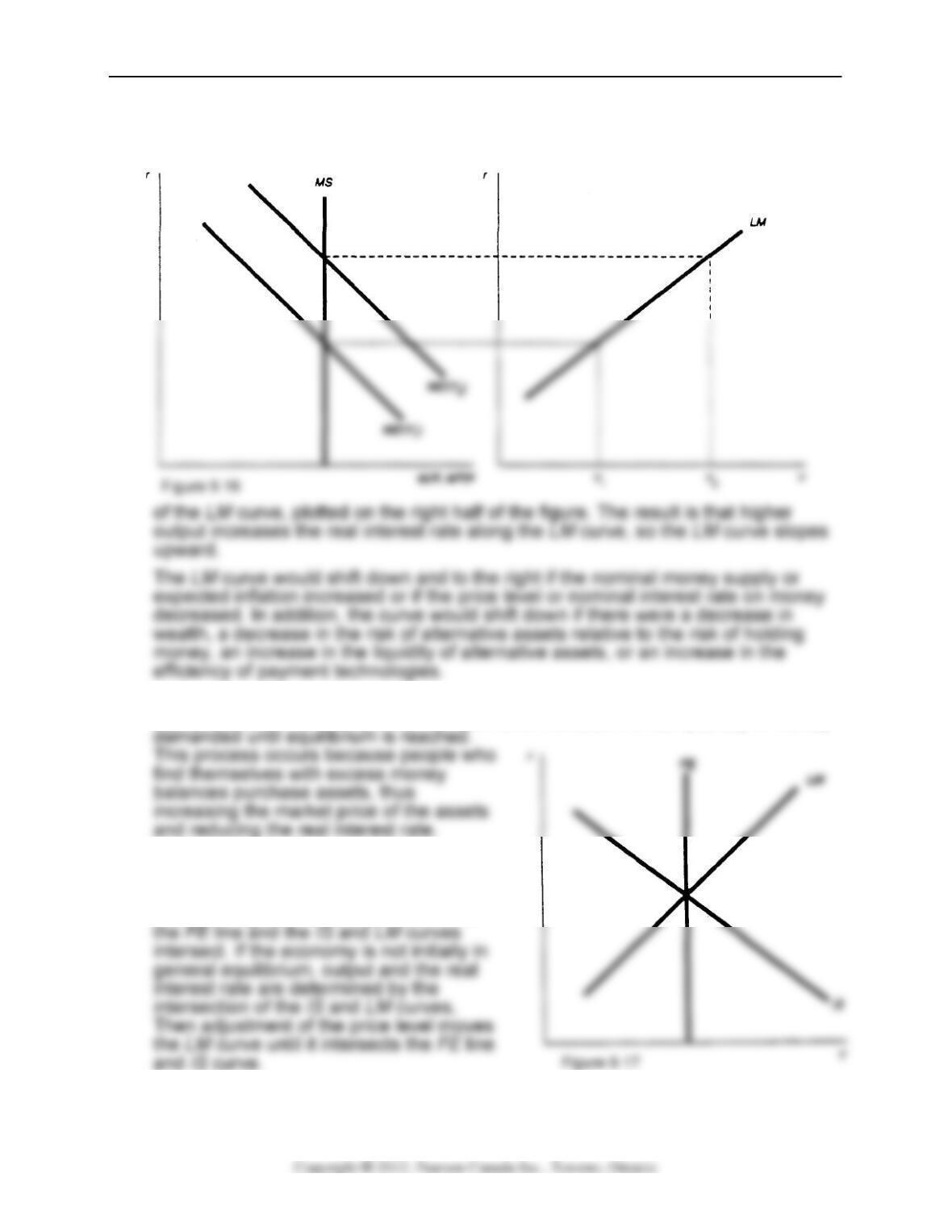
Figure 9.16 shows the derivation of the LM curve and why it slopes upward. An
The IS–LM/AD–AS Model: A General Framework for Macroeconomic Analysis 157
curve from MD(Y1) to MD(Y2). With money supply fixed at MS, there must be a
higher real interest rate to get equilibrium in the asset market. This gives two points
4. For constant output, if real money supply exceeds the real quantity of money
demanded, the real interest rate will decline to increase the real quantity of money
5. General equilibrium is a situation in which
all markets in an economy are
simultaneously in equilibrium. This is
shown in Fig. 9.17 as the point at which
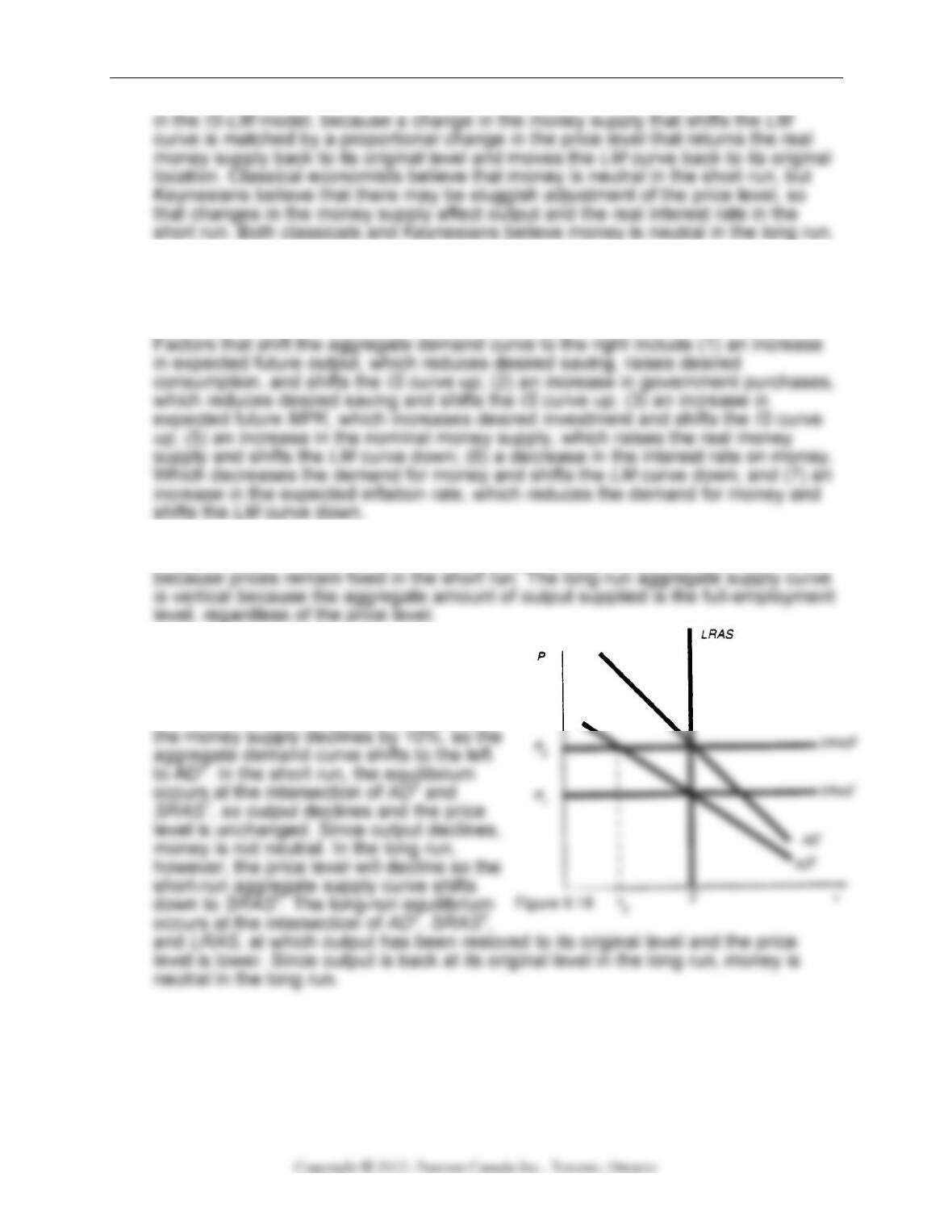
6. There is monetary neutrality if a change in the nominal money supply changes the
price level but has no effect on real variables. Once prices adjust, money is neutral
158 Chapter 9
7. The aggregate demand curve relates the price level to the aggregate demand for
goods and services. It is downward sloping, because with a fixed nominal money
supply, an increase in the price level shifts the LM curve up, so the level of output
at the IS–LM intersection is lower.
8. The short-run aggregate supply curve is horizontal and the long-run aggregate
supply curve is vertical. The short-run aggregate supply curve is horizontal
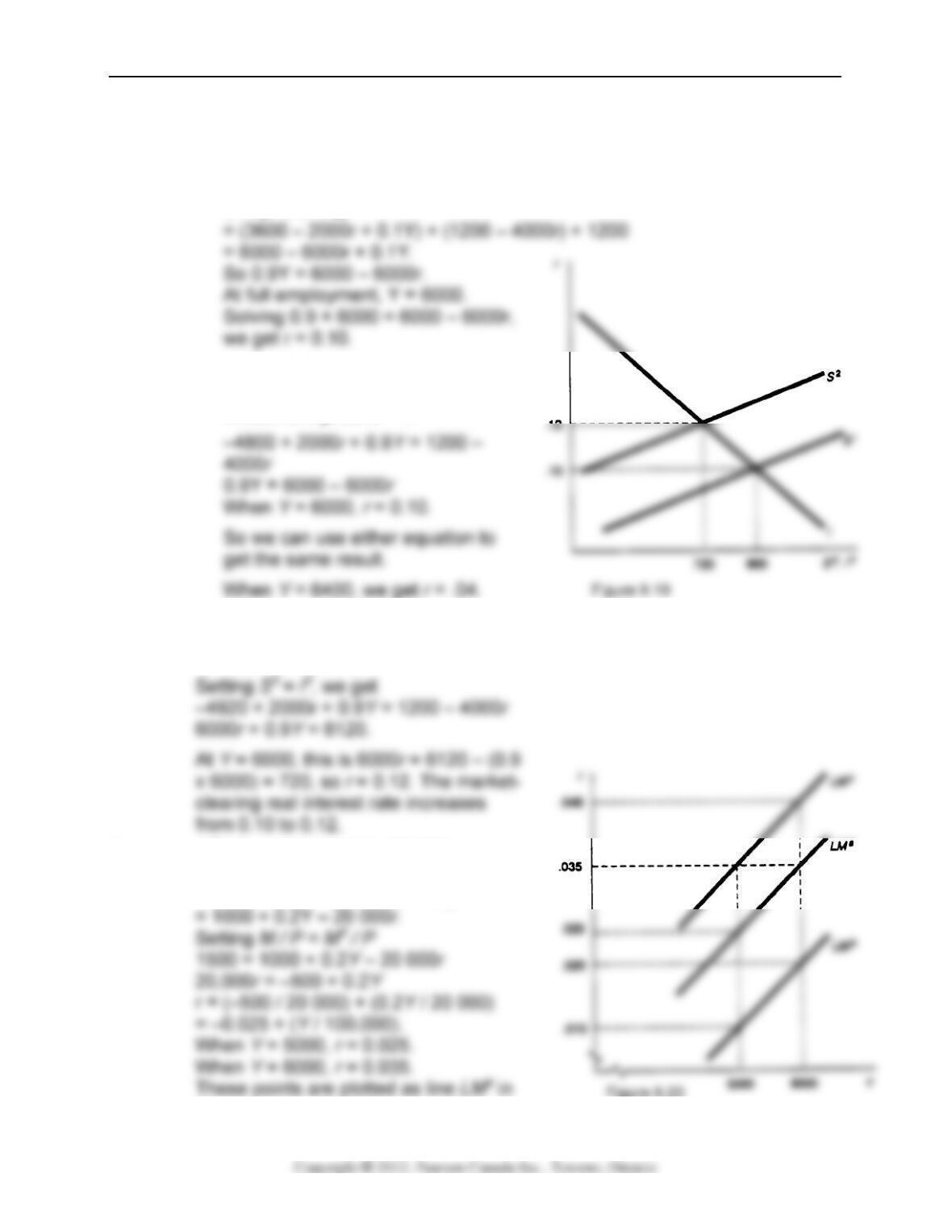
9. In the short run, money is not neutral, but
in the long run it is neutral. Suppose the
economy is initially in general equilibrium,
as shown in Fig. 9.18, where LRAS,
SRAS1, and AD1 intersect. Now suppose
The IS–LM/AD–AS Model: A General Framework for Macroeconomic Analysis 159
Numerical Problems
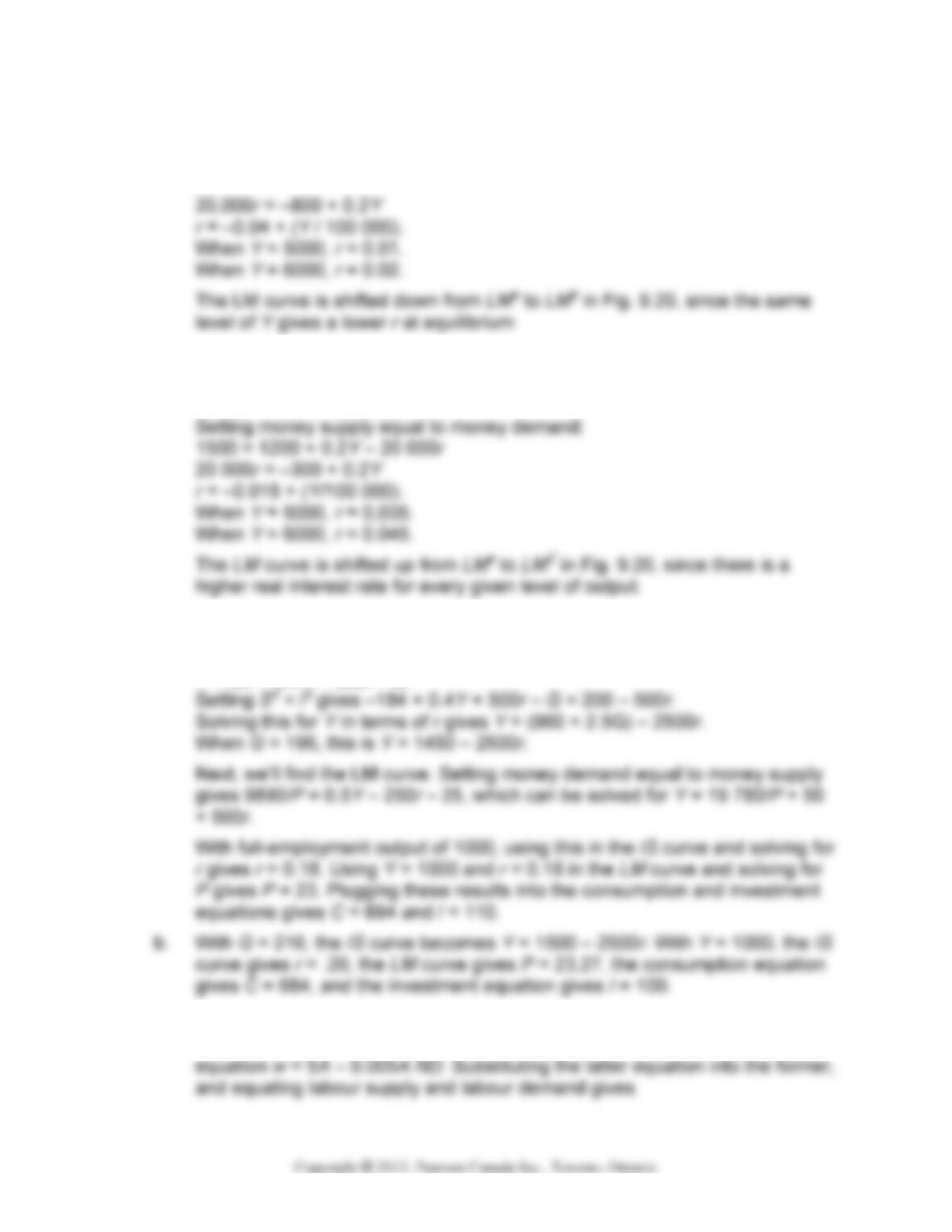
1. a. Sd = Y – Cd – G = Y – (3600 – 2000r + 01 Y) – 1200 = –4800 + 2000r + 0.9Y.
b. (1) Using the equation that goods supplied equals goods demanded gives
Y = Cd + Id + G
(2) Using the equivalent equation that
desired saving equals desired
investment gives Sd = Id
c. When G = 1320, desired saving becomes Sd = –4920 + 2000r + 0.9Y. Sd is now
120 less for any given r and Y; this shows up as a shift in the Sd line from S1 to
S2 in Fig. 9.19.
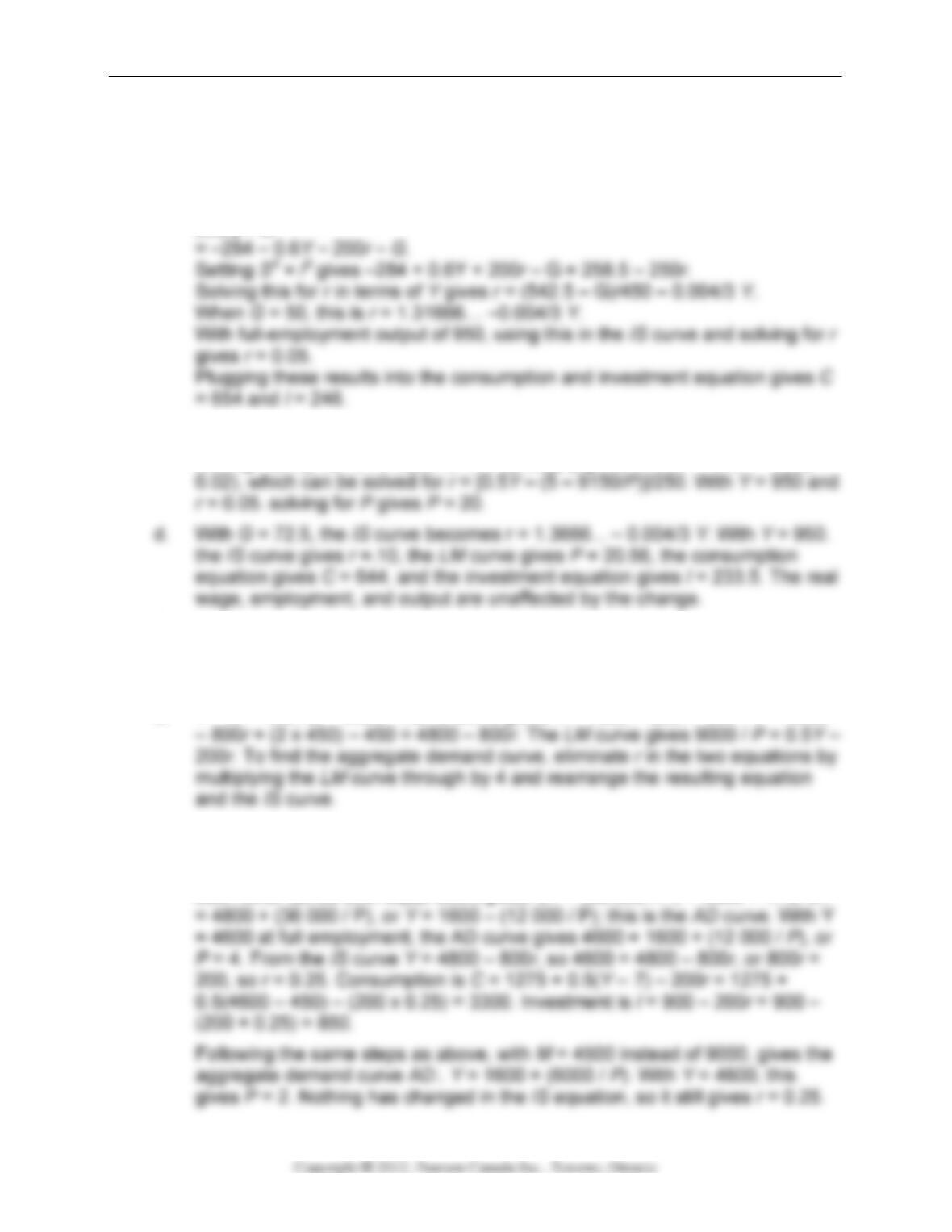
2. a. Md / P = 2000 + 0.2Y – 20 000i
= 2000 + 0.2Y – 20 000 ([r + πe)
= 2000 + 0.2Y – 20 000(r + .05)
Figure 9.20
160 Chapter 9
Fig. 9.20.
b. M = 3600, so M / P = 1800. Setting money supply equal to money demand:
1800 = 1000 + 0.2Y – 20 000r
c. Md / P = 2000 + 0.2Y – 20,000(r + πe)
= 2000 + 0.2Y – 20 000r – (20 000 × 0.04)
= 1200 + 0.2Y – 20 000r.
3. a. First, we will find the IS curve.
Sd = Y – Cd – G = Y –[200+0.8(Y – T) – 500r] – G = Y – [200 + (0.6Y – 16) –
500r] – G
= –184 + 0.4Y + 500r – G.
4. a. First, look at labour market equilibrium.
Labour supply is NS = 55 + 10(1 – t)w. Labour demand comes from the
The IS–LM/AD–AS Model: A General Framework for Macroeconomic Analysis 161
N = 100. Using this in either the labour supply or labour demand equation
then gives w = 9. Using N in the production function gives Y = 950.
b. Next, look at goods market equilibrium and the IS curve.
Sd – Y – Cd – G = Y – [300 – 0.8(Y – T) – 200r] – G – Y – [300 – (0.4Y – 16) –
200r] – G
c. Next, look at asset market equilibrium and the LM curve.
Setting money demand equal to money supply gives 9150/P = 0.5Y – 250(r –
5. The IS curve is found by setting desired saving equal to desired investment.
Desired saving is Sd = Y – Cd – G = Y – [1275 – 0.5(Y – T) – 200r] – G. Setting Sd
= Id gives Y – [1275 – 0.5(Y – 200r] – G = 900 – 200r, or Y = 4350 – 800r+ 2G – T.
The LM curve is M / P = L = 0.5Y – 200i = 0.5Y – 200(r + π) – 0.5Y – 200r.
a. T = G = 450, M = 9000. The IS curve gives Y = 4350 – 800r – 2G – T = 4350
b. LM: 9000 / P = 0.5Y – 200r. Multiplying by 4 gives 36 000 / P = 2Y – 800r.
Rearranging gives 800r = 2Y – 36,000 / P. IS: Y = 4800 – 800r. Rearranging
gives 800r = 4800 – Y. Setting the right-hand sides of these two equations to
each other (since both equal 800r) gives: 2Y – (36.000 / P) = 4800 – Y, or 3Y
162 Chapter 9
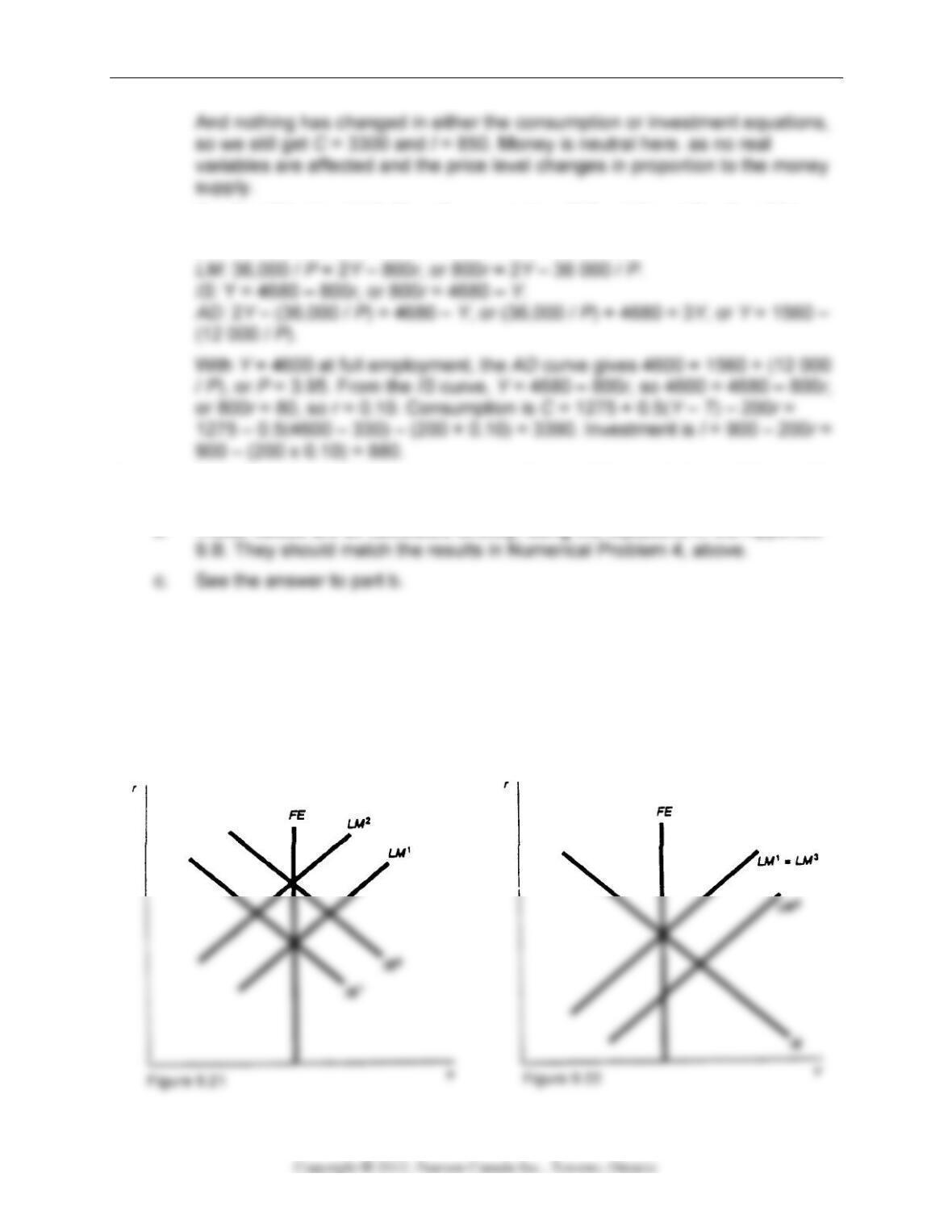
c. T = G = 330, M = 9000. The IS curve is Y = 4350 – 800r – 2G – T = 4350 –
800r – (2 x 330) – 330 = 4680 – 800r.
6. a. A = 2, ƒ1 = 5, ƒ2 = 0.005, n0 = 55, nW = 10, c0 = 300, cY = 0.8, cr = 200, t0 = 20,
t = 0.5, i0 = 258.5, ir = 250, ℓ0 = 0, ℓy = 0.5, ℓr = 250.
b. These values are all calculated directly, using the equations in the Appendix
Analytical Problems
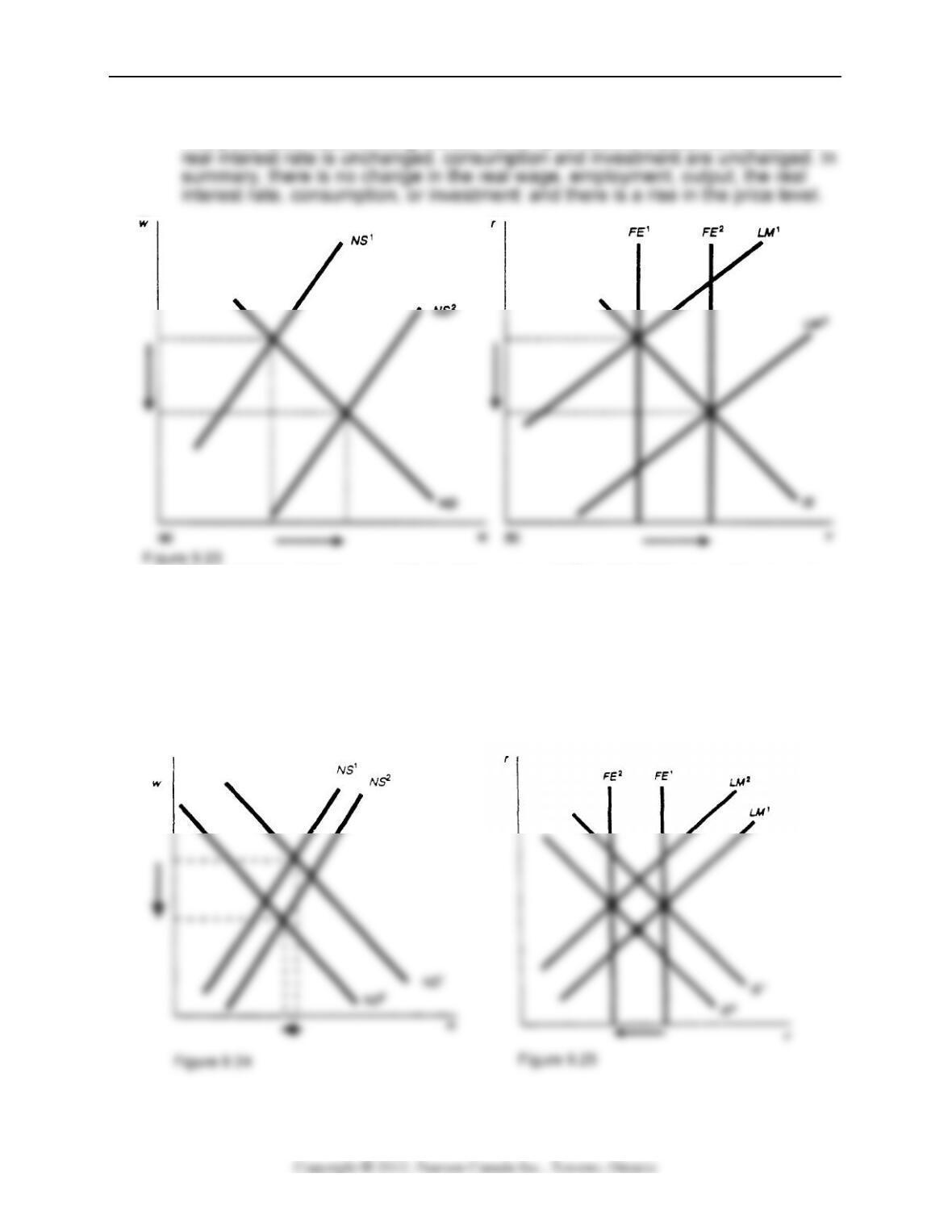
1. a. The increase in desired investment shifts the IS curve up, as shown in Fig.
9.21. The price level rises, shifting the LM curve up to restore equilibrium.
Since the real interest rate rises, consumption declines. In summary, there is
no change in the real wage, employment, or output; there is a rise in the real
interest rate, the price level, and investment; and there is a decline in
consumption.
The IS–LM/AD–AS Model: A General Framework for Macroeconomic Analysis 163
b. The rise in expected inflation shifts the LM curve down as shown in Fig. 9.22.
The price level rises, shifting the LM curve up to restore equilibrium since the
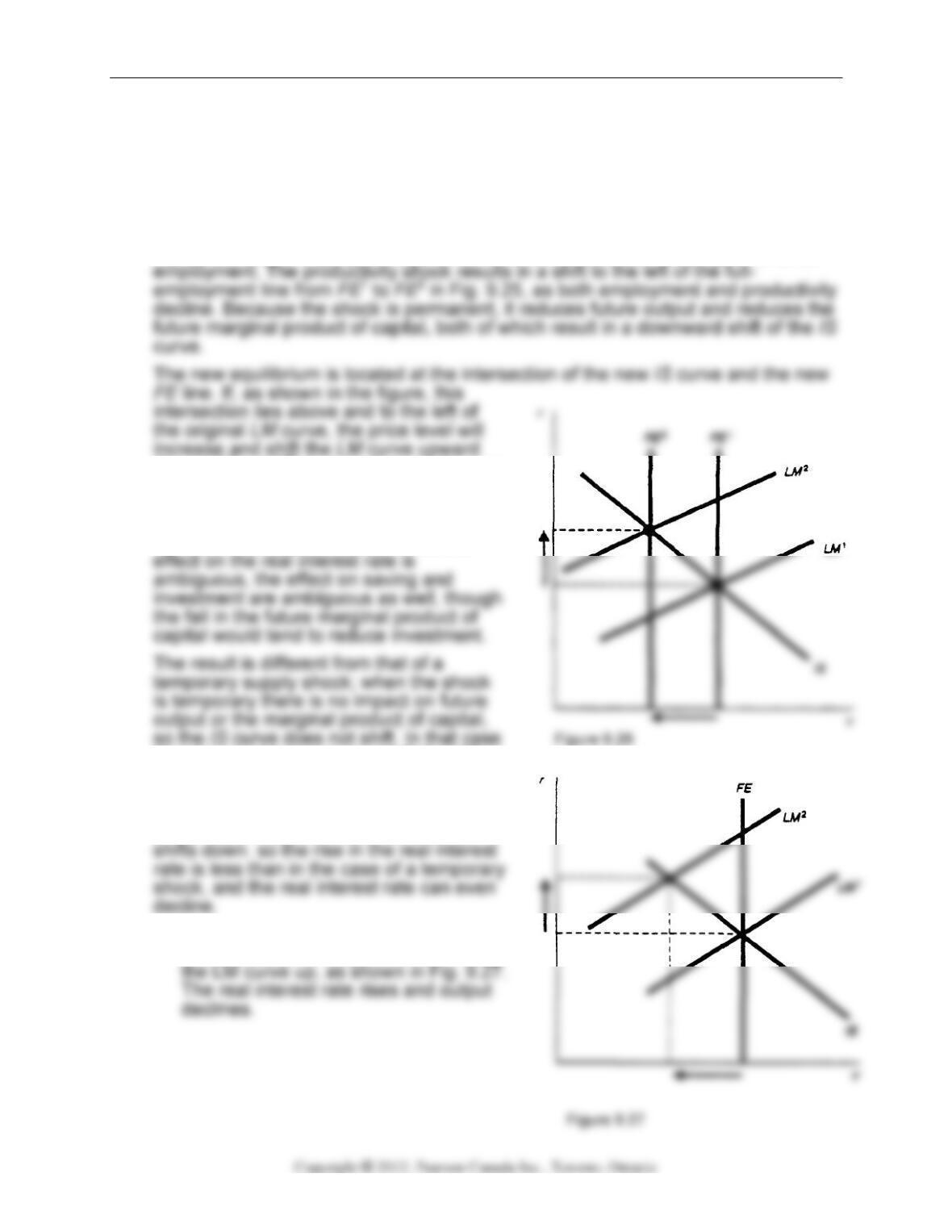
c. The increase in labour supply is shown as a shift in the labour supply curve in
Fig. 9.23(a). This leads to a decline in the real wage rate and an increase in
employment. The rise in employment causes an increase in output, shifting the
FE line to the right in Fig. 9.23
d. To restore equilibrium the price level must decline, shifting the LM curve down.
Since output increases and the real interest rate declines, consumption and
investment increase. In summary, the real wage, the real interest rate, and the
price level decline; and employment, output, consumption, and investment rise.
164 Chapter 9
e. The reduction in the demand for money gives results identical to those in part
(b).
2. The increases in the price of oil reduces the marginal product of labour, causing
the labour demand curve to shift to the left from ND1 to ND2 in Fig. 9.24. Since
households’ expected future incomes decline, labour supply increases NS1 to NS2
(but by assumption, the shift to the left in labour demand is larger than the shift to
the right in labour supply). At equilibrium, there is a reduced real wage and lower
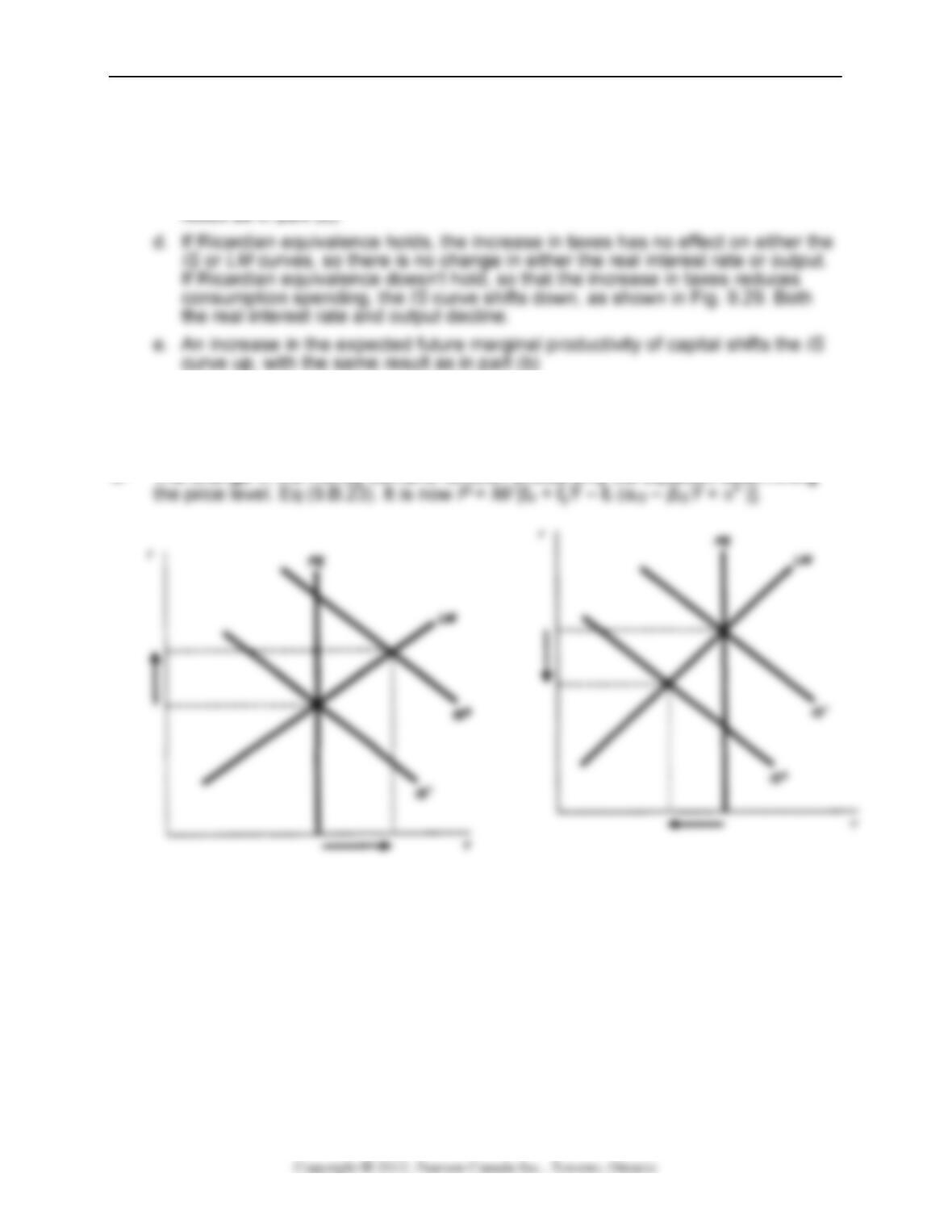
(from LM1 to LM2) to pass through the new
equilibrium point. The result is an increase
in the price level, but an ambiguous effect
on the real interest rate. Since output is
lower, consumption is lower. Since the
the price level increases to shift the LM
curve up from LM1 to LM2 in Figure 9.26 to
restore equilibrium. In that case, the real
interest rate unambiguously increases.
Under a permanent shock, the IS curve
3. a. The decrease in expected inflation
increases real money demand, shifting
The IS–LM/AD–AS Model: A General Framework for Macroeconomic Analysis 165
b. The increase in desired consumption shifts the IS curve up, as shown in Fig.
9.28. This causes the real interest and output to rise.
c. The increase in government purchases shifts the IS curve up, with the same
4. The change in Eq. (9.B.10) has no effect on employment, the real wage, or output.
The only effect this has is on the term βIS, which is now βIS = [1 – (1- t) cY – iY]/ (cr
+ ir). The real interest rate and price level are still determined by Eqs. (9.B.22) and
(9.B.23), respectively.
5. The change in the money demand function affects only the equation determining
Figure 9.29
Figure 9.28