Chapter 9
The Instruments of Trade Policy
◼ Chapter Organization
Basic Tariff Analysis
Supply, Demand, and Trade in a Single Industry
Effects of a Tariff
Measuring the Amount of Protection
Costs and Benefits of a Tariff
Consumer and Producer Surplus
Measuring the Costs and Benefits
Voluntary Export Restraints
Case Study: A Voluntary Export Restraint in Practice
Local Content Requirements
Box: Bridging the Gap
Other Trade Policy Instruments
The Effects of Trade Policy: A Summary
Summary
APPENDIX TO CHAPTER 9: Tariffs and Import Quotas in the Presence of Monopoly
46 Krugman/Obstfeld/Melitz • International Economics: Theory & Policy, Tenth Edition
◼ Chapter Overview
This chapter and the next three focus on international trade policy. Students will have heard in the media
various arguments for and against restrictive trade practices. Some of these arguments are sound, and some
are clearly not grounded in fact. This chapter provides a framework for analyzing the economic effects of
trade policies by describing the tools of trade policy and analyzing their effects on consumers and
producers in domestic and foreign countries. Case studies discuss actual episodes of restrictive trade
practices. An instructor might try to underscore the relevance of these issues by having students scan
newspapers and magazines for other timely examples of protectionism at work.
The import supply and export demand analysis assumes a large country tariff, in which the imposition of a
tariff drives a wedge between prices in domestic and foreign markets, and increases prices in the country
imposing the tariff and lowers the price in the other country by less than the amount of the tariff. This
contrasts with most textbook presentations, which make the small country assumption that the domestic
internal price equals the world price plus the tariff. The chapter also discusses how the actual protection
provided by a tariff may not equal the tariff rate if imported intermediate goods are used in the production
of the protected good. The proper measurement, the effective rate of protection, is described in the text and
calculated for a sample problem.
The costs of a tariff include distortionary efficiency losses in both consumption and production. A tariff
provides gains from terms of trade improvement when and if it lowers the foreign export price. Summing
the areas in a diagram of internal demand and supply provides a method for analyzing the net loss or gain
from a tariff. The gain from a tariff is larger the greater is the decrease in foreign export price from the
tariff (as the tariff-imposing country is able to pass some of the costs of the tariff on to foreign exporters).
Because large countries will have a larger influence on export prices than small countries, a large country
is more likely to gain and, therefore, impose an import tariff.
Chapter 9 The Instruments of Trade Policy 47
An import quota has similar effects as an import tariff upon prices and quantities, but revenues, in the form
of quota rents, accrue to the quota license holders, who are often foreign producers. For example, a quota
on sugar imported into the United States has greatly increased the fortunes of foreign sugar producers
(many of which are owned by American sugar refiners), at a significant cost to American consumers.
Estimates place the cost of each job in the American sugar industry “saved” by protection at $1.75 million.
Another trade instrument is to mandate local content requirements. These raise the price of imports as well
as domestic goods competing with imports but do not yield either tariff revenue or quota rents. The recent
construction of the new Bay Bridge linking San Francisco and Oakland is used as a case study. Federal
funding was available for this project but would have required the state of California to use a much more
costly American contractor as opposed to the significantly cheaper Chinese bid. In the end, the bridge was
built through local bonds rather than federal funding because of the local content requirement of federal
funding.
◼ Answers to Textbook Problems
1. The import demand equation, MD, is found by subtracting the Home supply equation from the Home
48 Krugman/Obstfeld/Melitz • International Economics: Theory & Policy, Tenth Edition
2. a. Foreign’s export supply curve, XS, is XS = −40 + 40 P. In the absence of trade, the price is 1.
3. a. The new MD curve is 80 − 40 (P + t) where t is the specific tariff rate, equal to 0.5. (Note: In
solving these problems, you should be careful about whether a specific tariff or ad valorem tariff
is imposed. With an ad valorem tariff, the MD equation would be expressed as MD = 80 − 40 (1
+ t)P. The equation for the export supply curve by the foreign country is unchanged.
MD = XS
Chapter 9 The Instruments of Trade Policy 49
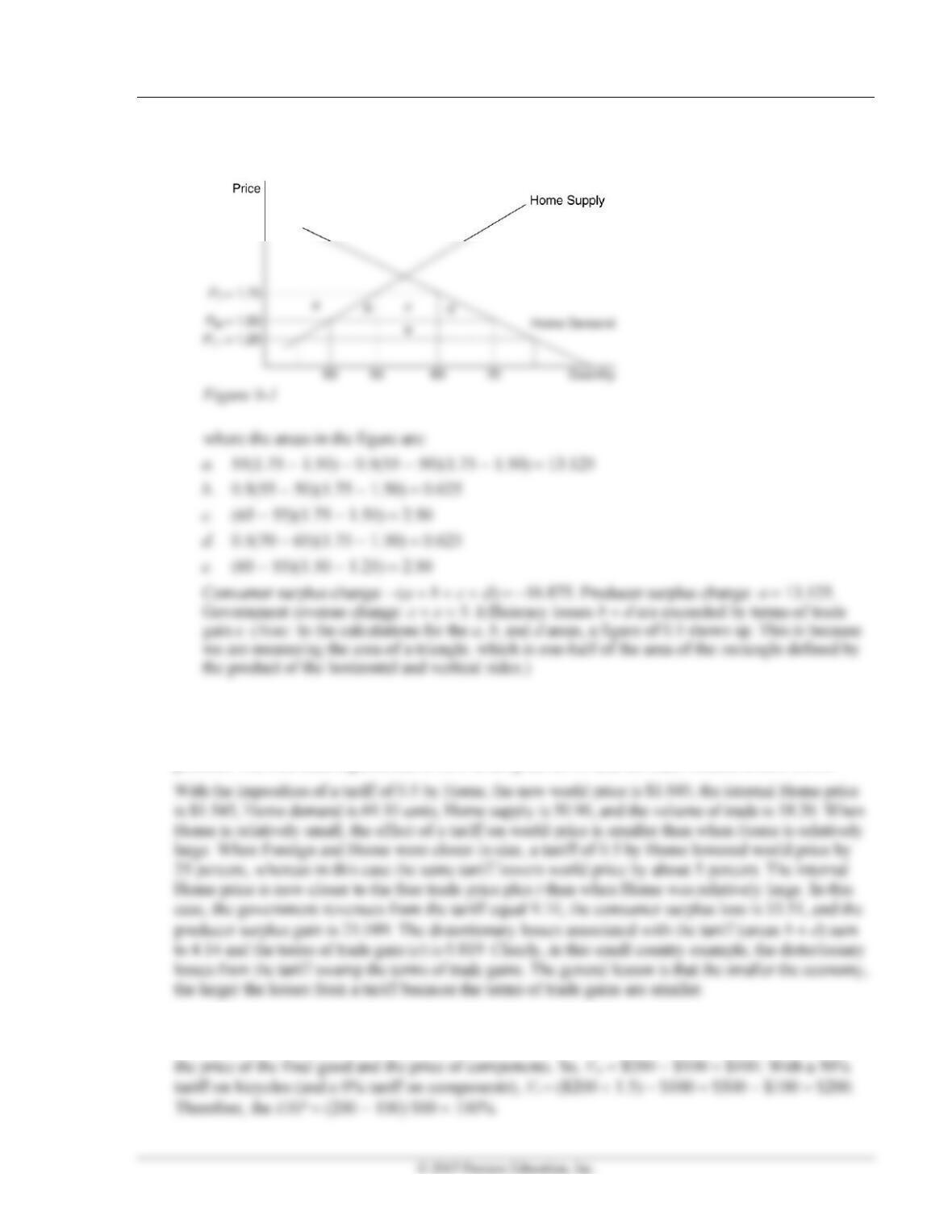
b. and c. The welfare of the Home country is best studied using the combined numerical and
graphical solutions presented below in Figure 9-1.
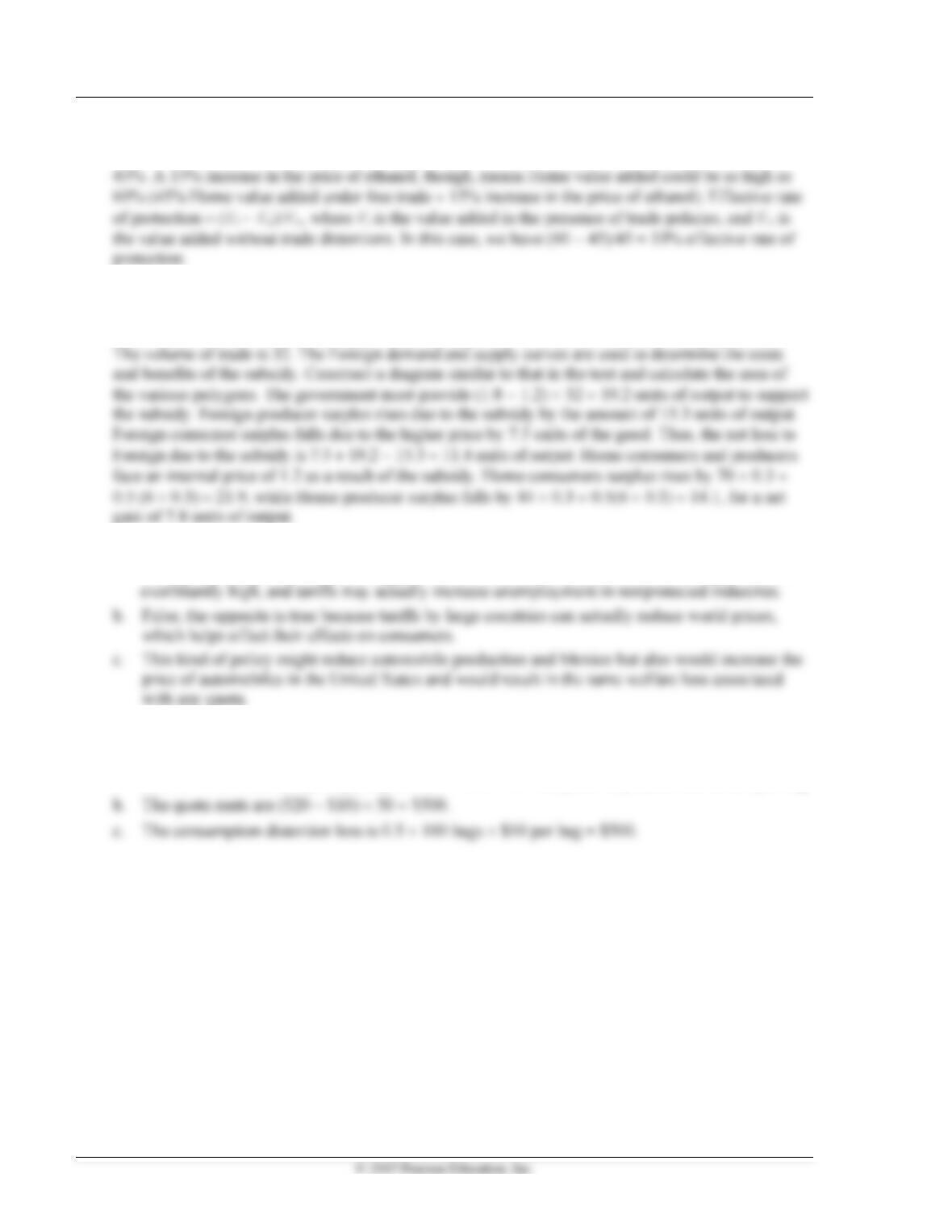
4. Using the same solution methodology as in Problem 3, when the Home country is very small relative
to the Foreign country, its effects on the terms of trade are expected to be much smaller. The small
country is much more likely to be hurt by its imposition of a tariff. Indeed, this intuition is shown in this
problem. The free trade equilibrium is now at the price $1.09 and the trade volume is now 36.40.
5. The effective rate of protection (ERP) is defined as (Vt − Vw)/Vw, where Vt is the value added under
protection and Vw is the value added under free trade. We define value added as the difference between
50 Krugman/Obstfeld/Melitz • International Economics: Theory & Policy, Tenth Edition
6. The effective rate of protection takes into consideration the costs of imported intermediate goods.
Here, 55% of the cost can be imported, suggesting with no distortion, Home value added would be
7. We first use Foreign’s export supply and Home’s import demand curves to determine the new
world price. The Foreign supply of exports curve, with a Foreign subsidy of 0.5 per unit, becomes
XS = −40 + 40(1 + 0.5) P. The equilibrium world price is 1.2, and the internal Foreign price is 1.8.
8. a. False, unemployment has more to do with labor market issues and the business cycle than with
tariff policy. Empirical estimates suggest that the cost to society of jobs saved through tariffs is
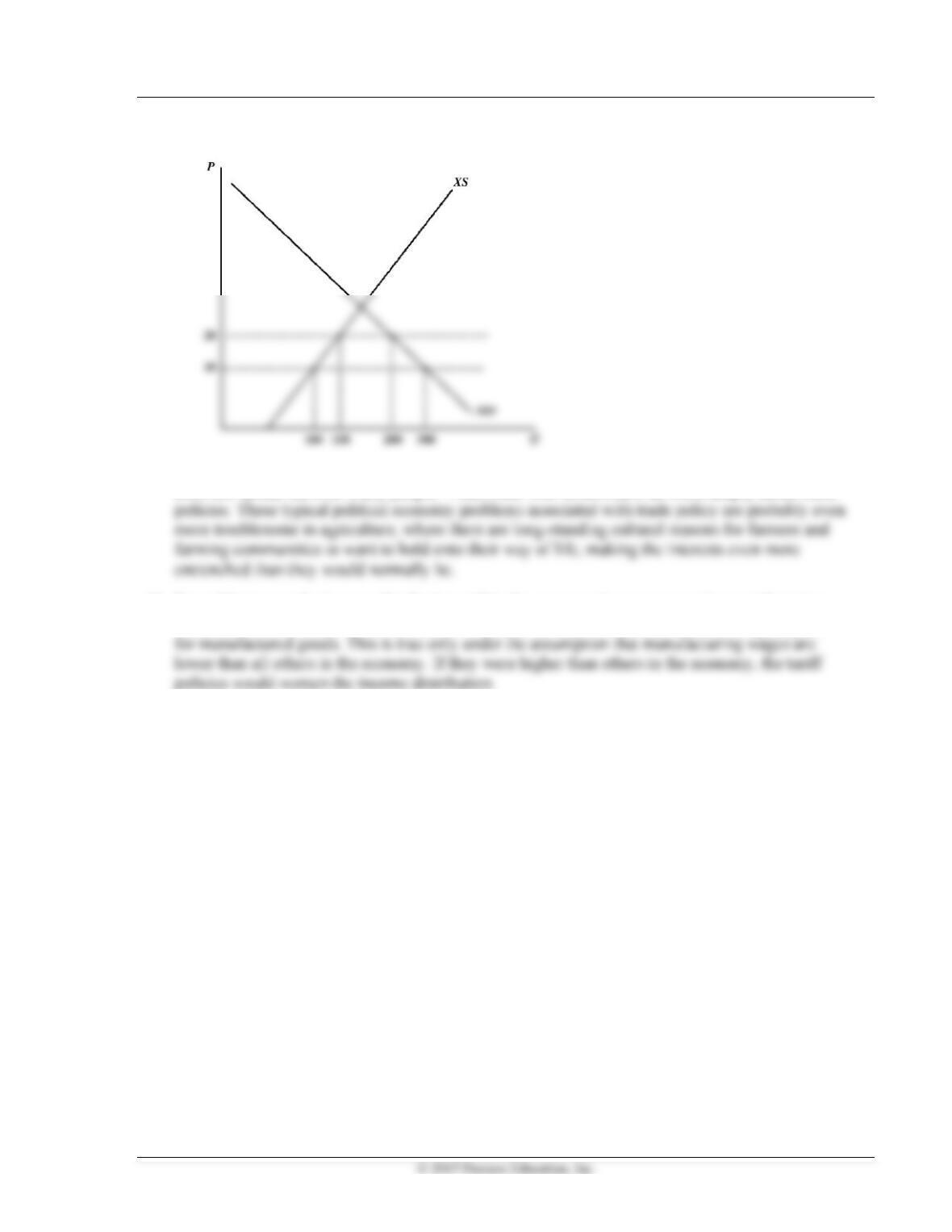
9. At a price of $10 per bag of peanuts, Acirema imports 200 bags of peanuts. A quota limiting the
import of peanuts to 50 bags has the following effects:
a. Set MD = 50 to find the post-quota price: 350 − 15P = 50. The price of peanuts rises to $20 per bag.
Chapter 9 The Instruments of Trade Policy 51
d. The production distortion loss is 0.5 50 bags $10 per bag = $250.
10. The reason is largely that the benefits of these policies accrue to a small group of people and the
costs are spread out over many people. Thus, those who benefit care far more deeply about these
11. It would improve the income distribution within the economy because wages in manufacturing
would increase, and real incomes for others in the economy would decrease due to higher prices