S-129
interactive activity
Chapter 9
Decision Making by
Individuals and Firms
1. Jackie owns and operates a website design business. To keep up with new tech-
nology, she spends $5,000 per year upgrading her computer equipment. She
runs the business out of a room in her home. If she didn’t use the room as her
business office, she could rent it out for $2,000 per year. Jackie knows that if
she didn’t run her own business, she could return to her previous job at a large
software company that would pay her a salary of $60,000 per year. Jackie has no
other expenses.
a. How much total revenue does Jackie need to make in order to break even in
the eyes of her accountant? That is, how much total revenue would give Jackie
an accounting profit of just zero?
1. a. Jackie’s accounting profit is: Total revenue − $5,000. (The only cost that her
2. You own and operate a bike store. Each year, you receive revenue of $200,000
from your bike sales, and it costs you $100,000 to obtain the bikes. In addition,
you pay $20,000 for electricity, taxes, and other expenses per year. Instead of
running the bike store, you could become an accountant and receive a yearly
salary of $40,000. A large clothing retail chain wants to expand and offers to rent
the store from you for $50,000 per year. How do you explain to your friends that
despite making a profit, it is too costly for you to continue running your store?
2. Your yearly accounting profit is:
$200,000 (total revenue)
But not renting the store to the retail chain is an opportunity cost, and not being
able to make $40,000 as an accountant is also an opportunity cost, so your
yearly economic profit is:
$80,000 (accounting profit)
So although you make an accounting profit each year, you would be better off
renting the store to the large chain and becoming an accountant yourself, since
your opportunity cost of continuing to run your own store is too high.
Solution
Solution
3. Suppose you have just paid a nonrefundable fee of $1,000 for your meal plan for
this academic term. This allows you to eat dinner in the cafeteria every evening.
a. You are offered a part-time job in a restaurant where you can eat for free each
evening. Your parents say that you should eat dinner in the cafeteria anyway,
since you have already paid for those meals. Are your parents right? Explain
3. a. Your parents are wrong. They are making the mistake of considering sunk
costs. Since the $1,000 that you have already paid for the meal plan is nonre–
fundable, it should not enter into your decision making now. Your decision of
where to eat should depend only on those costs and benefits that are affected
b. Your roommate is wrong. Since the $1,000 that you have already paid for the
meal plan is nonrefundable, it should not enter into your decision making
now. It is a sunk cost. In deciding where to eat, you should weigh the benefit
and cost of eating in the restaurant (where each meal costs $2) against the
4. You have bought a $10 ticket in advance for the college soccer game, a ticket that
cannot be resold. You know that going to the soccer game will give you a ben–
efit equal to $20. After you have bought the ticket, you hear that there will be a
professional baseball post-season game at the same time. Tickets to the baseball
game cost $20, and you know that going to the baseball game will give you a
4. Yes, you are making the correct decision. If you had known about the baseball
game before buying the ticket to the soccer game, your decision would have been
as follows:
Go to the soccer game Go to the baseball game
Solution
Solution
5. Amy, Bill, and Carla all mow lawns for money. Each of them operates a differ-
ent lawn mower. The accompanying table shows the total cost to Amy, Bill, and
Carla of mowing lawns.
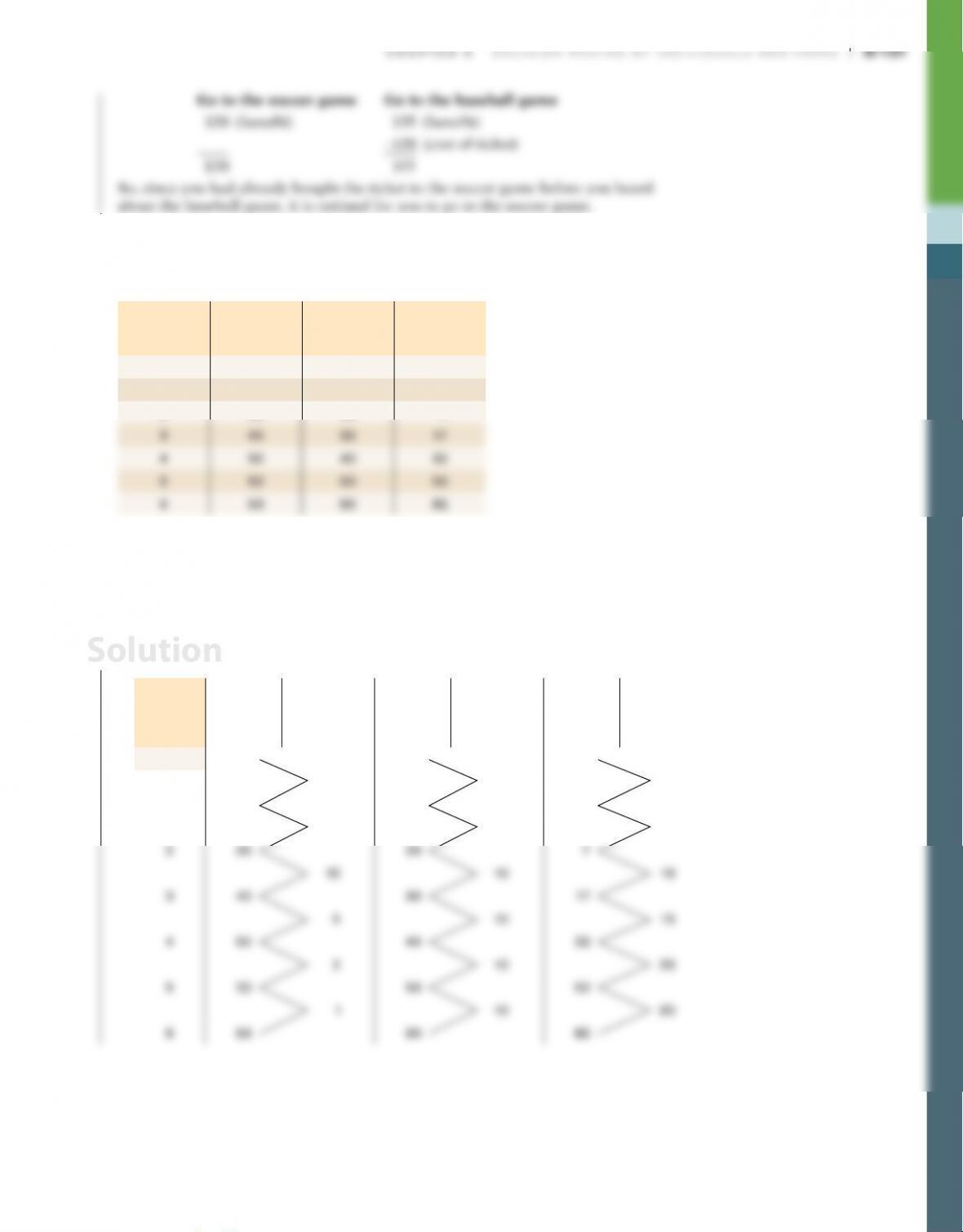
Quantity
of lawns Amy’s Bill’s Carla’s
mowed total cost total cost total cost
0$0 $0 $0
120 10 2
235 20 7
a. Calculate Amy’s, Bill’s, and Carla’s marginal costs, and draw each of their
marginal cost curves.
b. Who has increasing marginal cost, who has decreasing marginal cost, and
who has constant marginal cost?
5. a. The accompanying table shows Amy’s, Bill’s, and Carla’s marginal costs.
Quantity
of lawns
mowed
Amy’s
total cost
Amy’s
marginal
cost of
lawn mowed
Bill’s
total cost
Bill’s
marginal
cost of
lawn mowed
Carla’s
total cost
Carla’s
marginal
cost of
lawn mowed
0$0 $0 $0
$20 $10 $2
120 10 2
15 10 5
Solution
S-132 Chapter 9 Decision Making by inDiviDuals anD FirMs
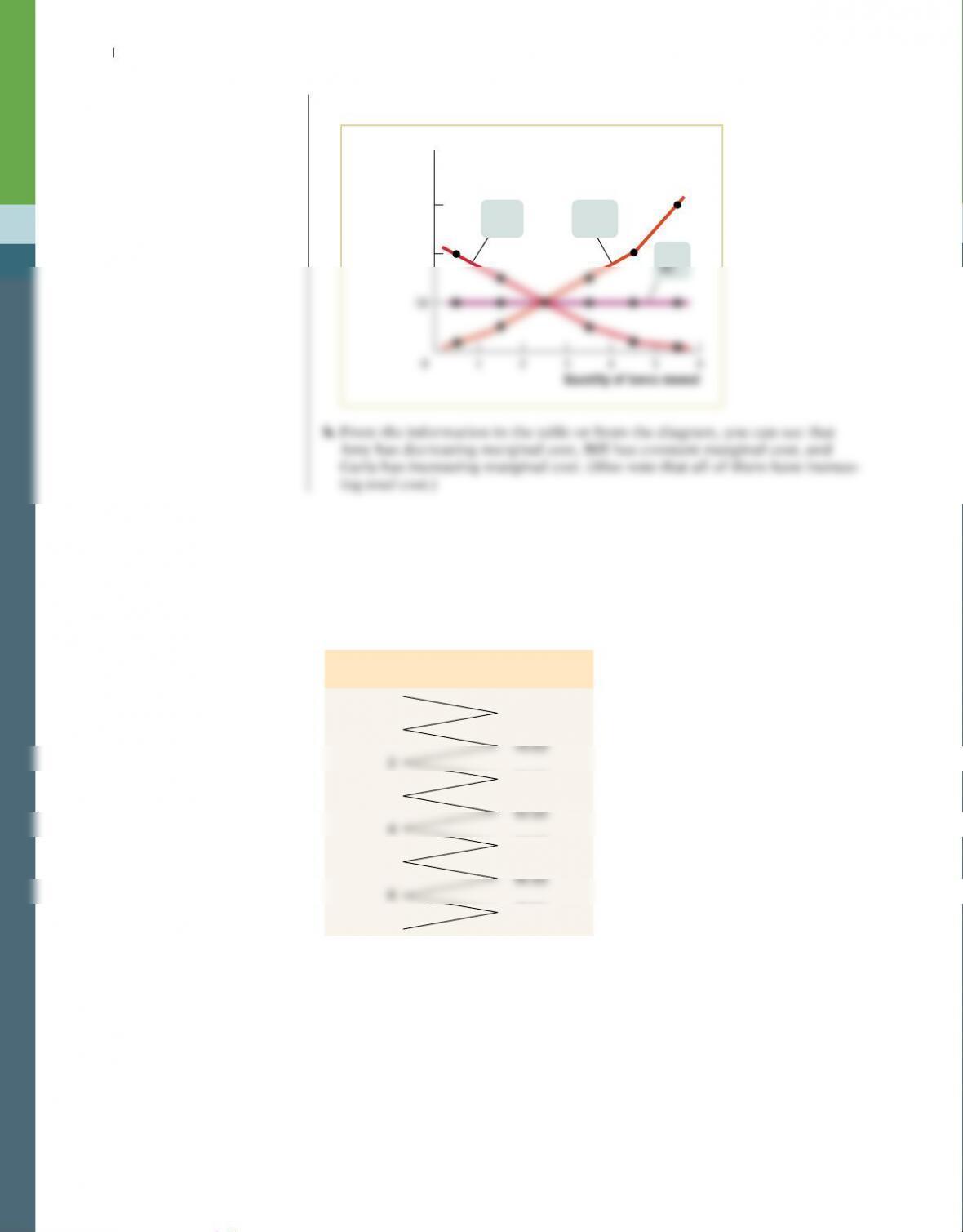
The accompanying diagram shows Amy’s, Bill’s, and Carla’s marginal cost curves.
$30
20
Marginal
cost of
lawn m
owed
Amy’s
MC
Carla’s
MC
Bill’s
6. You are the manager of a gym, and you have to decide how many customers to
admit each hour. Assume that each customer stays exactly one hour. Customers
are costly to admit because they inflict wear and tear on the exercise equipment.
Moreover, each additional customer generates more wear and tear than the cus-
tomer before. As a result, the gym faces increasing marginal cost. The accompa-
nying table shows the marginal costs associated with each number of customers
per hour.
Quantity of Marginal cost
customers per hour of customer
0
$14.00
1
15.00
3
16.00
5
17.00
7
a. Suppose that each customer pays $15.25 for a one-hour workout. Use the
profit-maximizing principle of marginal analysis to find the optimal number
of customers that you should admit per hour.
b. You increase the price of a one-hour workout to $16.25. What is the optimal
number of customers per hour that you should admit now?
($15.25) also exceeds the marginal cost ($14.50), so you want to admit the sec-
ond customer, too. The same is true for the third customer: the marginal ben-
($16.00). For the sixth customer, however, the marginal cost ($16.50) exceeds
the marginal benefit, so you do not want to admit a sixth customer.
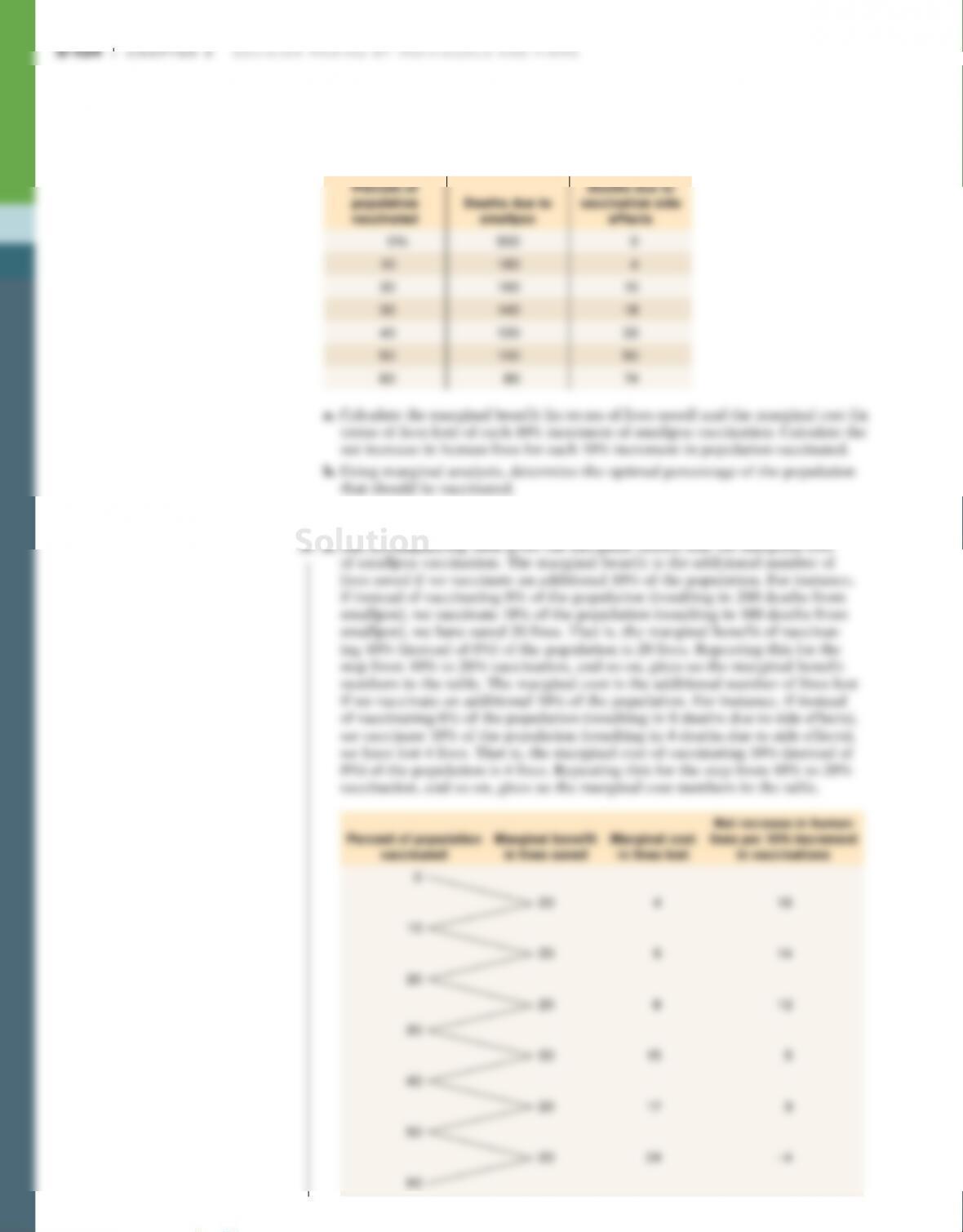
7. Georgia and Lauren are economics students who go to a karate class together.
Both have to choose how many classes to go to per week. Each class costs $20.
The accompanying table shows Georgia’s and Lauren’s estimates of the marginal
benefit that each of them gets from each class per week.
Lauren’s Georgia’s
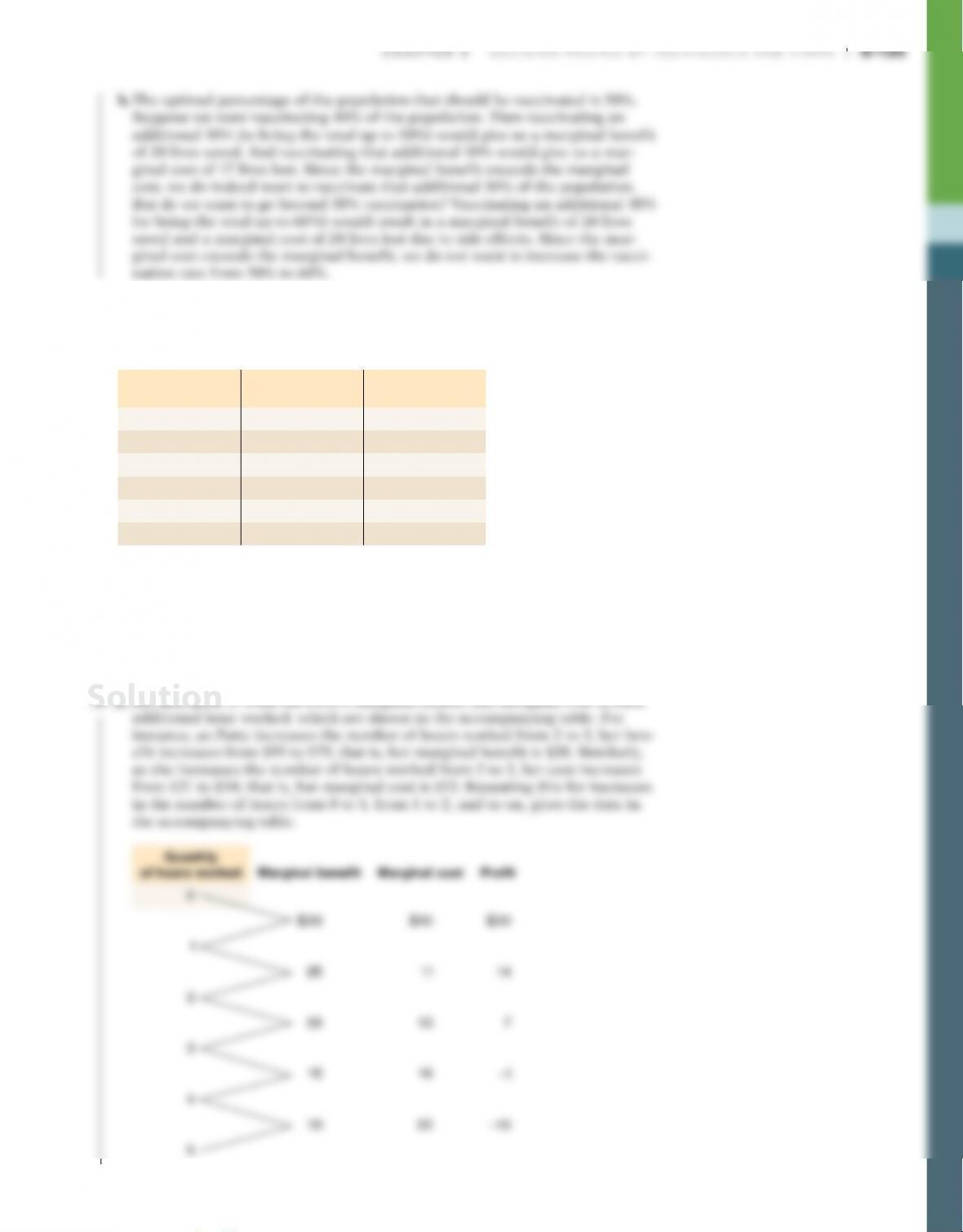
8. The Centers for Disease Control and Prevention (CDC) recommended against vacci–
nating the whole population against the smallpox virus because the vaccination has
undesirable, and sometimes fatal, side effects. Suppose the accompanying table gives
the data that are available about the effects of a smallpox vaccination program.
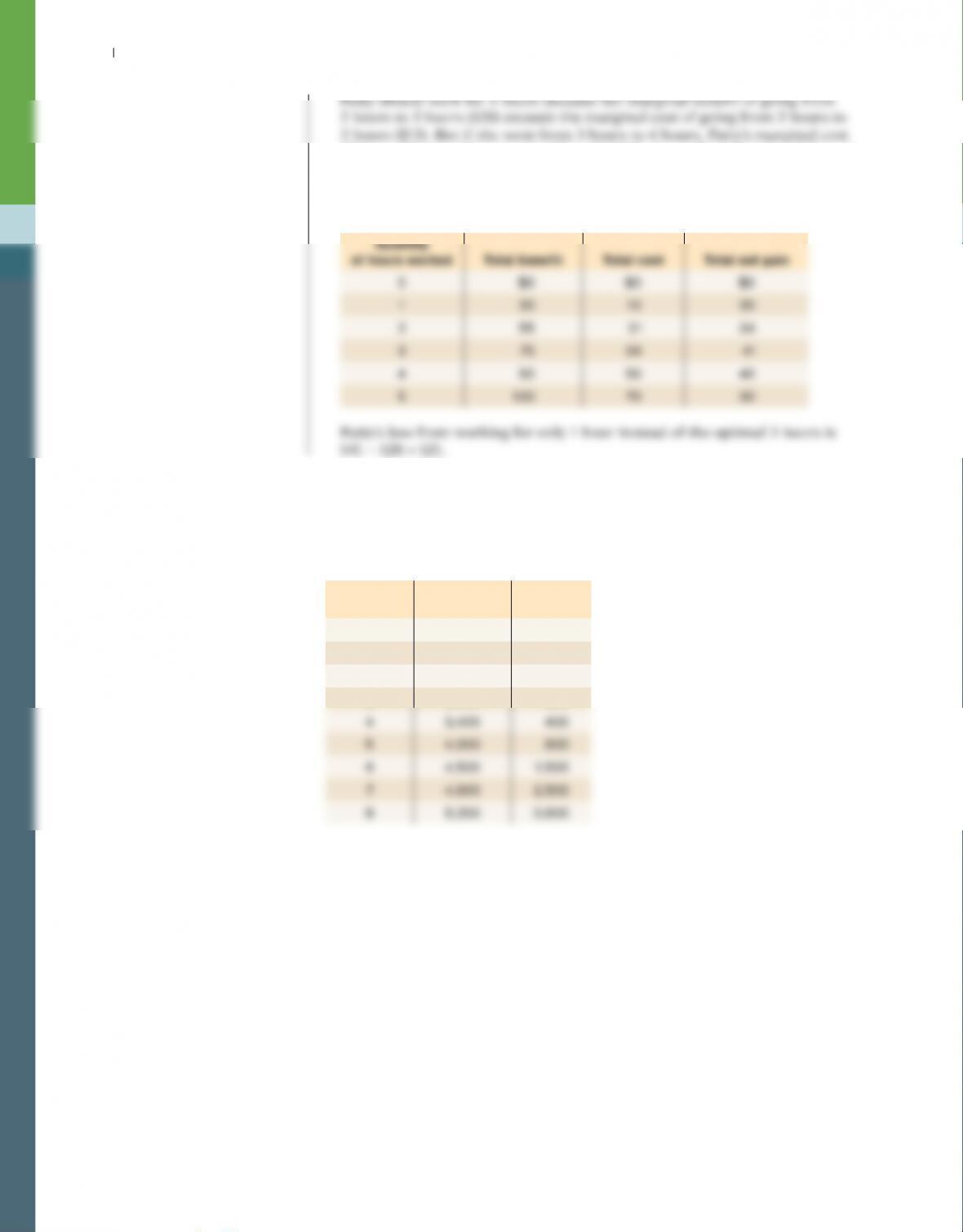
9. Patty delivers pizza using her own car, and she is paid according to the number
of pizzas she delivers. The accompanying table shows Patty’s total benefit and
total cost when she works a specific number of hours.
Quantity of
hours worked Total benefit Total cost
0$0 $0
130 10
255 21
375 34
490 50
5100 70
a. Use marginal analysis to determine Patty’s optimal number of hours worked.
b. Calculate the total profit to Patty from working 0 hours, 1 hour, 2 hours, and
so on. Now suppose Patty chooses to work for 1 hour. Compare her total profit
from working for 1 hour with her total profit from working the optimal num-
ber of hours. How much would she lose by working for only 1 hour?
9. a. We first need to work out Patty’s marginal benefit and marginal cost of each
Solution
S-136 Chapter 9 Decision Making by inDiviDuals anD FirMs
($16) would exceed her marginal benefit ($15). So working that fourth hour is
not optimal.
b. The accompanying table shows Patty’s total net gain in the fourth column. The
total net gain is the difference between total benefit and total cost.
10. Assume De Beers is the sole producer of diamonds. When it wants to sell more
diamonds, it must lower its price in order to induce shoppers to buy more.
Furthermore, each additional diamond that is produced costs more than the pre–
vious one due to the difficulty of mining for diamonds. De Beers’s total benefit
schedule is given in the accompanying table, along with its total cost schedule.
Quantity of
diamonds Total benefit Total cost
0$0 $0
11,000 50
21,900 100
32,700 200
a. Draw the marginal cost curve and the marginal benefit curve and, from your
diagram, graphically derive the optimal quantity of diamonds to produce.
b. Calculate the total profit to De Beers from producing each quantity of
diamonds. Which quantity gives De Beers the highest total profit?
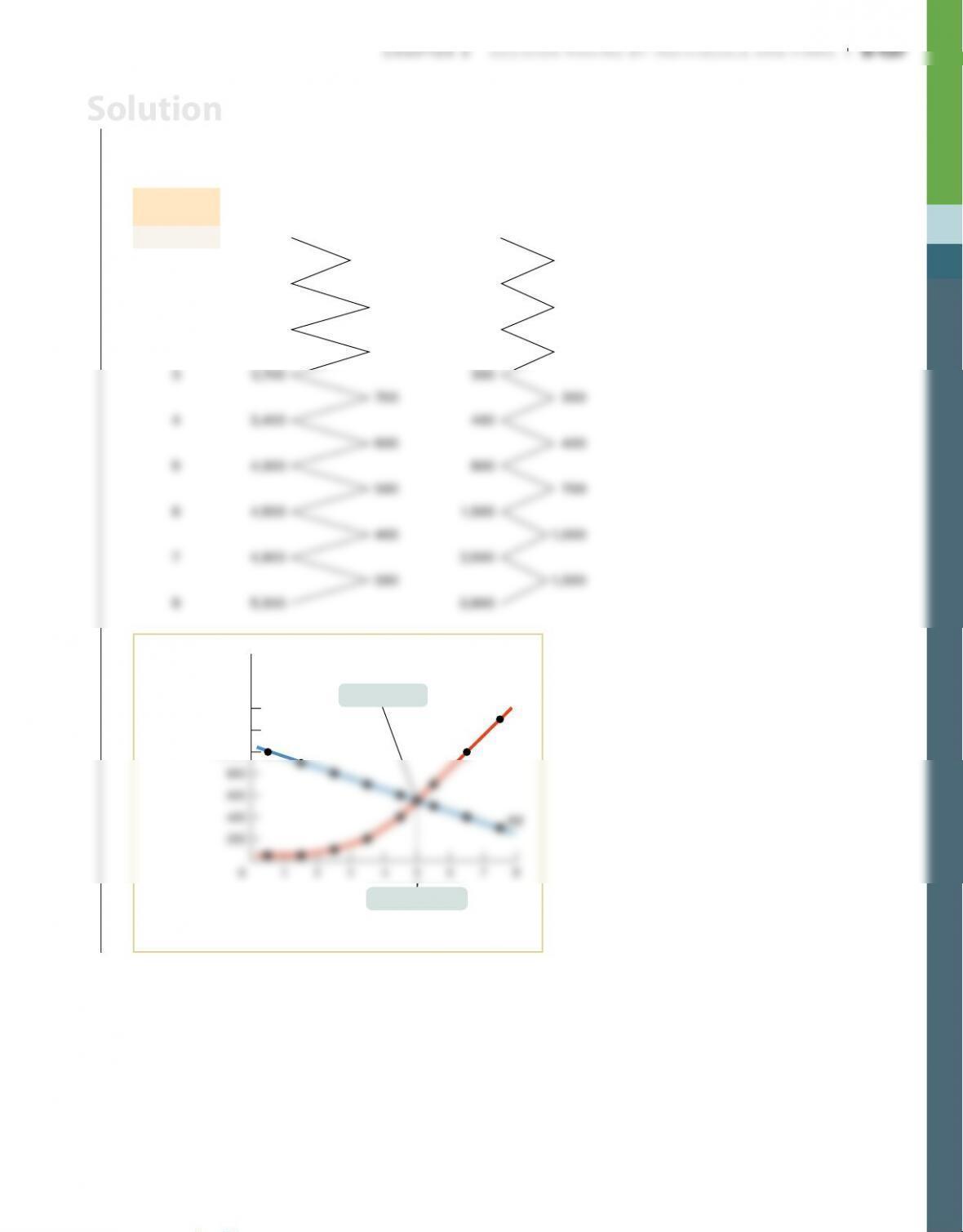
10. a. The accompanying table shows the marginal benefit and marginal cost of each
diamond. The accompanying diagram graphs marginal benefit and marginal
cost. From the diagram, you can conclude that the optimal number of dia-
monds to produce is 5.
Quantity of
diamonds Total benefit Marginal benefit Total cost Marginal cost
0$0 $0
$1,000 $50
11,000 50
900 50
21,900 100
800 100
Quantity of diamonds
Optimal quantity
Solution
S-138 Chapter 9 Decision Making by inDiviDuals anD FirMs
b. The accompanying table calculates the total profit to De Beers from producing
each quantity of diamonds. The quantity that gives De Beers the greatest total
profit gain is 5 diamonds. This is, of course, just what you found in part a.
Quantity of
diamonds Total benefit Total cost Total profit
0$0 $0 $0
11,000 50 950
21,900 100 1,800
11. In each of the following examples, explain whether the decision is rational or
irrational. Describe the type of behavior exhibited.
a. Kookie’s best friend likes to give her gift cards that Kookie can use at her
favorite stores. Kookie, however, often forgets to use the cards before their
expiration date or loses them. Kookie, though, is careful with her own cash.
b. The Panera Bread company opened a store in Clayton, Missouri, that allowed
customers to pay any amount they like for their orders; instead of prices, the
store listed suggested donations based on the cost of the goods. All profits
went to a charitable foundation set up by Panera. A year later, the store was
pleased with the success of the program.
d. Kimora has planned a trip to Florida during spring break in March. She has
several school projects due after her return. Rather than do them in February,
she figures she can take her books with her to Florida and complete her proj-
ects there.
e. Sahir overpaid when buying a used car that has turned out to be a lemon. He
could sell it for parts, but instead he lets it sit in his garage and deteriorate.
f. Barry considers himself an excellent investor in stocks. He selects new stocks
by finding ones with characteristics similar to those of his previous winning
stocks. He chalks up losing trades to ups and downs in the macroeconomy.
11. a. Kookie is behaving irrationally, engaging in mental accounting. By losing the
Solution
Chapter 9 Decision Making by inDiviDuals anD FirMs S-139
d. Kimora is behaving irrationally, exhibiting unrealistic expectations about her
future actions. If she can’t finish her projects now, she’s unlikely to complete
them while on spring break.
e. Sahir is behaving irrationally, engaging in loss aversion. If he were behaving ratio–
12. You have been hired as a consultant by a company to develop the company’s
retirement plan, taking into account different types of predictably irrational
12. There are numerous retirement plan policies you could consider to forestall vari-
ous types of irrational behavior by employees. Here are some examples. Because
of status quo bias, many employees do not enroll in company retirement plans.
To address this type of predictably irrational behavior, you could suggest that
all employees be automatically enrolled in the retirement plan; they should have
to actively choose not to enroll. To address unrealistic expectations about their
WORK IT OUT Interactive step-by-step help with solving this
problem can be found online.
13. Hiro owns and operates a small business that provides economic consult–
ing services. During the year he spends $57,000 on travel to clients and
other expenses. In addition, he owns a computer that he uses for business.
If he didn’t use the computer, he could sell it and earn yearly interest of
$100 on the money created through this sale. Hiro’s total revenue for the
year is $100,000. Instead of working as a consultant for the year, he could
teach economics at a small local college and make a salary of $50,000.
a. What is Hiro’s accounting profit?
b. What is Hiro’s economic profit?
Solution
S-140 Chapter 9 Decision Making by inDiviDuals anD FirMs