Chapter 9
Trade and the Balance
of Payments
◼ Outline
Introduction: The Current Account
The Trade Balance
The Current Account Balance
Introduction to the Financial and Capital Accounts
Types of Financial Flows
Limits on Financial Flows
Case Study: The Crisis of 2007–2009 and the Balance of Payments
The Current Account and the Macroeconomy
The National Income and Product Accounts
International Debt
Case Study: Odious Debt
International Investment Position
Appendix A: Measuring the International Investment Position
Appendix B: Balance of Payments Data
Chapter 9 Trade and the Balance of Payments 51
◼ What Students Should Know after Reading Chapter 9
The accounting detail of Chapter 9 remains relatively aggregated, but students should become familiar
with the key subaccounts within the balance of payments and be able to classify transactions as credits or
debits. The study questions provide practice problems and frequent examples of similar questions.
Once they understand the basic accounting, students can consider the deeper implications of the balance of
payments framework. The implications of a current account deficit or surplus on the financial account side
should become clear. Students should realize that trade flows are related to savings and investment
balances and cannot be treated as a separate independent variable.
◼ Assignment Ideas
1. Students should be introduced to the data on the U.S. balance of payments available from the Bureau
of Economic Analysis at www.bea.gov. You may find it useful to provide data if the source is too
2. Similarly, the IMF’s Balance of Payments Statistics is available in most research libraries and is a
very clear presentation of data for the most of the world’s nations. They provide both a detailed view
3. The Bureau of Economic Analysis also provides data on the international investment position of the
United States, along with information on foreign direct investment, broken down by sector and by
52 Gerber • International Economics, Sixth Edition
◼ Answers to End-of-Chapter Questions
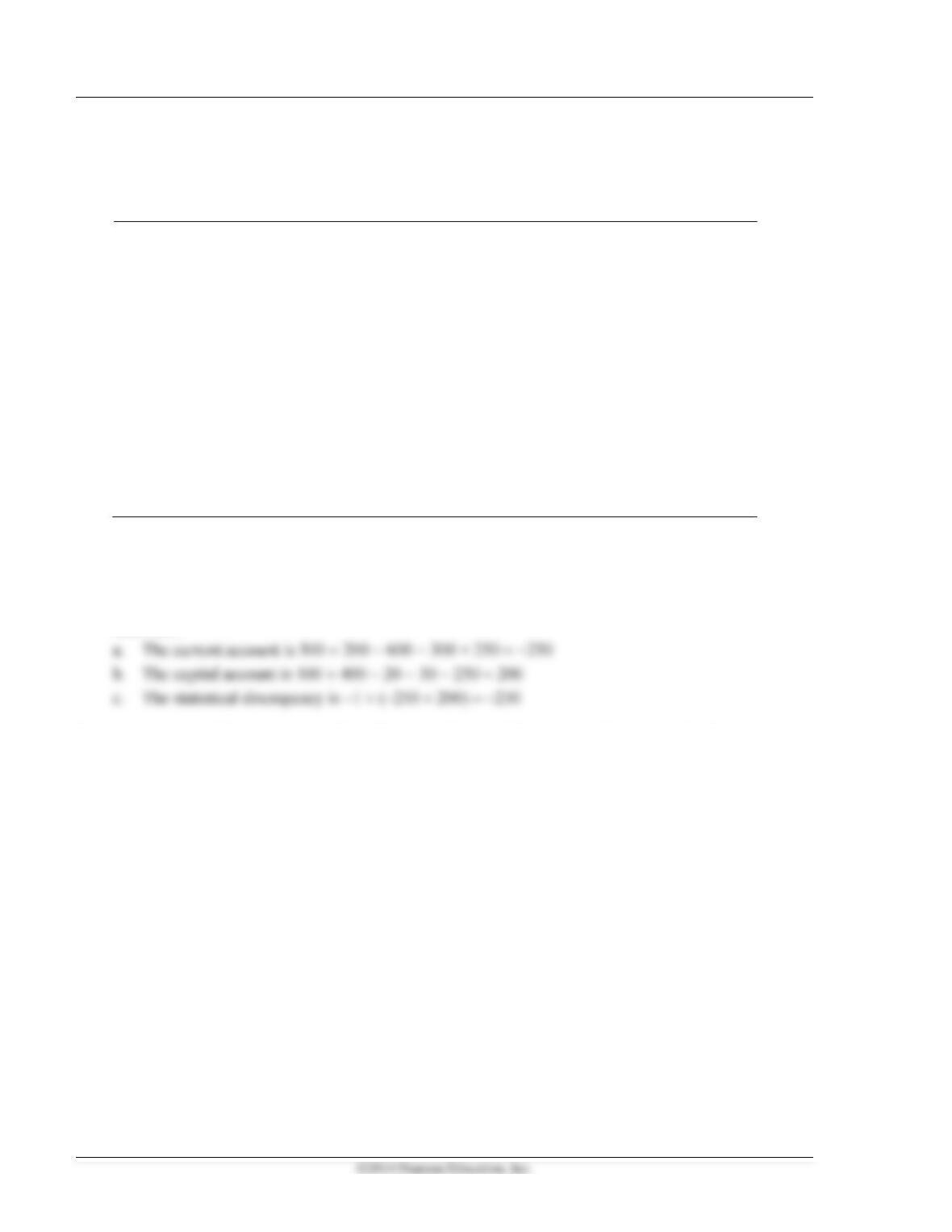
1. Use the following information to answer the questions below. Assume that the capital account is
equal to 0.
Net unilateral transfers
50
Exports of goods and services
500
Net increase in the U.S. government’s nonreserve foreign assets
30
Net increase in foreign ownership of U.S.-based nonreserve assets
400
Net increase in U.S. private assets abroad
250
Invest income received in the United States
200
Net increase in U.S. ownership of official reserve assets
20
Imports of goods and services
600
Net increase in foreign ownership of U.S.-based reserve assets
100
Investment income paid abroad by the United States
300
a. What is the current account balance?
b. Does the capital account equal the current account?
c. What is the statistical discrepancy?
Answers:
2. Look at each of the cases below from the point of view of the balance of payments for the United
States. Determine the subcategory of the current account or financial account that each transaction
would be classified in, and state whether it would enter as a credit or debit.
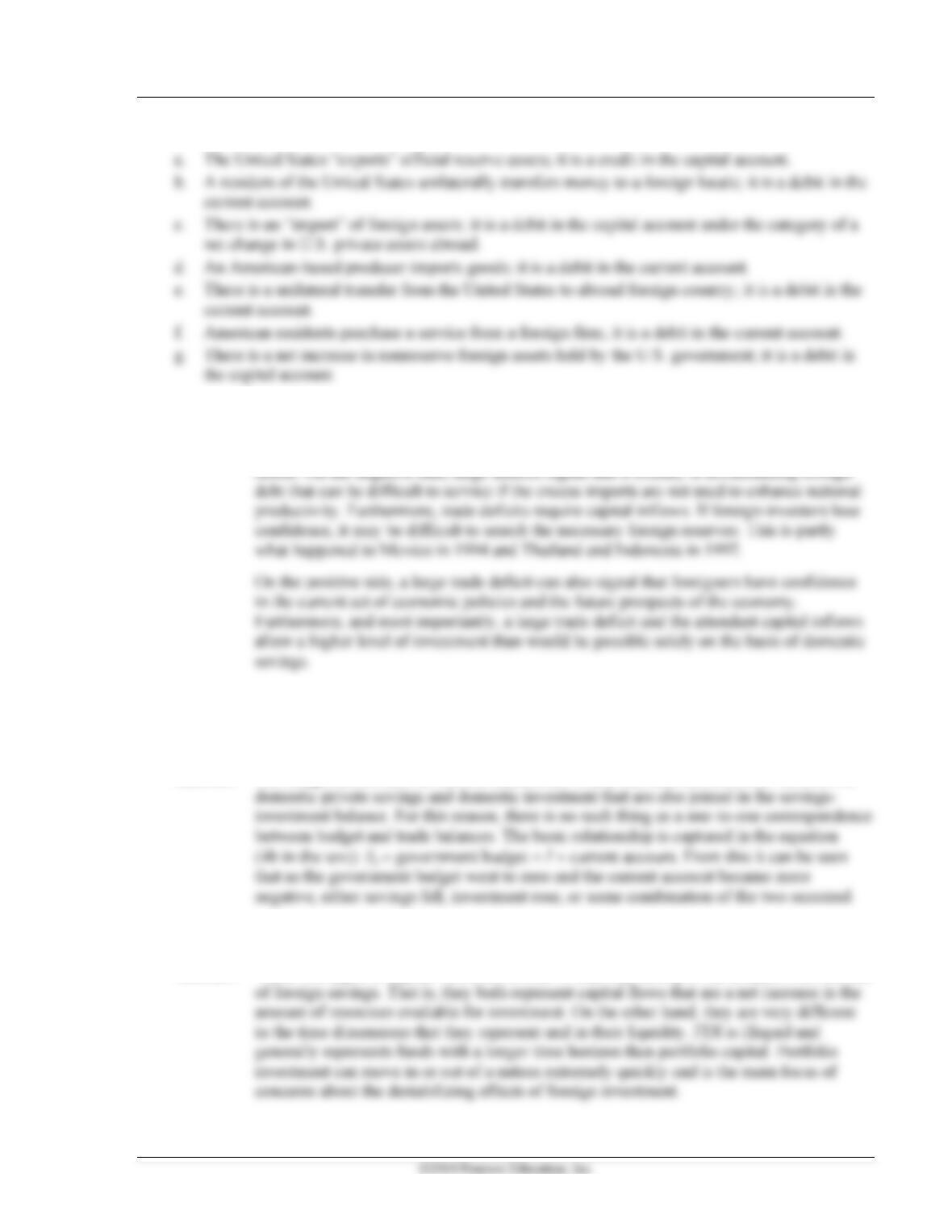
a. The U.S. government sells gold for dollars.
b. A migrant worker in California sends $500 home to his village in Mexico.
c. An American mutual fund manager uses the deposits of his fund investors to buy Brazilian
telecommunication stocks.
d. A Japanese firm in Tennessee buys car parts from a subsidiary in Malaysia.
e. An American church donates five tons of rice to the Sudan to help with famine relief.
f. An American retired couple flies from Seattle to Tokyo on Japan Airlines.
g. The Mexican government sells pesos to the United States Treasury and buys dollars.
Chapter 9 Trade and the Balance of Payments 53
Answers:
3. Weigh the pros and cons of a large trade deficit.
Answer: Trade deficits are generally considered a negative for a country, but the reality is more
4. Is the budget deficit of a country linked to its current account balance? How so? Explain how it is
possible for the United States’ current account deficit to grow while the budget deficit has
disappeared.
Answer: The budget deficit and the current account are linked but there are the other variables of
5. Compare and contrast portfolio capital flows with direct investment capital flows.
Answer: These two types of capital flows are similar in that they both provide a nation with the use
6. Why is a current account surplus equivalent to foreign investment?
Answer: A current account surplus leads to the net accumulation of foreign assets, whether real or