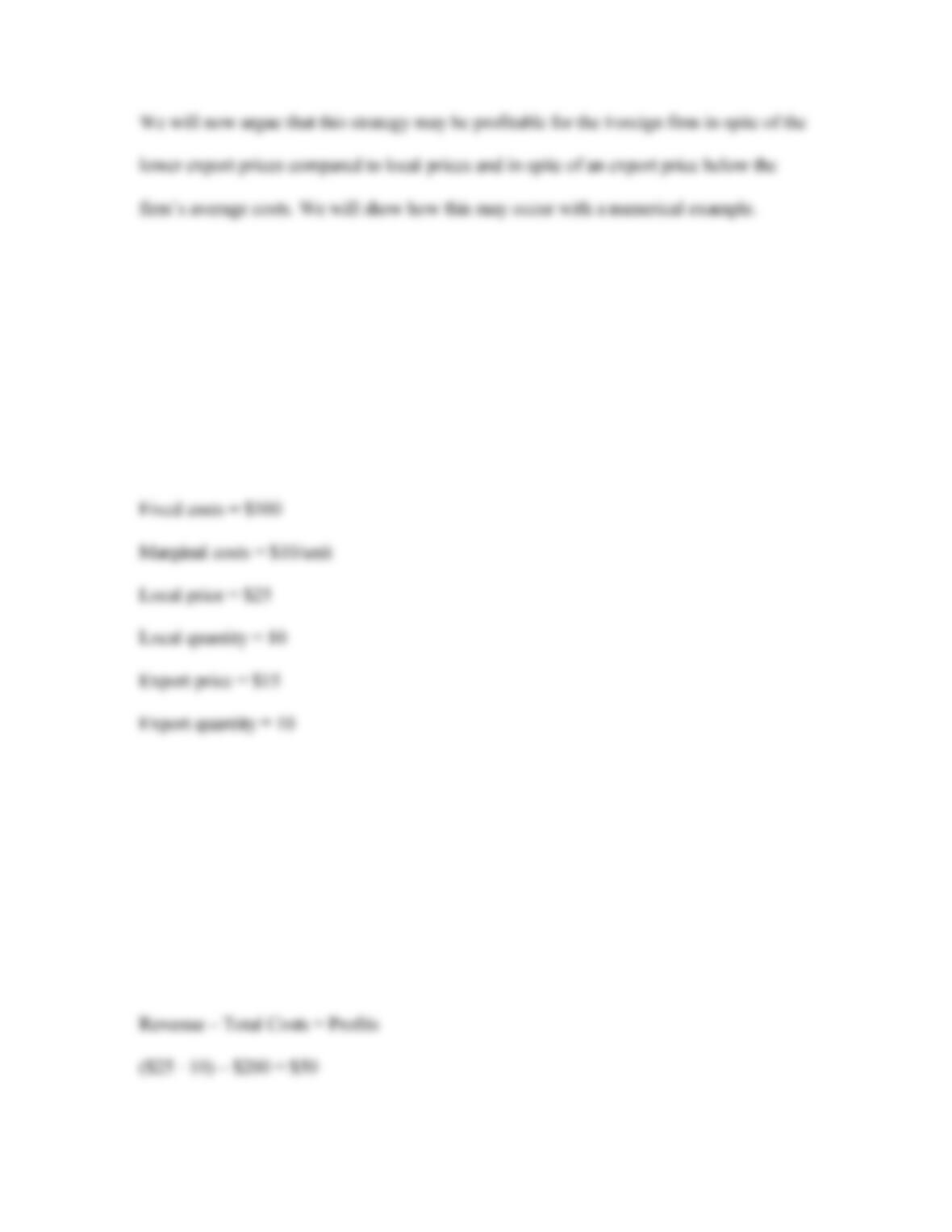
Numerical Example of Dumping
To understand why it is profitable for the Foreign firm to export the good at below-
average cost, we use the following hypothetical information pertaining to its costs and
demand.
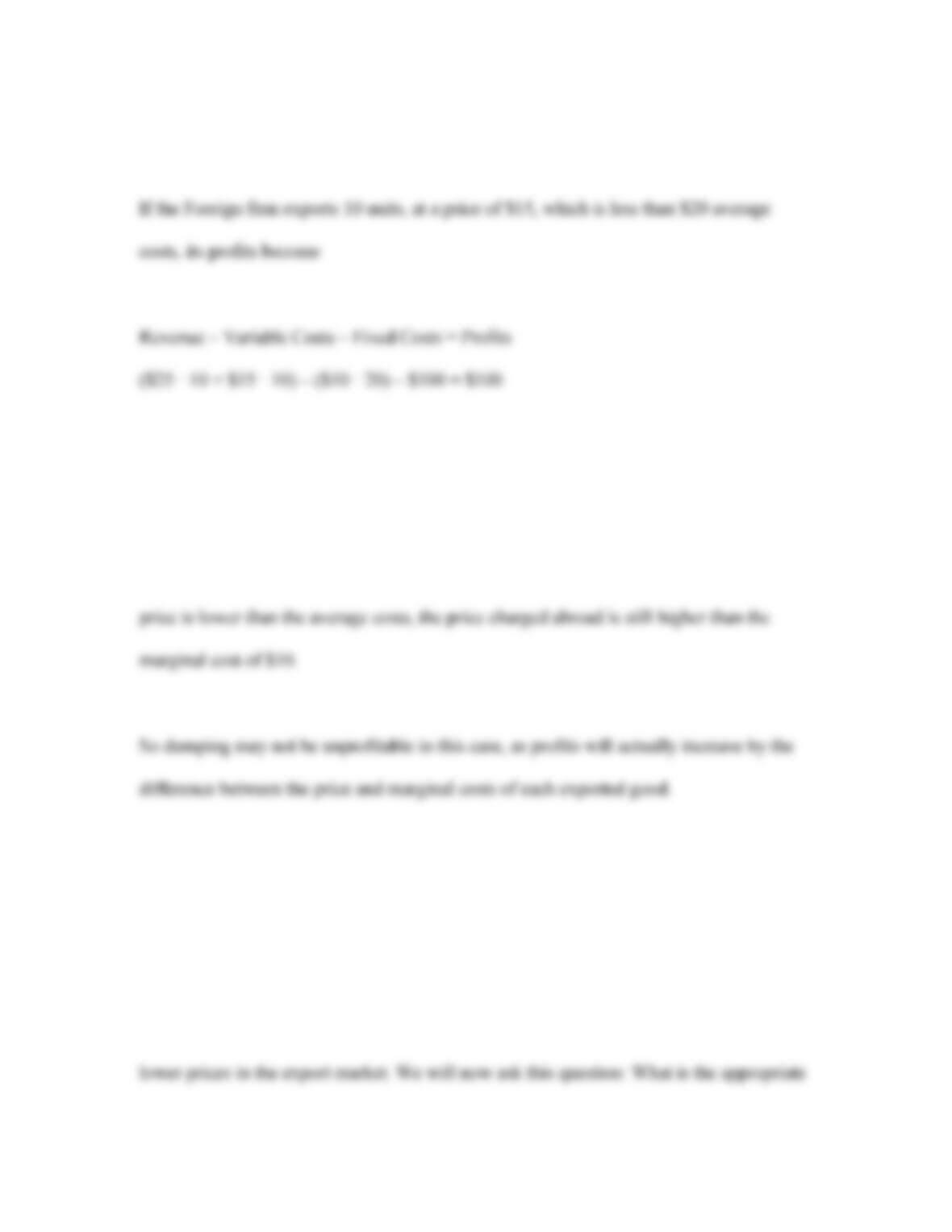
The firm’s total costs equal the sum of its fixed and variable costs:
Total Costs = Variable Costs + Fixed Costs = ($10 · 10) + $100
It follows that its average costs are ($200/10) = $20, and profits from selling only in the
local market are
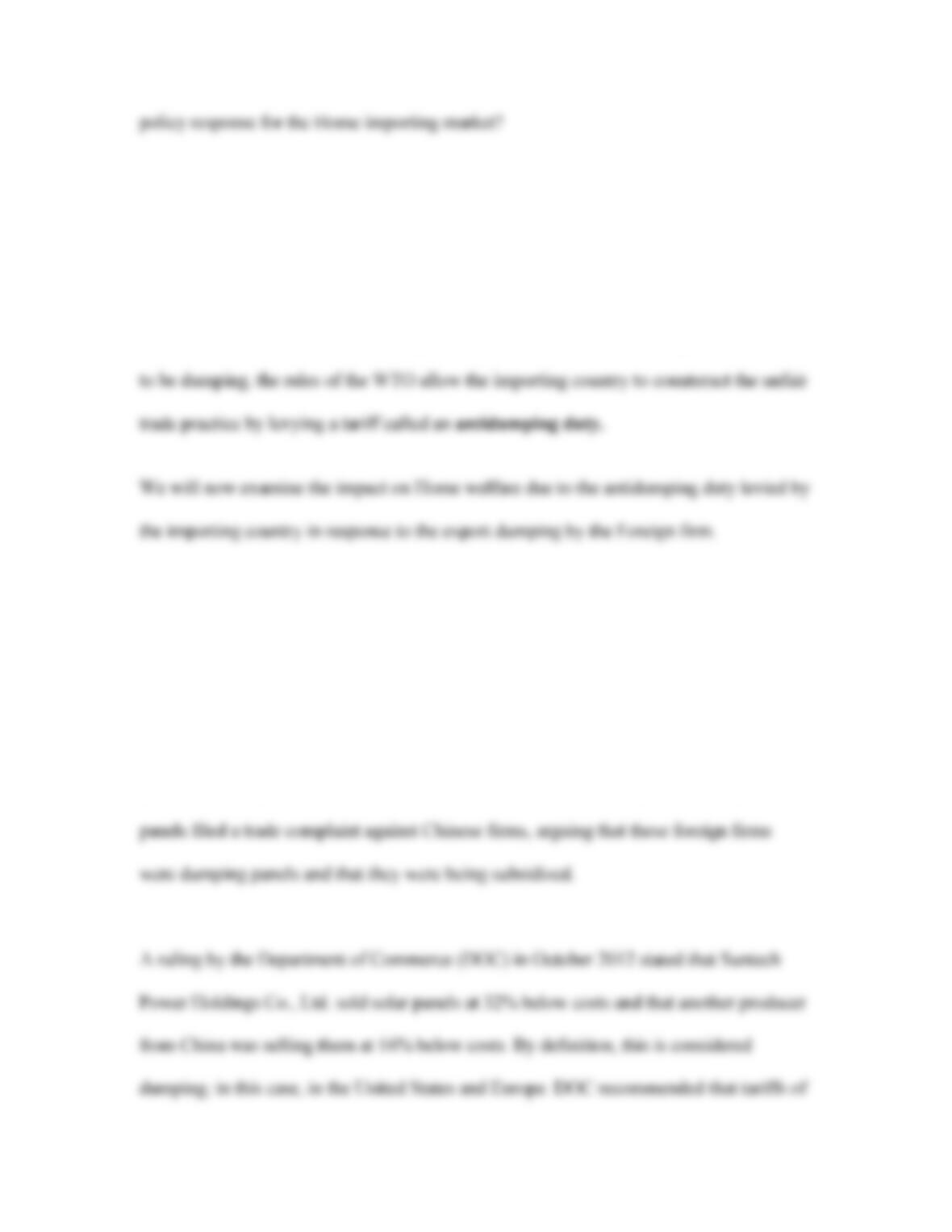
Therefore, the Foreign firm receives an additional $50 in profit by selling the 10 units
abroad, even though the average costs of production ($20) for those quantities are higher
than the exporting price ($15). The extra profit occurs because, although the exporting
4 Policy Response to Dumping
We know that dumping is not an unusual practice. We have also just learned that
dumping can be profitable for firms even when the prices charged are less than their
average costs. This could encourage firms to engage in price discrimination and charge
Antidumping Duties
A Foreign monopolist is considered to be dumping when its export price is less than its
average costs of production or it is selling more cheaply abroad than it does in its local
market (or a third market if the local price is unavailable). When a Foreign firm is found
A P P L I C A T I O N
U.S. and European Duties on Solar Panels from China
Beginning in 2009, the value of imports of solar panels from China to the United States
grew from $640 million to over $3 billion. During the same time period, American solar
panel firms had gone bankrupt. In October 2011, several U.S. companies selling solar
32% be implemented against Suntech and 24% against the second company.
The ITC made the final determination in November 2012, finding “material injury,” and
the tariffs then went into effect. This resulted in higher prices for panels and higher costs
to firms whose input required the panels. The European Union (EU) joined the effort and
Strategic Trade Policy? There are two reasons for implementing antidumping duties.
The first case involves the Foreign firm acting like a discriminating monopolist as
described above. By raising the price of the dumped product with a tariff equal to the
difference between the exporter’s local price and the import price, the importing country
is able to protect its domestic producers. Although the antidumping duty increases the
Comparison with Safeguard Tariff Contrary to the situation in which Japanese
producers of compact trucks treat the 25% tariff as fixed, a Foreign firm often has the
ability to influence the amount of the antidumping duty levied by changing the price of
its exporting product.
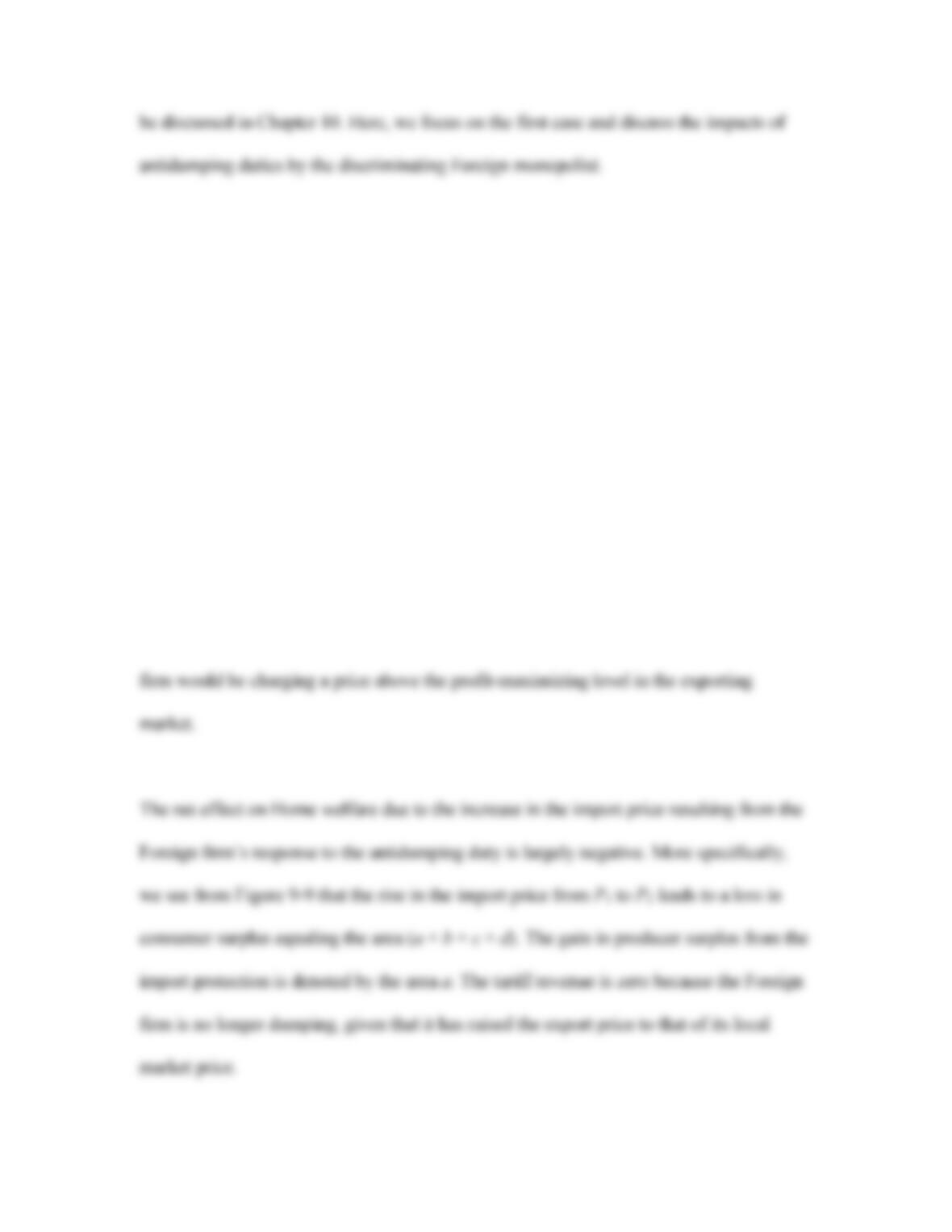
Calculation of Antidumping Duty Because the duty is equal to the difference between
the exporter’s local price and the dumped price, the Foreign firm can face a smaller tariff
by increasing the price charged abroad, creating strong incentives for doing so. In
particular, if it matches the exporting price to that of its local price, the duty would
effectively be nullified. However, doing so would decrease profits because the Foreign
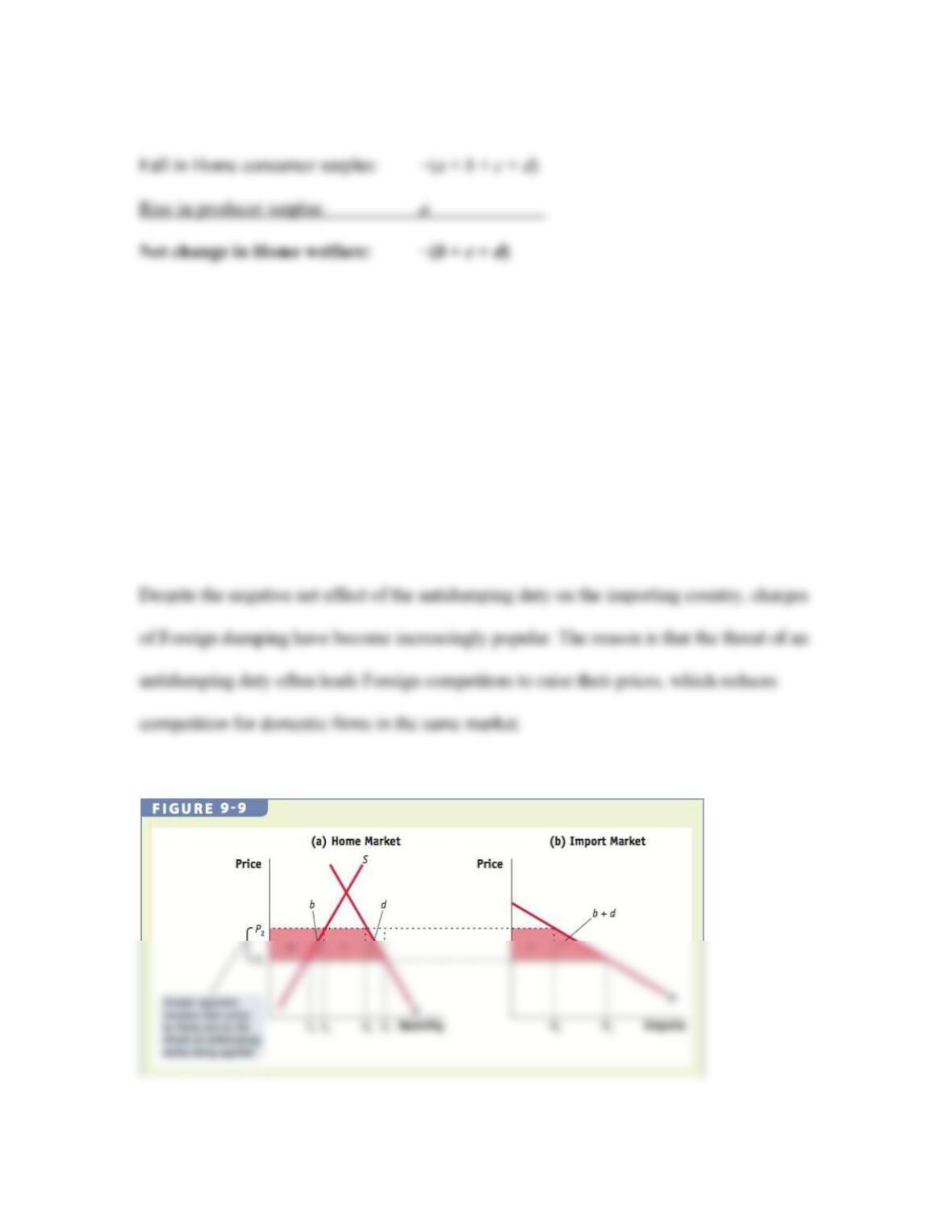
Thus, the overall effect of the exporting firm’s response to the antidumping duty is a net
loss for the Home country, represented by area (b + c + d). If the Foreign firm raises its
price, there is no government revenue. As a result, the loss generated (just by the threat
alone) of an antidumping duty is greater than the deadweight loss of a fixed tariff, which
would have been only area (b + d).
APPLICATION
Antidumping/Countervailing Duties Versus Safeguard Tariffs
The “safeguard” provision in Article XIX of the GATT and Section 201 of the U.S. trade
law, discussed in Chapter 8, allows a domestic firm temporary relief from foreign
competition when it is determined that rising imports are the “most important cause of
In contrast to the infrequent use of safeguard or escape clauses, more than 1,228
antidumping cases were filed in the United States in the same period from 1980 to 2011.
The reason for their popularity is that the procedure necessary for tariff protection is
relatively easier. In an antidumping case, the DOC first determines whether the imported
good is sold at “less than fair value” compared with the exporting firm’s own market
price or the average cost of production. The duties are applied when the ITC determines
that the import caused “material injury” to the domestic industry. This condition is less
strict than the guideline necessary for the safeguard tariff, which requires that the rising
import be a “substantial cause of serious injury.” Moreover, the president does not need
to approve the case before the antidumping duty can be applied. As a result, 548 of the
1,228 antidumping cases received tariff protection.
The incentive to file dumping claims becomes evident when we note their potential
benefits to the domestic producer. Namely, there is a relatively high success rate of
obtaining tariff protection. Furthermore, a domestic firm is given permission to
coordinate prices and market shares with its foreign competitor once the case is
withdrawn. Import competition is also lessened when a case is unsuccessful, because
5 Infant-Industry Protection
Aside from politics and the large-country case, a country may impose an import tariff to
allow its import-competing industry to become more competitive by lowering costs or
A successful protection is one in which the infant industry is able to increase future
output in an environment whereby it may not have the opportunity otherwise to survive
without the tariff. Such an environment may be caused by imperfection in the capital
market. Namely, a firm is unable to secure loans to cover losses in the current period
even with the potential of profits in the future. Another justification for infant-industry
protection is when there is a positive externality in the form of knowledge spillover
To analyze this case, we assume a Home monopoly. And we assume that this monopoly
will realize lower costs tomorrow if allowed to increase its output today—that by giving
the firm time to mature, it will learn how to produce more efficiently. The question is
should the government protect the industry today in order to allow it to survive long
enough to realize the gains from a more efficient production tomorrow?
Note that this is not a case of realizing increasing returns to scale by moving along a
decreasing average cost curve to greater output levels where costs are less. In this case,
once the tariff is removed, production would return to its original lower levels of output
Although it may be argued that the firm could simply borrow to cover its losses today and
pay back the loan with profits made tomorrow, this is often not possible due to the risks
faced by banks that the infant may not mature and eventually realize enough profits to
repay the loans. This market imperfection could be viewed as a Home capital market
a tariff in place, it is possible to offset the externality by increasing production, which
enables and supports the knowledge spillovers, thereby allowing cost reductions across
all firms.
In both cases, market failure is assumed and tariffs or quotas may help to correct this
market imperfection. The market failure in the first case addresses a shortage of bank
loans whose shortage increases the likelihood of bankruptcy for the infant firm. The
failure in the second case addresses the inability of the infant firm to protect its
intellectual knowledge through patents, which would allow it to be compensated for its
knowledge spillover.
However, we know that governments that attempt to address market failures often do so
inefficiently. If banks have knowledge that the infant may not be profitable in the future,
how is the government in any better position to challenge its kind of banking expertise?
And in the case of spillovers, the government may not have any special knowledge that
would enable it to estimate the value of such knowledge spillovers.
What we can conclude nonetheless is that although some form of market failure is a
Free–Trade Equilibrium
To more formally develop the case for infant-industry protection, we begin by assuming
that Home is a small-importing country facing fixed world prices. We know from
previous analysis that a Home monopolist will behave like a competitive firm under free
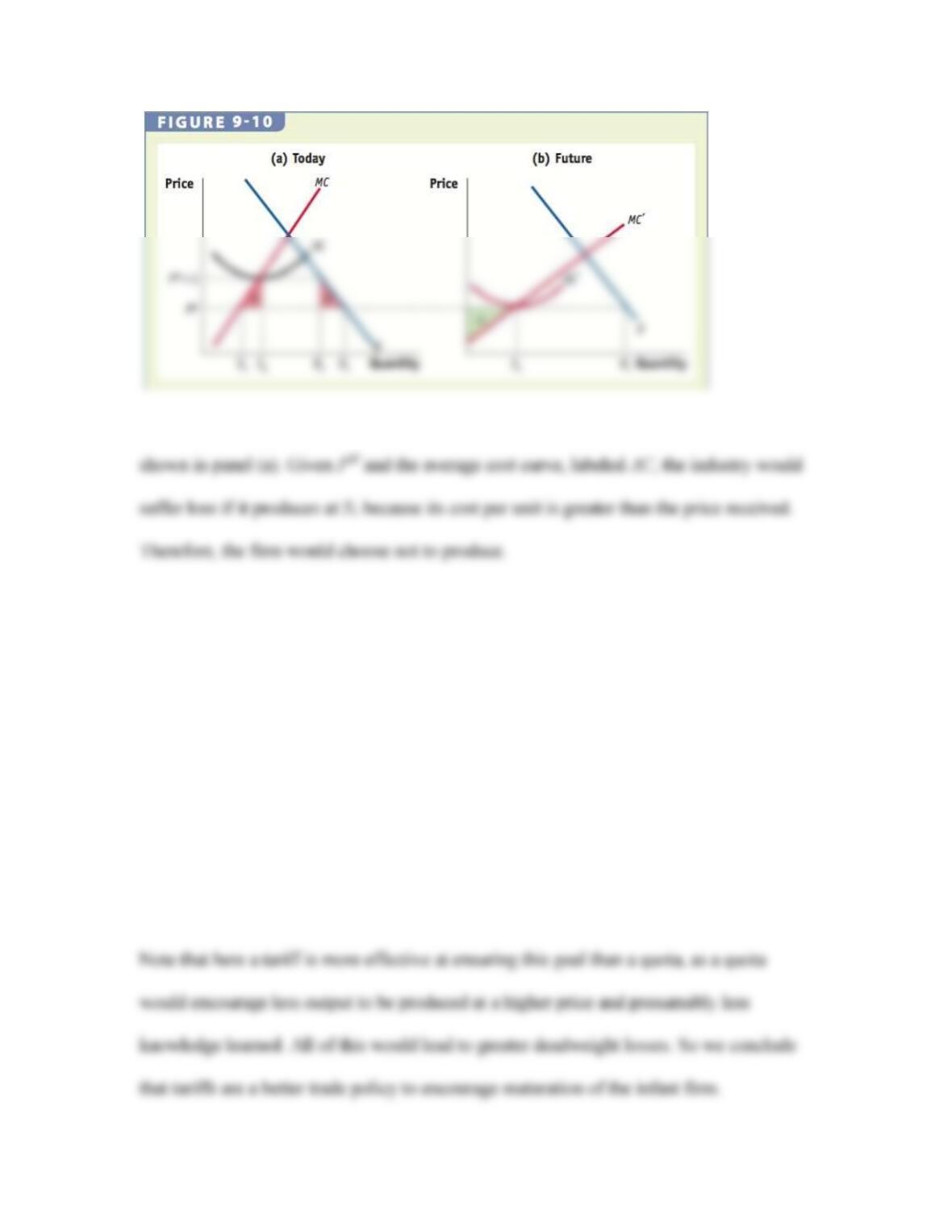
Equilibrium Today Today, the industry faces the world price of PW under free trade as
Tariff Equilibrium
However, if the government imposes a tariff in the amount of t to protect the infant
industry, then the domestic price increases from PW to PW + t, which equals the firm’s
average total cost. It is assumed that by providing the tariff, the firm could learn better
production techniques by producing at the greater levels of output, thereby lowering its
costs in the future.
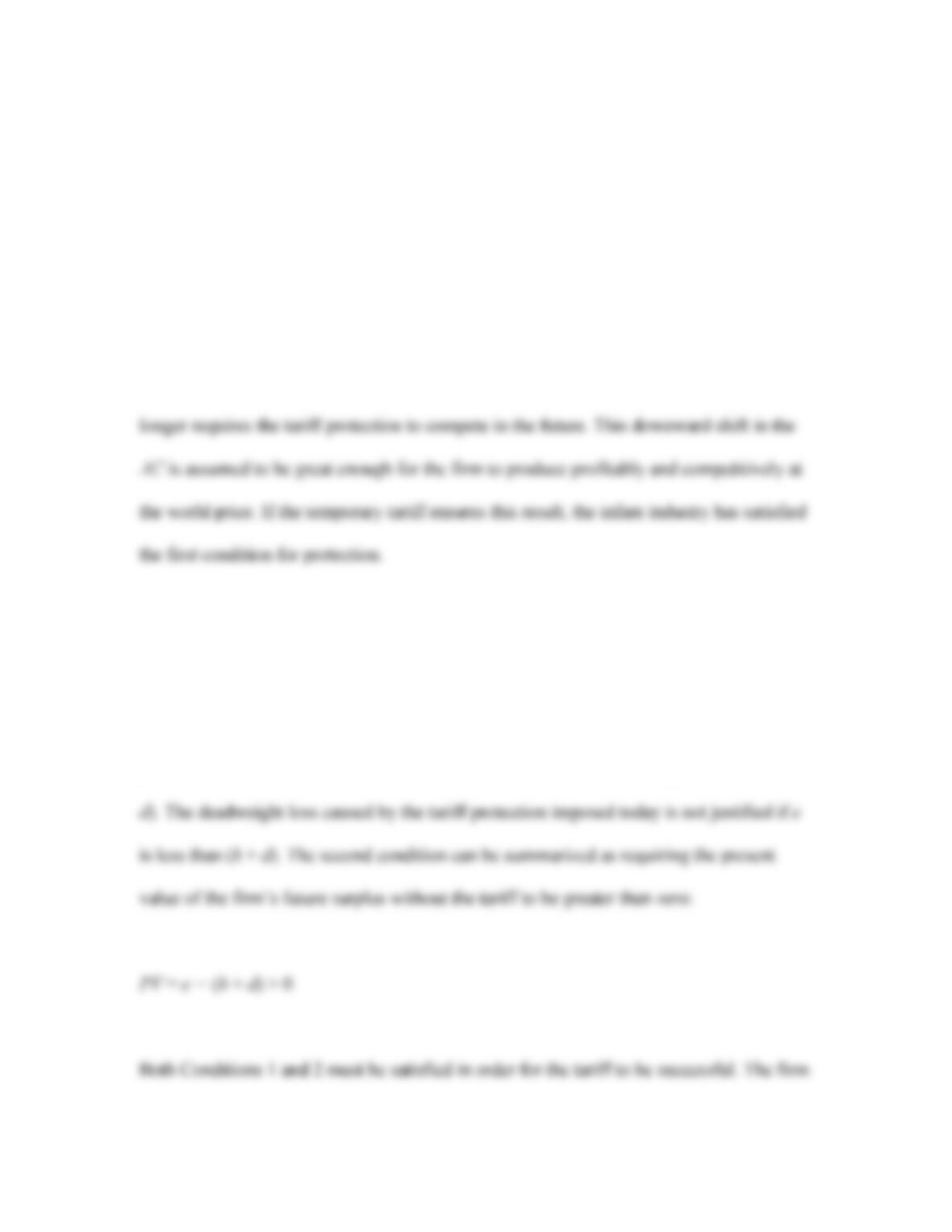
Equilibrium Today At the higher price, the industry earns zero profit rather than a loss.
Consequently, the industry produces S2 at lower average costs, and through learning by
doing, it will be able to become more efficient.
Equilibrium in the Future The resulting future efficiency is represented by the lower
average cost curve labeled AC
′
in panel (b). With the lower average costs, the industry no
Effect of the Tariff on Welfare To analyze the effect of the tariff on welfare, we need to
compare the deadweight loss today due to the tariff, denoted by the triangles (b + d) in
panel (a) of Figure 9-10 and the future gain in producer surplus represented by area e in
panel (b). The second condition for infant-industry protection is if e is greater than (b +
APPLICATION
Examples of Infant-Industry Protection
We examine four examples of infant-industry protection in this Application:
1. Solar panel industry policies in the United States, Europe, and China
2. U.S.–imposed tariffs in the heavyweight motorcycles industry
Government Policies in the Solar Panel Industry Subsidies to consumers who install
solar power panels in their homes should not be viewed as a form of infant–industry
protection to the solar panel industry because subsidizing them is a way of addressing the
externalities from generating electricity through burning fossil fuels. By subsidizing
Subsidies in the United States On the other hand, subsidies that encourage solar panel
production via tax breaks, low-interest loans, or loan guarantees are an example of infant–
industry protection. President Barack Obama engaged in this type of protection by
Subsidies in China Another example of unsuccessful cases of infant-industry protection
occurred in China. The Chinese also pursued similar trade policies for solar panels via
export subsidies. Export subsidies act much like import tariffs and carry deadweight
losses. Infant-industry protection is considered successful if once the export subsidy is
Import Duties in Europe and the United States Import duties were applied by
SolarWorld, a German firm with subsidiaries in the United States. These duties were
applied in the EU and U.S. in the form of antidumping measures. The German firm
increased production as a result of the measures, just as predicted, but, again as predicted,
it came at a cost to consumers, who in this case were companies that purchased panels for
Ultimately, the protections led to the installers producing their own panels to avoid the
higher prices of SolarWorld. This is a unique case of technology transfer. Remember, for
an infant industry to be successful, one condition is that learning occurs that results in
U.S. Tariff on Heavyweight Motorcycles
Partly due to a global price war between Honda and Kawasaki, two Japanese motorcycle
producers, inventories of imported heavyweight cycles increased substantially in the
United States during the early 1980s. As a result of lagging productivity and fierce
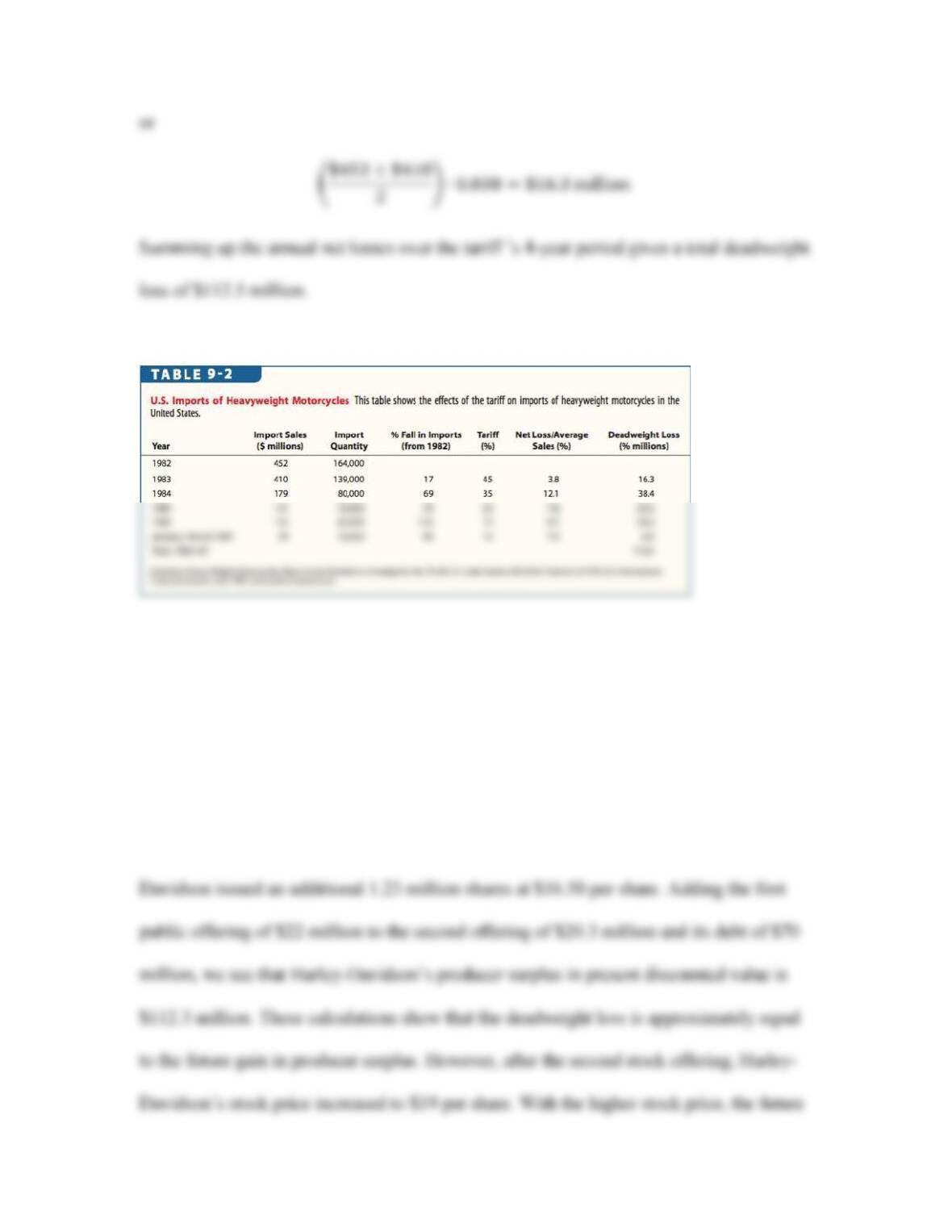
Calculation of Deadweight Loss Although Harley-Davidson requested that the import
tariff end earlier than scheduled, a comparison of the deadweight loss due to the tariff
against the potential gain in producer surplus is needed to more accurately study the
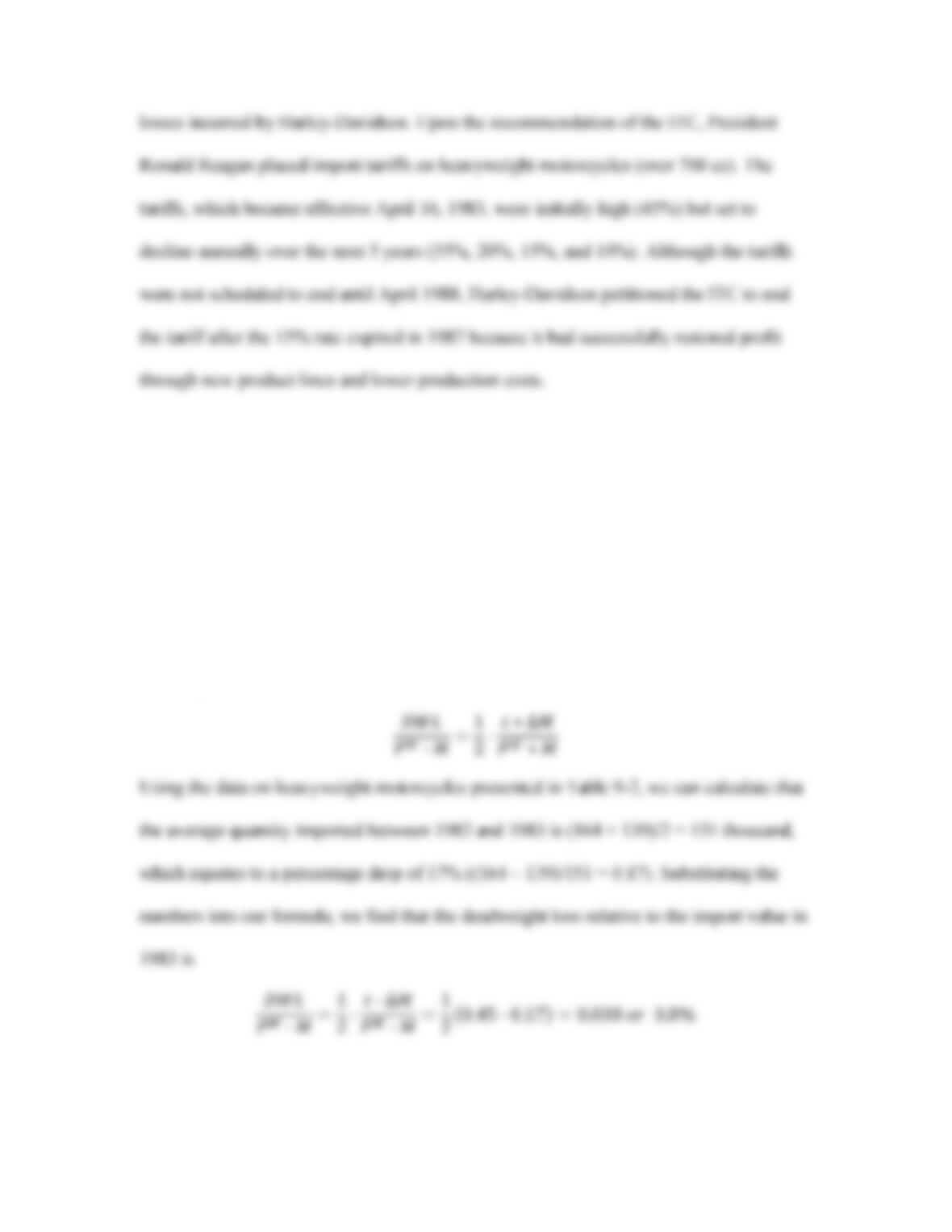
welfare implications of the heavyweight motorcycle protection. We will use the formula
developed earlier, which measures the deadweight loss relative to the import value
resulting from the tariff:
The deadweight loss in 1983 is the average import sales over 1982 and 1983 times 3.8%,
Future Gain in Producer Surplus Next we will calculate the future gain in producer
surplus to compare the value to the deadweight loss of $113 million. More specifically,
we will measure the future gains in producer surplus by examining Harley-Davidson’s
stock market value during the removal of the tariff protection. Harley-Davidson’s initial
public offering in July 1986 was 2 million shares at $11 per share. In June 1987, Harley-
Was Protection Successful? Our calculations imply that the tariff protection increased
welfare for the United States because the deadweight loss is less than the future gain in
producer surplus. However, there are doubts as to whether the heavyweight motorcycle
tariff was indeed successful. If Harley-Davidson had not been able to survive without the
Computers in Brazil
Between 1977 and the early 1990s, the Brazilian military government protected its
domestic computer industry through a ban on imports of personal computers (PCs) and
computer parts. In addition, it prevented foreign firms from producing computers in
Prices in Brazil Computer prices, adjusting for improvements in speed, storage, and so
forth, are shown in Figure 9-11 for Brazil and the United States for 1982 to 1992. The