Basic Econometrics, Gujarati and Porter
91
CHAPTER 9:
DUMMY VARIABLE REGRESSION MODELS
9.1 (a) If the intercept is present in the model, introduce 11 dummies.
9.2 (a) As per economic theory, the coefficients of X
2
, X
5
are expected
(b) Holding all other factors constant, one would expect that desired
(c) Perhaps, this is due to collinearity between age and education, as
9.3 (a) The relationship between the two variables is expected to be
92
9.4 The results show that the average price was higher by $5.22 per
9.5 (a): Male Professor:
( ) ( )
E Y X
α α β
= + +
(b) Male Professor:
1 2
( ) ( 2 )
i i
E Y X
α α β
= + +
(c) Male Professor
1 2
( ) ( )
i i
E Y X
α α β
= − +
9.6 Following Chapter 8, we can use the t test as follows:
Basic Econometrics, Gujarati and Porter
93
For exactly the same reasoning, to test the hypothesis that the
9.7
(a) & (b):The standard errors of the coefficients of the regression
(9.5.6) can be directly obtained from (9.5.4). But to obtain the
9.8
(a) Neglecting the dummies for the moment, since this is a double
Basic Econometrics, Gujarati and Porter
94
(b) & (c): Since the regressand is in the log form, we have to
dummy coefficients are to be interpreted similarly.
.
9.9
(a) & (c): Ceteris paribus, if the expected inflation rate goes up by 1
percentage point, the average Treasury bill rate (TB) is expected to
go down by about 0.13 percentage point, which does not make
` (b) In late 1979 the then Governor of the Federal Reserve System,
9.10
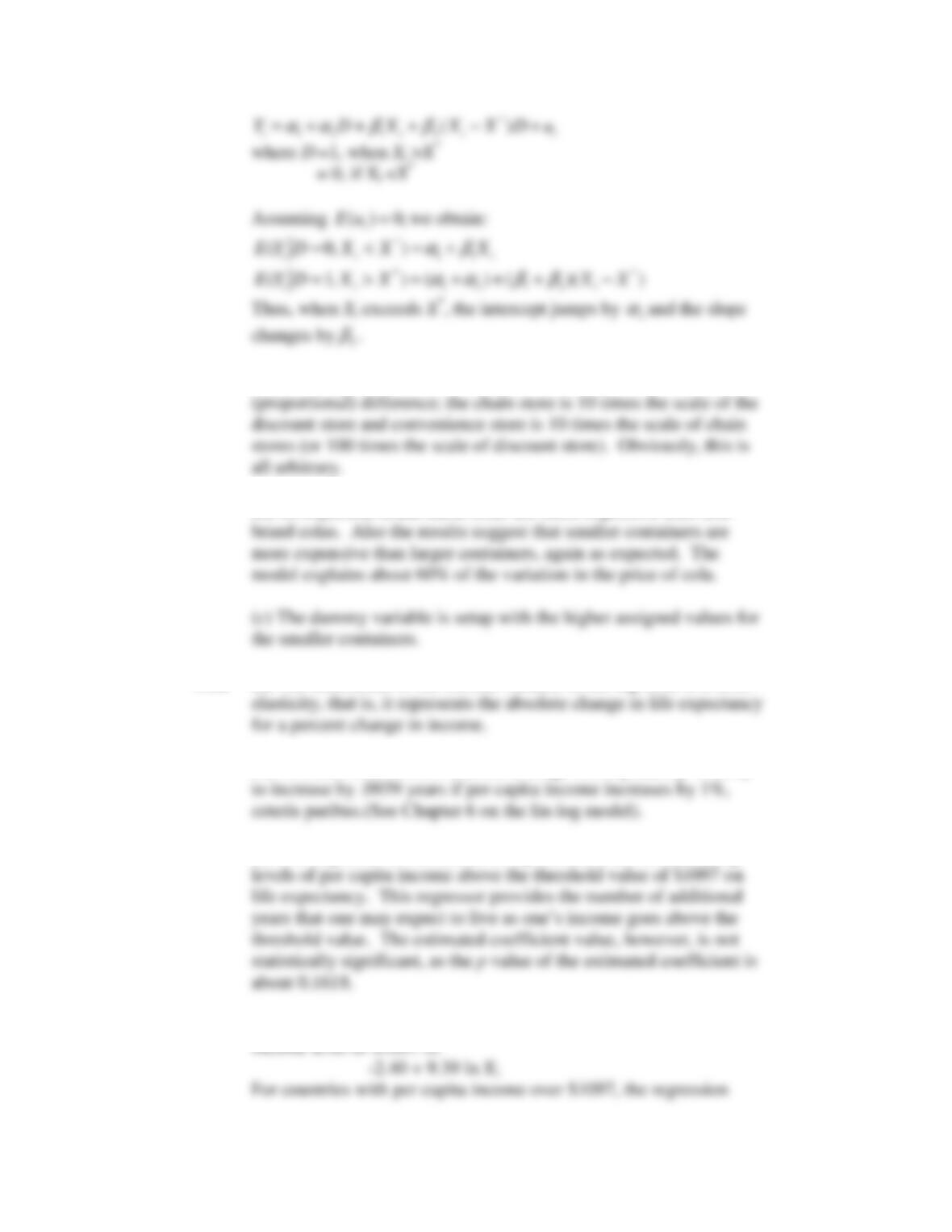
Write the model as:
Basic Econometrics, Gujarati and Porter
95
9.11
(a) This assignment of the dummy variables assumes a constant
(b) As expected, brand name colas are more expensive than non–
9.12
(a) The coefficient of the income variable in the log form is a semi-
(b) This coefficient shows that the average life expectancy is likely
(c) This regressor is introduced to capture the effect of increasing
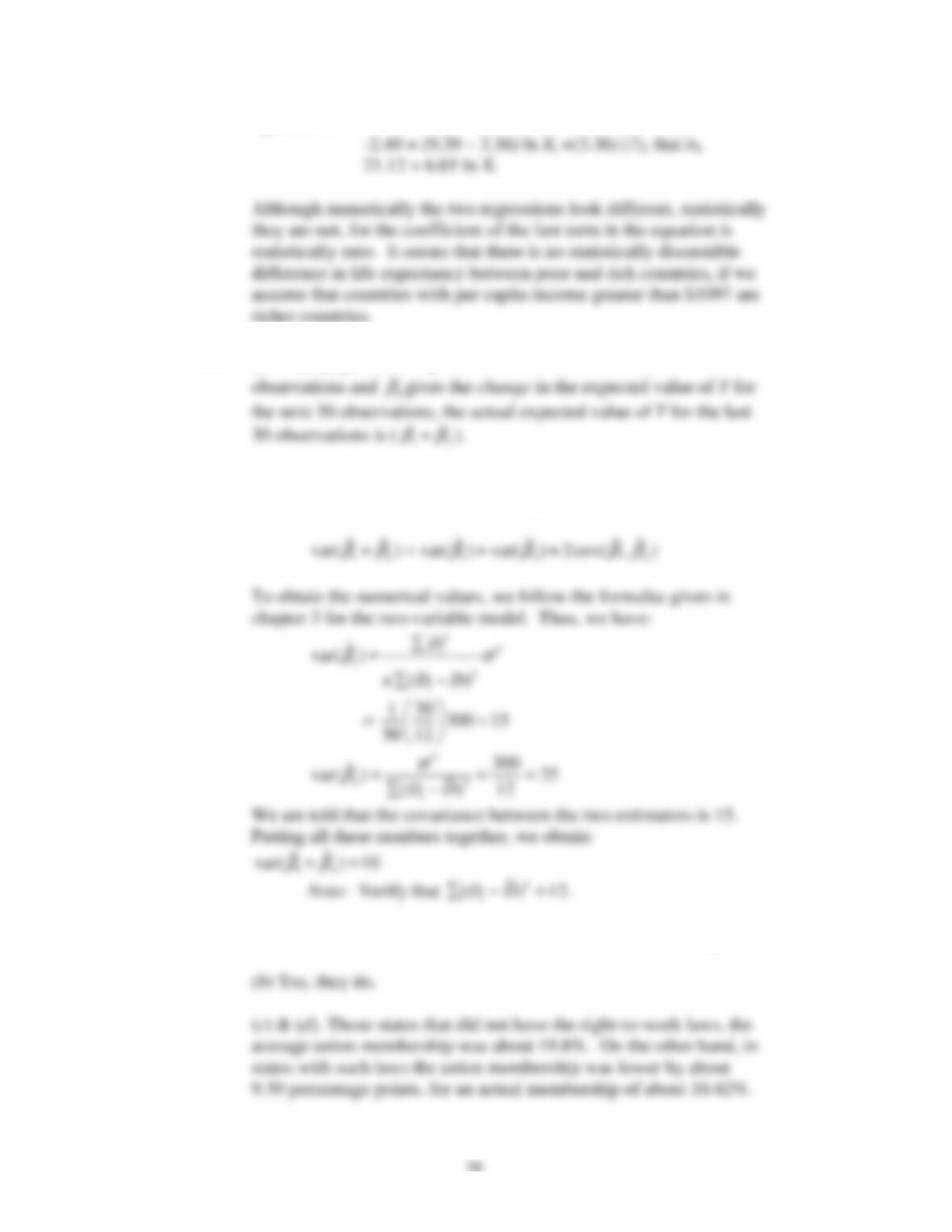
(d) The regression equation for countries below the per capita
Basic Econometrics, Gujarati and Porter
equation is:
9.13
(a)& (b).
1
β
gives the expected value of Y for the first 20
(c) From the well-known formula to find the sum or difference of
two or more random variables (See App. A), it can be shown that
9.14
(
a
) The expected relationship between the two variables is negative.
97
9.15
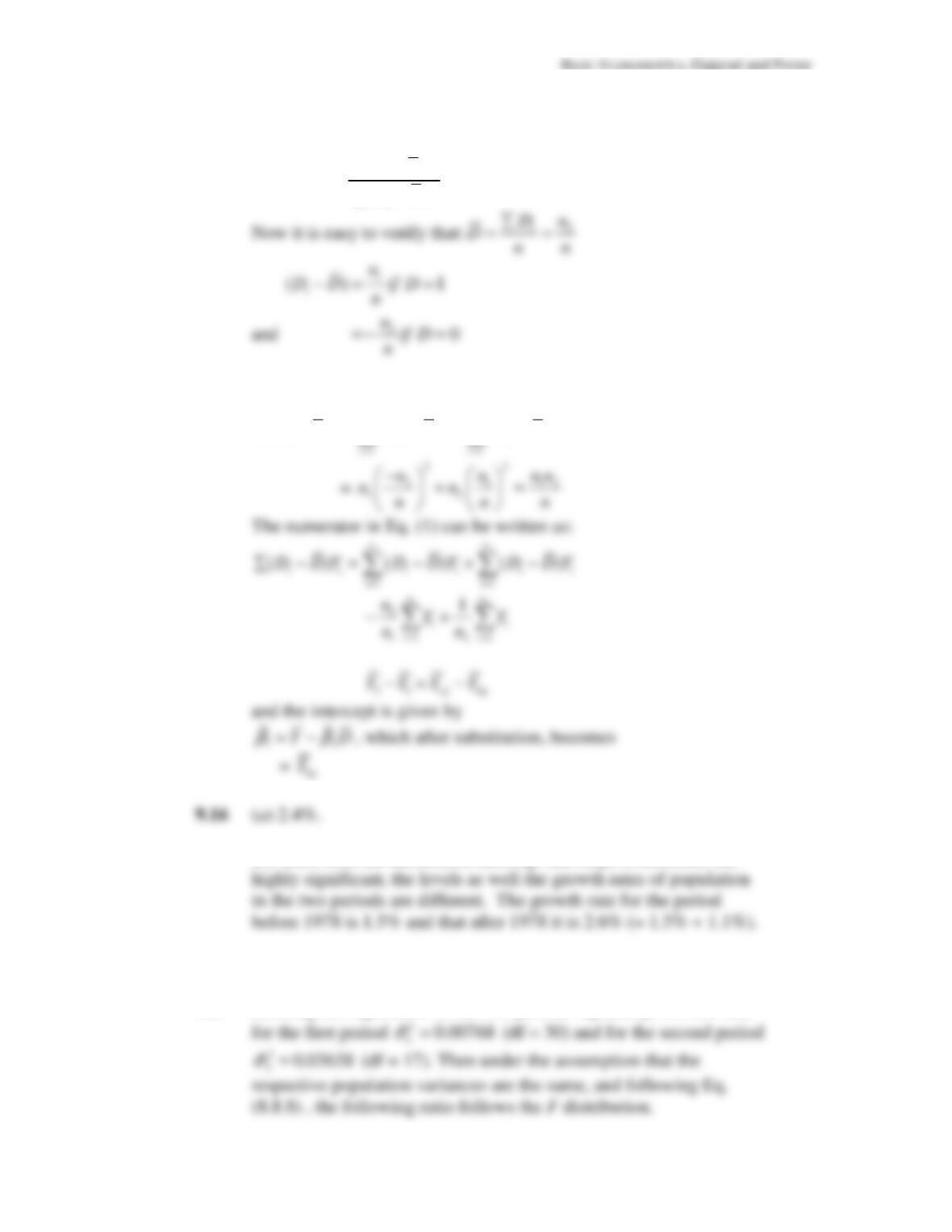
From the OLS formulas given in Chapter 3, we know that:
2
2
( )
ˆ
( )
i i
i
D D Y
D D
β
∑−
=∑−
(1)
Now the denominator in Eq. (1) can be written as:
1 2
2 2 2
( ) ( ) ( )
n n
i i i
D D D D D D
∑
− = − + −
∑ ∑
(b) Since both the differential intercept and slope coefficients are
Empirical Exercises
9.17
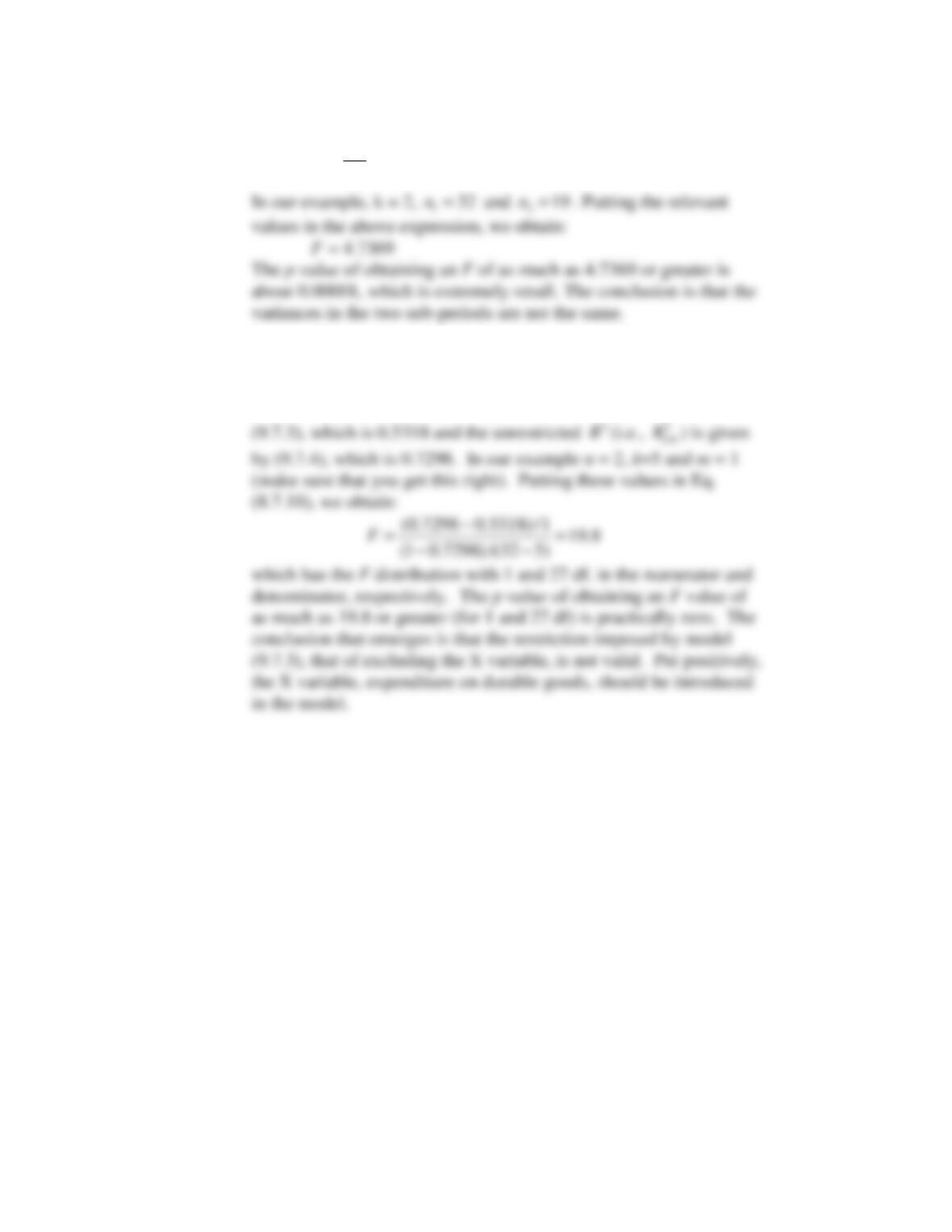
Running the regression for the two periods separately, we find that
Basic Econometrics, Gujarati and Porter
98
1 2
2
2
( ),( )
2
1
ˆ
ˆ
n k n k
F F
σ
σ
− −
=
∼
9.18
Since the dependent variable in models (9.7.3) and (9.7.4) is the
same, we can use the
2
R
version of the F test given in Eq. (8.7.10).
In the present instance, the restricted
2
R
(i.e.,
2
R
R
) is obtained from
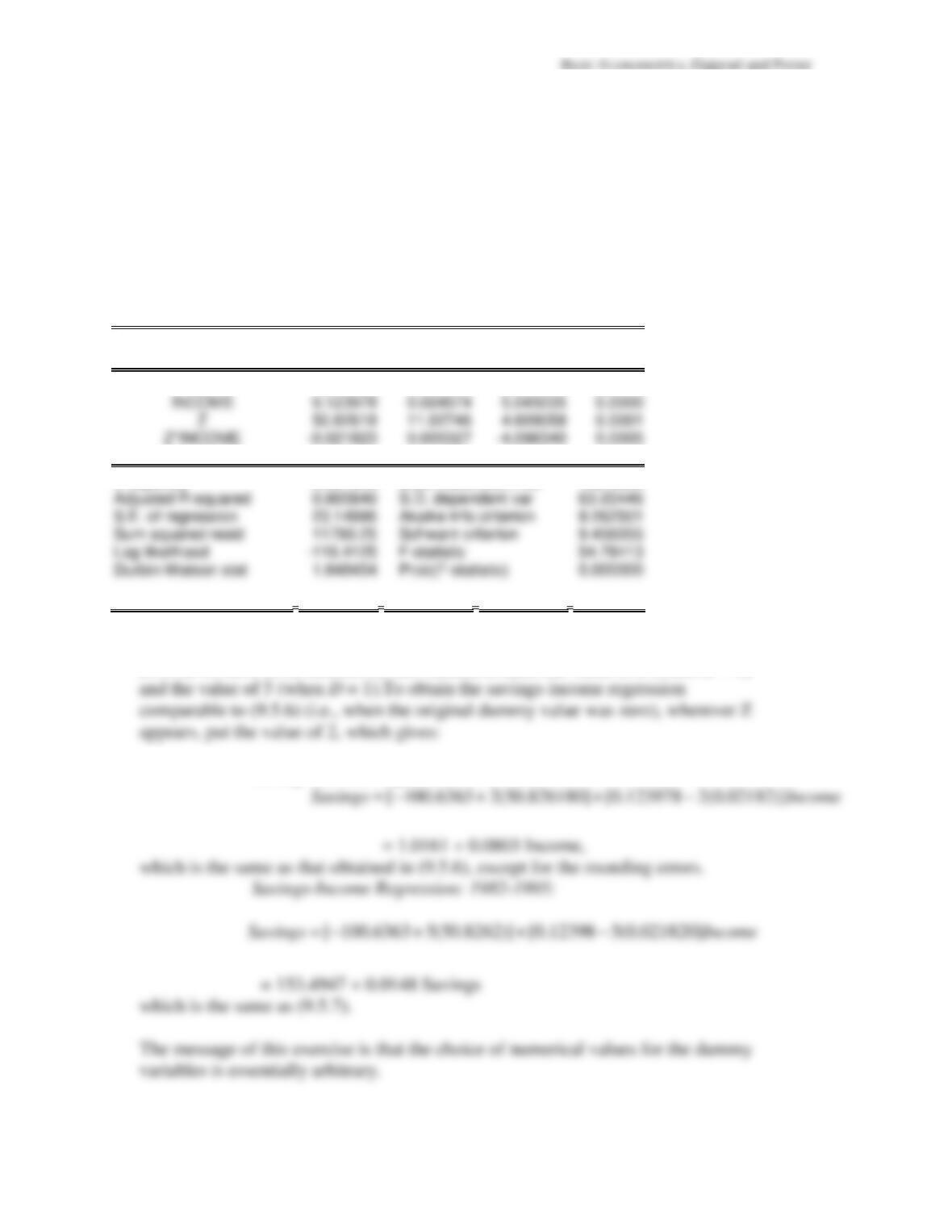
99
9.19
In this case the dummy variable Z takes the value of 2 when D= 0
and it takes the value of 5 when D = 1. Using this dummy
assignment, we get the following regression results:
Dependent Variable: SAVINGS
Method: Least Squares
.
Sample: 1970 1995
Included observations: 26
Variable Coefficient
Std. Error
t-Statistic
Prob.
C -100.6363
37.88404
-2.656429
0.0144
R-squared 0.881944
Mean dependent var 162.0885
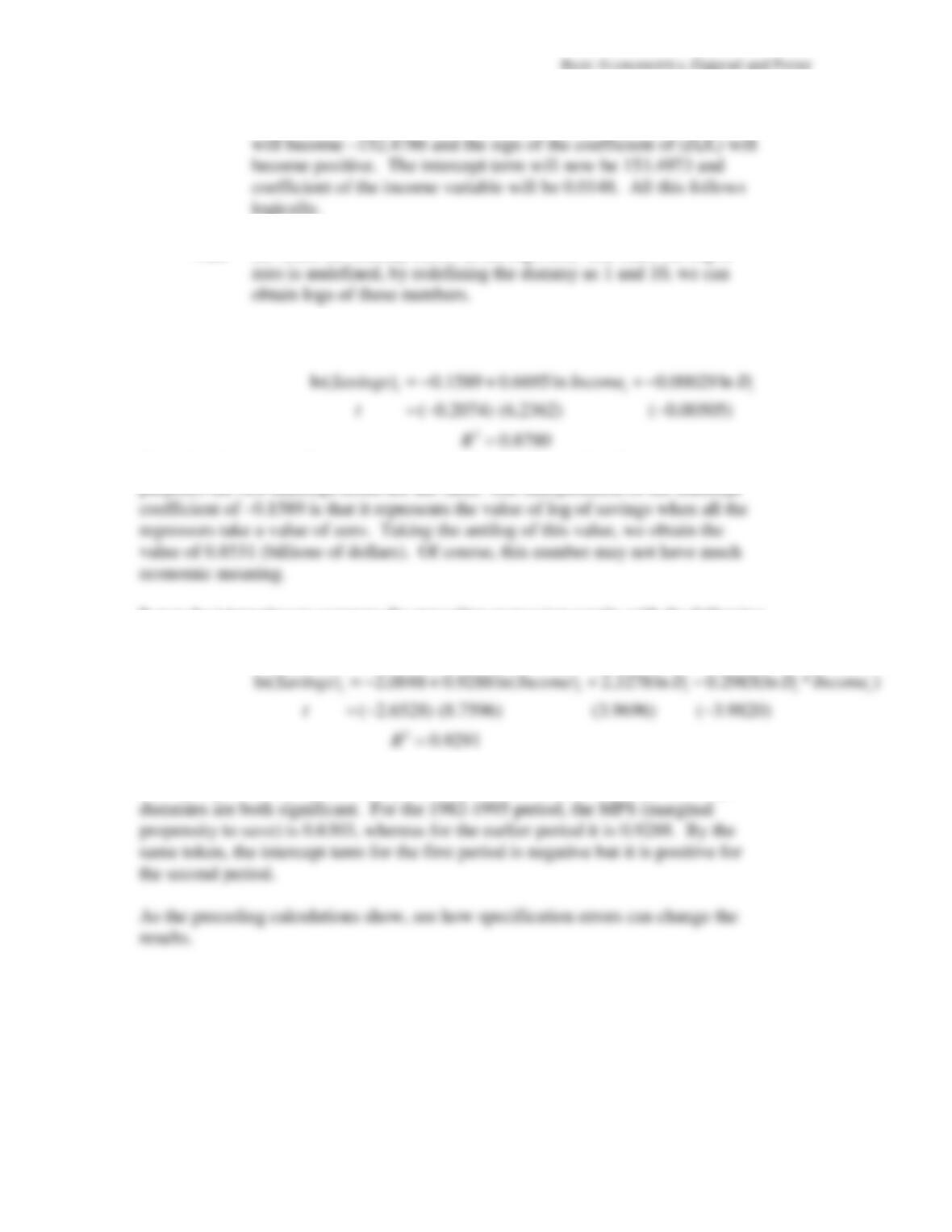
Now in comparing the preceding results with those given in (9.5.4), (9.5.6) and
(9.5.7), we have to be careful, for the variable Z takes the value of 2 (when D = 0)
Savings-Income Regression 1970-1981:
100
9.20
As you would suspect, the sign of the dummy coefficient in (9.5.4)
9.21
(
a
) Since the dummy enters in the log form, and since the log of
(
b
) The regression results are as follows (
t
values in parentheses):
Since the dummy coefficient is not statistically significant, for all practical
purposes the two intercept terms are the same. The interpretation of the intercept
It may be interesting to compare the preceding regression results with the following
results, which allow for the interaction effect:
Now you get an entirely different picture, for the differential intercept and slope
9.22
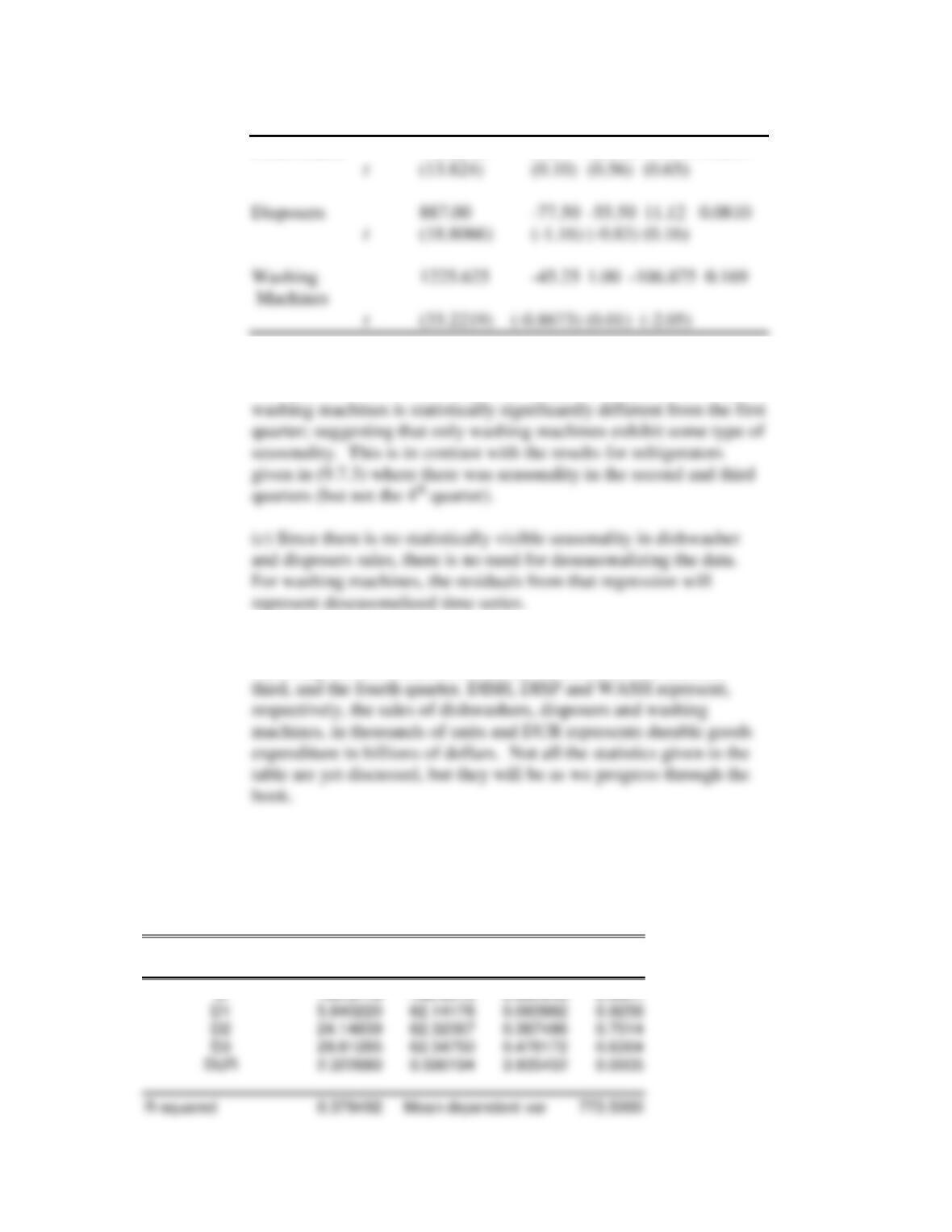
(a) We present the results for the three appliances in the following
tabular form:
Basic Econometrics, Gujarati and Porter
101
Type of Appliance Intercept D
2
D
3
D
4
R
2
Dishwashers 748.2500 8.25 42.875 49.875 0.0219
(b) The “slope” coefficients are in fact differential intercepts, with
first quarter as the reference quarter. Only the 4
th
quarter dummy for
9.23
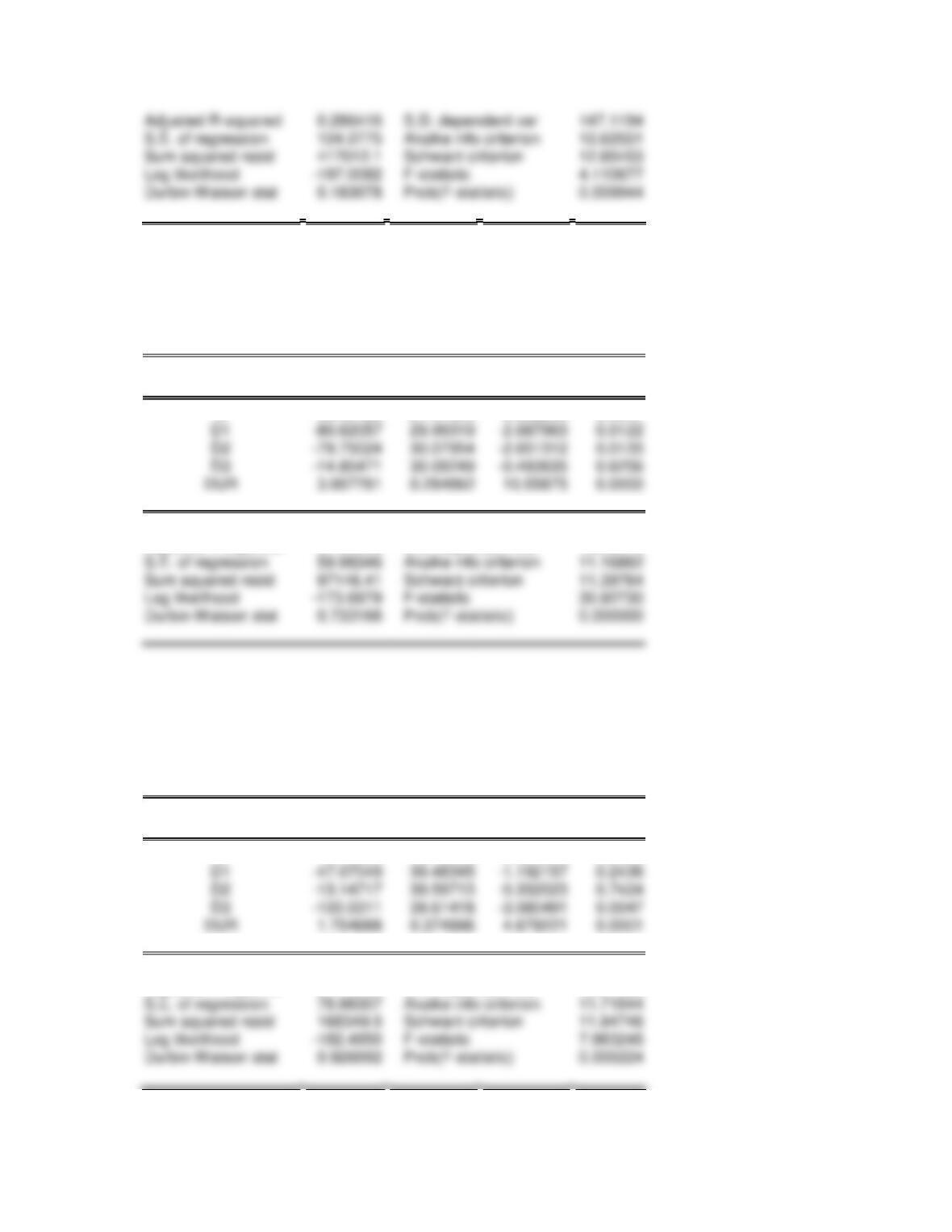
The regression results, obtained from EViews are as follows: In the
following table, D
1
, D
2
and D
3
are the dummies for the second,
Dependent Variable: DISH
Method: Least Squares
.
Sample: 1978:1 1985:4
Included observations: 32
Variable Coefficient
Std. Error
t-Statistic
Prob.
Basic Econometrics, Gujarati and Porter
102
Dependent Variable: DISP
Method: Least Squares
.
Sample: 1978:1 1985:4
Included observations: 32
Variable Coefficient
Std. Error
t-Statistic
Prob.
C 56.40125
81.47305
0.692269
0.4947
R-squared 0.820847
Mean dependent var 856.5312
Adjusted R-squared 0.794306
S.D. dependent var 132.2576
Dependent Variable: WASH
Method: Least Squares
.
Sample: 1978:1 1985:4
Included observations: 32
Variable Coefficient
Std. Error
t-Statistic
Prob.
C 741.0680
107.2523
6.909578
0.0000
R-squared 0.541230
Mean dependent var 1187.844
Adjusted R-squared 0.473264
S.D. dependent var 108.7996
Basic Econometrics, Gujarati and Porter
103
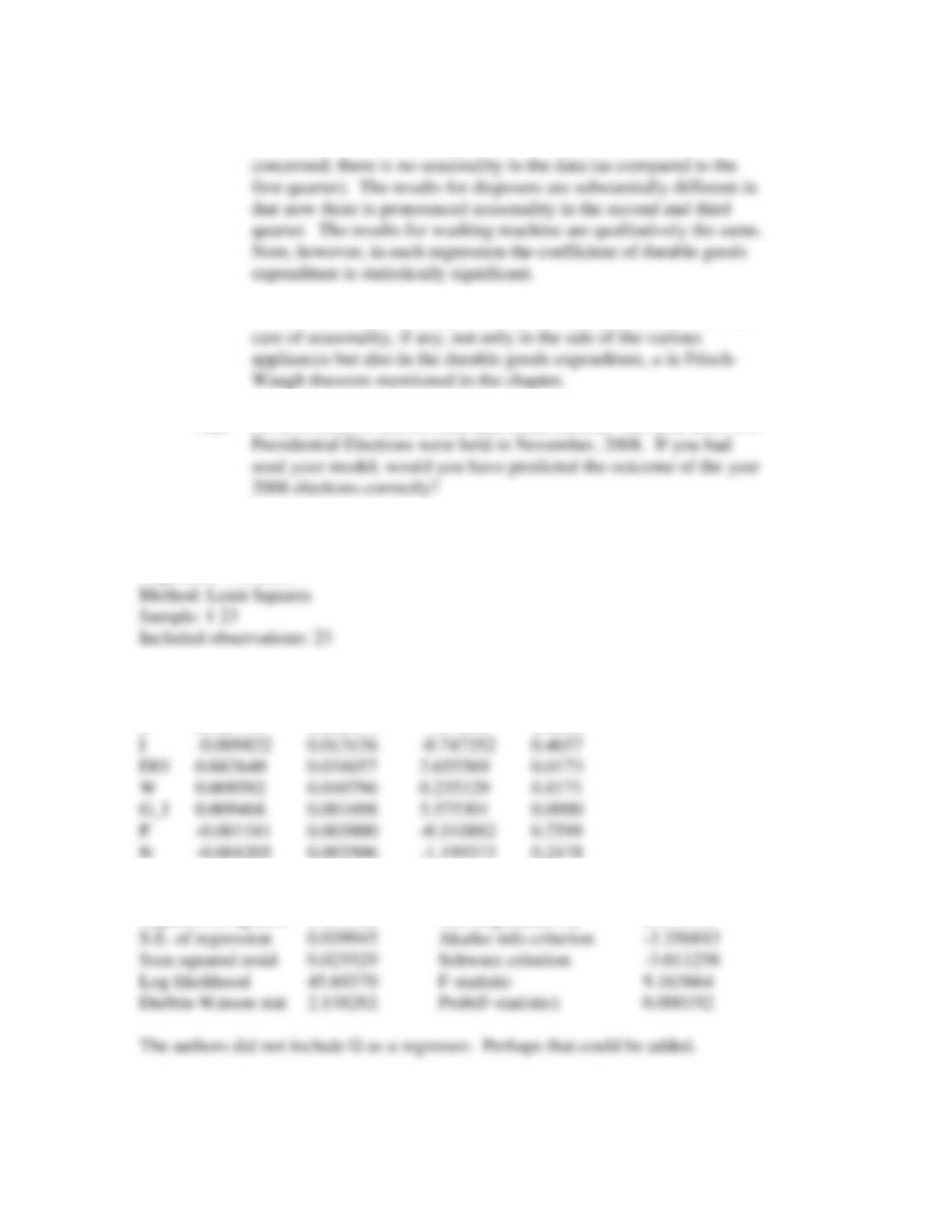
(b) The addition of expenditure on durable goods in the equation for
dishwashers does not change results insofar as seasonality is
(c) The inclusion of dummy variables in the regression model takes
9.24
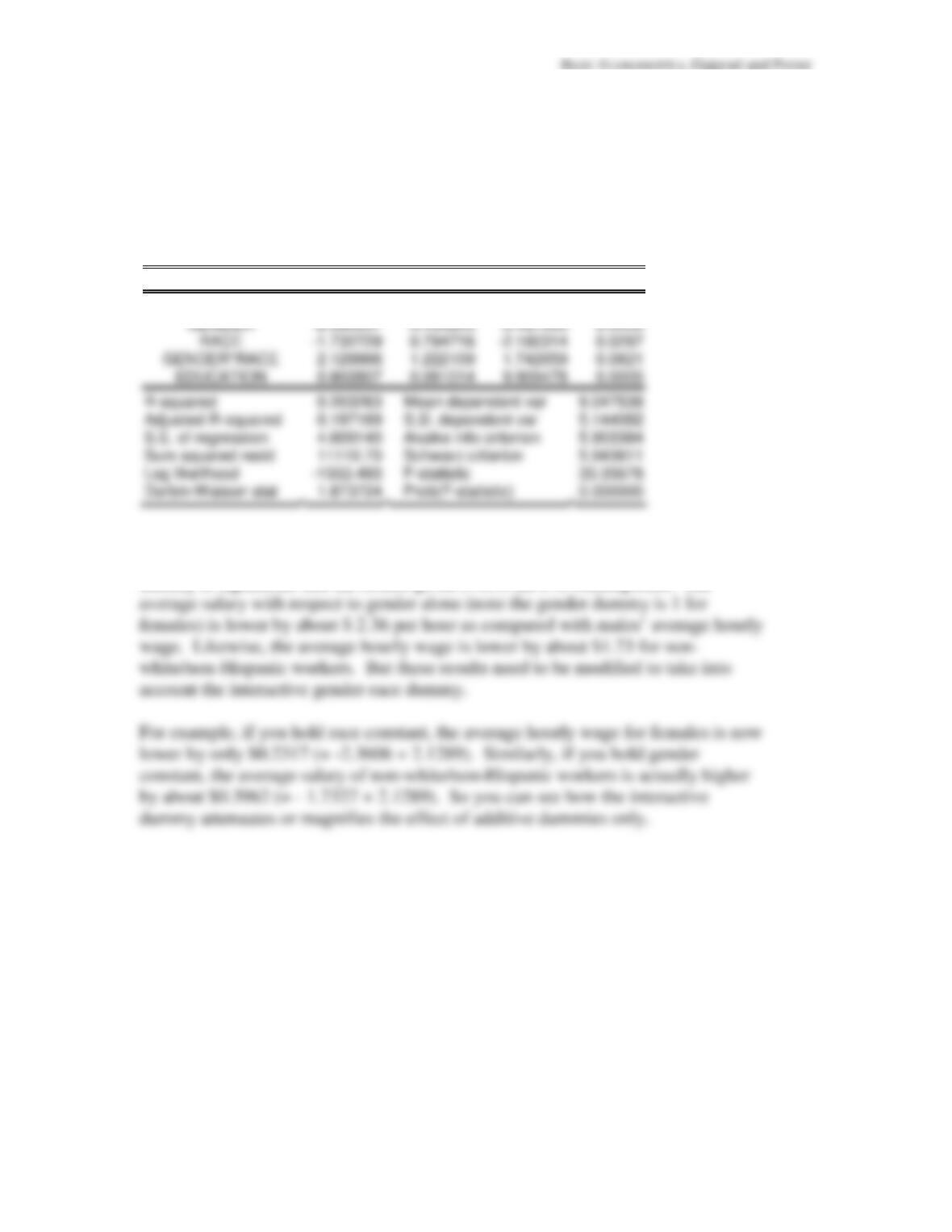
(a) & (b):This is left for each individual student. The year 2008 US
(c) The results of this model are as follows:
Dependent Variable: V
Variable Coefficient Std. Error t-Statistic Prob.
C 0.509175 0.029691 17.14936 0.0000
R-squared 0.774591 Mean dependent var 0.492151
Adjusted R-squared 0.690062 S.D. dependent var 0.071750
104
9.25
The regression results based on EViews are as follows:
Dependent Variable: HWAGE
Method: Least Squares
.
Sample: 1 528
Included observations: 528
Variable Coefficient
Std. Error
t-Statistic
Prob.
C –0.261014
1.106956
-0.235794
0.8137
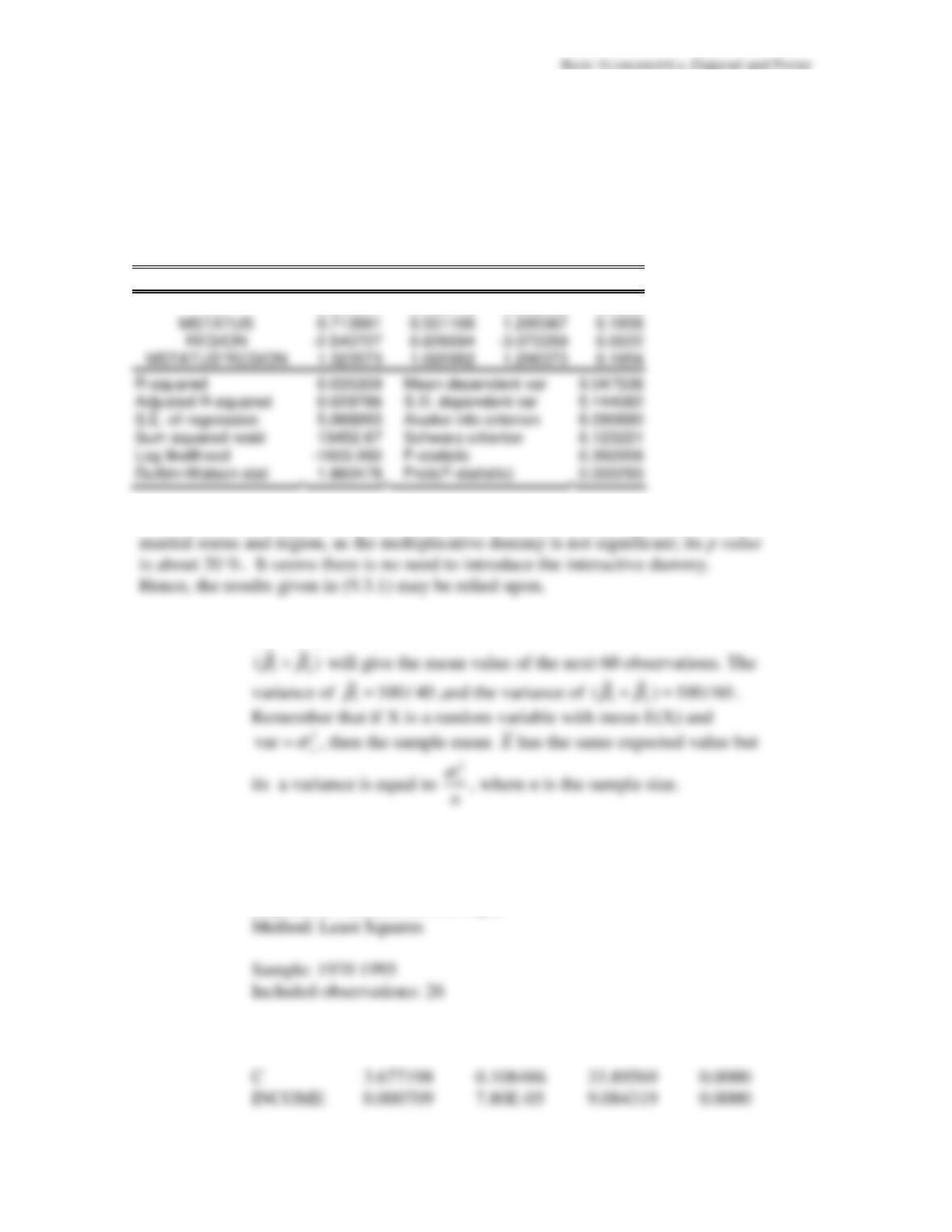
As these results show, the gender-race dummy is statistically significant at about
the 8% level. If you regard this p value as sufficiently low, then the interactive
dummy is significant and the results given (9.6.4) have to reinterpreted. The
105
9.26
The regression results, based on EViews, are as follows:
Dependent Variable: HWAGE
Method: Least Squares
.
Sample: 1 528
Included observations: 528
Variable Coefficient
Std. Error
t-Statistic
Prob.
C 9.067519
0.446115
20.32552
0.0000
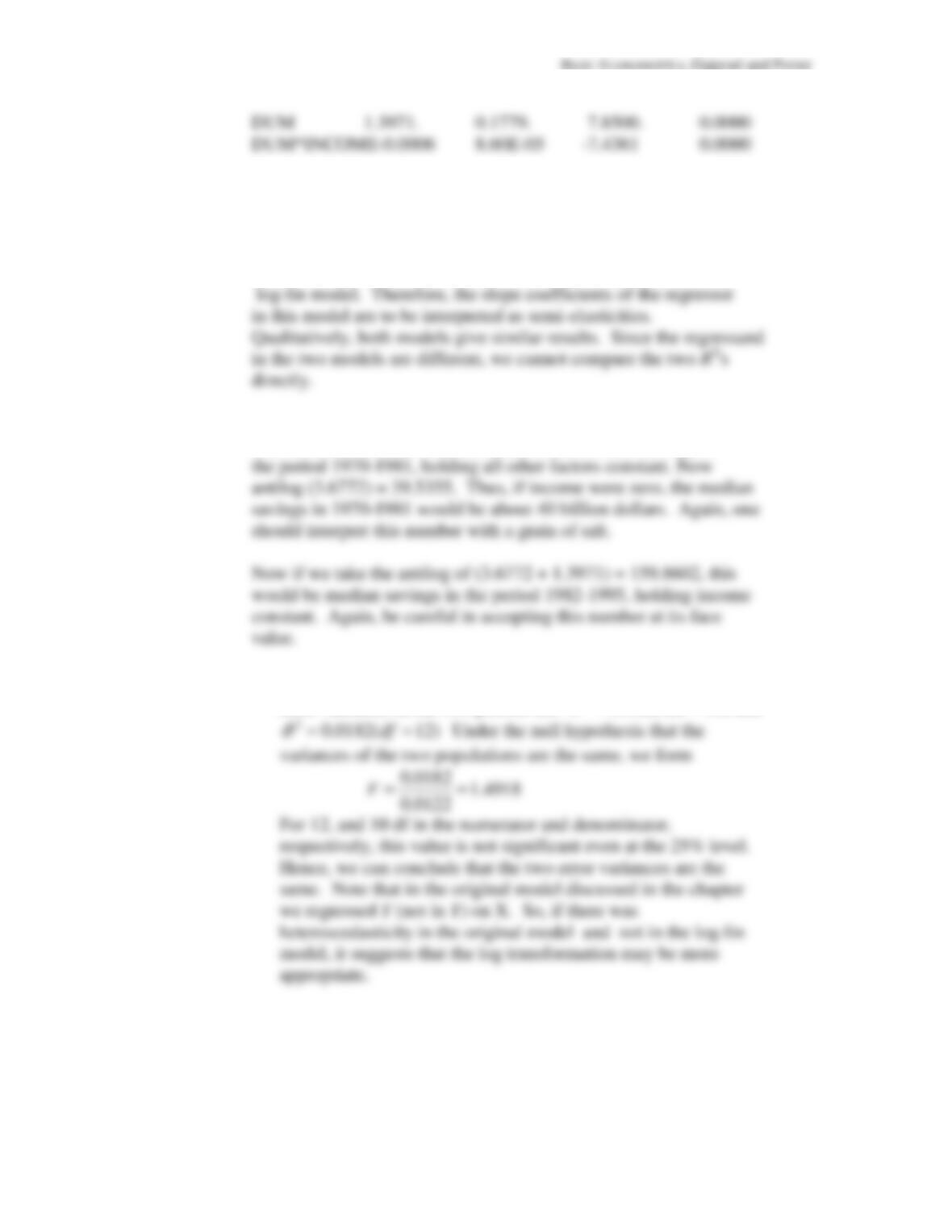
As these results suggest, there does not seem to be much interaction between
9.27
1
ˆ
β
will give the mean value of the first 40 observations and
9.28
The results, using EViews are as follows:
Dependent Variable: ln (Savings)
Variable Coefficient Std. Error t-Statistic Prob.
106
R-squared 0.933254 Sum squared resid 0.341255 .
F-statistic 102.5363
Durbin-Watson stat 1.612107
(a)
Model (9.5.4) is a linear model, whereas the present one is a
(b)
As noted in the chapter, if we take the antilog of the dummy
coefficient of 3.6772, what we obtain is the median savings in
(c)
Regressing log of Y (savings) on X (income), the estimated
error variances in the two periods are:
2
ˆ
0.0122
σ
=(df = 10) and
107
9.29
(a) Regression results using EViews are as follows:
Dependent Variable: LN_WI
Method: Least Squares
Sample: 1 114
Included observations: 114
Variable Coefficient Std. Error t-Statistic Prob.
C 3.688057 0.175749 20.98481 0.0000
AGE 0.030010 0.004734 6.339633 0.0000
R-squared 0.499976 Mean dependent var 4.648845
Adjusted R-squared 0.461879 S.D. dependent var 0.834751
Durbin-Watson stat 1.989598 Prob(F-statistic) 0.000000
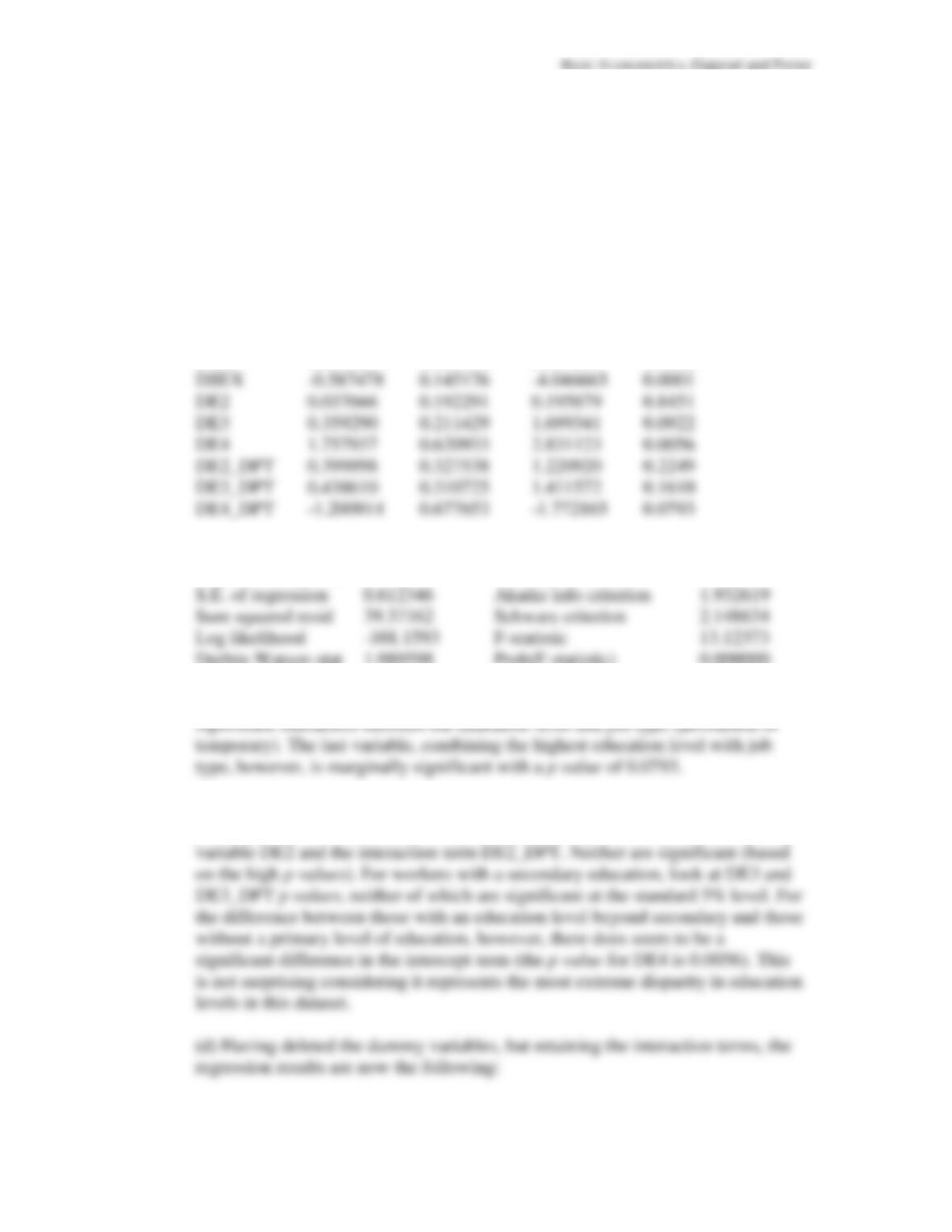
Based on the p-values of the new terms, there doesn’t really appear to be a
(b) To assess the difference between workers with an education level up to
primary and those without a primary education, we will look at both the dummy
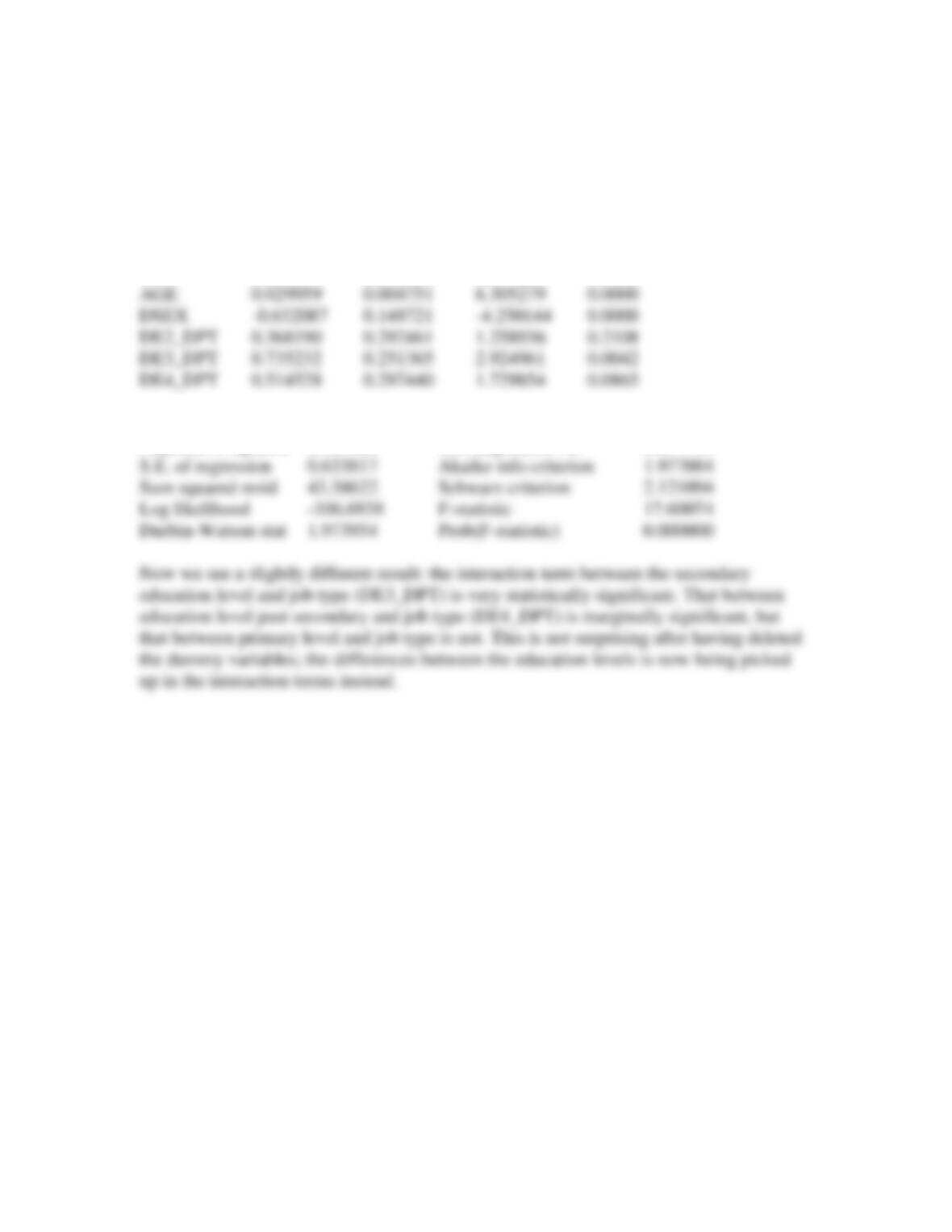
Basic Econometrics, Gujarati and Porter
108
Dependent Variable: LN_WI
Method: Least Squares
Sample: 1 114
Included observations: 114
Variable Coefficient Std. Error t-Statistic Prob.
C 3.759114 0.166655 22.55621 0.0000
R-squared 0.448990 Mean dependent var 4.648845
Adjusted R-squared 0.423480 S.D. dependent var 0.834751