* * This is Chapter 26 in Economics.
A n s w e r s t o t h e R e v i e w Q u i z z e s
Page 218 (page 626 in Economics)
1. What are the influences on the demand for U.S. dollars in the foreign exchange market?
2. What are the influences on the supply of U.S. dollars in the foreign exchange market?
3. How is the equilibrium exchange rate determined?
4. What happens if there is a shortage or a surplus of U.S. dollars in the foreign exchange market?
5. What makes the demand for U.S. dollars change?
Three factors change the demand for U.S. dollars: the world demand for U.S. exports, the interest rate
6. What makes the supply of U.S. dollars change?
Three factors change the supply of U.S. dollars: U.S. demand for imports, the interest rate in the United
9
THE EXCHANGE
RATE AND THE
BALANCE OF
PAYMENTS**
C h a p t e r
7. What makes the U.S. dollar exchange rate fluctuate?
Page 222 (page 630 in Economics)
1. What is arbitrage and what are its effects in the foreign exchange market?
Arbitrage is seeking to profit by buying in one market and selling for a higher price in another market.
Arbitrage has several effects:
• Law of one price: At any one time, an exchange rate is the same in all markets.
2. What is interest rate parity and what happens when this condition doesn’t hold?
Interest rate parity occurs when, for risk-free transactions, the rate of return earned by a unit of
3 What makes an exchange rate hard to predict?
4. What is purchasing power parity and what happens when this condition doesn’t hold?
5. What determines the real exchange rate and the nominal exchange rate in the short run?
The real exchange between the United States and Japan, RER, equals E P/P* where P is the U.S. price
6. What determines the real exchange rate and the nominal exchange rate in the long run?
In the long run, the real exchange rate is determined by demand and supply in the goods market.
T H E E X C H A N G E R A T E A N D T H E B A L A N C E O F P A Y M E N T S 1 1 5
Page 225 (page 633 in Economics)
1. What is a flexible exchange rate and how does it work?
2. What is a fixed exchange rate and how is its value fixed?
A fixed exchange rate policy is an exchange rate that is pegged at a value decided by the government or
central bank. The central bank directly intervenes in the foreign exchange market to block the
3. What is a crawling peg and how does it work?
4. How has China operated in the foreign exchange market, why, and with what effect?
From 1997 until 2005, the People’s Bank of China fixed the Chinese yuan exchange rate. Over this time,
Page 231 (page 639 in Economics)
1. What are the transactions that the balance of payments accounts record?
2. Is the United States a net borrower or a net lender? Is it a debtor or a creditor nation?
3. How are net exports and the government sector balance linked?
Net exports is the value of exports of goods and services minus the value of imports of goods and
services. Net exports is equal to the sum of government sector surplus or deficit plus the private sector
1 1 6 C H A P T E R 9
A n s w e rs t o t he S t u dy P l an P ro b l e m s a n d A pp li c at io n s
Use the following data to work Problems 1 to 3.
The U.S. dollar exchange rate increased from $0.96 Canadian in June 2011 to $1.03 Canadian in June
2012, and it decreased from 81 Japanese yen in June 2011 to 78 yen in June 2012.
1. Did the U.S. dollar appreciate or depreciate against the Canadian dollar? Did the U.S. dollar
appreciate or depreciate against the yen?
2. What was the value of the Canadian dollar in terms of U.S. dollars in June 2011 and June 2012?
Did the Canadian dollar appreciate or depreciate against the U.S. dollar over the year June 2011
to June 2012?
3. What was the value of 100 yen in terms of U.S. dollars in June 2011 and June 2012? Did the yen
appreciate or depreciate against the U.S. dollar over the year June 2011 to June 2012?
4. On March 30, 2012, the U.S. dollar was trading at 82 yen per U.S. dollar on the foreign exchange
market. On August 30, 2012, the U.S. dollar was trading at 79 yen per U.S. dollar.
a. What events in the foreign exchange market could have brought this fall in the value of the U.S.
dollar?
The fall in the U.S. exchange rate is the result of a decrease in the demand for U.S. dollars and/or an
b. Did the events you’ve described change the demand for U.S. dollars, the supply of U.S. dollars,
or both demand and supply in the foreign exchange market?
5. Colombia is the world’s biggest producer of roses. The global demand for roses increases and at
the same time Colombia’s central bank increases the interest rate. In the foreign exchange market
for Colombian pesos, what happens to
a. The demand for pesos?
b. The supply of pesos?
c. The quantity of pesos demanded?
d. The quantity of pesos supplied?
T H E E X C H A N G E R A T E A N D T H E B A L A N C E O F P A Y M E N T S 1 1 7
e. The peso-U.S. dollar exchange rate?
6. If a euro deposit in a bank in France earns interest of 4 percent a year and a yen deposit in Japan
earns 0.5 percent a year, other things remaining the same and adjusted for risk, what is the
exchange rate expectation of the Japanese yen?
7. The U.K. pound is trading at 1.50 U.S. dollars per U.K. pound and purchasing power parity holds.
The U.S. interest rate is 1 percent a year and the U.K. interest rate is 3 percent a year.
b. What is the U.K. pound expected to be worth in terms of U.S. dollars one year from now?
c. Which country more likely has the lower inflation rate? How can you tell?
8. The U.S. price level is 115, the Japanese price level is 92, and the real exchange rate is 98.75
Japanese real GDP per unit of U.S. real GDP. What is the nominal exchange rate?
9. With the strengthening of the yen against the U.S. dollar in 2012, Japan’s central bank did not take
any action. A Japanese politician called on the central bank to take actions to weaken the yen,
saying it will help exporters in the short run and have no long-run effects.
a. What is Japan’s current exchange rate policy?
b. What does the politician want the exchange rate policy to be in the short run? Why would such
Exports of goods and services
1,754
U.S. investment abroad
Net interest income
Net transfers
Statistical discrepancy
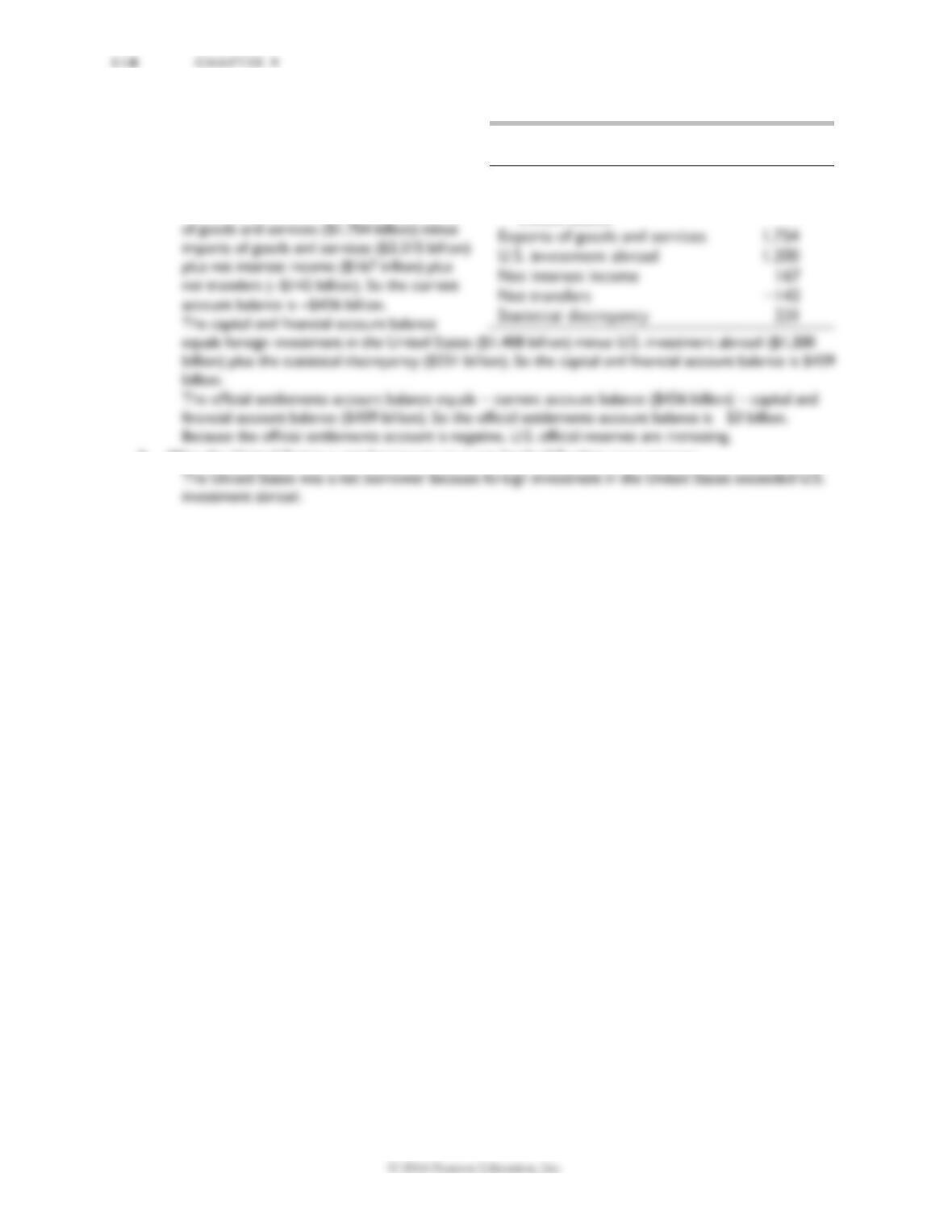
10. The table gives some information about the
U.S. international transactions.
a. Calculate the balance on the three balance
of payments accounts.
The current account balance equals exports
b. Was the United States a net borrower or a net lender? Explain your answer.
Item
Billions of
U.S. dollars
Imports of goods and services
2,215
Foreign investment in the
United States
1,408
T H E E X C H A N G E R A T E A N D T H E B A L A N C E O F P A Y M E N T S 1 1 9
Answers to Additional Problems and Applications
11. Suppose that yesterday, the U.S. dollar was trading on the foreign exchange market at 0.75 euros
per U.S. dollar and today the U.S. dollar is trading at 0.80 euros per U.S. dollar. Which of the two
currencies (the U.S. dollar or the euro) has appreciated and which has depreciated today?
12. Suppose that the exchange rate fell from 80 yen per U.S. dollar to 70 yen per U.S. dollar. What is
the effect of this change on the quantity of U.S. dollars that people plan to buy in the foreign
exchange market?
13. Suppose that the exchange rate rose from 80 yen per U.S. dollar to 90 yen per U.S. dollar. What
is the effect of this change on the quantity of U.S. dollars that people plan to sell in the foreign
exchange market?
14. Today’s exchange rate between the yuan and the U.S. dollar is 6.40 yuan per dollar and the
central bank of China is buying U.S. dollars in the foreign exchange market. If the central bank of
China did not purchase U.S. dollars would there be excess demand or excess supply of U.S.
dollars in the foreign exchange market? Would the exchange rate remain at 6.40 yuan per U.S.
dollar? If not, which currency would appreciate?
In the absence of the purchases by the central bank of China there would be an excess supply of U.S.
15. Yesterday, the current exchange rate was $1.05 Canadian per U.S. dollar and traders expected
the exchange rate to remain unchanged for the next month. Today, with new information, traders
now expect the exchange rate next month to fall to $1 Canadian per U.S. dollar. Explain how the
revised expected future exchange rate influences the demand for U.S. dollars, or the supply of
U.S. dollars, or both in the foreign exchange market.
The revision in the expected future exchange rate lowers the expected profit from holding U.S. dollars
16. In 2011, the exchange rate changed from 94 yen per U.S. dollar in January to 84 yen per U.S.
dollar in June, and back to 94 yen per dollar in December. What information would you need to
determine the factors that caused these changes in the exchange rate? Which factors would
change both demand and supply?
17. Australia produces natural resources (coal, iron ore, natural gas, and others), the demand for
which has increased rapidly as China and other emerging economies expand.
a. Explain how growth in the demand for Australia’s natural resources would affect the demand for
Australian dollars in the foreign exchange market.
1 2 0 C H A P T E R 9
b. Explain how the supply of Australian dollars
would change.
c. Explain how the value of the Australian dollar
would change.
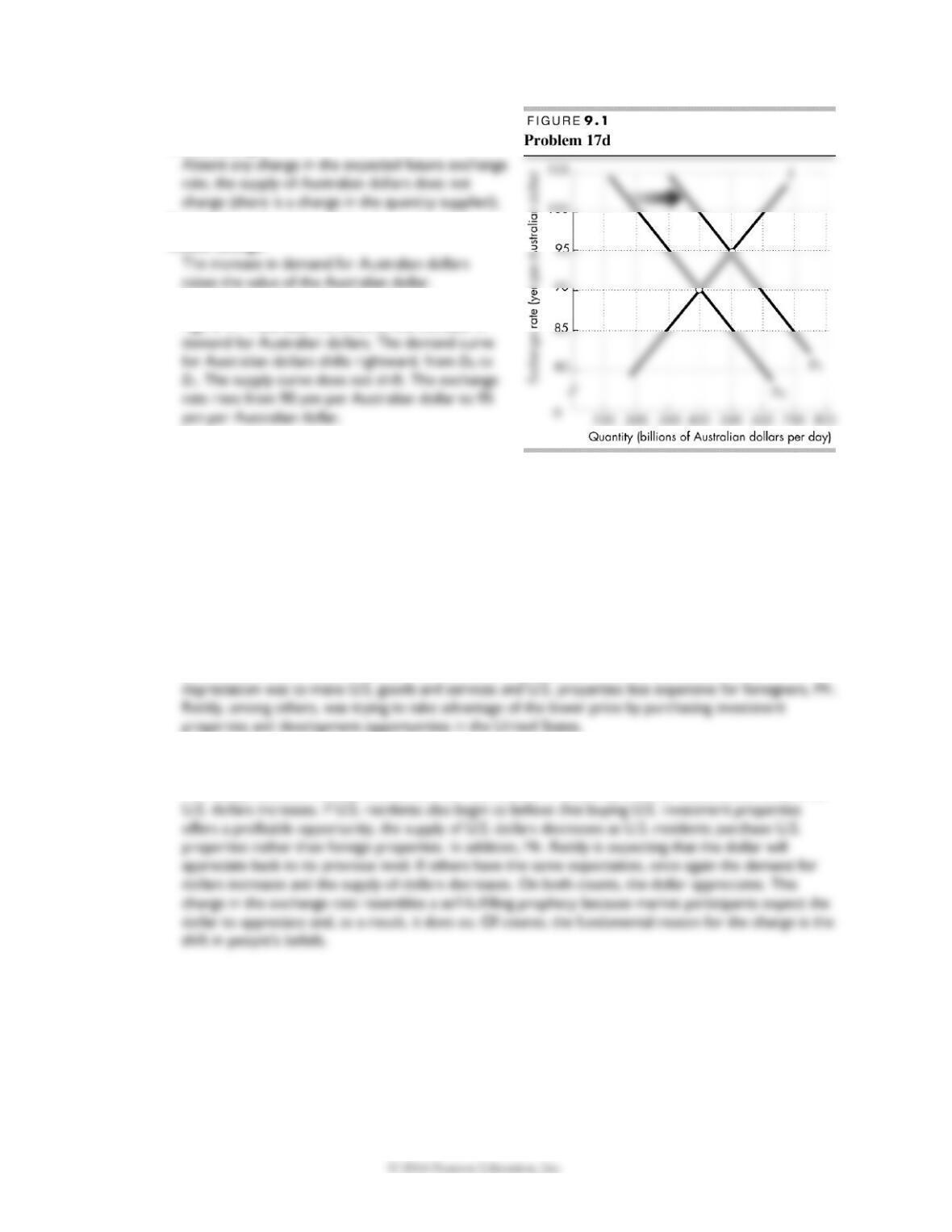
d. Illustrate your answer with a graphical analysis.
Figure 9.1 illustrates the effect of the increase in
Use the following news clip to work Problems 18 and 19.
Indian Entrepreneur Seeks Opportunities
Rahul Reddy, an Indian real estate entrepreneur, believes that “The United States is good for speculative
higher-risk investments.” He profited from earlier investment in Australia and a strong Australian dollar
provided him with the funds to enter the U.S. real estate market at prices that he believed “we will
probably not see for a long time.” He said, “The United States is an economic powerhouse that I think
will recover, and if the exchange rate goes back to what it was a few years ago, we will benefit.”
Based on an article in Forbes, July 10, 2008
18. Explain why Mr. Reddy is investing in the U.S. real estate market.
At the time of the news article, the U.S. dollar had depreciated. The short–run effect of this
19. Explain what would happen if the speculation made by Mr. Reddy became widespread. Would
expectations become self-fulfilling?
Mr. Reddy’s actions increase the demand for U.S. dollars. If others take similar actions, the demand for
T H E E X C H A N G E R A T E A N D T H E B A L A N C E O F P A Y M E N T S 1 2 1
Use the following information to work Problems 20 and 21.
Brazil’s Overvalued Real
The Brazilian real has appreciated 33 percent against the U.S. dollar and has pushed up the price of a Big
Mac in Sao Paulo to $4.60, higher than the New York price of $3.99. Despite Brazil’s interest rate being
at 8.75 percent a year compared to the U.S. interest rate at near zero, foreign funds flowing into Brazil
surged in October.
Source: Bloomberg News, October 27, 2009
20. Does purchasing power parity hold? If not, does PPP predict that the Brazilian real will appreciate
or depreciate against the U.S. dollar? Explain.
21. Does interest rate parity hold? If not, why not? Will the Brazilian real appreciate further or
depreciate against the U.S. dollar if the Fed raises the interest rate while the Brazilian interest rate
remains at 8.75 percent a year?
Interest rate parity holds. The difference in the interest rates is offset by the expected depreciation of
22. When the Chips Are Down
The Economist magazine uses the price of a Big Mac to determine whether a currency is
undervalued or overvalued. In July 2012, the price of a Big Mac was $4.33 in New York, 15.65
yuan in Beijing, and 6.50 Swiss francs in Geneva. The exchanges rates were 6.37 yuan per U.S.
dollar and 0.98 Swiss francs per U.S. dollar.
Source: The Economist, July 25, 2012
a. Was the yuan undervalued or overvalued relative to purchasing power parity?
b. Was the Swiss franc undervalued or overvalued relative to purchasing power parity?
Changing the price of a Big Mac in Switzerland into U.S. prices shows that the Swiss Big Mac has a dollar
c. Do you think the price of a Big Mac in different countries provides a valid test of purchasing
power parity?
1 2 2 C H A P T E R 9
Use the following news clip to work Problems 23 to 25.
U.S. Declines to Cite China as Currency Manipulator
In 2007, the U.S. trade deficit with China hit an all-time high of $256.3 billion, the largest deficit ever
recorded with a single country. Chinese currency, the yuan, has risen in value by 18.4 percent against
the U.S. dollar since the Chinese government loosened its currency system in July 2005. However, U.S.
manufacturers contend the yuan is still undervalued by as much as 40 percent, making Chinese products
more competitive in this country and U.S. goods more expensive in China. China buys U.S. dollar-
denominated securities to maintain the value of the yuan in terms of the U.S. dollar.
Source: MSN, May 15, 2008
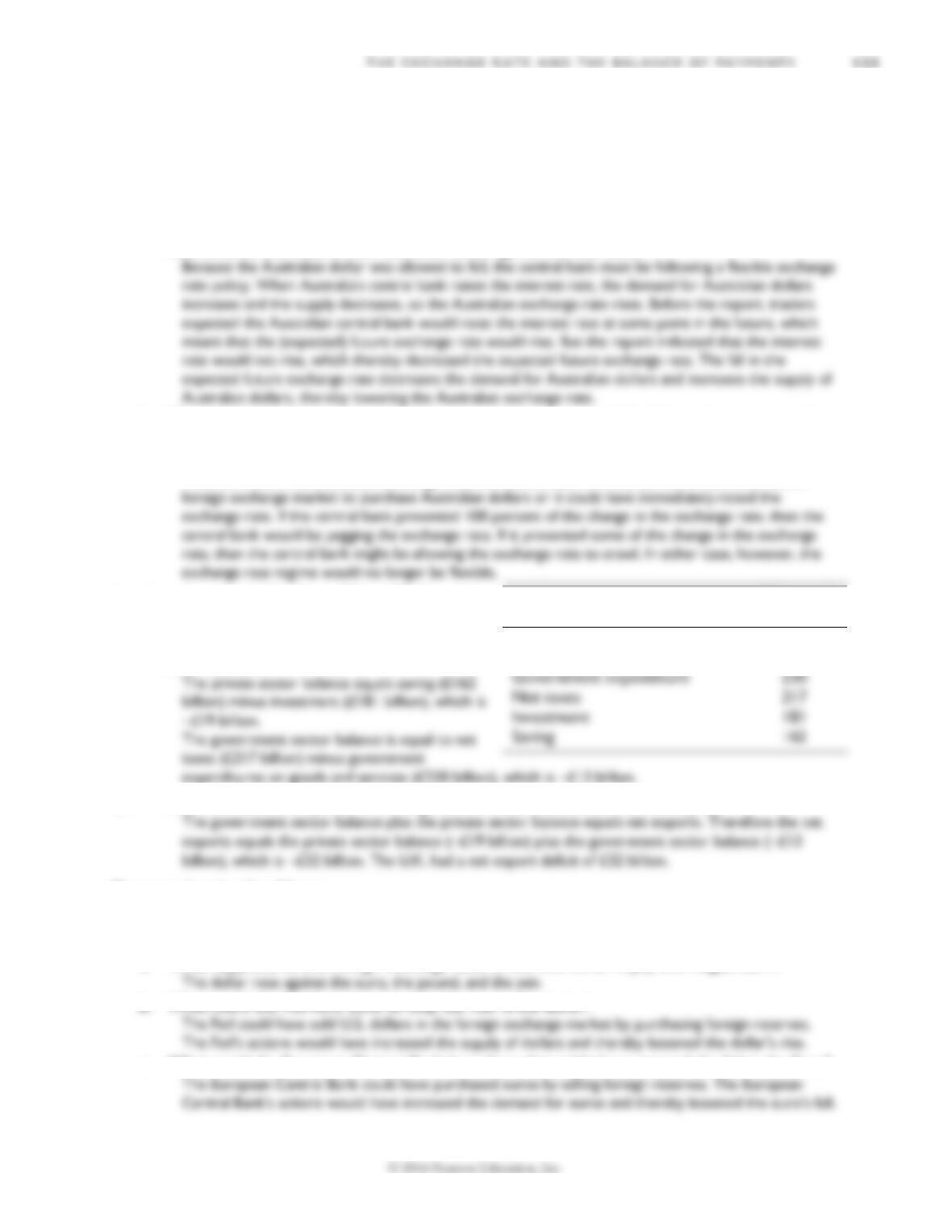
23. What was the exchange rate policy adopted by China until July 2005? Explain how it worked.
Draw a graph to illustrate your answer.
The actions in the foreign exchange market of
the People’s Bank allowed China to maintain a
fixed.
Figure 9.2 shows the foreign exchange market.
24. What was the exchange rate policy adopted by China after July 2005? Explain how it works.
25. Explain how fixed and crawling peg exchange rates can be used to manipulate trade balances in
the short run, but not the long run.
Net taxes
217
Investment
181
26. Aussie Dollar Hit by Interest Rate Talk
The Australian dollar fell against the U.S. dollar to its lowest value in the past two weeks. The CPI
inflation rate was reported to be generally as expected, but not high enough to justify
expectations for an aggressive interest rate rise by Australia’s central bank next week.
Source: Reuters, October 28, 2009
a. What is Australia’s exchange rate policy? Explain why expectations about the Australian interest
rate lowered the value of the Australian dollar against the U.S. dollar.
b. To avoid the fall in the value of the Australian dollar against the U.S. dollar, what action could
the central bank of Australia have taken? Would such an action signal a change in Australia’s
exchange rate policy?
To avoid a fall in the Australian exchange rate, the central bank of Australia could have entered the
Use the table to work Problems 27 and 28. The table
gives some data about the U.K. economy:
27. Calculate the private sector and government
sector balances.
28. What is the relationship between the government sector balance and net exports?
Economics in the News
29. After you have studied Economics in the News on pp. 232–233 (640–641 in Economics), answer the
following questions.
a. What happened to the foreign exchange value of the U.S. dollar in July and August 2014?
b. What could the Fed have done to stop the rise in the dollar?
c. What could the European Central Bank have done that might have stopped the fall in the Euro?
Item
Billions of
U.K. pounds
Consumption expenditure
721
Exports of goods and services
277
1 2 4 C H A P T E R 9
d. What can you infer about the changes in U.K. pound–euro exchange rate during July and August
2014? Can you think of a reason for the behavior of that exchange rate?
Stating on Jul 2, the U.K. pound and the European euro depreciated an almost identical amount against
f. If the dollar continues its upward path against the euro, what do you predict will be the
consequences for U.S. and European relative inflation rates?