Chapter 09 – Pure Competition in the Long Run
9-1
Chapter 09 Pure Competition in the Long Run
QUESTIONS
1. Explain how the long run differs from the short run in pure competition. LO1
Answer: The entry and exit of firms in our market models can only take place in the long
run. In the short run, the industry is composed of a specific number of firms, each with a
2. Relate opportunity costs to why profits encourage entry into purely competitive industries and
how losses encourage exit from purely competitive industries. L02
Answer: Entry or exit will continue until the market price determined by industry supply
interacting with market demand generates a normal profit for firms in the industry. With
3. How do the entry and exit of firms in a purely competitive industry affect resource flows and
long‐run profits and losses? LO3
Answer: Entry and exit help to improve resource allocation. Firms that exit an industry
due to low profits release their resources to be used more profitably in other industries.
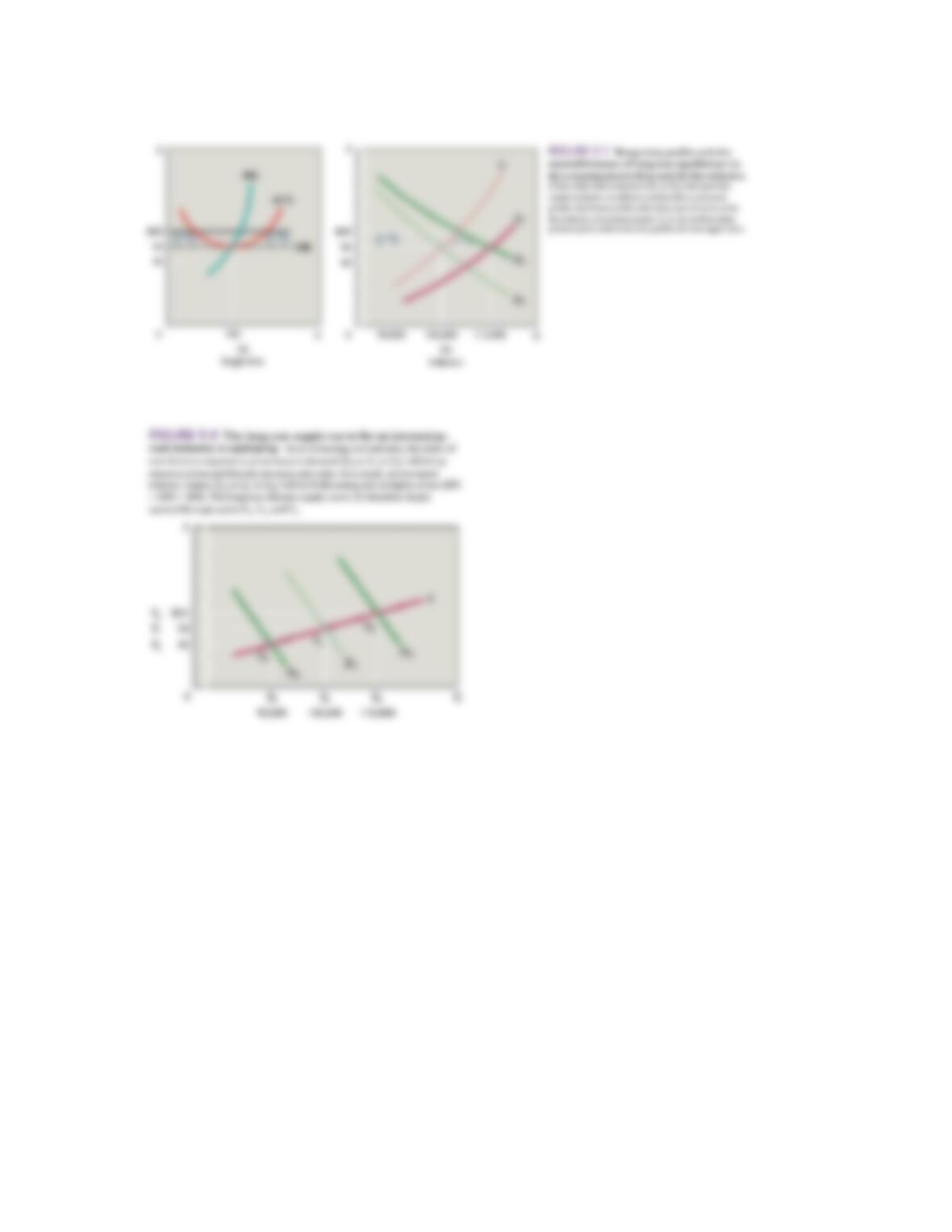
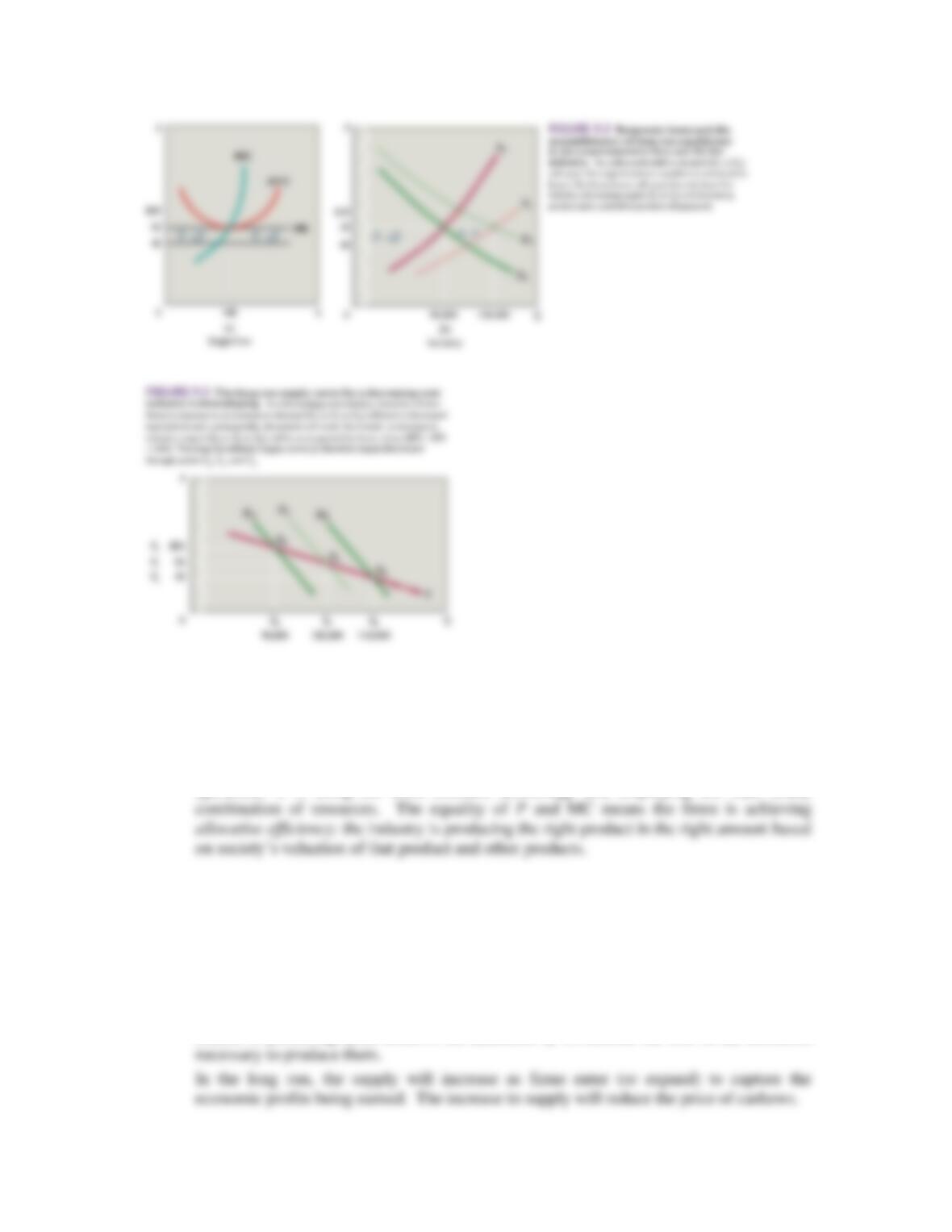
4. Using diagrams for both the industry and a representative firm, illustrate competitive long‐run
equilibrium. Assuming constant costs, employ these diagrams to show how (a) an increase and
(b) a decrease in market demand will upset that long‐run equilibrium. Trace graphically and
describe verbally the adjustment processes by which long‐run equilibrium is restored. Now
rework your analysis for increasing‐ and decreasing‐cost industries and compare the three
long‐run supply curves. LO4
Answer: See Figures 9.1 and 9.2 and their legends for the answers to (a) and (b) above.
Chapter 09 – Pure Competition in the Long Run
9-2
Chapter 09 – Pure Competition in the Long Run
9-3
5. In long‐run equilibrium, P = minimum ATC = MC. Of what significance for economic
efficiency is the equality of P and minimum ATC? The equality of P and MC? Distinguish
between productive efficiency and allocative efficiency in your answer. LO5
Answer: The equality of P and minimum ATC means the firms is achieving productive
efficiency; it is using the most efficient technology and employing the least costly
6. Suppose that purely competitive firms producing cashews discover that P exceeds MC. Will
their combined output of cashews be too little, too much, or just right to achieve allocative
efficiency? In the long run, what will happen to the supply of cashews and the price of cashews?
Use a supply and demand diagram to show how that response will change the combined amount
of consumer surplus and producer surplus in the market for cashews. LO5
Answer: The combined output is too little to achieve allocative efficiency. The marginal
benefit of producing more cashews (as measured by P) exceeds the cost of the resources
Chapter 09 – Pure Competition in the Long Run
9-4
7. The basic model of pure competition reviewed in this chapter finds that in the long run all
firms in a purely competitive industry will earn normal profits. If all firms will only earn a normal
profit in the long run, why would any firms bother to develop new products or lower‐cost
production methods? Explain. LO6
Answer: Competition involves the never-ending attempts by entrepreneurs and managers
to earn above-normal profits by either creating new products or developing lower-cost
8. “Ninety percent of new products fail within two years—so you shouldn’t be so eager to
innovate.” Do you agree? Explain why or why not. LO6
Answer: If your firm happens to be one of the 10% that succeed you can capture short
run economic profits. You may even qualify for a patent on your product which allows
9. LAST WORD How does a generic drug differ from its brand‐name, previously patented
equivalent? Explain why the price of a brand‐name drug typically declines when an equivalent
generic drug becomes available? Explain how that drop in price affects allocative efficiency.
Answer: Chemically there is typically no difference between a generic drug and its
brand-name equivalent. There may be a difference in the market because consumers tend
Chapter 09 – Pure Competition in the Long Run
9-5
PROBLEMS
1. A firm in a purely competitive industry has a typical cost structure. The normal rate of profit in
the economy is 5 percent. This firm is earning $5.50 on every $50 invested by its founders. What
is its percentage rate of return? Is the firm earning an economic profit? If so, how large? Will this
industry see entry or exit? What will be the rate of return earned by firms in this industry once the
industry reaches long-run equilibrium? LO3
Feedback: Consider the following example. The normal rate of profit in the economy is
5 percent. This firm is earning $5.50 on every $50 invested by its founders.
Since the firm is earning $5.50 on every $50 invested, the percentage rate of return is
11% (= ($5.50 / $50) x 100).
2. A firm in a purely competitive industry is currently producing 1000 units per day at a total cost
of $450. If the firm produced 800 units per day, its total cost would be $300, and if it produced
500 units per day, its total cost would be $275. What are the firm’s ATC per unit at these three
levels of production? If every firm in this industry has the same cost structure, is the industry in
long‐run competitive equilibrium? From what you know about these firms’ cost structures, what
is the highest possible price per unit that could exist as the market price in long‐run equilibrium?
If that price ends up being the market price and if the normal rate of profit is 10 percent, then how
big will each firm’s accounting profit per unit be? LO5
Feedback: Consider the following example. A firm in a purely competitive industry is
currently producing 1000 units per day at a total cost of $450. If the firm produced 800
units per day, its total cost would be $300, and if it produced 500 units per day, its total
cost would be $275.
Chapter 09 – Pure Competition in the Long Run
9-6
What are the firm’s ATC per unit at these three levels of production? The average total
If every firm in this industry has the same cost structure, is the industry in long‐run
competitive equilibrium? No, because the firm is producing 1000 (as stated in the
From what you know about these firms’ cost structures, what is the highest possible price
per unit that could exist as the market price in long‐run equilibrium? The highest possible
Given that the long-run market price is $0.38 and if the normal rate of profit is 10
percent, then how big will each firm’s accounting profit per unit be? Since the normal
3. There are 300 purely competitive farms in the local dairy market. Of the 300 dairy farms, 298
have a cost structure that generates profits of $24 for every $300 invested. What is their
percentage rate of return? The other two dairies have a cost structure that generates profits of $22
for every $200 invested. What is their percentage rate of return? Assuming that the normal rate of
profit in the economy is 10 percent, will there be entry or exit? Will the change in the number of
firms affect the two that earn $22 for every $200 invested? What will be the rate of return earned
by most firms in the industry in long‐run equilibrium? If firms can copy each other’s technology,
what will be the rate of return eventually earned by all firms? LO5
Feedback: Consider the following example. There are 300 purely competitive farms in
the local dairy market. Of the 300 dairy farms, 298 have a cost structure that generates
profits of $24 for every $300 invested. The other two dairies have a cost structure that
generates profits of $22 for every $200 invested. Also, assume that the normal rate of
profit in the economy is 10 percent.
Chapter 09 – Pure Competition in the Long Run
9-7
What will be the rate of return earned by most firms in the industry in long‐run
If firms can copy each other’s technology, what will be the rate of return eventually
earned by all firms? If firms can copy the technology used by the two more efficient