9: Assessing and Evaluating Learner Progress
Learning Outcomes
After studying this chapter, students should be able to:
• 9-1 Describe types and use of large–scale assessments, alternate assessments,
and on–going assessments.
• 9-2 Identify and describe effective classroom assessment approaches.
INTASC Standards
Standard #1: Learner Development. The teacher understands how learners grow and develop,
recognizing that patterns of learning and development vary individually within and across the
cognitive, linguistic, social, emotional, and physical areas, and designs and implements
Council for Exceptional Children
Special educators are to have knowledge of the following:
Standard #4: Assessment. Beginning special education professionals use multiple methods of
Chapter Outline
9-1 Types ad Purposes of Classroom Assessment
9-1a Large–Scale Assessments
9-1c Ongoing Assessment
9-2 Effective Classroom Assessment Approaches
9-2a Approaches to Initial Assessment That Increase Learner Engagement
9-2b Review of School Records
9-2c Formal and Informal Assessment
1. Interest Inventories
3. Multiple Intelligence Inventories
9-2e Working Collaboratively
9-2f Interpreting Standardized Tests
9-2h Positive Behavioral Interventions and Supports
9-3 Planning and Organizing Assessments
9-3a Planning for Ongoing Assessment
9-3b Formative Assessments
9-3d Informative Assessments
9-4 Recording Assessments
9-4b Data–Based Individualization
9-5 Applying Universal Design for Learning Principles
9-5a High–Tech and Low–Tech Materials
9-5b Computerized Assessments and Electronic Device Applications
9-5c Multiple Means of Engagement in Assessment
1. Fostering Motivation
9-5d Multiple Means of Representation in Assessment
2. Presenting Testing Accommodations
9-5e Student Expression in Assessment
1. High-Tech and Low–Tech Options
3. Portfolios
Key Concepts and Terms
alternative assessments: Assessments that have modified academic achievement
standards based on grade–level content that are used with a very small percentage of
criterion–referenced tests: Tests that provide data useful for instructional planning;
student performance on a task is compared to a particular level of mastery.
formal assessment: A type of norm–referenced measure used to compare student
performance to the performance of a nationally representative sample of students of the
same age or grade.
formative assessments: Ongoing, informal assessments that occur during instruction
over a specified period of time.
interests of students to assist in planning instruction to motivate learners.
large–scale assessments: Local, state, or national data collection efforts used to
document student, teacher, school, and school system progress and proficiency.
learning styles inventories: Surveys that can help teachers determine the learning
modalities of students.
multimedia inquiry project: A task in which a student uses scanned pictures, Internet
websites, digitized video clips, and software to evidence learning in multiple formats.
appropriate behavior; and view behavior errors as learning opportunities to be identified,
targeted, and corrected.
Lecture Notes
Large–scale assessments are used to collect, compare, and analyze performances of
teachers, schools, and school systems. In the United States today, the stakes for these
assessments are high.
Alternative assessments measure progress on alternate achievement standards that are
Summative assessments can be large–scale or they can be the culminating assessment
of a student project or unit of study. Scoring systems such as rubrics can be created and
used by teachers and students to determine the level of a performance.
Informative assessment judges student performance, informs instruction, and guides
both students and teachers in learning.
Suggestions for In–Class or Online Activities
1. Complete an MI assessment profile, such as in Figure 9.3, for a subject of your
choice.
3. Using the MindTap content, read the scenario and complete the assignment.
5. Create an agenda for a parent–teacher conference,
Discussion Questions
1. What type of decisions are formal assessments used for, primarily? What type of
decisions are informal assessments used for, primarily? Explain why each is
2. Complete the checklist in Figure 9.2 to assess your own multiple intelligences.
Now think back on your own experience as a high school student. Did the tests
3. When would you use a large–scale assessment?
4. Why is ongoing assessment important?
5. For each of the following students, describe one low–tech and one high–tech
means of expression that might be particularly effective: a) a student with a
6. What does a review of school records help you to do?
7. How can you use PBIS in your classroom?
8. What is the purpose of summative assessments? Are they even needed?
9. Why are rubrics important? What can the results tell you?
10. Should students use rubrics to grade themselves prior to submitting? Explain.
Field Experiences
2. Ask a teacher if you can work with a small group of learners and evaluate their
intelligence using Gardner’s Multiple Intelligences Inventory. How can you share
the results with the teacher?
Copyright © 2017 Cengage Learning. All Rights Reserved.
Videos
Watch the MindTap video for this chapter and have a class discussion using the
questions provided as a guide.
PBIS Right Way vs Wrong Way
1. After watching the video, list the right and wrong ways that PBIS was used.
2. How can you use PBIS in your classroom?
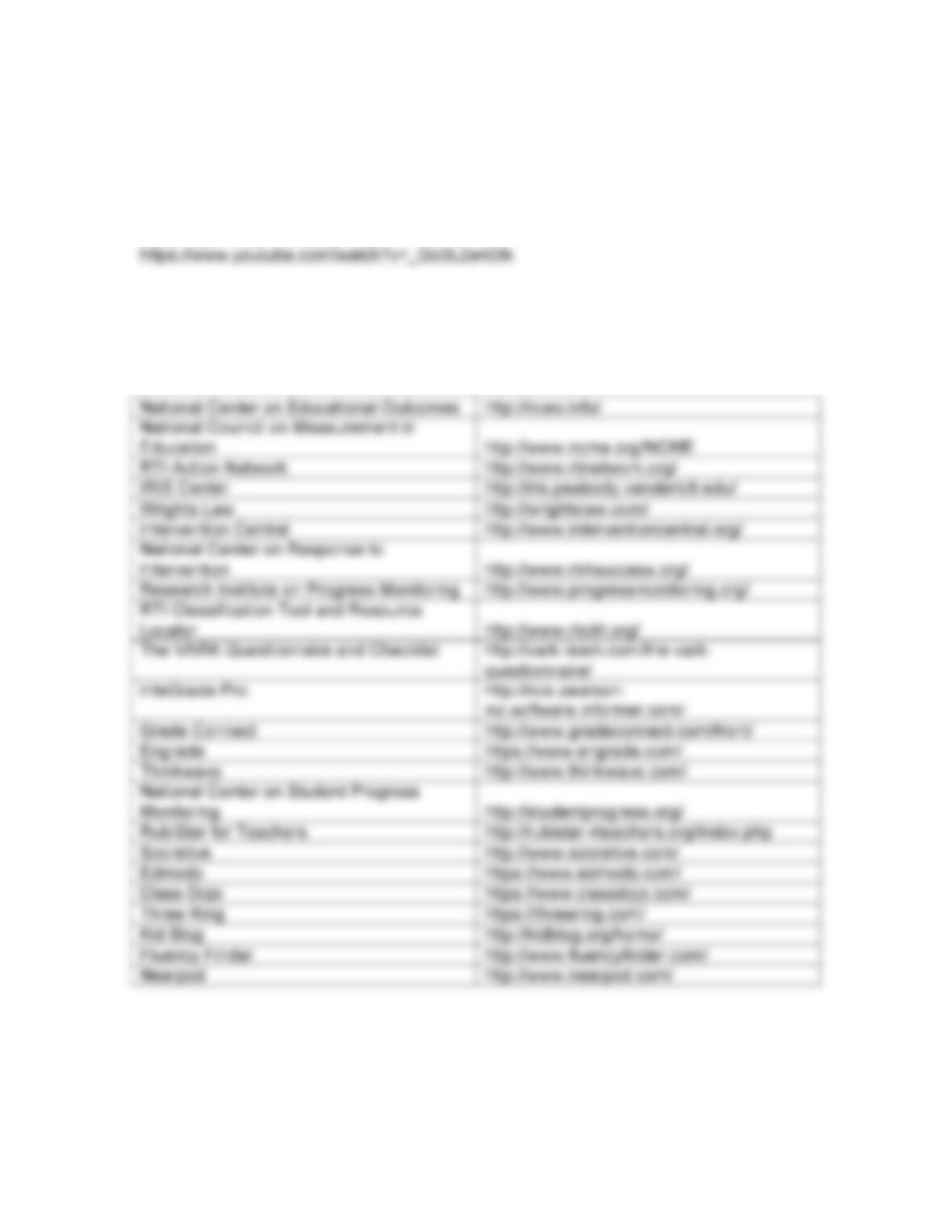
Web Resources