produced. These variable costs are avoidable if the
firm shuts down. So, when a firm decides whether
to shut down, it only considers whether its rev–
enues can cover its variable costs. The fixed costs
will have to be paid either way, so they don’t
enter into the decision- making pro cess.
Hints and Common Errors: It’s pos si ble
that a firm will decide to stay open and still loses
money— why would that be the case? It’s because
a lease (which is a fixed cost in the short run) and
go out of business. Because all costs are variable
in the long run, a firm will go out of business if
revenue cannot cover total costs.
In contrast, the same firm described above
might continue to operate in the short run if its
revenues can cover variable costs. This is because
the shutdown decision is a short- run decision,
when some costs are fixed. These fixed costs are
The opposite phenomenon occurs when
society does not value a good or ser vice; demand
for that good will fall, and then there will be
Questions for Review
1. In order for a perfectly competitive market to
exist, there must be homogenous goods and
many participants— both buyers and sellers.
When goods are very similar and there are many
sellers to choose from, competition will drive
prices down to the same level. Also, it must be
the case that competition can enter the market
easily.
2. First, locate the point where MR “ MC. Let’s call
this point A. Second, to get the output, move ver–
tically down from point A to the x axis. The point
where you land on the x axis is the profit–
maximizing quantity.
Hints and Common Errors: Why does
producing where MR “ MC mean profit
maximization? Well, as long as MR # MC, this
3. The firm decides whether to operate or shut down
in the short run. In the short run, there are some
costs that are fixed; these fixed costs are unavoid-
Solutions to Chapterfi9 Text Prob lems
Study Prob lems
1. a . Almost every one has a favorite pizza place,
and the range of quality varies dramatically in
guishes them from each other. Those with
better reputations will be able to set a higher
price. There is also variability in skill. Firms
that are able to complete very difficult jobs
will not have much competition, which gives
them some market power and means they can
United States.
d. While there are many brands of cereal, they
are certainly distinguishable from each other.
They have dif fer ent tastes, nutritional value,
shape, color, and so forth. This means cereal
firms are not price takers.
price takers.
2.
Output TC TR Profit MR MC
0$60 $0$60
50135150 1531
60 150 180 30 3 1.50
70 175 210 35 3 2.50
80225240 1535
6. Sunk costs are costs that have already been paid
and cannot be recouped. They are costs that
should not matter when making a decision,
because there is no way they can be recovered.
a sunk cost and should not matter in your deci-
sion. Instead, your decision about whether to see
the movie should be based on your marginal
cost— the cost of buying a new ticket (and your
next- best alternative).
Hints and Common Errors: People often
doesn’t directly affect your decision. Only the
marginal cost should directly affect your decision.
However, it is often true that your sunk cost will
affect your marginal cost; that is, the further
along you get, the less far you have to go to reach
the end. So, the fact that you’ve already started
7. Firms can easily enter and exit in competitive
markets. If there are positive economic profits in
a par tic u lar market, potential sellers can easily
enter that market. As sellers enter the market, the
this happens, supply decreases, and price
increases. Sellers keep exiting as long as they are
still earning negative profits, which means that in
the long run, the remaining firms all earn zero
economic profits.
4.
Total
Output Price
Total
Revenue
Marginal
Revenue
Total
Cost
Marginal
Cost
Total
Profit
■ The price in a competitive market does not
change because of one firm’s actions, so it is
always $20.
■ The total revenue is calculated by multiplying
price by output.
■ The marginal revenue is the change in total
revenue when producing that extra unit. In a
competitive market, it is equal to price.
■ Marginal cost is the additional cost of produc–
ing another unit; it is calculated as the differ-
5. a. The firm makes an economic profit at P5 and
P6, which are the prices above P4. The firm
breaks even at P4, and it makes economic
7. a . The firm should operate in the short run
because its losses are less if it operates
(- $5,000) than if it shuts down (- $8,000).
b. If this situation persists, the firm would go out
of business in the long run. In the long run,
all costs would be variable, and the firm’s rev-
enues would not cover all of its costs.
a. The total revenue (TR) is calculated by multi-
plying the quantity (output) by the price ($3).
b. The total profit is calculated by subtracting
between each level of output and dividing
this number by the difference in quantity.
For example, consider how to calculate the
marginal cost of going from 30 to 40 units
of output. The additional cost to create the
additional units is 125 120 “ 5. Divide this
change in cost of $5 by the number of addi-
tional units produced, 10. This gives you a
marginal cost of $0.50. There are two places
where MR “ MC. One is at the tenth unit and
the other is somewhere between 70 and 80
3. a. False. A firm does not necessarily make a
profit even if its revenue exceeds the average
variable cost because there might be fixed
minimized.
c. False. If economic profits are positive, firms
will enter the industry in the long run. The
profits entice firms to enter.
d. False. A firm that receives a price greater than
its average variable costs should not shut down
9. Disagree. A profit– maximizing firm should select
the output level at which the difference between
marginal revenue and marginal cost is the least.
In other words, the firm should produce where
marginal revenue “ marginal cost. Suppose the
Then, the firm can produce one extra unit and
earn the $7.
Hints and Common Errors: You can
think of the difference between MR and MC as
the marginal profit of that next unit. If this is the
case, then as long as that number is positive, you
should keep producing. If the next unit you
produce gets you a positive marginal profit, then
To determine whether Barney produces in
the short run, first determine what his revenues
and his variable costs are. His revenues are just
the price he charges multiplied by the quantity of
driveways he clears, which is $10 w 20 “ $200.
Now, find his variable costs. His total cost is $250,
means that Barney is earning economic losses,
which means he should exit in the long run.
12. a. Congratulations on avoiding the sunk- cost
fallacy. The $10 can’t be gotten back, so the
choice is between sitting through an annoy–
ing film and doing something else more
enjoyable. Leaving is the smart move.
b. You fell prey to the sunk fallacy. You’ve paid
Hints and Common Errors: In this prob–
lem, you don’t know the actual revenue or
variable costs of the firm. But even without this
knowledge, you should still be able to solve the
prob lem from the information given. If the firm
8. a.
Price
5
6
Camilo Esra Remzi
b.
QUANTITY SUPPLIED
Delivery
Charge Esra Remzi Camilo
Market
Supply
$1 2 3 611
2 4 6 717
c.
Price
4
5
6
Market
supply
Solutions to Chapterfi9 Text Prob lems / 217
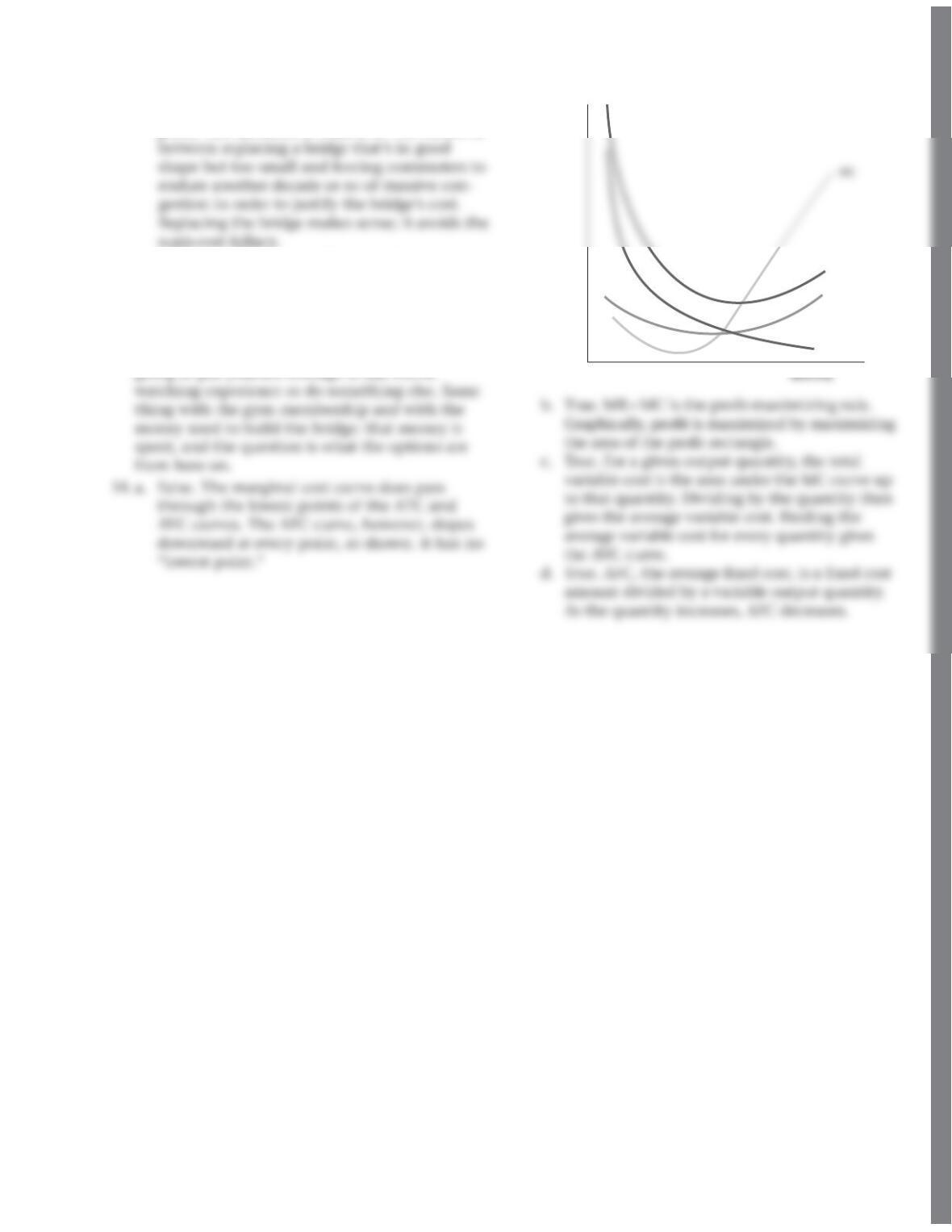
Cost
ATC
AVC
AFC
that’s water under the bridge (sorry for the
Hint and Common Errors: Any time a
cost is already incurred and no longer inuenced
by the decision you are now making, that cost is
a sunk cost and should be ignored. Whether you
leave the movie or stay, either way you’ve paid
out $10. Now the question is whether you’re