Mishkin • Instructor’s Manual for The Economics of Money, Banking, and Financial Markets, Twelfth Edition 119
Chapter 9
ANSWERS TO QUESTIONS
1. Why might a bank be willing to borrow funds from other banks at a higher rate than the rate
at which it can borrow from the Fed?
2. Rank the following bank assets from most to least liquid:
a. Commercial loans
3. The bank you own has the following balance sheet:
Assets Liabilities
Reserves $75 million Deposits $500 million
Loans $525 million Bank capital $100 million
If the bank suffers a deposit outflow of $50 million with a required reserve ratio on deposits of
10%, what actions should you take?
4. If a deposit outflow of $50 million occurs, which balance sheet would a bank rather have
initially, the balance sheet in Question 3 or the following balance sheet? Why?
Mishkin • Instructor’s Manual for The Economics of Money, Banking, and Financial Markets, Twelfth Edition 120
5. If no decent lending opportunity arises in the economy, and the central bank pays an interest
rate on reserves that is similar to other low-risk investments, do you think banks will be
willing to hold large amounts of excess reserves?
Banks should be willing to hold large amounts of excess reserves. This is exactly what
happened during the onset of the global financial crisis started in 2007. Banks were willing to
6. If the bank you own has no excess reserves and a sound customer comes in asking for a loan,
should you automatically turn the customer down, explaining that you don’t have any excess
reserves to lend out? Why or why not? What options are available that will enable you to
provide the funds your customer needs?
No. When you turn a customer down, you may lose that customer’s business forever, which
7. If a bank finds that its ROE is too low because it has too much bank capital, what can it do to
raise its ROE?
8. If a bank is falling short of meeting its capital requirements by $1 million, what three things
can it do to rectify the situation?
9. Why do equity holders care more about ROE than about ROA?
10. If a bank doubles the amount of its capital and ROA stays constant, what will happen to
ROE?
11. What are the benefits and costs for a bank when it decides to increase the amount of its bank
capital?
12. Why is being nosy a desirable trait for a banker?
In order for a banker to reduce adverse selection she must screen out good from bad credit
13. A bank almost always insists that the firms it lends to keep compensating balances at the
bank. Why?
Compensating balances can act as collateral. They also help establish long-term customer
14. If the president of a bank told you that the bank was so well run that it has never had to call
in loans, sell securities, or borrow as a result of a deposit outflow, would you be willing to
buy stock in that bank? Why or why not?
15. “Because diversification is a desirable strategy for avoiding risk, it never makes sense for a
bank to specialize in making specific types of loans.” Is this statement true, false, or
uncertain? Explain your answer.
False. Although diversification is a desirable strategy for a bank, it may still make sense for a
16. If you are a banker and expect interest rates to rise in the future, would you prefer to make
short-term loans or long-term loans?
17. “Bank managers should always seek the highest return possible on their assets.” Is this
statement true, false, or uncertain? Explain your answer.
18. After July 2010, bank customers using a debit card had to specifically opt-in to the bank’s
overdraft protection plan. Explain the effect of this regulation on a bank’s noninterest
income.
Before this regulation, customers were automatically enrolled in bank’s overdraft protection
plans. This meant that debit card transactions would be approved, even if funds were
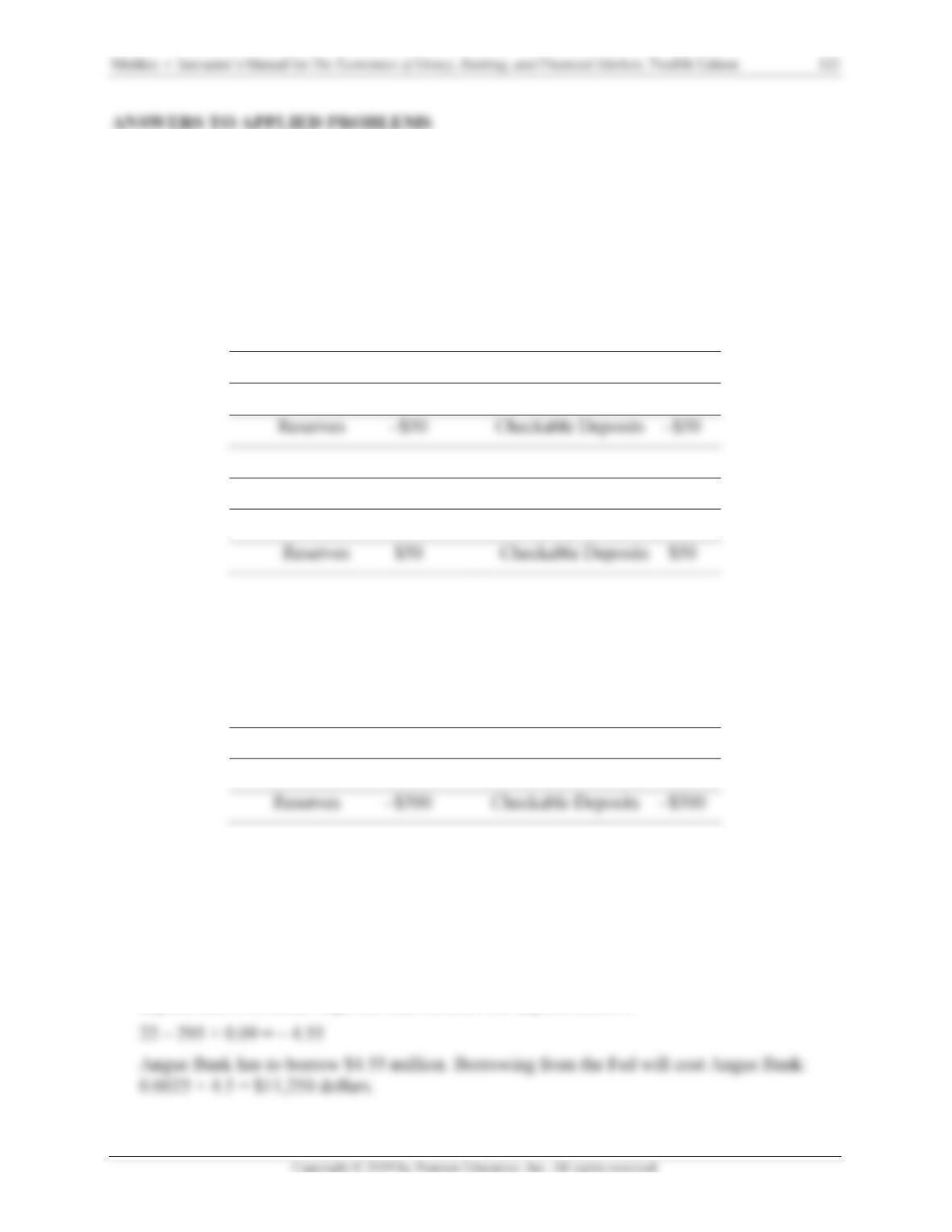
19. Using the t-accounts of the first national bank and the second national bank given in this
chapter, describe what happens when jane brown writes a $50 check on her account at the
first national bank to pay her friend Joe Green, who in turn deposits the check in his account
at the second national bank.
The T-accounts for the two banks are as follows:
First National Bank
Assets Liabilities
Second National Bank
Assets Liabilities
20. What happens to reserves at the First National Bank if one person withdraws $1,000 of cash
and another person deposits $500 of cash? Use T-accounts to explain your answer.
Reserves drop by $500. The T-account for the first National Bank is as follows:
First National Bank
Assets Liabilities
21. Angus Bank holds no excess reserves but complies with the reserve requirement. The
required reserves ratio is 9%, and reserves are currently $27 million. Determine the amount
of deposits, the reserve shortage created by a deposit outflow of $5 million, and the cost of
the reserve shortage if Angus Bank borrows in the federal funds market (assume the federal
funds rate is 0.25%).
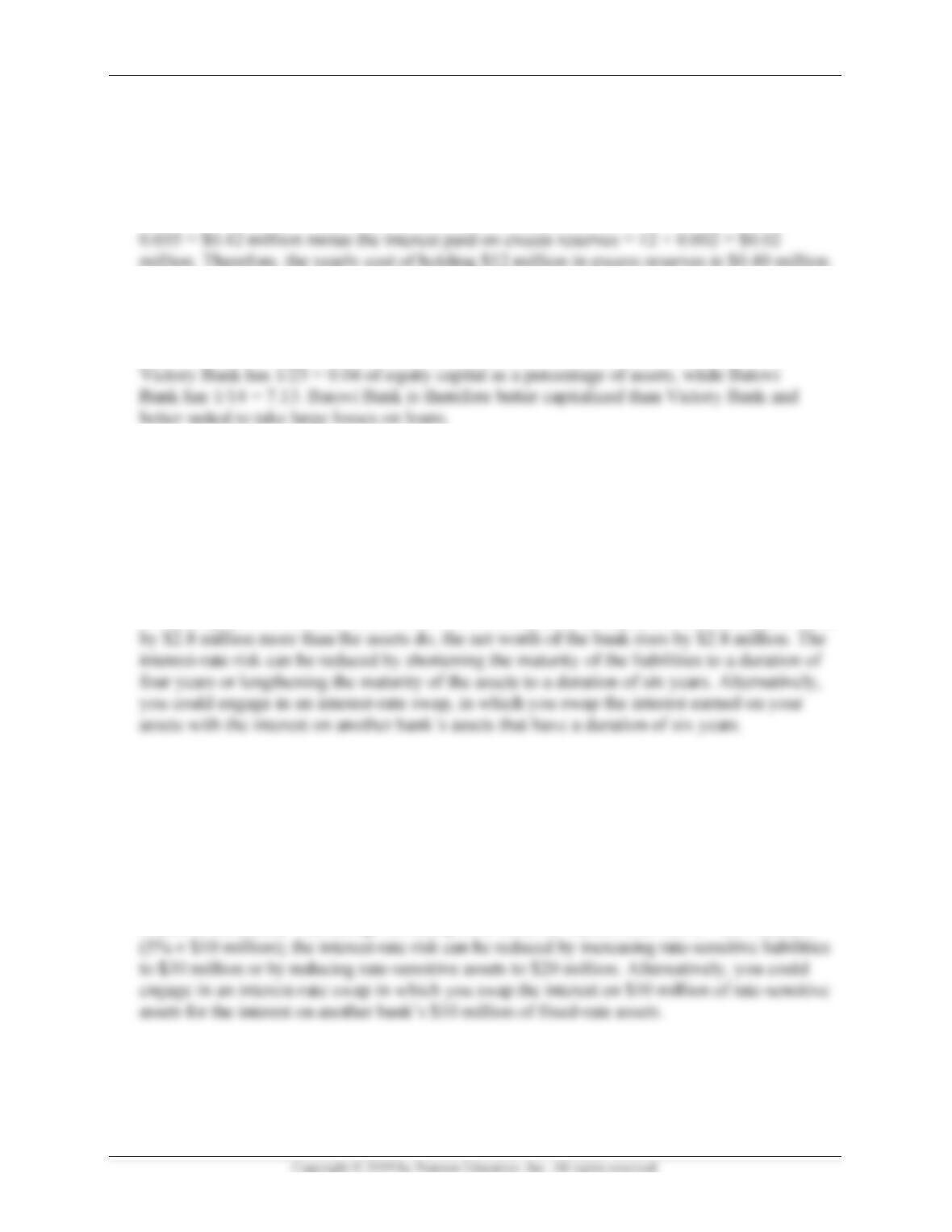
Deposits = 27/0.09 = 300. The reserve shortage is calculated as outstanding reserves after the
deposit outflow, minus required reserves after the deposit outflow:
Mishkin • Instructor’s Manual for The Economics of Money, Banking, and Financial Markets, Twelfth Edition 124
22. Excess reserves act as insurance against deposit outflows. Suppose that on a yearly basis
Malcom Bank holds $12 million in excess reserves and $88 million in required reserves.
Suppose that Malcom Bank can earn 3.5% on its loans and that the interest paid on (total)
reserves is 0.2%. What would be the cost of this insurance policy?
The cost of the insurance policy is the amount of foregone interest income equal to $12 ×
23. Victory Bank reports an EM of 25, while Batovi Bank reports an EM equal to 14. Which
bank is better prepared to respond against large losses on loans?
24. Suppose you are the manager of a bank whose $100 billion of assets have an average
duration of four years and whose $90 billion of liabilities have an average duration of six
years. Conduct a duration analysis for the bank, and show what will happen to the net worth
of the bank if interest rates rise by 2 percentage points. What actions could you take to
reduce the bank’s interest-rate risk?
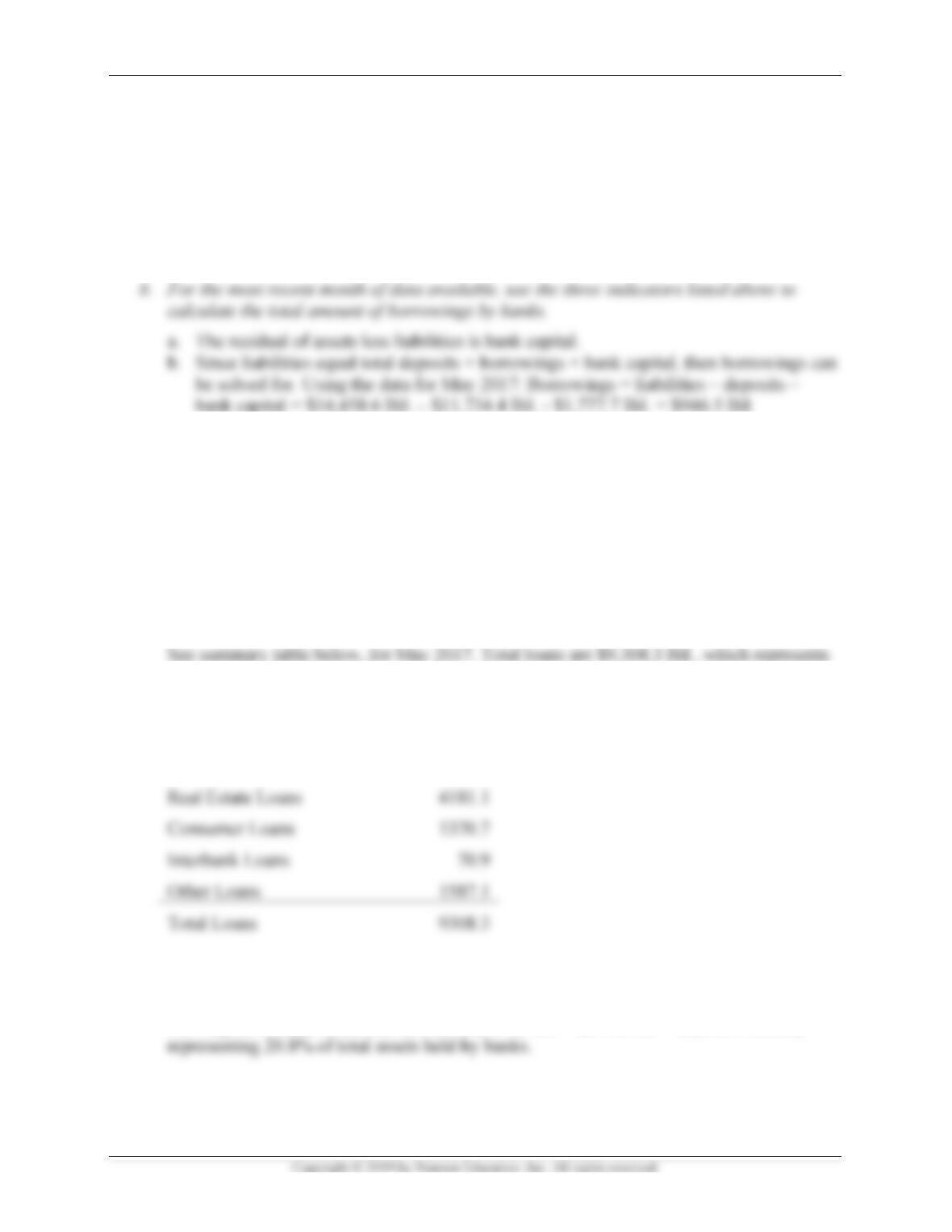
The assets fall in value by $8 million (= $100 million u –2% u 4 years) while the liabilities fall
in value by $10.8 million (= $90 million u –2% u 6 years). Because the liabilities fall in value
25. Suppose you are the manager of a bank that has $15 million of fixed-rate assets, $30 million
of rate-sensitive assets, $25 million of fixed-rate liabilities, and $20 million of rate-sensitive
liabilities. Conduct a gap analysis for the bank, and show what will happen to bank profits if
interest rates rise by 5 percentage points. What actions could you take to reduce the bank’s
interest-rate risk?
The gap is $10 million ($30 million of rate-sensitive assets minus $20 million of rate-
sensitive liabilities). The change in bank profits from the interest rate rise is +$0.5 million
Mishkin • Instructor’s Manual for The Economics of Money, Banking, and Financial Markets, Twelfth Edition 125
ANSWERS TO DATA ANALYSIS PROBLEMS
1. Go to the St. Louis Federal Reserve FRED database and find data for all commercial banks
on total liabilities (TLBACBM027SBOG), total deposits (DPSACBM027SBOG), and residual
of assets less liabilities (RALACBM027SBOG).
a. What is the balance sheet interpretation of the residual of assets less liabilities?
2. Go to the St. Louis Federal Reserve FRED database and find data for all commercial banks
on total assets (TLAACBM027SBOG), U.S. government and agency securities held
(USGSEC), other securities held (OTHSEC), commercial and industrial loans (BUSLOANS),
real estate loans (REALLN), consumer loans (CONSUMER), interbank loans
(IBLACBM027S-BOG), other loans (OLLACBM027SBOG), and other assets
(OATACBM027SBOG). Use the most recent month of data available across all indicators.
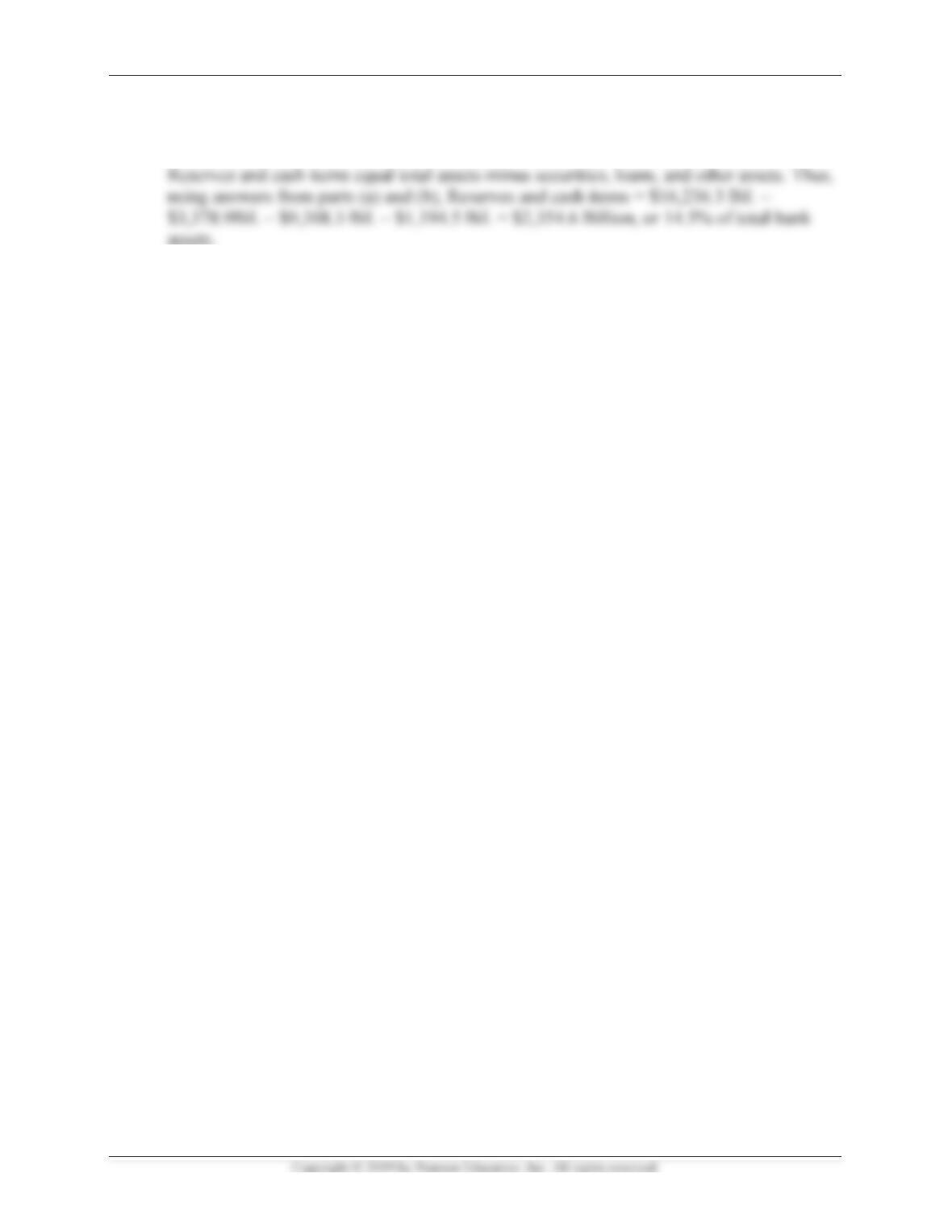
a. What is the total amount of loans held by banks? What is this number as a percentage of
total bank assets?
57.3% of the $16,236.3 Bil. in assets held by banks.
May 2017, $ Bil.
C&I Loans 2098.4
b. What is the total amount of securities held by banks? What is this number as a
percentage of total bank assets?
For May 2017, total securities held are $2,464.3 Bil. + $914.6 Bil = $3,378.9 Billion,
Mishkin • Instructor’s Manual for The Economics of Money, Banking, and Financial Markets, Twelfth Edition 126
c. What is the total amount of reserves and cash items? What is this number as a percentage
of total bank assets?