CHAPTER 9: THE IS–LM/AD–AS MODEL:
A GENERAL FRAMEWORK FOR MACROECONOMIC ANALYSIS
LEARNING OBJECTIVES
I. Goals of Chapter 9
A. Combine the labour market (Chapter 3), the goods market (Chapters 4 and
5), and the asset market (Chapter 7) into a complete macroeconomic model
(for a closed economy)
TEACHING NOTES
I. The FE Line: Equilibrium in the Labour Market (Sec. 9.1)
A. In the discussion of the labour market in Chapter 3, we showed how
equilibrium in the labour market leads to employment at its full-employment
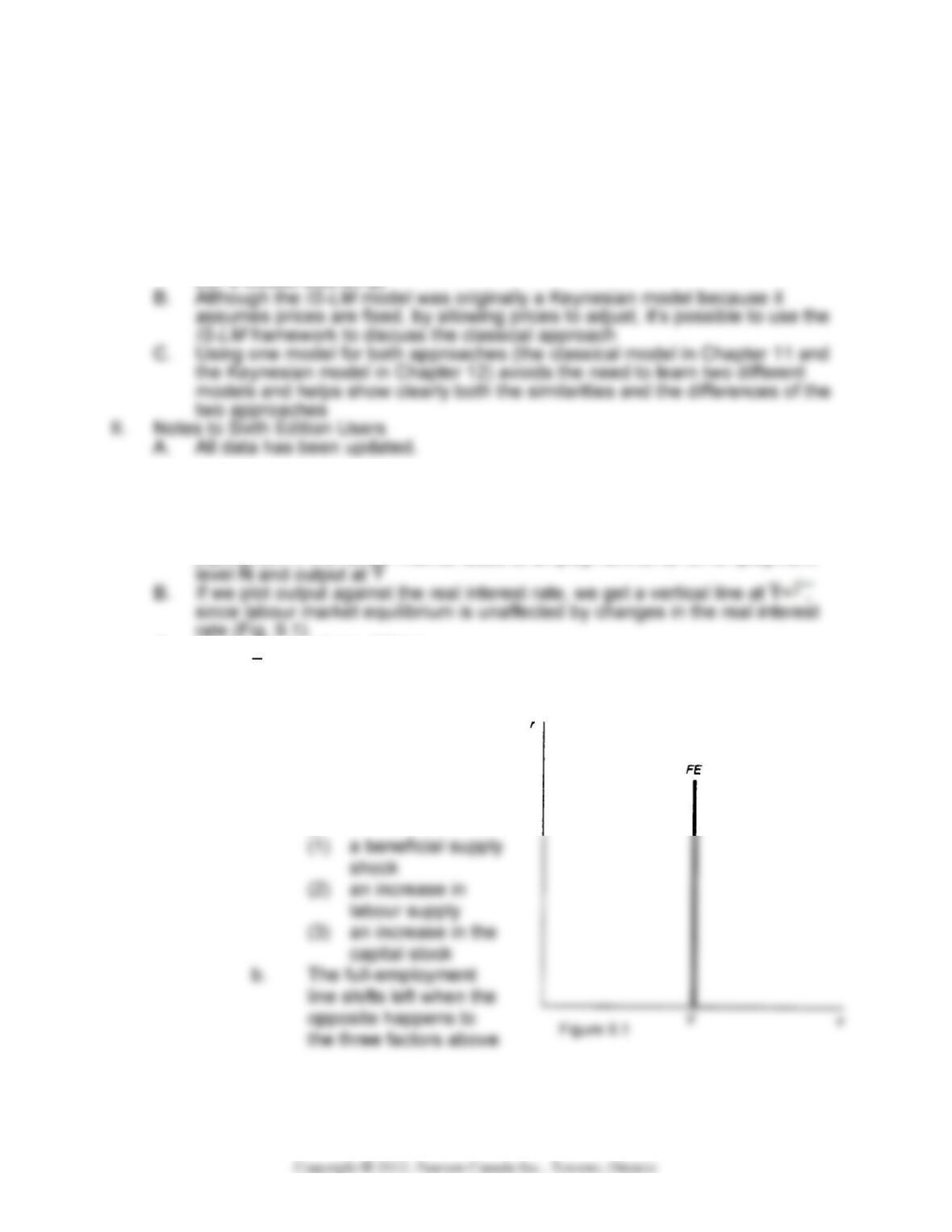
rate (Fig. 9.1)
C. Factors that shift the FE line
1. Y is determined by the full-employment level of employment and the
current levels of capital and productivity; any change in these variables
shifts the FE line
2. Summary Table 11 lists the
factors that shift the full-
employment line
a. The full–employment
line shifts right because
of

The IS–LM/AD–AS Model: A General Framework for Macroeconomic Analysis 141
II. The IS Curve: Equilibrium in the Goods Market (Sec. 9.2)
A. The goods market clears when desired investment equals desired national
saving
1. Adjustments in the real interest rate bring about equilibrium
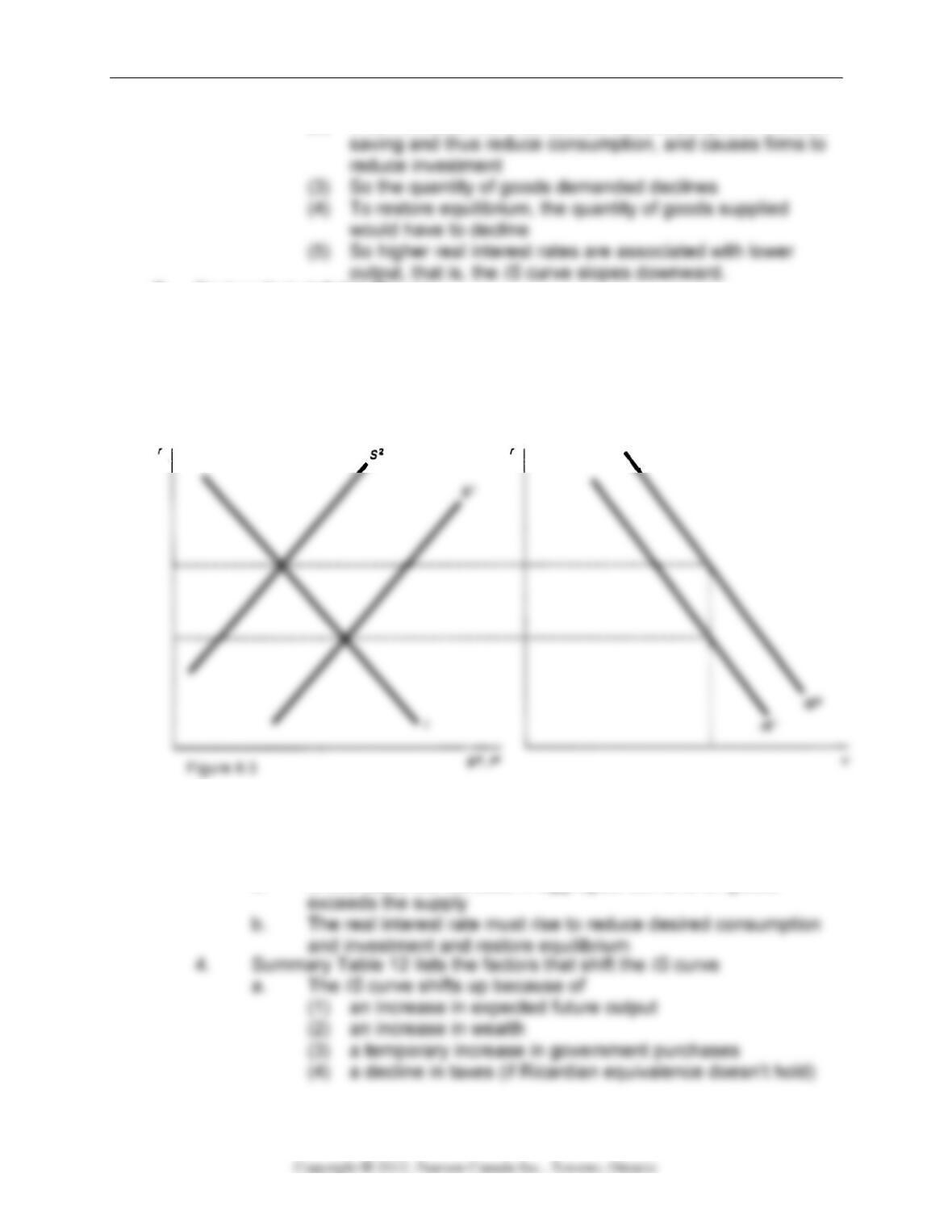
3. Derivation of the IS curve from the saving-investment diagram (Fig.
9.2)
a. Key features
(1) The saving curve slopes upward because a higher real
interest rate increases saving
reducing investment
b. Consider two different levels of output
(1) At the higher level of output, the saving curve is shifted to
the right compared to the situation at the lower level of
c. Alternative interpretation in terms of goods market equilibrium
(1) Beginning at a point of equilibrium, suppose the real
interest rate rises
142 Chapter 9
(2) The increased real interest rate causes people to increase
B. Factors that shift the IS curve
1. Any change that reduces desired national saving relative to desired
investment shifts the IS curve up
a. Intuitively, imagine constant output, so a reduction in saving
means more investment relative to saving; the interest rate must
rise to reduce investment and increase saving (Fig. 9.3)
2. Similarly, a change that increases desired national saving relative to
desired investment shifts the IS curve down
3. An alternative way of stating this is that a change that increases
aggregate demand for goods shifts the IS curve up
a. In this case, the increase in aggregate demand for goods
The IS–LM/AD–AS Model: A General Framework for Macroeconomic Analysis 143
(5) an increase in the expected future marginal product of
capital
III. The LM Curve: Asset Market Equilibrium (Sec. 9.3)
A. The interest rate and the price of a nonmonetary asset
1. The price of a nonmonetary asset is inversely related to its interest rate
or yield
a. Example: A bond pays $10,000 in one year; its current price is
5%
2. For a given level of expected inflation, the price of a nonmonetary
asset is inversely related to the real interest rate
B. The equality of money demanded and money supplied
1. Equilibrium in the asset market requires that the real money supply
equal the real quantity of money demanded

144 Chapter 9
6. By what mechanism is equilibrium restored?
a. Starting at equilibrium, suppose output rises, so real money
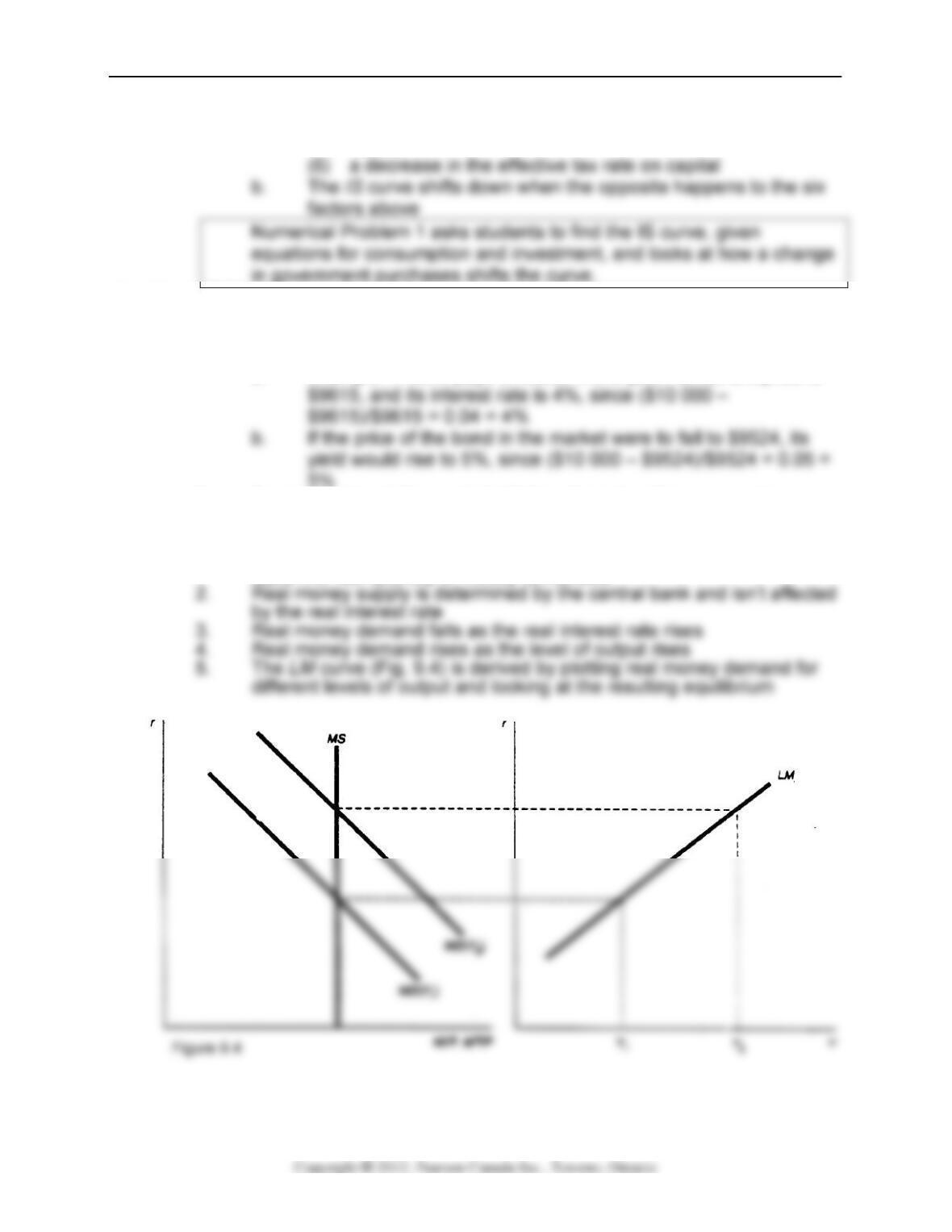
7. The LM curve shows the combinations of the real interest rate and
output that clear the asset market
a. Intuitively, for any given level of output, the LM curve shows the
IV. Factors that shift the LM curve
1. Any change that reduces real money supply relative to real money
demand shifts the LM curve up
2. Similarly, a change that increases real money supply relative to real
money demand shifts the LM curve down
3. Summary Table 13 lists the factors that shift the LM curve
a. The LM curve shifts down because of
(1) an increase in the nominal money supply
(2) a decrease in the price level
(3) an increase in expected inflation
(4) a decrease in the nominal interest rate on money
factors listed above
4. Changes in the real money supply
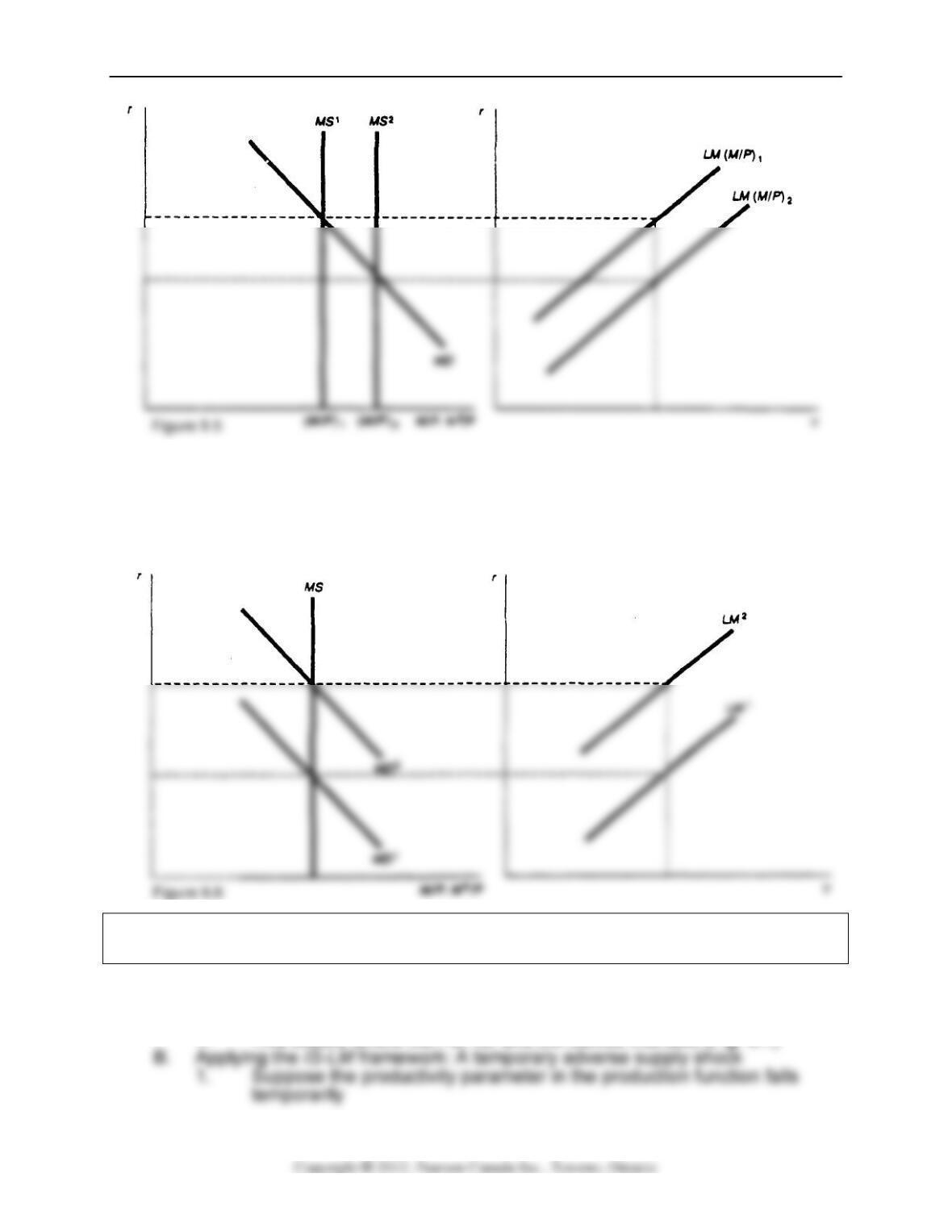
a. An increase in the real money supply shifts the LM curve down
(Fig. 9.5)
The IS–LM/AD–AS Model: A General Framework for Macroeconomic Analysis 145
5. Changes in real money demand
a. An increase in real money demand shifts the LM curve up (Fig.
9.6)
b. Similarly, a drop in real money demand shifts the LM curve
down
Numerical Problem 2 shows the derivation of the LM curve from a money demand
equation and looks at how changes in money demand and supply shift the curve.
V. General Equilibrium in the Complete IS–LM Model (Sec. 9.4)
A. When all markets are simultaneously in equilibrium there is a general
equilibrium
1. This occurs where the FE, IS, and LM curves intersect (Fig. 9.7)

Figure 9.8
146 Chapter 9
2. The supply shock reduces the
marginal productivity of
labour, hence labour demand
a. With lower labour
3. There’s no effect of a
temporary supply shock on
the IS or LM curves
4. Since the FE, IS, and LM
curves don’t intersect, the price level adjusts, shifting the LM curve
5. The inflation rate rises
temporarily, not permanently
6. Summary: The real wage,
employment, and output
decline, while the real interest
rate and price level are higher
lower
C. Application: Oil price shocks revisited
1. Does the IS–LM correctly predict the results of an adverse supply
shock?
2. The data from the 1973–1974 and 1979–1980 oil price shocks shows
the following
a. As discussed in Chapter 3, output, employment, and the real
Figure 9.7

The IS–LM/AD–AS Model: A General Framework for Macroeconomic Analysis 147
(1) It could be that people expected the 1973–1974 oil price
shock to be permanent
Analytical Problem 2 examines the effect on the real interest rate of a permanent oil
price shock compared to a temporary oil price shock.
D. Box 9.1: Econometric models and macroeconomic forecasts
1. Many models that are used for macroeconomic research and analysis
are based on the IS–LM model
2. There are three major steps in using an economic model for
forecasting
a. An econometric model estimates the parameters of the model
3. Large forecasting firms have models that forecast large numbers of
variables (examples range from 700 to 1200)
VI. Price Adjustment and the Attainment of General Equilibrium (Sec. 9.5)
A. The effects of a monetary expansion
1. An increase in money supply shifts the LM curve down
2. Because financial markets respond most quickly to changes in
economic conditions, the asset market responds to the disequilibrium
Analytical Problem 3 looks at this short-run equilibrium.
3. The increase in the money supply causes people to try to get rid of
excess money balances by buying assets, driving the real interest rate
down
a. The decline in the real interest rate causes consumption and

148 Chapter 9
4. The adjustment of the price level
a. Since the demand for
goods exceeds firms’
desired supply of goods,
firms raise prices
b. The rise in the price level
Numerical Problems 3 and 4 and Analytical Problem 1 look at the complete IS–LM
model, including adjustment of the price level to restore equilibrium.
5. Trend money growth and inflation
a. This analysis also handles the case in which the money supply
is growing continuously
(1) The examples can often be thought of as a change in M or
P relative to the expected or trend growth of money and
inflation
(2) Thus when we talk about “an increase in the money
B. Classical versus Keynesian versions of the IS–LM model
1. There are two key questions in the debate between classical and
Keynesian approaches
a. How rapidly does the economy reach general equilibrium?
b. What are the effects of monetary policy on the economy?

The IS–LM/AD–AS Model: A General Framework for Macroeconomic Analysis 149
2. Price adjustment and the self-correcting economy
a. The economy is brought into general equilibrium by
d. Keynesian economists see slow adjustment of the price level
(1) It may be several years before prices and wages adjust
fully
3. Monetary neutrality
a. Money is neutral if a change in the nominal money supply
changes the price level proportionately but has no effect on real
variables
b. The classical view is that a monetary expansion affects prices
Supply Model (Sec. 9.6)
A. Use the IS–LM model to develop the AD-AS model
1. The two models are equivalent
2. Depending on the issue, one model or the other may prove more
B. The aggregate demand curve
1. The AD curve shows the relationship between the quantity of goods
demanded and the price level when the goods market and asset
market are in equilibrium
a. So the AD curve represents the price level and output level at
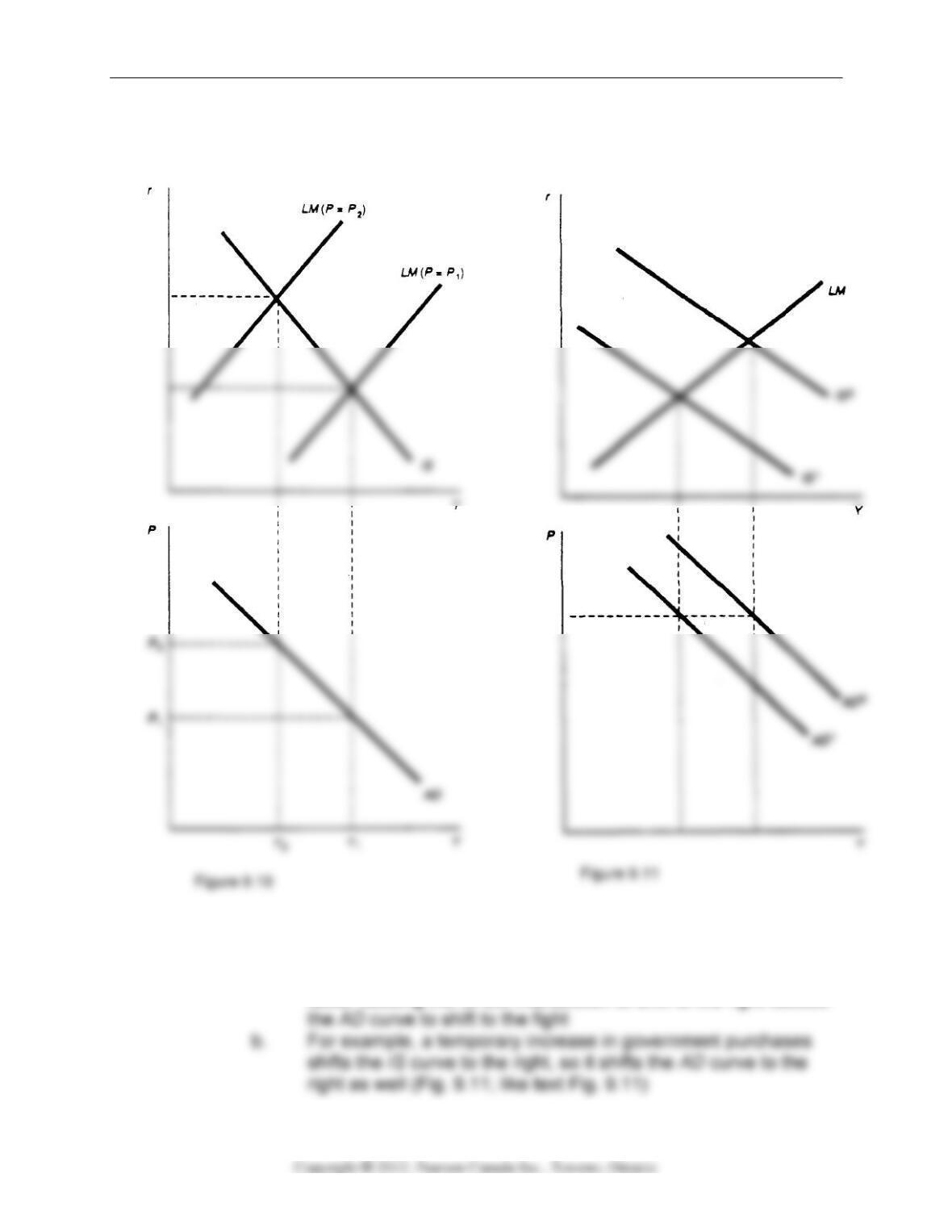
150 Chapter 9
up, raising the real interest rate, and decreasing output
demanded (Fig. 9.10; like text Fig. 9.10; key diagram 7)
2. Factors that shift the AD curve
a. Any factor that causes the intersection of the IS and LM curves
to shift to the left causes the AD curve to shift to the left; any
factor causing the IS–LM intersection to shift to the right causes
The IS–LM/AD–AS Model: A General Framework for Macroeconomic Analysis 151
c. Summary Table 14: Factors that shift the AD curve
(1) Factors that shift the IS curve up and thus the AD curve to
the right as well
(a) Increases in future output (Yf), wealth, government
or the real demand for money
C. The aggregate supply curve
1. The aggregate supply curve shows the relationship between the price
level and the aggregate amount of output that firms supply
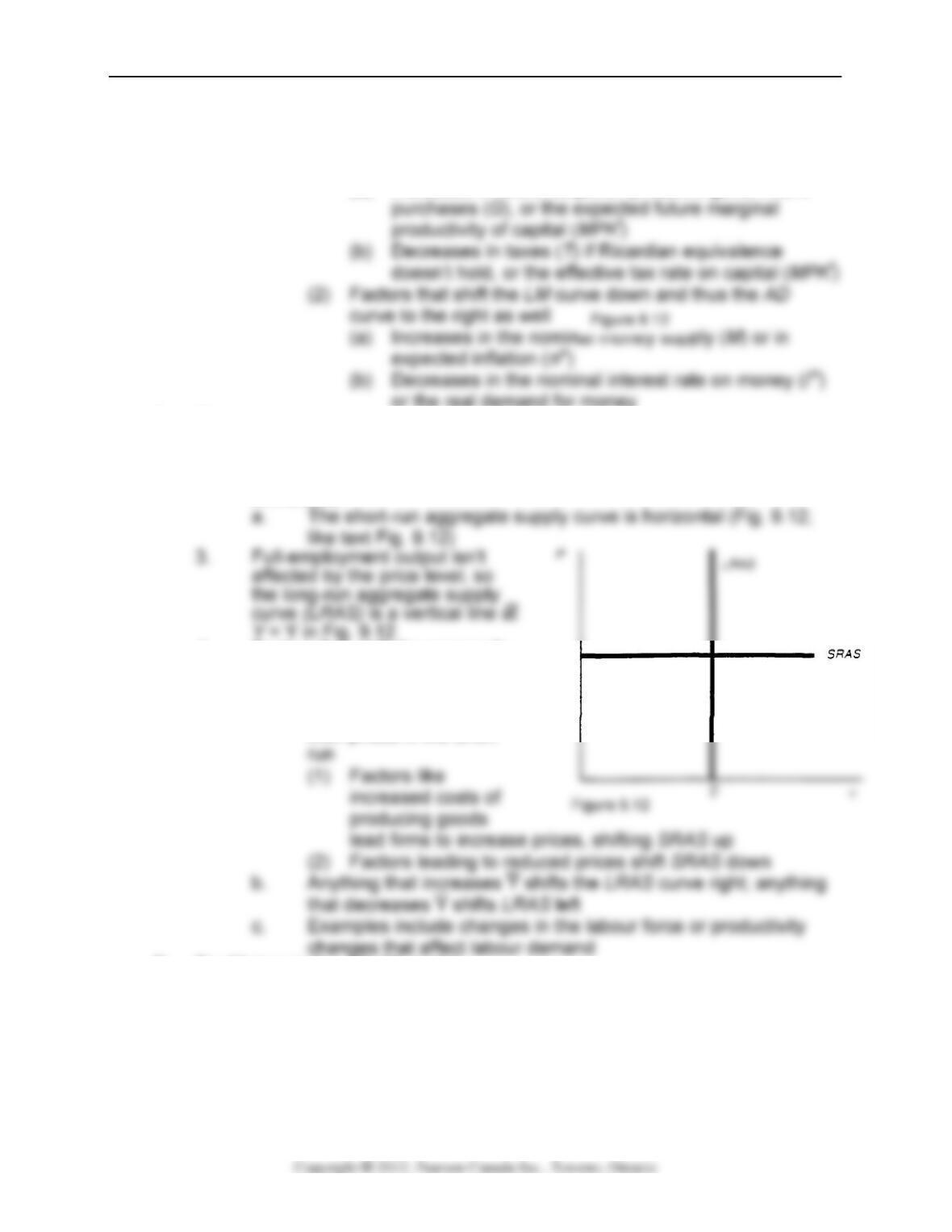
2. In the short run, prices remain fixed, so firms supply whatever output is
demanded
4. Factors that shift the aggregate
supply curves
a. The SRAS curve shifts
whenever firms change
their prices in the short
D. Equilibrium in the AD-AS model
1. Short-run equilibrium: AD intersects SRAS
2. Long-run equilibrium: AD intersects LRAS
a. Also called general equilibrium
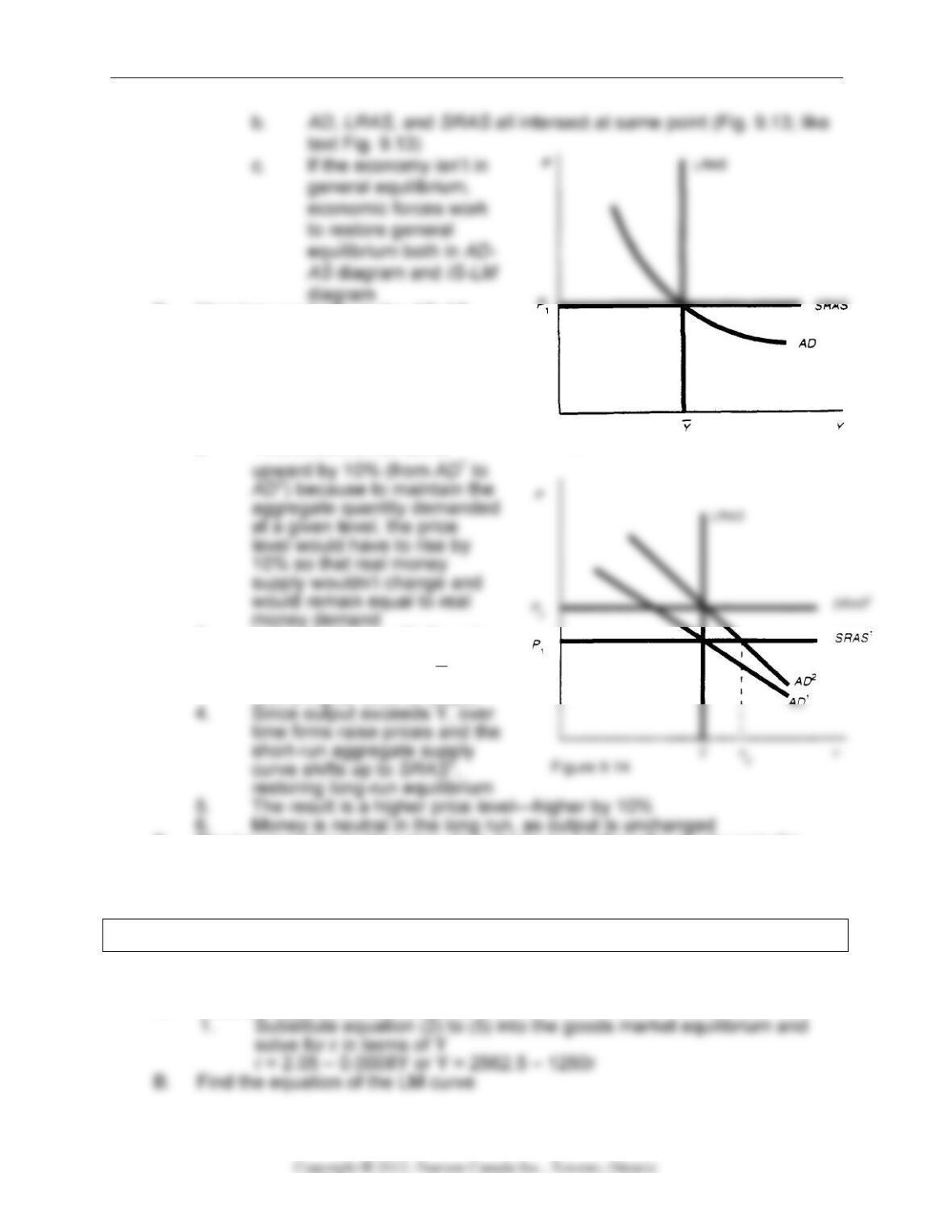
Figure 9.14
152 Chapter 9
E. Monetary neutrality in the AD-AS
model (Fig. 9.14; like text Fig. 9.14
and key diagram 8)
1. Suppose the economy begins
in general equilibrium, but
then the money supply is
increased by10%
2. This shifts the AD curve
3. In the short run, with the price
level fixed, equilibrium occurs
where AD2 intersects SRAS1,
with a higher level of output
F. The key question is: How long does it take to get from the short run to the
long run?
1. The answer to this question is what separates classicals from
Keynesians
Numerical Problem 5 illustrates the effects of fiscal policy using the model.
VIII. Appendix 9.A: A Worked-Out Numerical Exercise for Solving the IS-LM and AD-AS
Models
A. Find the equation of the IS curve
Figure 9.13