Chapter 9:
1. Why would means-tested transfer payments, such as food stamps, in which benefits are reduced as
income rises, act like an income tax facing recipients?
2. Why are income taxes more progressive than excise taxes such as those on alcohol, tobacco, and
gasoline?
Answer: A tax is progressive when it takes a larger percentage of income at higher levels
3. Why is the Social Security payroll tax considered regressive?
Answer: The Social Security tax is proportional to earnings up to a ceiling level of
4. Could the burdens of a regulation be either progressive or regressive, like the effects of a tax?
Answer: Since the costs of regulation have similar effects to those of taxes (they both
5. Is a gas tax better described as reflecting the ability to pay principle or the benefits received principle?
What about the federal income tax?
Answer: A gas tax is roughly proportional to the number of miles driven and so reflects the
6. Why would the benefits received principle be difficult to apply to national defense and the provision of
the justice system?
Answer: Since both national defense and provision of the justice system are supplied
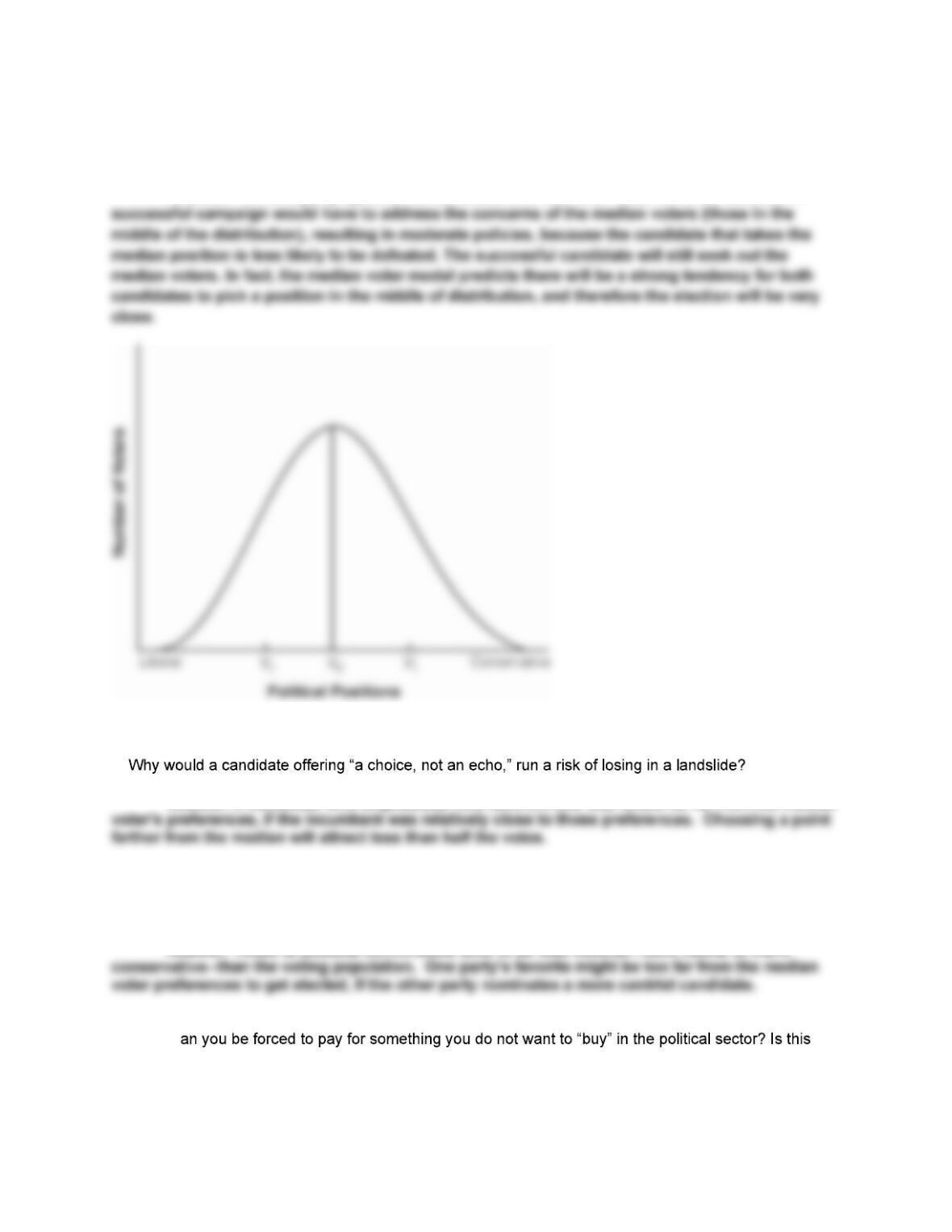
7. Illustrate the median voter model graphically and explain it.
Answer: In a two-party system, the candidate with the most votes wins the election. A
8.
Answer: A candidate who emphasized how different she was would be far from the median
9. Why might the party favorites at a political convention sometimes be harder to elect than more
moderate candidates?
Answer: Those at political conventions tend to be less centrist–more liberal or more
10. How c
sometimes good?
Answer: It is rational in the large group public good case for people not to voluntarily
11. Why does the creation of a government program create a special interest group, which makes it
difficult to reduce or eliminate it in the future?
Answer: Any program makes its beneficiaries into a special interest group, each member
12.
national education issues?
Answer: licies allow them to make better
13. Why do you think news reporters are more informed than average citizens about public policy issues?
Answer: Since reporters have jobs that involve being informed, they have a far greater