CHAPTER 8 | GDP: Measuring Total
Production and Income
Brief Chapter Summary and Learning Objectives
8.1 Gross Domestic Product Measures Total Production (pages 633–640)
8.2 Does GDP Measure What We Want It to Measure? (pages 640–643)
8.3 Real GDP versus Nominal GDP (pages 643–647)
8.4 Other Measures of Total Production and Total Income (pages 647–649)
Describe other measures of total production and total income.
▪ Other measures of total production and total income include gross national product
(GNP), national income, personal income, and disposable personal income.
Key Terms
Business cycle, p. 632. Alternating periods of
economic expansion and economic recession.
Consumption, p. 636. Spending by households
on goods and services, not including spending
on new houses.
Final good or service, p. 633. A good or service
purchased by a final user.
GDP deflator, p. 645. A measure of the price
level, calculated by dividing nominal GDP by
real GDP and multiplying by 100.
176 CHAPTER 8 | GDP: Measuring Total Production and Income
Inflation rate, p. 632. The percentage increase
in the price level from one year to the next.
Macroeconomics, p. 632. The study of the
economy as a whole, including topics such as
inflation, unemployment, and economic growth.
Microeconomics, p. 632. The study of how
Price level, p. 644. A measure of the average
prices of goods and services in the economy.
government to households for which the
government does not receive a new good or
service in return.
Underground economy, p. 640. Buying and
selling of goods and services that is concealed
Chapter Outline
Ford Motor Company Rides the Business Cycle
Sales of the Ford Motor Company’s cars and trucks plummeted beginning in 2008 as the U.S. economy
suffered its worst downturn since the 1930s. Overall, the automobile industry saw sales of new vehicles
Teaching Tips
The end of the chapter in the main text includes a special category of exercises titled Real-Time Data
Exercises. These exercises help students become familiar with a key data source, learn how to locate data,
CHAPTER 8 | GDP: Measuring Total Production and Income 177
8.1
Gross Domestic Product Measures Total Production (pages 633–640)
Learning Objective: Explain how total production is measured.
Microeconomics is the study of how households and firms make choices, how they interact in markets,
and how the government attempts to influence their choices. Macroeconomics is the study of the
economy as a whole, including topics such as inflation, unemployment, and economic growth. The
A. Measuring Total Production: Gross Domestic Product
Economists use gross domestic product to measure total production. Gross domestic product (GDP)
is the market value of all final goods and services produced in a country during a period of time,
B. Production, Income, and the Circular-Flow Diagram
When we add up the value of total production in the economy by calculating GDP, we are simultaneously
measuring the value of total income. The circular-flow diagram illustrates the interaction of firms
C. Components of GDP
The BEA divides its statistics on GDP into four major categories of expenditures. Economists use these
categories to understand why GDP fluctuates and to forecast future GDP. Personal consumption
178 CHAPTER 8 | GDP: Measuring Total Production and Income
D. An Equation for GDP and Some Actual Values
A simple equation sums up the components of GDP:
E. Measuring GDP Using the Value-Added Method
An alternative way of calculating GDP is the value-added method. Value added is the market value a
firm adds to a product. It is equal to the difference between the price for which the firm sells a good and
the price it paid other firms for intermediate goods.
CHAPTER 8 | GDP: Measuring Total Production and Income 179
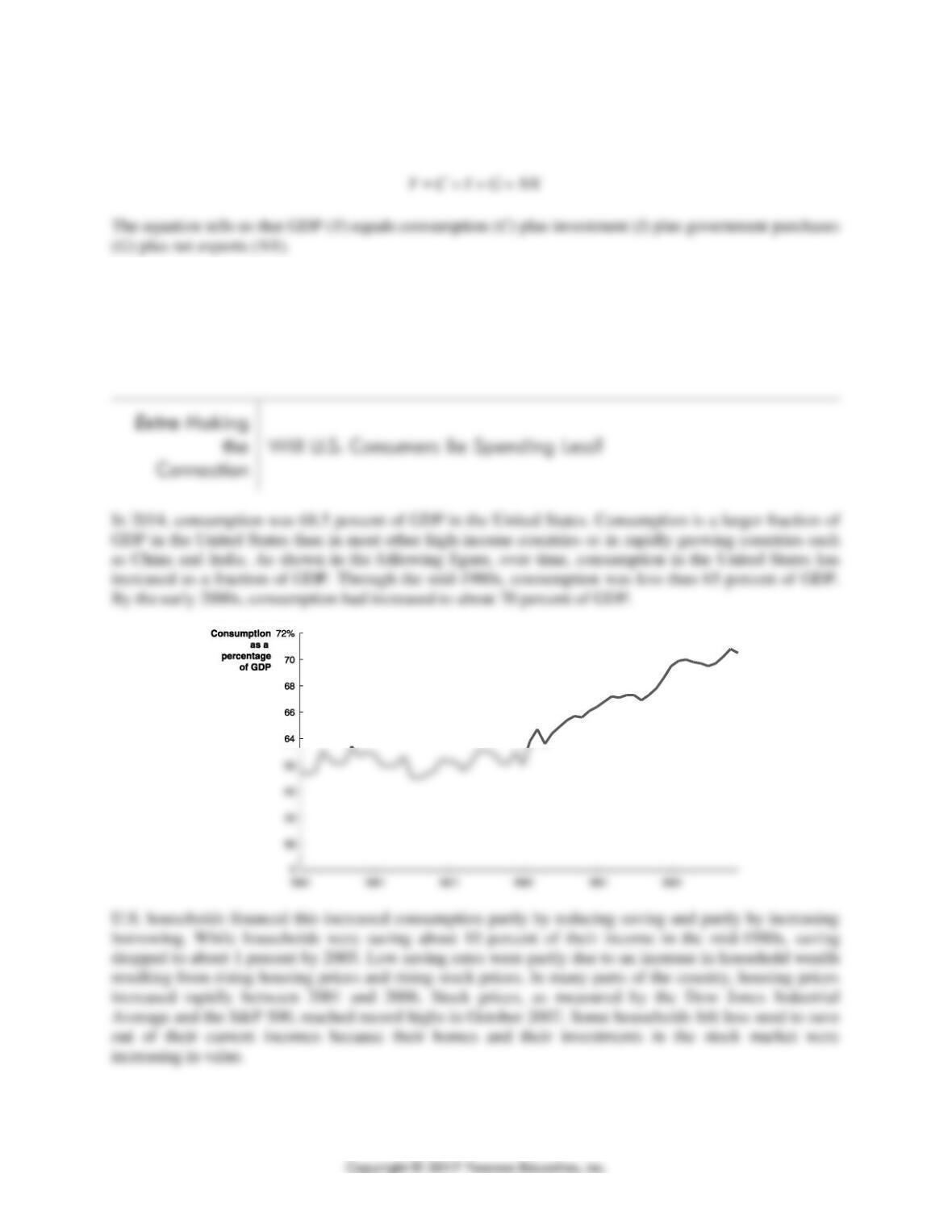
During the early 2000s, many households borrowed against the increased value of their homes by taking
out home equity loans, which many banks were increasingly willing to grant. Banks and other financial
firms also loosened the requirements for issuing credit cards, so some households with flawed credit
histories were able to borrow against their credit cards to finance their spending. The ratio of loans and
Question
An article on USAToday.com observed: “Consumer spending, once the driving force of the U.S.
economy, is likely to remain stagnant for years as households struggle to cut debt and build up savings,
economists say.” Why does cutting debt and building up savings affect consumer spending? If consumer
spending remains stagnant, what will be the likely effect on the economy?
Source: Karina Frayter, “Economists: Consumers Won’t Save the Economy,” USAToday.com, October 2, 2011.
Answer
8.2
Does GDP Measure What We Want It to Measure? (pages 640–643)
Learning Objective: Discuss whether GDP is a good measure of well-being.
Economists use GDP to measure total production in the economy. Most economists believe that GDP
does a good—but not flawless—job of measuring production. GDP provides only a rough measure of
well-being.
A. Shortcomings in GDP as a Measure of Total Production
When the BEA calculates GDP, it does not include two types of production: production in the home and
B. Shortcomings of GDP as a Measure of Well-Being
The main purpose of GDP is to measure a country’s total production. Although increases in GDP often
180 CHAPTER 8 | GDP: Measuring Total Production and Income
Extra Solved Problem 8.2
Measuring Economic Welfare
Although GDP is widely used as a measure of the value of a country’s production and income, some
economists argue that it is not a good measure of the progress countries make in raising the standard of
living of their citizens. In 2010, British Prime Minister David Cameron announced the United Kingdom’s
plans to construct a measure of well-being that would account for such factors as citizens’ satisfaction
with their lives. France also announced an effort to construct an alternative to GDP as a measure of well–
One critic of GDP wrote that the recession of 2007–2009 “. . . offers an excellent opportunity to get rid of
[an economic concept] that has long outlived its usefulness: gross domestic product. . . . It ought to join
buggy whips and VCRs on the dust-heap of history.”
Sources: Market Whitehouse, “Nations Seek Success Beyond GDP,” Wall Street Journal, January 10, 2011. William Nordhaus
and James Tobin, “Is Growth Obsolete?” Economic Growth, Fiftieth Anniversary Colloquium, Vol. 5. New York: National
Bureau of Economic Research, 1972; and Eric Zencey, New York Times, August 10, 2009.
a. Do economists overstate the value of GDP as a measure of economic welfare?
b. Should GDP be replaced as a measure of growth in the overall economy?
Solving the Problem
Step 1: Review the chapter material.
This problem is about whether gross domestic product is a good measure of well-being, so
CHAPTER 8 | GDP: Measuring Total Production and Income 181
Extra Making
the
Connection
Did World War II Bring Prosperity?
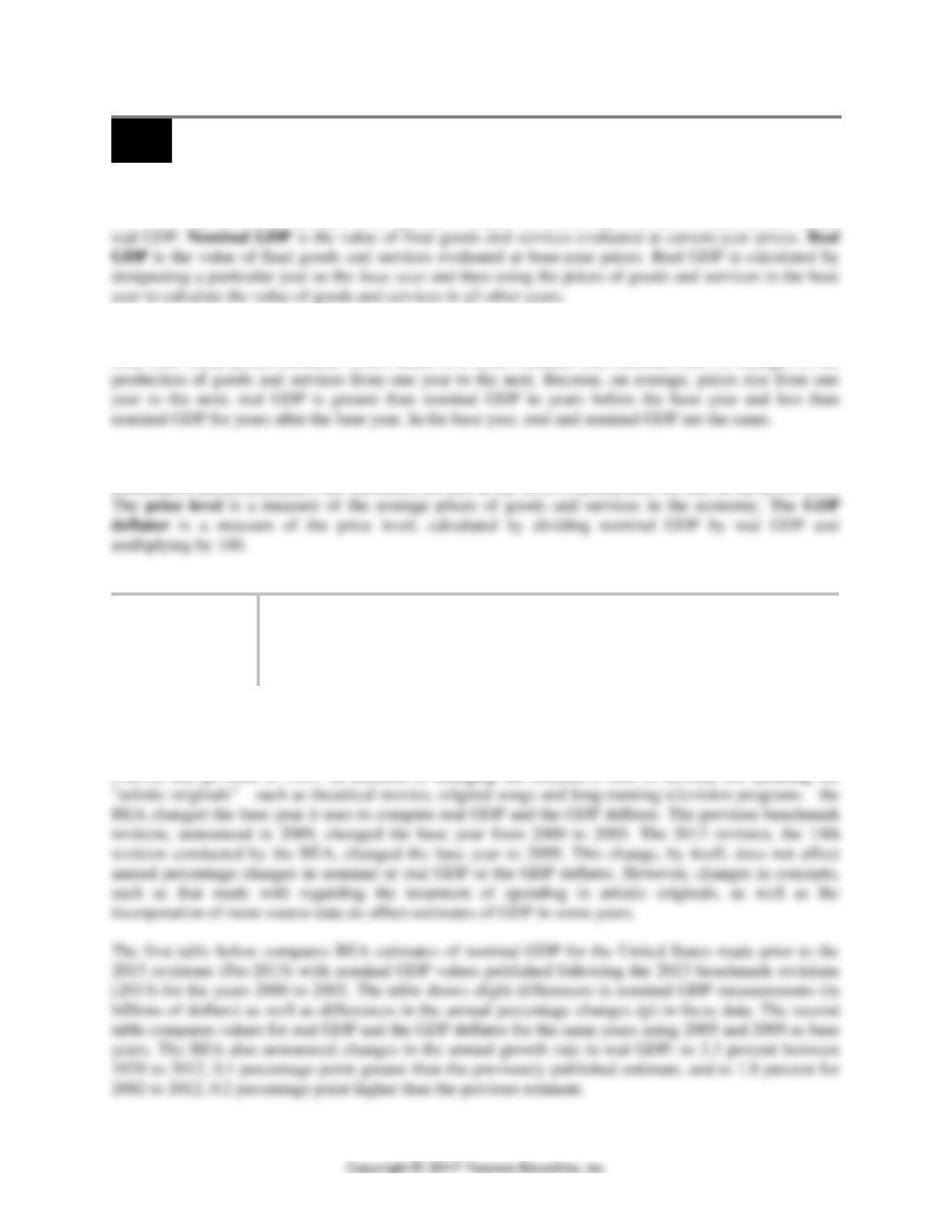
The Great Depression of the 1930s was the worst economic downturn in U.S. history. GDP declined by
Traditionally, historians have argued that World War II brought prosperity back to the U.S. economy. But
did it? Economist Robert Higgs argued that if we look at the well-being of a typical person, the World
War II years were anything but prosperous. Higgs pointed out that increased production of tanks, ships,
planes, and munitions accounted for most of the increase in GDP during those years. Between 1943 and
1945, more than 40 percent of the labor force was either in the military or producing war goods. As a
result, between 1939 and 1944, production of clothing, radios, books, and other consumption goods per
person increased only about 2 percent, leaving the quantity of consumption goods available to the typical
person in 1944 still below what it had been in 1929. With the end of the war, true prosperity did return to
the U.S. economy, and by 1946, production of consumption goods per person had risen by more than
25 percent from what it had been in 1929.
World War II was a period of extraordinary sacrifice and achievement by the “greatest generation.” But
statistics on GDP may give a misleading indication of whether it was also a period of prosperity.
182 CHAPTER 8 | GDP: Measuring Total Production and Income
8.3
Real GDP versus Nominal GDP (pages 643–647)
Learning Objective: Discuss the difference between real GDP and nominal GDP.
A. Calculating Real GDP
The BEA separates price changes from quantity changes by calculating a measure of production called
B. Comparing Real GDP and Nominal GDP
Real GDP holds prices constant, which makes it a better measure than nominal GDP of changes in the
C. The GDP Deflator
Economists and policymakers are interested not just in the level of production but also in the price level.
Extra Making
the
Connection
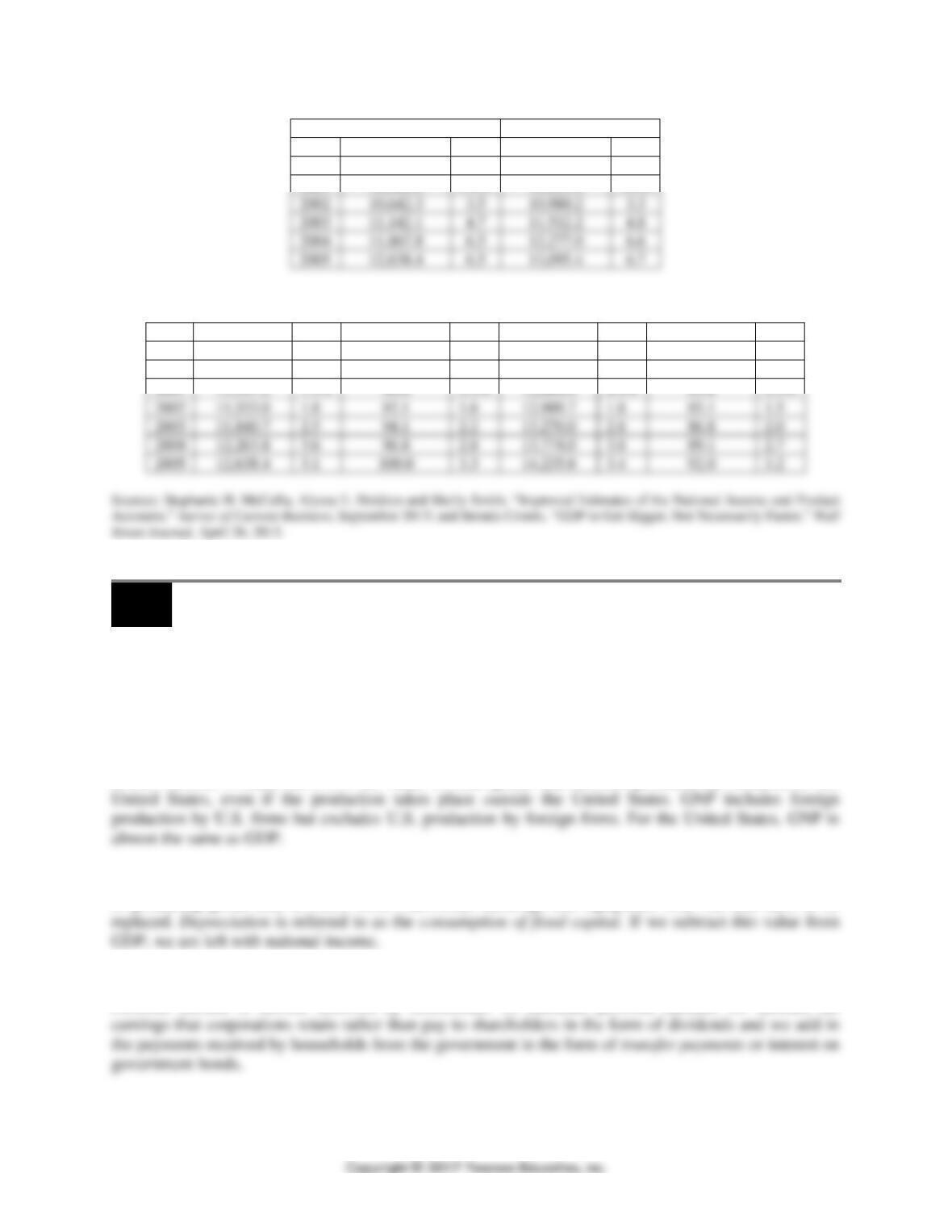
The BEA’s 2013 Benchmark Revisions
Making the Connection on page 638 (“Adding More of Lady Gaga to GDP”) described one of the
revisions made in 2013 to the way the Bureau of Economic Analysis (BEA) measures GDP. Every four or
five years the BEA announces benchmark revisions used to adjust national income and product accounts
(NIPA) that go back to 1929. In addition to changing the formula it uses to account for spending for
CHAPTER 8 | GDP: Measuring Total Production and Income 183
Pre-2013
2013
Year
Nominal GDP
(p)
Nominal GDP
(p)
2000
$9,951.5
—
$10,289.7
—
2001
10,286.2
3.4%
10,625.3
3.3%
2002
10,642.3
10,980.2
2003
11,142.1
11,512.2
2004
11,867.8
12,277.0
2005
12,638.4
13,095.4
Real GDP
GDP Deflator
Real GDP
GDP Deflator
Year
(2005 = 100)
(p)
(2005 = 100)
(p)
(2009 = 100)
(p)
(2009 = 100)
(p)
2000
$11,226.0
—
88.6
—
$12,565.2
—
81.9
—
2001
1.1%
90.6
2.3%
0.9%
83.8
2.3%
2002
1.8
92.1
1.6
1.8
85.1
1.5
2003
2.5
94.1
2.2
2.8
86.8
2.0
2004
3.6
96.8
2.8
3.8
89.1
2.7
2005
3.1
3.3
3.4
92.0
3.2
8.4
Other Measures of Total Production and Total Income (pages 647–649)
Learning Objective: Describe other measures of total production and total income.
National income accounting refers to the methods the BEA uses to track total production and total income
in the economy. In addition to computing GDP, the BEA computes the following four measures of
production and income: gross national product, national income, personal income, and disposable
personal income.
A. Gross National Product
Gross National Product (GNP) is the value of final goods and services produced by residents of the
B. National Income
In producing goods and services, some machinery, buildings and equipment wear out and have to be
C. Personal Income
Personal income is income received by households. To calculate personal income, we subtract the
184 CHAPTER 8 | GDP: Measuring Total Production and Income
D. Disposable Personal Income
Disposable personal income is equal to personal income minus personal tax payments, such as the federal
E. The Division of Income
We can measure GDP in terms of total expenditure or as the total income received by households. GDP
calculated as the sum of income payments to households is sometimes referred to gross domestic income.
The largest component of gross domestic income is wages, which are about three times as large as profits.
Extra Solved Problem 8.4
GDP and National Income: Accounting for Changes in the Stock of Capital
Suppose you are hired to measure the population in your home town. You could go door–to-door and
determine how many people live in each household. But let’s assume that your mayor had the following
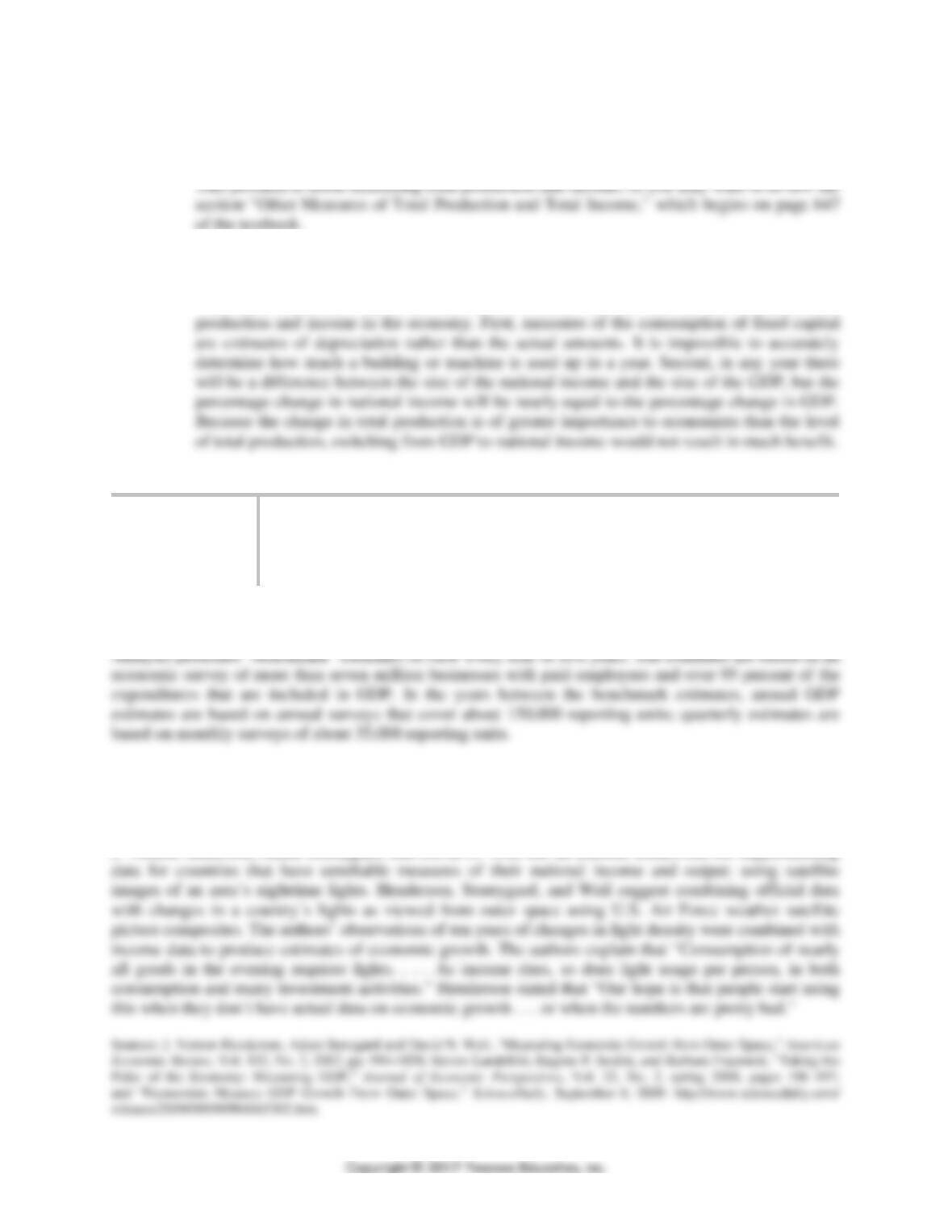
Included in GDP is the value of gross private domestic investment (or simply “investment”). This is an
overestimate of the change in the nation’s stock of capital because some investment spending represents
replacement of capital (buildings, machines, etc.) that has worn out. Using gross private domestic
investment as a measure of the increase in the nation’s stock of capital is similar to computing a
population census without accounting for people who died and moved elsewhere. Net private domestic
investment subtracts from gross investment estimates of the “deaths”—or depreciation—of the nation’s
capital stock. The following example illustrates the difference between gross private domestic investment
and net private domestic investment for the 4th quarter (IV) of 2015. Data are measured in billions of
dollars at annual rates.
2015
IV
Gross private domestic investment $3,019.2
CHAPTER 8 | GDP: Measuring Total Production and Income 185
Solving the Problem
Step 1: Review the chapter material.
of the textbook.
Step 2: Answer the question by explaining why economists don’t use national income rather
than GDP as the primary measure of total production and income in the economy.
There are two reasons why economists use GDP rather than national income to measure total
Extra Making
the
Connection
“I see more lights!—increase GDP”
The United States and other industrialized nations recognize the importance of accurately calculating
GDP and other measures of total production and income. In the United States, the Bureau of Economic
The national income data published for some areas of the world, such as sub-Saharan Africa and other
developing nations, are not measured so carefully. The quality of data from Iraq, Myanmar, Somalia, and
Liberia are so poor that national income and price data do not appear in the Penn World Tables, a
standard source for international macroeconomic data. Three economists from Brown University,
J. Vernon Anderson, Adam Storeygard, and David N. Weil use an unusual framework for supplementing
186 CHAPTER 8 | GDP: Measuring Total Production and Income
Extra Economics in Your Life:
What is the Most Desirable Country to Live In?
Since 1990, the United Nations Development Programme (UNDP) has ranked the world’s “most
desirable places to live.” The rankings are based on a Human Development Index (HDI), which includes
national measures of life expectancy at birth, mean years of schooling, expected years of schooling, and
per capita GDP. In 2014, the five nations that scored the highest HDI values were: (1) Norway, (2)
Australia, (3) Switzerland, (4), Denmark, and (5) Germany. The United States was ranked 8th.
Question: If you were asked to make your own list of the best places to live, how important would a
country’s per capita real GDP be as a criterion? What other factors would you consider in making your list?
Answer: A list of “best places to live” is subjective. Someone who enjoys skiing and ice skating would
probably rank a country that had a cold, snowy climate higher compared to someone who hated cold
Extra AN INSIDE LOOK News Article to Use in Class
CHAPTER 8 | GDP: Measuring Total Production and Income 187
Solutions to End-of-Chapter Exercises
8.1
Gross Domestic Product Measures Total Production
Learning Objective: Explain how total production is measured.
Review Questions
1.1 In microeconomics, we focus on a particular market and can measure production by the quantity
of the good or service produced. In macroeconomics, we look at the production of all goods and
1.2 The total of every good and service sold during the year would be larger than GDP because some
of the goods and services sold, such as intermediate goods and services and goods produced in a
prior year, are not included in GDP.
1.3 All of the revenue a firm receives from the sale of its output is paid out as income to the owners
of the factors of production.
1.4 GDP = C + I + G + NX. Consumption (C) is spending by households on goods and services, and
1.5 A firm’s value added equals the market price of the good its sells minus the cost of the
intermediate goods included in the production of the good.
Problems and Applications
1.6 The value of intermediate goods and services, though not counted directly, is included in the
1.7 a. The purchase of flour by a bakery is the purchase of an intermediate good, not a final good,
188 CHAPTER 8 | GDP: Measuring Total Production and Income
1.8 Part of the investment component of GDP is additions to inventories – final goods that have been
produced but not purchased in the time period in which they were produced. When the value of
1.9 a. Consumption
b. None of the components of GDP will be affected because the car is not new production.
1.10 The value of the house built in 2006 would not be included in GDP for 2017 because the sale
does not represent new production. The value of the services of the real estate agent who helped
1.12 The statement is incorrect because it confuses investment in the economic sense of purchases of
machinery, factories, and houses with financial investment in stocks and bonds.
1.13 A factory invests in a new machine to produce a good and a singer works in a recording studio to
produce an entertainment product–an album. The Bureau of Economic Analysis now counts both
8.2
Does GDP Measure What We Want It to Measure?
Learning Objective: Discuss whether GDP is a good measure of well-being.
Review Questions
2.1 GDP measures the value of final goods and services produced in a country during a period of
time and the level of income in the country during that same period. Although production of
CHAPTER 8 | GDP: Measuring Total Production and Income 189
2.2 The underground economy is the buying and selling of goods and services that is concealed from
2.3 GDP does not include household production and the underground economy. Even if GDP
included all production, it would still not be a perfect measure of economic well-being because it
Problems and Applications
2.4 a. This is likely to increase measured GDP because household production is not counted in
GDP.
2.5 Because the decline in the number of hours of paid work was almost the same as the increase in
the number of hours of work devoted to household production, total production in the economy
probably did not change much when these workers became unemployed, even though measured
2.6 Real GDP per capita is the level of real output or income per person. Real GDP per capita for the
United States has risen since 1890. A higher income level today might be due to Americans
2.7 No, the African-American farmers increased their well-being by choosing to work less and to
enjoy more leisure time than slavery allowed. We know that they valued the increased leisure
190 CHAPTER 8 | GDP: Measuring Total Production and Income
2.8 a. The underground economy is the buying and selling of goods and services that is concealed
from the government to avoid taxes or regulations or because the goods and services bought
2.9 a. Working “off the books” means working in the underground economy where economic
transactions are concealed from the government to avoid taxes or regulations or because the
goods and services sold are illegal.
2.10 This is a normative question so responses may vary. German workers receive a mandatory 20
paid vacation days and 10 paid holidays. Some workers value additional leisure time more than
the income they would earn from additional hours worked, while other workers would rather
8.3
Real GDP versus Nominal GDP
Learning Objective: Discuss the difference between real GDP and nominal GDP.
Review Questions
3.1 Nominal GDP can change because of either quantity changes or price changes. When there is
inflation, nominal GDP overstates the increase in total production. The Bureau of Economic
Analysis separates price changes from quantity changes by calculating real GDP.
CHAPTER 8 | GDP: Measuring Total Production and Income 191
Problems and Applications
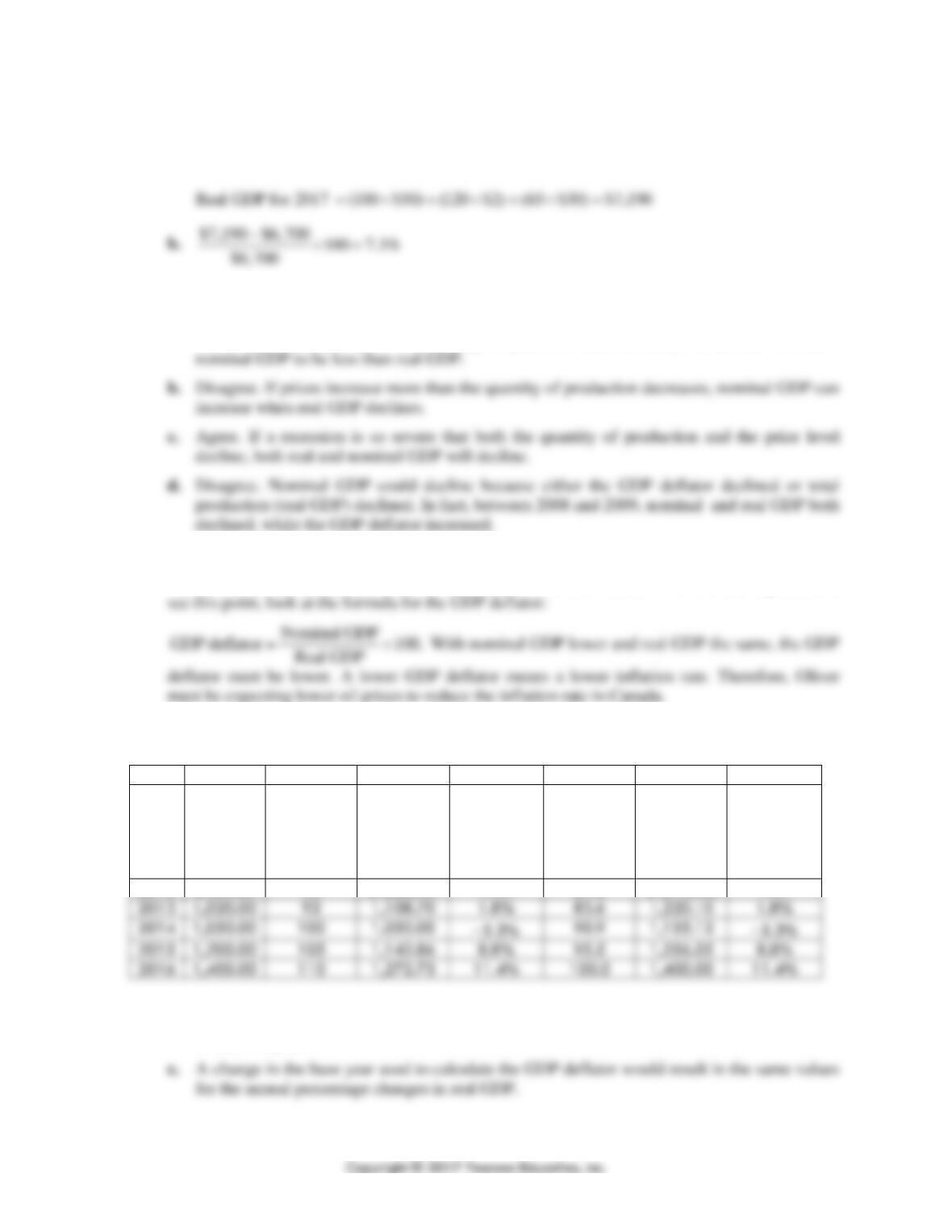
3.4 a. Real GDP for 2016
(100 $50) (100 $2) (50 $30) $6,700= + + =
3.5 a. Disagree. Nominal GDP is less than real GDP if the current price level, which is used in
calculating nominal GDP, is less than the base period price level, which is used in calculating
real GDP. A fall in the price level during the year is neither necessary nor sufficient to cause
3.6 The only way for nominal GDP to be lower than previously expected at the same time as the
value of real GDP remains the same is if the value of the GDP deflator is lower than expected. To
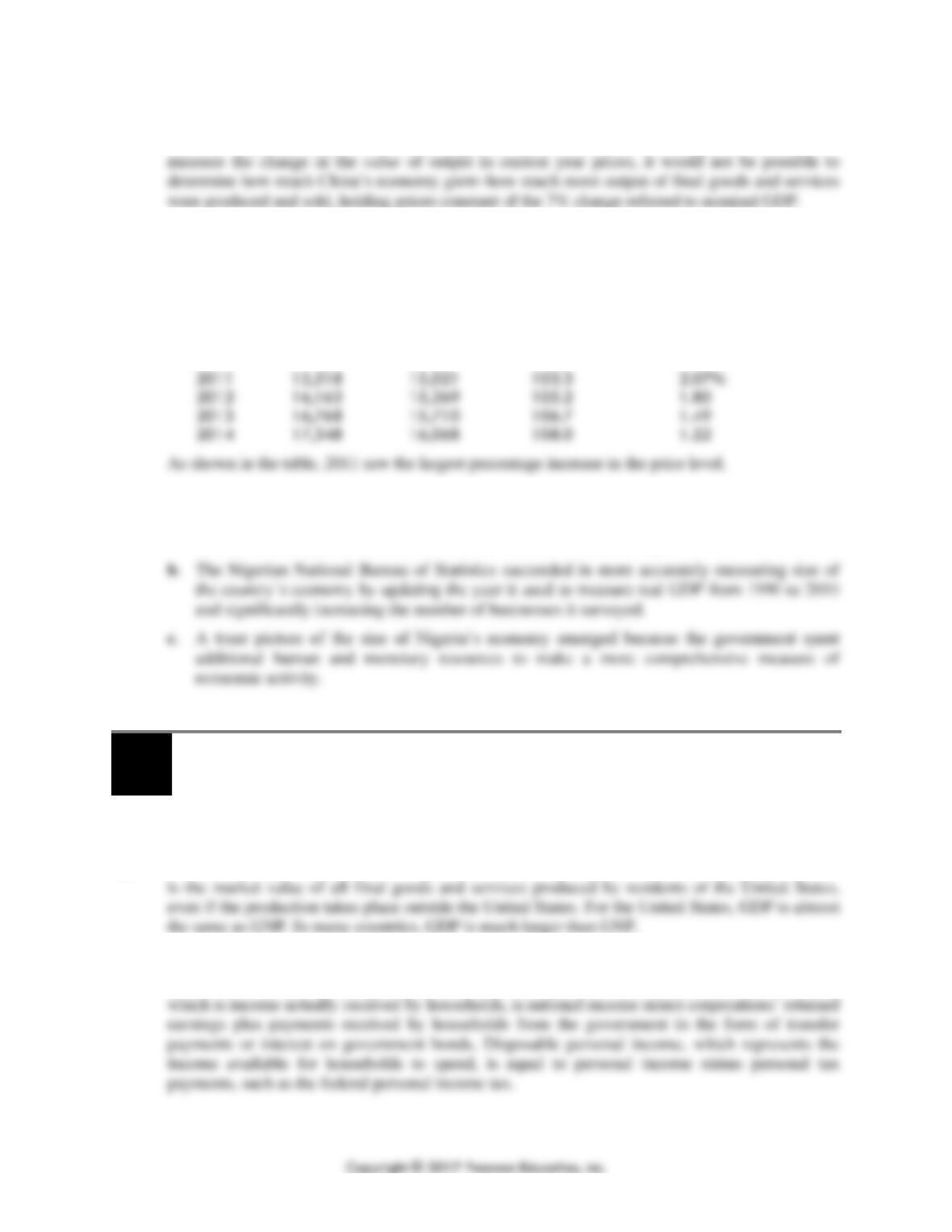
3.7 a.
(1)
(2)
(3)
(4)
(5)
(6)
(7)
(8)
Year
Nominal
GDP
GDP
Deflator
(base year
= 2014)
Real GDP
(base year
= 2014)
Percentage
change
in real
GDP
GDP
Deflator
(base year
= 2016)
Real GDP
(base year
= 2016)
Percentage
change in
Real GDP
2012
$980.00
90
$1,088.89
——
81.8
$1,198.04
—–
2013
1,020.00
92
83.6
2015
1,200.00
95.5
2016
1,400.00
b. The calculations for the annual percentage change in real GDP are not affected by the change
in the base year.
192 CHAPTER 8 | GDP: Measuring Total Production and Income
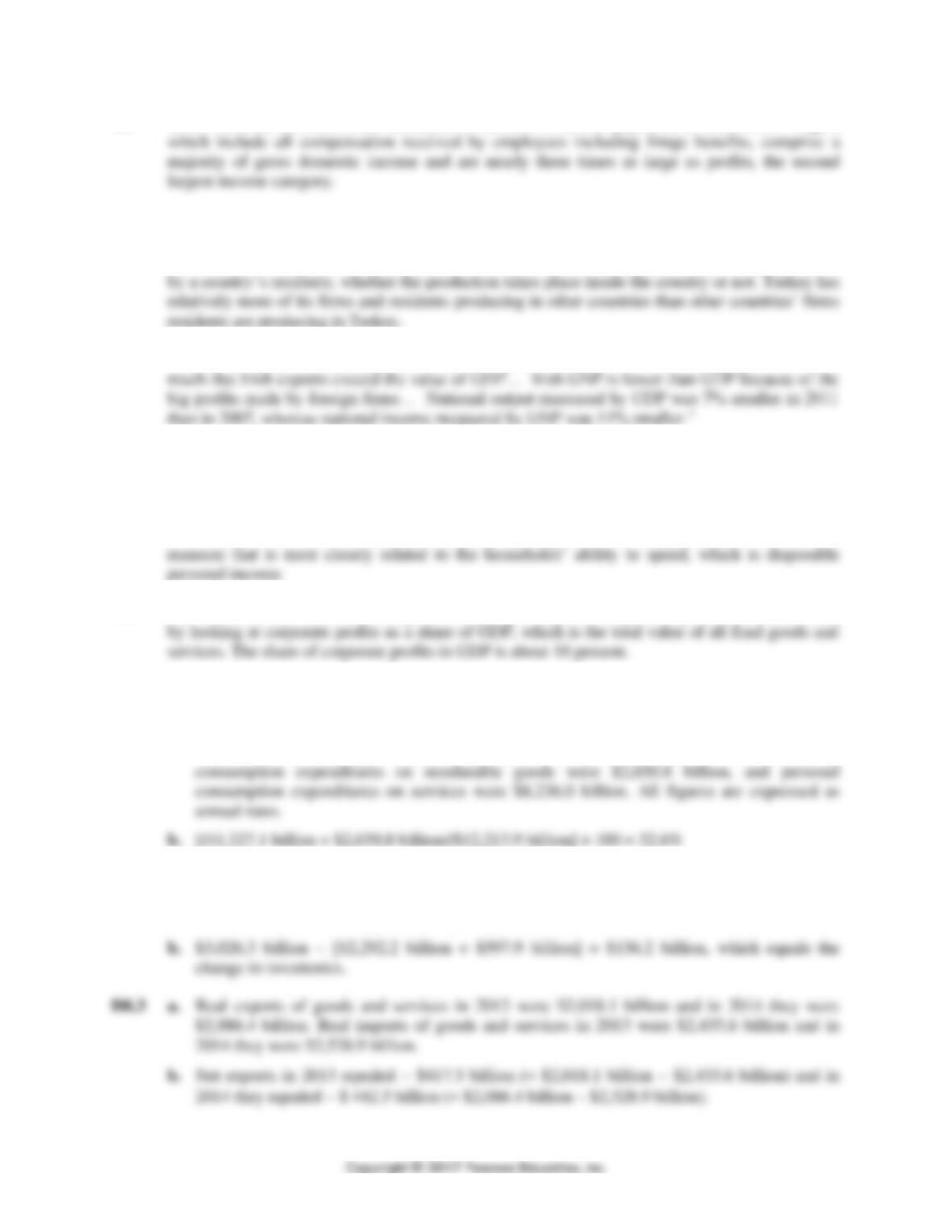
3.8 It is likely that the article is referring to the percentage change in real GDP, which measures the
value of output, holding constant the change in the price level. Because changes in nominal GDP
3.9 The GDP deflator is calculated as [nominal GDP/real GDP]
100.
The percentage change is calculated as [(value in the second period – value in the first
period)/value in the first period]
100.
Nominal GDP
Real GDP
GDP Deflator
Percentage Increase
2010
$14,964
$14,784
101.2
—
3.10 a. When the Nigerian government devoted more resources to the measurement of its GDP it
found that a more accurate accounting increased the relative size of the service and the
telecommunications sectors, as well as other sectors of the economy.
8.4
Other Measures of Total Production and Total Income
Learning Objective: Describe other measures of total production and total income.
Review Questions
4.1 GDP is the market value of all final goods and services produced within the United States. GNP
4.2 National income is the total income received by a country’s residents. National income is equal to
GDP minus the value of depreciation, or the consumption of fixed capital. Personal income,
CHAPTER 8 | GDP: Measuring Total Production and Income 193
4.3 Gross domestic income is GDP calculated as the sum of income payments to households. Wages,
Problems and Applications
4.4 GNP would be larger than GDP because GNP is the value of final goods and services produced
4.5 The author of this article explained: “The foreign presence [in the Irish economy] is now…so
4.6 The federal personal income tax partially accounts for the difference between personal income
and disposable personal income. Therefore, the levels of national income and personal income
will not change, while the level of disposable personal income will decrease.
4.7 To forecast the level of consumption spending by households, we should focus on the income
4.8 The statement overstates the average share of corporate profits in product prices. We can see this
Real-Time Data Exercises
D8.1 a. In the second quarter of 2015, total personal consumption expenditures were $12,213.9
billion, personal consumption expenditures on durable goods were $1,327.1 billion, personal
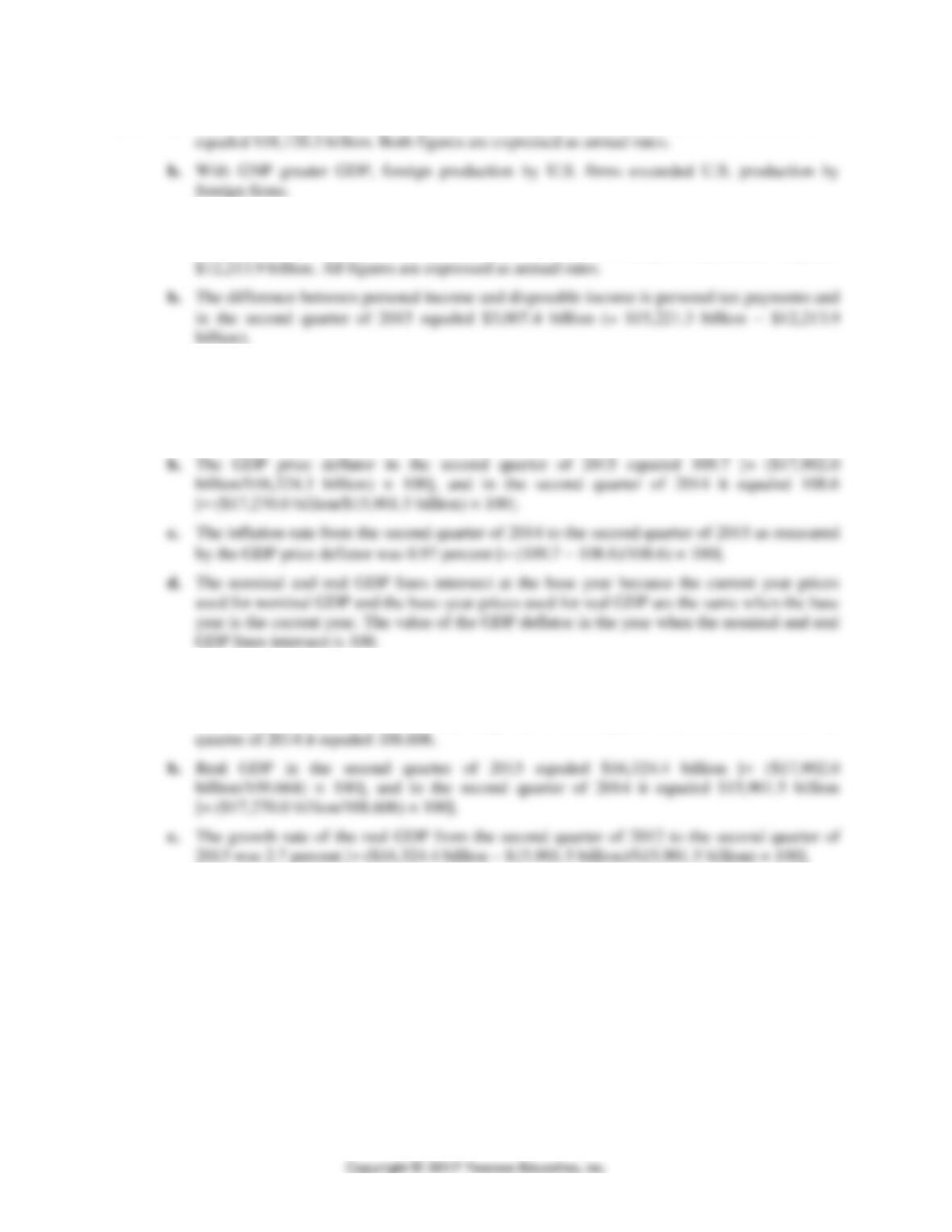
D8.2 a. In the second quarter of 2015, gross private domestic investment was $3,026.3 billion, private
nonresidential fixed investment was $2,292.2billion, and private residential fixed investment
was $597.9 billion. All figures are expressed as annual rates.
194 CHAPTER 8 | GDP: Measuring Total Production and Income
D8.4 a. In the second quarter of 2015, nominal GDP equaled $17,902.0 billion and nominal GNP
D8.5 a. In the second quarter of 2015, personal income equaled $15,221.3 billion, disposable
personal income equaled $13,294.1 billion, and personal consumption expenditures equaled
D8.6 a. Nominal GDP equaled $17,902.0 billion in the second quarter of 2015 and equaled $17,270.0
billion in the second quarter of 2014. Real GDP equaled $16,324.3 billion in the second
quarter of 2015 and equaled $15,901.5 billion in the second quarter of 2014. All figures are
expressed as annual rates.
D8.7 a. Nominal GDP in the second quarter of 2015 equaled $17,902.0 billion, and in the second
quarter of 2014 it equaled $17,270.0 billion. Both figures are expressed as annual rates The
GDP Implicit Price Deflator in the second quarter of 2015 equaled 109.664, and in the second