Instructor’s Manual 8-1
8
EMOTIONAL/BEHAVIORAL DISORDERS
INSTRUCTOR OVERVIEW
Chapter 8, “Emotional/Behavioral Disorders,” introduces people with emotional disturbance and
behavior disorders, described as “emotional disturbance” in federal law under IDEA. These
students face many behavioral challenges in educational, family, and community settings,
including being able to adapt to school and community behavioral standards, social relationships,
as well as emotional difficulties with anxiety or depression. The various definitions and
classifications, and characteristics and prevalence of children and youth with
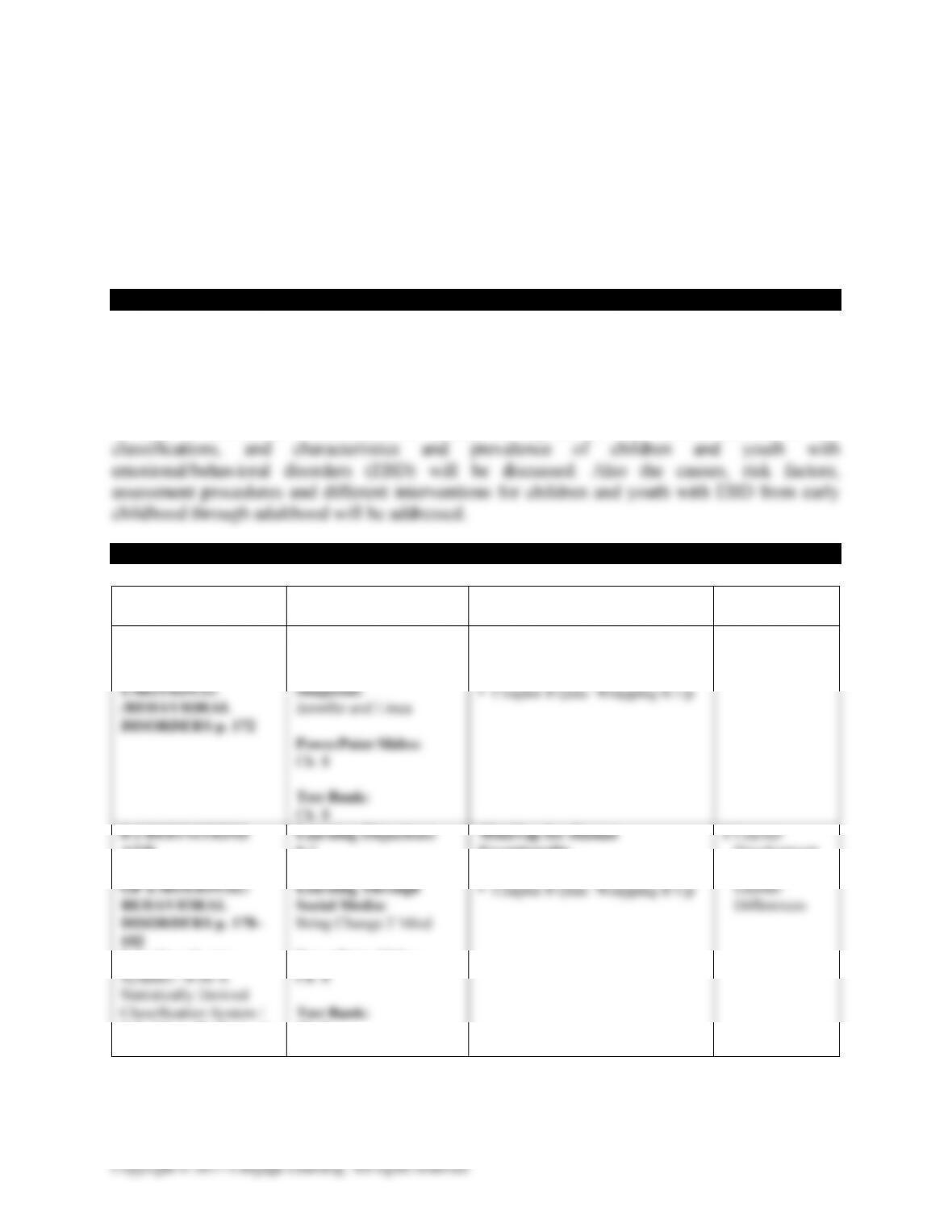
CHAPTER-AT-A-GLANCE
DETAILED
OUTLINE
TRADITIONAL
LEARNING
ONLINE
LEARNING
CEC
STANDARDS
8-1 A CHANGING
ERA IN THE LIVES
OF PEOPLE WITH
EMOTIONAL
/BEHAVIORAL
DISORDERS p. 172
Learning Objectives:
8-1
Snapshot:
Jennifer and Linea
PowerPoint Slides:
Ch. 8
Test Bank:
Ch. 8
MindTap for Human
Exceptionality
• Chapter 8 Quiz: Did You Get It?
• Chapter 8 Quiz: Wrapping It Up
8-2 DEFINITIONS
AND
CLASSIFICATIONS
OF EMOTIONAL/
BEHAVIORAL
DISORDERS p. 178–
182
8-2a Classification
Systems / 8–2b A
Statistically Derived
Classification System /
8-2c Clinically Derived
Classification Systems
Learning Objectives:
8-2
Learning Through
Social Media:
Bring Change 2 Mind
PowerPoint Slides:
Ch. 8
Test Bank:
Ch. 8
MindTap for Human
Exceptionality
• Chapter 8 Quiz: Did You Get It?
• Chapter 8 Quiz: Wrapping It Up
1 Learner
Development
and Individual
Learner
Differences
Instructor’s Manual 8-2
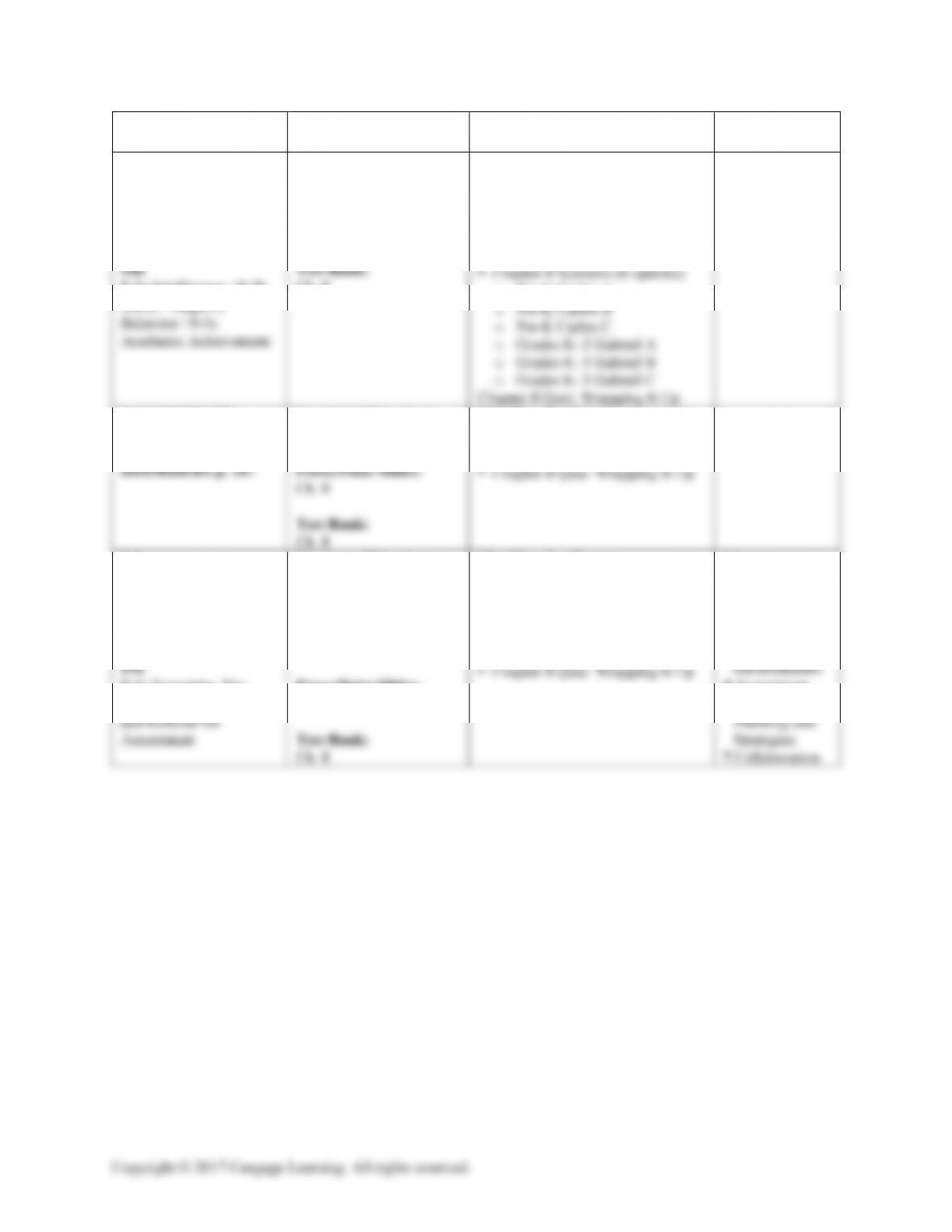
DETAILED
OUTLINE
TRADITIONAL
LEARNING
ONLINE
LEARNING
CEC
STANDARDS
8-3
CHARACTERISTICS
AND PREVALENCE
OF EMOTIONAL/
BEHAVIORAL
DISORDERS p. 183–
186
8-3a Intelligence / 8–3b
Social–Adaptive
Behavior / 8–3c
Academic Achievement
Learning Objectives:
8-3
PowerPoint Slides:
Ch. 8
Test Bank:
Ch. 8
MindTap for Human
Exceptionality
• Chapter 8 Video Case: Handling
a Student with Behavior
Problems
• Chapter 8 Quiz: Did You Get It?
• Chapter 8 Scenario (6 options):
o Pre–K Carlos A
o Pre–K Carlos B
o Pre–K Carlos C
o Grades K–3 Gabriel A
o Grades K–3 Gabriel B
o Grades K–3 Gabriel C
Chapter 8 Quiz: Wrapping It Up
1 Learner
Development
and Individual
Learner
Differences
6 Collaboration
8-4 CAUSES OF
EMOTIONAL/
BEHAVIORAL
DISORDERS p. 187
Learning Objectives:
8-4
PowerPoint Slides:
Ch. 8
Test Bank:
Ch. 8
MindTap for Human
Exceptionality
• Chapter 8 Quiz: Did You Get It?
• Chapter 8 Quiz: Wrapping It Up
8-5
IDENTIFICATION
AND ASSESSMENT
OF EMOTIONAL/
BEHAVIORAL
DISORDERS P. 188–
192
8-5a Screening, Pre–
Referral Interventions,
and Referral for
Assessment
Learning Objectives:
8-5
Case Study on
Embracing Diversity:
Leon
PowerPoint Slides:
Ch. 8
Test Bank:
Ch. 8
MindTap for Human
Exceptionality
• Chapter 8 Video Case: Handling
a Student with Behavior
Problems
• Chapter 8 Quiz: Did You Get It?
• Chapter 8 Quiz: Wrapping It Up
1 Learner
Development
and Individual
Learner
Differences
2 Learning
Environments
4 Assessment
5 Instructional
Planning and
Strategies
7 Collaboration
Instructor’s Manual 8-3
Copyright © 2017 Cengage Learning. All rights reserved.
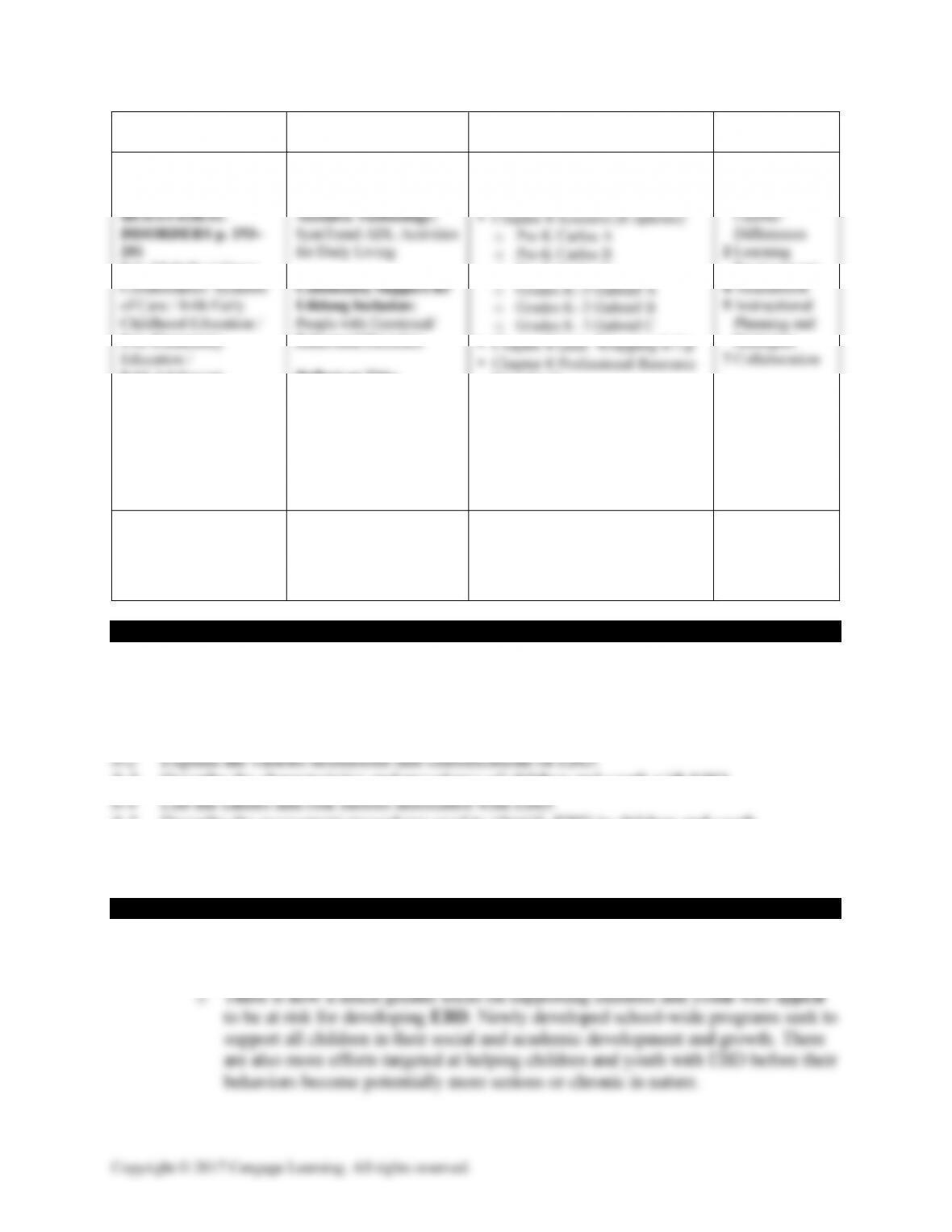
DETAILED
OUTLINE
TRADITIONAL
LEARNING
ONLINE
LEARNING
CEC
STANDARDS
8-6 INTERVENTIONS
AND TREATMENTS
FOR EMOTIONAL/
BEHAVIORAL
DISORDERS p. 193–
201
8-6a Multidisciplinary
Collaboration: Systems
of Care / 8–6b Early
Childhood Education /
8-6c Elementary
Education /
8-6d Adolescent
Education and
Transition to Adulthood
Learning Objectives:
8-6
Assistive Technology:
SymTrend ADL Activities
for Daily Living
Community Support for
Lifelong Inclusion:
People with Emotional/
Behavioral Disorders
Collaboration: Wraparound Services
Reflect on This:
Henry: Wraparound
PowerPoint Slides:
Ch. 8
Test Bank:
Ch. 8
MindTap for Human
Exceptionality
• Chapter 8 Quiz: Did You Get It?
• Chapter 8 Scenario (6 options):
o Pre–K Carlos A
o Pre–K Carlos B
o Pre–K Carlos C
o Grades K–3 Gabriel A
o Grades K–3 Gabriel B
o Grades K–3 Gabriel C
• Chapter 8 Quiz: Wrapping It Up
• Chapter 8 Professional Resource
Downloads
o Figure 8.7 Point Card for IEP
Goals
o Blank Point Card for IEP
Goals
1 Learner
Development
and Individual
Learner
Differences
2 Learning
Environments
4 Assessment
5 Instructional
Planning and
Strategies
7 Collaboration
LOOKING TOWARD
A BRIGHT FUTURE
p. 202
PowerPoint Slides:
Ch. 8
Test Bank: Ch. 8
LEARNING OBJECTIVES
After completing this chapter, your students should be able to:
8-1 Describe how the lives of people with emotional and behavioral disorders (EBD) have
changed since the advent of IDEA.
8-2 Explain the various definitions and classifications of EBD.
8-3 Describe the characteristics and prevalence of children and youth with EBD.
8-4 List the causes and risk factors associated with EBD.
8-5 Describe the assessment procedures used to identify EBD in children and youth.
8-6 Describe the different interventions for children and youth with EBD from early childhood
through adulthood.
CHAPTER/LECTURE OUTLINE
o There is now a much greater focus on supporting children and youth who appear
Instructor’s Manual 8-4
Instructor’s Manual 8-5
Copyright © 2017 Cengage Learning. All rights reserved.
• Internalizing behaviors, or those behaviors directed at the self
o 8-2c Clinically Derived Classification Systems
! Although several clinically derived classification systems have been
professionals is that contained in the Diagnostic and Statistical Manual of
Mental Disorders (DSM-5). The DSM-5 identifies seven major groups of
childhood disorders under the general heading of neurodevelopmental
disorders that may be exhibited by infants, children, or adolescents. Again,
not all of these disorders are included within the IDEA definition of EBD.
! Attention Deficit/Hyperactivity Disorder (ADHD): ADHD!disorder is
characterized by “a persistent pattern of inattention and/or hyperactivity-
impulsivity that interferes with functioning or development.”
! Disruptive, Impulse Control, and Conduct Disorders: These disorders are
manifested in individuals who have difficulty regulating their emotions
and behaviors, resulting in conflict with other people in the learning or
social environment, or with those in authority.
• Oppositional defiant disorder
• Intermittent explosive disorder
• Conduct disorder
! Feeding and Eating Disorders: Behaviors that interfere with normal eating
and digestion, resulting in health or psychosocial functioning.
! Tic Disorders: Involve movements or vocalizations that are involuntary,
8-3 CHARACTERISTICS AND PREVALENCE OF EMOTIONAL/BEHAVIORAL
DISORDERS
o 8-3a Intelligence
! Research suggests that children and youth with EBD tend to have average
o 8-3b Social–Adaptive Behavior
! Children and youth with EBD exhibit a variety of problems in adapting to
their home, school, and community environments. They usually exhibit
difficulties in relating socially and responsibly.
Instructor’s Manual 8-6
Copyright © 2017 Cengage Learning. All rights reserved.
o 8-3c Academic Achievement
! Students with EBD experience significant difficulties and deficits in
8-4 CAUSES OF EMOTIONAL/BEHAVIORAL DISORDERS
o Clearly, many factors contribute to the emergence of EBD. Family and home
environments play critical roles. Economic stress, involvement of primary
8-5 IDENTIFICATION AND ASSESSMENT OF EMOTIONAL/BEHAVIORAL
DISORDERS
o The contexts in which behaviors occur dramatically influences our views of their
appropriateness.
o 8-5a Screening, Pre-Referral Interventions, and Referral for Assessment
! Interventions are designed to address the presenting problems, often using
positive behavior support (PBS) strategies without formally labeling the
child or youth as having EBD.
! Collaborative Teams: Pre-referral interventions are designed to address
students’ identified behavioral and academic problems and to reduce the
environment events—may contribute to a child’s or youth’s problems. If a
child or youth is showing behaviors that are highly problematic, teachers
and other professionals have an obligation to look at them from a
functional point of view—to see what purposes these behaviors serve and
what conditions give rise to them.
• Functional behavioral assessments: Gather information about a
Instructor’s Manual 8-7
Copyright © 2017 Cengage Learning. All rights reserved.
8-6 INTERVENTIONS AND TREATMENTS FOR EMOTIONAL/BEHAVIORAL
DISORDERS
o Historically, most children and youth with EBD received treatments and
o 8-6a Multidisciplinary Collaboration: Systems of Care
! Wraparound is not a set of services, but a collaborative planning process.
It is rooted in a certain idea of how services should be provided to students
o 8-6b Early Childhood Education
! Interventions for young children with EBD are child-, family-, and home-
centered.
o 8-6c Elementary Education
! Elementary children with EBD often present overlapping behavioral
problems. These problems center on accepting appropriate consequences,
building appropriate academic skills, interacting successfully with others,
o 8-6d Adolescent Education and Transition to Adulthood
! Individually and collectively, adolescents with EBD pose significant
challenges for parents, teachers, and other care providers. These problems
include violent exchanges with parents and others, delinquency, school
refusal, bullying, fighting, withdrawal, substance abuse, and other difficult
LOOKING TOWARD A BRIGHT FUTURE
Instructor’s Manual 8-8
Copyright © 2017 Cengage Learning. All rights reserved.
o As we anticipate the future for children and youth with EBD and their families,
there is room for optimism. This optimism is centered in having professionals and
others actively apply evidenced-based practices—practices that are supported by
rigorous research. Systems of care—often delivered in the form of wraparound
programs—are being embraced by communities, schools, and other mental health
agencies. Systems of care—often delivered in the form of wraparound
programs—are being embraced by communities, schools, and other mental health
agencies.
DISCUSSION QUESTION STARTERS
1. What are some of the factors that influence perceptions of behavior?
2. How are your experiences similar to those revealed by Jennifer’s mother and Linea?
3. Why are the definitions of emotional disturbance in IDEA and the National Special
Education and Mental Health Coalition not seen as the same? Which definition do you
believe is better?
4. Why is the pathway to behavioral disorders multidimensional?
5. The placement of students with EBD in the general education classrooms present
overlapping problems. How could improper placement result in formal or informal
segregation?
6. If you had to describe children or youth with EBD, what would you say about their
IN-CLASS OR ONLINE ACTIVITY SUGGESTIONS
ACTIVITY 1
INTRODUCTION: Individuals vary in their tolerance of behaviors. As a future teacher or service
provider, each class member has his or her own perception of what constitutes appropriate and
inappropriate behavior. These perceptions are influenced by personal beliefs, standards, and
values about what constitutes normal behavior.
ACTIVITY: Assign class members to identify behaviors they do not tolerate in their friendships
and then determine which behaviors they would not tolerate in a classroom or work setting. For
Instructor’s Manual 8-9
Copyright © 2017 Cengage Learning. All rights reserved.
Alternatively, have students reflect on their perceptions of behaviors in their service-
learning journals. Ask them to write an entry describing some of the factors that influence their
perceptions of the behaviors that they observe at their service-learning placement.
ACTIVITY 2
INTRODUCTION: Emotional/behavioral disorders may appear in mild to severe forms. At the
university/college level, young adults dealing with the stress of college life may experience
emotional distress or some type of behavioral disorder (e.g., anxiety disorder, eating disorder).
ACTIVITY: Assign several class members to gather information about available resources on
campus. After this information has been presented, ask class members to discuss what services
they believe should be available. Discuss why the pathway to behavioral disorders is
multidimensional.
ACTIVITY 3
INTRODUCTION: One advantage of the Diagnostic and Statistical Manual-5 is that it provides a
concise set of characteristics for classification purposes.
ACTIVITY: Show the class examples of classification systems from the DSM-5 and discuss the
uses and limitations of such systems. For example, fitting students into classification systems
provides little information to aid in individual education program (IEP) development, but it can
provide information about characteristics that affect the way a child learns or behaves.
ACTIVITY 4
INTRODUCTION: Certain contributing factors to behavior disorders can be altered specifically by
the teacher.
ACTIVITY: Discuss with the students how a teacher’s behavior and classroom adaptations could
assist individuals with EBD to cope with their classroom environments. If a student is easily
distracted, how can the physical environment help or hinder attention?
Alternatively, ask students to reflect in their journals about whether or not their service-
learning site has any promising practices for the future. Look for things like a school-wide
behavior system or a multidisciplinary/multiagency system of care approach. Do you think the
ACTIVITY 5
INTRODUCTION: Direct observation can be used to count and record a variety of behaviors that
may be of concern to parents and teachers. Although an observation form may clearly define the
behaviors to be observed, it is often difficult for multiple evaluators to reach the same conclusion
Instructor’s Manual 8–10
Copyright © 2017 Cengage Learning. All rights reserved.
ACTIVITY: Present a video of a subject and have class members identify an observable and
measurable behavior, or have class members observe a specific behavior that you perform
throughout the class period. Using an observation form, instruct students to count either the
frequency or duration of the behavior. After observing the behavior and calculating the results,
discuss what was observed as well as the difficulties of reaching complete agreement about
observations.
ACTIVITY 6
INTRODUCTION: Current practices in the field of special education support educating students in
the least restrictive environment (LRE). However, individuals with moderate or severe behavior
disorders are often educated in special classes.
ACTIVITY: Lead class members in a discussion about the continuum of educational placements
for students with behavior disorders, specifically in relation to the LRE mandate of IDEA. Pose
the following questions:
• How can teachers use these strategies in restricted settings? Or can they?
VIDEO ACTIVITIES
ACTIVITY 1
VIDEO: Allies for Student Success: Making a Difference
VIDEO URL: https://www.youtube.com/watch?v=PayHMqH5cIU
ACTIVITY 2
VIDEO: Surviving Anxiety
VIDEO URL: https://youtu.be/8PcdRyB8YJY
Instructor’s Manual 8–11
Copyright © 2017 Cengage Learning. All rights reserved.
ACTIVITY: Watch the TEDx Talk Surviving Anxiety with Solome Tibebu. Solome talks about the
fears from teen anxiety. Afterward, discuss with students what they learned about the stresses of
adolescence. How will this understanding impact their classroom practice?
DEBATE FORUM
Emergency Rooms: The Best Place for Routine Care of Children and Youth with Mental
Illnesses?
Estimates of hospital emergency department use by children and youth with mental health
problems range from 200,000 to over 825,000 visits annually. Mental health–related emergency
department visits range from 2 percent to 5 percent of all pediatric hospital emergency
department visits. In rural areas, 5 percent of all pediatric emergency department visits and 10
percent of all psychiatric-related emergency department visits are from children and youth with
POINT
Affordable, community-based, mental health care should be available to all children and youth.
The emergency room should not be the primary or sole option for mental health care. Children,
youth, and families experiencing profound needs for mental health care and services should not
be pushed to emergency rooms for needed care. Access to quality mental health care should be
COUNTERPOINT
Universal health care, including mental health care, is not a fundamental right. It is a personal
responsibility of each family to provide. Establishing a universal health care system would
reward individuals who are unwilling to take responsibility for their own well-being and would
undermine self-reliance. Also, government-run systems are far less effective financially than
private-sector systems in delivering quality care. The focus on mental health care ought to be
prevention not treatment.
Instructor’s Manual 8–12
Copyright © 2017 Cengage Learning. All rights reserved.
TAKE A STAND
1. Do you think that there should be a universal healthcare system? How should it be
funded? Explain your answer.
CASE STUDY FEEDBACK
Leon
1. What would you do as a teacher for and with Leon, if he were in your classroom?
Consider Leon’s strengths when implementing interventions that develop social
competence, academic skills and promote achievement. Use Positive Behavior Support
2. How could the wraparound approach be used in Leon’s case?
First, Leon’s family is introduced to the wraparound program. Second, carefully
conducted assessments should be completed, with his family’s consent and
3. Given what you have learned in this chapter, what are some recommendations that you
would make to Leon’s parents?
Provide suggestions to help Leon develop new behaviors, grow academically, achieve
worthwhile goals, and learn how to deal with their thoughts and feelings in positive
ways. Suggestions include providing structure and support. In other words, rules are