Chapter 8
COST ANALYSIS AND ESTIMATION
QUESTIONS AND ANSWERS
Q8.1 What advantages or disadvantages do you see in using current costs for tax and
stockholder reporting purposes?
Q8.1 ANSWER
Theoretically, it would be preferable to use current costs for income tax calculations and
Q8.2 Assume that two years ago, you purchased a new Jeep Wrangler SE 4WD with a soft top
for $16,500 using five-year interest-free financing. Today, the remaining loan balance
is $9,900 and your Jeep has a trade-in value of $9,500. What is your opportunity cost of
continuing to drive the Jeep? Discuss the financing risk exposure of the lender.
Q8.2 ANSWER
The opportunity cost of continuing to drive the Jeep is $9,500. If you sell the Jeep,
$9,500 can be generated to pay down your remaining loan balance. It is the current cost
Q8.3 Southwest Airlines offers four flights per weekday from Cleveland, Ohio to Tucson,
Arizona. If adding a fifth flight per weekday would cost $15,000 per flight, or $110 per
available seat, calculate the incremental costs borne by Southwest following a decision
to go ahead with a fifth flight per day for a minimal 60-flight trial period. What is the
marginal cost? In this case, is incremental cost or marginal cost relevant for decision
making purposes?
Q8.3 ANSWER
Cost Analysis and Estimation 203
Marginal costs are the cost effect of one-unit changes in output. Incremental cost is the
Q8.4 Suppose the Big Enchilada restaurant has been offered a binding one-year lease
agreement on an attractive site for $5,200 per month. Before the lease agreement has
been signed, what is the incremental cost per month of site rental? After the lease
agreement has been signed, what is the incremental cost per month of site rental?
Explain.
Q8.4 ANSWER
Any cost that is invariant across decision alternatives is a sunk cost. Sunk costs are
Q8.5 What is the relation between production functions and cost functions? Be sure to
include in your discussion the effect of competitive conditions in input factor markets.
Q8.5 ANSWER
There is a direct relation between production and cost functions. A cost function is
Q8.6 The definition of point output elasticity is εQ = ∂Q/Q ÷ ∂X/X (X represents all inputs),
whereas the definition of point cost elasticity is εC = ∂C/C ÷ ∂Q/Q. Explain why εQ > 1
indicates increasing returns to scale, whereas εC < 1 indicates economies of scale.
204 Chapter 8
Q8.6 ANSWER
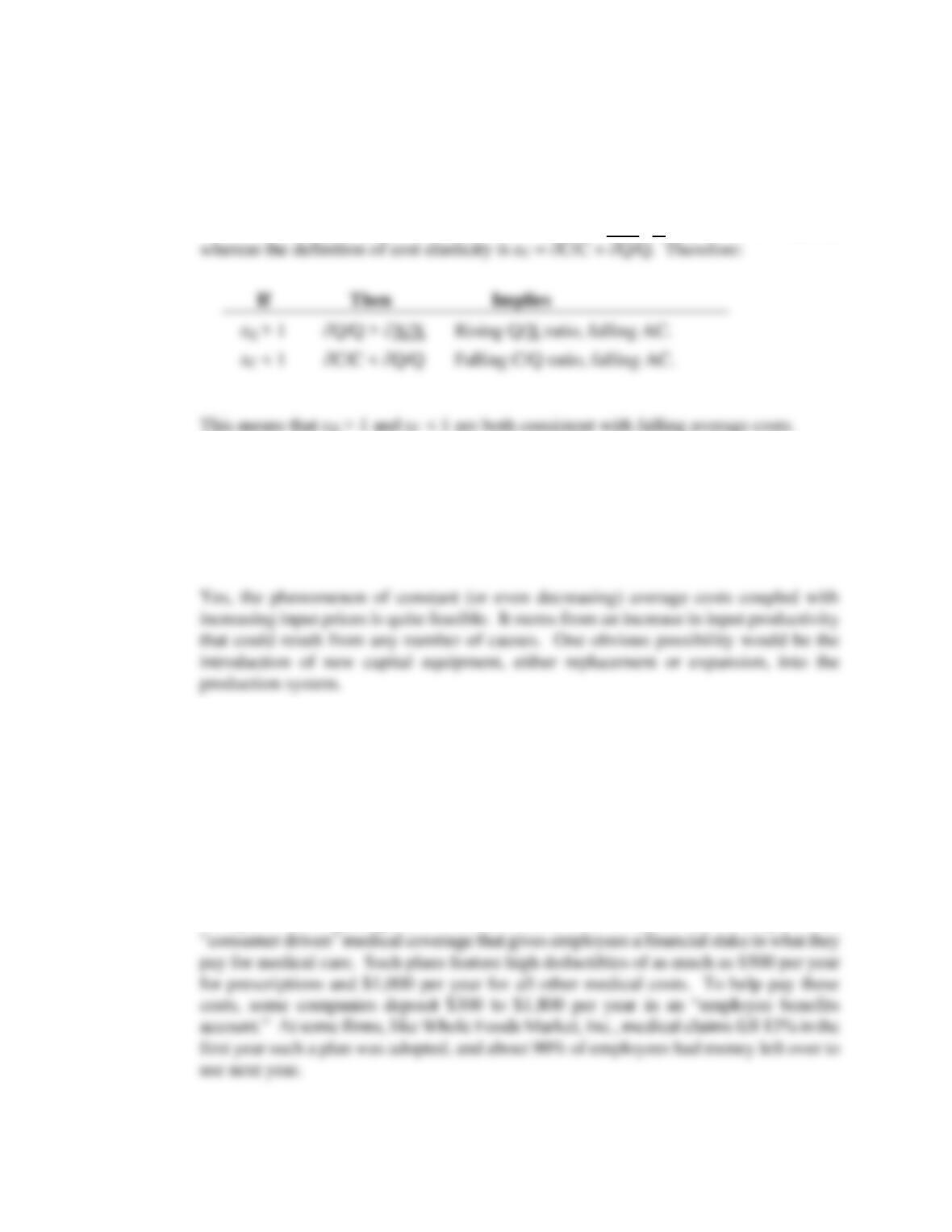
The definition of output elasticity is εQ = ∂Q/Q ÷ ∂X/X (X represents all inputs),
Q8.7 The president of a small firm has been complaining to the controller about rising labor
and material costs. However, the controller notes that average costs have not increased
during the past year. Is this possible?
Q8.7 ANSWER
Q8.8 With traditional medical insurance plans, workers pay a premium that is taken out of
each paycheck and must meet an annual deductible of a few hundred dollars. After that,
insurance picks up most of their health-care costs. Companies complain that this gives
workers little incentive to help control medical insurance costs, and those costs are
spinning out of control. Can you suggest ways of giving workers better incentives to
control employer medical insurance costs?
Q8.8 ANSWER
In hopes of slowing the growth in medical costs, some companies are moving towards
Cost Analysis and Estimation 205
Q8.9 Will firms in industries in which high levels of output are necessary for minimum
efficient scale tend to have substantial degrees of operating leverage?
Q8.9 ANSWER
Q8.10 Do operating strategies of average cost minimization and profit maximization always
lead to identical levels of output?
Q8.10 ANSWER
SELF-TEST PROBLEMS AND SOLUTIONS
ST8.1 Learning Curves. Suppose Modern Merchandise, Inc., makes and markets do-it–
yourself hardware, housewares, and industrial products. The company’s new Aperture
206 Chapter 8
Miniblind is winning customers by virtue of its high quality and quick order turnaround
time. The product also benefits because its price point bridges the gap between ready-
made vinyl blinds and their high-priced custom counterpart. In addition, the company‘s
expanding product line is sure to benefit from cross-selling across different lines. Given
the success of the Aperture Miniblind product, Modern Merchandise plans to open a
new production facility near Beaufort, South Carolina. Based on information provided
by its chief financial officer, the company estimates fixed costs for this product of
$50,000 per year and average variable costs of:
AVC = $0.5 + $0.0025Q,
where AVC is average variable cost (in dollars) and Q is output.
A. Estimate total cost and average total cost for the projected first-year volume of
20,000 units.
B. An increase in worker productivity because of greater experience or learning
during the course of the year resulted in a substantial cost saving for the
company. Estimate the effect of learning on average total cost if actual second-
year total cost was $848,000 at an actual volume of 20,000 units.
ST8.1 SOLUTION
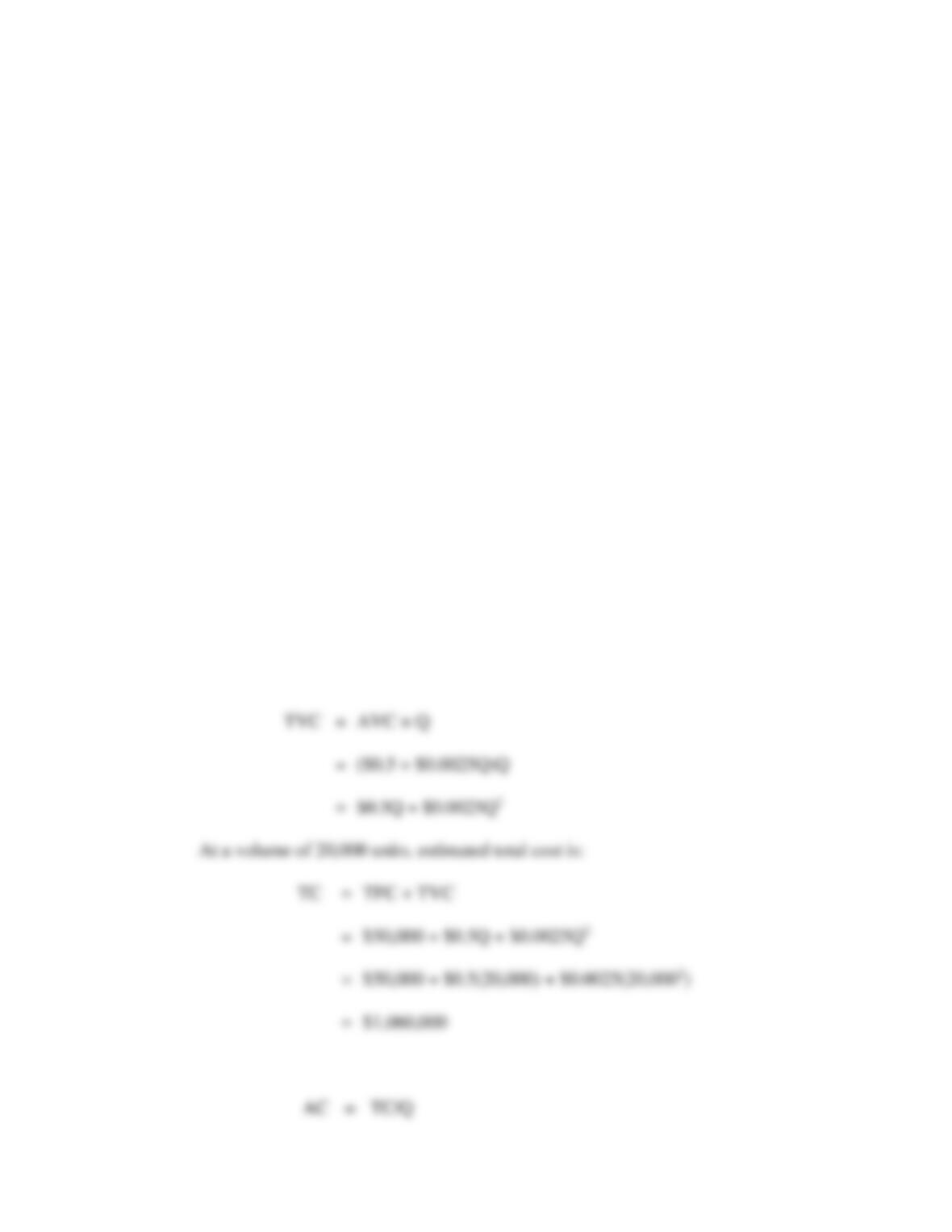
A. The total variable cost function for the first year is:
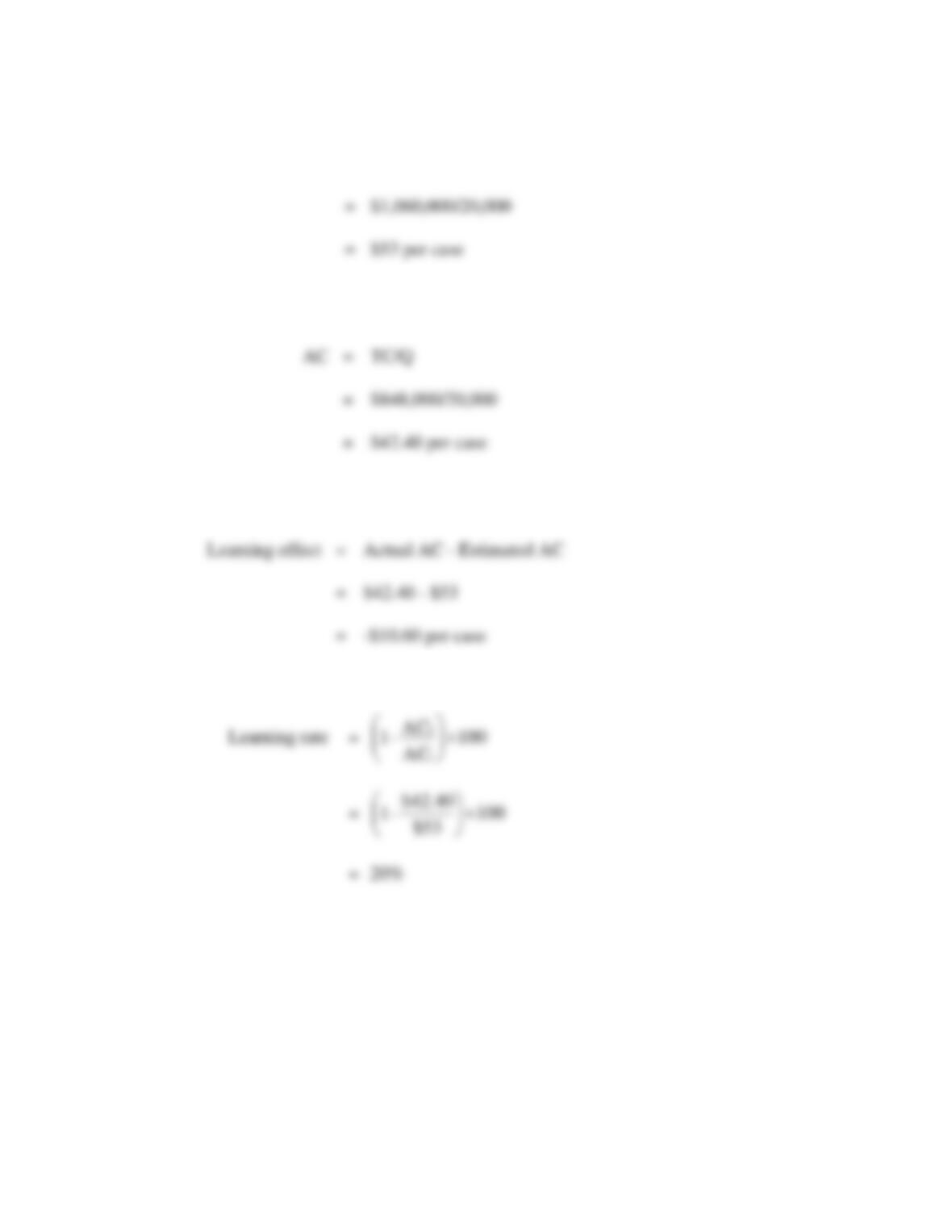
Estimated average cost is:
Cost Analysis and Estimation 207
B. If actual total costs were $848,000 at a volume of 20,000 units, actual average total costs
were:
Therefore, greater experience or learning has resulted in an average cost saving of
$10.60 per case since:
Alternatively,
ST8.2 Minimum Efficient Scale Estimation. Assume Kanata Corporation is a leading
manufacturer of telecommunications equipment based in Ontario, Canada. Its main
product is micro-processor controlled telephone switching equipment, called automatic
private branch exchanges (PABXs), capable of handling 8 to 3,000 telephone extensions.
Severe price cutting throughout the PABX industry continues to put pressure on sales
and margins. To better compete against increasingly aggressive rivals, the company is
contemplating the construction of a new production facility capable of producing 1.5
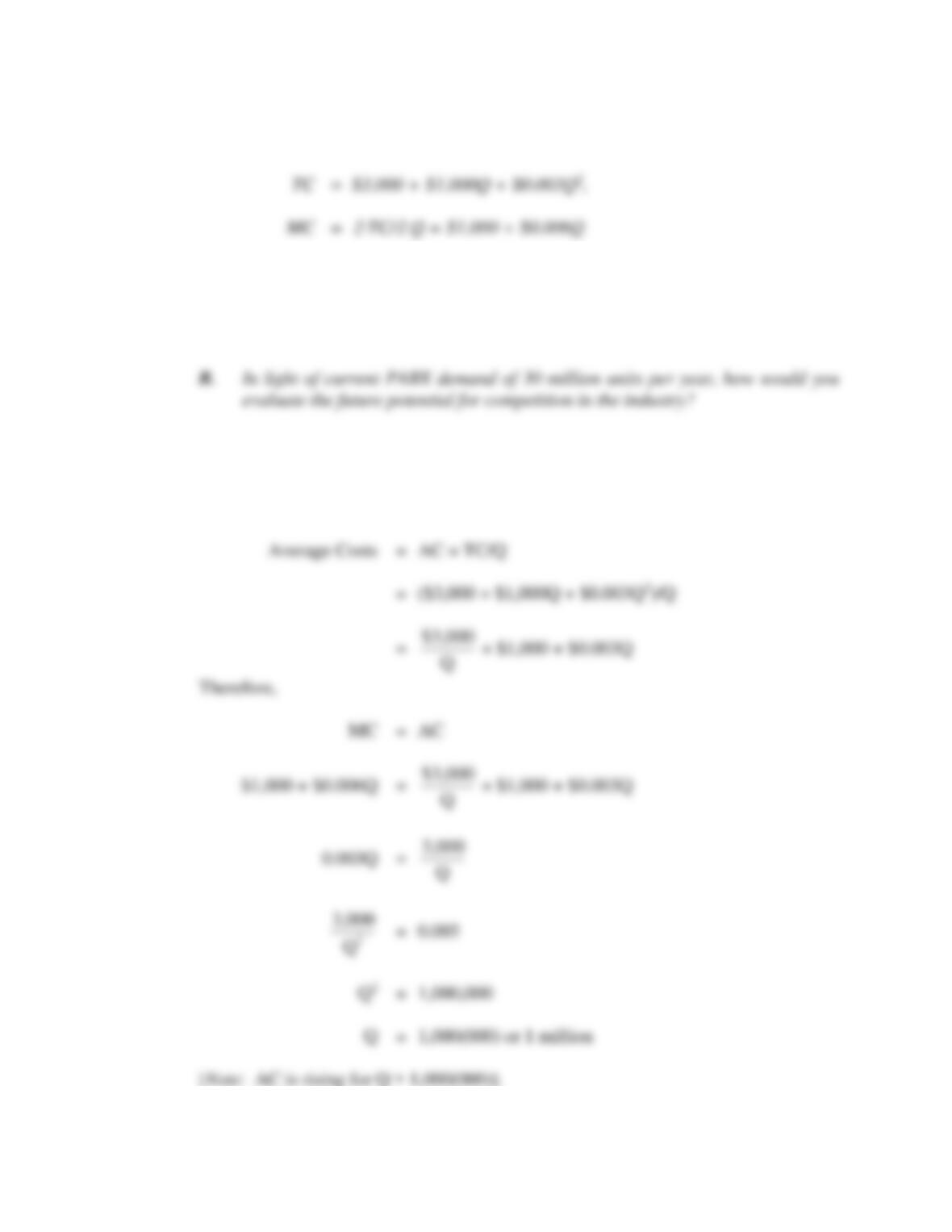
million units per year. Kanata’s in-house engineering estimate of the total cost function
for the new facility is:
208 Chapter 8
where TC = Total Costs in thousands of dollars, Q = Output in thousands of units, and
MC = Marginal Costs in thousands of dollars.
A. Estimate minimum efficient scale in this industry.
ST8.2 SOLUTION
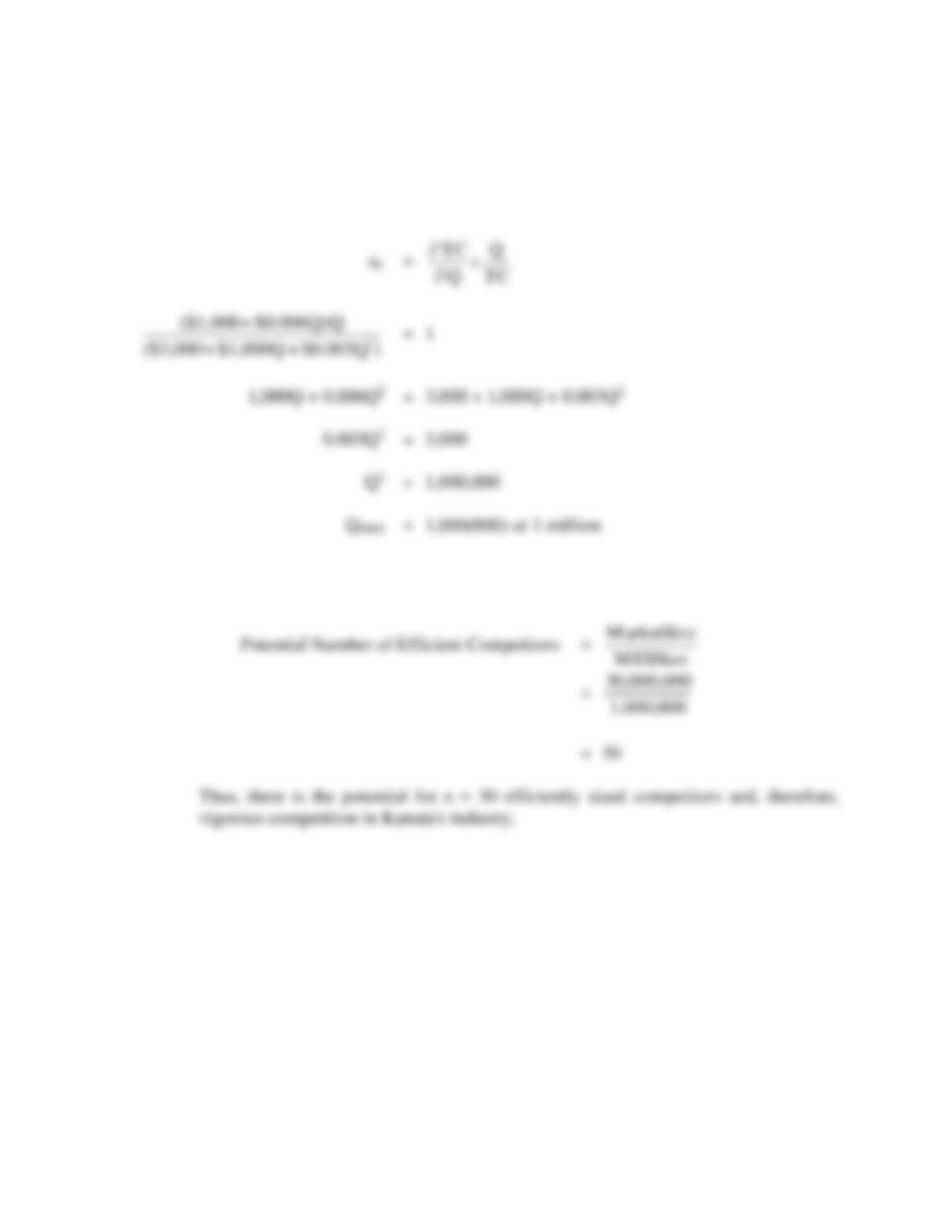
A. Minimum efficient scale is reached when average costs are first minimized. This occurs
at the point where MC = AC.
Cost Analysis and Estimation 209
Alternatively, MES can be calculated using the point cost elasticity formula, since MES
is reached when εC = 1.
B. With a minimum efficient scale of 1 million units and total industry sales of 30 million
units, up to 30 efficiently sized competitors are possible in Kanata’s market.
PROBLEMS AND SOLUTIONS
P8.1 Cost Relations. Determine whether each of the following is true or false. Explain why.
A. Average cost equals marginal cost at the minimum efficient scale of plant.
B. When total fixed cost and price are held constant, an increase in average variable
cost will typically cause a reduction in the breakeven activity level.
C. If εC > 1, diseconomies of scale and increasing average costs are indicated.
210 Chapter 8
D. When long-run average cost is decreasing, it can pay to operate larger plants with
some excess capacity rather than smaller plants at their peak efficiency.
E. An increase in average variable cost always increases the degree of operating
leverage for firms making a positive net profit.
P8.1 SOLUTION
TFC). Therefore, when total fixed costs are zero, DOL is a constant and an increase in
average variable cost will have no effect on DOL.
P8.2 Cost Curves. Indicate whether each of the following involves an upward or downward
shift in the long-run average cost curve or, instead, involves a leftward or rightward
movement along a given curve. Also indicate whether each will have an increasing,
decreasing, or uncertain effect on the level of average cost.
A. A rise in wage rates.
D. A fall in interest rates.
E. An increase in learning or experience.
P8.2 SOLUTION
A. A rise in wage rates will cause an upward shift in the LRAC curve and increase LRAC.
Cost Analysis and Estimation 211
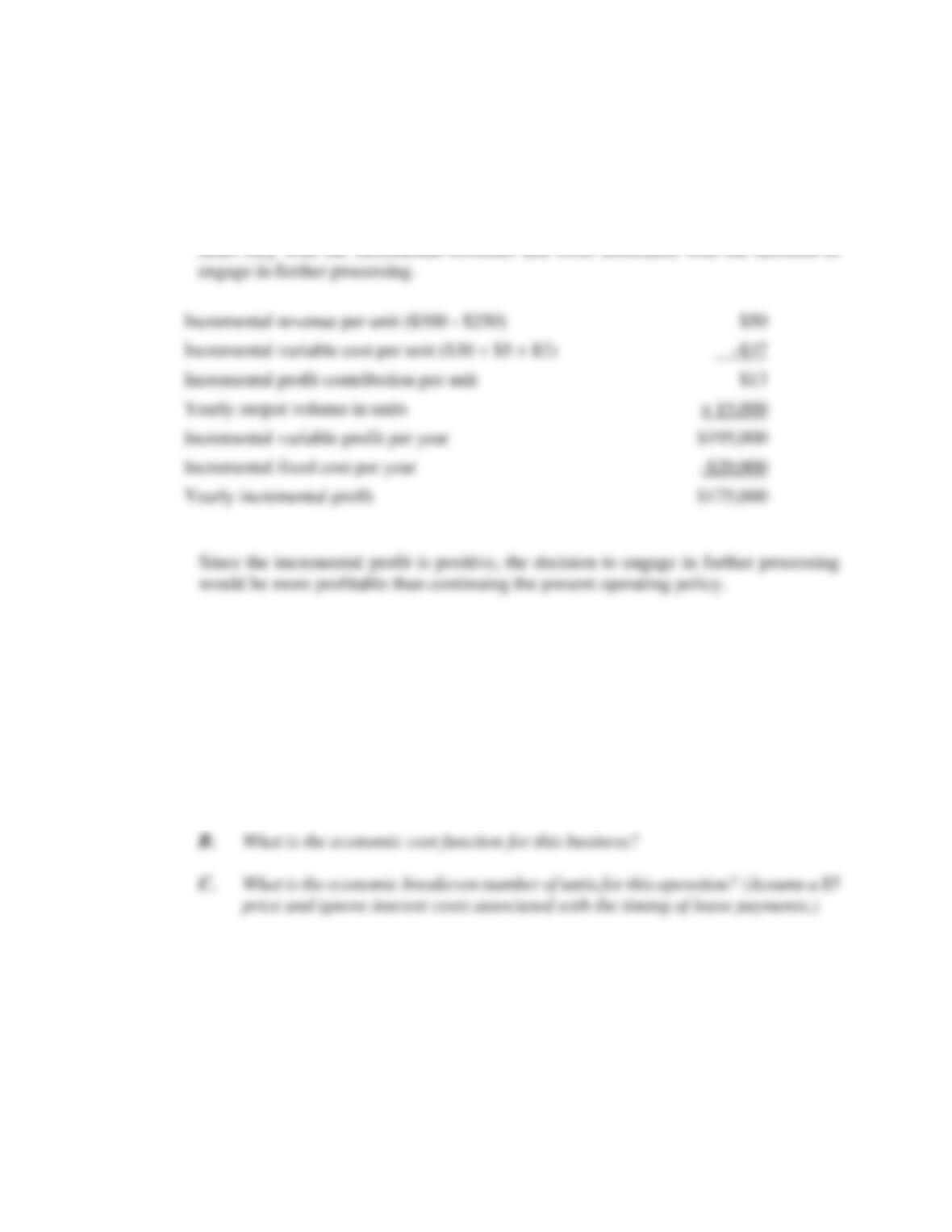
P8.3 Incremental Cost. South Park Software, Inc. produces innovative interior decorating
software that it sells to design studios, home furnishing stores, and so on. The yearly
volume of output is 15,000 units. Selling price and costs per unit are as follows:
Selling Price
$250
Costs:
Direct material
$40
Direct labor
60
Variable selling expenses
25
Fixed selling expenses
20
Unit profit before tax
Management is evaluating the possibility of using the Internet to sell its software directly
to consumers at a price of $300 per unit. Although no added capital investment is
required, additional shipping and handling costs are estimated as follows:
Direct labor
$30 per unit
Variable overhead
$5 per unit
Variable selling expenses
$2 per unit
Fixed selling expenses
$20,000 per year
Calculate the incremental profit that South Park would earn by customizing its
instruments and marketing them directly to end users.
212 Chapter 8
P8.3 SOLUTION
This problem should be answered by using incremental profit analysis. The analysis
P8.4 Accounting and Economic Costs. Three graduate business students are considering
operating a fruit smoothie stand in the Harbor Springs, Michigan, resort area during
their summer break. This is an alternative to summer employment with a local firm,
where they would each earn $6,000 over the three-month summer period. A fully
equipped facility can be leased at a cost of $8,000 for the summer. Additional projected
costs are $1,000 for insurance and $3.20 per unit for materials and supplies. Their fruit
smoothies would be priced at $5 per unit.
A. What is the accounting cost function for this business?
P8.4 SOLUTION
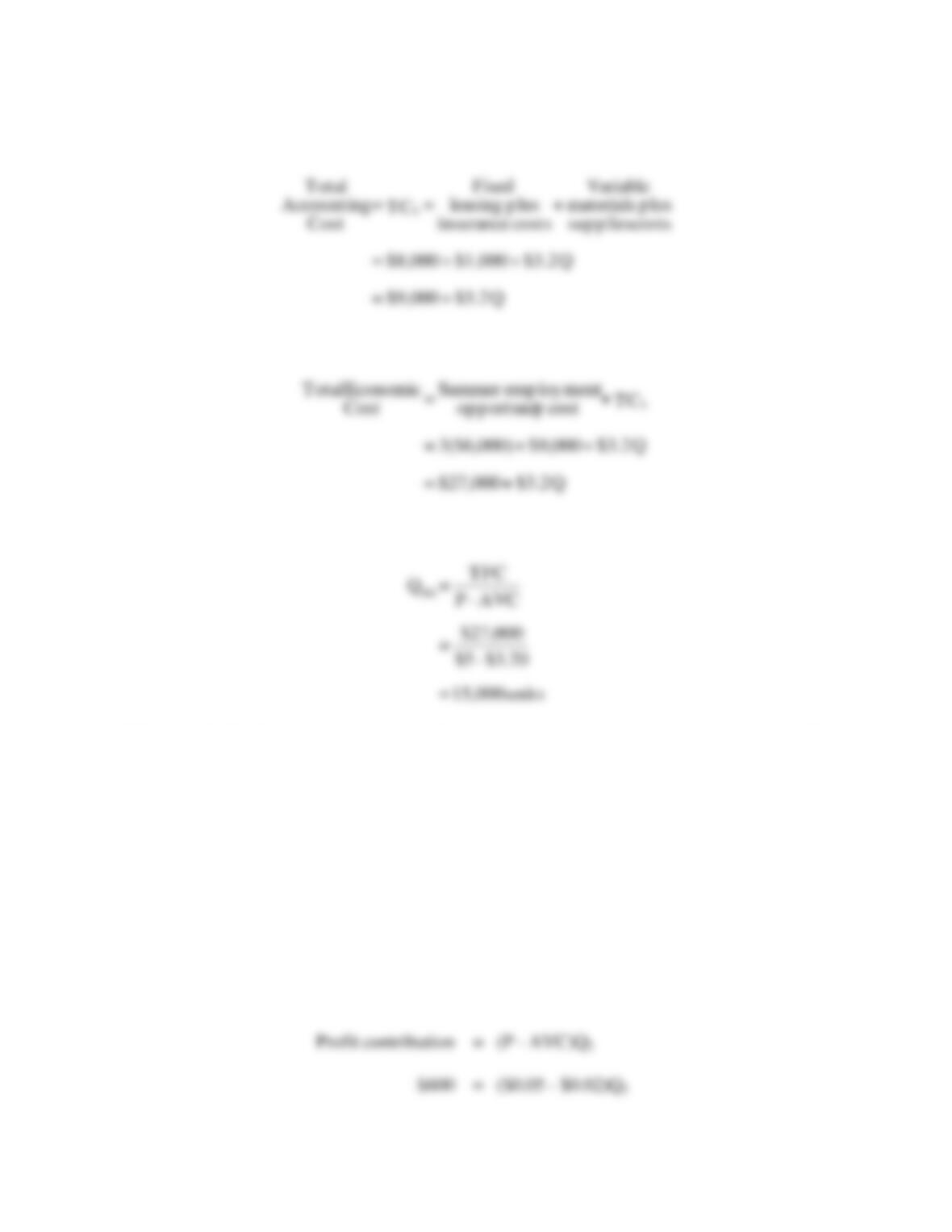
A. The accounting cost function is:
Cost Analysis and Estimation 213
B. The economic cost function is:
C. The economic breakeven point is reached when:
P8.5 Profit Contribution. Angelica Pickles is manager of a Quick Copy franchise in White
Plains, New York. Pickles projects that by reducing copy charges from 5¢ to 4¢ each,
Quick Copy’s $600-per-week profit contribution will increase by one-third.
A. If average variable costs are 2¢ per copy, calculate Quick Copy’s projected
increase in volume.
B. What is Pickles’ estimate of the arc price elasticity of demand for copies?
P8.5 SOLUTION
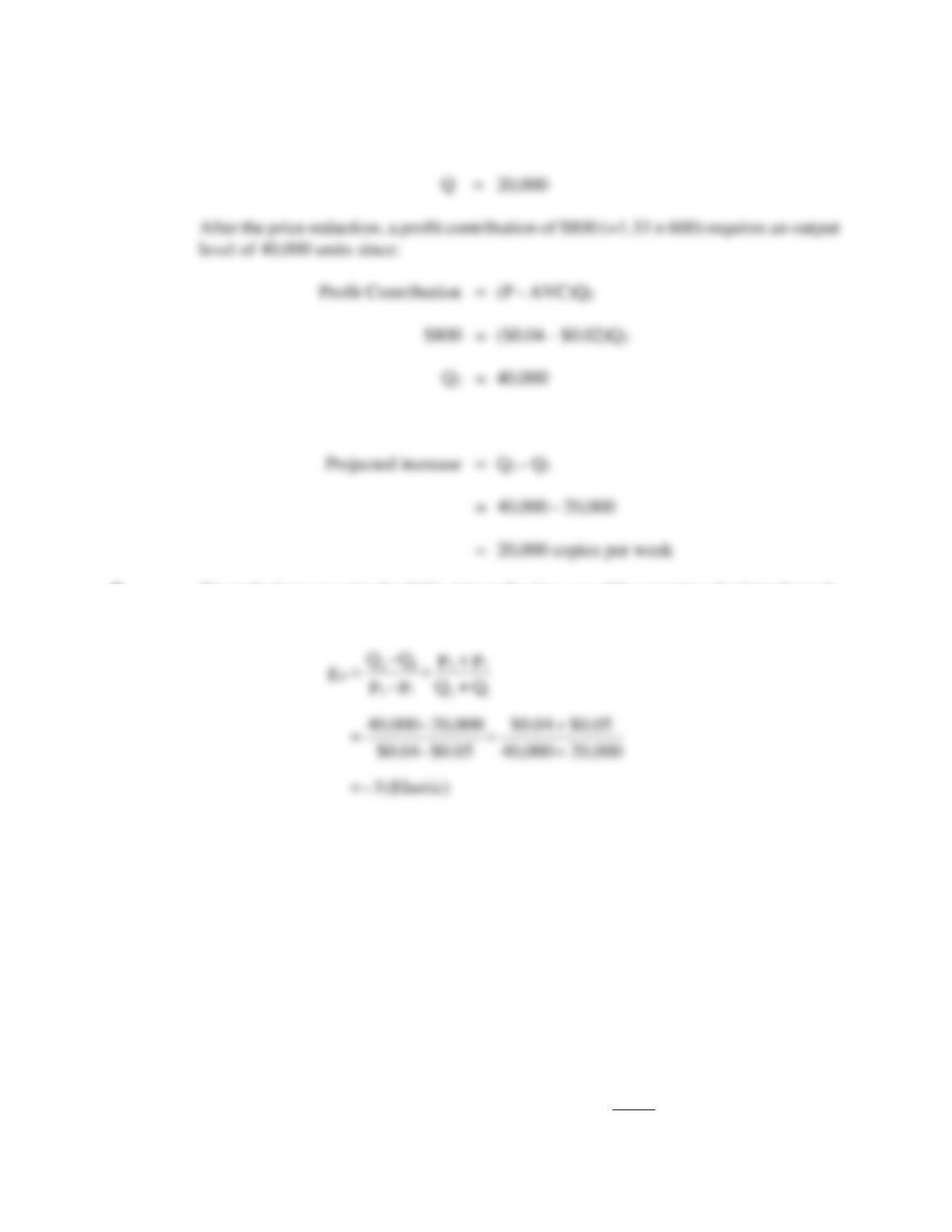
A. The initial, or before-price reduction, copy volume can be calculated using the profit
contribution formula.
214 Chapter 8
Therefore, Pickles’ projected increase in volume is:
B. Given the large magnitude of this price reduction, use of the arc price elasticity formula
is appropriate.
P8.6 Cost-Volume-Profit Analysis. Textbook publishers evaluate market size, the degree of
competition, expected revenues, and costs for each prospective new title. With these
data in mind, they estimate the probability that a given book will reach or exceed the
breakeven point. If the publisher estimates that a book will not exceed the breakeven
point based upon standard assumptions, they may consider cutting production costs by
reducing the number of illustrations, doing only light copy editing, using a lower grade
of paper, or negotiating with the author to reduce the royalty rate. To illustrate the
process, consider the following data:
Cost Category
Dollar Amount
Fixed Costs
Copyediting and other editorial costs
$15,750
Illustrations
32,750
Typesetting
51,500
Cost Analysis and Estimation 215
Total fixed costs
$100,000
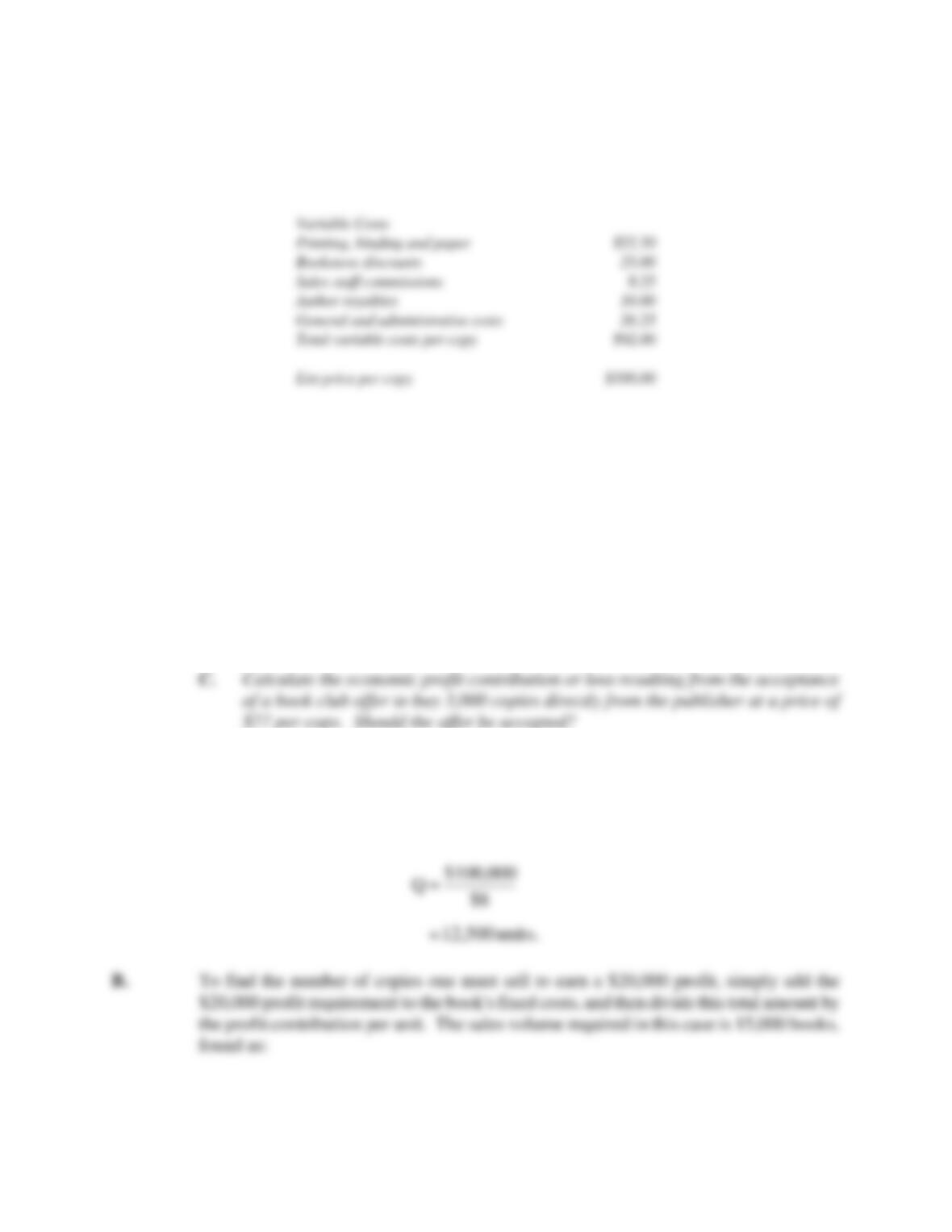
Fixed costs of $100,000 can be estimated quite accurately. Variable costs are linear
and set by contract. List prices are variable, but competition keeps prices within a
narrow range. Variable costs for the proposed book are $92 a copy, and the expected
wholesale price is $100. This means that each copy sold provides the publisher with an
$8 profit contribution.
A. Estimate the volume necessary to reach a breakeven level of output.
B. How many textbooks would have to be sold to generate a profit contribution of
$20,000?
P8.6 SOLUTION
A. Applying the breakeven formula, the breakeven sales volume is 12,500 units, calculated
as
Variable Costs
Author royalties
List price per copy