8 Import Tariffs and Quotas Under Perfect Competition
1. At the opening of this chapter, we referred to the events of May 1995, when the
United States considered putting tariffs on imports of luxury cars from Japan.
Specifically, on May 16, 1995, U.S. Trade Representative Mickey Kantor announced
that the United States would impose trade sanctions against Japan, targeting 13
Japanese import vehicles for 100% tariffs valued at $5.9 billion annually. Those
targeted vehicles included all Lexus models and several Acura and Infiniti models.
To determine how U.S. interest rates reacted to this announcement, use the FRED
database at: https://research.stlouisfed.org/fred2/.
a. Search for “Interest rate on US treasury bills,” and choose the 3-Month Treasury
Bill: Secondary Market Rate, Weekly. Adjust the graph to see what happened to
the interest rate in the week including May 16, 1995. How does this movement in
the interest rate compare with neighboring weeks?
b. What type of retaliation by the government of Japan for the proposed tariff can
explain this change in interest rates?
c. About one month later, President Clinton announced that the two countries had
reached an agreement, which ended the threat of the tariffs being imposed. What
happened to the interest rate during the month of June?
2. The following questions refer to Side Bar: Key Provisions of the GATT.
a. If the United States applies a tariff to a particular product (e.g., steel) imported
from one country, what is the implication for its steel tariffs applied to all other
countries according to the “most favored nation” principle?
b. Is Article XXIV an exception to most favored nation treatment? Explain why or
c. Under the GATT articles, instead of a tariff, can a country impose a quota
(quantitative restriction) on the number of goods imported? What has been one
exception to this rule in practice?
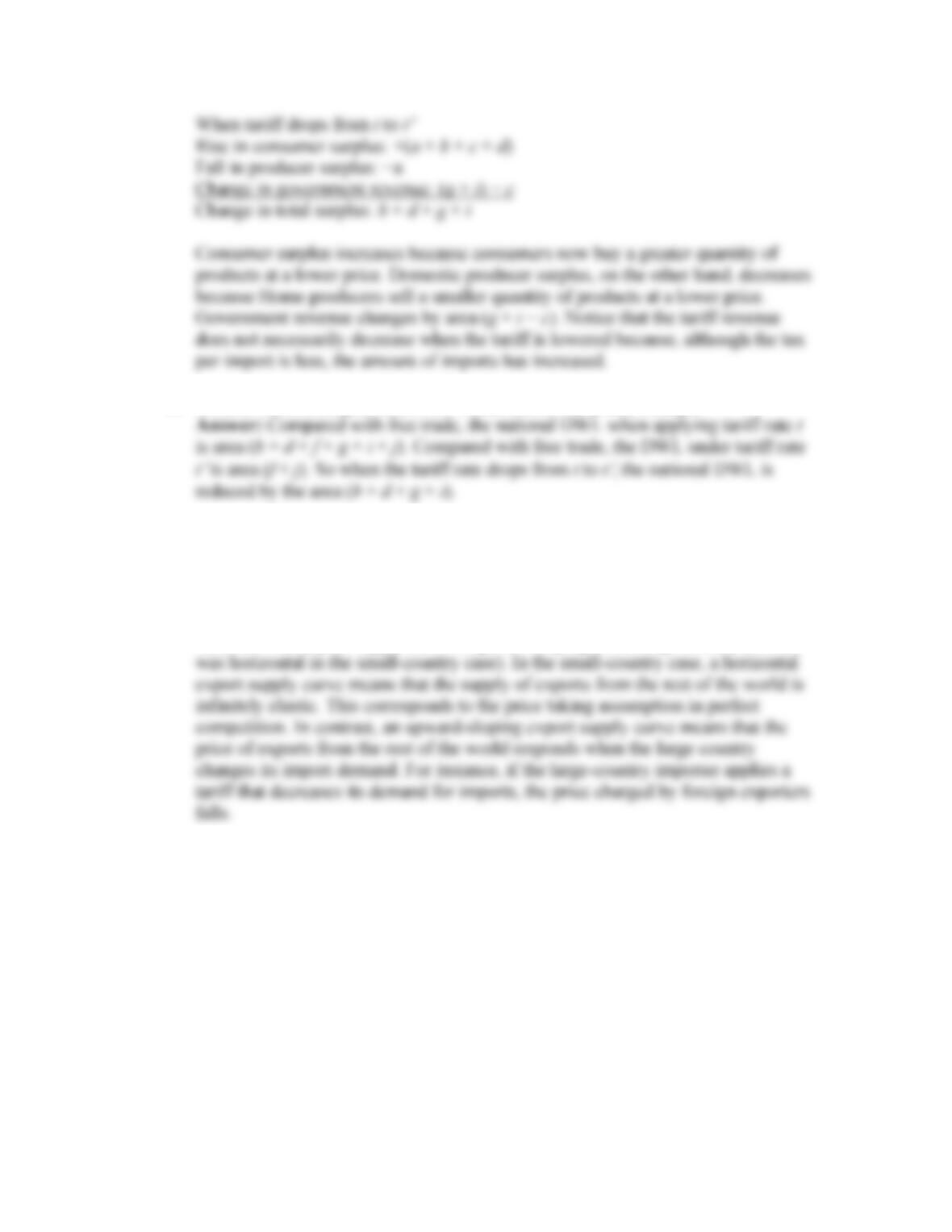
3. Consider a small country applying a tariff t to imports of a good like that represented
in Figure 8-5.
a. Suppose that the country decides to reduce its tariff to t
′
. Redraw the graphs for
the Home and import markets and illustrate this change. What happens to the
quantity of goods produced at Home and their price? What happens to the
quantity of imports?
b. Are there gains or losses to domestic consumer surplus due to the reduction in
tariff? Are there gains or losses to domestic producer surplus due to the reduction
in tariff? How is government revenue affected by the policy change? Illustrate
these on your graphs.
Answer:
c. What is the overall gain or loss in welfare due to the policy change?
4. Consider a large country applying a tariff t to imports of a good like that represented
in Figure 8-9.
a. How does the export supply curve in panel (b) compare with that in the small-
country case? Explain why these are different.
Answer: The export supply curve is upward-sloping in the large-country case (it
b. Explain how the tariff affects the price paid by consumers in the importing
country, and the price received by producers in the exporting country. Use graphs
to illustrate how the prices are affected if (i) the export supply curve is very
elastic (flat) or (ii) the export supply curve is inelastic (steep).
Answer:
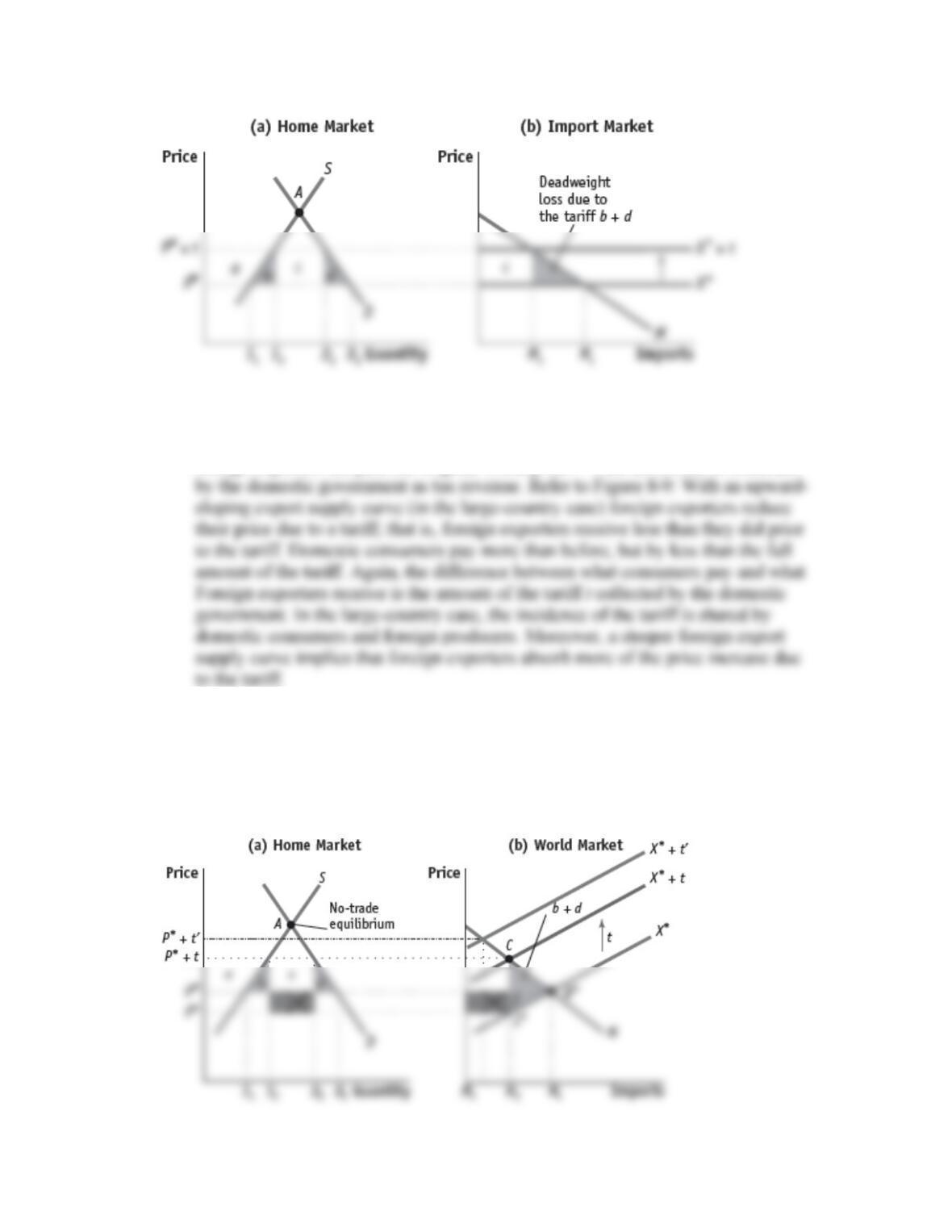
Refer to Figure 8-5: In the small-country case (flat export supply curve), a tariff
increases the amount that consumers pay by exactly the amount of the tariff, and
foreign exporters are paid the original world price PW; the difference is collected
5. Consider a large country applying a tariff t to imports of a good like that represented
in Figure 8-9. How does the size of the terms-of-trade gain compare with the size of
the deadweight loss when (i) the tariff is very small and (ii) the tariff is very large?
Use graphs to illustrate your answer.
Answer:
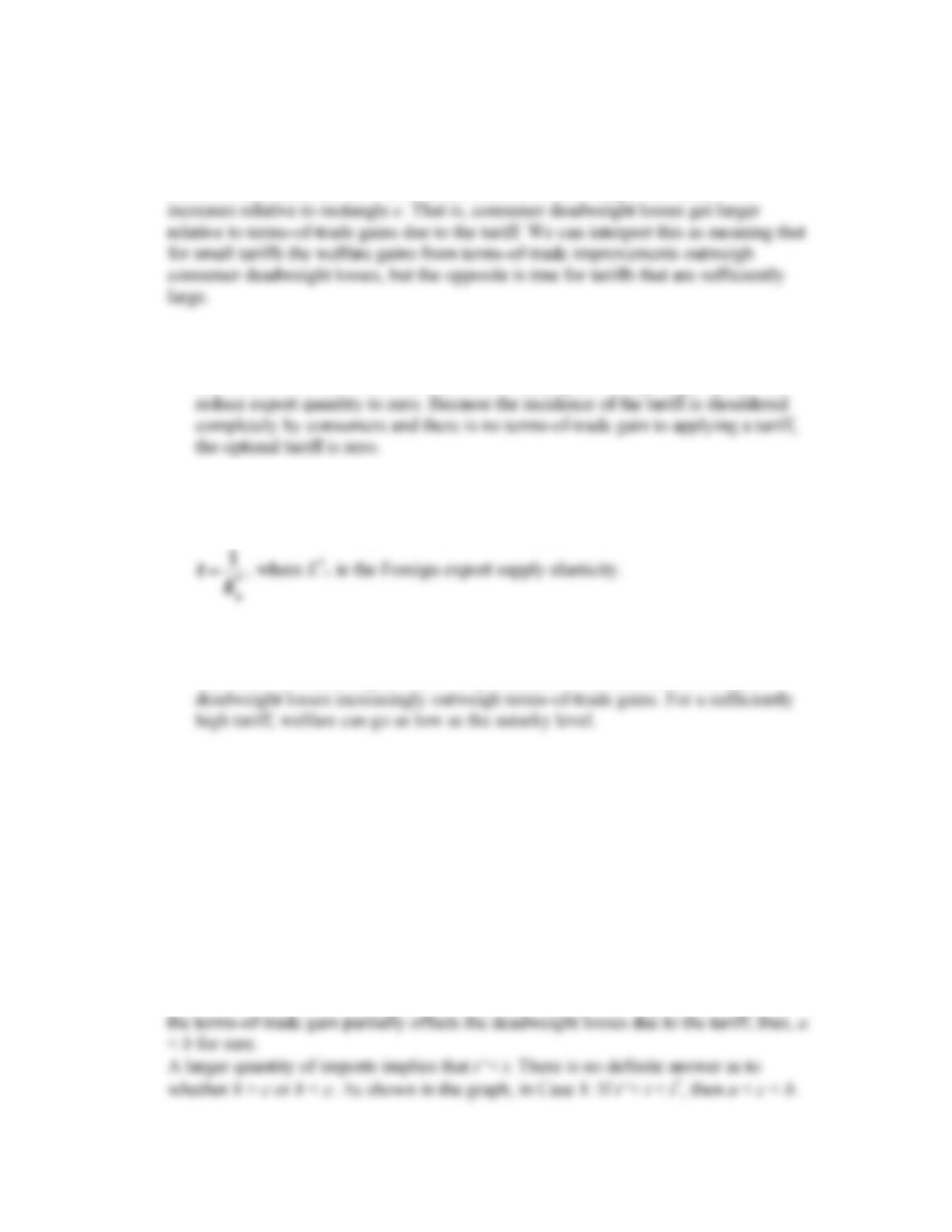
As the size of the tariff increases from t to t
′
, the export supply curve shifts upward by
more, M2 decreases (relative to M3), and the size of the triangle with area b + d
6. a. If the foreign export supply is perfectly elastic, what is the optimal tariff Home
should apply to increase welfare? Explain.
Answer: This is the small-country case. Lowering the foreign export price will
b. If the foreign export supply is less than perfectly elastic, what is the formula for
the optimal tariff Home should apply to increase welfare?
Answer: This is the large–country case. The optimal tariff is determined as:
c. What happens to Home’s welfare if it applies a tariff higher than the optimal
tariff?
Answer: For a tariff higher than the optimal tariff, welfare declines because
Work It Out
Rank the following in ascending order of Home welfare and justify your answers. If two
items are equivalent, indicate this accordingly.
a. Tariff of t in a small country corresponding to the quantity of imports M
b. Tariff of t in a large country corresponding to the same quantity of imports M
c. Tariff of t
′
in a large country corresponding to the quantity of imports M
′
> M
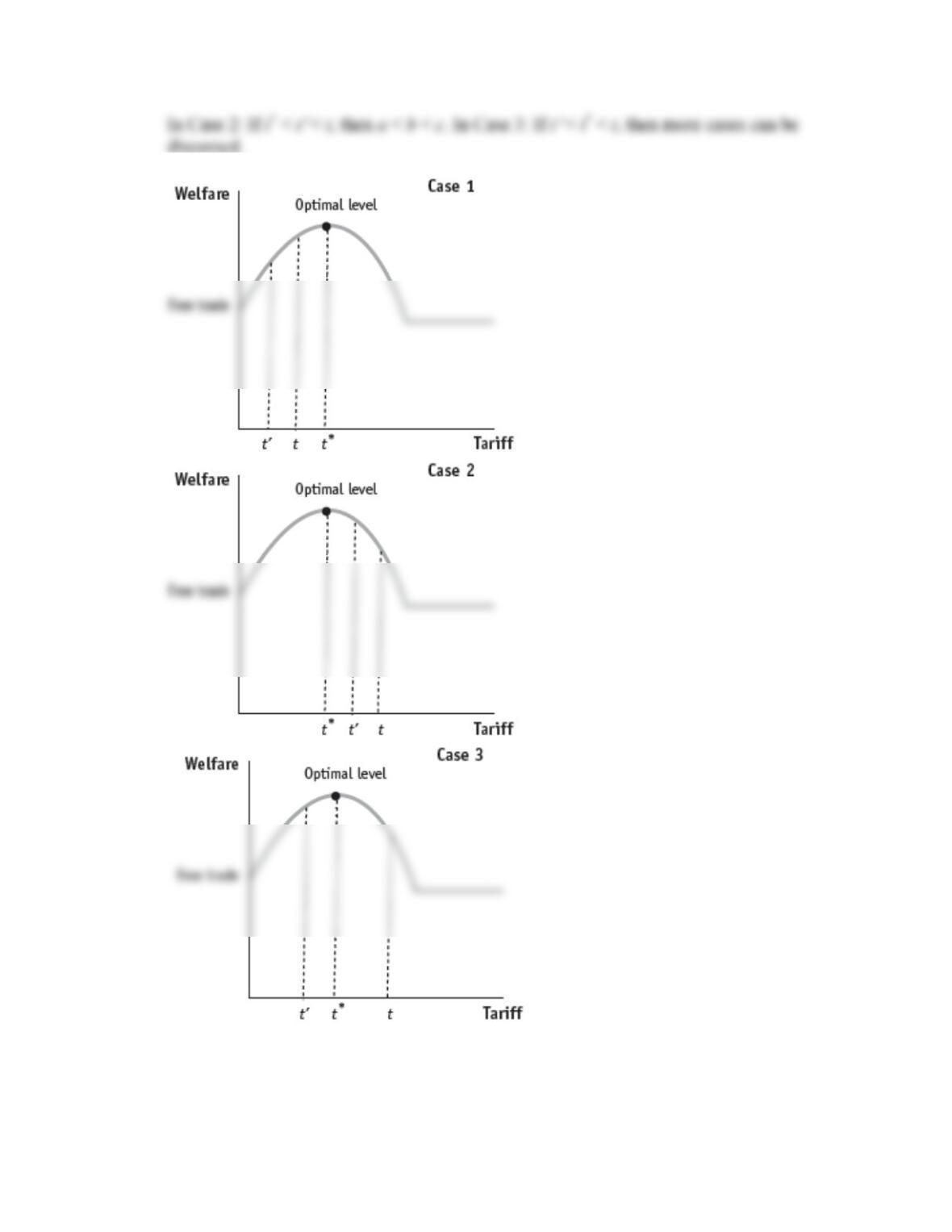
Answer: For the same quantity of imports M, Home welfare is greater in the large–
country case relative to the small–country case because (assuming an optimal tariff)
7. Rank the following in ascending order of Home welfare and justify your answers. If
two items are equivalent, indicate this accordingly.
a. Tariff of t in a small country corresponding to the quantity of imports M
b. Quota with the same imports M in a small country, with quota licenses distributed
to Home firms and no rent seeking
c. Quota of M in a small country with quota licenses auctioned to Home firms
d. Quota of M in a small country with the quota given to the exporting firms
e. Quota of M in a small country with quota licenses distributed to rent–seeking
Home firms
Answer: d = e, a = b = c. Refer to Figure 8-11, under cases a, b, and c; Home DWL =
8. Why did President George W. Bush suspend the U.S. tariffs on steel 17 months ahead
of schedule?
9. What provision of U.S. trade law was used by President Barack Obama to apply a
tariff on tires imported from China? Does this provision make it easier or harder to
apply a tariff than Section 201?
Answer: President Obama used Section 421 to apply the tariff on imports of tires
from China. Section 421, which is a China-specific safeguard provision, is easier to
10. No U.S. tire producers joined in the request for the tariff on tires in 2009. Rather, the
petition for a tariff on tires imported from China was brought by the United
Steelworkers of America, the union who represents workers in the tire industry. Why
did major tire manufacturers operating in the United States, like Goodyear, Michelin,
Cooper, and Bridgestone, not support the tariff?
Answer: Tire manufacturers operating in the United States did not support the tariff
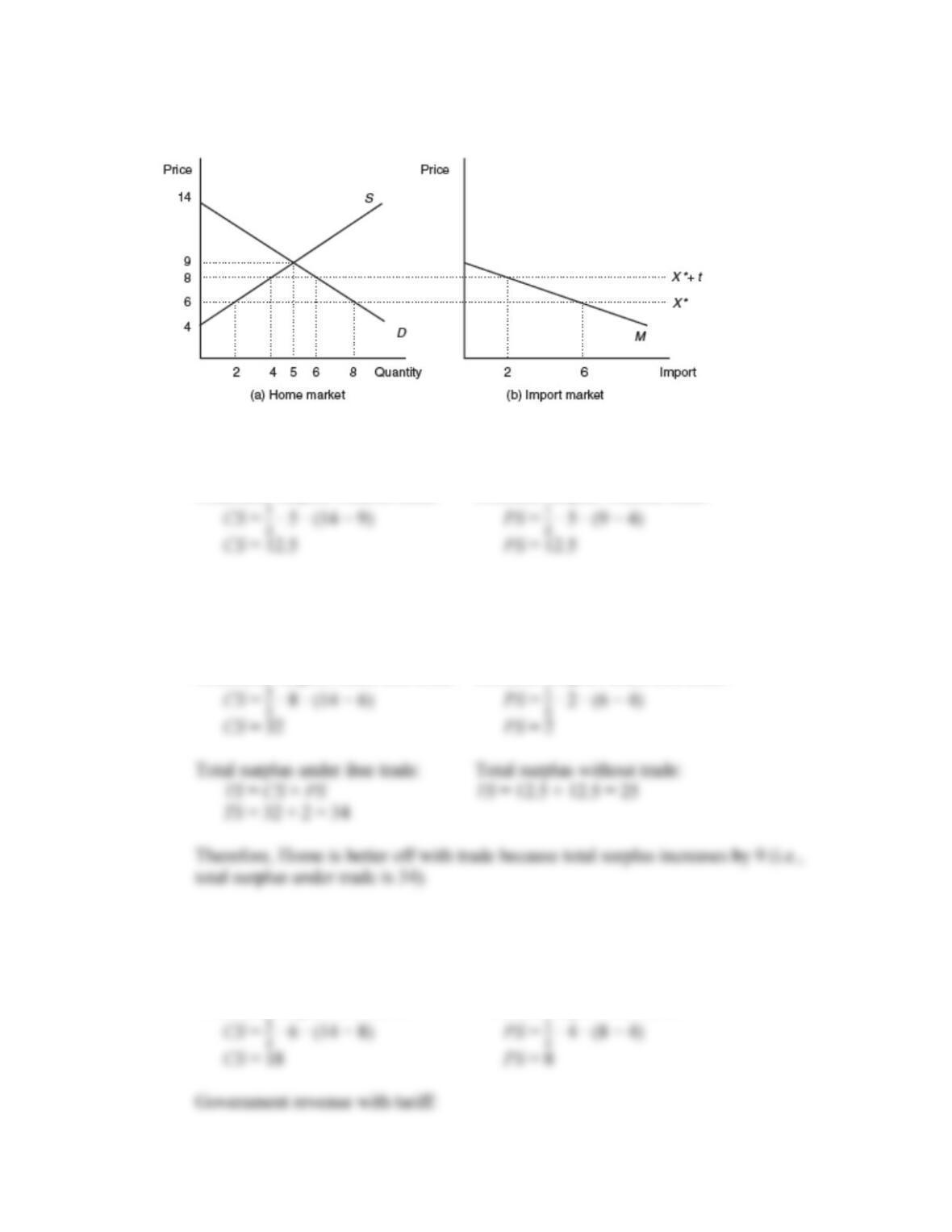
11. Suppose Home is a small country. Use the graphs below to answer the questions.
a. Calculate Home consumer surplus and producer surplus in the absence of trade.
Answer:
Consumer surplus without trade: Producer surplus without trade:
b. Now suppose that Home engages in trade and faces the world price, P* = $6.
Determine the consumer and producer surplus under free trade. Does Home
benefit from trade? Explain.
Answer:
Consumer surplus under free trade: Producer surplus under free trade:
c. Concerned about the welfare of the local producers, the Home government
imposes a tariff in the amount of $2 (i.e., t = $2). Determine the net effect of the
tariff on the Home economy.
Answer:
Consumer surplus with tariff: Producer surplus with tariff:
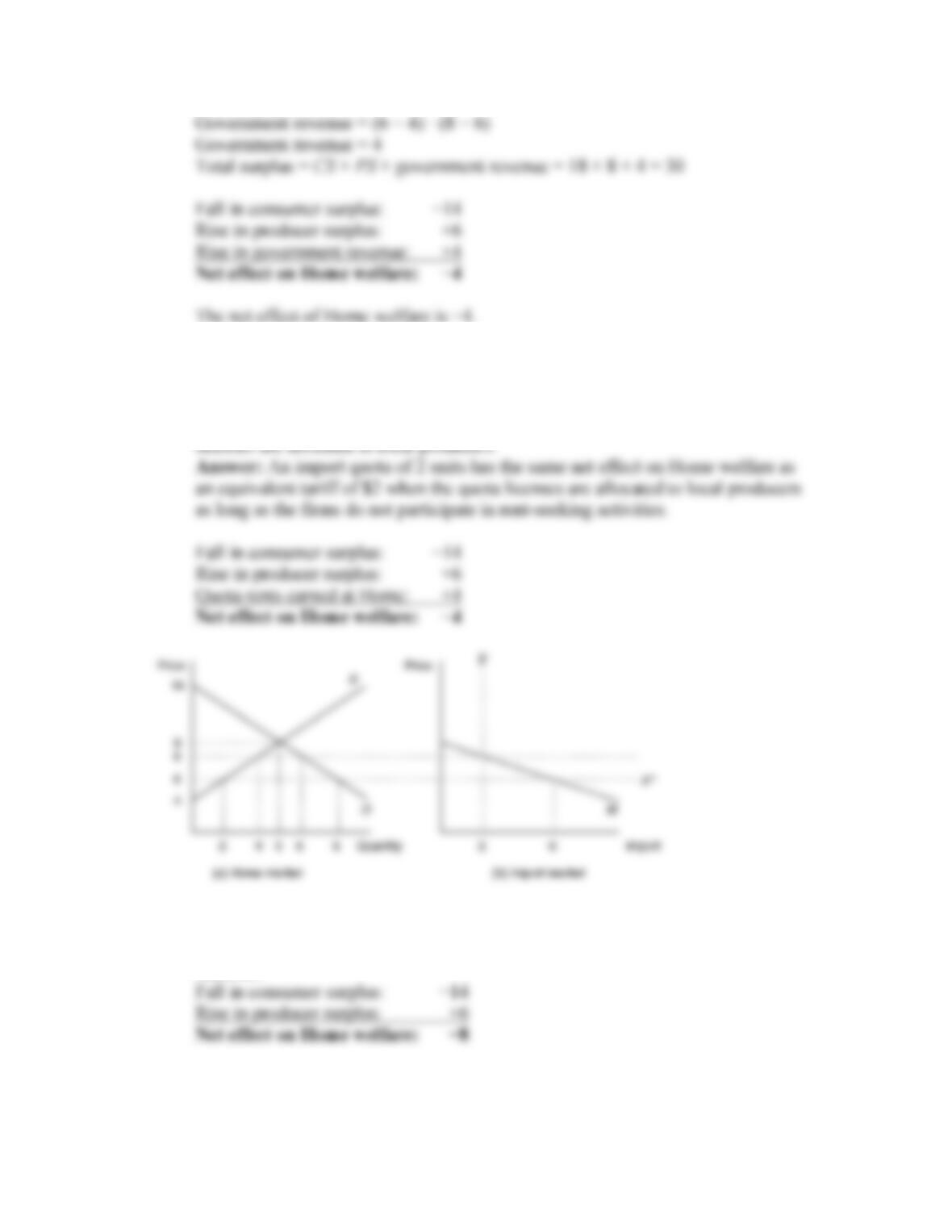
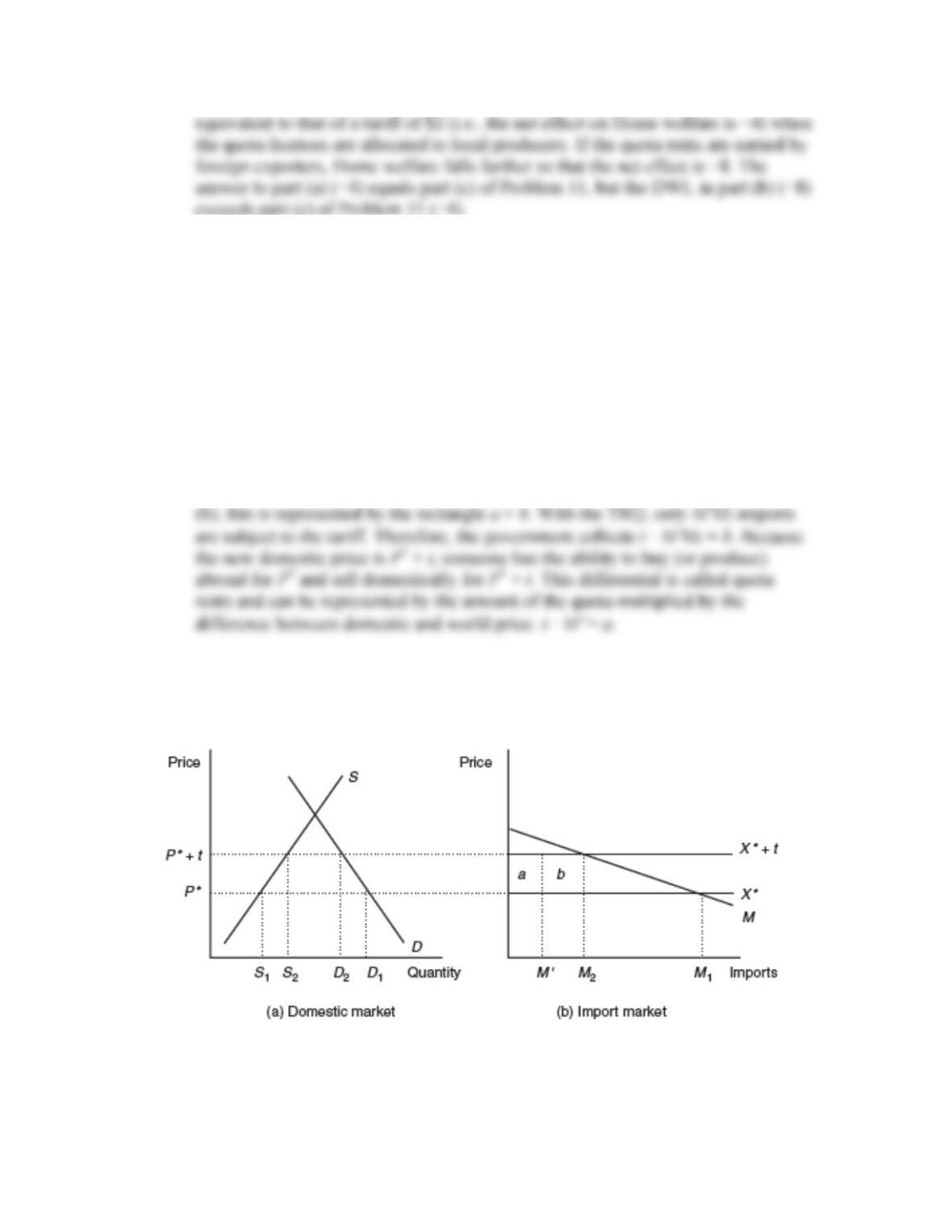
12. Refer to the graphs in Problem 11. Suppose that instead of a tariff, Home applies an
import quota limiting the amount foreign can sell to 2 units.
a. Determine the net effect of import quota on the Home economy if the quota
b. Calculate the net effect of the import quota on Home welfare if the quota rents are
earned by foreign exporters.
Answer:
c. How do your answers to parts (a) and (b) compare with part (c) of Problem 11?
Answer: With an import quota of 2 units the net effect on Home welfare is
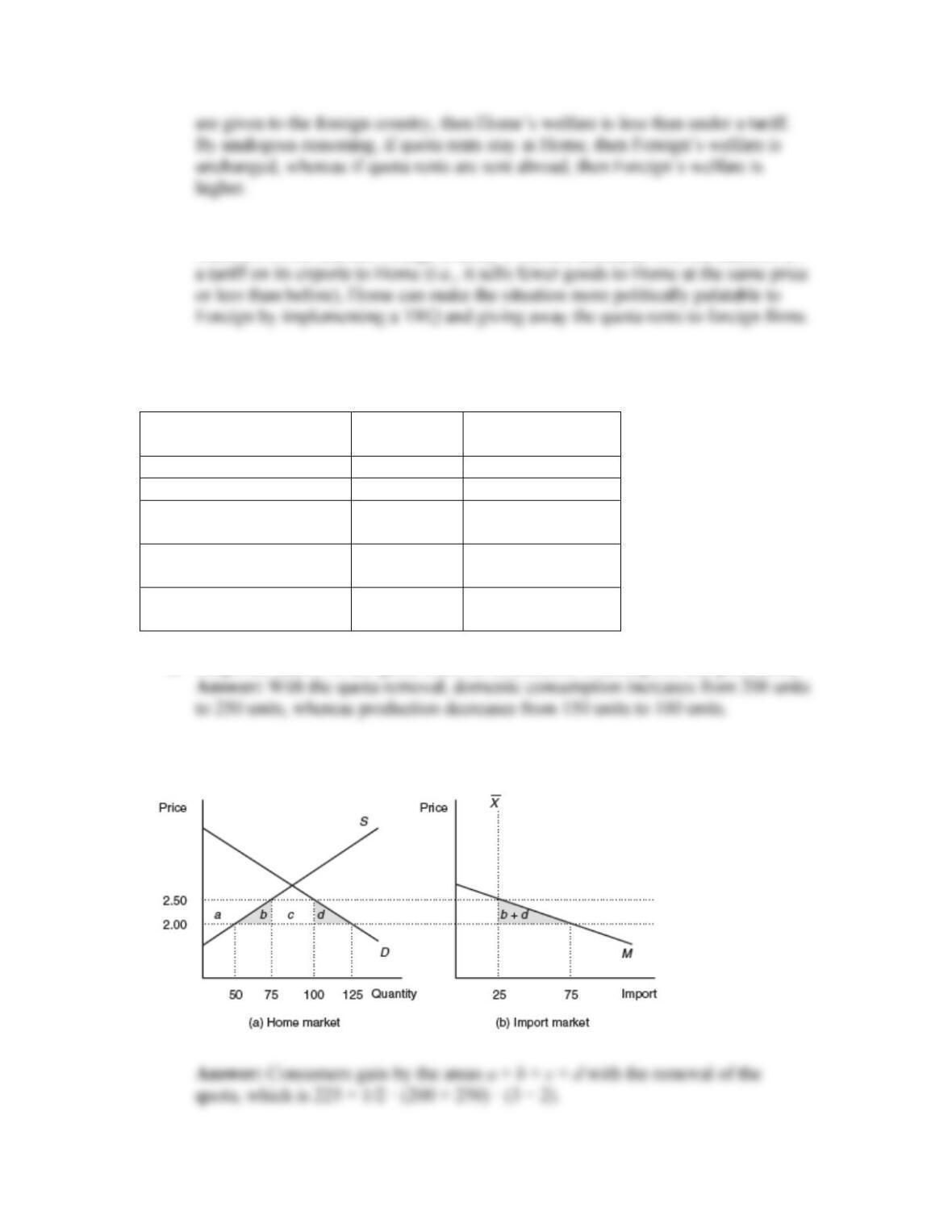
13. Consider a small country applying a tariff t such as in Figure 8-5. Instead of a tariff
on all units imported, however, we will suppose that the tariff applies only to imports
in excess of some quota amount M
′
(which is less than the total imports). This is
called a “tariff-rate quota” (TRQ) and is commonly used on agricultural goods,
including sugar imports into the United States.
a. Redraw Figure 8-5, introducing the quota amount M
′
. Remember that the tariff
applies only to imports in excess of this amount. With this in mind, what is the
rectangle of tariff revenue collected? What is the rectangle of quota rents? Explain
briefly what quota rents mean in this scenario.
Answer: Refer to the following figure: For the small-country tariff case, tariff
revenue equals the tariff per import multiplied by the amount of imports. In panel
b. How does the use of a TRQ rather than a tariff at the same rate affect Home
welfare? How does the TRQ, as compared with a tariff at the same rate, affect
Foreign welfare? Does it depend on who gets the quota rents?
Answer: If the quota rents stay at Home and are not squandered by rent seekers
(i.e., they are collected by the government through auction or given to Home
firms), then Home’s welfare is the same as under a tariff. However, if quota rents
c. Based on your answer to (b), why do you think TRQs are used quite often?
Answer: Given that the Foreign country’s welfare decreases with the addition of
14. Consider the following hypothetical information pertaining to a country’s imports,
consumption, and production of T-shirts following the removal of the MFA quota:
With MFA
Without MFA
(Free Trade)
World price ($/shirt)
2.00
2.00
Domestic price ($/shirt)
3.00
2.00
Domestic consumption
(million shirts/year)
200
250
Domestic production
(million shirts/year)
150
100
Imports (million
shirts/year)
50
150
a. Graph the effects of the quota removal on domestic consumption and production.
b. Determine the gain in consumer surplus from the removal of the quota.
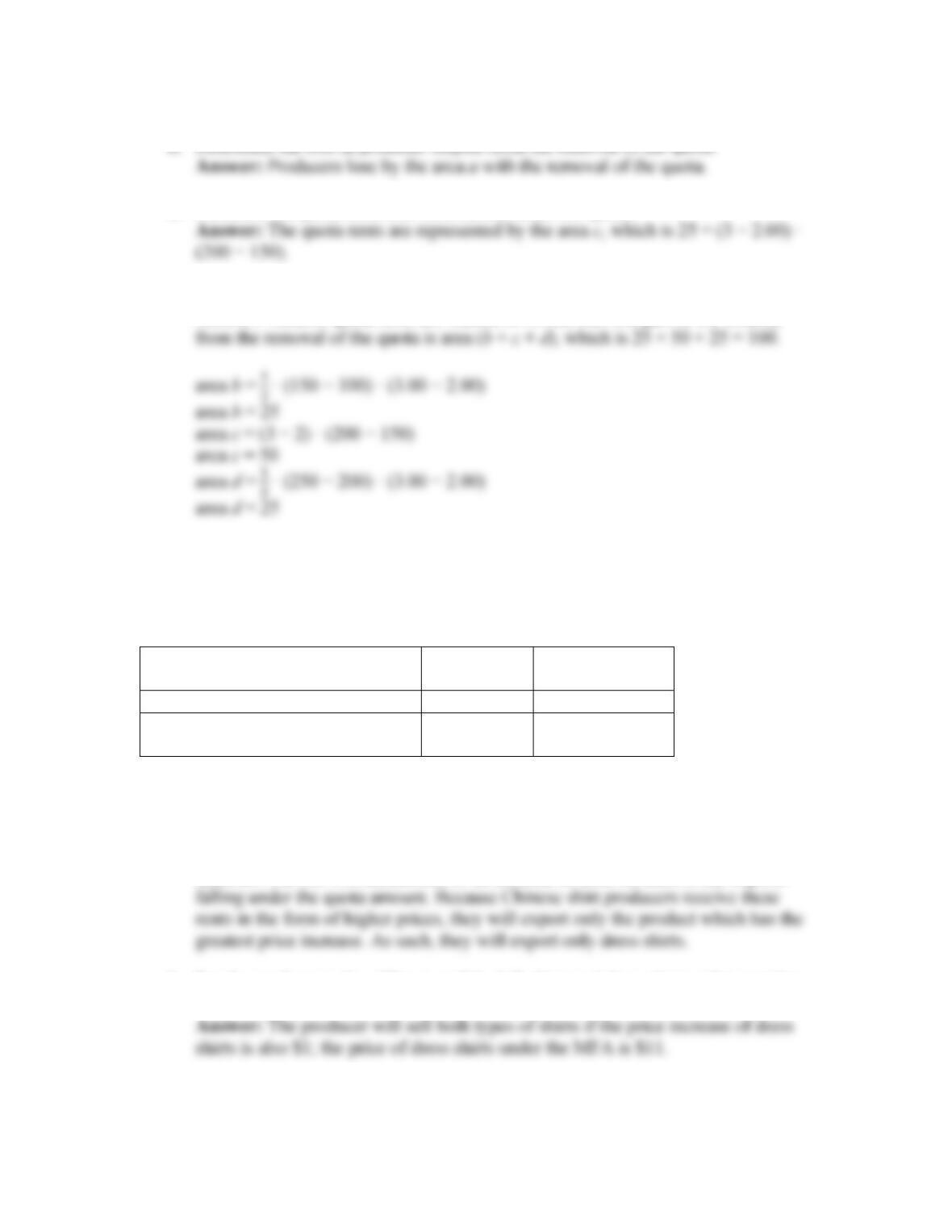
c. Determine the loss in producer surplus from the removal of the quota.
d. Calculate the quota rents that were earned under the quota.
e. Determine how much the country has gained from removal of the quota.
Answer: Assume quota rents are wasted in Home, then the gain to the country
15. Suppose that a producer in China is constrained by the MFA to sell a certain number
of shirts, regardless of the type of shirt. For a T-shirt selling for $2.00 under free
trade, the MFA quota leads to an increase in price to $3.00. For a dress shirt selling
for $10.00, the MFA will also lead to an increase in price.
With MFA
Without MFA
(Free Trade)
Domestic price of t–shirt ($/shirt)
3.00
2.00
Domestic price of dress shirt
($/shirt)
?
10.00
a. Suppose that the MFA leads to an increase in the price of dress shirts from $10 to
$12. Will the producer be willing to export both T-shirts and dress shirts?
(Remember that only a fixed number of shirts can be exported, but of any type.)
Explain why or why not.
Answer: The MFA is tantamount to an increase in rents on each of the imports
b. For the producer to be willing to sell both T-shirts and dress shirts, what must be
the price of dress shirts under the MFA?
c. Based on your answer to part (b), calculate the price of dress shirts relative to T-
shirts before and after the MFA. What has happened to the relative price due to
the MFA?
d. Based on your answer to part (c), what will happen to the relative demand in the
United States for dress shirts versus T-shirts from this producer due to the MFA?
e. Thinking now of the total export bundle of this producer, does the MFA lead to
quality upgrading or downgrading? How about the removal of the MFA?