Chapter 8
Measuring the Economy’s Performance
◼ Overview
This chapter introduces national income accounting. It is important because it provides the foundation
for the heart of macroeconomics—the national income determination models. The first objective is to
◼ Learning Objectives
After studying this chapter, students should be able to:
• 8.1 Describe the circular flow of income and output
◼ Outline
I. The Simple Circular Flow: The concept of a circular flow of income involves two principles:
(1) in every economic exchange, the seller receives exactly the same amount that the buyer spends
and (2) goods and services flow in one direction and money payments flow in the other.
(See Figure 8-1.)
A. Profits Explained: Profits are a part of costs because entrepreneurs must be rewarded for
B. Total Income or Total Output: Total income is the total of all individuals’ income and is also
defined as the annual cost of producing the entire output of final goods and services. Total output
is the value of all of the final goods and services produced in the economy during the year.
112 Miller • Economics Today, Nineteenth Edition
C. Why the Dollar Value of Total Output Must Equal Total Income: Total income is income
II. National Income Accounting: A measurement system used to estimate national income and its
components.
A. Gross Domestic Product (GDP): The total market value of all final goods and services
produced by factors of production located within a nation’s borders in a year. GDP is a flow,
i.e., an activity that occurs over time. Contrast this with a stock measured at a point in time.
B. Stress on Final Output: GDP does not count intermediate goods (goods used up entirely in
the production of final goods) because to do so would be to double count. Value added is the
amount of dollar value contributed to a product at each state of production. (See Table 8-1.)
C. Exclusion of Financial Transactions, Transfer Payments, and Secondhand Goods: Many
transactions occur that have nothing to do with final goods and services produced.
1. Financial Transactions: There are three categories of purely financial transactions:
a. Securities: The value of brokers’ services is included in GDP when an investor buys
2. Transfer of Secondhand Goods: The value of secondhand goods is included in the GDP
in the year they were produced.
3. Other Excluded Transactions
a. Household Production: Tasks performed by homemakers within their households for
which they are not paid through the marketplace.
b. Otherwise Legal Underground Transactions: Legal transactions that are not
D. Recognizing the Limitations of GDP: GDP is a measure of production and an indicator of
economic activity. It is not a measure of a nation’s welfare.
1. GDP Excludes Nonmarket Production: GDP excludes nonmarket activity, such as
household services of homemakers.
2. GDP Is Not a Direct Measure of Human Well-Being: GDP says little about our
III. Two Main Methods of Measuring GDP: The expenditure approach is a way of adding up the
dollar value at current market prices of all final goods and services. The income approach could
also be used, by adding up the income received by everyone producing final goods and services.
A. Deriving GDP by the Expenditure Approach: The components of total expenditures are
added together. (See Figure 8-3.)
1. Consumption Expenditures (C): Consumption expenditures fall into three categories:
2. Gross Private Domestic Investment (I): When economists refer to investment, they are
3. Fixed versus Inventory Investment: Fixed investment is the purchase of capital goods
4. Government Expenditures (G): The government buys goods and services from private
5. Net Exports (Foreign Expenditures): Net exports (X) are equal to total exports minus
B. Presenting the Expenditure Approach: GDP is C + I + G + X. C is consumption spending, I
is investment spending, G is government purchases, and X is net exports.
2. Depreciation and Net Domestic Product: Depreciation is a reduction in the value
C. Deriving GDP by the Income Approach: The second approach to calculating GDP is the
income approach, which looks at total factor payments. Total income is all income earned by the
owners (or resources) who put their factors of production to work. Using this approach, gross
domestic income or GDI is computed, and GDI is identically equal to GDP. (See Figure 8-3.)
1. Wages: Wages, salaries, and other forms of labor income, such as income in kind and
2. Interest: Only interest received by households plus net interest paid to us by foreigners is
included.
4. Profits: Total corporate profits plus proprietors’ income, i.e., income earned from the
5. Indirect Business Taxes: All business taxes except the tax on corporate profits. Indirect
business taxes include sales and business property taxes.
6. Depreciation: Depreciation must be added to Net Domestic Income to get Gross Domestic
IV. Other Components of National Income Accounting (See Table 8-3.)
A. National Income (NI): National Income is the total of all factor payments to resource owners.
It can be obtained by subtracting indirect business taxes from NDP.
114 Miller • Economics Today, Nineteenth Edition
V. Distinguishing Between Nominal and Real Values: Nominal values are the values of variables
such as GDP and investment expressed in current dollars (actual market prices), also called money
values. Real values measure economic values after adjustments have been made for changes in the
average of prices between years.
A. Correcting GDP for Price Changes: A price index that approximates the changes in overall
prices is divided into the value of GDP in current dollars to adjust the value of GDP to what
B. Plotting Nominal and Real GDP (See Figure 8-4.)
C. Per Capita Real GDP: This is the calculation of the amount of real GDP per person. Compute
1. Foreign Exchange Rates: A foreign exchange rate is the price of one currency in terms
◼ Points to Emphasize
The Circular Flow of Income
The purpose of measuring the National Income statistics can be demonstrated in the simple circular
Double Counting and Value Added
It is easy to confuse the value of total output with the value of final output. The value–added approach shows
Nominal GDP/Real GDP
Upon closer examination it is apparent that people have trouble with the concepts of nominal GDP versus
Chapter 8 Measuring the Economy’s Performance 115
Interpreting GDP and Changes in It
Students should have a healthy suspicion of the National Income statistics. It is not clear what changes
◼ For Those Who Wish to Stress Theory
National Income Accounting—Objectives
Two main objectives of National Income accounting are to measure the economy’s rate of productive
activity between two points in time and to make statements about changes in the community’s
economic well-being between two points in time. These objectives have the concept of utility in
The second component of an ideal measure cannot be established scientifically because value
judgments are necessary. Though the U.S. standard of living seems to be rising for some people,
for certain groups this is not the case. Such groups are experiencing a worsened economic situation.
In both the upper and lower loops, money is used as a proxy for utility. In the upper loop, prices are the
proper weights for goods and services. A transaction in the commodity market has utility flowing to the
116 Miller • Economics Today, Nineteenth Edition
Problems with National Income Accounting
Those who wish to emphasize theory can point out that the upper and lower loop approaches sometimes
provide incorrect signals regarding productive activity and/or group economic well-being. The following
list indicates how imperfect national income accounting really is.
1. In periods of inflation, both the upper and lower loops increase by the same amount; both the
market value of final goods and services produced and the incomes generated from their production
rise at the same rate. The signals indicate that productive activity and group economic well-being
2. In many cases, productive activity occurs, but there is no corresponding money transaction. The
3. In a part of the “underground economy,” barter services are rendered. Productive activity and
economic well-being arise, but no money flows occur, and barter leads to an understating of
4. Over time, in the United States, the length of the average workday has fallen from 16 hours to
8 hours. Thus, the amount of leisure has increased dramatically. Technological advances have
◼ Further Questions for Class Discussion
1. If a $20 billion increase in GDP is accompanied by a significant amount of pollution, can we
say that the nation is better off? Even though productive activity has increased by $20 billion, to
2. Consider a year in which there is a major hurricane, such as Ike in 2008, which causes $400 billion
in damages. In the next year, real GDP increases by $400 billion as a result of rebuilding and
3. Suppose that the wage component of GDP in the private business sector increases in a given year
when neither real output nor the price level increases. Would the increase in wages under these
conditions cause GDP to increase? Why or why not? There would be no increase in GDP because
4. Currently, higher education expenditures by students are treated as consumption spending in the
calculation of GDP. Suppose that these expenditures by students were to be treated as investment in
human capital and included in Gross Private Domestic Investment. Would the change in definition
5. Suppose that the following stages of production exist in the production of a gallon of gasoline:
Stage of Production
Dollar Value of Sales
Value Added
Stage 1: Producing oil
$ 1.50
$1.50
Stage 2: Transporting oil
$ 2.00
0.50
Stage 3: Refining oil into gasoline
$ 2.55
Stage 4: Wholesale gasoline distributing
$ 3.10
0.55
Stage 5: Retailing the gasoline
$ 3.50
Suppose that refiners bought up the wholesale distributors. What would be the effect on the final
sales price of a gallon of gasoline, ceteris paribus? None. The costs of distributing gasoline to
retailers would still have to be incurred and presumably the refiners would wish to make a profit
on this portion of their business. There would still be $1.10 in value added at the new Stage 3,
which would now consist of the value added at the original Stages 3 and 4.
118 Miller • Economics Today, Nineteenth Edition
◼ Answers to Questions for Critical Analysis
Complications in Assessing the GDP Effects of the “Free Web” (p. 169)
If market tuition rate for college courses were used as implicit dollar valuations of “free” Internet
courses for inclusion in GDP, what assumption would be adopted in comparing the “free” courses
with the tuition-based courses? (Hint: Are online college courses always of equal quality compared
with regular college courses?)
Should an Economic “Dashboard” Supplement or Replace GDP?
(pp. 170−171)
Why might a range of dashboard economic indicators be difficult to include in one single measure
such as GDP?
Accuracy versus Precision in Measuring Business Fixed Investment (p. 172)
Why might current intangible investments in recorded music by Katie Perry or Rihanna be easier
to measure with greater precision today than long-past investments in the recorded music of, say,
Elvis Presley in the 1960s or Elton John in the 1970s? (Hint: Is it easier to project forward or to
look back at past data?)
Correcting GDP for Price Index Changes, 2007–2017 (pp. 178–179)
Based on the information in Table 8-3, in what years was the economy in a recession? Explain
briefly.
Purchasing Power Parity Comparisons of World Incomes (p. 181)
What is the percentage increase in China’s per capita GDP when one switches from foreign
exchange rates to purchasing power parity?
China’s per capita GDP increased more than 80 percent when going from the exchange rate measure to
the purchasing power parity measure. The increase is calculated as follows:
Chapter 8 Measuring the Economy’s Performance 119
◼ You Are There
Redesigning GDP to Take into Account the Treatment of Natural Resources
(pp. 181–182)
1. Why might it be difficult to measure natural resource depletion or pollution and convert the
resulting quantity into a dollar-denominated amount?
2. Why do you suppose that many economists worry that including the degree of depletion or
pollution of natural resources could make the value of GDP harder to interpret?
◼ Issues and Applications
How Big Is the Underground Economy (pp. 182–183)
1. Why do you suppose that there is a positive relationship between nations’ tax rates and the
relative size of their underground economies?
2. How do you suppose that differing levels of government business regulations and varying
levels of enforcement of those regulations might affect the size of the underground economy?
Explain your reasoning.
◼ Research Project
1. For a complete discussion of different ways that economists have developed to try to measure
◼ Answers to Problems
8-1. Explain in your own words why the flow of gross domestic product during a given interval
must always be equivalent to the flow of gross domestic income within that same period.
8-2. In the first stage of manufacturing each final unit of a product, a firm purchases a key input
at a price of $4 per unit. The firm then pays a wage rate of $3 for the time that labor is
exerted, combining an additional $2 of inputs for each final unit of output produced. The firm
sells every unit of the product for $10. What is the contribution of each unit of output to GDP
in the current year?
8-3. Each year after a regular spring cleaning, Maria spruces up her home a little by retexturing
and repainting the walls of one room in her house. In a given year, she spends $25 on
magazines to get ideas about wall textures and paint shades, $45 on newly produced texturing
materials and tools, $35 on new paintbrushes and other painting equipment, and $175 on
newly produced paint. Normally, she preps the walls, a service that a professional wall-
texturing specialist would charge $200 to do, and applies two coats of paint, a service that a
painter would charge $350 to do, on her own.
a. When she purchases her usual set of materials and does all the work on her home by
herself in a given spring, how much does Maria’s annual spring texturing and painting
activity contribute to GDP?
b. Suppose that Maria hurt her back this year and is recovering from surgery. Her surgeon
has instructed her not to do any texturing work, but he has given her the go-ahead to
paint a room as long as she is cautious. Thus, she buys all the equipment required to
both texture and paint a room. She hires someone else to do the texturing work but does
the painting herself. How much would her spring painting activity add to GDP?
c. As a follow-up to part (b), suppose that as soon as Maria bends down to dip her brush
into the paint, she realizes that painting will be too hard on her back after all. She
decides to hire someone else to do all the work using the materials she has already
purchased. In this case, how much will her spring painting activity contribute to GDP?
a. When Maria does all the work herself, only her purchases of the materials in markets (magazines,
8-4. Each year, Johan typically does all his own landscaping and yard work. He spends $200 per
year on mulch for his flower beds, $225 per year on flowers and plants, $50 on fertilizer for
his lawn, and $245 on gasoline and lawn mower maintenance. The lawn and garden store
where he obtains his mulch and fertilizer charges other customers $500 for the service of
spreading that much mulch in flower beds and $50 for the service of distributing fertilizer
over a yard the size of Johan’s. Paying a professional yard care service to mow his lawn
would require an expenditure of $1,200 per year, but in that case Johan would not have to
buy gasoline or maintain his own lawn mower.
Chapter 8 Measuring the Economy’s Performance 121
a. In a normal year, how much does Johan’s landscaping and yard work contribute to
GDP?
b. Suppose that Johan has developed allergy problems this year and will have to reduce the
amount of his yard work. He can wear a mask while running his lawn mower, so he will
keep mowing his yard, but he will pay the lawn and garden center to spread mulch and
distribute fertilizer. How much will all the work on Johan’s yard contribute to GDP this
year?
c. As a follow-up to part (b), at the end of the year, Johan realizes that his allergies are
growing worse and that he will have to arrange for all his landscaping and yard work to
be done by someone else next year. How much will he contribute to GDP next year?
a. In a typical year in which Johan buys materials and does all the landscaping work in his yard,
8-5. Consider the following hypothetical data for the U.S. economy in 2020 (all amounts are in
trillions of dollars).
Consumption
11.0
Indirect business taxes
.8
Depreciation
1.3
Government spending
3.8
Imports
2.7
Gross private domestic investment
4.0
Exports
2.5
a. Based on the data, what is GDP? NDP? NI?
b. Suppose that in 2021, exports fall to $2.3 trillion, imports rise to $2.85 trillion, and gross
private domestic investment falls to $3.25 trillion. What will GDP be in 2019, assuming
that other values do not change between 2020 and 2021?
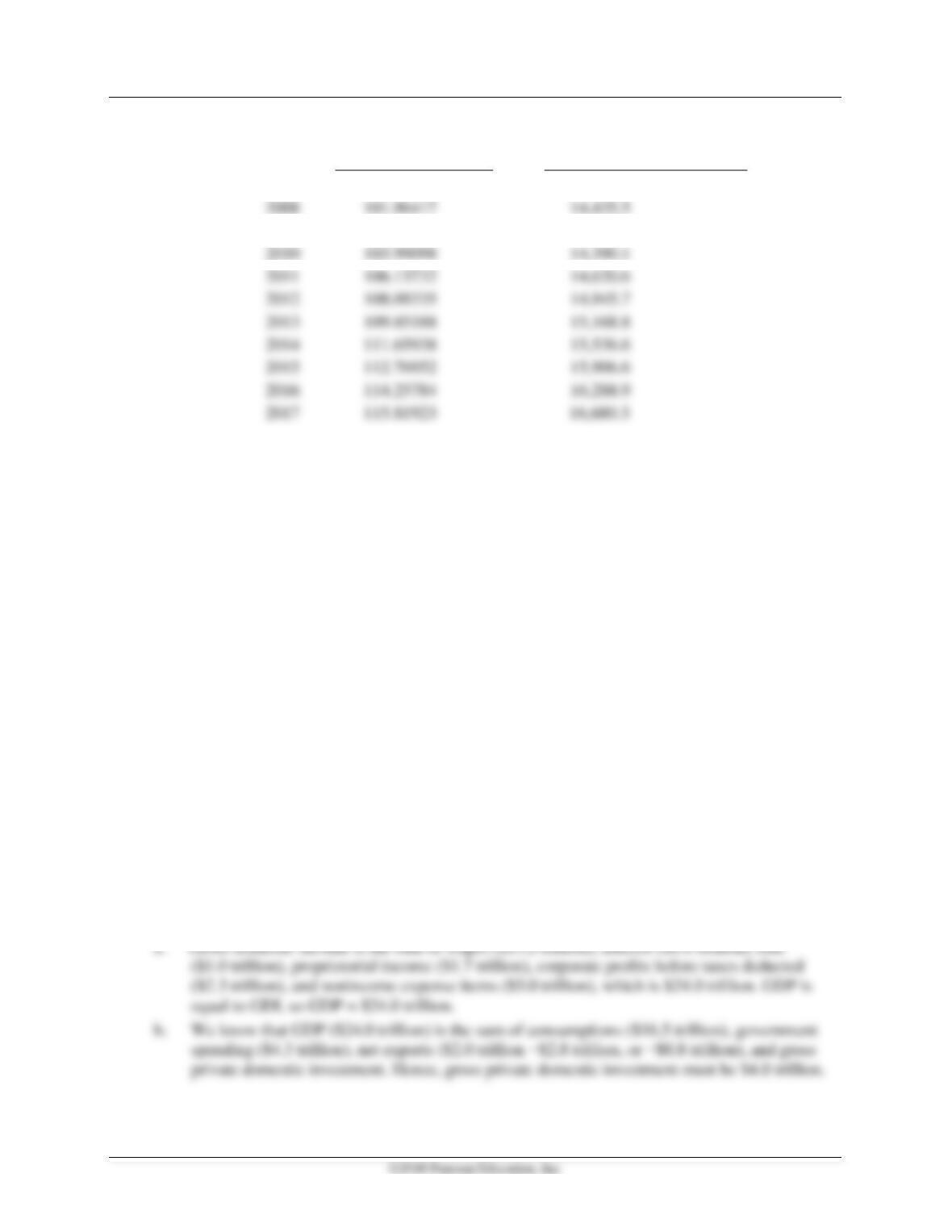
8-6. Look back at Table 8-3, which explains how to calculate real GDP in terms of 2009 constant
dollars. Change the base year to 2007. Recalculate the price index, and then recalculate real
GDP—that is, express column 4 of Table 8-3 in terms of 2007 dollars instead of 2009 dollars.
122 Miller • Economics Today, Nineteenth Edition
Price Index Real GDP (billions of dollars per
(base year 2007 = 100) year in constant 2007 dollars)
2007 100.00000 14,477.6
2009 102.73595 14,034.7
8-7. Consider the following hypothetical data for the U.S. economy in 2020 (in trillions of dollars),
and assume that there are no statistical discrepancies or other adjustments.
Profit
2.8
Indirect business taxes and transfers
0.8
Rent
0.7
Interest
0.8
Wages
8.2
Depreciation
1.3
Consumption
12.0
Exports
1.5
Government transfer payments
2.0
Personal income taxes and nontax payments
1.7
Imports
1.7
Corporate taxes and retained earnings
0.5
Social Security contributions
2.0
Government spending
3.8
a. What is gross domestic income? GDP?
b. What is gross private domestic investment?
c. What is personal income? Personal disposable income?
Chapter 8 Measuring the Economy’s Performance 123
8-8. Which of the following are production activities that are included in GDP? Which are not?
a. Mr. King performs the service of painting his own house instead of paying someone else
to do it.
b. Mr. King paints houses for a living.
c. Mrs. King earns income from parents by taking baby photos in her digital photography
studio.
d. Mrs. King takes photos of planets and stars as part of her astronomy hobby.
e. E*Trade charges fees to process Internet orders for stock trades.
f. Mr. Ho spends $10,000 on shares of stock via an Internet trade order and pays a
$10 brokerage fee.
g. Mrs. Ho receives a Social Security payment.
h. Ms. Hernandez makes a $300 payment for an Internet-based course on stock trading.
i. Mr. Langham sells a used laptop computer to his neighbor.
a. Not included in GDP
8-9. Explain what happens to contributions to GDP in each of the following situations.
a. A woman who makes a living charging for investment advice on her Internet Web site
marries one of her clients, to whom she now provides advice at no charge.
b. A man who had washed the windows of his own house every year decides to pay a
private company to wash those windows this year.
c. A company that had been selling used firearms illegally finally gets around to obtaining
an operating license and performing background checks as specified by law prior to each
gun sale.
8-10. Explain what happens to the official measure of GDP in each of the following situations.
a. Air quality improves significantly throughout the United States, but there are no effects
on aggregate production or on market prices of final goods and services.
124 Miller • Economics Today, Nineteenth Edition
b. The U.S. government spends considerably less on antipollution efforts this year than it
did in recent years.
c. The quality of cancer treatments increases, so patients undergo fewer treatments, which
hospitals continue to provide at the same price per treatment as before.
8-11. Which of the following activities of a computer manufacturer during the current year are
included in this year’s measure of GDP?
a. The manufacturer produces a chip in June, uses it as a component in a computer in
August, and sells the computer to a customer in November.
b. A retail outlet of the firm sells a computer completely built during the current year.
c. A marketing arm of the company receives fee income during the current year when a
buyer of one of its computers elects to use the computer manufacturer as her Internet
service provider.
8-12. A number of economists contend that official measures of U.S. gross private investment
expenditures are understated. For instance, household spending on education, such as college
tuition expenditures, is counted as consumption. Some economists suggest that these
expenditures, which amount to 6 percent of GDP, should be counted as investment instead.
Based on this 6 percent estimate and the GDP computations detailed in Figure 8-3 on page
185, how many billions of dollars would shift from consumption to investment if this
suggestion was adopted?
8-13. Consider the table below for the economy of a nation whose residents produce five final
goods.
Good
2017
2021
Price
Quantity
Price
Quantity
Shampoo
$ 2
15
$ 4
20
External
Hard drives
200
10
250
10
Books
40
5
50
4
Milk
3
10
4
3
Candy
1
40
2
20
Chapter 8 Measuring the Economy’s Performance 125
Assuming a 2017 base year:
a. What is nominal GDP for 2017and 2021?
b. What is real GDP for 2017 and 2021?
8-14. Consider the following table for the economy of a nation whose residents produce four final
goods.
Good
2019
2020
Price Quantity
Price Quantity
Computers
$1,000
10
$800
15
Bananas
6
3,000
11
1,000
Televisions
100
500
150
300
Cookies
1
10,000
2
10,000
Assuming a 2018 base year:
a. What is nominal GDP for 2019 and 2020?
b. What is real GDP for 2019 and 2020?
8-15. In the table for Problem 8-14, if 2020 is the base year, what is the price index for 2019?
(Round decimal fractions to the nearest tenth)
8-16. Suppose that early in a year, a hurricane hits a town in Florida and destroys a substantial
number of homes. A portion of this stock of housing, which had a market value of
$100 million (not including the market value of the land), was uninsured. The owners of the
residences spent a total of $5 million during the rest of the year to pay salvage companies to
help them save remaining belongings. A small percentage of uninsured owners had sufficient
resources to spend a total of $15 million during the year to pay construction companies to
rebuild their homes. Some were able to devote their own time, the opportunity cost of which
was valued at $3 million, to work on rebuilding their homes. The remaining people, however,
chose to sell their land at its market value and abandon the remains of their houses. What was
the combined effect of these transactions on GDP for this year? (Hint: Which transactions
took place in the markets for final goods and services?) In what ways, if any, does the effect
on GDP reflect a loss in welfare for these individuals?
8-17. Suppose that in 2019, geologists discover large reserves of oil under the tundra in Alaska.
These new reserves have a market value estimated at $50 billion at current oil prices. Oil
companies spend $1 billion to hire workers and move and position equipment to begin
exploratory pumping during that same year. In the process of loading some of the oil onto
tankers at a port, one company accidentally spills some of the oil into a bay and by the end of
the year pays $1 billion to other companies to clean it up. The oil spill kills thousands of birds,
seals, and other wildlife. What was the combined effect of these events on GDP for this year?
(Hint: Which transactions took place in the markets for final goods and services?) In what
ways, if any, does the effect on GDP reflect a loss in national welfare?
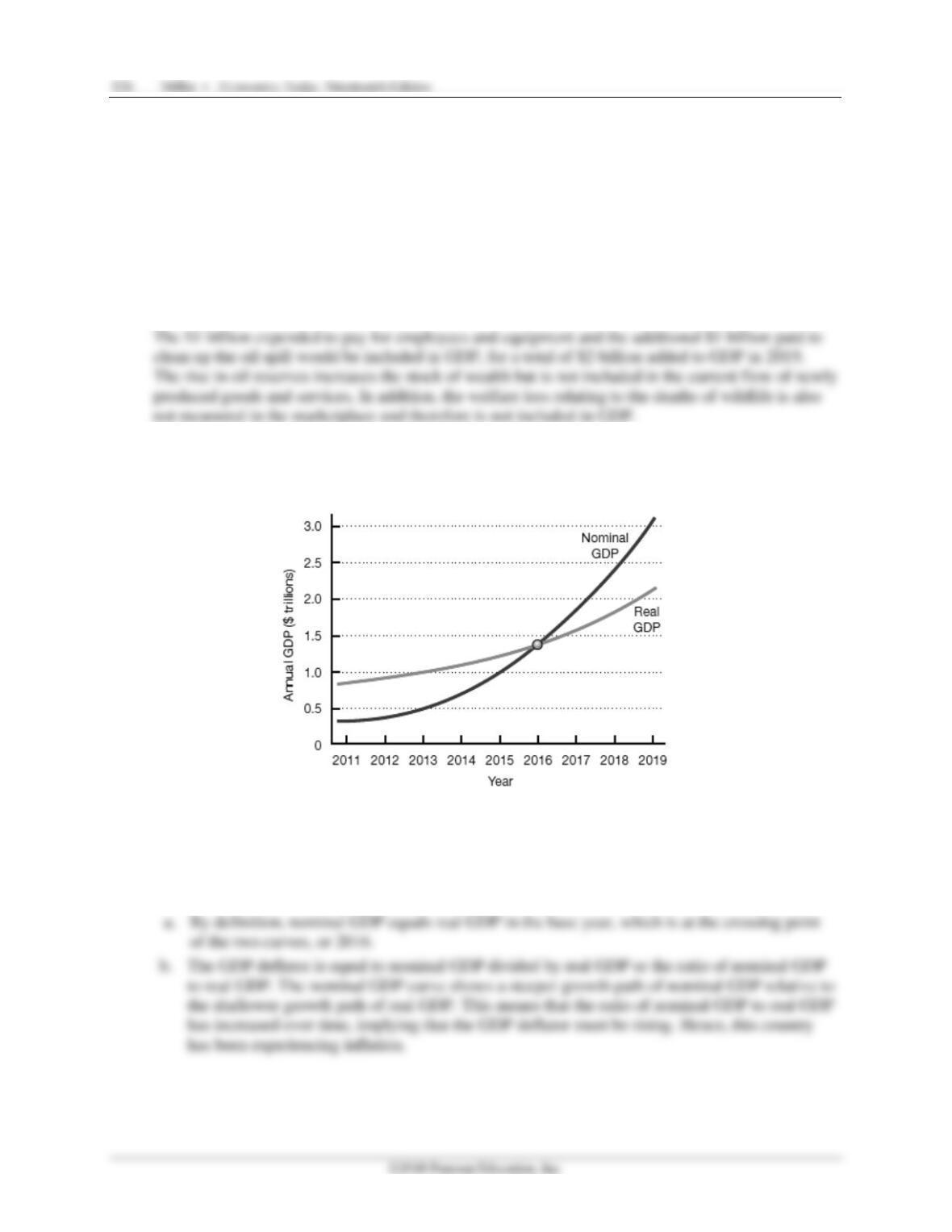
8-18. Consider the diagram below, and answer the following questions.
a. What is the base year? Explain.
b. Has this country experienced inflation or deflation since the base year? How can you
tell?
8-19. Suppose that in Figure 8-1, the sum total of all the goods and services produced during the
relevant period—pairs of shoes, candy bars, digital devices, etc., all summed together—is
500 trillion units. The total dollar value of this flow of output is $20 trillion. The total amount
of factors of production—labor, land, capital, entrepreneurship, all summed together—is
1 billion units. What is the follow of income—that is, the sum of wages, rents, interest, and
profits?
8-20. In Table 8-1, what is the total dollar amount that is added to the nation’s gross domestic
product? Why?
8-21. Suppose that U.S. consumption spending is $13 trillion, gross private domestic investment is
$3.5 trillion, government spending is $4 trillion, and net exports are −$0.5 trillion. If interest
income is $1 trillion, depreciation is $0.5 trillion, wages are $12 trillion, and rental income is
$0.75 trillion, what is the net domestic product?
8-22. In Problem 8-21, what is net investment?
8-23. Consider Figure 8-4. Explain what is special about the year at which the two data plots cross,
and why this is so.
8-24. Take a look at Table 8-4. Provide a possible explanation of why per capita GDP based on
purchasing power parity is higher in China and Indonesia than GDP based on foreign
exchange rate.
128 Miller • Economics Today, Nineteenth Edition
◼ Selected References
Bailey, Martin J., “Appendix: The Concept of Income,” National Income and the Price Level, 2nd ed.,
New York: McGraw-Hill, 1971.
Dennison, Edward F., “Welfare Measurement and the GNP,” Survey of Current Business, January 1971.
Kuznets, Simon, National Income: A Summary of Findings, New York: NBER, 1946.
Landefeld, Steven J. and Barbara M. Fraumeni, Measuring the New Economy, Bureau of Economic
Analysis, Department of Commerce, May 2000, http://www.bea.doc.gov/bea/about/newec.pdf.
National Income and Its Composition: 1919–1938, Vol. 1, New York: NBER, 1941.