A n s w e r s t o t h e R e v i e w Q u i z z e s
Page 184 (page 592 in Economics)
1. What makes something money? What functions does money perform? Why do you think packs of
chewing gum don’t serve as money?
2. What are the problems that arise when a commodity is used as money?
3. What are the main components of money in the United States today?
4. What are the official measures of money? Are all the measures really money?
5. Why are checks and credit cards not money?
8
MONEY, THE PRICE
LEVEL, AND
INFLATION**
C h a p t e r
1 0 0 C H A P T E R 8
Page 188 (page 596 in Economics)
1. What are depository institutions?
2. What are the functions of depository institutions?
3. How do depository institutions balance risk and return?
4. How do depository institutions create liquidity, pool risks, and lower the cost of borrowing?
Liquidity is the property of being easily convertible into a means of payment without loss in value.
Depository institutions create liquidity when they offer deposits that can be withdrawn as money at
5. How have depository institutions made innovations that have influenced the composition of
money?
Checking deposits at thrift institutions such as S&L’s savings banks, and credit unions are examples of
Page 192 (page 600 in Economics)
1. What is the central bank of the United States and what functions does it perform?
2. What is the monetary base and how does it relate to the Fed’s balance sheet?
3. What are the Fed’s three policy tools?
4. What is the Federal Open Market Committee and what are its main functions?
5. How does an open market operation change the monetary base?
Page 194 (page 602 in Economics)
1. How do banks create money?
2. What limits the quantity of money that the banking system can create?
3. A bank manager tells you that she doesn’t create money. She just lends the money that people
deposit. Explain why she’s wrong.
Though the manager does not see the entire process, nonetheless the loans the manager makes create
more deposits and more money. Point out to the manager that when she makes a loan, the deposits at
her bank initially increase. And, when the loan is spent, the recipient selling the goods or services that
Page 199 (page 607 in Economics)
1. What are the main influences on the quantity of real money that people and businesses plan to
hold?
The quantity of real money demanded depends on four factors: the price level, the nominal interest
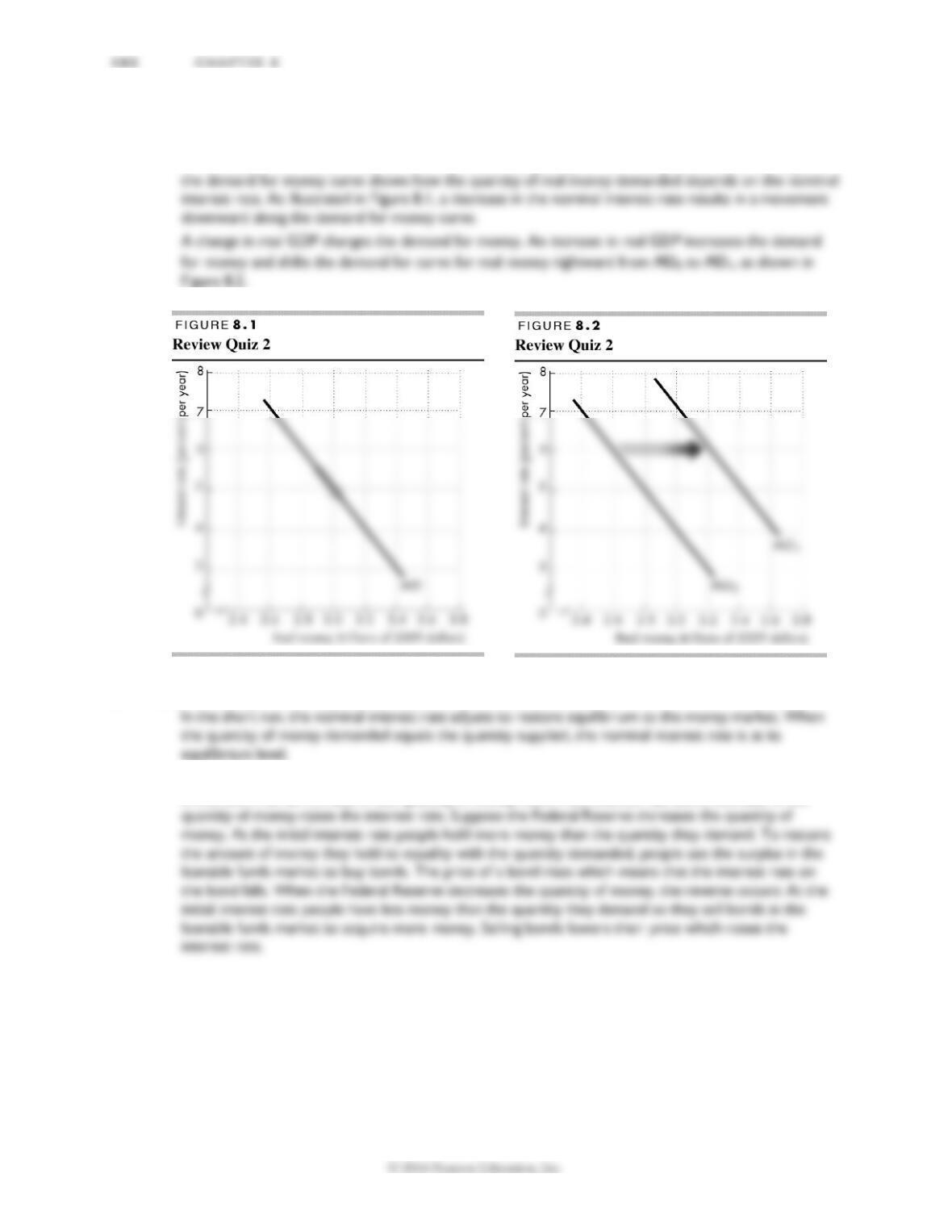
2. Show the effects of a change in the nominal interest rate and a change in real GDP using the
demand for money curve.
An increase in the nominal interest rate decreases the quantity of real money demanded. The slope of
3. How is money market equilibrium determined in the short run?
4. How does a change in the quantity of money change the interest rate in the short run?
In the short run an increase in the quantity of money lowers the interest rate and a decrease in the
5. How does a change in the quantity of money change the interest rate in the long run?
In the long run a change in the quantity of money does not change the interest rate. For example,
Page 201 (page 609 in Economics)
1. What is the quantity theory of money?
2. How is the velocity of circulation calculated?
3. What is the equation of exchange?
4. Does the quantity theory correctly predict the effects of money growth on inflation?
1 0 4 C H A P T E R 8
(millions)
Wells Fargo
Assets
(millions)
A n s w e r s t o t h e S t u dy P l a n P r o b l e ms a n d Ap pl i c a t i o n s
1. Money in the United States today includes which of the following items?
• Cash in Citibank’s cash machines
Money includes currency outside the banks. Currency inside cash machines is not money.
2. In June 2013, currency held by individuals and businesses was $1,124 billion; traveler’s checks
were $4 billion; checkable deposits owned by individuals and businesses were $1,042 billion;
savings deposits were $6,884 billion; time deposits were $583 billion; and money market funds
and other deposits were $647 billion. Calculate M1 and M2 in June 2011.
3. Europe’s Banks Must Be Forced to Recapitalize
E.U. banks must hold more capital. Where private funding is not forthcoming, recapitalization
must be imposed by E.U. governments.
Source: Financial Times, November 24, 2011
What is the “capital” referred to in the news clip? How might the requirement to hold more
capital make banks safer?
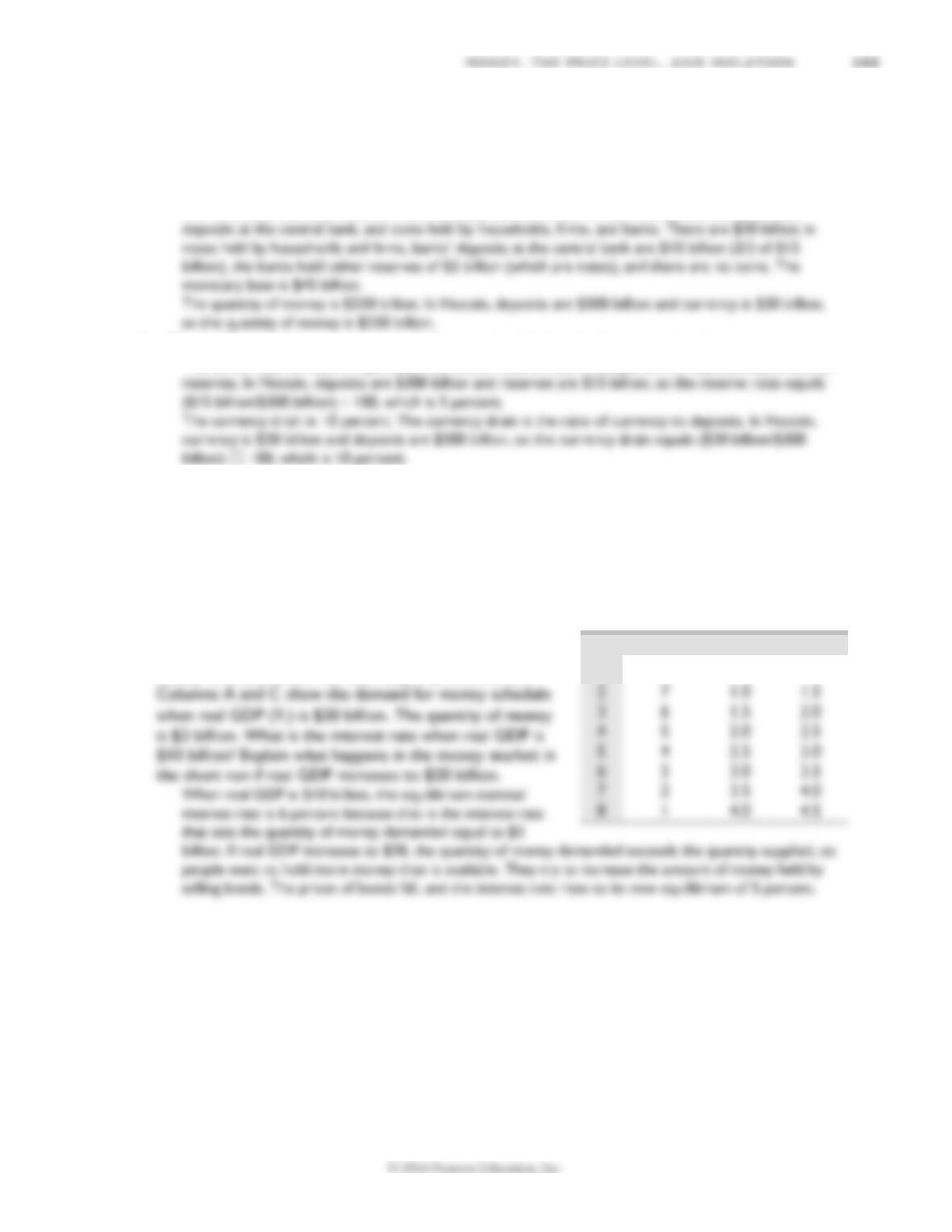
4. The FOMC sells $20 million securities to Wells Fargo. Enter the transactions that take place to
show the changes in the following balance sheets.
The first balance sheet to the right shows the
balance sheet of the Federal Reserve Bank of
New York. The Fed’s assets decrease by $20
Federal Reserve Bank of New York
Assets
Liabilities
5. In the economy of Nocoin, bank deposits are $300 billion, bank reserves are $15 billion of which
two thirds are deposits with the central bank. Households and firms hold $30 billion in bank
notes. There are no coins. Calculate
a. The monetary base and the quantity of money.
The monetary base is $45 billion. The monetary base is the sum of the central bank’s notes, banks’
b. The banks’ desired reserve ratio and the currency drain ratio (as percentages).
The banks’ reserve ratio is 5 percent. The banks’ reserve ratio is the percent of deposits that is held as
6. China Cuts Banks’ Reserve Ratios
The People’s Bank of China announces it will cut the required reserve ratio.
Source: Financial Times, February 19, 2012
Explain how lowering the required reserve ratio will impact banks’ money creation process.
Lowering the required reserve ratio decreases banks’ desired reserves. When banks’ desired reserves
decrease they will make more loans so the quantity of money in China increases. (The Mathematical
Note shows that an decrease in the desired reserve ratio increases the money multiplier.)
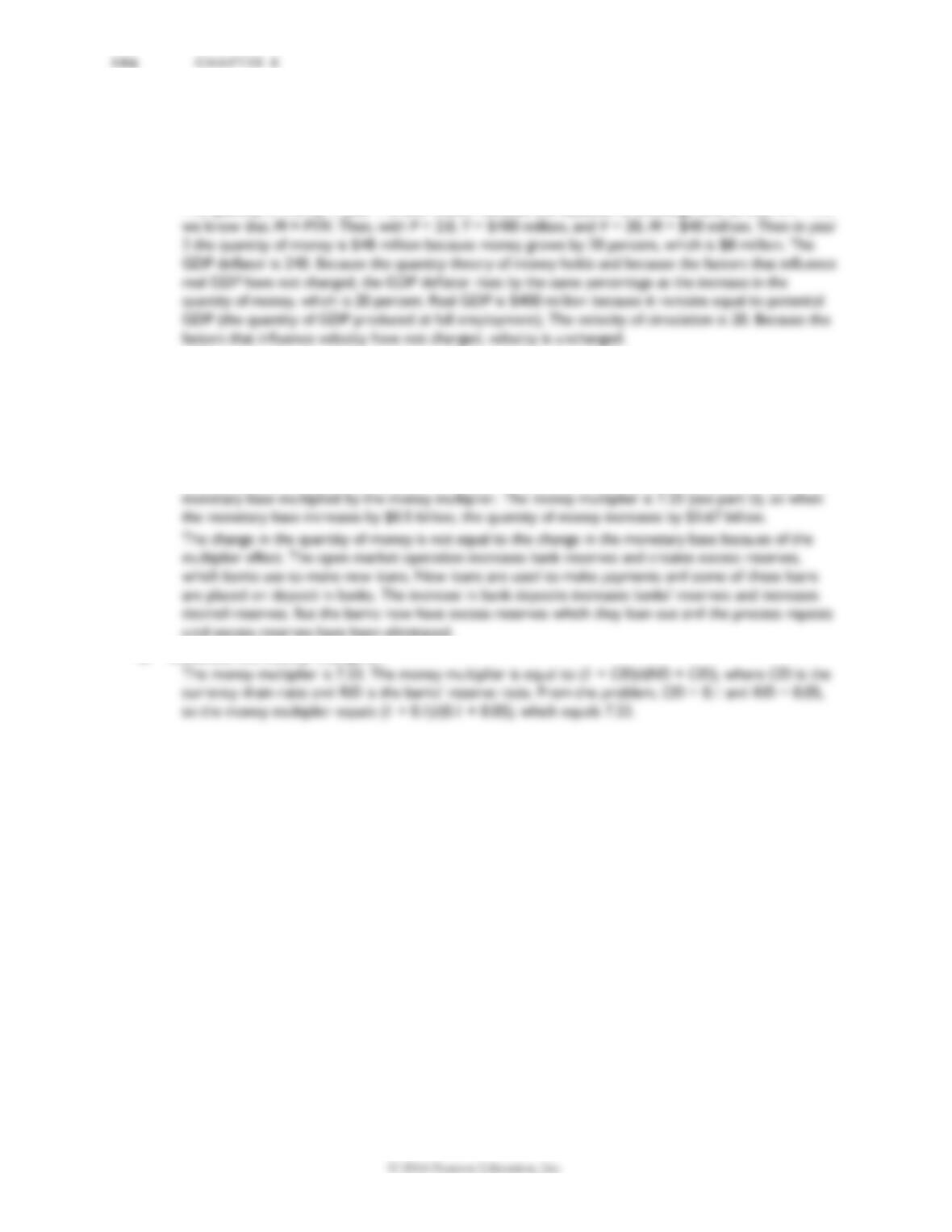
7. The spreadsheet provides data about the demand for
money in Minland. Columns A and B show the demand for
money schedule when real GDP (Y0) is $10 billion and
A
B
C
1
r
Y0
Y1
8. In year 1, the economy is at full employment and real GDP is $400 million, the GDP deflator is
200 (a price level is 2), and the velocity of circulation is 20. In year 2, the quantity of money
increases by 20 percent. If the quantity theory of money holds, calculate the quantity of money,
the GDP deflator, real GDP, and the velocity of circulation in year 2.
The quantity of money in year 1 is $40 million. Because the equation of exchange tells us that MV = PY,
Mathematical Note
9. In Problem 5, the banks have no excess reserves. Suppose that the central bank of Nocoin
increases bank reserves by $0.5 billion.
a. Explain what happens to the quantity of money and why the change in the quantity of money is
not equal to the change in the monetary base.
The quantity of money increases by $3.67 billion. The quantity of money increases by the change in the
until excess reserves have been eliminated.
b. Calculate the money multiplier.
M O N E Y , T H E P R I C E L E V E L , A N D I N F L A T I O N 1 0 7
Answers to Additional Problems and Applications
10. Sara withdraws $1,000 from her savings account at the Lucky S&L, keeps $50 in cash, and
deposits the balance in her checking account at the Bank of Illinois. What is the immediate change
in M1 and M2?
11. Rapid inflation in Brazil in the early 1990s caused the cruzeiro to lose its ability to function as
money. Which of the following commodities would most likely have taken the place of the
cruzeiro in the Brazilian economy? Explain why.
a. Tractor parts
b. Packs of cigarettes
d. Impressionist paintings
Impressionist paintings would be unlikely to be used as a substitute for money because they would be
e. Baseball trading cards
12. Are You Ready to Pay by smartphone?
Starbucks customers can now pay for their coffee using their smartphone. Does this mean the
move to electronic payments is finally coming?
Source: The Wall Street Journal, January 20, 2011
If people can use their smartphone to make payments, will currency disappear? How will the
components of M1 change?
1 0 8 C H A P T E R 8
Use the following news clip to work Problems 13 and 14.
U.S. Bank Earnings Up 21% As Loan Losses Decline, FDIC Says
For the 12th straight quarter, U.S. bank profits increased. At $34.5 billion, they were 21 percent higher
than a year earlier, and, according to the Federal Deposit Insurance Corporation (FDIC), balance sheets
www.bloomberg.com, August 29, 2012
13. Explain how the pursuit of profits can sometimes lead to bank failures.
The bank knows that its safe reserves pay low (or no) returns so retaining safe reserves lowers the
14. How does FDIC insurance help minimize the cost of bank failure? Does it bring more stability to
the banking system?
Prior to FDIC insurance, a bank failure might impose significant costs on its depositors because the
depositors might lose their entire deposit. FDIC insurance removes this cost of bank failure. It also
15. Explain the distinction between a central bank and a commercial bank.
A central bank is basically a “bank for banks.” It will conduct business with commercial banks, such as
16. If the Fed makes an open market sale of $1 million of securities to a bank, what initial changes
occur in the economy?
If the Fed sells $1 million of securities to a bank, both the Fed’s balance sheet and the bank’s balance
17. Set out the transactions that the Fed undertakes to increase the quantity of money.
The Fed has three procedures by which it can increase the quantity of money:
• The Fed could use an open market purchase of securities from banks. When the Fed buys
18. Describe the Fed’s assets and liabilities. What is the monetary base and does it relate to the Fed’s
balance sheet?
The Fed has two main assets: U.S. government securities and loans to depository institutions. The Fed
19. Fed Minutes Show Active Discussion of QE3
The FOMC discussed “a new large–scale asset purchase program” commonly called “QE3.” Some
FOMC members said such a program could help the economy by lowering long-term interest
rates and making financial conditions more broadly easier. They discussed whether a new
program should snap up more Treasury bonds or buying mortgage-backed securities issued by the
likes of Fannie Mae and Freddie Mac.
Source: The Wall Street Journal, August 22, 2012
What would the Fed do to implement QE3, how would the monetary base change, and how
would bank reserves change?
20. Banks in New Transylvania have a desired reserve ratio of 10 percent of deposits and no excess
reserves. The currency drain ratio is 50 percent of deposits. Now suppose that the central bank
increases the monetary base by $1,200 billion.
a. How much do the banks lend in the first round of the money creation process?
b. How much of the initial amount lent flows back to the banking system as new deposits?
c. How much of the initial amount lent does not return to the banks but is held as currency?
1 1 0 C H A P T E R 8
d. Why does a second round of lending occur?
21. Explain the change in the nominal interest rate in the short run if
a. Real GDP increases.
The nominal interest rate rises. When real GDP increases, the demand for money increases. At the
b. The money supply increases.
The nominal interest rate falls. When the supply of money increases, the quantity of real money
c. The price level rises.
The nominal interest rate rises. When the price level rises, the quantity of real money decreases. The
22. Figure 8.3 shows the demand for money curve. If
the Fed decreases the quantity of real money
supplied from $4 trillion to $3.9 trillion, explain
how the price of a bond will change.
If the Fed decreases the quantity of money to
$3.9 trillion, the price of a bond falls. The
23. Use the data in Problem 7 to work this problem. The interest rate is 4 percent a year. Suppose
that real GDP decreases from $20 billion to $10 billion and the quantity of money remains
unchanged. Do people buy bonds or sell bonds? Explain how the interest rate changes.
Real GDP (1929 dollars)
$7.4 billion
Price level (1929 = 100)
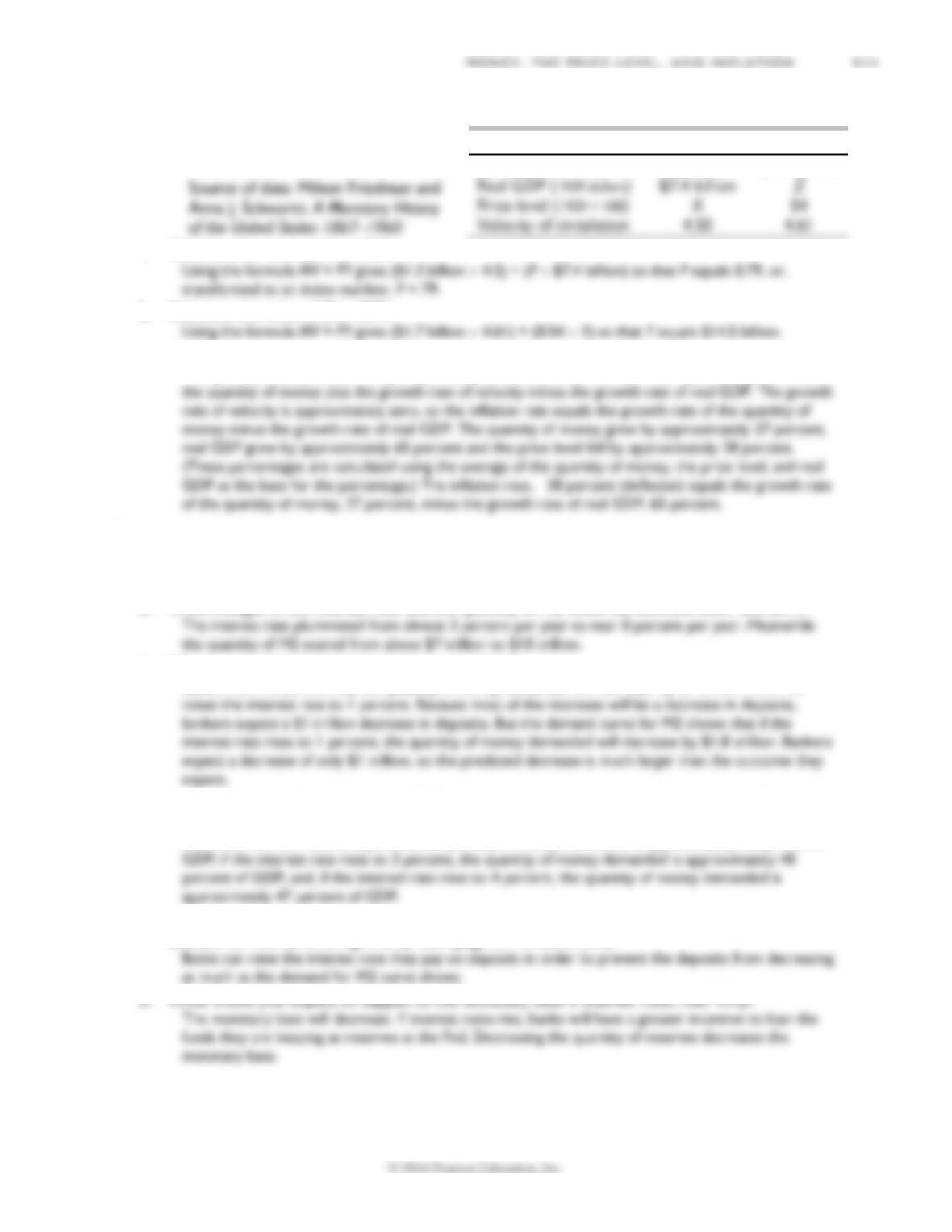
24. The table provides some data for the
United States in the first decade following
the Civil War.
a. Calculate the value of X in 1869.
b. Calculate the value of Z in 1879.
c. Are the data consistent with the quantity theory of money? Explain your answer.
The quantity theory holds. The quantity theory predicts that the inflation rate equals the growth rate of
Economics in the News
25. After you have studied Reading Economics in the News on pp. 202–203 (610–611 in Economics,)
answer the following questions.
a. What changes in the interest rate and the quantity of M2 occurred between 2007 and 2014?
b. Why is the outcome feared by bankers optimistic?
Bankers are concerned that the quantity of money demanded will decrease by $1 trillion if the Fed
c. By how much would the quantity of M2 demand decrease if the interest rate rose to 2 percent,
3 percent, and 4 percent? (Express your answer as a percentage of GDP.)
If the interest rate rises to 2 percent, the quantity of money demanded is approximately 50 percent of
d. What could the banks do to prevent deposits from decreasing by as much as predicted by the
demand for M2 curve in Fig. 3 on p. 203 (page 611 in Economics)?
1869
1879
Quantity of money
$1.3 billion
$1.7 billion
26. Fed at Odds with ECB over Value of Policy Tool
Financial innovation and the spread of U.S. currency throughout the world has broken down
relationships between money, inflation, and output growth, making monetary gauges a less useful
tool for policy makers, the U.S. Federal Reserve chairman, Ben Bernanke, said. Many other central
banks use monetary aggregates as a guide to policy decision, but Bernanke believes reliance on
monetary aggregates would be unwise. “There are differences between the United States and
Europe in terms of the stability of money demand,” Bernanke said.
Source: International Herald Tribune, November 10, 2006
a. Explain how the debate surrounding the quantity theory of money could make “monetary
gauges a less useful tool for policy makers.”
The ECB policymakers believe that the quantity theory and its relationship between the monetary
b. What do Ben Bernanke’s statements reveal about his view on the accuracy of the quantity
theory of money?
Mathematical Note
27. In the United Kingdom, the currency drain ratio is 38 percent of deposits and the reserve ratio is
2 percent of deposits. In Australia, the quantity of money is $150 billion, the currency drain ratio
is 33 percent of deposits, and the reserve ratio is 8 percent of deposits.
a. Calculate the U.K. money multiplier.
b. Calculate the monetary base in Australia.
The monetary base equals $46.2 billion. The monetary base equals the sum of currency and depository