Chapter 08 – Pure Competition in the Short Run
8-1
Chapter 08 Pure Competition in the Short Run
QUESTIONS
1. Briefly state the basic characteristics of pure competition, pure monopoly, monopolistic
competition, and oligopoly. Under which of these market classifications does each of the
following most accurately fit? (a) a supermarket in your hometown; (b) the steel industry; (c) a
Kansas wheat farm; (d) the commercial bank in which you or your family has an account; (e) the
automobile industry. In each case justify your classification. LO1
Answer: Pure competition: very large number of firms; standardized products; no control
over price: price takers; no obstacles to entry; no nonprice competition.
Pure monopoly: one firm; unique product: with no close substitutes; much control over
price: price maker; entry is blocked; mostly public relations advertising.
Chapter 08 – Pure Competition in the Short Run
8-2
2. Strictly speaking, pure competition is relatively rare. Then why study it? LO2
Answer: It can be shown that pure competition results in low-cost production (productive
efficiency)—through long-run equilibrium occurring where P equals minimum ATC—
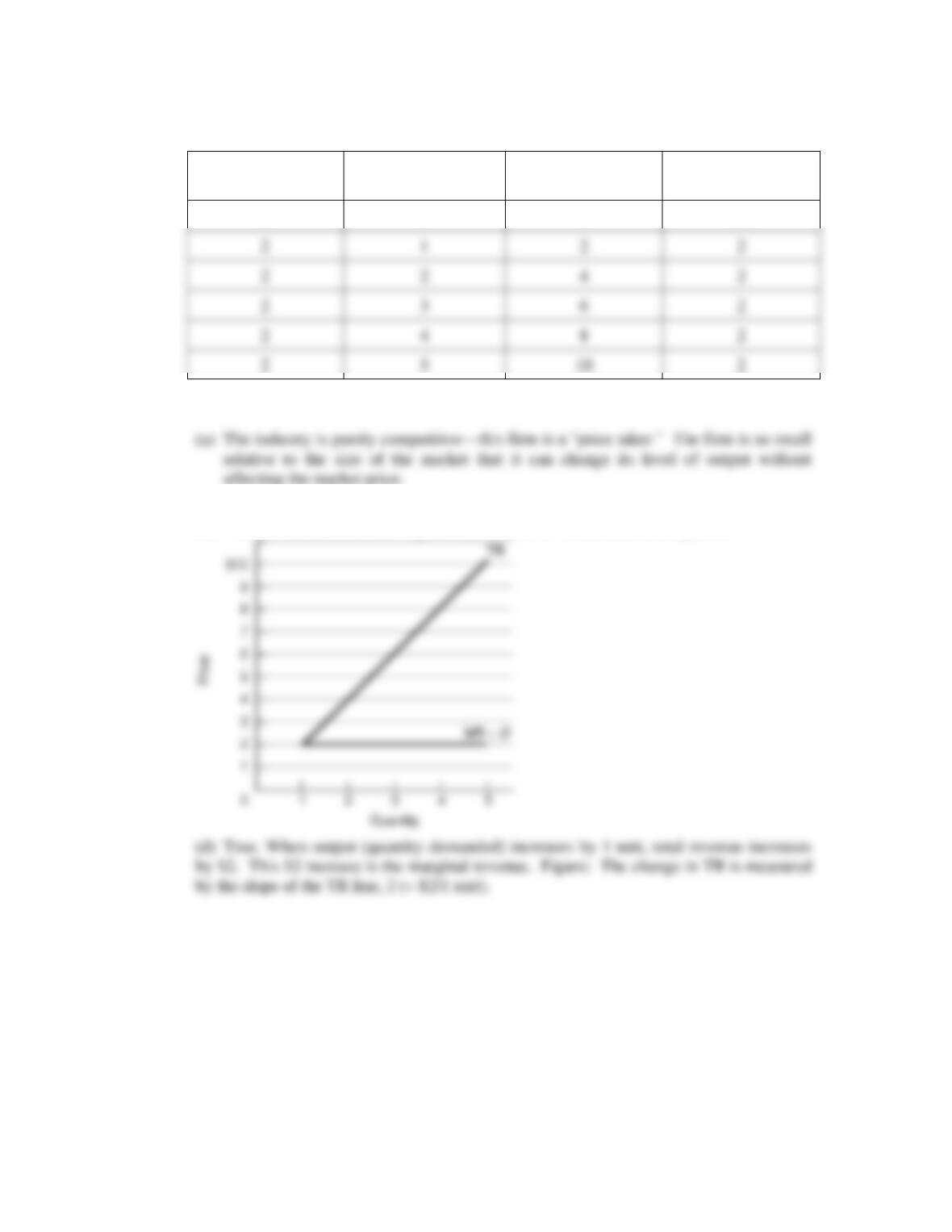
3. Use the following demand schedule to determine total revenue and marginal revenue for each
possible level of sales: LO2
a. What can you conclude about the structure of the industry in which this firm is operating?
Explain.
b. Graph the demand, total-revenue, and marginal-revenue curves for this firm.
c. Why do the demand and marginal-revenue curves coincide?
d. “Marginal revenue is the change in total revenue associated with additional units of output.”
Explain verbally and graphically, using the data in the table.
Chapter 08 – Pure Competition in the Short Run
8-3
Answer: Table:
Product Price ($)
Quantity
Demanded
Total Revenue ($)
Marginal Revenue
($)
2
0
0
NA
(b) See graph.
(c) The firm’s demand curve is perfectly elastic; MR is constant and equal to P.
4. “Even if a firm is losing money, it may be better to stay in business in the short run.” Is this
statement ever true? Under what condition(s)? LO3
2
1
2
2
2
3
6
2
2
5
2
Chapter 08 – Pure Competition in the Short Run
8-4
Answer: Yes, a firm may want to stay in business even if it is losing money. For
example, assume the firm has a fixed cost of $1,000 which it must pay even if it stops
5. Consider a firm that has no fixed costs and which is currently losing money. Are there any
situations in which it would want to stay open for business in the short run? If a firm has no fixed
costs, is it sensible to speak of the firm distinguishing between the short run and the long run?
LO3
Answer: No, the firm will want to shut down. This follows because the firm is losing
money, but there are no fixed costs. Since there are no fixed costs, only variable cost,
6. Why is the equality of marginal revenue and marginal cost essential for profit maximization in
all market structures? Explain why price can be substituted for marginal revenue in the MR = MC
rule when an industry is purely competitive. LO3
Answer: If the last unit produced adds more to costs than to revenue, its production must
necessarily reduce profits (or increase losses). On the other hand, profits must increase
Chapter 08 – Pure Competition in the Short Run
8-5
7. “That segment of a competitive firm’s marginal-cost curve that lies above its average-variable-
cost curve constitutes the short-run supply curve for the firm.” Explain using a graph and words.
LO4
Answer: The firm will not produce if P < AVC. When P > AVC, the firm will
8. LAST WORD If a firm’s current revenues are less than its current variable costs, when should
it shut down? If it decides to shut down, should we expect that decision to be final? Explain using
an example that is not in the book.
Answer: The firm should shut down immediately. If the firm were to continue
production in this case it would be adding to its losses. That is, not only would the firm
PROBLEMS
1. A purely competitive firm finds that the market price for its product is $20. It has a fixed cost
of $100 and a variable cost of $10 per unit for the first 50 units and then $25 per unit for all
successive units. Does price exceed average variable cost for the first 50 units? What about for
the first 100 units? What is the marginal cost per unit for the first 50 units? What about for units
51 and higher? For each of the first 50 units, does MR exceed MC? What about for units 51 and
higher? What output level will yield the largest possible profit for this purely competitive firm?
(Hint: Draw a graph similar to Figure 8.2 using data for this firm.) LO3
Feedback: Consider the following example. A purely competitive firm finds that the
market price for its product is $20. It has a fixed cost of $100 and a variable cost of $10
per unit for the first 50 units and then $25 per unit for all successive units.
Chapter 08 – Pure Competition in the Short Run
8-6
What about for the first 100 units? Yes, price ($20) exceeds average variable cost for the
What is the marginal cost per unit for the first 50 units? What about for units 51 and
higher? For each of the first 50 units, does MR exceed MC? What about for units 51 and
higher? The MC is $10 per unit for the first 50 units and the MC is $25 per unit for
What output level will yield the largest possible profit for this purely competitive firm?
2. A purely competitive wheat farmer can sell any wheat he grows for $10 per bushel. His five
acres of land show diminishing returns because some are better suited for wheat production than
others. The first acre can produce 1000 bushels of wheat, the second acre 900, the third 800, and
so on. Draw a table with multiple columns to help you answer the following questions. How
many bushels will each of the farmer’s five acres produce? How much revenue will each acre
generate? What are the TR and MR for each acre? If the marginal cost of planting and harvesting
an acre is $7000 per acre for each of the five acres, how many acres should the farmer plant and
harvest? LO3
Feedback: Consider the following example. A purely competitive wheat farmer can sell
any wheat he grows for $10 per bushel. His five acres of land show diminishing returns
because some are better suited for wheat production than others. The first acre can
produce 1000 bushels of wheat, the second acre 900, the third 800, and so on. Also
assume the marginal cost of planting and harvesting an acre is $7000 per acre for each of
the five acres.
Chapter 08 – Pure Competition in the Short Run
8-7
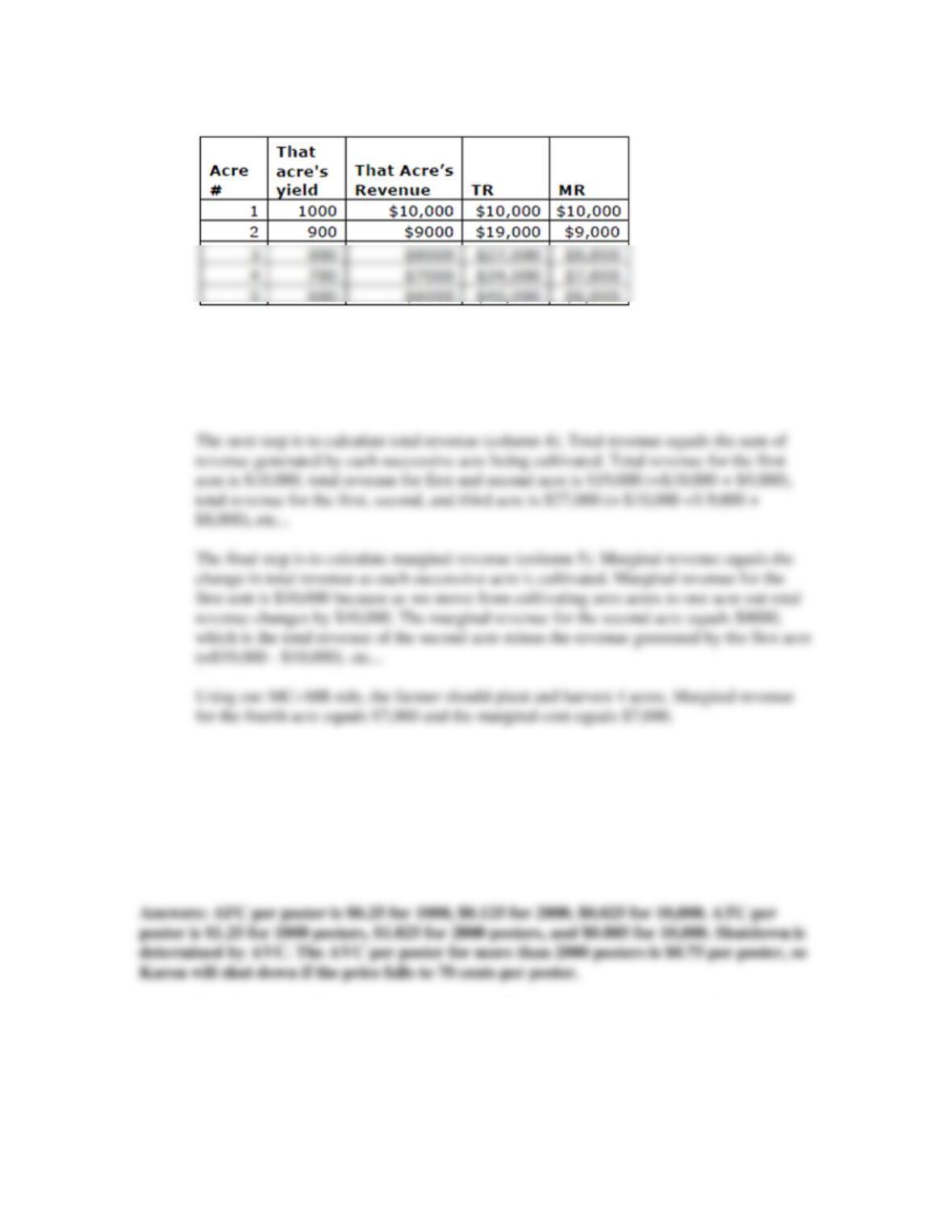
Table:
The first step is to calculate the revenue generated by each acre (column 3). Each entry,
the acre’s revenue, is found by multiplying the price per bushel by the acre’s yield. The
revenue generated by the first acre is $10,000 (=$10 x 1000), the second acre $9000
(=$10 x 900), the third acre $8000 (=$10 x 800), etc…
3. Karen runs a print shop that makes posters for large companies. It is a very competitive
business. The market price is currently $1 per poster. She has fixed costs of $250. Her variable
costs are $1000 for the first thousand posters, $800 for the second thousand, and then $750 for
each additional thousand posters. What is her AFC per poster (not per thousand!) if she prints
1000 posters? 2000? 10,000? What is her ATC per poster if she prints 1000? 2000? 10,000? If the
market price fell to 70 cents per poster, would there be any output level at which Karen would not
shut down production immediately? LO3
Feedback: Consider the following example. The market price is currently $1 per poster.
She has fixed costs of $250. Her variable costs are $1000 for the first thousand posters,
$800 for the second thousand, and then $750 for each additional thousand posters.
What is her AFC per poster (not per thousand!) if she prints 1000 posters? 2000? 10,000?
Chapter 08 – Pure Competition in the Short Run
8-8
To calculate average fixed cost (AFC) divide total fixed cost by the number of posters
being produced (=Total Fixed Cost / # of posters).
AVC for 2000 posters is $0.90. This is the total variable cost $1800, $1000 for the first
1000 and $800 for the second 1000, divided by the total number of posters 2000
(=$1800/2000).
AVC for 10,000 posters is $0.78. This is the total variable cost of 7800, $1000 for the
first 1000, $800 for the second 1000, and $6000 for the next 8000 ($750 per 1000 or
8x$750), divided by 10,000 posters (=$7800/10,000).
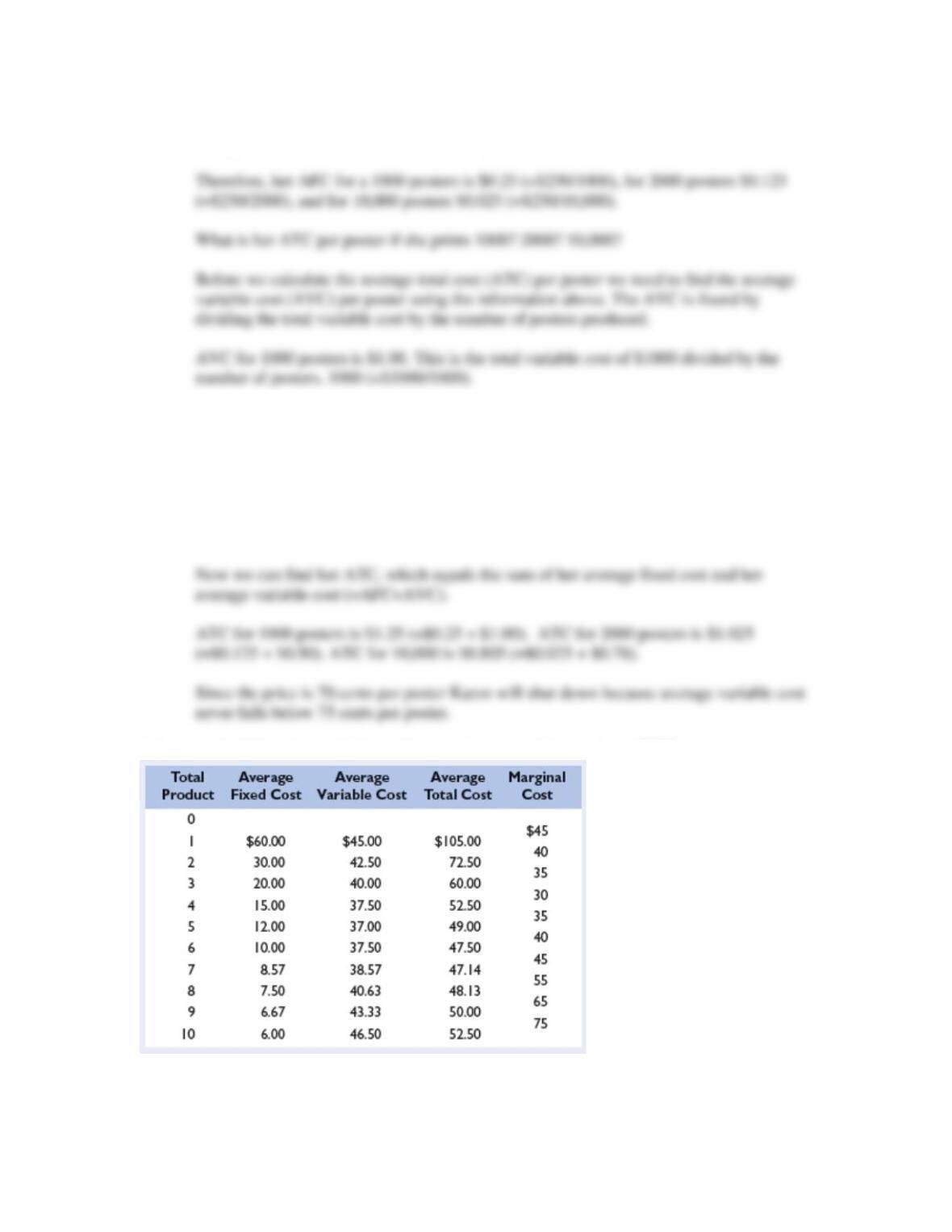
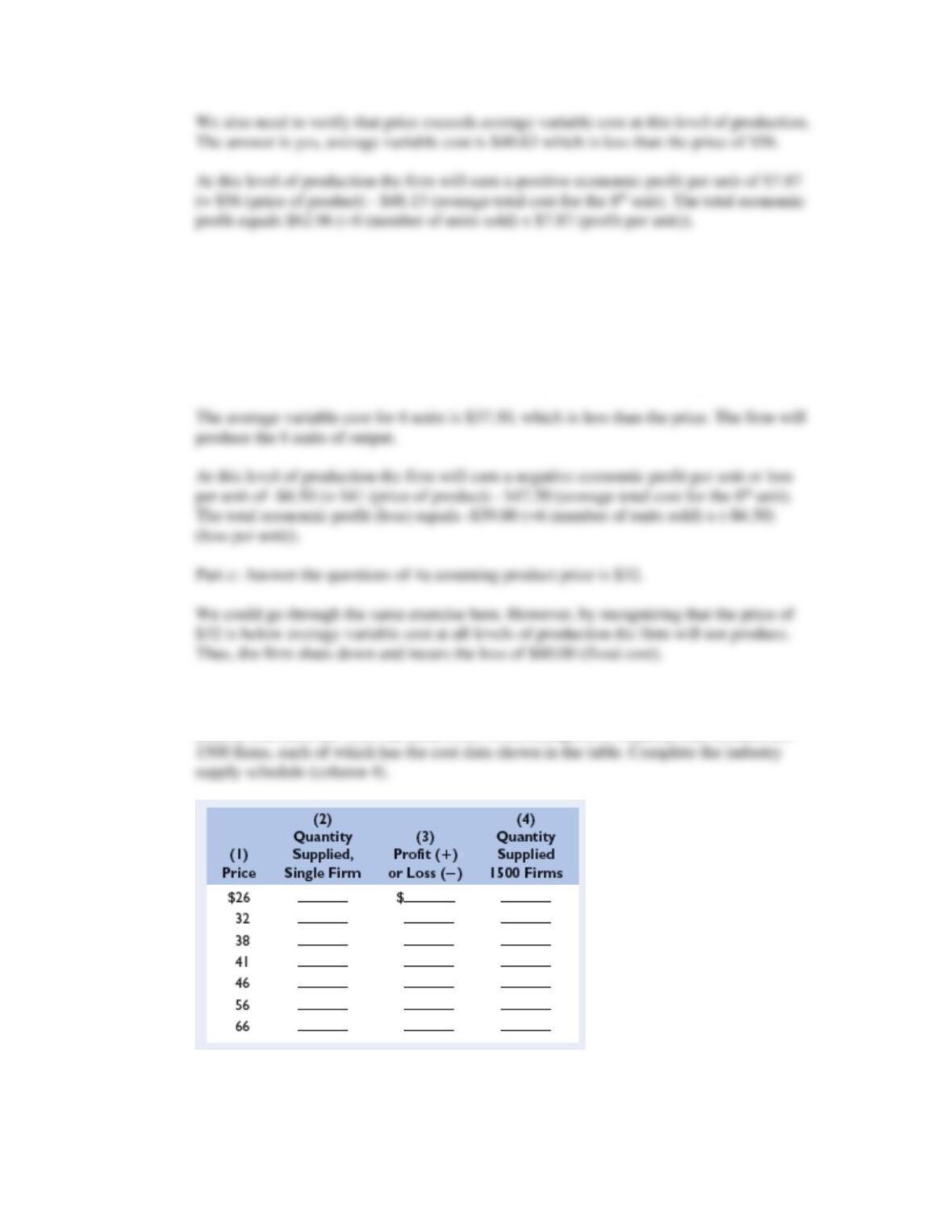
4. Assume the following cost data are for a purely competitive producer: LO3
a. At a product price of $56, will this firm produce in the short run? If it is preferable to produce,
what will be the profit-maximizing or loss-minimizing output? What economic profit or loss will
the firm realize per unit of output?
Chapter 08 – Pure Competition in the Short Run
8-9
b. Answer the questions of 4a assuming product price is $41.
c. Answer the questions of 4a assuming product price is $32.
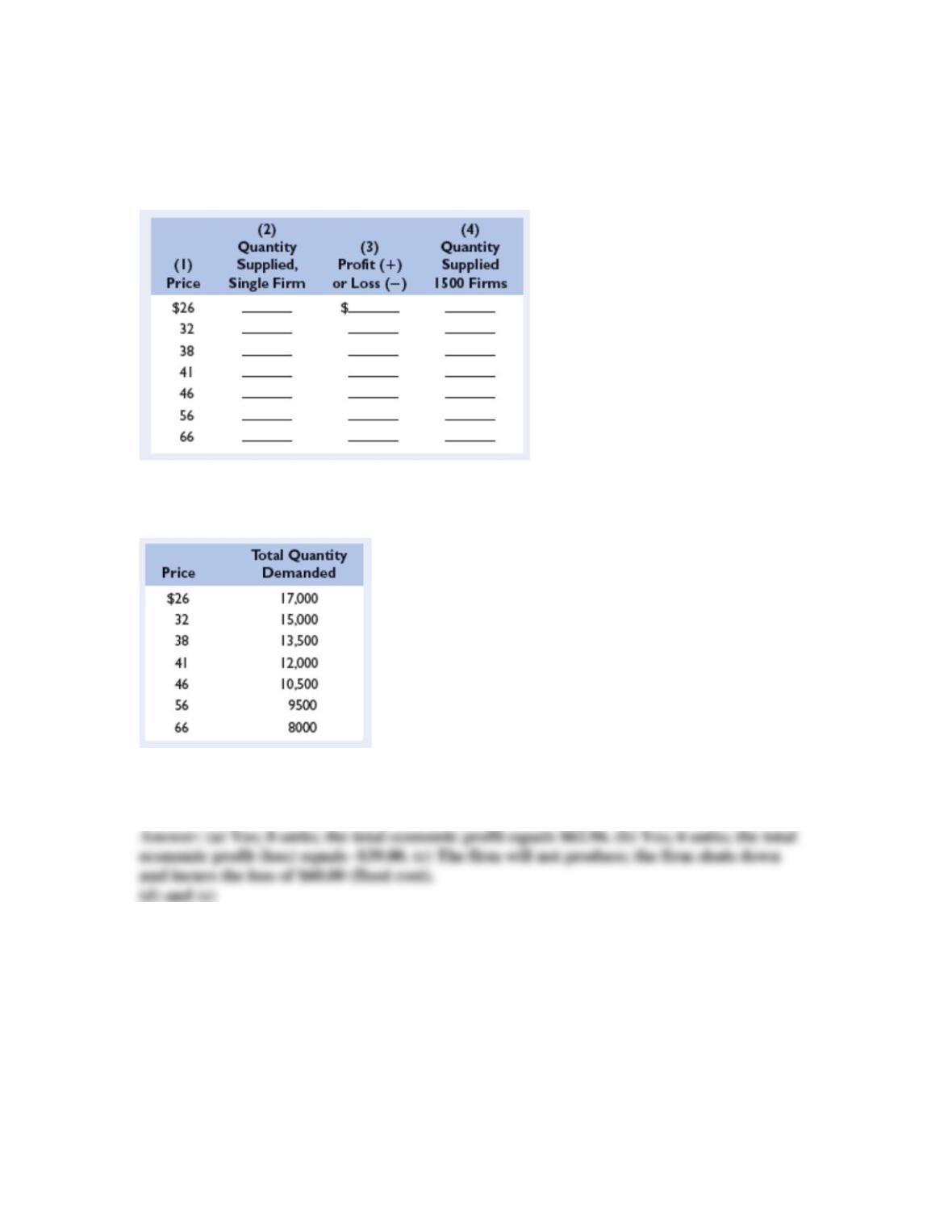
d. In the table below, complete the short-run supply schedule for the firm (columns 1 and 2) and
indicate the profit or loss incurred at each output (column 3).
e. Now assume that there are 1500 identical firms in this competitive industry; that is, there are
1500 firms, each of which has the cost data shown in the table. Complete the industry supply
schedule (column 4).
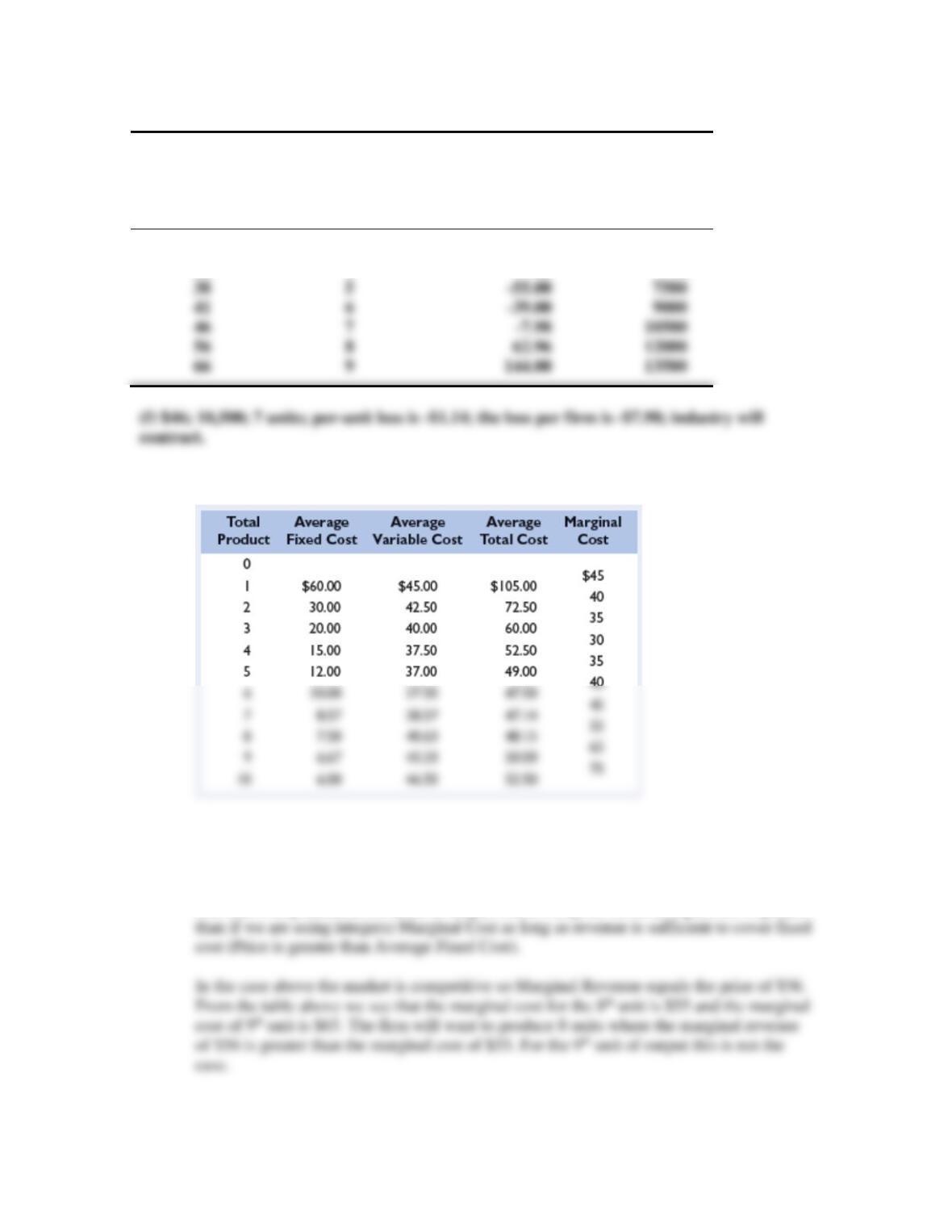
f. Suppose the market demand data for the product are as follows:
What will be the equilibrium price? What will be the equilibrium output for the industry? For
each firm? What will profit or loss be per unit? Per firm? Will this industry expand or contract in
the long run?
Chapter 08 – Pure Competition in the Short Run
8-10
(1)
Price
(2)
Quantity
supplied,
single firm
(3)
Profit (+)
or loss (-)
(4)
Quantity
supplied,
1500 firms
$26
32
0
0
$-60
-60
0
0
Feedback: Consider the following example.
Part a: At a product price of $56, will this firm produce in the short run? If it is preferable
to produce, what will be the profit-maximizing or loss-minimizing output? What
economic profit or loss will the firm realize per unit of output?
The rule is to produce at the level of output where Marginal Revenue equals (or is greater
41
Chapter 08 – Pure Competition in the Short Run
8-11
Part b: Answer the questions of 4a assuming product price is $41.
The same process is applied here.
The price of $41, which is marginal revenue, is greater than the marginal cost of the 6th
unit in the table above. Beyond this level of production marginal cost exceeds marginal
revenue. Thus, the firm will produce 6 units as long as price covers average variable cost.
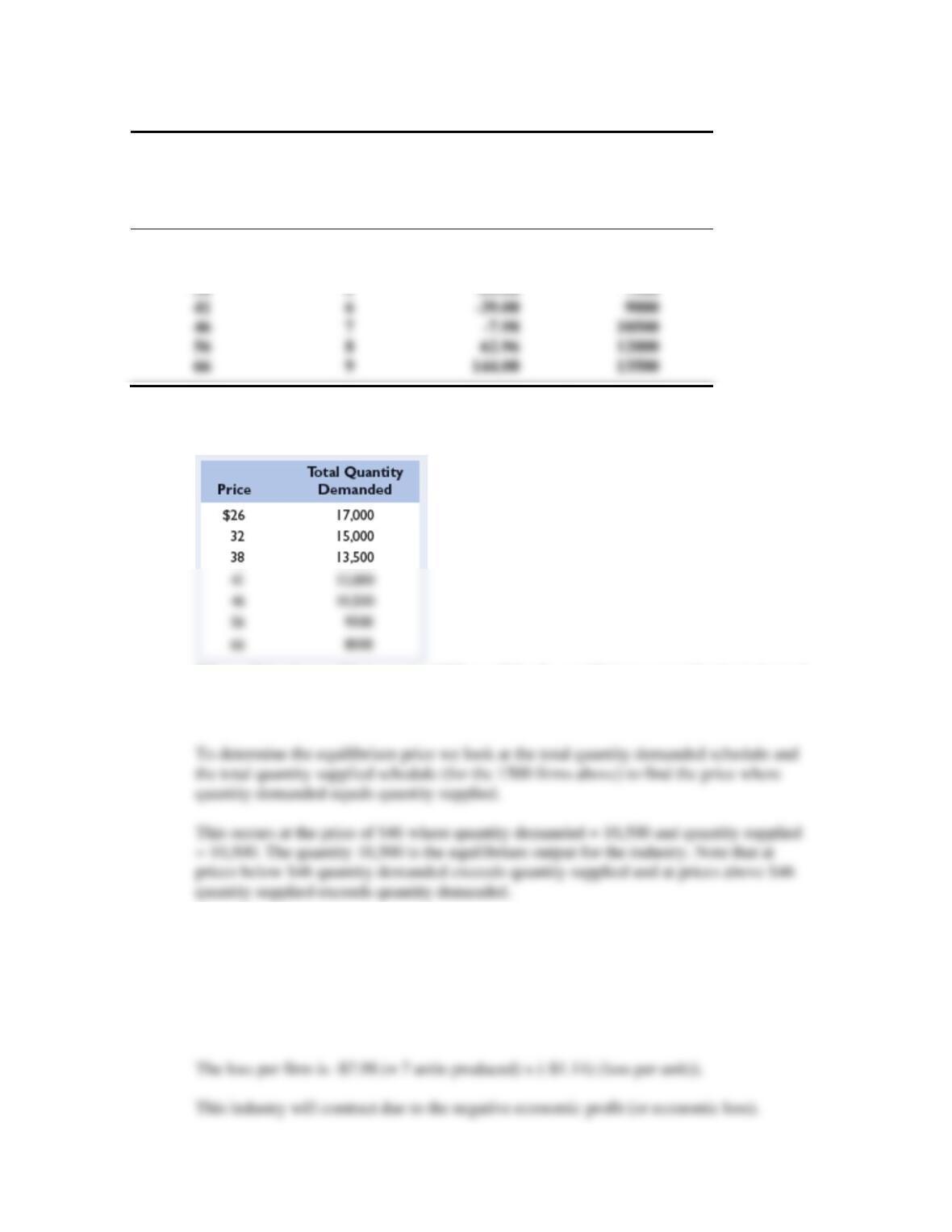
Part d and e: Using the table below, complete the short-run supply schedule for the firm
(columns 1 and 2) and indicate the profit or loss incurred at each output (column 3). Now
assume that there are 1500 identical firms in this competitive industry; that is, there are
Chapter 08 – Pure Competition in the Short Run
8-12
(1)
Price
(2)
Quantity
supplied,
single firm
(3)
Profit (+)
or loss (-)
(4)
Quantity
supplied,
1500 firms
$26
32
0
0
$-60
-60
0
0
Part f:
Suppose the market demand data for the product are as follows:
What will be the equilibrium price? What will be the equilibrium output for the industry?
For each firm? What will profit or loss be per unit? Per firm? Will this industry expand or
contract in the long run?
The equilibrium output for each firm is 7 units (= 10500 (industry output)/ 1500 (number
of firms)).
Since the equilibrium price of $46 is below the average total cost for 7 units of output at
the firm level there will be a loss. The per-unit loss for the firm is -$1.14 (= $46 (price) –
$47.14 (average total cost for 7 units)).
41