CHAPTER 7
(MACRO CHAPTER 7)
Unemployment and Inflation
FUNDAMENTAL QUESTIONS
1. What is a business cycle?
2. How is the unemployment rate defined and measured?
OVERVIEW AND OBJECTIVES
The primary purpose of this chapter is to present the three major problems of macroeconomics: the
business cycle, unemployment, and inflation. The unique features of this chapter include the discussion
of the GDP gap and an introduction to the basic justification for macroeconomic policy. The chapter
also discusses the major problems of a capitalist macroeconomy: inflation and unemployment.
After reading and reviewing this chapter, the student should be able to:
1. Describe the business cycle.
4. Define and calculate the unemployment rate.
5. Explain limitations of the unemployment rate calculation.
KEY TERM REVIEW
business cycle
recession
depression
nominal interest rate
real interest rate
hyperinflation
LECTURE OUTLINE AND TEACHING STRATEGIES
I. Business Cycles
A. Definitions: A business cycle is the recurrent pattern of rising real GDP followed by falling
real GDP.
B. Historical record: There have been fourteen recessions since 1929.
economy.
II. Unemployment
A. Definition and measurement: The unemployment rate is the percentage of the labor force
that is not working.
Teaching Strategy: Place special emphasis on who is not counted in the labor force.
B. Interpreting the unemployment rate: The existence of underemployment and discouraged
III. Inflation
Inflation is a sustained rise in the average level of prices.
Teaching Strategy: Note that for price increases to be inflationary, they must persist over time.
44 Chapter 7: Unemployment and Inflation
A. Absolute versus relative price changes
Teaching Strategy: Pay special attention to the material on relative versus absolute price
OPPORTUNITIES FOR DISCUSSION
1. Why does it take time for the NBER to determine business cycle peaks and troughs?
2. Why and how do economists and policymakers use cyclical indicators?
ANSWERS TO EXERCISES
1. The labor force is the sum of all adults (persons older than 16 years of age) who are employed and
who are unemployed but are currently seeking work except those who are in institutions.
The second part of this question can be answered in two mutually exclusive ways. First, the
2. Because of discouraged workers and the underemployed, the official unemployment rate
understates the social burden of unemployment. Nevertheless, because many people who are
3.
4.
a. The government may try to reduce frictional and structural unemployment by helping
workers obtain information about available jobs and wages and by providing training to
5. No. The personal and social costs of unemployment are not measured by the GDP gap.
6. Teenagers have the highest unemployment rate because they typically have the fewest marketable
skills.
7. You would expect to earn $11 after the raise. If you always receive the cost-of-living raise a year
8. The real interest rate is the nominal interest rate (the rate that is quoted by the bank) less the rate
of inflation that is expected over the term of the loan. When the inflation rate is unexpectedly
9. The standard fixed-interest-rate mortgage commits a mortgage company to a fixed interest rate for
30 years. If the inflation rate turns out to be unexpectedly high, the mortgage company will end up
10. Although the actual pattern of the business cycle is not as regular as is shown in Figure 2, the
economy is subject to recurrent periods of expansion and contraction.
11. Changes in the average workweek are made in response to changes in economic conditions. It is
easier for a firm to adapt to new economic conditions by adjusting the length of the workweek
than it is to increase employment. When unemployment claims change, this indicates changes in
46 Chapter 7: Unemployment and Inflation
When it takes longer for firms to deliver goods, this means that in many cases they are receiving
12.
a. 460
13.
14.
a.
b.
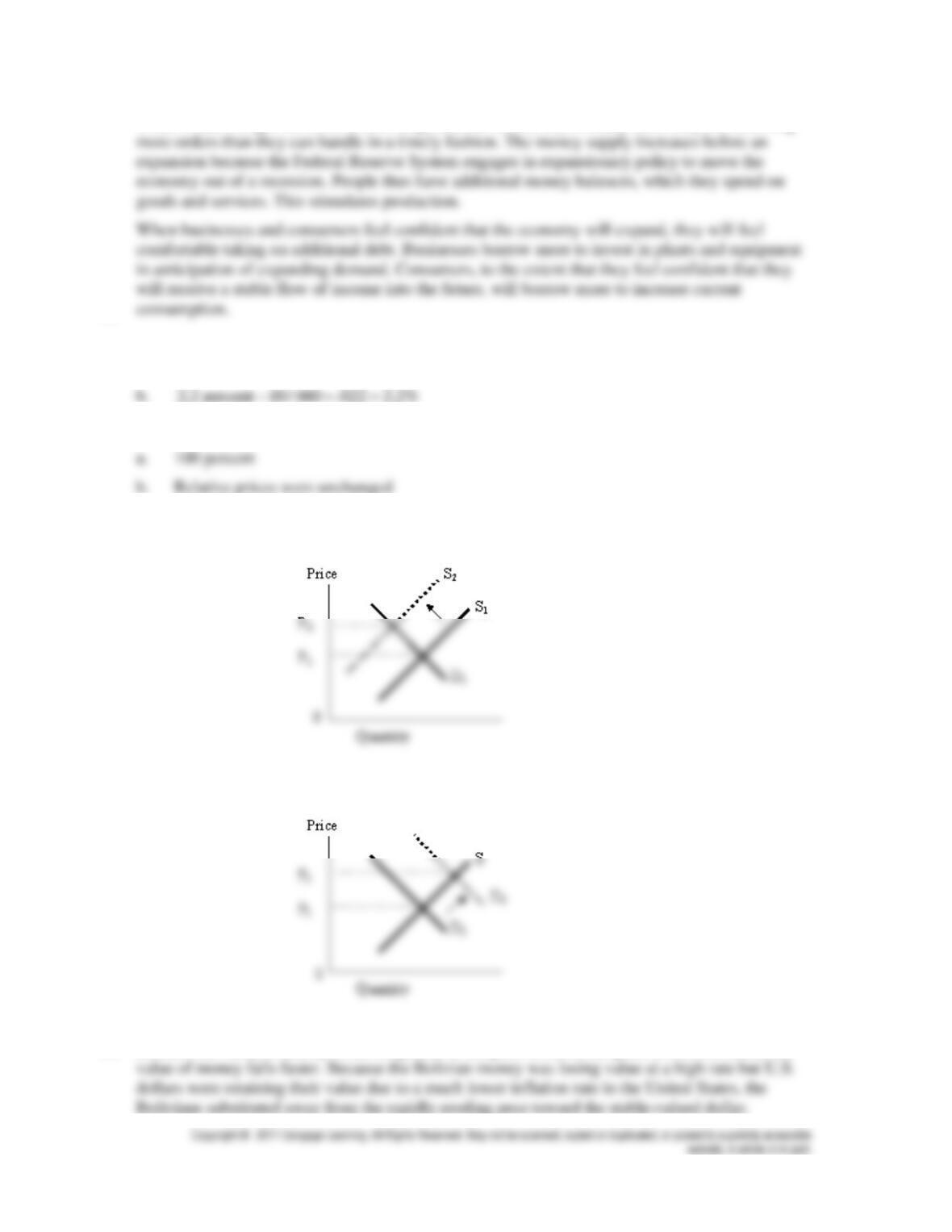
15. Because the value of money is the reciprocal of the price level, as the price level rises faster, the
Chapter 78: Unemployment and Inflation 47
16. Government policies aimed at protecting workers from unemployment may create a bigger
ANSWERS TO STUDY GUIDE HOMEWORK
1. U.S. residents over 16 years old, not institutionalized, and either working or actively looking for
work.
2. Frictional: workers changing jobs or newly entering the labor force.
4.
a. You would vote for Candidate B. You would gain from inflation; you would have to pay
back your mortgage in dollars that were worth less.
ACTIVE LEARNING EXERCISE
This exercise will explore the definition and measurement of the unemployment rate through the use of
role-playing. Beyond testing the actual calculation of the unemployment rate, students will explore the
composition of the labor force and define those persons who are statistically unemployed. Be sure to
Divide the class into groups of four. Each group is a separate economy. In each group, students count
off from 1 to 4 and play roles in the following scenarios:
1. 1: full-time worker; 2: full-time student; 3: laid-off worker searching for a new job; 4: full-time
worker whose job picking fruit will end in one month.
2. 1: housewife or househusband; 2: recent graduate looking for a job; 3: someone neither working
nor looking for work (stays home and watches TV); 4: full-time worker.
48 Chapter 7: Unemployment and Inflation
3. 1: retired worker; 2: full-time worker; 3: prisoner; 4: full-time worker.