CHAPTER 7: THE ASSET MARKET, MONEY, AND PRICES
LEARNING OBJECTIVES
I. Goals of Chapter 7
A. What money is and why people hold it
B. The decision about money demand is part of a broader portfolio decision
II. Notes to Sixth Edition Users
A. All Figures and Tables have been updated to reflect the newly available data
TEACHING NOTES
I. What is Money? (Sec. 7.1)
A. The functions of money
1. Medium of exchange
a. Barter is inefficient—it requires a double coincidence of wants
b. Money allows people to trade their labour for money, then use
2. Unit of account
a. Money is the basic unit for measuring economic value b. This
simplifies comparisons of prices, wages, and incomes
Theoretical Application
There have been a number of attempts to supply detailed microfoundations for money.
Recently, an explicit theory that shows the superiority of money to barter has been
developed by Nobuhiro Kiyotaki and Randall Wright (“On Money as a Medium of
Exchange” Journal of Political Economy, August 1989, pp. 927-954). They show how
introducing fiat money unambiguously improves society’s welfare.
3. Store of value
a. Money can be used to hold wealth
b. Most people use money only as a store of value for a short
114 Chapter 7
Theoretical Application
Money’s usefulness as a store of value declines the higher the inflation rate. In
4. A Closer Look 7.1: Money in a prisoner-of-war camp
a. Radford article on the use of cigarettes as money
smoke them and use them as money at the same time
B. Measuring money—the monetary aggregates
1. Distinguishing what is money from what isn’t money is sometimes
difficult
a. For example, MMMFs allow cheque-writing, but give a higher
return than bank chequing accounts: Are they money?
Data Application
One concern about measuring money is that the amount of money that is issued may
be significantly higher than that available for use within the country, because of foreign
demand. The United States, in particular, has the problem that citizens in other
3. The M2 and M3 monetary aggregates
a. M2 = M1+ + less moneylike assets
b. Additional assets in M2 include personal and non-personal non-
The Asset Market, Money, and Prices 115
Analytical Problem 1 looks at portfolio changes and how they affect M1 and M2.
5. Weighted monetary aggregates
a. It is constructed by adding the outstanding amounts of various
type of assets.
Data Application
Research and empirical work on weighted monetary aggregates was begun by a group
of economists at the Federal Reserve Board in the late 1970s. William Barnett, now at
Washington University of St. Louis, was part of that group and is now the main
proponent of the use of Divisia indexes as a weighted monetary aggregate. The leading
Canadian expert on Divisia indexes is Paul Serletis of the University of Calgary. See
William Barnett, Douglas Fisher, and Apostolos Serletis, “Consumer Theory and the
Demand for Money,” Journal of Economic Literature, December 1992, pp. 2086–2119.
C. The money supply
1. Money supply = money stock = amount of money available in the
economy
2. How does the central bank of a country increase the money supply?
a. Use newly printed money to buy financial assets from the
public—an open-market purchase
II. Portfolio Allocation and the Demand for Assets (Sec. 7.2)
How do people allocate their wealth among various assets? The portfolio allocation
decision
A. Expected return
1. Rate of return = an asset’s increase in value per unit of time
a. Bank account: Rate of return = interest rate
116 Chapter 7
3. Returns aren’t always known in advance (for example, stock prices
fluctuate unexpectedly), so people must estimate their expected return
B. Risk
1. Risk is the degree of uncertainty in an asset’s return
2. People don’t like risk, so prefer assets with low risk (other things equal)
Theoretical Application
Their separate work in developing financial theory brought the 1990 Nobel Prize in
C. Liquidity
1. Liquidity is the ease and quickness with which an asset can be traded
D. Time to Maturity
1. The amount of time until a financial security matures and the security’s
owner is repaid his or her principal.
2. Term premium: an interest rate on long-term bonds that is somewhat
higher than the expectations theory would suggest.
E. Types of assets and their characteristics
1. Households hold many different assets: money, bonds, stocks,
G. Application: The US housing crisis and its aftermath
1. Housing prices in the US and Canada increased quickly and for a
prolonged period during the late 1990s and most of the 2000s.
III. The Demand for Money (Sec. 7.3)
A. The demand for money is the quantity of monetary assets people want to hold
in their portfolios
1. Money demand depends on expected return, risk, and liquidity
The Asset Market, Money, and Prices 117
B. Key macroeconomic variables that affect money demand
1. Price level
a. The higher the price level, the more money you need for
2. Real income
a. The more transactions you conduct, the more money you need
b. Real income is a prime determinant of the number of
3. Interest rates
a. An increase in the interest rate or return on nonmonetary assets
decreases the demand for money
b. An increase in the interest rate on money increases money
C. The money demand function
1. Md = PL( Y, i) (7.1)
a. Md is nominal money demand (aggregate)
b. P is the price level
c. L is the real money demand function
118 Chapter 7
D. Other factors affecting money demand
1. Wealth: A rise in wealth may increase money demand, but not by
much
2. Risk
a. Increased riskiness in the economy may increase money
E. Elasticities of money demand
1. How strong are the various effects on money demand?
2. Statistical studies on the money demand function show results in
elasticities
3. Elasticity: The percent change in money demand caused by a one
F. Velocity and the quantity theory of money
1. Velocity (V) measures how much money “turns over” each period
2. V = nominal GDP / nominal money stock = PY / M (7.4)
Numerical Problem 1 is an empirical exercise calculating velocity from a money-demand
equation.
3. Plot of velocities for M1+ and M2 from 1975–2009 (text Fig. 7.2) shows
Analytical Problem 2 asks for explanations for the upward trend in M1 velocity before
the 1990s.
4. Quantity theory of money: Real money demand is proportional to real
income
The Asset Market, Money, and Prices 119
c. But velocity of M1+ is not constant; it rose steadily during the
d. M2 velocity is more stable.
Data Application
For a good source of information about the recent behaviour of monetary aggregates in
Canada, including trends and velocities, see www. bank–banque-canada.ca. Click on
Publications and Research, then click on Topic Index and search under Monetary
Aggregates.
(1) But even M2 velocity isn’t constant over short periods
(2) M2 velocity rose sharply during the late 1990s
IV. Asset Market Equilibrium (Sec. 7.4)
A. Asset market equilibrium—an aggregation assumption
1. Assume that all assets can be grouped into two categories, money and
nonmonetary assets
a. Money includes currency and chequing accounts
(1) Pays interest rate im
2. Asset market equilibrium occurs when quantity of money supplied
equals quantity of money demanded
a. md = nmd = total nominal wealth of an individual
B. The asset market equilibrium condition
1. M / P = L(Y, r +
π
e) (7.9) real money supply = real money demand
a. M is determined by the central bank
120 Chapter 7
Numerical Problem 2 is an exercise in calculating the equilibrium real interest rate.
2. With all other variables in Eq. (7.9) determined, the asset market
For exercises dealing with price level determination, see Numerical Problems 3 and 5
and Analytical Problem 4.
V. Money Growth and Inflation (Sec. 7.5)
A. The inflation rate is closely related to the growth rate of the money supply
1. Rewrite Eq. (7.10) in growth-rate terms:
ΔP/P = ΔM/M − ΔL(Y, r +
π
e)/L(Y, r + π e) (7.11)
2. If the asset market is in equilibrium, the inflation rate equals the growth
Numerical Problem 4 gives practice in using elasticities to predict inflation.
B. Application: Money growth and inflation in European countries in transition
1. Though the countries of Eastern Europe are becoming more market-
money growth
2. Both the growth rates of money demand and money supply affect
inflation, but (in cases of high inflation) usually growth of nominal
money supply is the most important factor
a. For example, if the income elasticity of money demand were 2/3
The Asset Market, Money, and Prices 121
3. Text Figure 7.3 shows the line between money growth and inflation in
these countries; inflation in clearly positively associated with money
Data Application
For a review of the causes of inflation in the short run and long run in countries
throughout the world, see Larry Bali’s article, “What Causes Inflation?” Federal Reserve
Bank of Philadelphia Business Review, March / April 1993, pp. 3–12.
C. The expected inflation rate and the nominal interest rate
1. For a given r, expected inflation determines the nominal interest rate
2. What factors determine expected inflation?
a. People could use Eq. (7.12), relating inflation to the growth rates
Analytical Problem 3 shows how expected inflation depends on the money supply.
b. Expectations can’t be observed directly
3. Text Fig. 7.4 plots Canadian inflation and nominal interest rates from
1960 to 2010
a. Inflation and nominal interest rates have tended to move
Data Application
A careful attempt to measure the world real interest rate was undertaken by Robert J.
Barro and Xavier Sala-i-Martin, “World Real Interest Rates,” in O. Blanchard and S.
Fischer, eds., NBER Macroeconomics Annual, Cambridge, Mass.: MIT Press, 1990, pp.
15–61.
D. A Closer Look 7.3: Measuring Inflation Expectations
1. Expected inflation is not measured with any great deal of accuracy
2. Economists at the Bank of Canada have developed a number of
methods to gain insights into both inflationary expectations and the
expected real interest rate
a. Survey from private firms
ADDITIONAL ISSUES FOR CLASSROOM DISCUSSION
1. Understanding the Demand for Money
In understanding the economy’s transactions demand for money, it might help students
to think of their own demand for money. Most of us carry money. How do you determine
how much to carry with you and how much to invest or save?
The amount of money an individual carries depends on daily expenses, income, the
probability of extra expenses, and the difficulty of obtaining extra money when needed.
2. Credit Cards: How Do They Change Our Use of Money?
How does the demand for money change over time as the ways we pay for goods
change? One major change in the past thirty years is the increasing use of credit cards.
How does this affect payment patterns and the velocity of money?
Credit cards tend to reduce the quantity of money we must hold and increase the
velocity of money. Today, credit cards are used to make both large and small
The Asset Market, Money, and Prices 123
3. What Does Rapid Inflation Do to the Demand for Money and to Velocity?
While not constant, M2 velocity tends to vary only a little over time in Canada, with its
moderate inflation. The demand for money also tends to grow at a roughly predictable
rate. How would this change if inflation were very high?
In 1995–2001 inflation averaged 148% in Belarus. (See text Figure 7.2). How do such
enormous changes in prices affect velocity and the demand for money?
When a nation undergoes rapid inflation, people must adapt to survive. Money, which
under normal conditions serves as a store of value and a unit of account, no longer can
ANSWERS TO TEXTBOOK PROBLEMS
Review Questions
1. Money is the economist’s term for assets that can be used in making payments,
2. The three functions of money are (1) the medium of exchange function, which
contributes to a better-functioning economy by allowing people to make trades at a
3. The size of the nation’s money supply is determined by its central bank; in Canada,
the central bank is the Bank of Canada. If all money is in the form of currency, the
4. The three characteristics of assets that are most important to wealth holders are
(1) expected return, (2) risk, and (3) liquidity. Money has a low expected return
124 Chapter 7
6. Velocity is a measure of how often money “turns over” in a period. It is equal to
7. Equilibrium in the asset market is described by the condition that real money
supply equals real money demand because when supply equals demand for
8. In equilibrium the price level is proportional to the nominal money supply; in
9. Factors that could increase the public’s expected rate of inflation include a rise in
money growth or a decline in income growth. With no effect on the real interest
rate, the increase in expected inflation would increase the nominal interest rate.
Numerical Problems
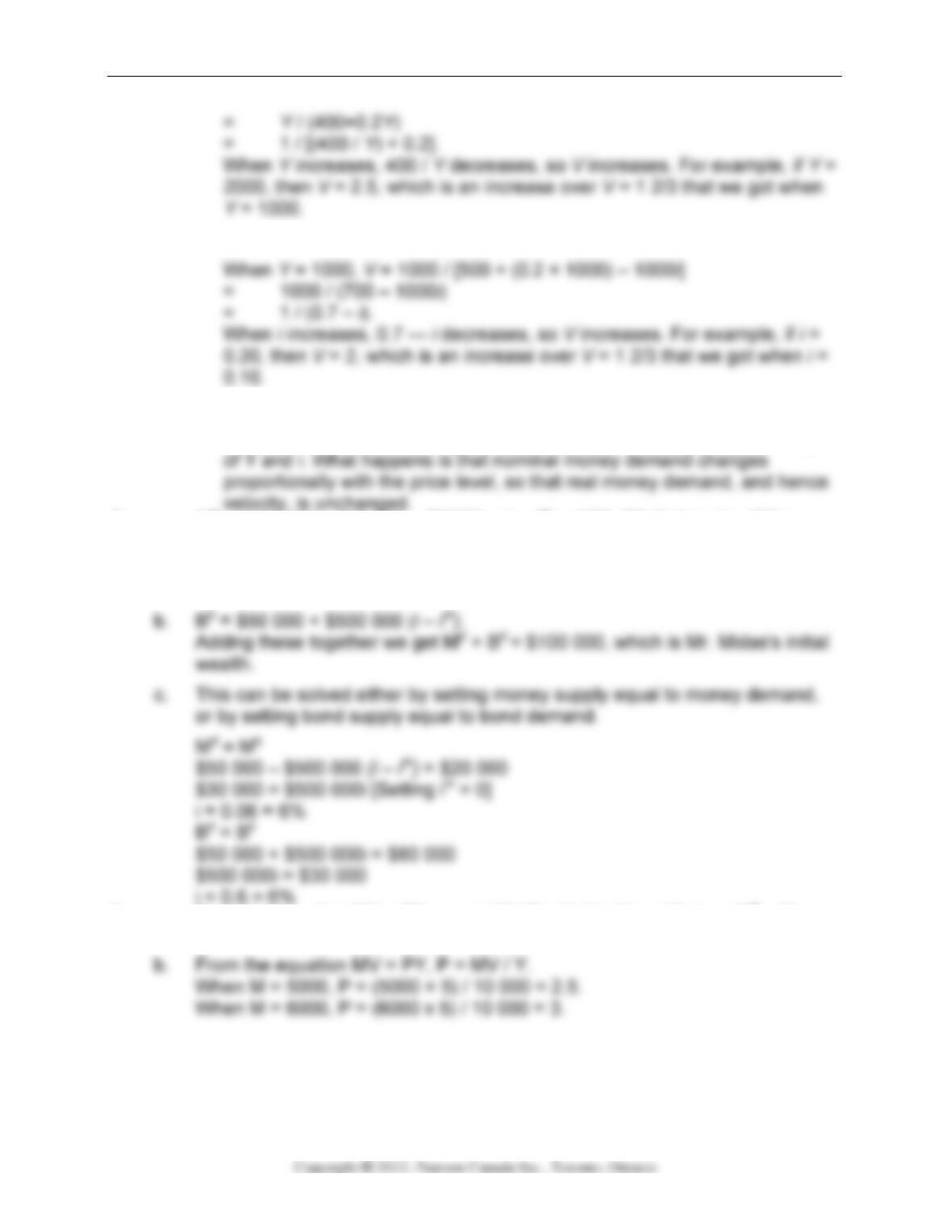
1. a. Real money demand is
Md / P = 500+0.2Y – 1000i
= 500 + (0.2 x 1000) – (1000 x 0.10)
= 600.
d.
(1) Effect of increase in real income:
When i = 0.10, V = Y / [500 + 0.2Y – (1000 x 0.10)]
The Asset Market, Money, and Prices 125
(2) Effect of increase in the nominal interest rate:
(3) Effect of increase in the price level:
There is no effect on velocity, since we can write velocity as a function just
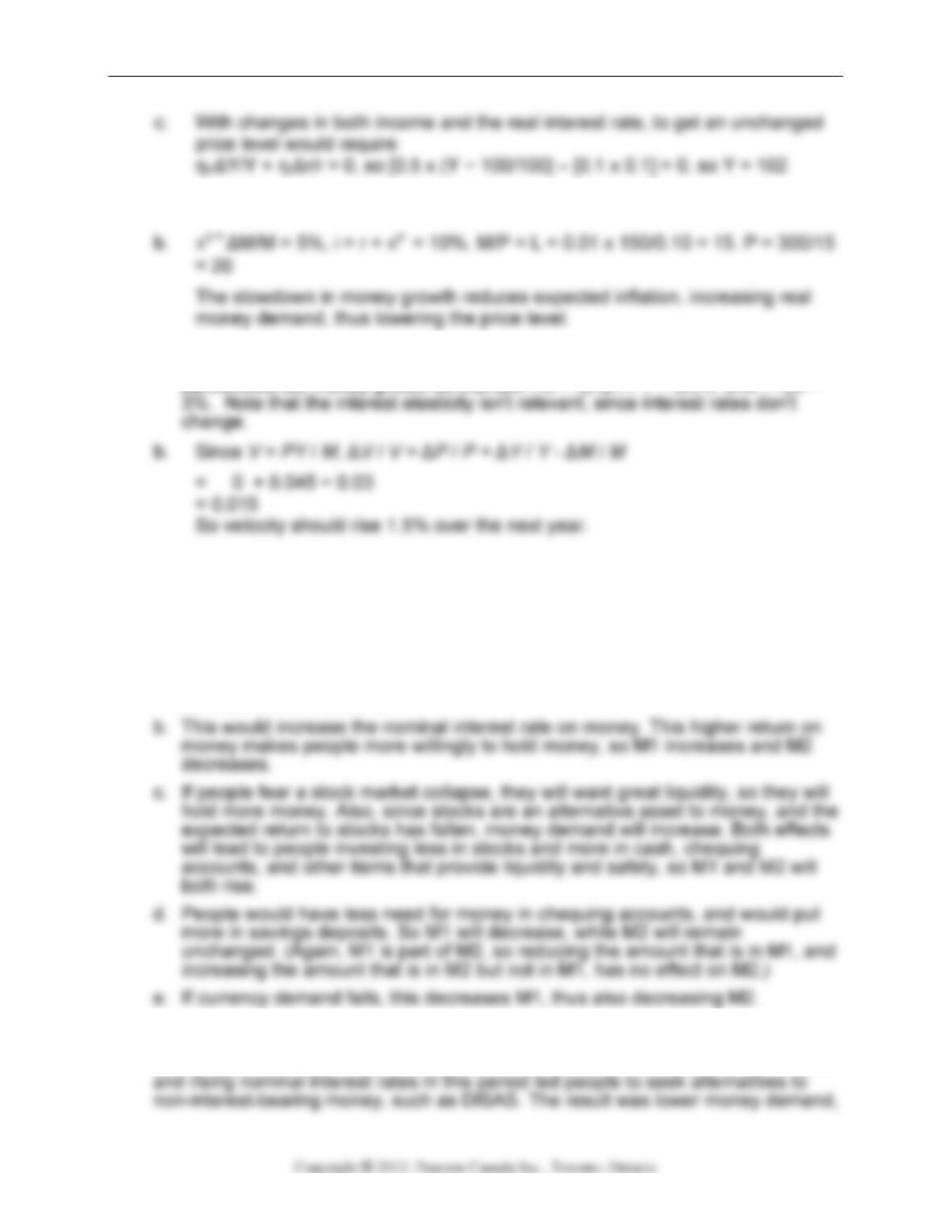
2. a. Md = $100 000 – $50 000 – [$5000 x (i – im) x 100]. (Multiplying by 100 is
necessary since i and im are in decimals, not percent.) Simplifying this
expression, we get
Md = $50 000 – $500 000 (i – im).
3. a. From the equation MV = PY, we get M / P = Y / V. At equilibrium, Md = M. so
Md / P = Y, V = 10 000 / 5 = 2000. Md = P × (Md / P) = 2 × 2000 = 4000.
4. a. π = ηYΔY/Y = –0.5 x: 6% = –3%. The price level will be 3% lower.
b. π = ηrΔr/r = – (–0.1) × 0.1 = 1%. The price level will be 1% higher.
126 Chapter 7
5. a. πe = ΔM/M = 10%, i = r + πe = 15%. M/P = L = 0.01 x 150/0.15 = 10. P =
300/10 = 30
6. a. With a constant real interest rate and zero expected inflation, inflation is given
by the equation
π
= ΔM / M – ηYΔY / Y. To get inflation equal to zero, the central
Analytical Problems
1. a. People would probably take money out of chequing accounts and put it into
money market mutual funds and money market deposit accounts. Money
market mutual funds and money market deposit accounts are included in M2
but are not part of M1. The result is a decrease in M1, but no change in M2. M2
does not increase because M1 is part of M2, so the decrease in M1 offsets the
increase in the rest of M2.
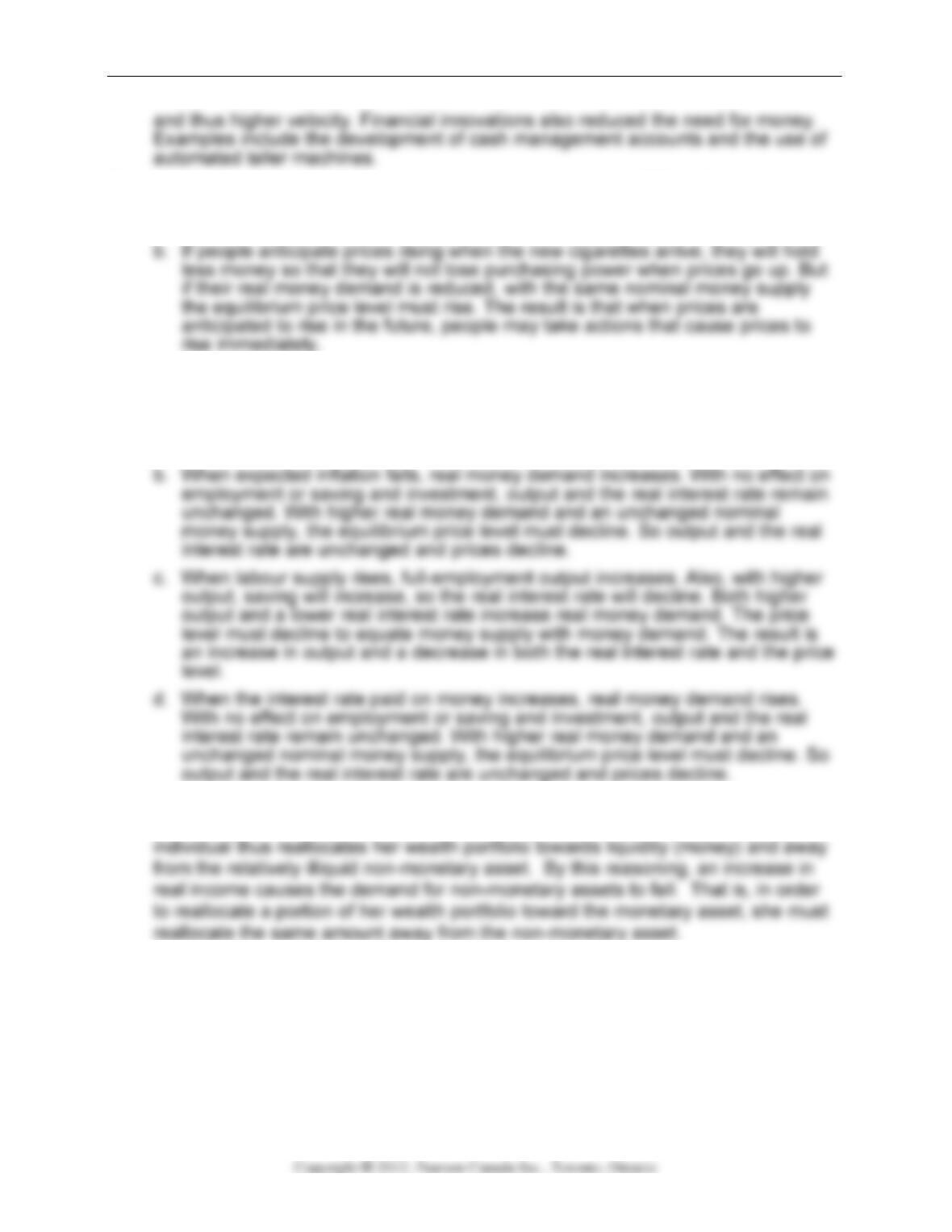
2. The general rise in velocity before the 1990s is most likely due to changes in
income, in interest rates, and in financial institutions. Higher income led to a less
than proportional rise in real money demand, so velocity increased. Rising inflation
The Asset Market, Money, and Prices 127
3. a. New cigarettes mean an increase in the money supply. With higher nominal
money supply and no change in real money demand, the equilibrium price level
must rise.
4. a. An increase in government purchases reduces national saving, causing the
reap interest rate to rise for a fixed level of income. If the real interest rate is
higher, then real money demand will be lower. So prices must rise to make
money supply equal money demand. The result is that output is unchanged, the
real interest rate increases, and the price level increases.
5. The demand for money depends positively on real income because higher real
income implies more transactions and thus a greater demand for liquidity. An