162 CHAPTER 7 | Comparative Advantage and the Gains from International Trade
Extra Making
the
Connection
The Unintended Consequences of Banning Goods Made with
Child Labor
In many developing countries, such as Indonesia, Thailand, and Peru, children as young as seven or eight
years old work ten or more hours a day. Reports of very young workers laboring long hours to produce
goods for export have upset many people in high-income countries. In the United States, boycotts have
been organized against stores that stock goods made in developing countries with child labor. Many
people assume that if child workers in developing countries weren’t working in factories making clothing,
toys, and other products, they would be in school, as are children in high-income countries.
As preparations began in France for the 1998 World Cup, there were protests that Baden Sports—the
main supplier of soccer balls—was purchasing the balls from suppliers in Pakistan that used child
workers. France decided to ban all use of soccer balls made by child workers. Bowing to this pressure,
Baden Sports moved production from Pakistan, where the balls were hand-stitched by child workers, to
China, where the balls were machine-stitched by adult workers in factories. There was some criticism of
the boycott of hand-stitched soccer balls at the time. In a broad study of child labor, three economists
argued:
Of the array of possible employment in which impoverished children might engage, soccer ball
stitching is probably one of the most benign…. [In Pakistan] children generally work alongside
CHAPTER 7 | Comparative Advantage and the Gains from International Trade 163
Question
The following excerpt is from a newspaper story on former President Bill Clinton’s proposal to create a
group within the World Trade Organization (WTO) responsible for developing labor standards. The story
was published just before a 1999 WTO meeting in Seattle that ended in rioting:
not interested in adopting tougher U.S. labor standards.
What did Clinton mean by “core labor standards”? Why would developing countries resist adopting these
standards?
Source: Terence Hunt, “Salute to Trade’s Benefits Turns into ‘Kind of Circus,’” Associated Press, December 2, 1999.
Answer
Clinton was probably referring to child labor laws, minimum-wage laws, the rights to form unions, and
Extra Economics in Your Life:
Baseball—The (Inter)national Pastime
Question: Why aren’t fans concerned about outsourcing in Major League Baseball? The controversy
over the outsourcing of jobs from the United States to India, China, and other countries has hardly
touched professional baseball. Although baseball has long been known as the National Pastime, Major
League Baseball (MLB) has taken on an increasingly international look. On Opening Day of the 2015
season, 230 of the 868 players—including those on teams’ 25 man active rosters and disabled and
restricted player lists—on rosters of Major League Baseball teams were born outside of the United States.
The number of foreign-born players equaled 26.8 percent of the total. The Texas Rangers had the most
foreign-born players (15) followed by the Toronto Blue Jays (12) and the Boston Red Sox (11). The
Dominican Republic, with a total population of just over 8 million people, accounted for 83 Major
Leaguers, the most of any foreign country. Venezuela had the next highest total (65) followed by Cuba
(18), Puerto Rico (13), and Japan, Mexico and Canada (9 each).
Answer: Apparently, baseball fans accept the proposition that the best qualified players deserve roster
164 CHAPTER 7 | Comparative Advantage and the Gains from International Trade
Solutions to End-of-Chapter Exercises
7.1
The United States in the International Economy
Learning Objective: Discuss the role of international trade in the U.S. economy.
Review Questions
1.1 Since the early 1980s, the value of U.S. exports has been smaller than the value of U.S.
imports. In 2014, U.S. exports were about 13 percent of GDP, and U.S. imports were about 17
percent of GDP.
Problems and Applications
1.4 Agriculture would see a large decline, as would many manufacturing industries. Many service
industries, such as haircuts and medical services, would not be affected much because the United
States does not export these types of services.
1.5 You should disagree. As Figure 7.3 shows, Japan is less dependent on international trade than
countries such as Great Britain and Germany and as shares of its GDP, Japan’s exports and
imports are similar to the exports and imports of the United States as shares of its GDP.
CHAPTER 7 | Comparative Advantage and the Gains from International Trade 165
7.2
Comparative Advantage in International Trade
Learning Objective: Explain the difference between comparative advantage and
absolute advantage in international trade.
Review Questions
2.1 Absolute advantage is the ability to produce more of a good or service than competitors using the
same amount of resources. Comparative advantage is the ability to produce a good or service at a
2.2 Comparative advantage is the ability of an individual, a firm, or a country to produce a good or
service at the lowest opportunity cost. This insight is powerful because it runs counter to most
Problems and Applications
2.3 a. Usain Bolt’s performance is better explained by comparative advantage. He specialized in
competing in an event for which he had a comparative advantage. The opportunity cost of
competing in a different event, for example, the marathon or the 3,000 meter race, would
2.4 For Germany to have a comparative advantage in the production of cars and machine tools
2.5 The argument is probably unsound because Bolivia most likely has a comparative advantage in
producing at least one good. (The value of U.S. trade with Bolivia is not zero.) Remember that
166 CHAPTER 7 | Comparative Advantage and the Gains from International Trade
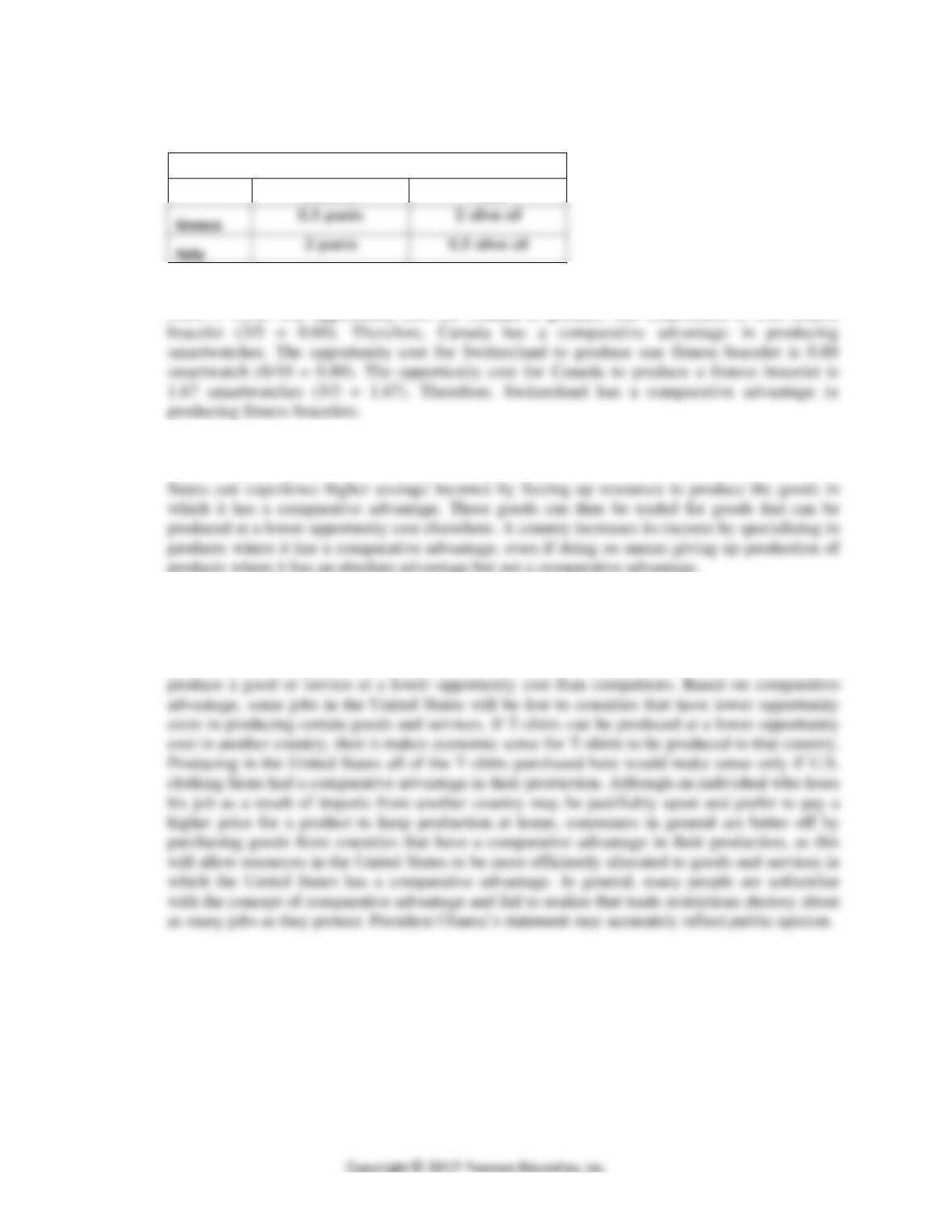
2.6
Opportunity Costs
Olive Oil
Pasta
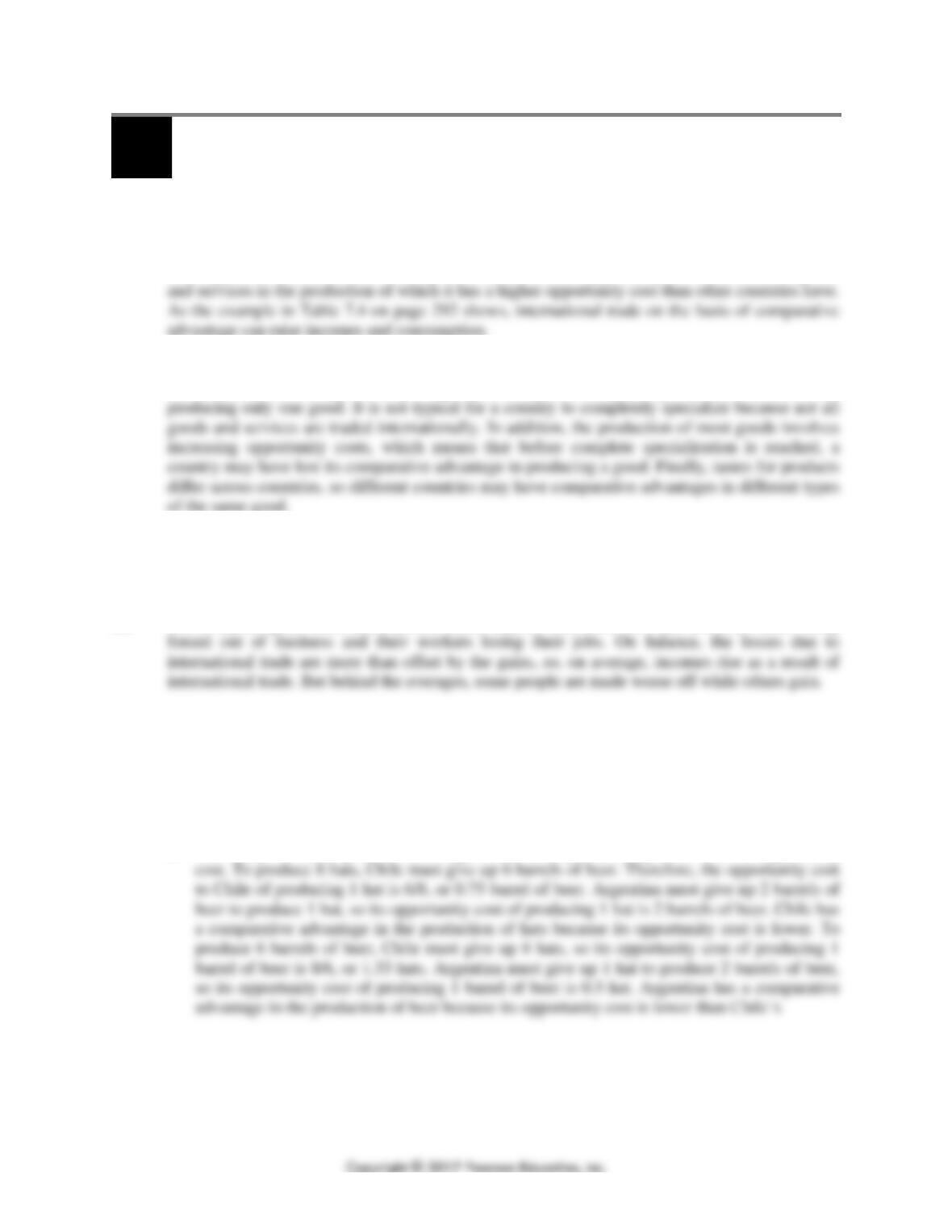
2.7 The opportunity cost for Switzerland to produce one smartwatch is 1.25 fitness bracelets
(10/8 = 1.25). The opportunity cost for Canada to produce one smartwatch is 0.60 fitness
2.8 You should disagree. U.S. textile firms produce their goods at a higher opportunity cost than do
the corresponding firms in China. By moving resources out of the textile industry, the United
2.9 President Obama meant that some U.S. clothing manufactures have been driven out of business
by competition from imports from countries that can produce T-shirts and other clothing at a
lower cost than can the U.S. firms. As those U.S. firms closed, the people who worked in them
lost their jobs. Comparative advantage refers to the ability of an individual, a firm, or a country to
CHAPTER 7 | Comparative Advantage and the Gains from International Trade 167
7.3
How Countries Gain from International Trade
Learning Objective: Explain how countries gain from international trade.
Review Questions
3.1 International trade increases a country’s consumption because it allows the country to specialize
in the goods and services that it can produce at the lowest opportunity cost and trade for goods
3.2 A country specializes in the production of a good when it produces all of the good that is
consumed in the country, not importing any of the good. Complete specialization would mean
3.3 The main sources of comparative advantage are climate and natural resources, the relative
abundance of various types of labor and capital, technology and know-how, and external
economies.
3.4 Not everyone gains from international trade. Imports can result in some domestic firms being
Problems and Applications
3.5 a. A country has an absolute advantage over another country when it can produce more of a
good using the same resources. Chile has an absolute advantage in the production of both hats
and beer because it can produce more of both goods (8 hats; 6 barrels of beer) than can
Argentina (1 hat; 2 barrels of beer) with the same amount of labor input.
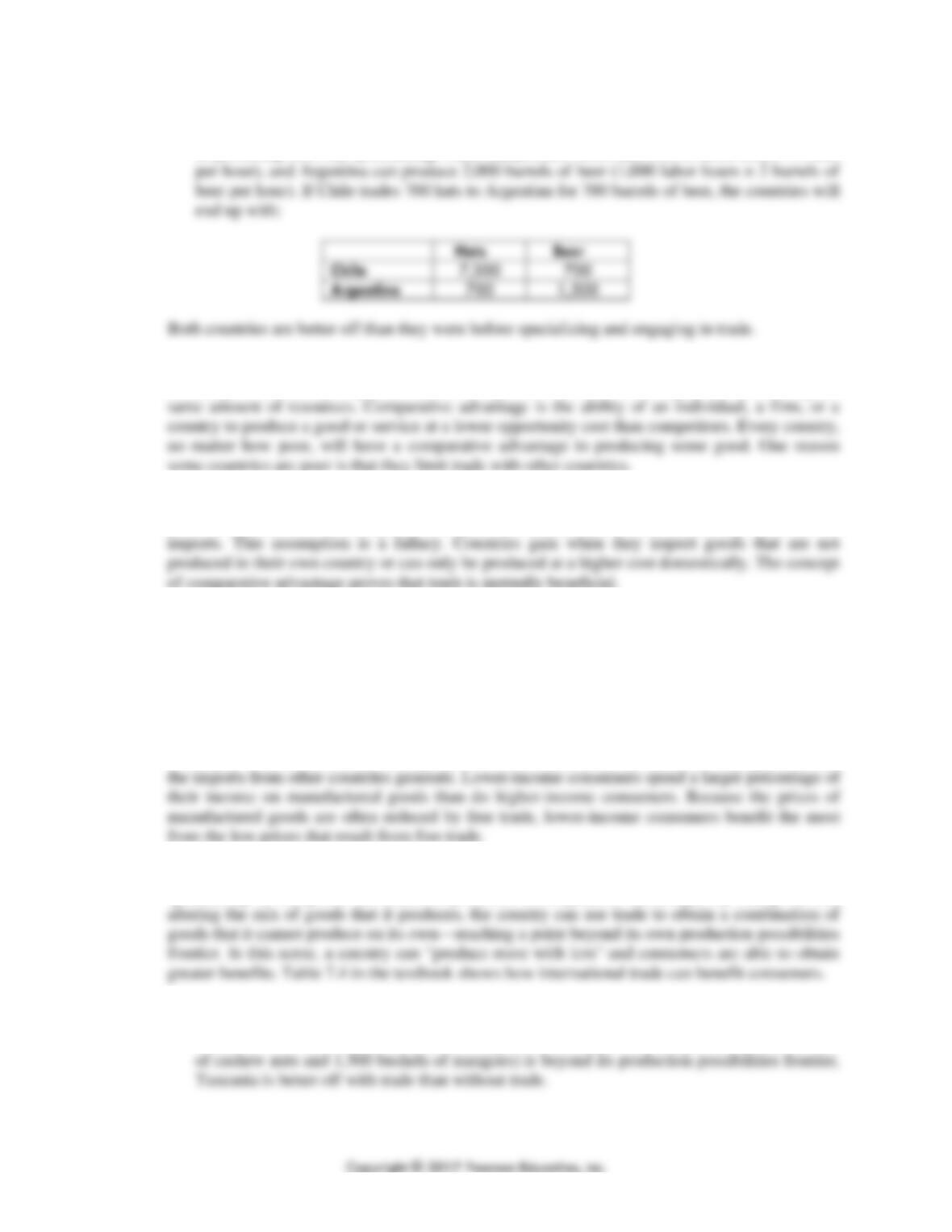
b. A country has a comparative advantage when it can produce a good at a lower opportunity
168 CHAPTER 7 | Comparative Advantage and the Gains from International Trade
c. As part (b) shows, Chile should specialize in producing hats, and Argentina should specialize
in producing beer. By specializing, Chile can produce 8,000 hats (1,000 labor hours × 8 hats
3.6 The commentator is confusing absolute advantage and comparative advantage. Absolute
advantage is the ability to produce more of a good or service than competitors when using the
3.7 Both countries benefited from their bilateral trade. It is not possible to determine which country
benefited more; however, the question asked assumes that exports benefit a country more than its
3.8 Free trade often benefits smaller countries more because without specialization and trade it would
be difficult for producers in these countries to benefit from low cost production of many goods.
Also, larger, more populous countries are likely to have a wider range of both natural resources
and people with particular skills, so these countries gain from internal trade to a greater extent
than is possible in many small countries.
3.9 Although middle- and lower-income Americans may be losing jobs or receiving lower wages due
to cheaper overseas labor, this same group benefits the most from the increased buying power that
3.10 You should agree with Hal Varian. Opening up markets to trade allows a country to benefit by
specializing in the goods for which it possesses a comparative advantage. By doing so, and
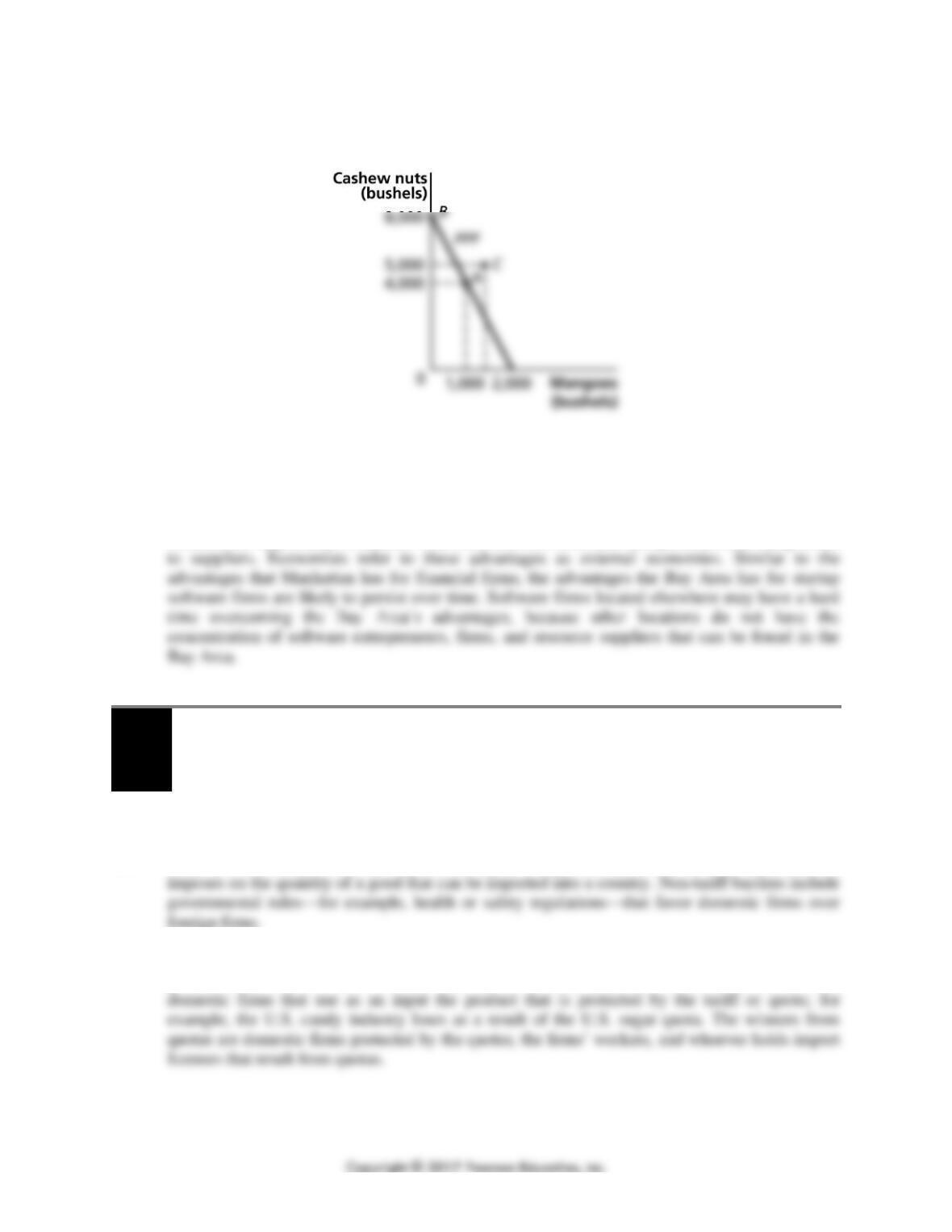
3.11 a. Tanzania produces 8,000 bushels of cashew nuts.
b. Tanzania will receive 1,500 bushels of mangoes in exchange. Because point C (5,000 bushels
CHAPTER 7 | Comparative Advantage and the Gains from International Trade 169
c. With trade, Tanzania is producing on its production possibilities frontier but consuming
beyond its production possibilities frontier.
3.12 Although both countries will gain from the trade agreement, not every citizen or company in the
United States and Colombia will “win.” Some domestic suppliers and their workers lose if they
are driven out of existing markets (and into new markets) by lower-priced imports.
3.13 Startup software firms located in the Bay Area can take advantage of the availability of skilled
workers, the opportunity to interact with other software firms and entrepreneurs, and being closer
7.4
Government Policies That Restrict International Trade
Learning Objective: Analyze the economic effects of government policies that restrict
international trade.
Review Questions
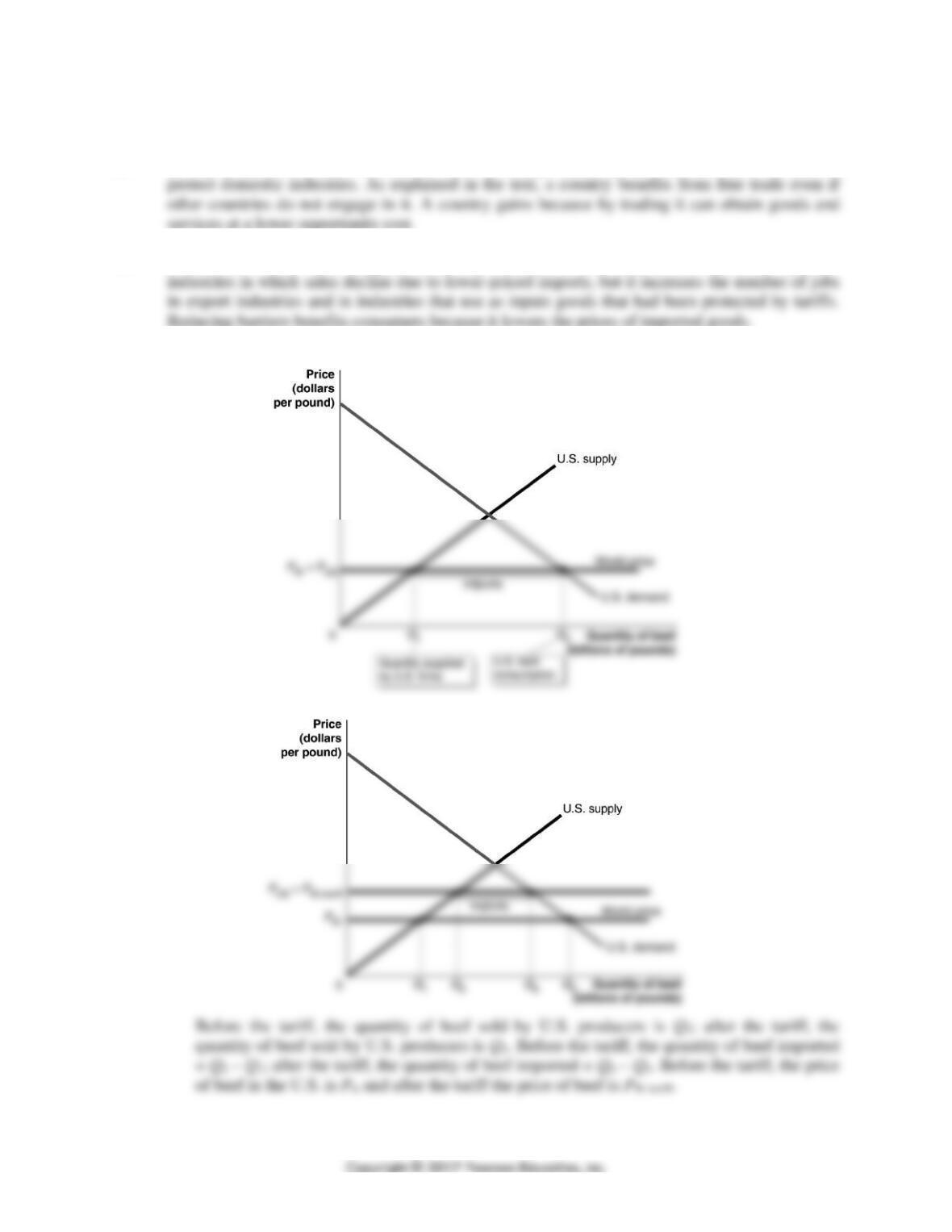
4.1 A tariff is a tax a government imposes on imports. A quota is a numerical limit a government
4.2 The winners from tariffs are domestic firms protected by the tariffs, the firms’ workers, and the
government, which collects revenue from the tariff. The losers are domestic consumers and
170 CHAPTER 7 | Comparative Advantage and the Gains from International Trade
Problems and Applications
4.3 In this context, economic nationalism refers to using tariffs, quotas, and non-tariff barriers to
4.4 Most economists would disagree. Reducing barriers to trade reduces the number of jobs in
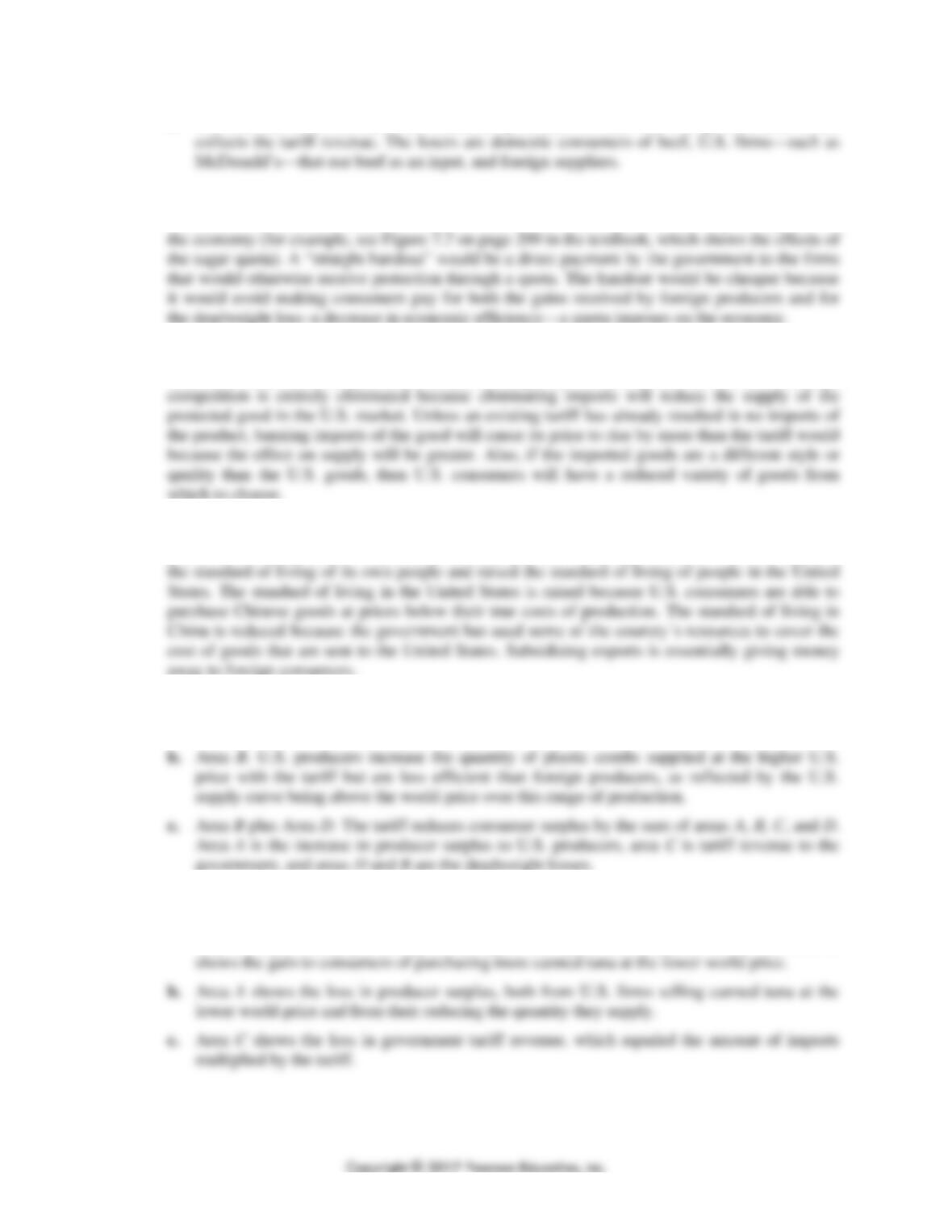
4.5 a.
b.
CHAPTER 7 | Comparative Advantage and the Gains from International Trade 171
c. The winners from the tariff are domestic producers of beef and the government, which
4.6 Consumers pay more than domestic producers receive because foreign producers capture some of
the benefits. In addition, consumers bear the cost of the deadweight loss that a quota imposes on
4.7 The student’s reasoning is flawed. As we saw in the chapter, placing a tariff on imports of a good
does raise the price of the good. But the price charged by U.S. producers will also rise if foreign
4.8 Economists usually measure the standard of living by the goods and services that the typical
person in a country is able to purchase. In this case, the Chinese government will have reduced
4.9 a. Area D. Consumers cut back on the quantity of plastic combs purchased at the higher U.S.
price with the tariff and lose the consumer surplus they were receiving from these purchases.
4.10 a. The gain in consumer surplus equals the sum of areas A, B, C, and D. Areas A, B, and C show
the gain to consumers of paying the lower world price on the quantity of canned tuna that
they were previously purchasing at the higher U.S. price caused by the tariff, and Area D
172 CHAPTER 7 | Comparative Advantage and the Gains from International Trade
4.11 a. The United States practices sugar protectionism by imposing quotas on sugar imports to
protect U.S. sugar producers.
b. Sugar protectionism hurts consumers who must pay more for sugar and goods with sugar in
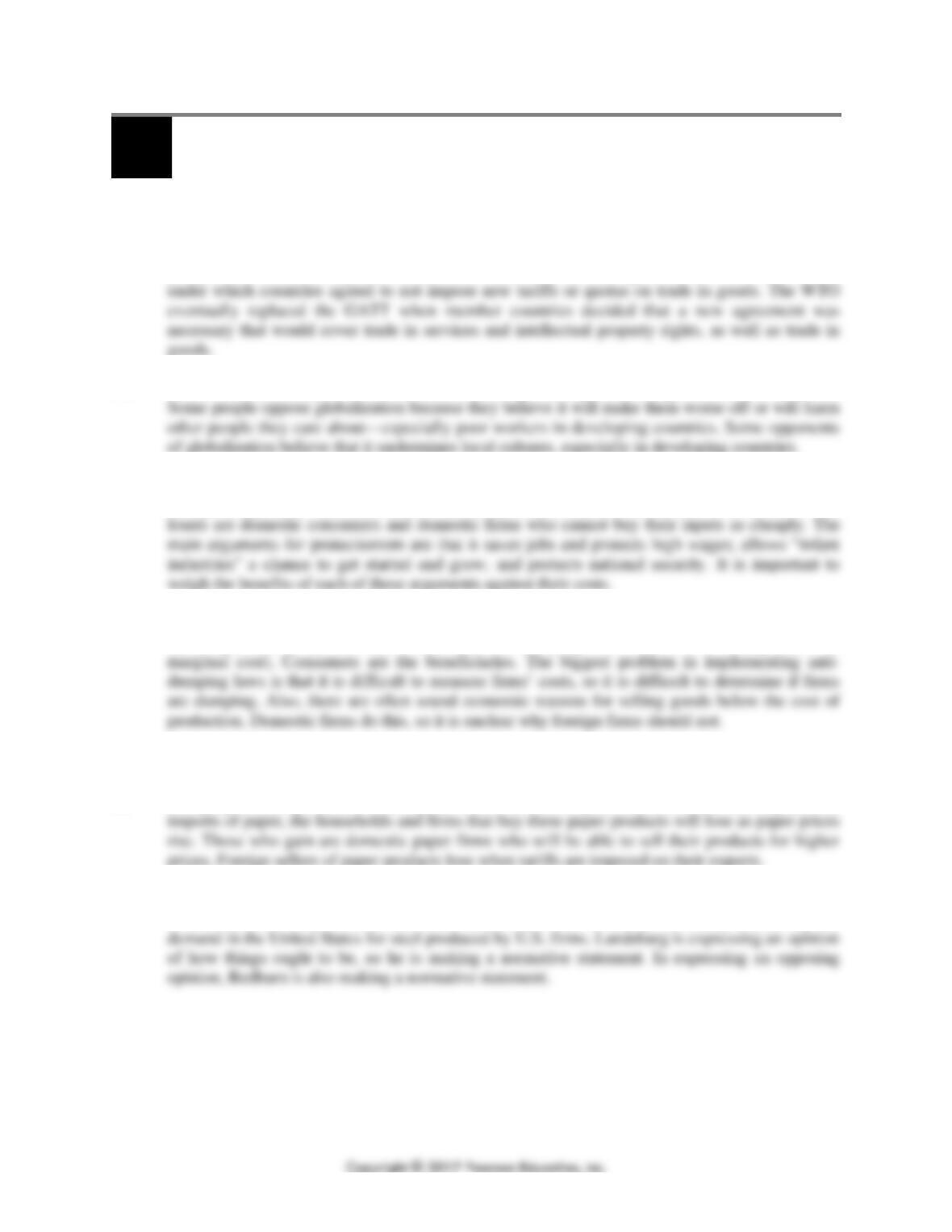
4.12 You can refer to the graph on page 301 in the text for guidance in filling out the table.
Without Quota
With Quota
World price of kumquats
$0.75
$0.75
U.S. price of kumquats
$0.75
$1.00
Quantity supplied by U.S. firms
Quantity demanded
Quantity imported
Area of consumer surplus
Area of domestic producer surplus
Area of deadweight loss
4.13 a. If the government imposes a tariff, area C shows the government tariff revenue, which equals
the quantity of imports times the tariff.
4.14 A quota on steel imports raises the costs of producing goods that use steel. As a result, the prices
4.15 It would have been cheaper for the federal government to have raised taxes on U.S. consumers
and given the money to tire workers rather than to have imposed a tariff. Several reasons could
explain why the federal government didn’t adopt this alternative policy. A tax tied directly to
CHAPTER 7 | Comparative Advantage and the Gains from International Trade 173
7.5
The Arguments over Trade Policies and Globalization
Learning Objective: Evaluate the arguments over trade policies and globalization.
Review Questions
5.1 The collapse of world trade during the Great Depression and the desire to create a stable,
prosperous world economy after World War II led to the General Agreement on Tariffs and Trade
5.2 Globalization is the process of countries becoming more open to foreign trade and investment.
5.3 Protectionism is the use of trade barriers to shield domestic companies and their workers from
foreign competition. The beneficiaries are the protected domestic firms and their workers. The
5.4 Dumping is selling a product for a price below its cost of production. The losers from dumping
are competitors of the firm that dumps (and the dumping firm itself if it is selling below its
Problems and Applications
5.5 Dumping is selling a product for a price below its cost of production. If tariffs are imposed on
5.6 When the U.S. government puts a tariff on steel imports, it protects steelworkers in West Virginia
at the expense of steelworkers in South Korea (and elsewhere) by artificially increasing the
174 CHAPTER 7 | Comparative Advantage and the Gains from International Trade
5.7 You should disagree with the statement because it doesn’t take into account the whole process of
international trade. Buying a less expensive good from Brazil leaves a consumer with more
money to spend on other domestic goods. In addition, buying a good from Brazil provides
5.8 a. Answers will vary. Foreign trade helps an economy to increase its standard of living over
time by specializing in the goods and services in which it has a comparative advantage and
trading those goods and services for the goods and services in which it does not have a
5.9 Answers will vary. Globalization, the process of countries becoming more open to foreign trade
and investment, enabled some foreign firms to better respond to changes in consumer demand for
5.10. Restrictions on catfish imports into the United States result in higher prices that harm U.S.