CHAPTER 7
UNEMPLOYMENT AND INFLATION
In this chapter, you will find:
Learning Outcomes
Chapter Outline with PowerPoint Script
Chapter Summary
Teaching Points (as on Prep Card)
Solutions to Problems Appendix
Experiential Assignments
INTRODUCTION
This chapter examines the macroeconomic problems of unemployment and inflation. The idea is to show
what can go wrong with the economy, thereby providing the rationale for studying macroeconomics. If the
LEARNING OUTCOMES
7-1 Describe what the unemployment rate measures, and summarize four sources of unemployment.
The unemployment rate is the number of people looking for work divided by the number in the labor
force. The unemployment rate masks differences among particular groups and across regions. The
7-2 Outline the pros and cons of unemployment insurance.
Unemployment often creates both an economic and a psychological hardship. For some, this burden
7-3 Define inflation and describe the two sources of inflation.
Inflation is a sustained rise in the average price level. An increase in aggregate demand can cause
Chapter 7 Unemployment and Inflation 94
7-4 Explain how unanticipated inflation harms some individuals and harms the economy as a whole.
Anticipated inflation causes fewer distortions in the economy than unanticipated inflation. Unantici-
CHAPTER OUTLINE WITH POWERPOINT SCRIPT
USE POWERPOINT SLIDES 2-6 FOR THE FOLLOWING SECTION
Unemployment
Measuring Unemployment
USE POWERPOINT SLIDES 7-9 FOR THE FOLLOWING SECTION
Labor force participation rate: The number in the labor force divided by the adult population.
• The participation rates of men and women have converged since WWII.
Unemployment over Time
• The unemployment rate experienced a downward trend between 1980-2000 due to the overall
USE POWERPOINT SLIDES 10-12 FOR THE FOLLOWING SECTION
Unemployment in Various Groups
Unemployment rates are:
• Higher among blacks than among whites.
USE POWERPOINT SLIDES 12-14 FOR THE FOLLOWING SECTION
Unemployment Varies across Occupations and Regions: The national unemployment rate reveals
nothing about the variation of unemployment rates across the country.
USE POWERPOINT SLIDES 15-17 FOR THE FOLLOWING SECTION
Sources of Unemployment
decreasing during expansions.
USE POWERPOINT SLIDE 18 FOR THE FOLLOWING SECTION
The Meaning of Full Employment: There is no cyclical unemployment, but unemployment is not zero.
There will still be some frictional, structural, and seasonal unemployment in an economy considered to be
at full employment.
Chapter 7 Unemployment and Inflation 95
USE POWERPOINT SLIDE 19 FOR THE FOLLOWING SECTION
Unemployment Compensation
• Provides a safety net for the unemployed and is on average 40% of person’s take home pay
USE POWERPOINT SLIDES 20-21 FOR THE FOLLOWING SECTION
International Comparisons of Unemployment: Should be analyzed carefully because definitions of
unemployment vary across countries.
USE POWERPOINT SLIDES 22-23 FOR THE FOLLOWING SECTION
Problems with Official Unemployment Figures:
• Ignore discouraged workers and those who are underemployed, causing unemployment rates to be
underestimated.
USE POWERPOINT SLIDES 24-25 FOR THE FOLLOWING SECTION
Inflation: A sustained increase in the economy’s average price level.
USE POWERPOINT SLIDES 26-27 FOR THE FOLLOWING SECTION
Two Sources of Inflation
USE POWERPOINT SLIDES 28-329 FOR THE FOLLOWING SECTION
A Historical Look at Inflation and the Price Level
Prior to WW II, years of inflation and deflation balanced out over the long run. Since the end of WW II,
USE POWERPOINT SLIDE 30 FOR THE FOLLOWING SECTION
Anticipated Versus Unanticipated Inflation
USE POWERPOINT SLIDES 31-32 FOR THE FOLLOWING SECTION
The Transaction Costs of Variable Inflation: Increase as inflation becomes more unpredictable.
Inflation Obscures Relative Price Changes: During periods of volatile inflation, there is greater
uncertainty about the price of one good relative to another.
Chapter 7 Unemployment and Inflation 96
Inflation across Metropolitan Areas: Inflation rates differ across regions mostly because of differences
in housing prices.
USE POWERPOINT SLIDES 33-34 FOR THE FOLLOWING SECTION
International Comparisons of Inflation: Inflation is difficult to compare across countries. When
USE POWERPOINT SLIDES 35-39 FOR THE FOLLOWING SECTION
Inflation and Interest Rates
• Interest: The dollar amount paid by borrowers to lenders.
USE POWERPOINT SLIDE 40 FOR THE FOLLOWING SECTION
Why Is Inflation Unpopular?
Unanticipated inflation:
• Arbitrarily redistributes income and wealth from one group to another;
CHAPTER SUMMARY
The unemployment rate is the number of people in the labor force who are looking for work divided by the
number in the labor force. The unemployment rate masks differences among particular groups and across
regions. The rate is lowest among white adults and highest among black teenagers.
Unemployment often creates both an economic and a psychological hardship. For some, this burden is
reduced by an employed spouse and by unemployment insurance. Unemployment insurance provides a
safety net for some and that’s good, but it may also reduce incentives to find work for some, as is the case
in Europe, and that’s an unintended consequence.
Chapter 7 Unemployment and Inflation 97
with the effects of inflation. The negative effects of high and variable inflation on productivity can be
observed in countries that have experienced hyperinflation, such as Zimbabwe.
TEACHING POINTS
1. This chapter discusses two important macroeconomic problems, unemployment and inflation. Alt-
hough these subjects are often discussed in the news, they are widely misunderstood by the general
public.
2. Most students will believe that the only people hurt when the unemployment rate rises are those
who lose their jobs. Society as a whole, however, loses output because of underutilization of
3. You might choose to list and give examples of each of the four types of unemployment. For exam-
4. Some students will believe that those who are unemployed represent a group perpetually without
jobs. This is untrue. The group of individuals currently unemployed is constantly changing.
5. The idea that “full employment” includes frictional, structural, and seasonal unemployment needs
to be emphasized. You should note that while all unemployment has costs, frictional unemployment
6. Inflation can be as confusing as unemployment for the student. Most students believe that inflation
is a unique and precisely measured concept. It is easy to dispel this myth. The measured inflation rate
Chapter 7 Unemployment and Inflation 98
7. You may wish to emphasize that although unemployment and inflation are the most commonly
8. A discussion of frictional and structural unemployment is important, since it lays the foundation for
the discussion of potential output found in Chapter 9 on Aggregate Expenditure and Aggregate De-
mand.
SOLUTIONS TO PROBLEMS APPENDIX
1. (Measuring Unemployment) Determine the impact on each of the following if 2 million
formerly unemployed workers decide to return to school full time and stop looking for work:
a. The labor force participation rate
b. The size of the labor force
c. The unemployment rate
a. The labor force participation rate drops since these workers have left the labor force.
2. (Measuring Unemployment) Suppose that the U.S. noninstitutional adult population is 230
million and the labor force participation rate is 67 percent.
a. What would be the size of the U.S. labor force?
b. If 85 million adults are not working, what is the unemployment rate?
a. Of 230 million, 67 percent, or 154.1 million.
3. (Types of Unemployment) Determine whether each of the following would be considered
frictional, structural, seasonal, or cyclical unemployment:
a. A UPS employee who was hired for the Christmas season is laid off after Christmas.
b. A worker who is laid off due to reduced aggregate demand in the economy.
c. A worker in a DVD rental store becomes unemployed as video-on-demand cable service
becomes more popular.
d. A new college graduate is looking for employment.
a. Seasonal
4. (Unemployment Insurance) What are the pros and cons of unemployment insurance?
Unemployment often creates both an economic and a psychological hardship. For some, this
5. (The Meaning of Full Employment) When the economy is at full employment, is the unem-
ployment rate at zero percent? Why or why not? How would a more generous unemployment
insurance system affect the full employment figure?
When the economy is at full employment, the unemployment rate is not zero because there
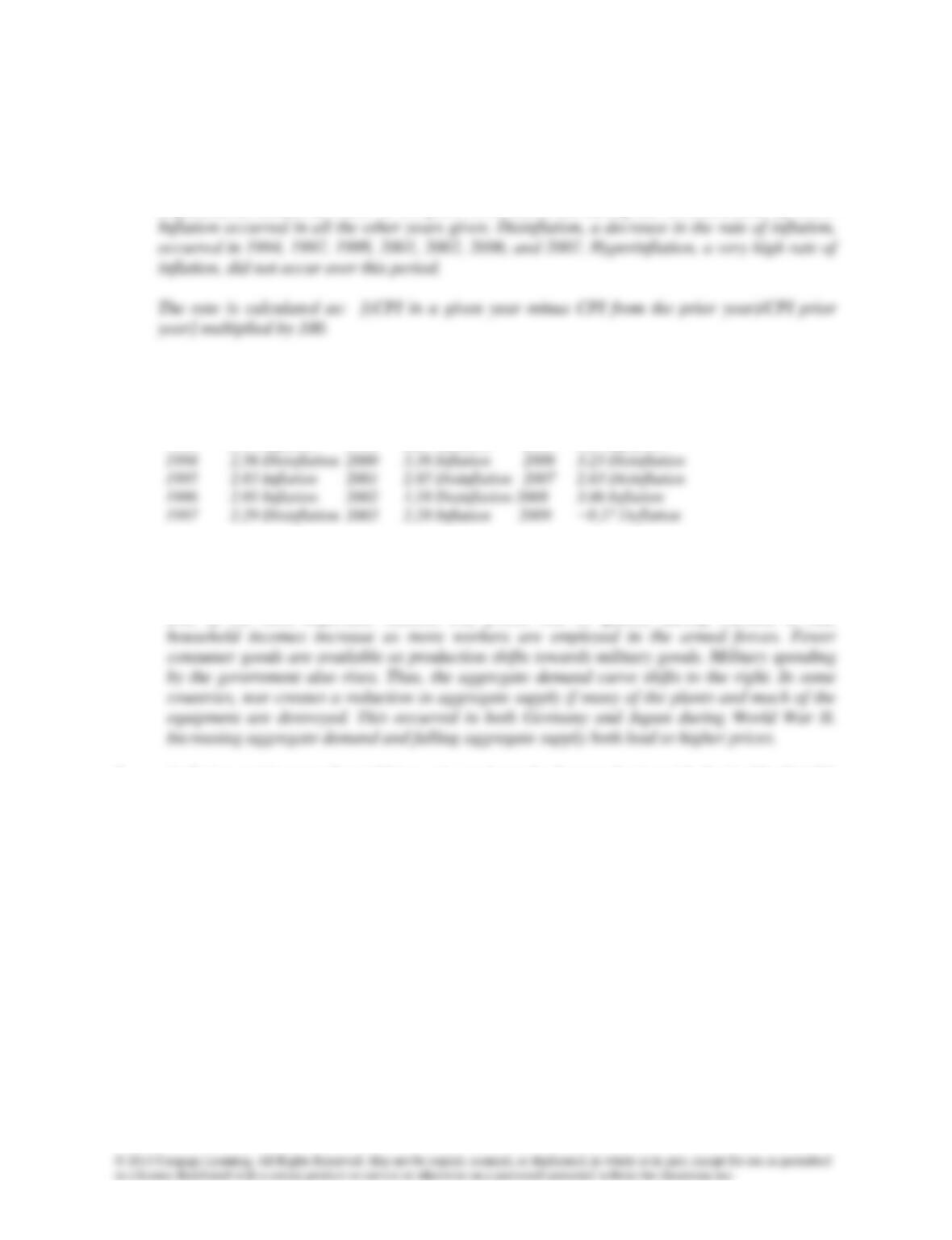
6. (Two Sources of Inflation) Using aggregate supply and aggregate demand, demonstrate two
sources of inflation.
7. (Inflation) Here are some recent data on the U.S. consumer price index:
Year CPI Year CPI Year CPI
1992 140.3 1998 163.0 2004 188.9
1993 144.5 1999 166.6 2005 195.3
1994 148.2 2000 172.2 2006 201.6
1995 152.4 2001 177.1 2007 207.3
1996 156.9 2002 179.9 2008 215.3
1997 160.5 2003 184.0 2009 214.5
Chapter 7 Unemployment and Inflation 100
Compute the inflation rate for each year 1993-2009 and determine which years were years of
inflation. In which years did deflation occur? In which years did disinflation occur? Was there
hyperinflation in any year?
Deflation, an actual decrease in the price level, occurred during the recession year of 2009.
Inflation Inflation Inflation
Year Rate (%) Year Rate (% ) Year Rate (%)
1998 1.56 Disinflation 2004 2.66 Inflation
1993 2.99 Inflation 1999 2.21 Inflation 2005 3.39 Inflation
8. (Sources of Inflation) Using the concepts of aggregate supply and aggregate demand, explain
why inflation usually accelerates during wartime.
One of the most important reasons why prices rise so quickly during wartime is that
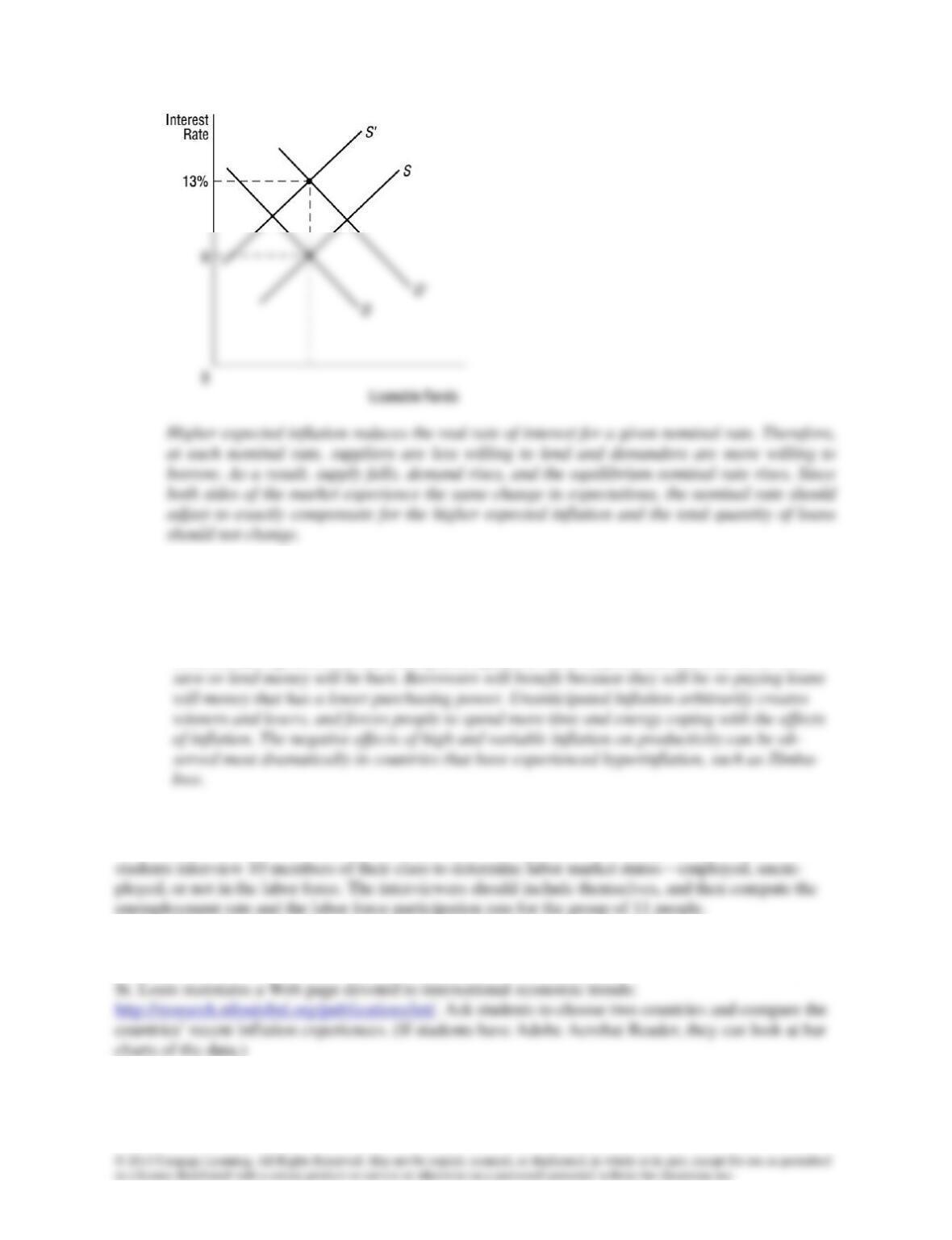
9. (Inflation and Interest Rates) Using a demand-supply diagram for loanable funds (like Exhibit
10), show what happens to the nominal interest rate and the equilibrium quantity of loans
when both borrowers and lenders increase their estimates of the expected inflation rate from 5
percent to 10 percent.
Chapter 7 Unemployment and Inflation 101
10. (Anticipated Versus Unanticipated Inflation) If actual inflation exceeds anticipated inflation,
who will lose purchasing power and who will gain? How does unanticipated inflation harm
the economy?
When actual inflation exceeds anticipated inflation, those on fixed incomes and those who
Experiential Assignments
1. The chapter explains the definitions the government employs in measuring unemployment. Have
2. In recent years, how has the U.S. inflation rate compared with rates in other industrial economies?
Why should we be careful in comparing inflation rates across countries? The Federal Reserve Bank of
3. Have students scan the Economy page in the first section of today’s Wall Street Journal. They are
almost sure to find a discussion of a policy proposal that will affect unemployment, inflation, or
Chapter 7 Unemployment and Inflation 102